

ISO 4829-2:2016
(Main)Steels — Determination of total silicon contents — Reduced molybdosilicate spectrophotometric method — Part 2: Silicon contents between 0,01 % and 0,05 %
General Information
- Abstract
ISO 4829-2:2016 specifies a spectrophotometric method for the determination of total silicon in steels using reduced molybdosilicate. The method is applicable to silicon contents between 0,01 % and 0,05 % (mass fraction) in steels.
- Status
- Published
- Publication Date
- 11-Feb-2016
- Technical Committee
- ISO/TC 17/SC 1 - Methods of determination of chemical composition
- Drafting Committee
- ISO/TC 17/SC 1 - Methods of determination of chemical composition
- Current Stage
- 9020 - International Standard under periodical review
- Start Date
- 15-Jul-2026
- Completion Date
- 15-Jul-2026
Buy Documents


ISO 4829-2:2016 - Steels -- Determination of total silicon contents -- Reduced molybdosilicate spectrophotometric method
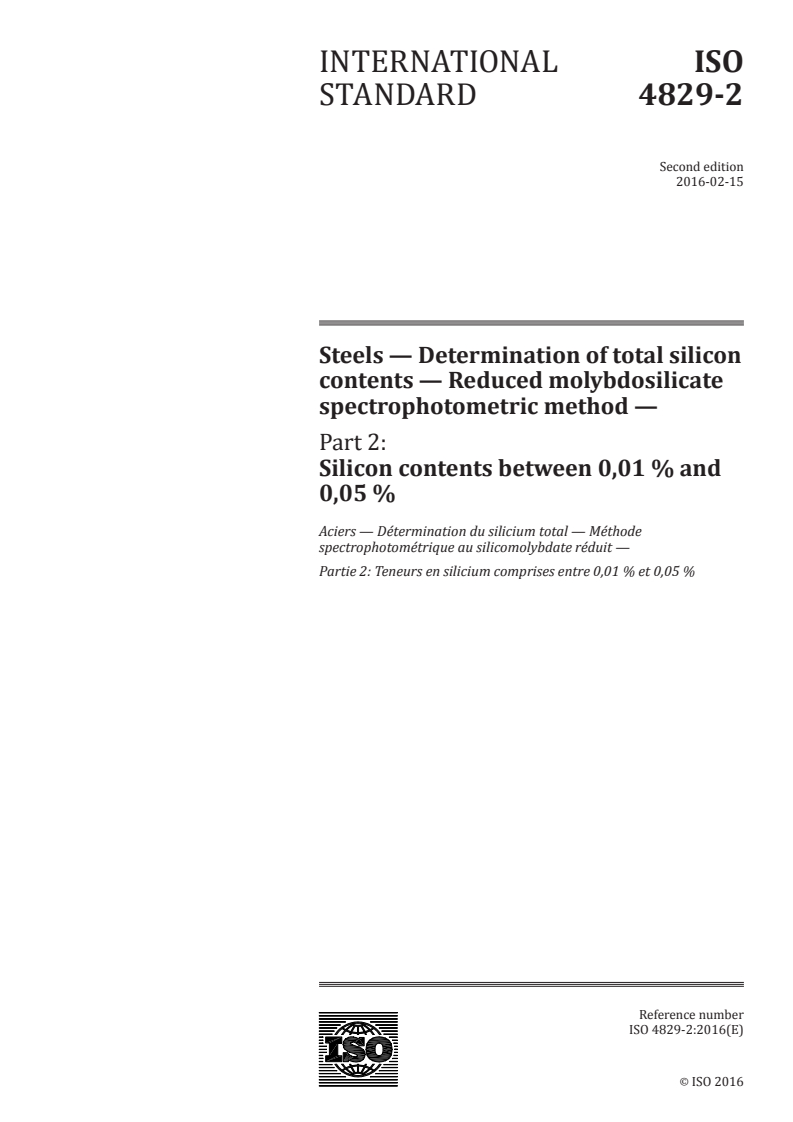
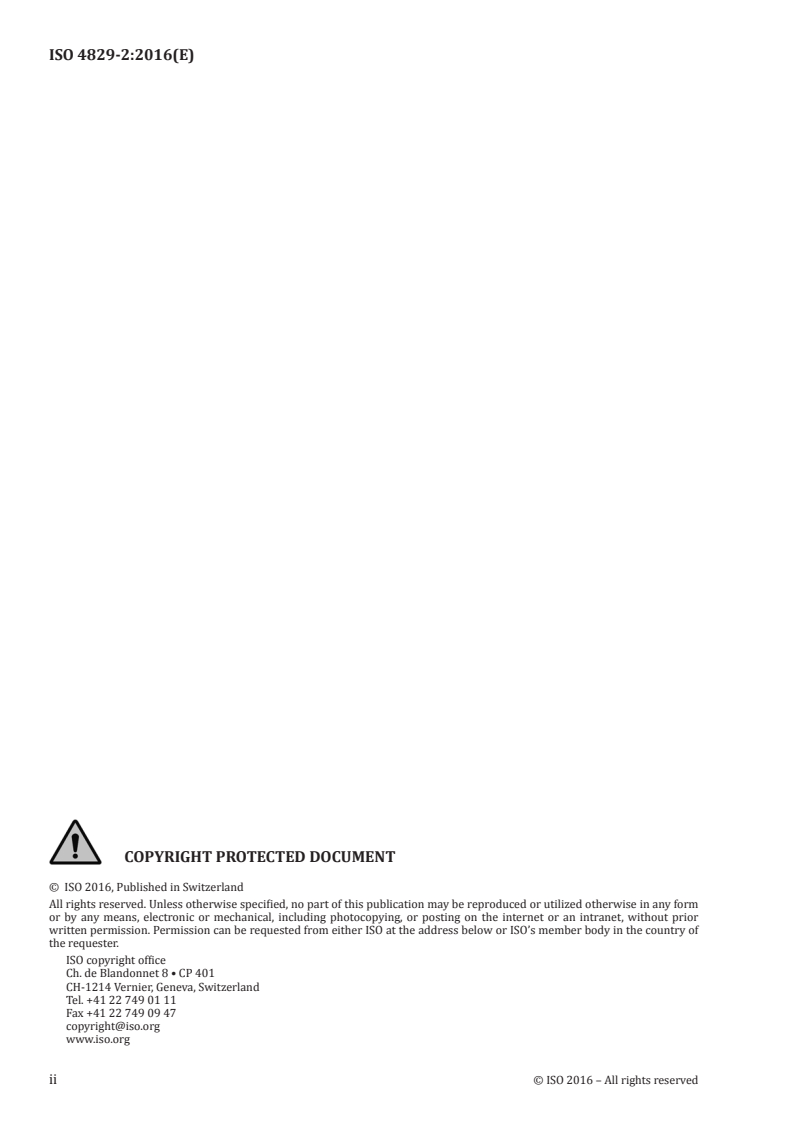
ISO 4829-2:2016 - Steels — Determination of total silicon contents — Reduced molybdosilicate spectrophotometric method — Part 2: Silicon contents between 0,01 % and 0,05 %/12/2016

ISO 4829-2:2016 - Aciers -- Détermination du silicium total -- Méthode spectrophotométrique au silicomolybdate réduit
ISO 4829-2:2016 - Aciers — Détermination du silicium total — Méthode spectrophotométrique au silicomolybdate réduit — Partie 2: Teneurs en silicium comprises entre 0,01 % et 0,05 %/12/2016
Overview
ISO 4829-2:2016 - Steels - Determination of total silicon contents - Reduced molybdosilicate spectrophotometric method - Part 2: Silicon contents between 0,01 % and 0,05 % defines a chemical test method for measuring low levels of total silicon in steels. The procedure uses a reduced molybdosilicate color reaction and spectrophotometric measurement to determine silicon mass fractions in the range 0,01 % to 0,05 %.
This standard is intended for laboratory quality control and compositional analysis where accurate determination of low silicon content is required.
Key topics and technical requirements
- Analytical principle: Dissolve the steel sample in hydrochloric/nitric acid, fuse the acid-insoluble residue with sodium peroxide, form an oxidized molybdosilicate complex and selectively reduce it with ascorbic acid to produce a blue complex measured spectrophotometrically (about 810 nm).
- Measurement: Absorbance measured at ~810 nm using a 4 cm optical path cell. Spectrophotometer spectral bandwidth ≤10 nm; wavelength accuracy ±2 nm; repeatability of max-absorbance measurement ≈ ±0,3 % (relative).
- Reagents and contamination control: Use analytical-grade reagents and grade 2 water (ISO 3696). Avoid ion-exchange demineralized water due to colloidal silica risk. Freshly prepare solutions and use polypropylene/PTFE containers to reduce contamination.
- Interference control: Oxalic acid is added to suppress interferences from phosphorus, arsenic and vanadium; potassium permanganate and hydrogen peroxide steps control organic/manganese interferences.
- Quality checks: Run duplicate blanks in parallel (using low-silicon pure iron) and monitor blank absorbance - recommended blank absorbance not to exceed 0,050 (equivalent to ~0,008 % Si with a 4 cm cell).
- Sample size & sampling: Typical test portion is 0,50 ± 0,01 g of fine chips/turnings/filings. Sampling and sample preparation follow ISO 14284.
Practical applications and users
- Steel manufacturing and processing plants for quality control (ensuring alloying and deoxidation targets).
- Metallurgical laboratories and third‑party testing labs performing chemical composition analysis of steels.
- R&D and failure‑analysis teams needing accurate low‑level silicon quantification.
- Certification bodies and suppliers verifying compliance with material specifications.
Related standards
- ISO 4829-1 - Part 1 covers silicon contents between 0,05 % and 1,0 %.
- ISO 14284 - Sampling and preparation of samples for chemical composition.
- ISO 3696 - Water for analytical laboratory use.
- ISO 385, ISO 648, ISO 1042 - Laboratory glassware specifications used in the method.
Keywords: ISO 4829-2:2016, steels, total silicon determination, reduced molybdosilicate spectrophotometric method, silicon 0.01–0.05%, spectrophotometry, steel quality control.
Relations
- Effective Date
- 12-Feb-2026
- Effective Date
- 06-Jun-2022
- Effective Date
- 15-Dec-2012
Buy Documents
ISO 4829-2:2016 - Steels -- Determination of total silicon contents -- Reduced molybdosilicate spectrophotometric method
ISO 4829-2:2016 - Steels — Determination of total silicon contents — Reduced molybdosilicate spectrophotometric method — Part 2: Silicon contents between 0,01 % and 0,05 %/12/2016
ISO 4829-2:2016 - Aciers -- Détermination du silicium total -- Méthode spectrophotométrique au silicomolybdate réduit
ISO 4829-2:2016 - Aciers — Détermination du silicium total — Méthode spectrophotométrique au silicomolybdate réduit — Partie 2: Teneurs en silicium comprises entre 0,01 % et 0,05 %/12/2016
Get Certified
Connect with accredited certification bodies for this standard

Element Materials Technology
Materials testing and product certification.

Inštitut za kovinske materiale in tehnologije
Institute of Metals and Technology. Materials testing, metallurgical analysis, NDT.
Sponsored listings
Frequently Asked Questions
ISO 4829-2:2016 is a standard published by the International Organization for Standardization (ISO). Its full title is "Steels — Determination of total silicon contents — Reduced molybdosilicate spectrophotometric method — Part 2: Silicon contents between 0,01 % and 0,05 %". This standard covers: ISO 4829-2:2016 specifies a spectrophotometric method for the determination of total silicon in steels using reduced molybdosilicate. The method is applicable to silicon contents between 0,01 % and 0,05 % (mass fraction) in steels.
ISO 4829-2:2016 specifies a spectrophotometric method for the determination of total silicon in steels using reduced molybdosilicate. The method is applicable to silicon contents between 0,01 % and 0,05 % (mass fraction) in steels.
ISO 4829-2:2016 is classified under the following ICS (International Classification for Standards) categories: 77.080.01 - Ferrous metals in general. The ICS classification helps identify the subject area and facilitates finding related standards.
ISO 4829-2:2016 has the following relationships with other standards: It is inter standard links to EN ISO 4829-2:2016, ISO 6182-2:2005, ISO 4829-2:1988. Understanding these relationships helps ensure you are using the most current and applicable version of the standard.
ISO 4829-2:2016 is available in PDF format for immediate download after purchase. The document can be added to your cart and obtained through the secure checkout process. Digital delivery ensures instant access to the complete standard document.
Standards Content (Sample)
INTERNATIONAL ISO
STANDARD 4829-2
Second edition
2016-02-15
Steels — Determination of total silicon
contents — Reduced molybdosilicate
spectrophotometric method —
Part 2:
Silicon contents between 0,01 % and
0,05 %
Aciers — Détermination du silicium total — Méthode
spectrophotométrique au silicomolybdate réduit —
Partie 2: Teneurs en silicium comprises entre 0,01 % et 0,05 %
Reference number
©
ISO 2016
© ISO 2016, Published in Switzerland
All rights reserved. Unless otherwise specified, no part of this publication may be reproduced or utilized otherwise in any form
or by any means, electronic or mechanical, including photocopying, or posting on the internet or an intranet, without prior
written permission. Permission can be requested from either ISO at the address below or ISO’s member body in the country of
the requester.
ISO copyright office
Ch. de Blandonnet 8 • CP 401
CH-1214 Vernier, Geneva, Switzerland
Tel. +41 22 749 01 11
Fax +41 22 749 09 47
copyright@iso.org
www.iso.org
ii © ISO 2016 – All rights reserved
Contents Page
Foreword .iv
1 Scope . 1
2 Normative references . 1
3 Principle . 1
4 Reagents . 1
5 Apparatus . 3
6 Sampling . 4
7 Procedure. 4
7.1 Test portion . 4
7.2 Blank test . 4
7.3 Determination . 4
7.3.1 Dissolution of the test portion . 4
7.3.2 Treatment of insoluble residue . 4
7.3.3 Preparation of the test solution . 4
7.3.4 Development of the colour . 5
7.3.5 Spectrophotometric measurements . 5
7.4 Establishment of the calibration curve . 6
7.4.1 Preparation of the calibration solutions . 6
7.4.2 Spectrophotometric measurements . 6
7.4.3 Plotting of the calibration curve . 6
8 Expression of results . 6
8.1 Method of calculation . 6
8.2 Precision . 7
9 Test report . 7
Annex A (informative) Additional information on the interlaboratory test .9
Bibliography .10
Foreword
ISO (the International Organization for Standardization) is a worldwide federation of national standards
bodies (ISO member bodies). The work of preparing International Standards is normally carried out
through ISO technical committees. Each member body interested in a subject for which a technical
committee has been established has the right to be represented on that committee. International
organizations, governmental and non-governmental, in liaison with ISO, also take part in the work.
ISO collaborates closely with the International Electrotechnical Commission (IEC) on all matters of
electrotechnical standardization.
The procedures used to develop this document and those intended for its further maintenance are
described in the ISO/IEC Directives, Part 1. In particular the different approval criteria needed for the
different types of ISO documents should be noted. This document was drafted in accordance with the
editorial rules of the ISO/IEC Directives, Part 2 (see www.iso.org/directives).
Attention is drawn to the possibility that some of the elements of this document may be the subject of
patent rights. ISO shall not be held responsible for identifying any or all such patent rights. Details of
any patent rights identified during the development of the document will be in the Introduction and/or
on the ISO list of patent declarations received (see www.iso.org/patents).
Any trade name used in this document is information given for the convenience of users and does not
constitute an endorsement.
For an explanation on the meaning of ISO specific terms and expressions related to conformity
assessment, as well as information about ISO’s adherence to the WTO principles in the Technical
Barriers to Trade (TBT) see the following URL: Foreword - Supplementary information.
The committee responsible for this document is ISO/TC 17, Steel, Subcommittee SC 1, Methods of
determination of chemical composition.
This second edition cancels and replaces the first edition (ISO 4829-2:1988), which has been
technically revised.
ISO 4829 consists of the following parts, under the general title Steels — Determination of total silicon
contents — Reduced molybdosilicate spectrophotometric method:
— Part 1: Silicon contents between 0,05 % and 1,0 %
— Part 2: Silicon contents between 0,01 % and 0,05 %
iv © ISO 2016 – All rights reserved
INTERNATIONAL STANDARD ISO 4829-2:2016(E)
Steels — Determination of total silicon contents —
Reduced molybdosilicate spectrophotometric method —
Part 2:
Silicon contents between 0,01 % and 0,05 %
1 Scope
This part of ISO 4829 specifies a spectrophotometric method for the determination of total silicon in
steels using reduced molybdosilicate.
The method is applicable to silicon contents between 0,01 % and 0,05 % (mass fraction) in steels.
2 Normative references
The following documents, in whole or in part, are normatively referenced in this document and are
indispensable for its application. For dated references, only the edition cited applies. For undated
references, the latest edition of the referenced document (including any amendments) applies.
ISO 648, Laboratory glassware — Single-volume pipettes
ISO 1042, Laboratory glassware — One-mark volumetric flasks
ISO 3696, Water for analytical laboratory use — Specification and test methods
ISO 14284, Steel and iron — Sampling and preparation of samples for the determination of chemical
composition
3 Principle
Dissolution of a test portion in a hydrochloric/nitric acids mixture.
Fusion of the acid-insoluble residue with sodium peroxide. Formation of the oxidized molybdosilicate
(yellow) complex in weak acid solution.
Selective reduction of the molybdosilicate complex to a blue complex with ascorbic acid, after increasing
the sulphuric acid concentration and adding oxalic acid to prevent the interference of phosphorus,
arsenic and vanadium.
Spectrophotometric measurement of the reduced blue complex at a wavelength of about 810 nm.
4 Reagents
During the analysis, unless otherwise specified, use only reagents of recognized analytical grade and
only grade 2 water as specified in ISO 3696. Water demineralized by ion-exchange shall not be used as
it may contain significant amounts of colloidal silica.
Reagents supplied in glass bottles, once opened, might absorb moisture and become reactive to
glassware. Alkaline reagents, e.g. sodium carbonate and sodium peroxide, are particularly susceptible.
To avoid the risk of significant contamination arising from this source, it is recommended that only
freshly opened bottles of all reagents be used for the preparation of reagent solutions.
To avoid adventitious contamination, the water shall be prepared, as required, for the specific purpose
and collected in polypropylene containers for immediate use.
All solutions shall be freshly prepared and stored in polypropylene or polytetrafluoroethylene containers.
4.1 Pure iron, silicon content less than 2 µg/g.
4.2 Sodium peroxide, particle size less than 500 µm.
4.3 Sulphuric acid, ρ approximately 1,84 g/ml, diluted 1 + 3.
Add cautiously, while stirring, 250 ml of sulphuric acid, ρ approximately 1,84 g/ml to 600 ml of water.
Cool, dilute to 1 l with water and mix.
4.4 Sulphuric acid, ρ approximately 1,84 g/ml, diluted 1 + 19.
Add cautiously, while stirring, 50 ml of sulphuric acid, ρ approximately 1,84 g/ml to 800 ml of water.
Cool, dilute to 1 l with water and mix.
4.5 Hydrochloric/nitric acids mixture.
Add 180 ml of hydrochloric acid, ρ approximately 1,19 g/ml and 65 ml of nitric acid, ρ approximately
1,40 g/ml, to 500 ml of water. Cool, dilute to 1 l with water and mix.
4.6 Ascorbic acid, 20 g/l solution.
This solution shall be freshly prepared.
4.7 Oxalic acid, 50 g/l solution.
Dissolve 5 g of oxalic acid di-hydrate (C H O ·2H O) in water, dilute to 100 ml with water and mix.
2 2 4 2
4.8 Hydrogen peroxide, 60 g/l solution.
Dilute 200 ml of hydrogen peroxide, 300 g/l, to 1 l with water and mix.
4.9 Potassium permanganate, 22,5 g/l solution.
This solution shall be filtered before use in order to remove the fine particles of MnO that may be
present in the solution, as they will interfere with the measurement.
4.10 Sodium molybdate, 25 g/l solution.
Dissolve 2,5 g of sodium molybdate di-hydrate (Na MoO ·2H O) in 50 ml of water and filter through a
2 4 2
medium-texture filter paper.
Immediately before use, add 15 ml of sulphuric acid (4.4), dilute to 100 ml with water and mix.
4.11 Silicon standard solution, 1 g/l.
Prepare a 1 g/l silicon standard solution by using one of the procedures described in 4.11.1 or 4.11.2.
4.11.1 Preparation with silica
Weigh to the nearest 0,1 mg, 2,139 3 g of freshly calcined high-purity silica (> 99,9 % SiO ) and transfer
to a platinum crucible.
2 © ISO 2016 – All rights reserved
The high-purity silica shall be calcined for 1 h at 1 100 °C and cooled in a desiccator immediately before
use.
Mix thoroughly with 16 g of anhydrous sodium carbonate and fuse at 1 050 °C for 30 min. Extract the
fusion product with 100 ml of water in a polypropylene or polytetrafluoroethylene beaker.
NOTE Extraction of the fusion product might require gentle heating.
Transfer the extract, which should contain no trace of residue, into a 1 000 ml one-mark volumetric
flask, dilute to the mark with water and mix. Transfer immediately into a well-stoppered
polytetrafluoroethylene bottle for storage.
1 ml of this standard solution contains 1 mg of silicon.
4.11.2 Preparation with ammonium hexafluorosilic
...
INTERNATIONAL ISO
STANDARD 4829-2
Second edition
2016-02-15
Steels — Determination of total silicon
contents — Reduced molybdosilicate
spectrophotometric method —
Part 2:
Silicon contents between 0,01 % and
0,05 %
Aciers — Détermination du silicium total — Méthode
spectrophotométrique au silicomolybdate réduit —
Partie 2: Teneurs en silicium comprises entre 0,01 % et 0,05 %
Reference number
©
ISO 2016
© ISO 2016, Published in Switzerland
All rights reserved. Unless otherwise specified, no part of this publication may be reproduced or utilized otherwise in any form
or by any means, electronic or mechanical, including photocopying, or posting on the internet or an intranet, without prior
written permission. Permission can be requested from either ISO at the address below or ISO’s member body in the country of
the requester.
ISO copyright office
Ch. de Blandonnet 8 • CP 401
CH-1214 Vernier, Geneva, Switzerland
Tel. +41 22 749 01 11
Fax +41 22 749 09 47
copyright@iso.org
www.iso.org
ii © ISO 2016 – All rights reserved
Contents Page
Foreword .iv
1 Scope . 1
2 Normative references . 1
3 Principle . 1
4 Reagents . 1
5 Apparatus . 3
6 Sampling . 4
7 Procedure. 4
7.1 Test portion . 4
7.2 Blank test . 4
7.3 Determination . 4
7.3.1 Dissolution of the test portion . 4
7.3.2 Treatment of insoluble residue . 4
7.3.3 Preparation of the test solution . 4
7.3.4 Development of the colour . 5
7.3.5 Spectrophotometric measurements . 5
7.4 Establishment of the calibration curve . 6
7.4.1 Preparation of the calibration solutions . 6
7.4.2 Spectrophotometric measurements . 6
7.4.3 Plotting of the calibration curve . 6
8 Expression of results . 6
8.1 Method of calculation . 6
8.2 Precision . 7
9 Test report . 7
Annex A (informative) Additional information on the interlaboratory test .9
Bibliography .10
Foreword
ISO (the International Organization for Standardization) is a worldwide federation of national standards
bodies (ISO member bodies). The work of preparing International Standards is normally carried out
through ISO technical committees. Each member body interested in a subject for which a technical
committee has been established has the right to be represented on that committee. International
organizations, governmental and non-governmental, in liaison with ISO, also take part in the work.
ISO collaborates closely with the International Electrotechnical Commission (IEC) on all matters of
electrotechnical standardization.
The procedures used to develop this document and those intended for its further maintenance are
described in the ISO/IEC Directives, Part 1. In particular the different approval criteria needed for the
different types of ISO documents should be noted. This document was drafted in accordance with the
editorial rules of the ISO/IEC Directives, Part 2 (see www.iso.org/directives).
Attention is drawn to the possibility that some of the elements of this document may be the subject of
patent rights. ISO shall not be held responsible for identifying any or all such patent rights. Details of
any patent rights identified during the development of the document will be in the Introduction and/or
on the ISO list of patent declarations received (see www.iso.org/patents).
Any trade name used in this document is information given for the convenience of users and does not
constitute an endorsement.
For an explanation on the meaning of ISO specific terms and expressions related to conformity
assessment, as well as information about ISO’s adherence to the WTO principles in the Technical
Barriers to Trade (TBT) see the following URL: Foreword - Supplementary information.
The committee responsible for this document is ISO/TC 17, Steel, Subcommittee SC 1, Methods of
determination of chemical composition.
This second edition cancels and replaces the first edition (ISO 4829-2:1988), which has been
technically revised.
ISO 4829 consists of the following parts, under the general title Steels — Determination of total silicon
contents — Reduced molybdosilicate spectrophotometric method:
— Part 1: Silicon contents between 0,05 % and 1,0 %
— Part 2: Silicon contents between 0,01 % and 0,05 %
iv © ISO 2016 – All rights reserved
INTERNATIONAL STANDARD ISO 4829-2:2016(E)
Steels — Determination of total silicon contents —
Reduced molybdosilicate spectrophotometric method —
Part 2:
Silicon contents between 0,01 % and 0,05 %
1 Scope
This part of ISO 4829 specifies a spectrophotometric method for the determination of total silicon in
steels using reduced molybdosilicate.
The method is applicable to silicon contents between 0,01 % and 0,05 % (mass fraction) in steels.
2 Normative references
The following documents, in whole or in part, are normatively referenced in this document and are
indispensable for its application. For dated references, only the edition cited applies. For undated
references, the latest edition of the referenced document (including any amendments) applies.
ISO 648, Laboratory glassware — Single-volume pipettes
ISO 1042, Laboratory glassware — One-mark volumetric flasks
ISO 3696, Water for analytical laboratory use — Specification and test methods
ISO 14284, Steel and iron — Sampling and preparation of samples for the determination of chemical
composition
3 Principle
Dissolution of a test portion in a hydrochloric/nitric acids mixture.
Fusion of the acid-insoluble residue with sodium peroxide. Formation of the oxidized molybdosilicate
(yellow) complex in weak acid solution.
Selective reduction of the molybdosilicate complex to a blue complex with ascorbic acid, after increasing
the sulphuric acid concentration and adding oxalic acid to prevent the interference of phosphorus,
arsenic and vanadium.
Spectrophotometric measurement of the reduced blue complex at a wavelength of about 810 nm.
4 Reagents
During the analysis, unless otherwise specified, use only reagents of recognized analytical grade and
only grade 2 water as specified in ISO 3696. Water demineralized by ion-exchange shall not be used as
it may contain significant amounts of colloidal silica.
Reagents supplied in glass bottles, once opened, might absorb moisture and become reactive to
glassware. Alkaline reagents, e.g. sodium carbonate and sodium peroxide, are particularly susceptible.
To avoid the risk of significant contamination arising from this source, it is recommended that only
freshly opened bottles of all reagents be used for the preparation of reagent solutions.
To avoid adventitious contamination, the water shall be prepared, as required, for the specific purpose
and collected in polypropylene containers for immediate use.
All solutions shall be freshly prepared and stored in polypropylene or polytetrafluoroethylene containers.
4.1 Pure iron, silicon content less than 2 µg/g.
4.2 Sodium peroxide, particle size less than 500 µm.
4.3 Sulphuric acid, ρ approximately 1,84 g/ml, diluted 1 + 3.
Add cautiously, while stirring, 250 ml of sulphuric acid, ρ approximately 1,84 g/ml to 600 ml of water.
Cool, dilute to 1 l with water and mix.
4.4 Sulphuric acid, ρ approximately 1,84 g/ml, diluted 1 + 19.
Add cautiously, while stirring, 50 ml of sulphuric acid, ρ approximately 1,84 g/ml to 800 ml of water.
Cool, dilute to 1 l with water and mix.
4.5 Hydrochloric/nitric acids mixture.
Add 180 ml of hydrochloric acid, ρ approximately 1,19 g/ml and 65 ml of nitric acid, ρ approximately
1,40 g/ml, to 500 ml of water. Cool, dilute to 1 l with water and mix.
4.6 Ascorbic acid, 20 g/l solution.
This solution shall be freshly prepared.
4.7 Oxalic acid, 50 g/l solution.
Dissolve 5 g of oxalic acid di-hydrate (C H O ·2H O) in water, dilute to 100 ml with water and mix.
2 2 4 2
4.8 Hydrogen peroxide, 60 g/l solution.
Dilute 200 ml of hydrogen peroxide, 300 g/l, to 1 l with water and mix.
4.9 Potassium permanganate, 22,5 g/l solution.
This solution shall be filtered before use in order to remove the fine particles of MnO that may be
present in the solution, as they will interfere with the measurement.
4.10 Sodium molybdate, 25 g/l solution.
Dissolve 2,5 g of sodium molybdate di-hydrate (Na MoO ·2H O) in 50 ml of water and filter through a
2 4 2
medium-texture filter paper.
Immediately before use, add 15 ml of sulphuric acid (4.4), dilute to 100 ml with water and mix.
4.11 Silicon standard solution, 1 g/l.
Prepare a 1 g/l silicon standard solution by using one of the procedures described in 4.11.1 or 4.11.2.
4.11.1 Preparation with silica
Weigh to the nearest 0,1 mg, 2,139 3 g of freshly calcined high-purity silica (> 99,9 % SiO ) and transfer
to a platinum crucible.
2 © ISO 2016 – All rights reserved
The high-purity silica shall be calcined for 1 h at 1 100 °C and cooled in a desiccator immediately before
use.
Mix thoroughly with 16 g of anhydrous sodium carbonate and fuse at 1 050 °C for 30 min. Extract the
fusion product with 100 ml of water in a polypropylene or polytetrafluoroethylene beaker.
NOTE Extraction of the fusion product might require gentle heating.
Transfer the extract, which should contain no trace of residue, into a 1 000 ml one-mark volumetric
flask, dilute to the mark with water and mix. Transfer immediately into a well-stoppered
polytetrafluoroethylene bottle for storage.
1 ml of this standard solution contains 1 mg of silicon.
4.11.2 Preparation with ammonium hexafluorosilic
...
NORME ISO
INTERNATIONALE 4829-2
Deuxième édition
2016-02-15
Aciers — Détermination du
silicium total — Méthode
spectrophotométrique au
silicomolybdate réduit —
Partie 2:
Teneurs en silicium comprises entre
0,01 % et 0,05 %
Steels — Determination of total silicon contents — Reduced
molybdosilicate spectrophotometric method —
Part 2: Silicon contents between 0,01 % and 0,05 %
Numéro de référence
©
ISO 2016
DOCUMENT PROTÉGÉ PAR COPYRIGHT
© ISO 2016, Publié en Suisse
Droits de reproduction réservés. Sauf indication contraire, aucune partie de cette publication ne peut être reproduite ni utilisée
sous quelque forme que ce soit et par aucun procédé, électronique ou mécanique, y compris la photocopie, l’affichage sur
l’internet ou sur un Intranet, sans autorisation écrite préalable. Les demandes d’autorisation peuvent être adressées à l’ISO à
l’adresse ci-après ou au comité membre de l’ISO dans le pays du demandeur.
ISO copyright office
Ch. de Blandonnet 8 • CP 401
CH-1214 Vernier, Geneva, Switzerland
Tel. +41 22 749 01 11
Fax +41 22 749 09 47
copyright@iso.org
www.iso.org
ii © ISO 2016 – Tous droits réservés
Sommaire Page
Avant-propos .iv
1 Domaine d’application . 1
2 Références normatives . 1
3 Principe . 1
4 Réactifs . 1
5 Appareillage . 3
6 Prélèvement . 4
7 Mode opératoire. 4
7.1 Prise d’essai . 4
7.2 Essai à blanc . 4
7.3 Détermination . 4
7.3.1 Mise en solution de la prise d’essai . 4
7.3.2 Traitement du résidu insoluble . 5
7.3.3 Préparation de la solution pour essai . 5
7.3.4 Développement de la coloration . 5
7.3.5 Mesurages spectrophotométriques . 6
7.4 Etablissement de la courbe d’étalonnage . 6
7.4.1 Préparation des solutions d’étalonnage . 6
7.4.2 Mesurages spectrophotométriques . 7
7.4.3 Tracé de la courbe d’étalonnage . 7
8 Expression des résultats. 7
8.1 Méthode de calcul . 7
8.2 Fidélité . 7
9 Rapport d’essai . 8
Annexe A (informative) Informations supplémentaires sur l’essai inter laboratoire .9
Bibliographie .10
Avant-propos
L’ISO (Organisation internationale de normalisation) est une fédération mondiale d’organismes
nationaux de normalisation (comités membres de l’ISO). L’élaboration des Normes internationales est
en général confiée aux comités techniques de l’ISO. Chaque comité membre intéressé par une étude
a le droit de faire partie du comité technique créé à cet effet. Les organisations internationales,
gouvernementales et non gouvernementales, en liaison avec l’ISO participent également aux travaux.
L’ISO collabore étroitement avec la Commission électrotechnique internationale (IEC) en ce qui
concerne la normalisation électrotechnique.
Les procédures utilisées pour élaborer le présent document et celles destinées à sa mise à jour sont
décrites dans les Directives ISO/IEC, Partie 1. Il convient, en particulier de prendre note des différents
critères d’approbation requis pour les différents types de documents ISO. Le présent document a été
rédigé conformément aux règles de rédaction données dans les Directives ISO/IEC, Partie 2 (voir www.
iso.org/directives).
L’attention est appelée sur le fait que certains des éléments du présent document peuvent faire l’objet de
droits de propriété intellectuelle ou de droits analogues. L’ISO ne saurait être tenue pour responsable
de ne pas avoir identifié de tels droits de propriété et averti de leur existence. Les détails concernant
les références aux droits de propriété intellectuelle ou autres droits analogues identifiés lors de
l’élaboration du document sont indiqués dans l’Introduction et/ou dans la liste des déclarations de
brevets reçues par l’ISO (voir www.iso.org/brevets).
Les appellations commerciales éventuellement mentionnées dans le présent document sont données
pour information, par souci de commodité, à l’intention des utilisateurs et ne sauraient constituer
un engagement.
Pour une explication de la signification des termes et expressions spécifiques de l’ISO liés à
l’évaluation de la conformité, ou pour toute information au sujet de l’adhésion de l’ISO aux principes
de l’OMC concernant les obstacles techniques au commerce (OTC), voir le lien suivant: Avant-propos —
Informations supplémentaires.
Le comité chargé de l’élaboration du présent document est l’ISO/TC 17, Aciers, Sous-comité SC 1,
Méthodes de détermination de la composition chimique.
Cette deuxième édition annule et remplace la première édition (ISO 4829-2:1988), qui a fait l’objet d’une
révision technique.
L’ISO 4829 comprend les parties suivantes, présentées sous le titre général Aciers — Détermination du
silicium total — Méthode spectrophotométrique au silicomolybdate réduit:
— Partie 1: Teneurs en silicium comprises en 0,05 % et 1,0 %
— Partie 2: Teneurs en silicium comprises entre 0,01 % et 0,05 %
iv © ISO 2016 – Tous droits réservés
NORME INTERNATIONALE ISO 4829-2:2016(F)
Aciers — Détermination du silicium total — Méthode
spectrophotométrique au silicomolybdate réduit —
Partie 2:
Teneurs en silicium comprises entre 0,01 % et 0,05 %
1 Domaine d’application
La présente partie de l’ISO 4829 spécifie une méthode spectrophotométrique au silicomolybdate réduit
pour la détermination du silicium total dans les aciers.
La méthode est applicable aux teneurs en silicium comprises entre 0,01 % et 0,05 % (fraction massique)
dans les aciers.
2 Références normatives
Les documents suivants, en tout ou partie, sont référencés de façon normative dans le présent document
et sont indispensables à son application. Pour les références datées, seule l’édition citée s’applique.
Pour les références non datées, la dernière édition du document de référence s’applique (y compris les
éventuels amendements).
ISO 648, Verrerie de laboratoire — Pipettes à un volume
ISO 1042, Verrerie de laboratoire — Fioles jaugées à un trait
ISO 3696, Eau pour laboratoire à usage analytique — Spécification et méthodes d’essai
ISO 14284, Fontes et aciers — Prélèvement et préparation des échantillons pour la détermination de la
composition chimique
3 Principe
Mise en solution d’une prise d’essai par un mélange d’acide chlorhydrique/acide nitrique.
Fusion du résidu insoluble dans l’acide avec du peroxyde de sodium. Formation du complexe
silicomolybdique oxydé (jaune) dans une solution faiblement acide.
Réduction sélective du complexe silicomolybdique en un complexe, coloré en bleu, par l’acide ascorbique,
après augmentation de la concentration en acide sulfurique et addition d’acide oxalique afin d’éliminer
l’interférence du phosphore, de l’arsenic et du vanadium.
Mesurage spectrophotométrique du complexe réduit, coloré en bleu, à une longueur d’onde voisine de
810 nm.
4 Réactifs
Au cours de l’analyse, sauf indication contraire, utiliser uniquement des réactifs de qualité
analytique reconnue et seulement de l’eau distillée de grade 2 selon la spécification de l’ISO 3696.
L’eau déminéralisée par échange d’ions ne doit pas être utilisée, car elle peut contenir une quantité
importante de silice colloïdale.
Les réactifs conservés dans des récipients en verre, une fois ouverts, peuvent absorber de l’humidité et
réagir avec la verrerie. Les réactifs alcalins, tels le carbonate de sodium et le peroxyde de sodium, sont
particulièrement susceptibles de réagir. Pour éviter le risque de contamination importante provenant
de ces sources, il est recommandé de n’utiliser que des récipients fraîchement ouverts de tous les
produits à utiliser, pour préparer les solutions des réactifs.
Pour éviter toute contamination accidentelle, l’eau doit être préparée pour chaque série d’analyse et
être conservée dans un récipient en polypropylène pour l’emploi immédiat.
Toutes les solutions doivent être fraîchement préparées et conservées dans des récipients en
polypropylène ou en polytétrafluoroéthylène.
4.1 Fer pur, à teneur en silicium inférieure à 2 μg/g.
4.2 Peroxyde de sodium, granulométrie inférieure à 500 μm.
4.3 Acide sulfurique, ρ 1,84 g/ml environ, dilué 1 + 3.
Ajouter avec précaution, tout en agitant, 250 ml d’acide sulfurique, ρ 1,84 g/ml environ, à 600 ml d’eau.
Refroidir, diluer à 1 l avec de l’eau, et homogénéiser.
4.4 Acide sulfurique, ρ 1,84 g/ml environ, dilué 1 + 19.
Ajouter avec précaution, tout en agitant, 50 ml d’acide sulfurique, ρ 1,84 g/ml environ, à 800 ml d’eau.
Refroidir, diluer à 1 l avec de l’eau, et homogénéiser.
4.5 Mélange d’acides chlorhydrique et nitrique.
Ajouter 180 ml d’acide chlorhydrique, ρ 1,19 g/ml environ, et 65 ml d’acide nitrique, ρ 1,40 g/ml environ,
à 500 ml d’eau. Refroidir, diluer à 1 l avec de l’eau, et homogénéiser.
4.6 Acide ascorbique, solution à 20 g/l.
Cette solution doit être préparée au moment de l’emploi.
4.7 Acide oxalique, solution à 50 g/l.
Dissoudre 5 g d’acide oxalique di-hydraté (C H O ·2H O) dans de l’eau, diluer à 100 ml avec de l’eau, et
2 2 4 2
homogénéiser.
4.8 Peroxyde d’hydrogène, solution à 60 g/l.
Diluer 200 ml de peroxyde d’hydrogène à 300 g/l, à 1 l avec de l’eau, et homogénéiser.
4.9 Permanganate de potassium, solution à 22,5 g/l.
Cette solution doit être filtrée avant emploi afin d’éliminer les fines particules de MnO qui peuvent être
présentes dans la solution, car celles-ci vont interférer lors du mesurage.
4.10 Molybdate de sodium, solution à 25 g/l.
Dissoudre 2,5 g de molybdate de sodium di-hydraté (Na MoO ·2H O) dans 50 ml d’eau et filtrer sur un
2 4 2
papier filtre de texture moyenne.
Immédiatement avant l’emploi, ajouter 15 ml d’acide sulfurique (4.4), diluer à 100 ml avec de l’eau et
homogénéiser.
2 © ISO 2016 – Tous droits réservés
4.11 Solution étalon de silicium à 1 g/l.
Préparer une solution étalon de silicium à 1 g/l, en utilisant l’une des procédures décrites en 4.11.1 ou
4.11.2.
4.11.1 Préparation à partir de silice
Peser, à 0,1 mg près, 2,139 3 g de silice haute pureté, fraîchement calcinée (> 99,9 % SiO ) et les
introduire dans un creuset en platine.
Immédiatement avant l’emploi, calciner la silice de haute pureté pendant 1 h à 1 100° C et refroidir dans
un dessiccateur.
Mélanger parfaitement avec 16 g de carbonate de sodium anhydre et faire fondre à 1 050° C pendant
30 min. Reprendre le produit de fusion par 100 ml d’eau dans un bécher en polypropylène ou en
polytétrafluoroéthylène.
NOTE La reprise du produit de fusion peut exiger un chauffage modéré.
Transvaser la solution de reprise, qui ne doit contenir aucune trace de résidu, dans une fiole jaugée
de 1 000 ml, compléter au volume avec de l’eau et homogénéiser. Transvaser immédiatement dans un
flacon en polytétrafluoroéthylène convenablement bouché pour le stockage.
1 ml de cette solution étalon contient 1 mg de silicium.
4.11.2 Préparation à partir d’hexafluorosilicate d’ammonium
Sécher plusieurs grammes d’hexafluorosilicate d’ammonium [(NH ) SiF ] pendant environ 1 h dans
4 2 6
une étuve réglée entre 105 °C et 110 °C et refroidir à température ambiante dans un dessiccateur.
Peser, à 0,1 mg près, 3,171 0 g du produit sec. L
...
NORME ISO
INTERNATIONALE 4829-2
Deuxième édition
2016-02-15
Aciers — Détermination du
silicium total — Méthode
spectrophotométrique au
silicomolybdate réduit —
Partie 2:
Teneurs en silicium comprises entre
0,01 % et 0,05 %
Steels — Determination of total silicon contents — Reduced
molybdosilicate spectrophotometric method —
Part 2: Silicon contents between 0,01 % and 0,05 %
Numéro de référence
©
ISO 2016
DOCUMENT PROTÉGÉ PAR COPYRIGHT
© ISO 2016, Publié en Suisse
Droits de reproduction réservés. Sauf indication contraire, aucune partie de cette publication ne peut être reproduite ni utilisée
sous quelque forme que ce soit et par aucun procédé, électronique ou mécanique, y compris la photocopie, l’affichage sur
l’internet ou sur un Intranet, sans autorisation écrite préalable. Les demandes d’autorisation peuvent être adressées à l’ISO à
l’adresse ci-après ou au comité membre de l’ISO dans le pays du demandeur.
ISO copyright office
Ch. de Blandonnet 8 • CP 401
CH-1214 Vernier, Geneva, Switzerland
Tel. +41 22 749 01 11
Fax +41 22 749 09 47
copyright@iso.org
www.iso.org
ii © ISO 2016 – Tous droits réservés
Sommaire Page
Avant-propos .iv
1 Domaine d’application . 1
2 Références normatives . 1
3 Principe . 1
4 Réactifs . 1
5 Appareillage . 3
6 Prélèvement . 4
7 Mode opératoire. 4
7.1 Prise d’essai . 4
7.2 Essai à blanc . 4
7.3 Détermination . 4
7.3.1 Mise en solution de la prise d’essai . 4
7.3.2 Traitement du résidu insoluble . 5
7.3.3 Préparation de la solution pour essai . 5
7.3.4 Développement de la coloration . 5
7.3.5 Mesurages spectrophotométriques . 6
7.4 Etablissement de la courbe d’étalonnage . 6
7.4.1 Préparation des solutions d’étalonnage . 6
7.4.2 Mesurages spectrophotométriques . 7
7.4.3 Tracé de la courbe d’étalonnage . 7
8 Expression des résultats. 7
8.1 Méthode de calcul . 7
8.2 Fidélité . 7
9 Rapport d’essai . 8
Annexe A (informative) Informations supplémentaires sur l’essai inter laboratoire .9
Bibliographie .10
Avant-propos
L’ISO (Organisation internationale de normalisation) est une fédération mondiale d’organismes
nationaux de normalisation (comités membres de l’ISO). L’élaboration des Normes internationales est
en général confiée aux comités techniques de l’ISO. Chaque comité membre intéressé par une étude
a le droit de faire partie du comité technique créé à cet effet. Les organisations internationales,
gouvernementales et non gouvernementales, en liaison avec l’ISO participent également aux travaux.
L’ISO collabore étroitement avec la Commission électrotechnique internationale (IEC) en ce qui
concerne la normalisation électrotechnique.
Les procédures utilisées pour élaborer le présent document et celles destinées à sa mise à jour sont
décrites dans les Directives ISO/IEC, Partie 1. Il convient, en particulier de prendre note des différents
critères d’approbation requis pour les différents types de documents ISO. Le présent document a été
rédigé conformément aux règles de rédaction données dans les Directives ISO/IEC, Partie 2 (voir www.
iso.org/directives).
L’attention est appelée sur le fait que certains des éléments du présent document peuvent faire l’objet de
droits de propriété intellectuelle ou de droits analogues. L’ISO ne saurait être tenue pour responsable
de ne pas avoir identifié de tels droits de propriété et averti de leur existence. Les détails concernant
les références aux droits de propriété intellectuelle ou autres droits analogues identifiés lors de
l’élaboration du document sont indiqués dans l’Introduction et/ou dans la liste des déclarations de
brevets reçues par l’ISO (voir www.iso.org/brevets).
Les appellations commerciales éventuellement mentionnées dans le présent document sont données
pour information, par souci de commodité, à l’intention des utilisateurs et ne sauraient constituer
un engagement.
Pour une explication de la signification des termes et expressions spécifiques de l’ISO liés à
l’évaluation de la conformité, ou pour toute information au sujet de l’adhésion de l’ISO aux principes
de l’OMC concernant les obstacles techniques au commerce (OTC), voir le lien suivant: Avant-propos —
Informations supplémentaires.
Le comité chargé de l’élaboration du présent document est l’ISO/TC 17, Aciers, Sous-comité SC 1,
Méthodes de détermination de la composition chimique.
Cette deuxième édition annule et remplace la première édition (ISO 4829-2:1988), qui a fait l’objet d’une
révision technique.
L’ISO 4829 comprend les parties suivantes, présentées sous le titre général Aciers — Détermination du
silicium total — Méthode spectrophotométrique au silicomolybdate réduit:
— Partie 1: Teneurs en silicium comprises en 0,05 % et 1,0 %
— Partie 2: Teneurs en silicium comprises entre 0,01 % et 0,05 %
iv © ISO 2016 – Tous droits réservés
NORME INTERNATIONALE ISO 4829-2:2016(F)
Aciers — Détermination du silicium total — Méthode
spectrophotométrique au silicomolybdate réduit —
Partie 2:
Teneurs en silicium comprises entre 0,01 % et 0,05 %
1 Domaine d’application
La présente partie de l’ISO 4829 spécifie une méthode spectrophotométrique au silicomolybdate réduit
pour la détermination du silicium total dans les aciers.
La méthode est applicable aux teneurs en silicium comprises entre 0,01 % et 0,05 % (fraction massique)
dans les aciers.
2 Références normatives
Les documents suivants, en tout ou partie, sont référencés de façon normative dans le présent document
et sont indispensables à son application. Pour les références datées, seule l’édition citée s’applique.
Pour les références non datées, la dernière édition du document de référence s’applique (y compris les
éventuels amendements).
ISO 648, Verrerie de laboratoire — Pipettes à un volume
ISO 1042, Verrerie de laboratoire — Fioles jaugées à un trait
ISO 3696, Eau pour laboratoire à usage analytique — Spécification et méthodes d’essai
ISO 14284, Fontes et aciers — Prélèvement et préparation des échantillons pour la détermination de la
composition chimique
3 Principe
Mise en solution d’une prise d’essai par un mélange d’acide chlorhydrique/acide nitrique.
Fusion du résidu insoluble dans l’acide avec du peroxyde de sodium. Formation du complexe
silicomolybdique oxydé (jaune) dans une solution faiblement acide.
Réduction sélective du complexe silicomolybdique en un complexe, coloré en bleu, par l’acide ascorbique,
après augmentation de la concentration en acide sulfurique et addition d’acide oxalique afin d’éliminer
l’interférence du phosphore, de l’arsenic et du vanadium.
Mesurage spectrophotométrique du complexe réduit, coloré en bleu, à une longueur d’onde voisine de
810 nm.
4 Réactifs
Au cours de l’analyse, sauf indication contraire, utiliser uniquement des réactifs de qualité
analytique reconnue et seulement de l’eau distillée de grade 2 selon la spécification de l’ISO 3696.
L’eau déminéralisée par échange d’ions ne doit pas être utilisée, car elle peut contenir une quantité
importante de silice colloïdale.
Les réactifs conservés dans des récipients en verre, une fois ouverts, peuvent absorber de l’humidité et
réagir avec la verrerie. Les réactifs alcalins, tels le carbonate de sodium et le peroxyde de sodium, sont
particulièrement susceptibles de réagir. Pour éviter le risque de contamination importante provenant
de ces sources, il est recommandé de n’utiliser que des récipients fraîchement ouverts de tous les
produits à utiliser, pour préparer les solutions des réactifs.
Pour éviter toute contamination accidentelle, l’eau doit être préparée pour chaque série d’analyse et
être conservée dans un récipient en polypropylène pour l’emploi immédiat.
Toutes les solutions doivent être fraîchement préparées et conservées dans des récipients en
polypropylène ou en polytétrafluoroéthylène.
4.1 Fer pur, à teneur en silicium inférieure à 2 μg/g.
4.2 Peroxyde de sodium, granulométrie inférieure à 500 μm.
4.3 Acide sulfurique, ρ 1,84 g/ml environ, dilué 1 + 3.
Ajouter avec précaution, tout en agitant, 250 ml d’acide sulfurique, ρ 1,84 g/ml environ, à 600 ml d’eau.
Refroidir, diluer à 1 l avec de l’eau, et homogénéiser.
4.4 Acide sulfurique, ρ 1,84 g/ml environ, dilué 1 + 19.
Ajouter avec précaution, tout en agitant, 50 ml d’acide sulfurique, ρ 1,84 g/ml environ, à 800 ml d’eau.
Refroidir, diluer à 1 l avec de l’eau, et homogénéiser.
4.5 Mélange d’acides chlorhydrique et nitrique.
Ajouter 180 ml d’acide chlorhydrique, ρ 1,19 g/ml environ, et 65 ml d’acide nitrique, ρ 1,40 g/ml environ,
à 500 ml d’eau. Refroidir, diluer à 1 l avec de l’eau, et homogénéiser.
4.6 Acide ascorbique, solution à 20 g/l.
Cette solution doit être préparée au moment de l’emploi.
4.7 Acide oxalique, solution à 50 g/l.
Dissoudre 5 g d’acide oxalique di-hydraté (C H O ·2H O) dans de l’eau, diluer à 100 ml avec de l’eau, et
2 2 4 2
homogénéiser.
4.8 Peroxyde d’hydrogène, solution à 60 g/l.
Diluer 200 ml de peroxyde d’hydrogène à 300 g/l, à 1 l avec de l’eau, et homogénéiser.
4.9 Permanganate de potassium, solution à 22,5 g/l.
Cette solution doit être filtrée avant emploi afin d’éliminer les fines particules de MnO qui peuvent être
présentes dans la solution, car celles-ci vont interférer lors du mesurage.
4.10 Molybdate de sodium, solution à 25 g/l.
Dissoudre 2,5 g de molybdate de sodium di-hydraté (Na MoO ·2H O) dans 50 ml d’eau et filtrer sur un
2 4 2
papier filtre de texture moyenne.
Immédiatement avant l’emploi, ajouter 15 ml d’acide sulfurique (4.4), diluer à 100 ml avec de l’eau et
homogénéiser.
2 © ISO 2016 – Tous droits réservés
4.11 Solution étalon de silicium à 1 g/l.
Préparer une solution étalon de silicium à 1 g/l, en utilisant l’une des procédures décrites en 4.11.1 ou
4.11.2.
4.11.1 Préparation à partir de silice
Peser, à 0,1 mg près, 2,139 3 g de silice haute pureté, fraîchement calcinée (> 99,9 % SiO ) et les
introduire dans un creuset en platine.
Immédiatement avant l’emploi, calciner la silice de haute pureté pendant 1 h à 1 100° C et refroidir dans
un dessiccateur.
Mélanger parfaitement avec 16 g de carbonate de sodium anhydre et faire fondre à 1 050° C pendant
30 min. Reprendre le produit de fusion par 100 ml d’eau dans un bécher en polypropylène ou en
polytétrafluoroéthylène.
NOTE La reprise du produit de fusion peut exiger un chauffage modéré.
Transvaser la solution de reprise, qui ne doit contenir aucune trace de résidu, dans une fiole jaugée
de 1 000 ml, compléter au volume avec de l’eau et homogénéiser. Transvaser immédiatement dans un
flacon en polytétrafluoroéthylène convenablement bouché pour le stockage.
1 ml de cette solution étalon contient 1 mg de silicium.
4.11.2 Préparation à partir d’hexafluorosilicate d’ammonium
Sécher plusieurs grammes d’hexafluorosilicate d’ammonium [(NH ) SiF ] pendant environ 1 h dans
4 2 6
une étuve réglée entre 105 °C et 110 °C et refroidir à température ambiante dans un dessiccateur.
Peser, à 0,1 mg près, 3,171 0 g du produit sec. L
...