

ISO 23041:2018
(Main)Space systems — Unmanned spacecraft operational procedures — Documentation
General Information
- Abstract
ISO 23041:2018 establishes standards, current guidelines and uniform procedures to minimize duplication of effort between the customer, the agency, participating nations and the emerging commercial space community. This document provides recommended practices for the development of space operations and support documentation, which should facilitate the sharing and exchange of beneficial information between organizations involved with space operations. This document establishes a common interface to simplify space operations planning and reduce the effort needed to learn and work with new space programmes and support organizations.
- Status
- Published
- Publication Date
- 05-Apr-2018
- Technical Committee
- ISO/TC 20/SC 14 - Space systems and operations
- Drafting Committee
- ISO/TC 20/SC 14/WG 3 - Operations and support systems
- Current Stage
- 9092 - International Standard to be revised
- Start Date
- 23-Jan-2024
- Completion Date
- 29-Aug-2026
Buy Documents

ISO 23041:2018 - Space systems -- Unmanned spacecraft operational procedures -- Documentation

ISO 23041:2018 - Space systems — Unmanned spacecraft operational procedures — Documentation/6/2018
Overview - ISO 23041:2018 (Space systems - Unmanned spacecraft operational procedures - Documentation)
ISO 23041:2018 defines recommended practices and a common documentation interface for unmanned spacecraft operational procedures. The standard (second edition, 2018) replaces ISO 23041:2007 and is intended to minimize duplication of effort between customers, agencies, participating nations and the emerging commercial space community. Its core purpose is to simplify space operations planning and to facilitate sharing and exchange of operational information among organizations involved in space operations.
Key topics and technical requirements
- Space operation handbook structure: specifies mandatory clauses and front material (cover, verification status, table of contents, lists of illustrations/tables, foreword) and requires a clear arrangement of material and subsidiary clause tables of contents.
- Documentation format and revision control: handbooks and checklists must include a reproducible digital copy (format as specified by the acquiring agency) and maintain a revision record.
- Content requirements:
- Space system description - satellite and ground segment overviews (AOCS, TCS, TTC, PS, payloads, launch/pre-launch).
- Operating functions - procedures for status/fault monitoring, changeovers, security, mission planning and execution, post-mission including de-orbit and re-entry.
- Mission operating procedures - detailed crew and individual responsibilities.
- Contingency and emergency procedures - space and ground segment troubleshooting and corrective actions.
- Operating limitations and crew duties - explicit limits and role definitions.
- Vocabulary and abbreviations - standardized technical terms, acronyms and symbols.
- Illustration requirements: diagrams showing system configuration, operations centre layout, consoles, panels and functional schematics.
- Checklists and step-by-step procedures: abbreviated checklists and detailed step procedures for telemetry/command and network consoles.
- Handling classified/proprietary information: guidelines for separate classified handbooks or supplements while keeping main table of contents non-sensitive.
- Ancillary materials: informative annexes (operational documentation tree, mission checklist).
Practical applications - who uses ISO 23041:2018
- Spacecraft manufacturers and developing/acquiring agencies preparing operations deliverables.
- Operations agencies and mission control centres producing or using space operations handbooks and checklists.
- Ground segment engineers, mission planners, and operations crew members** who rely on standardized documentation for training, operations and contingency response.
- Commercial space operators and international partners** aiming to harmonize procedures and ease interoperability between programmes.
Related standards and context
- The 2018 revision incorporates debris mitigation considerations aligned with ISO 24113 and was prepared by ISO/TC 20/SC 14 (Space systems and operations). It follows ISO/IEC Directives for development and maintenance.
Keywords: ISO 23041:2018, space systems, unmanned spacecraft, operational procedures, space operations handbook, mission checklist, spacecraft documentation, contingency procedures, de-orbit, operations crew.
Relations
- Effective Date
- 28-Jan-2017
Buy Documents
ISO 23041:2018 - Space systems -- Unmanned spacecraft operational procedures -- Documentation
ISO 23041:2018 - Space systems — Unmanned spacecraft operational procedures — Documentation/6/2018
Get Certified
Connect with accredited certification bodies for this standard

BUREAU VERITAS Certification Germany
Bureau Veritas certification in Germany.

Element Materials Technology
Materials testing and product certification.

AQMS Ltd.
AQMS provides ISO certification to SMEs across the UK.
Sponsored listings
Frequently Asked Questions
ISO 23041:2018 is a standard published by the International Organization for Standardization (ISO). Its full title is "Space systems — Unmanned spacecraft operational procedures — Documentation". This standard covers: ISO 23041:2018 establishes standards, current guidelines and uniform procedures to minimize duplication of effort between the customer, the agency, participating nations and the emerging commercial space community. This document provides recommended practices for the development of space operations and support documentation, which should facilitate the sharing and exchange of beneficial information between organizations involved with space operations. This document establishes a common interface to simplify space operations planning and reduce the effort needed to learn and work with new space programmes and support organizations.
ISO 23041:2018 establishes standards, current guidelines and uniform procedures to minimize duplication of effort between the customer, the agency, participating nations and the emerging commercial space community. This document provides recommended practices for the development of space operations and support documentation, which should facilitate the sharing and exchange of beneficial information between organizations involved with space operations. This document establishes a common interface to simplify space operations planning and reduce the effort needed to learn and work with new space programmes and support organizations.
ISO 23041:2018 is classified under the following ICS (International Classification for Standards) categories: 49.140 - Space systems and operations. The ICS classification helps identify the subject area and facilitates finding related standards.
ISO 23041:2018 has the following relationships with other standards: It is inter standard links to ISO 23041:2007. Understanding these relationships helps ensure you are using the most current and applicable version of the standard.
ISO 23041:2018 is available in PDF format for immediate download after purchase. The document can be added to your cart and obtained through the secure checkout process. Digital delivery ensures instant access to the complete standard document.
Standards Content (Sample)
INTERNATIONAL ISO
STANDARD 23041
Second edition
2018-04
Space systems — Unmanned
spacecraft operational procedures —
Documentation
Systèmes spatiaux — Procédures opérationnelles de véhicule spatial
non habité — Documentation
Reference number
©
ISO 2018
© ISO 2018
All rights reserved. Unless otherwise specified, or required in the context of its implementation, no part of this publication may
be reproduced or utilized otherwise in any form or by any means, electronic or mechanical, including photocopying, or posting
on the internet or an intranet, without prior written permission. Permission can be requested from either ISO at the address
below or ISO’s member body in the country of the requester.
ISO copyright office
CP 401 • Ch. de Blandonnet 8
CH-1214 Vernier, Geneva
Phone: +41 22 749 01 11
Fax: +41 22 749 09 47
Email: copyright@iso.org
Website: www.iso.org
Published in Switzerland
ii © ISO 2018 – All rights reserved
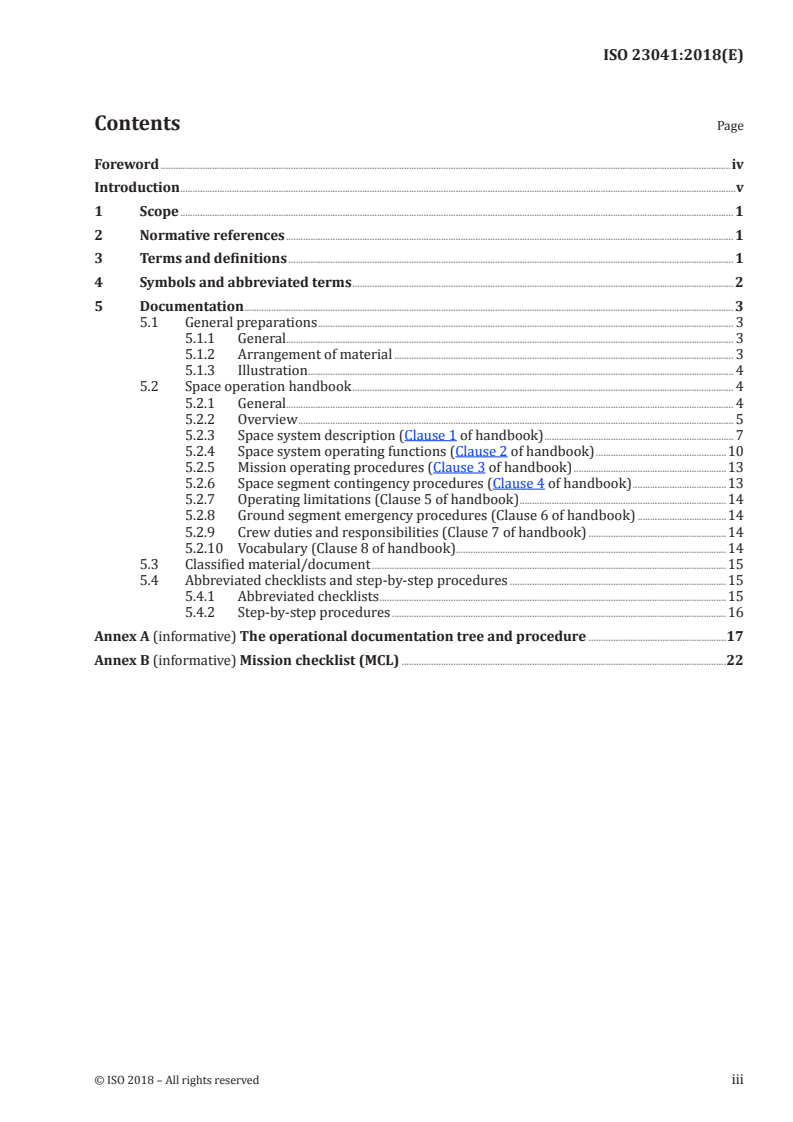
Contents Page
Foreword .iv
Introduction .v
1 Scope . 1
2 Normative references . 1
3 Terms and definitions . 1
4 Symbols and abbreviated terms . 2
5 Documentation . 3
5.1 General preparations . 3
5.1.1 General. 3
5.1.2 Arrangement of material . 3
5.1.3 Illustration . 4
5.2 Space operation handbook . 4
5.2.1 General. 4
5.2.2 Overview . 5
5.2.3 Space system description (Clause 1 of handbook) . 7
5.2.4 Space system operating functions (Clause 2 of handbook) .10
5.2.5 Mission operating procedures (Clause 3 of handbook) .13
5.2.6 Space segment contingency procedures (Clause 4 of handbook) .13
5.2.7 Operating limitations (Clause 5 of handbook) .14
5.2.8 Ground segment emergency procedures (Clause 6 of handbook) .14
5.2.9 Crew duties and responsibilities (Clause 7 of handbook) .14
5.2.10 Vocabulary (Clause 8 of handbook).14
5.3 Classified material/document .15
5.4 Abbreviated checklists and step-by-step procedures .15
5.4.1 Abbreviated checklists .15
5.4.2 Step-by-step procedures .16
Annex A (informative) The operational documentation tree and procedure .17
Annex B (informative) Mission checklist (MCL) .22
Foreword
ISO (the International Organization for Standardization) is a worldwide federation of national standards
bodies (ISO member bodies). The work of preparing International Standards is normally carried out
through ISO technical committees. Each member body interested in a subject for which a technical
committee has been established has the right to be represented on that committee. International
organizations, governmental and non-governmental, in liaison with ISO, also take part in the work.
ISO collaborates closely with the International Electrotechnical Commission (IEC) on all matters of
electrotechnical standardization.
The procedures used to develop this document and those intended for its further maintenance are
described in the ISO/IEC Directives, Part 1. In particular the different approval criteria needed for the
different types of ISO documents should be noted. This document was drafted in accordance with the
editorial rules of the ISO/IEC Directives, Part 2 (see www .iso .org/ directives).
Attention is drawn to the possibility that some of the elements of this document may be the subject of
patent rights. ISO shall not be held responsible for identifying any or all such patent rights. Details of
any patent rights identified during the development of the document will be in the Introduction and/or
on the ISO list of patent declarations received (see www .iso .org/ patents).
Any trade name used in this document is information given for the convenience of users and does not
constitute an endorsement.
For an explanation on the voluntary nature of standards, the meaning of ISO specific terms and
expressions related to conformity assessment, as well as information about ISO's adherence to the
World Trade Organization (WTO) principles in the Technical Barriers to Trade (TBT) see the following
URL: www .iso .org/ iso/ foreword .html
This document was prepared by Technical Committee ISO/TC 20, Aircraft and space vehicles,
Subcommittee SC 14, Space systems and operations.
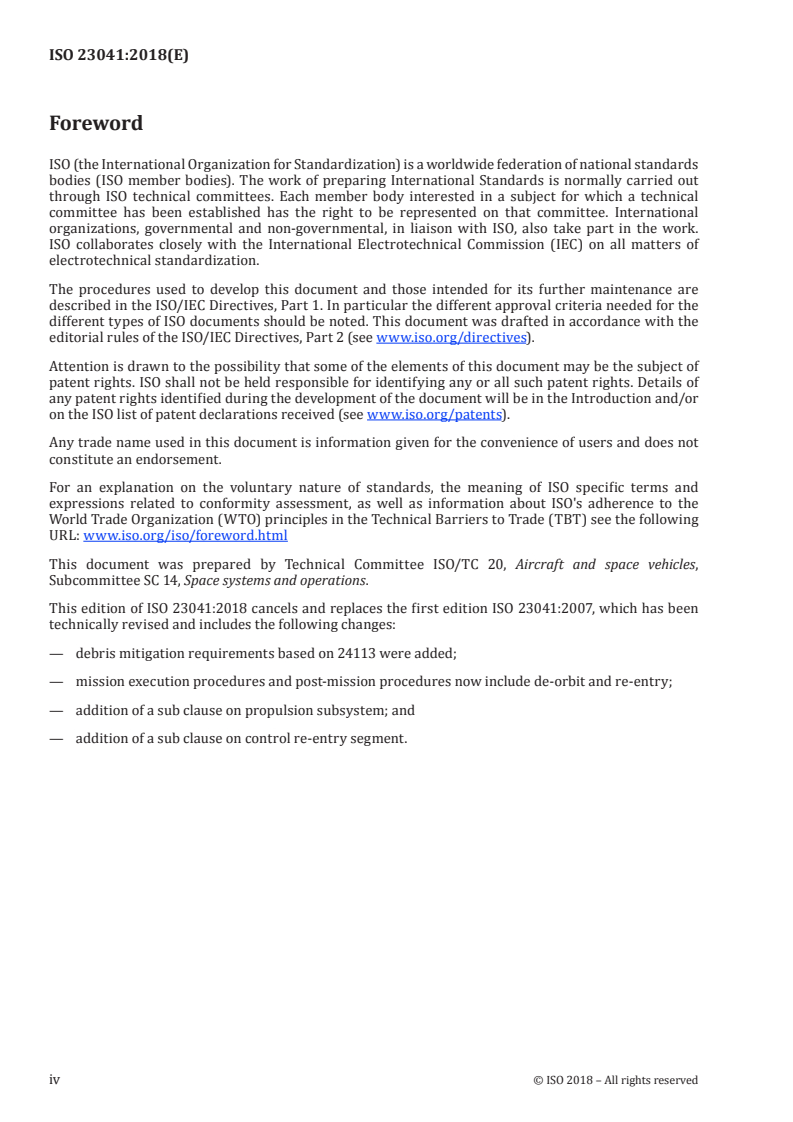
This edition of ISO 23041:2018 cancels and replaces the first edition ISO 23041:2007, which has been
technically revised and includes the following changes:
— debris mitigation requirements based on 24113 were added;
— mission execution procedures and post-mission procedures now include de-orbit and re-entry;
— addition of a sub clause on propulsion subsystem; and
— addition of a sub clause on control re-entry segment.
iv © ISO 2018 – All rights reserved
Introduction
This document prescribes a standard means to facilitate the sharing and exchange of beneficial
information among organizations (the spacecraft manufacturer, the mission equipment supplier, the
customer or the spacecraft operation centre) and their involvement with space operations and support.
This document provides a common interface to simplify space operations planning and reduce the
effort needed to learn and deal with new space programmes and support organizations.
INTERNATIONAL STANDARD ISO 23041:2018(E)
Space systems — Unmanned spacecraft operational
procedures — Documentation
1 Scope
This document establishes standards, current guidelines and uniform procedures to minimize
duplication of effort between the customer, the agency, participating nations and the emerging
commercial space community. This document provides recommended practices for the development
of space operations and support documentation, which should facilitate the sharing and exchange
of beneficial information between organizations involved with space operations. This document
establishes a common interface to simplify space operations planning and reduce the effort needed to
learn and work with new space programmes and support organizations.
2 Normative references
There are no normative references in this document.
3 Terms and definitions
For the purposes of this document, the following terms and definitions apply.
ISO and IEC maintain terminological databases for use in standardization at the following addresses:
— IEC Electropedia: available at https:// www .electropedia .org/
— ISO Online browsing platform: available at https:// www .iso .org/ obp
3.1
abbreviated checklist
comprehensive list of items and time schedule of tasks to be done that are needed to check each step-
by-step task at the telemetry/command (TLM/CMD) console and at the network console
3.2
acquiring agency
organization that is planning and managing the development and acquisition contracts for the space
system, understands the engineering and technical aspects of the system’s operation and acts as a
provider of particular equipment if necessary
3.3
developing agency
organization that develops the spacecraft and operation system under contract to the acquiring agency
Note 1 to entry: One organization may constitute more than one of these agencies.
3.4
mission segment
ground system that consists of the facilities of mission data acquisition and processing
3.5
operations agency
agency responsible for the operations and maintenance of the space systems and organization to which
the operations crew members belong
3.6
operations crew members
personnel who will be using the operations handbook to support space systems
3.7
separate and distinctive checklist
list that contains information to compensate the part of the operation facilities peculiar to the
operations agency
3.8
spacecraft operation handbook
handbook that includes information needed for normal and contingent TLM/CMD operations
3.9
tracking control segment
ground system consisting of the facilities of spacecraft tracking, ranging and telemetry (TLM) monitor
and command (CMD) control
Note 1 to entry: The launch segment includes the pre-launch segment, the spacecraft segment includes the
mission segment and the ground segment includes the facilities and operations handbook.
3.10
space system operation
operation that contains launch segment operation, spacecraft segment operation and tracking control
segment operation
Note 1 to entry: The launch segment operation includes pre-launch segment operation and the spacecraft
segment operation includes the mission phase segment and the post-mission phase segment.
4 Symbols and abbreviated terms
AOCS attitude and orbit control subsystem
AOS acquisition of signal
BB base band
CMD command
EL elevation angle
FCP flight control procedure
FDIR fault detection, isolation and reconfiguration
GCP ground segment control procedure
IOT in-orbit test
LEOP launch and early orbit phase
LOS loss of signal
MCL mission (operation) checklist
OBC onboard computer
OBDH onboard data handling unit
OBS onboard computer software
2 © ISO 2018 – All rights reserved
PS power subsystem
RF radio frequency
SOE sequence of events
SOOH satellite on-orbit operational handbook
SOP satellite operation procedure
STR structure
TCS thermal control subsystem
TLM telemetry
TTC tracking, telemetry and command subsystem
5 Documentation
5.1 General preparations
5.1.1 General
Unless otherwise specified, the operation handbook and checklists shall include a reproducible copy in
a digital format specified by the acquiring agency. If the magnitude of the information to be included
in the operation handbook is such that a single volume is not practical, then more than one volume
may be used to provide the material. The operation handbook shall contain a revision record when the
document is changed or revised.
5.1.2 Arrangement of material
The document shall contain a main table of contents. At the beginning of each clause, there shall be a
subsidiary clause table of contents. The clause table of contents shall include the page number and title
of each sub clause or major subject headings.
When classified or proprietary information (needed for operation handbook) is involved, the same
principles established for the treatment of the main table of contents shall be followed. The main table
of contents shall contain numbers and titles of clauses with their initial page numbers, but shall not
contain any classified or proprietary information.
EXAMPLE Operation crew members sometimes need detailed classified or proprietary design information
of spacecraft for troubleshooting.
Space operation handbooks are normally unclassified. If the space system classification guide identifies
the subjects as classified by the space systems operation crew members requirements, in accordance
with current classification standards and for these classified subjects, the operation agency shall
prepare a separate classified handbook or a classified supplement of the basic handbook.
The heading of the first or introductory paragraph of each clause shall be general in nature to facilitate
including information concerning the main subject. Subordinate headings shall be definitive and
identify the principal item that needs to be covered.
Wherever practical, text shall be simplified and decreased in quantity by the use of complementary
artwork. All technical matter shall be written so that it is understandable by all personnel who are
expected to use the handbook.
5.1.3 Illustration
The operation handbook shall contain the following illustrations:
a) general illustrations depicting the space system configuration;
b) illustrations to show clearly the layout of the space operations centre, including separate
emergency/contingency facilities where applicable;
c) sufficient other illustrations and diagrams to show the major panels, cabinets, consoles, related
equipment, etc. that the space operations crew personnel will use for operations;
d) sufficient diagrams, charts, schematics, etc. to depict the function, control and interrelationship of
significant space system equipment.
Abbreviations, symbols, reference designations and colour coding references used in the space
operations handbook shall also be specified, where applicable.
5.2 Space operation handbook
5.2.1 General
The space operation handbook shall provide the following:
a) General description of the space system giving the purpose, main features and particulars of the
space system and supporting facilities [satellite segment, structure (STR), attitude and orbit control
subsystem (AOCS), thermal control subsystem (TCS), tracking, telemetry and command subsystem
(TTC), power subsystem (PS), payload communications subsystem and payload subsystem]; and
a ground segment description giving both general and detailed information, including electrical
power subsystem, environmental control subsystem, auxiliary equipment, communications, pre-
launch segment, launch segment and mission life segment.
b) Operating functions giving general information, including the process and functional explanations,
operations centre security procedures, changeover procedures, status and fault monitoring,
activity coordination procedures, safety procedures, operations centre inspections and system
test procedures, communications equipment procedures, ground system procedures, mission
planning procedures, mission execution procedures and post-mission procedures including de-
orbit and re-entry.
c) Mission operating procedures giving detailed information and defining individual and crew
responsibilities.
d) Segment contingency procedures giving troubleshooting guidelines and remedial actions.
e) Operating limitations giving a description of specific limitations.
f) Ground segment emergency procedures giving detailed emergency operations procedures and
corrective action.
g) Crew duties and responsibilities giving the individual positions and duties required during nominal
and off-nominal operations.
h) Vocabulary giving technical terms, definitions, acronyms and abbreviations.
4 © ISO 2018 – All rights reserved
5.2.2 Overview
5.2.2.1 Front material
Front material shall include the bulleted list items in Figure 1. The cover/title page, list of effective pages,
verification status sheets, table of contents, list of illustrations and list of tables shall be similar to the
format of this recommended practice with details for preparation at the discretion of the acquiring agency.
NOTE The list of effective pages contains the revision of each page and revised date; the verification status
sheets contain the stage of the document (i.e. WD, CD, review) and approved date.
The foreword shall discuss the various aspects of the operation handbook. Such discussion shall
include the scope of the operation handbook and indicate the technical proficiency expected of the
various space operations crew personnel. The foreword shall also indicate special interest items, e.g.
new development items and critical operation items.
5.2.2.2 Requirements for clauses
Each operation handbook shall include the clauses listed in Figure 1. Additional clauses may be added if
required. If a clause is not applicable, the title of that clause shall appear on the last page of the previous
clause along with a notation that the clause is not applicable or that information will appear when it
becomes available. The title of the clause shall appear in the main table of contents with an appropriate
notation.
As appropriate, each clause shall have separate sections for information pertaining to satellite
support during:
a) pre-launch period;
b) launch early orbit;
c) operations in nominal mode;
d) operations in degraded mode (period when the satellite is no longer fully operational but is still on
orbit); and
e) post-mission phase (satellite end-of-life process).
The format for the presentation of the text, the amplified procedures and the abbreviated checklists
shall be at the discretion of the acquiring agency. The format shall present the crew procedures in a
simple, concise and understandable layout, consistent with space system requirements. For systems
using digitized technical data, the visual template and the text shall be formatted so the screen
presentation will be identical to the printed data.
If the operations agency does not require a printed page of the visual display, the visual display format
shall comply with the style and format of a printed page. Each page of the emergency procedures clause
shall have dialogue box and icon markings on all pages. An example is shown in Figure 2.
Warning marks “1” and contingent check segments “2” shall be selected by the operation agency.
Where possible, amplified procedures and checklists developed for a particular space system shall be
standardized.
Figure 1 — Standard sequence for space operation handbook
Figure 2 — Visual display page of an emergency procedure
6 © ISO 2018 – All rights reserved
Key
1 warning marks
2 contingent check segments
5.2.3 Space system description (Clause 1 of handbook)
5.2.3.1 General
Clause 1 shall consist of a system description and a description of supporting facilities designed for
general orientation. The narrative shall state the purpose and describe the main features and leading
particulars for the space system.
The descriptions of system and supporting facilities shall contain sufficient detail to provide a single
source handbook of general system information. Illustrations shall clarify a particular system or reduce
the verbiage necessary for explanation and aid in understanding the system. Clause 1 shall consist of
several sub clauses: satellite segment description, ground segment description, pre-launch segment
description, launch segment description and the mission life segment (including the post-mission phase
and the reduced operation phase).
The satellite developing agency (i.e. satellite manufacturer) shall provide the documentation including
the above mentioned descriptions, i.e. satellite on-orbit operational handbook (SOOH) and satellite
operation procedure (SOP). By extracting the needed information from SOOH and other sources, the
operation agency shall provide FCPs (see example in Table A.2).
5.2.3.2 Satellite segment
5.2.3.2.1 General
A general description of the satellite segment shall include the following subsystems: structure;
attitude and orbit control; propulsion; thermal control; tracking, telemetry and command; power;
payload/mission communication; payload; and OBDH. Subsequent clauses shall describe in greater
detail the subsystems peculiar to that satellite segment. Such information shall include a general
discussion of satellite segment operations to include a description of major subsystems. The description
shall be of sufficient detail to provide an understanding of the purpose and function of the subsystems,
their relation to overall system operations and such additional information to enable the crew member
to understand subsystem functions peculiar to the overall system. Highly complex satellite segments
may require a stand-alone satellite segment operations handbook. Illustrations shall be used to simplify
the explanation of system interrelation and component function. Separate appendices or handbooks
shall describe, as needed, each of the satellite segment subsystems, depending on the volume of the
telemetry and command material provided.
5.2.3.2.2 Structure subsystem (STR)
The STR information shall include a description of the structural components with dimensions and
particular data concerning component locations, plus the location of other subsystems, if necessary, to
afford a better understanding of the satellite construction.
5.2.3.2.3 Attitude and orbit control subsystem (AOCS)
The AOCS information shall include a brief description of the purpose and type of attitude control and
give a more detailed description of the components and their respective functions, including sensor
unit, regulator unit and actuator unit (which includes the thrusting unit). Illustrations shall be used to
simplify the explanation of system interrelations and component functions.
If the actuators of AOCS are allocated functions to conduct collision avoidance, disposal manoeuvres,
depletion of residual fluids, or controlled re-entry, this shall be described in the AOCS information.
5.2.3.2.4 Propulsion subsystem
The propulsion subsystem information shall include a description of the purpose and type of engine
or motor, and provide a detailed description of the components and relation with any AOCS actuators.
Illustrations shall be used to simplify the explanation of system interrelations and component functions.
5.2.3.2.5 Thermal control subsystem (TCS)
The TCS information shall include a description of the environmental control systems, list the type of
controls employed (i.e. active or passive) and give sufficient detail on the operations and configuration of
the environmental control components to provide an understanding of system operations. Illustrations
shall be used to simplify the explanation of system interrelations and component functions (e.g. heater,
radiator).
5.2.3.2.6 Tracking, telemetry and command subsystem (TTC)
The TTC information shall include a description of the antenna unit, radio frequency (RF) unit,
tracking and ranging unit, base band (BB) unit/telemetry (TLM) command (CMD) and control systems,
command groups, individual command sequences and type and individual telemetry data. The TTC
shall give sufficient detail on operations and configuration of command and control components to
provide understanding of the system operations. Illustrations shall be used to simplify the explanation
of system interrelations and component functions.
5.2.3.2.7 Power subsystem (PS)
The PS information shall include a description of the power system, distribution system, storage system,
power control and sufficient detail on operations and configuration of power system components
to provide an understanding of the system operations. Illustrations shall be used to simplify the
explanation of system interrelations and component functions.
5.2.3.2.8 Payload/mission communication subsystem
The payload/mission communication subsystem information shall include a description of the
payload/mission communication subsystem (antenna unit, RF unit) and its function with operational
configuration.
5.2.3.2.9 Payload subsystem
The payload subsystem information shall include a description of the payload subsystem, mission
sensors, data formatting, data recording and data playback control processors. Sufficient detail on
operations and configuration of payload subsystem components shall provide an understanding of
system operations. Illustrations shall explain the simplified system interrelations and component
functions.
5.2.3.2.10 Onboard data handling unit (OBDH)
The OBDH information shall include a description and configuration of the OBC and OBS that provides
an understanding of system operations and the following functions:
a) TTC, payload data handling (i.e. data formatting for packet/de-packet);
b) satellite attitude data processing (i.e. satellite attitude error check and regulation);
c) FDIR for satellite safety and survivability (i.e. error source detection and recovery; prevents drain
on satellite electronic power resource, satellite attitude missing); and
d) automatic, autonomous and robotic data processing for payload mission operation.
8 © ISO 2018 – All rights reserved
The illustrations shall explain the simplified system interrelations of each function and related
subsystems.
5.2.3.3 Ground segment
5.2.3.3.1 General
A general description of the ground segment (which includes facilities and operations handbook)
shall include the physical layout, with location and function of mission data processing, data archive,
telemetry data processing, radar subsystems, ground sensors, recorder subsystems, security, personnel
access and power systems. Detailed discussions shall include the data processor, data storage, telemetry
processor, data switching, external interfaces, antenna/array, transmitter, receiver and associated
support equipment required for system configuration as they support space operations crew member
operations. Highly complex ground systems can require a stand-alone ground system operations
manual. Illustrations shall explain the simplified system interrelations and component functions.
The ground segment developing agency (i.e. ground segment manufacturer) shall provide the ground
segment operational manuals (see Table A.3) and the operation agency shall provide the ground segment
procedures (GSP, see Tables A.3 and A.4), operation agency’s operation crew and/or operation teams.
5.2.3.3.2 Electrical power subsystem
A description of the electrical power subsystem shall include normal, standby, emergency and
uninterruptible power sources, with a description of distribution components, switch gear and power-
generating equipment.
5.2.3.3.3 Environmental control subsystem
A description of the environmental control subsystem shall include the environmental control
subsystem for the space operations centre and equipment areas, and a general description of the
heating and ventilating equipment and associated maintenance support equipment. A description shall
include the equipment interface with the alarm and detector system.
5.2.3.3.4 Auxiliary equipment
A description of the auxiliary equipment shall include equipment that is required by the operator to
perform other subsystem functions, such as fire detection/suppression, environmental sensing and
security detection.
5.2.3.3.5 Communications
A description of the communications systems shall include, but not be limited to, higher authority,
payload communication control and payload data process, tracking, telemetry and command control,
secure/non-secure voice, secure/non-secure data, multiplexing/de-multiplexing systems and inter-site,
intercom and administrative communications systems. A description shall address any crew activity
regarding normal, emergency, or malfunction operations in the applicable clause. Highly complex
communications systems can require a stand-alone communications system operations handbook.
Illustrations shall explain simplified system interrelations and component functions.
5.2.3.4 Pre-launch segment
The pre-launch segment shall provide information consistent with what operations personnel need
to know for the type of pre-launch phase support needed. Information shall also include the ground
segment schedule, the work with an overview of the pre-launch event sequence and the constraints
resulting from the pre-launch ground segment test (i.e. data system test with database verification)
and the interface test between space segments (i.e. radio frequency and base band compatibility test
and the data interface test).
5.2.3.5 Launch segment
The launch segment shall provide information consistent with what operations personnel need
to know for the type of launch and early orbit phase (LEOP) support needed. Information shall also
include an overview of the launch sequence plus telemetry, boost phase programmed events and other
launch phase items as appropriate. If information needed by operations personnel and provided in the
preceding satellite segment and ground segment sections is different during the launch phase, those
differences shall be identified in this clause as appropriate.
5.2.3.6 Mission life segment
The mission life segment shall describe the in-orbit test (IOT) phase, the mission phase and post-mission
phase operations. In the mission phase the operations agency executes every mission duty operation
and in the post-mission phase the operations agency executes degraded mode operations and end-of
–life operation. This clause shall provide information consistent with what operations personnel need
to know for the type of mission phase support and post-mission phase support needed. If post-mission
phase support is to be provided, information shall include an overview of the post-mission operation
with operation items and time limits.
5.2.3.7 Control re-entry segment
If the satellite is disposed by controlled re-entry, a ground facility for command and monitoring for
successful re-entry shall be allocated. The operator shall provide re-entry segment information, such
as operation time sequence, re-entry trajectory, expected landing zone, and notification to related
organization or countries.
5.2.4 Space system operating functions (Clause 2 of handbook)
5.2.4.1 General
The space system operating functions clause shall emphasize the process required to bring the system
to full operational capability, status monitoring, alarm/anomaly response by the limit check defined
in the database system (DB), mission planning, mission execution by the event go/no-go judgement by
SOE and post-mission activity through LEOP, IOT, mission and post-mission phase.
In the IOT phase, the developing agency and operating agency shall check the on-orbit performance and
function of bus equipment and mission equipment. After the check, the developing agency shall hand
over satellite operation to the operating agency.
Clause 2 shall contain a functional explanation of the mission and contingency, i.e. SOOH Vol. Two shall
contain data needed for the space segment (see Table A.1, satellite nominal and contingent operation
description in LEOP, IOT and control for initial acquiring mission orbit) and emergency procedures
contained in other clauses (in the ground segment) of the handbook. Flow diagrams shall support text
as needed. The functional description shall include the following, as applicable:
a) when the procedure shall start and terminate;
b) where the procedure shall activate, e.g. rack, console, or other location;
c) the time usually required for the system to complete a function;
d) what is accomplished by the procedure;
e) prerequisites for procedure execution;
f) procedure peculiarities, if any;
g) when it is possible (or prohibited) to accomplish the procedure; and
h) identification of the crew interface and actions required to operate the function.
10 © ISO 2018 – All rights reserved
Where possible, common titles shall identify crew procedures common to all space systems (i.e. complex
entry and exit, crew changeover briefings, activity co-ordination briefings). Amplified procedures shall
tell who, what, when, where, why and how. Most procedures in Clause 2 and in Clause 3 shall be in
checklist format.
5.2.4.2 Operations centre security procedures
Amplified security procedures shall include functions accomplished by the relief crew and duty crew
necessary for personnel identification, classified inventory, check of warning devices (if applicable) and
specified equipment, as applicable to the space system.
5.2.4.3 Changeover procedures
Crew changeover procedures and briefings shall facilitate the assumption of duties by the relief crew.
These procedures shall include briefings and procedures that will enable both the duty crew and the
relief crew to review, examine and determine the system status during the course of the changeover.
Procedures and briefings shall include material which assists in accomplishing an effective crew
changeover.
5.2.4.4 Status and fault monitoring
With regard to SOE event processing and satellite health status, space system status and fault
monitoring received at the space operations centre can be presented by console indications, printouts
and alarms. For abnormal indications, the operator shall receive instructions on the best method of
prioritizing crew actions and reacting to the indications. Instructions shall provide clear directions for
the space operations crew member to understand and react to these stimuli and to be able to perform
normal, emergency, and malfunction procedures to isolate the condition and maintain maximum space
system capability. SOE (see Table A.1) describes the sequence of procedures with the timing constraints
in order to realize an operation and refers to the FCP and GCP to be executed. In order to perform status
and fault monitoring, each agency shall require the following:
a) checking and recording of the deviations from the reference and reporting of its influence;
b) selection of the report format of the status data card/characteristics sheet; and
c) maintenance of the DB value (see Table A.3) by the operating agency after the review by
the developing agency to obtain the appropriate reference.
5.2.4.5 Activity coordination procedures
Activity coordination procedures shall include information required by space operations crew
members to accomplish their duty assignments. Information shall advise space operations crew
members of scheduled activities, operational and maintenance support tasks, emergency procedures
and administrative matters. An activity coordination briefing shall be held before operating the
system equipment or performing any on-site maintenance or servicing task. The purpose of an activity
coordination briefing is to ensure that safe and correct procedures are followed during the performance
of any function involving on-site equipment. It is the responsibility of the briefing official to ensure
that personnel are thoroughly briefed on all aspects of the activity to be conducted. This briefing shall
include, but not be restricted to, communications and normal, malfunction, emergency and contingency
procedures in progress or anticipated.
5.2.4.6 Safety procedures
The safety procedures shall include rules for evacuation of the operation crew and on-site safety
briefings for visiting personnel. The procedures shall include information sufficient in scope to advise
visiting personnel of existing site hazards, alert procedures, hazardous operations scheduled or in
progress and danger areas. The procedures shall describe the escort/visitor relationship, location of
safety equipment, reaction to announced emergency conditions and communications procedures.
5.2.4.7 Operations centre inspections and system test procedures
Inspections and system test procedures shall provide the space operations crew during alert with a
verification of system capability and system status. The extent and complexity of these procedures
shall depend on the particular space system. In each case, the amplified procedures in this clause and
applicable corresponding abbreviated checklist shall contain complete verification procedures for
determining system capability and system status. System test procedures shall augment the verification
of system status and enhance the ability of the space operations crew member to isolate problems and
restore the space system to full operational posture. If deemed necessary by the acquiring agency, an
abbreviated checklist shall include these procedures.
The operations handbook shall include verification/inspection procedures performed by persons other
than space operations crew members.
Equipment status verified by crew personnel during the verification/inspection shall include mission-
essential equipment. Verification/inspection procedures for equipment requiring less frequent status
verification shall be in other space system technical orders.
5.2.4.8 Communications equipment procedures
Communications equipment procedures shall include the descriptions of activities required to inspect,
start up, initialize and operate equipment and to perform diagnostic tests. These procedures shall also
include requirements for isolating communications equipment from space system equipment. Either
the operations agency or the acquiring agency may request a stand-alone operation handbook for
complex or highly integrated communications equipment.
5.2.4.9 Ground system procedures
The ground system procedures shall include the descriptions of activities required to inspect, start
up, initialize, configure and operate equipment and to perform diagnostic tests. These procedures also
include the requirements for isolating ground systems from communications equipment. Either the
operations agency or the acquiring agency may request a stand-alone operations handbook for complex
or highly integrated ground systems. The ground system procedures include a ground segment nominal
operation procedure and contingency procedure that includes error finding, identifying and isolating
the most probable system malfunctions that could occur during mission operations and recovery
functions including switching to a redundant system corresponding to the style of their ground
segment.
5.2.4.10 Mission planning procedures
Mission planning procedures shall include the necessary actions to be performed by the space
operations crew to achieve the long- and short-term mission planning necessary to accomplish all
mission requirements including nominal, collision avoidance and disposal operations. Amplified
procedures and the applicable corresponding abbreviated checklist shall contain sufficient detail to
ensure all aspects of mission planning are accomplished.
5.2.4.11 Mission execution procedures
Mission execution procedures shall contain mission execution requirements to be accomplished
by space operations crew personnel. These procedures shall be in sufficient detail to direct space
operations crew personnel in accomplishing mission execution of space assets. These procedures shall
include the methods needed to identify and correct system anomalies.
5.2.4.12 Post-mission procedures
Post-mission procedures shall contain post-mission requirements to be accomplished by space
operations crew personnel. These procedures shall be in sufficient detail to direct space operations
12 © ISO 2018 – All rights reserved
crew personnel in accomplishing shut-down, de-orbit / re-entry and reporting procedures (if applicable
to the space system).
5.2.5 Mission operating procedures (Clause 3 of handbook)
Mission operating procedures shall contain detailed information for satellite and related ground
segment operation required by the space operations crew in the performance of normal and contingent
operational duties. It shall include briefings and procedures to be conducted during normal and
contingent case duty shift, mission planning, mission execution, post-mission, training operations,
mission verification and such other operations as may be applicable or specifically required by the
acquiring, operations, or owner agency (e.g. SOOH Vol. Eight describes nominal and contingent mission
operation and related ground facility).
Clause 3 shall consist of normal and contingent operational briefings and procedures required
of space operations crew personnel during the course of a duty shift. The procedures shall identify
requirements from the point of crew arrival on-site, during daily or recurring tasks and until crew
departure following completion of the duty shift.
Operational procedures shall define individual and crew responsibilities and provide amplified
procedures sufficient to ensure complete, accurate and timely accomplishment of these functions. This
clause shall contain simplified procedures, such as operations centre security. This clause shall explain
complex or lengthy procedures in amplified procedures format.
The contents of Clause 3 shall include those crew briefings and procedures required to determine
system status, maintain operational capability, execute mission, conduct post-mission operations and
ensure secure operations.
5.2.6 Space segment contingency procedures (Clause 4 of handbook)
The contingency procedure shall primarily make it possible to establish whether a contingency
originates from the space segment or ground segme
...
INTERNATIONAL ISO
STANDARD 23041
Second edition
2018-04
Space systems — Unmanned
spacecraft operational procedures —
Documentation
Systèmes spatiaux — Procédures opérationnelles de véhicule spatial
non habité — Documentation
Reference number
©
ISO 2018
© ISO 2018
All rights reserved. Unless otherwise specified, or required in the context of its implementation, no part of this publication may
be reproduced or utilized otherwise in any form or by any means, electronic or mechanical, including photocopying, or posting
on the internet or an intranet, without prior written permission. Permission can be requested from either ISO at the address
below or ISO’s member body in the country of the requester.
ISO copyright office
CP 401 • Ch. de Blandonnet 8
CH-1214 Vernier, Geneva
Phone: +41 22 749 01 11
Fax: +41 22 749 09 47
Email: copyright@iso.org
Website: www.iso.org
Published in Switzerland
ii © ISO 2018 – All rights reserved
Contents Page
Foreword .iv
Introduction .v
1 Scope . 1
2 Normative references . 1
3 Terms and definitions . 1
4 Symbols and abbreviated terms . 2
5 Documentation . 3
5.1 General preparations . 3
5.1.1 General. 3
5.1.2 Arrangement of material . 3
5.1.3 Illustration . 4
5.2 Space operation handbook . 4
5.2.1 General. 4
5.2.2 Overview . 5
5.2.3 Space system description (Clause 1 of handbook) . 7
5.2.4 Space system operating functions (Clause 2 of handbook) .10
5.2.5 Mission operating procedures (Clause 3 of handbook) .13
5.2.6 Space segment contingency procedures (Clause 4 of handbook) .13
5.2.7 Operating limitations (Clause 5 of handbook) .14
5.2.8 Ground segment emergency procedures (Clause 6 of handbook) .14
5.2.9 Crew duties and responsibilities (Clause 7 of handbook) .14
5.2.10 Vocabulary (Clause 8 of handbook).14
5.3 Classified material/document .15
5.4 Abbreviated checklists and step-by-step procedures .15
5.4.1 Abbreviated checklists .15
5.4.2 Step-by-step procedures .16
Annex A (informative) The operational documentation tree and procedure .17
Annex B (informative) Mission checklist (MCL) .22
Foreword
ISO (the International Organization for Standardization) is a worldwide federation of national standards
bodies (ISO member bodies). The work of preparing International Standards is normally carried out
through ISO technical committees. Each member body interested in a subject for which a technical
committee has been established has the right to be represented on that committee. International
organizations, governmental and non-governmental, in liaison with ISO, also take part in the work.
ISO collaborates closely with the International Electrotechnical Commission (IEC) on all matters of
electrotechnical standardization.
The procedures used to develop this document and those intended for its further maintenance are
described in the ISO/IEC Directives, Part 1. In particular the different approval criteria needed for the
different types of ISO documents should be noted. This document was drafted in accordance with the
editorial rules of the ISO/IEC Directives, Part 2 (see www .iso .org/ directives).
Attention is drawn to the possibility that some of the elements of this document may be the subject of
patent rights. ISO shall not be held responsible for identifying any or all such patent rights. Details of
any patent rights identified during the development of the document will be in the Introduction and/or
on the ISO list of patent declarations received (see www .iso .org/ patents).
Any trade name used in this document is information given for the convenience of users and does not
constitute an endorsement.
For an explanation on the voluntary nature of standards, the meaning of ISO specific terms and
expressions related to conformity assessment, as well as information about ISO's adherence to the
World Trade Organization (WTO) principles in the Technical Barriers to Trade (TBT) see the following
URL: www .iso .org/ iso/ foreword .html
This document was prepared by Technical Committee ISO/TC 20, Aircraft and space vehicles,
Subcommittee SC 14, Space systems and operations.
This edition of ISO 23041:2018 cancels and replaces the first edition ISO 23041:2007, which has been
technically revised and includes the following changes:
— debris mitigation requirements based on 24113 were added;
— mission execution procedures and post-mission procedures now include de-orbit and re-entry;
— addition of a sub clause on propulsion subsystem; and
— addition of a sub clause on control re-entry segment.
iv © ISO 2018 – All rights reserved
Introduction
This document prescribes a standard means to facilitate the sharing and exchange of beneficial
information among organizations (the spacecraft manufacturer, the mission equipment supplier, the
customer or the spacecraft operation centre) and their involvement with space operations and support.
This document provides a common interface to simplify space operations planning and reduce the
effort needed to learn and deal with new space programmes and support organizations.
INTERNATIONAL STANDARD ISO 23041:2018(E)
Space systems — Unmanned spacecraft operational
procedures — Documentation
1 Scope
This document establishes standards, current guidelines and uniform procedures to minimize
duplication of effort between the customer, the agency, participating nations and the emerging
commercial space community. This document provides recommended practices for the development
of space operations and support documentation, which should facilitate the sharing and exchange
of beneficial information between organizations involved with space operations. This document
establishes a common interface to simplify space operations planning and reduce the effort needed to
learn and work with new space programmes and support organizations.
2 Normative references
There are no normative references in this document.
3 Terms and definitions
For the purposes of this document, the following terms and definitions apply.
ISO and IEC maintain terminological databases for use in standardization at the following addresses:
— IEC Electropedia: available at https:// www .electropedia .org/
— ISO Online browsing platform: available at https:// www .iso .org/ obp
3.1
abbreviated checklist
comprehensive list of items and time schedule of tasks to be done that are needed to check each step-
by-step task at the telemetry/command (TLM/CMD) console and at the network console
3.2
acquiring agency
organization that is planning and managing the development and acquisition contracts for the space
system, understands the engineering and technical aspects of the system’s operation and acts as a
provider of particular equipment if necessary
3.3
developing agency
organization that develops the spacecraft and operation system under contract to the acquiring agency
Note 1 to entry: One organization may constitute more than one of these agencies.
3.4
mission segment
ground system that consists of the facilities of mission data acquisition and processing
3.5
operations agency
agency responsible for the operations and maintenance of the space systems and organization to which
the operations crew members belong
3.6
operations crew members
personnel who will be using the operations handbook to support space systems
3.7
separate and distinctive checklist
list that contains information to compensate the part of the operation facilities peculiar to the
operations agency
3.8
spacecraft operation handbook
handbook that includes information needed for normal and contingent TLM/CMD operations
3.9
tracking control segment
ground system consisting of the facilities of spacecraft tracking, ranging and telemetry (TLM) monitor
and command (CMD) control
Note 1 to entry: The launch segment includes the pre-launch segment, the spacecraft segment includes the
mission segment and the ground segment includes the facilities and operations handbook.
3.10
space system operation
operation that contains launch segment operation, spacecraft segment operation and tracking control
segment operation
Note 1 to entry: The launch segment operation includes pre-launch segment operation and the spacecraft
segment operation includes the mission phase segment and the post-mission phase segment.
4 Symbols and abbreviated terms
AOCS attitude and orbit control subsystem
AOS acquisition of signal
BB base band
CMD command
EL elevation angle
FCP flight control procedure
FDIR fault detection, isolation and reconfiguration
GCP ground segment control procedure
IOT in-orbit test
LEOP launch and early orbit phase
LOS loss of signal
MCL mission (operation) checklist
OBC onboard computer
OBDH onboard data handling unit
OBS onboard computer software
2 © ISO 2018 – All rights reserved
PS power subsystem
RF radio frequency
SOE sequence of events
SOOH satellite on-orbit operational handbook
SOP satellite operation procedure
STR structure
TCS thermal control subsystem
TLM telemetry
TTC tracking, telemetry and command subsystem
5 Documentation
5.1 General preparations
5.1.1 General
Unless otherwise specified, the operation handbook and checklists shall include a reproducible copy in
a digital format specified by the acquiring agency. If the magnitude of the information to be included
in the operation handbook is such that a single volume is not practical, then more than one volume
may be used to provide the material. The operation handbook shall contain a revision record when the
document is changed or revised.
5.1.2 Arrangement of material
The document shall contain a main table of contents. At the beginning of each clause, there shall be a
subsidiary clause table of contents. The clause table of contents shall include the page number and title
of each sub clause or major subject headings.
When classified or proprietary information (needed for operation handbook) is involved, the same
principles established for the treatment of the main table of contents shall be followed. The main table
of contents shall contain numbers and titles of clauses with their initial page numbers, but shall not
contain any classified or proprietary information.
EXAMPLE Operation crew members sometimes need detailed classified or proprietary design information
of spacecraft for troubleshooting.
Space operation handbooks are normally unclassified. If the space system classification guide identifies
the subjects as classified by the space systems operation crew members requirements, in accordance
with current classification standards and for these classified subjects, the operation agency shall
prepare a separate classified handbook or a classified supplement of the basic handbook.
The heading of the first or introductory paragraph of each clause shall be general in nature to facilitate
including information concerning the main subject. Subordinate headings shall be definitive and
identify the principal item that needs to be covered.
Wherever practical, text shall be simplified and decreased in quantity by the use of complementary
artwork. All technical matter shall be written so that it is understandable by all personnel who are
expected to use the handbook.
5.1.3 Illustration
The operation handbook shall contain the following illustrations:
a) general illustrations depicting the space system configuration;
b) illustrations to show clearly the layout of the space operations centre, including separate
emergency/contingency facilities where applicable;
c) sufficient other illustrations and diagrams to show the major panels, cabinets, consoles, related
equipment, etc. that the space operations crew personnel will use for operations;
d) sufficient diagrams, charts, schematics, etc. to depict the function, control and interrelationship of
significant space system equipment.
Abbreviations, symbols, reference designations and colour coding references used in the space
operations handbook shall also be specified, where applicable.
5.2 Space operation handbook
5.2.1 General
The space operation handbook shall provide the following:
a) General description of the space system giving the purpose, main features and particulars of the
space system and supporting facilities [satellite segment, structure (STR), attitude and orbit control
subsystem (AOCS), thermal control subsystem (TCS), tracking, telemetry and command subsystem
(TTC), power subsystem (PS), payload communications subsystem and payload subsystem]; and
a ground segment description giving both general and detailed information, including electrical
power subsystem, environmental control subsystem, auxiliary equipment, communications, pre-
launch segment, launch segment and mission life segment.
b) Operating functions giving general information, including the process and functional explanations,
operations centre security procedures, changeover procedures, status and fault monitoring,
activity coordination procedures, safety procedures, operations centre inspections and system
test procedures, communications equipment procedures, ground system procedures, mission
planning procedures, mission execution procedures and post-mission procedures including de-
orbit and re-entry.
c) Mission operating procedures giving detailed information and defining individual and crew
responsibilities.
d) Segment contingency procedures giving troubleshooting guidelines and remedial actions.
e) Operating limitations giving a description of specific limitations.
f) Ground segment emergency procedures giving detailed emergency operations procedures and
corrective action.
g) Crew duties and responsibilities giving the individual positions and duties required during nominal
and off-nominal operations.
h) Vocabulary giving technical terms, definitions, acronyms and abbreviations.
4 © ISO 2018 – All rights reserved
5.2.2 Overview
5.2.2.1 Front material
Front material shall include the bulleted list items in Figure 1. The cover/title page, list of effective pages,
verification status sheets, table of contents, list of illustrations and list of tables shall be similar to the
format of this recommended practice with details for preparation at the discretion of the acquiring agency.
NOTE The list of effective pages contains the revision of each page and revised date; the verification status
sheets contain the stage of the document (i.e. WD, CD, review) and approved date.
The foreword shall discuss the various aspects of the operation handbook. Such discussion shall
include the scope of the operation handbook and indicate the technical proficiency expected of the
various space operations crew personnel. The foreword shall also indicate special interest items, e.g.
new development items and critical operation items.
5.2.2.2 Requirements for clauses
Each operation handbook shall include the clauses listed in Figure 1. Additional clauses may be added if
required. If a clause is not applicable, the title of that clause shall appear on the last page of the previous
clause along with a notation that the clause is not applicable or that information will appear when it
becomes available. The title of the clause shall appear in the main table of contents with an appropriate
notation.
As appropriate, each clause shall have separate sections for information pertaining to satellite
support during:
a) pre-launch period;
b) launch early orbit;
c) operations in nominal mode;
d) operations in degraded mode (period when the satellite is no longer fully operational but is still on
orbit); and
e) post-mission phase (satellite end-of-life process).
The format for the presentation of the text, the amplified procedures and the abbreviated checklists
shall be at the discretion of the acquiring agency. The format shall present the crew procedures in a
simple, concise and understandable layout, consistent with space system requirements. For systems
using digitized technical data, the visual template and the text shall be formatted so the screen
presentation will be identical to the printed data.
If the operations agency does not require a printed page of the visual display, the visual display format
shall comply with the style and format of a printed page. Each page of the emergency procedures clause
shall have dialogue box and icon markings on all pages. An example is shown in Figure 2.
Warning marks “1” and contingent check segments “2” shall be selected by the operation agency.
Where possible, amplified procedures and checklists developed for a particular space system shall be
standardized.
Figure 1 — Standard sequence for space operation handbook
Figure 2 — Visual display page of an emergency procedure
6 © ISO 2018 – All rights reserved
Key
1 warning marks
2 contingent check segments
5.2.3 Space system description (Clause 1 of handbook)
5.2.3.1 General
Clause 1 shall consist of a system description and a description of supporting facilities designed for
general orientation. The narrative shall state the purpose and describe the main features and leading
particulars for the space system.
The descriptions of system and supporting facilities shall contain sufficient detail to provide a single
source handbook of general system information. Illustrations shall clarify a particular system or reduce
the verbiage necessary for explanation and aid in understanding the system. Clause 1 shall consist of
several sub clauses: satellite segment description, ground segment description, pre-launch segment
description, launch segment description and the mission life segment (including the post-mission phase
and the reduced operation phase).
The satellite developing agency (i.e. satellite manufacturer) shall provide the documentation including
the above mentioned descriptions, i.e. satellite on-orbit operational handbook (SOOH) and satellite
operation procedure (SOP). By extracting the needed information from SOOH and other sources, the
operation agency shall provide FCPs (see example in Table A.2).
5.2.3.2 Satellite segment
5.2.3.2.1 General
A general description of the satellite segment shall include the following subsystems: structure;
attitude and orbit control; propulsion; thermal control; tracking, telemetry and command; power;
payload/mission communication; payload; and OBDH. Subsequent clauses shall describe in greater
detail the subsystems peculiar to that satellite segment. Such information shall include a general
discussion of satellite segment operations to include a description of major subsystems. The description
shall be of sufficient detail to provide an understanding of the purpose and function of the subsystems,
their relation to overall system operations and such additional information to enable the crew member
to understand subsystem functions peculiar to the overall system. Highly complex satellite segments
may require a stand-alone satellite segment operations handbook. Illustrations shall be used to simplify
the explanation of system interrelation and component function. Separate appendices or handbooks
shall describe, as needed, each of the satellite segment subsystems, depending on the volume of the
telemetry and command material provided.
5.2.3.2.2 Structure subsystem (STR)
The STR information shall include a description of the structural components with dimensions and
particular data concerning component locations, plus the location of other subsystems, if necessary, to
afford a better understanding of the satellite construction.
5.2.3.2.3 Attitude and orbit control subsystem (AOCS)
The AOCS information shall include a brief description of the purpose and type of attitude control and
give a more detailed description of the components and their respective functions, including sensor
unit, regulator unit and actuator unit (which includes the thrusting unit). Illustrations shall be used to
simplify the explanation of system interrelations and component functions.
If the actuators of AOCS are allocated functions to conduct collision avoidance, disposal manoeuvres,
depletion of residual fluids, or controlled re-entry, this shall be described in the AOCS information.
5.2.3.2.4 Propulsion subsystem
The propulsion subsystem information shall include a description of the purpose and type of engine
or motor, and provide a detailed description of the components and relation with any AOCS actuators.
Illustrations shall be used to simplify the explanation of system interrelations and component functions.
5.2.3.2.5 Thermal control subsystem (TCS)
The TCS information shall include a description of the environmental control systems, list the type of
controls employed (i.e. active or passive) and give sufficient detail on the operations and configuration of
the environmental control components to provide an understanding of system operations. Illustrations
shall be used to simplify the explanation of system interrelations and component functions (e.g. heater,
radiator).
5.2.3.2.6 Tracking, telemetry and command subsystem (TTC)
The TTC information shall include a description of the antenna unit, radio frequency (RF) unit,
tracking and ranging unit, base band (BB) unit/telemetry (TLM) command (CMD) and control systems,
command groups, individual command sequences and type and individual telemetry data. The TTC
shall give sufficient detail on operations and configuration of command and control components to
provide understanding of the system operations. Illustrations shall be used to simplify the explanation
of system interrelations and component functions.
5.2.3.2.7 Power subsystem (PS)
The PS information shall include a description of the power system, distribution system, storage system,
power control and sufficient detail on operations and configuration of power system components
to provide an understanding of the system operations. Illustrations shall be used to simplify the
explanation of system interrelations and component functions.
5.2.3.2.8 Payload/mission communication subsystem
The payload/mission communication subsystem information shall include a description of the
payload/mission communication subsystem (antenna unit, RF unit) and its function with operational
configuration.
5.2.3.2.9 Payload subsystem
The payload subsystem information shall include a description of the payload subsystem, mission
sensors, data formatting, data recording and data playback control processors. Sufficient detail on
operations and configuration of payload subsystem components shall provide an understanding of
system operations. Illustrations shall explain the simplified system interrelations and component
functions.
5.2.3.2.10 Onboard data handling unit (OBDH)
The OBDH information shall include a description and configuration of the OBC and OBS that provides
an understanding of system operations and the following functions:
a) TTC, payload data handling (i.e. data formatting for packet/de-packet);
b) satellite attitude data processing (i.e. satellite attitude error check and regulation);
c) FDIR for satellite safety and survivability (i.e. error source detection and recovery; prevents drain
on satellite electronic power resource, satellite attitude missing); and
d) automatic, autonomous and robotic data processing for payload mission operation.
8 © ISO 2018 – All rights reserved
The illustrations shall explain the simplified system interrelations of each function and related
subsystems.
5.2.3.3 Ground segment
5.2.3.3.1 General
A general description of the ground segment (which includes facilities and operations handbook)
shall include the physical layout, with location and function of mission data processing, data archive,
telemetry data processing, radar subsystems, ground sensors, recorder subsystems, security, personnel
access and power systems. Detailed discussions shall include the data processor, data storage, telemetry
processor, data switching, external interfaces, antenna/array, transmitter, receiver and associated
support equipment required for system configuration as they support space operations crew member
operations. Highly complex ground systems can require a stand-alone ground system operations
manual. Illustrations shall explain the simplified system interrelations and component functions.
The ground segment developing agency (i.e. ground segment manufacturer) shall provide the ground
segment operational manuals (see Table A.3) and the operation agency shall provide the ground segment
procedures (GSP, see Tables A.3 and A.4), operation agency’s operation crew and/or operation teams.
5.2.3.3.2 Electrical power subsystem
A description of the electrical power subsystem shall include normal, standby, emergency and
uninterruptible power sources, with a description of distribution components, switch gear and power-
generating equipment.
5.2.3.3.3 Environmental control subsystem
A description of the environmental control subsystem shall include the environmental control
subsystem for the space operations centre and equipment areas, and a general description of the
heating and ventilating equipment and associated maintenance support equipment. A description shall
include the equipment interface with the alarm and detector system.
5.2.3.3.4 Auxiliary equipment
A description of the auxiliary equipment shall include equipment that is required by the operator to
perform other subsystem functions, such as fire detection/suppression, environmental sensing and
security detection.
5.2.3.3.5 Communications
A description of the communications systems shall include, but not be limited to, higher authority,
payload communication control and payload data process, tracking, telemetry and command control,
secure/non-secure voice, secure/non-secure data, multiplexing/de-multiplexing systems and inter-site,
intercom and administrative communications systems. A description shall address any crew activity
regarding normal, emergency, or malfunction operations in the applicable clause. Highly complex
communications systems can require a stand-alone communications system operations handbook.
Illustrations shall explain simplified system interrelations and component functions.
5.2.3.4 Pre-launch segment
The pre-launch segment shall provide information consistent with what operations personnel need
to know for the type of pre-launch phase support needed. Information shall also include the ground
segment schedule, the work with an overview of the pre-launch event sequence and the constraints
resulting from the pre-launch ground segment test (i.e. data system test with database verification)
and the interface test between space segments (i.e. radio frequency and base band compatibility test
and the data interface test).
5.2.3.5 Launch segment
The launch segment shall provide information consistent with what operations personnel need
to know for the type of launch and early orbit phase (LEOP) support needed. Information shall also
include an overview of the launch sequence plus telemetry, boost phase programmed events and other
launch phase items as appropriate. If information needed by operations personnel and provided in the
preceding satellite segment and ground segment sections is different during the launch phase, those
differences shall be identified in this clause as appropriate.
5.2.3.6 Mission life segment
The mission life segment shall describe the in-orbit test (IOT) phase, the mission phase and post-mission
phase operations. In the mission phase the operations agency executes every mission duty operation
and in the post-mission phase the operations agency executes degraded mode operations and end-of
–life operation. This clause shall provide information consistent with what operations personnel need
to know for the type of mission phase support and post-mission phase support needed. If post-mission
phase support is to be provided, information shall include an overview of the post-mission operation
with operation items and time limits.
5.2.3.7 Control re-entry segment
If the satellite is disposed by controlled re-entry, a ground facility for command and monitoring for
successful re-entry shall be allocated. The operator shall provide re-entry segment information, such
as operation time sequence, re-entry trajectory, expected landing zone, and notification to related
organization or countries.
5.2.4 Space system operating functions (Clause 2 of handbook)
5.2.4.1 General
The space system operating functions clause shall emphasize the process required to bring the system
to full operational capability, status monitoring, alarm/anomaly response by the limit check defined
in the database system (DB), mission planning, mission execution by the event go/no-go judgement by
SOE and post-mission activity through LEOP, IOT, mission and post-mission phase.
In the IOT phase, the developing agency and operating agency shall check the on-orbit performance and
function of bus equipment and mission equipment. After the check, the developing agency shall hand
over satellite operation to the operating agency.
Clause 2 shall contain a functional explanation of the mission and contingency, i.e. SOOH Vol. Two shall
contain data needed for the space segment (see Table A.1, satellite nominal and contingent operation
description in LEOP, IOT and control for initial acquiring mission orbit) and emergency procedures
contained in other clauses (in the ground segment) of the handbook. Flow diagrams shall support text
as needed. The functional description shall include the following, as applicable:
a) when the procedure shall start and terminate;
b) where the procedure shall activate, e.g. rack, console, or other location;
c) the time usually required for the system to complete a function;
d) what is accomplished by the procedure;
e) prerequisites for procedure execution;
f) procedure peculiarities, if any;
g) when it is possible (or prohibited) to accomplish the procedure; and
h) identification of the crew interface and actions required to operate the function.
10 © ISO 2018 – All rights reserved
Where possible, common titles shall identify crew procedures common to all space systems (i.e. complex
entry and exit, crew changeover briefings, activity co-ordination briefings). Amplified procedures shall
tell who, what, when, where, why and how. Most procedures in Clause 2 and in Clause 3 shall be in
checklist format.
5.2.4.2 Operations centre security procedures
Amplified security procedures shall include functions accomplished by the relief crew and duty crew
necessary for personnel identification, classified inventory, check of warning devices (if applicable) and
specified equipment, as applicable to the space system.
5.2.4.3 Changeover procedures
Crew changeover procedures and briefings shall facilitate the assumption of duties by the relief crew.
These procedures shall include briefings and procedures that will enable both the duty crew and the
relief crew to review, examine and determine the system status during the course of the changeover.
Procedures and briefings shall include material which assists in accomplishing an effective crew
changeover.
5.2.4.4 Status and fault monitoring
With regard to SOE event processing and satellite health status, space system status and fault
monitoring received at the space operations centre can be presented by console indications, printouts
and alarms. For abnormal indications, the operator shall receive instructions on the best method of
prioritizing crew actions and reacting to the indications. Instructions shall provide clear directions for
the space operations crew member to understand and react to these stimuli and to be able to perform
normal, emergency, and malfunction procedures to isolate the condition and maintain maximum space
system capability. SOE (see Table A.1) describes the sequence of procedures with the timing constraints
in order to realize an operation and refers to the FCP and GCP to be executed. In order to perform status
and fault monitoring, each agency shall require the following:
a) checking and recording of the deviations from the reference and reporting of its influence;
b) selection of the report format of the status data card/characteristics sheet; and
c) maintenance of the DB value (see Table A.3) by the operating agency after the review by
the developing agency to obtain the appropriate reference.
5.2.4.5 Activity coordination procedures
Activity coordination procedures shall include information required by space operations crew
members to accomplish their duty assignments. Information shall advise space operations crew
members of scheduled activities, operational and maintenance support tasks, emergency procedures
and administrative matters. An activity coordination briefing shall be held before operating the
system equipment or performing any on-site maintenance or servicing task. The purpose of an activity
coordination briefing is to ensure that safe and correct procedures are followed during the performance
of any function involving on-site equipment. It is the responsibility of the briefing official to ensure
that personnel are thoroughly briefed on all aspects of the activity to be conducted. This briefing shall
include, but not be restricted to, communications and normal, malfunction, emergency and contingency
procedures in progress or anticipated.
5.2.4.6 Safety procedures
The safety procedures shall include rules for evacuation of the operation crew and on-site safety
briefings for visiting personnel. The procedures shall include information sufficient in scope to advise
visiting personnel of existing site hazards, alert procedures, hazardous operations scheduled or in
progress and danger areas. The procedures shall describe the escort/visitor relationship, location of
safety equipment, reaction to announced emergency conditions and communications procedures.
5.2.4.7 Operations centre inspections and system test procedures
Inspections and system test procedures shall provide the space operations crew during alert with a
verification of system capability and system status. The extent and complexity of these procedures
shall depend on the particular space system. In each case, the amplified procedures in this clause and
applicable corresponding abbreviated checklist shall contain complete verification procedures for
determining system capability and system status. System test procedures shall augment the verification
of system status and enhance the ability of the space operations crew member to isolate problems and
restore the space system to full operational posture. If deemed necessary by the acquiring agency, an
abbreviated checklist shall include these procedures.
The operations handbook shall include verification/inspection procedures performed by persons other
than space operations crew members.
Equipment status verified by crew personnel during the verification/inspection shall include mission-
essential equipment. Verification/inspection procedures for equipment requiring less frequent status
verification shall be in other space system technical orders.
5.2.4.8 Communications equipment procedures
Communications equipment procedures shall include the descriptions of activities required to inspect,
start up, initialize and operate equipment and to perform diagnostic tests. These procedures shall also
include requirements for isolating communications equipment from space system equipment. Either
the operations agency or the acquiring agency may request a stand-alone operation handbook for
complex or highly integrated communications equipment.
5.2.4.9 Ground system procedures
The ground system procedures shall include the descriptions of activities required to inspect, start
up, initialize, configure and operate equipment and to perform diagnostic tests. These procedures also
include the requirements for isolating ground systems from communications equipment. Either the
operations agency or the acquiring agency may request a stand-alone operations handbook for complex
or highly integrated ground systems. The ground system procedures include a ground segment nominal
operation procedure and contingency procedure that includes error finding, identifying and isolating
the most probable system malfunctions that could occur during mission operations and recovery
functions including switching to a redundant system corresponding to the style of their ground
segment.
5.2.4.10 Mission planning procedures
Mission planning procedures shall include the necessary actions to be performed by the space
operations crew to achieve the long- and short-term mission planning necessary to accomplish all
mission requirements including nominal, collision avoidance and disposal operations. Amplified
procedures and the applicable corresponding abbreviated checklist shall contain sufficient detail to
ensure all aspects of mission planning are accomplished.
5.2.4.11 Mission execution procedures
Mission execution procedures shall contain mission execution requirements to be accomplished
by space operations crew personnel. These procedures shall be in sufficient detail to direct space
operations crew personnel in accomplishing mission execution of space assets. These procedures shall
include the methods needed to identify and correct system anomalies.
5.2.4.12 Post-mission procedures
Post-mission procedures shall contain post-mission requirements to be accomplished by space
operations crew personnel. These procedures shall be in sufficient detail to direct space operations
12 © ISO 2018 – All rights reserved
crew personnel in accomplishing shut-down, de-orbit / re-entry and reporting procedures (if applicable
to the space system).
5.2.5 Mission operating procedures (Clause 3 of handbook)
Mission operating procedures shall contain detailed information for satellite and related ground
segment operation required by the space operations crew in the performance of normal and contingent
operational duties. It shall include briefings and procedures to be conducted during normal and
contingent case duty shift, mission planning, mission execution, post-mission, training operations,
mission verification and such other operations as may be applicable or specifically required by the
acquiring, operations, or owner agency (e.g. SOOH Vol. Eight describes nominal and contingent mission
operation and related ground facility).
Clause 3 shall consist of normal and contingent operational briefings and procedures required
of space operations crew personnel during the course of a duty shift. The procedures shall identify
requirements from the point of crew arrival on-site, during daily or recurring tasks and until crew
departure following completion of the duty shift.
Operational procedures shall define individual and crew responsibilities and provide amplified
procedures sufficient to ensure complete, accurate and timely accomplishment of these functions. This
clause shall contain simplified procedures, such as operations centre security. This clause shall explain
complex or lengthy procedures in amplified procedures format.
The contents of Clause 3 shall include those crew briefings and procedures required to determine
system status, maintain operational capability, execute mission, conduct post-mission operations and
ensure secure operations.
5.2.6 Space segment contingency procedures (Clause 4 of handbook)
The contingency procedure shall primarily make it possible to establish whether a contingency
originates from the space segment or ground segme
...