


ISO/DTR 18146
(Main)Space systems — Space debris mitigation design and operation manual for spacecraft
Space systems — Space debris mitigation design and operation manual for spacecraft
This document contains information on the design and operational practices for launch vehicle orbital stages for mitigating space debris. This document provides information to engineers on what are required or recommended in the family of space debris mitigation standards to reduce the growth of space debris by ensuring that spacecraft is designed, operated, and disposed of in a manner that prevents them from generating debris throughout their orbital lifetime.
Systèmes spatiaux — Conception de réduction des débris spatiaux et manuel d’utilisation pour les engins spatiaux
General Information
- Status
- Not Published
- Technical Committee
- ISO/TC 20/SC 14 - Space systems and operations
- Drafting Committee
- ISO/TC 20/SC 14/WG 7 - Orbital Debris Working Group
- Current Stage
- 5092 - FDIS referred back to TC or SC
- Start Date
- 26-Jun-2025
- Completion Date
- 14-Feb-2026
Relations
- Effective Date
- 27-Jan-2024
Overview
ISO/DTR 18146:2025 is a comprehensive manual published by ISO focusing on the mitigation of space debris through smart design and operational practices for spacecraft and launch vehicle orbital stages. With the exponential growth of space debris threatening the sustainability of space activities and safety on Earth, this technical report provides engineers and space systems professionals with critical guidance on how to design, operate, and dispose of spacecraft responsibly. By adhering to this manual, stakeholders can actively reduce the generation of orbital debris and align with prevailing international space debris mitigation standards.
Key Topics
This manual covers an extensive range of topics centered on space debris mitigation:
- System-level Activities: Methods to limit the release of debris, prevent spacecraft breakup, ensure safe disposal post-mission, and protect ground safety from re-entering debris.
- Design for Limiting Release of Objects: Preventing intentional or accidental release of mission-related objects and fragments during operations.
- Prevention of Break-up: Strategies addressing both intentional destruction and accidental fragmentation caused by debris collision or stored energy.
- Disposal Strategies: Guidelines on maneuvering spacecraft to minimize interference with protected orbital regions following mission completion.
- Lifecycle Integration: Debris mitigation activities incorporated from mission analysis to disposal phases, ensuring sustained mitigation efforts.
- Subsystem Design Considerations: Practical impacts on propulsion, attitude control, power systems, telemetry, structure, and thermal subsystems.
- Quality and Reliability Assurance: Measures to confirm conformance with debris mitigation requirements through qualification and programmatic reviews.
- Space Debris Mitigation Plans: Detailed templates and examples to facilitate management planning for debris mitigation.
Applications
ISO/DTR 18146 is vital for spacecraft engineers, mission planners, space agencies, and private aerospace companies aiming to:
- Develop spacecraft with minimal debris generation risk by integrating mitigation principles during design and manufacturing phases.
- Execute responsible operational practices including collision avoidance and end-of-life disposal planning.
- Ensure compliance with international standards such as ISO 24113:2023 and related ISO documents on space debris.
- Promote sustainability in Earth’s orbital environment by contributing to debris population stabilization.
- Enhance safety for terrestrial populations through stringent controls on debris re-entry risk.
- Support transparent and standardized debris mitigation reporting, helping regulatory bodies assess mission impact.
This document’s guidance assists with implementing debris mitigation from early mission concept phases through disposal, making it indispensable for reducing collision risks with trackable debris and mitigating damage from micro-debris.
Related Standards
ISO/DTR 18146 complements and aligns with several important international standards and references:
- ISO 24113:2023 – Space systems - Space debris mitigation requirements. This is the core normative document setting mandatory limits and thresholds.
- ISO 23312 – Prevention of accidental break-up and disposal requirements, which absorbed some requirements from cancelled standards like ISO 16127 and ISO 16164.
- ISO 26872:2019 – Disposal of geosynchronous satellites, whose annexes have been integrated into ISO/DTR 18146 for comprehensive GEO satellite disposal strategies.
- Space debris guidelines by the Inter-Agency Space Debris Coordination Committee (IADC) and national space agencies.
- Tools and assessment software references such as DRAMA (ESA), MASTER, and MIDAS which support debris risk evaluation.
By conforming to these harmonized standards and utilizing the ISO/DTR 18146 manual, space operators worldwide contribute to maintaining a safe and sustainable space environment while supporting global space traffic management goals.
Keywords: ISO/DTR 18146, space debris mitigation, spacecraft design, orbital debris, satellite disposal, space sustainability, ISO space standards, launch vehicle stages, collision avoidance, space debris mitigation plan, spacecraft operations, space environment protection, ISO 24113, space debris prevention
Buy Documents
ISO/DTR 18146 - Space systems — Space debris mitigation design and operation manual for spacecraft Released:4. 04. 2025
REDLINE ISO/DTR 18146 - Space systems — Space debris mitigation design and operation manual for spacecraft Released:4. 04. 2025
Get Certified
Connect with accredited certification bodies for this standard

DEKRA North America
DEKRA certification services in North America.

Eagle Registrations Inc.
American certification body for aerospace and defense.

Element Materials Technology
Materials testing and product certification.
Sponsored listings
Frequently Asked Questions
ISO/DTR 18146 is a draft published by the International Organization for Standardization (ISO). Its full title is "Space systems — Space debris mitigation design and operation manual for spacecraft". This standard covers: This document contains information on the design and operational practices for launch vehicle orbital stages for mitigating space debris. This document provides information to engineers on what are required or recommended in the family of space debris mitigation standards to reduce the growth of space debris by ensuring that spacecraft is designed, operated, and disposed of in a manner that prevents them from generating debris throughout their orbital lifetime.
This document contains information on the design and operational practices for launch vehicle orbital stages for mitigating space debris. This document provides information to engineers on what are required or recommended in the family of space debris mitigation standards to reduce the growth of space debris by ensuring that spacecraft is designed, operated, and disposed of in a manner that prevents them from generating debris throughout their orbital lifetime.
ISO/DTR 18146 is classified under the following ICS (International Classification for Standards) categories: 49.140 - Space systems and operations. The ICS classification helps identify the subject area and facilitates finding related standards.
ISO/DTR 18146 has the following relationships with other standards: It is inter standard links to ISO/TR 18146:2020. Understanding these relationships helps ensure you are using the most current and applicable version of the standard.
ISO/DTR 18146 is available in PDF format for immediate download after purchase. The document can be added to your cart and obtained through the secure checkout process. Digital delivery ensures instant access to the complete standard document.
Standards Content (Sample)
FINAL DRAFT
Technical
Report
ISO/TC 20/SC 14
Space systems — Space debris
Secretariat: ANSI
mitigation design and operation
Voting begins on:
manual for spacecraft
2025-04-18
Systèmes spatiaux — Conception de réduction des débris spatiaux
Voting terminates on:
et manuel d’utilisation pour les engins spatiaux
2025-06-13
RECIPIENTS OF THIS DRAFT ARE INVITED TO SUBMIT,
WITH THEIR COMMENTS, NOTIFICATION OF ANY
RELEVANT PATENT RIGHTS OF WHICH THEY ARE AWARE
AND TO PROVIDE SUPPOR TING DOCUMENTATION.
IN ADDITION TO THEIR EVALUATION AS
BEING ACCEPTABLE FOR INDUSTRIAL, TECHNO
LOGICAL, COMMERCIAL AND USER PURPOSES, DRAFT
INTERNATIONAL STANDARDS MAY ON OCCASION HAVE
TO BE CONSIDERED IN THE LIGHT OF THEIR POTENTIAL
TO BECOME STAN DARDS TO WHICH REFERENCE MAY BE
MADE IN NATIONAL REGULATIONS.
Reference number
FINAL DRAFT
Technical
Report
ISO/TC 20/SC 14
Space systems — Space debris
Secretariat: ANSI
mitigation design and operation
Voting begins on:
manual for spacecraft
Systèmes spatiaux — Conception de réduction des débris spatiaux
Voting terminates on:
et manuel d’utilisation pour les engins spatiaux
RECIPIENTS OF THIS DRAFT ARE INVITED TO SUBMIT,
WITH THEIR COMMENTS, NOTIFICATION OF ANY
RELEVANT PATENT RIGHTS OF WHICH THEY ARE AWARE
AND TO PROVIDE SUPPOR TING DOCUMENTATION.
© ISO 2025
IN ADDITION TO THEIR EVALUATION AS
All rights reserved. Unless otherwise specified, or required in the context of its implementation, no part of this publication may
BEING ACCEPTABLE FOR INDUSTRIAL, TECHNO
LOGICAL, COMMERCIAL AND USER PURPOSES, DRAFT
be reproduced or utilized otherwise in any form or by any means, electronic or mechanical, including photocopying, or posting on
INTERNATIONAL STANDARDS MAY ON OCCASION HAVE
the internet or an intranet, without prior written permission. Permission can be requested from either ISO at the address below
TO BE CONSIDERED IN THE LIGHT OF THEIR POTENTIAL
or ISO’s member body in the country of the requester.
TO BECOME STAN DARDS TO WHICH REFERENCE MAY BE
MADE IN NATIONAL REGULATIONS.
ISO copyright office
CP 401 • Ch. de Blandonnet 8
CH-1214 Vernier, Geneva
Phone: +41 22 749 01 11
Email: copyright@iso.org
Website: www.iso.org
Published in Switzerland Reference number
ii
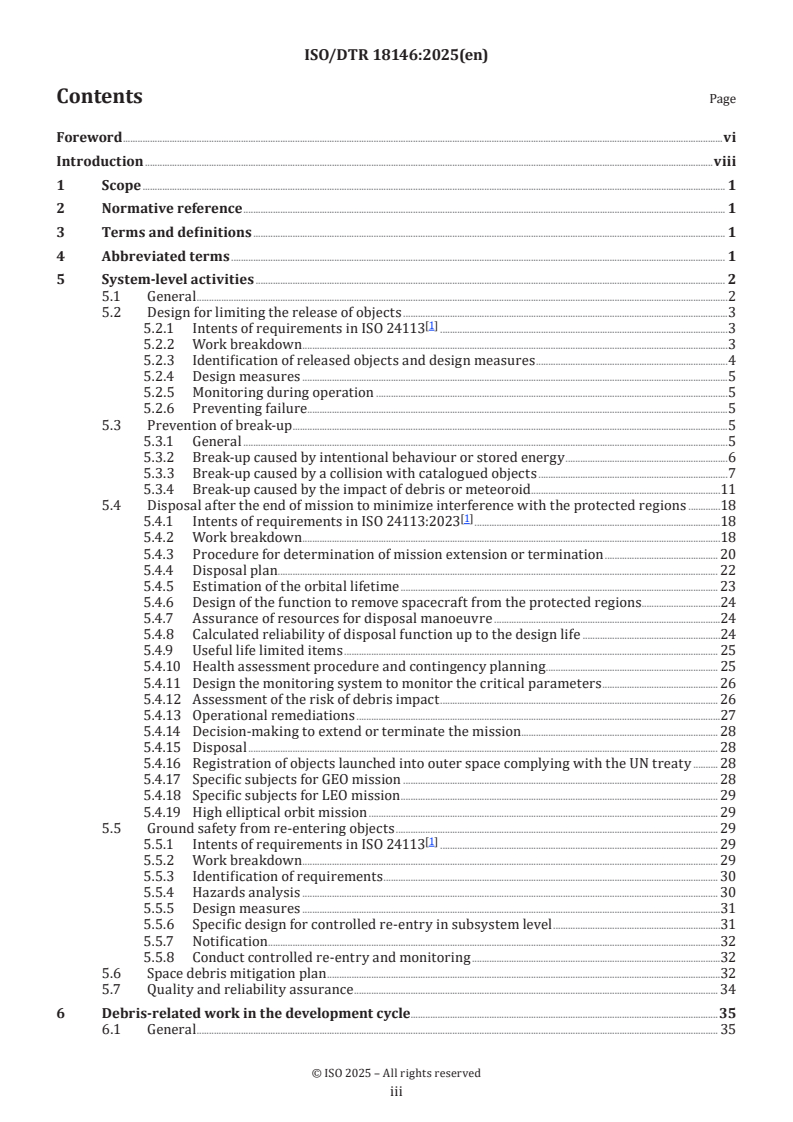
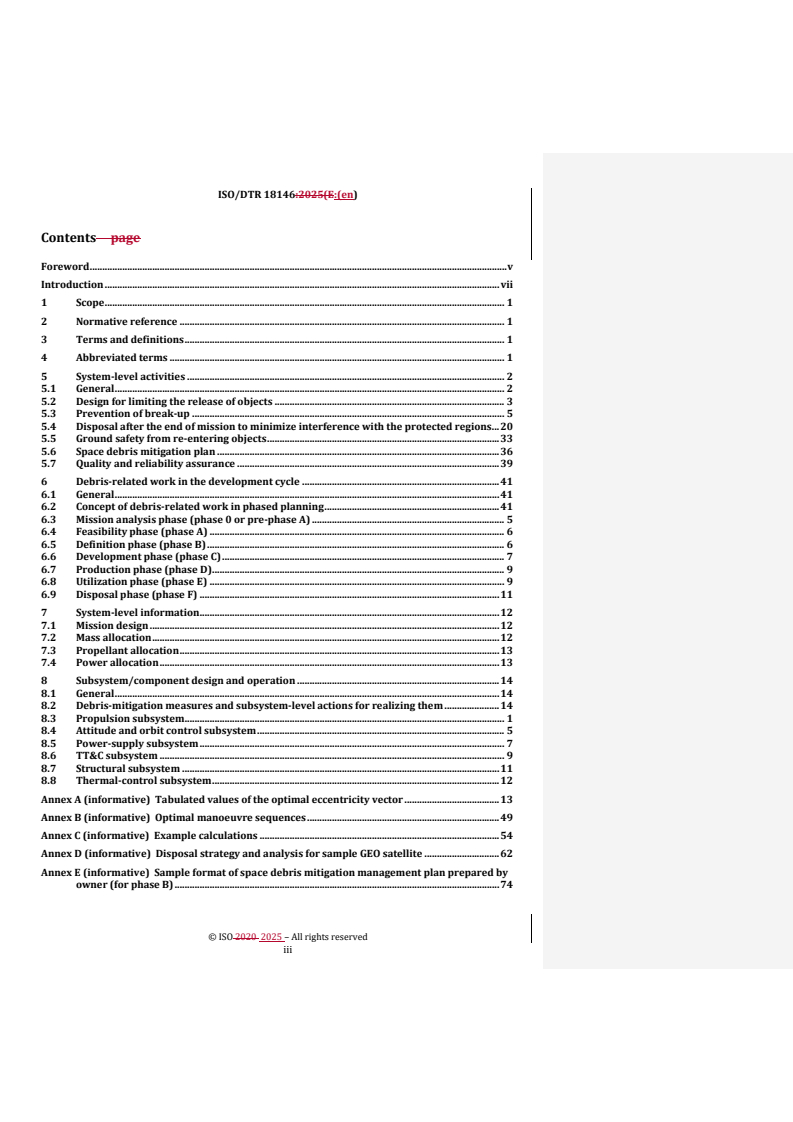
Contents Page
Foreword .vi
Introduction .viii
1 Scope . 1
2 Normative reference . 1
3 Terms and definitions . 1
4 Abbreviated terms . 1
5 System-level activities . 2
5.1 General .2
5.2 Design for limiting the release of objects .3
[1]
5.2.1 Intents of requirements in ISO 24113 .3
5.2.2 Work breakdown . .3
5.2.3 Identification of released objects and design measures .4
5.2.4 Design measures .5
5.2.5 Monitoring during operation .5
5.2.6 Preventing failure.5
5.3 Prevention of break-up .5
5.3.1 General .5
5.3.2 Break-up caused by intentional behaviour or stored energy .6
5.3.3 Break-up caused by a collision with catalogued objects .7
5.3.4 Break-up caused by the impact of debris or meteoroid .11
5.4 Disposal after the end of mission to minimize interference with the protected regions .18
[1]
5.4.1 Intents of requirements in ISO 24113:2023 .18
5.4.2 Work breakdown . .18
5.4.3 Procedure for determination of mission extension or termination . 20
5.4.4 Disposal plan. 22
5.4.5 Estimation of the orbital lifetime . 23
5.4.6 Design of the function to remove spacecraft from the protected regions.24
5.4.7 Assurance of resources for disposal manoeuvre .24
5.4.8 Calculated reliability of disposal function up to the design life .24
5.4.9 Useful life limited items . 25
5.4.10 Health assessment procedure and contingency planning . 25
5.4.11 Design the monitoring system to monitor the critical parameters . 26
5.4.12 Assessment of the risk of debris impact . 26
5.4.13 Operational remediations .27
5.4.14 Decision-making to extend or terminate the mission. 28
5.4.15 Disposal . 28
5.4.16 Registration of objects launched into outer space complying with the UN treaty . 28
5.4.17 Specific subjects for GEO mission . 28
5.4.18 Specific subjects for LEO mission . 29
5.4.19 High elliptical orbit mission . 29
5.5 Ground safety from re-entering objects . 29
[1]
5.5.1 Intents of requirements in ISO 24113 . 29
5.5.2 Work breakdown . . 29
5.5.3 Identification of requirements . 30
5.5.4 Hazards analysis . 30
5.5.5 Design measures .31
5.5.6 Specific design for controlled re-entry in subsystem level .31
5.5.7 Notification .32
5.5.8 Conduct controlled re-entry and monitoring .32
5.6 Space debris mitigation plan .32
5.7 Quality and reliability assurance . 34
6 Debris-related work in the development cycle .35
6.1 General . 35
iii
6.2 Concept of debris-related work in phased planning . 35
6.3 Mission analysis phase (phase 0 or pre-phase A) . 40
6.3.1 General . 40
6.3.2 Debris-related work . 40
6.4 Feasibility phase (phase A) . 40
6.5 Definition phase (phase B) .41
6.5.1 Work in phase B . .41
6.5.2 Work procedure .41
6.6 Development phase (phase C).42
6.6.1 Work in phase C .42
6.6.2 Conditions.43
6.7 Production phase (phase D) .43
6.7.1 Work in phase D .43
6.7.2 Qualification review . 44
6.8 Utilization phase (phase E) . 44
6.8.1 Launch preparation . 44
6.8.2 Lift-off time . 44
6.8.3 Initial operation .45
6.8.4 Normal operation.45
6.8.5 Decision to terminate or extension of operations .45
6.9 Disposal phase (phase F) .45
7 System-level information .46
7.1 Mission design. 46
7.2 Mass allocation .47
7.3 Propellant allocation .47
7.4 Power allocation .47
8 Subsystem/component design and operation .48
8.1 General . 48
8.2 Debris-mitigation measures and subsystem-level actions for realizing them . 48
8.3 Propulsion subsystem . 50
8.3.1 General . 50
8.3.2 Debris-related design . 50
8.3.3 Information of propulsion subsystems . 50
8.3.4 Information in component design .52
8.4 Attitude and orbit control subsystem . 54
8.4.1 Debris-related designs . 54
8.4.2 Information of AOCS . 54
8.4.3 Information of component design . 54
8.5 Power-supply subsystem . 55
8.5.1 Debris-related designs . 55
8.5.2 Information of power-supply subsystems . 56
8.5.3 Information of component design . 56
8.6 TT&C subsystem .57
8.6.1 Debris-related designs .57
8.6.2 Information of TT&C subsystems. 58
8.6.3 Information of component design . 58
8.7 Structural subsystem .59
8.7.1 Debris-related design .59
8.7.2 Information of structural subsystems .59
8.8 Thermal-control subsystem . 60
8.8.1 Debris-related design . 60
8.8.2 Information of thermal-control subsystem . 60
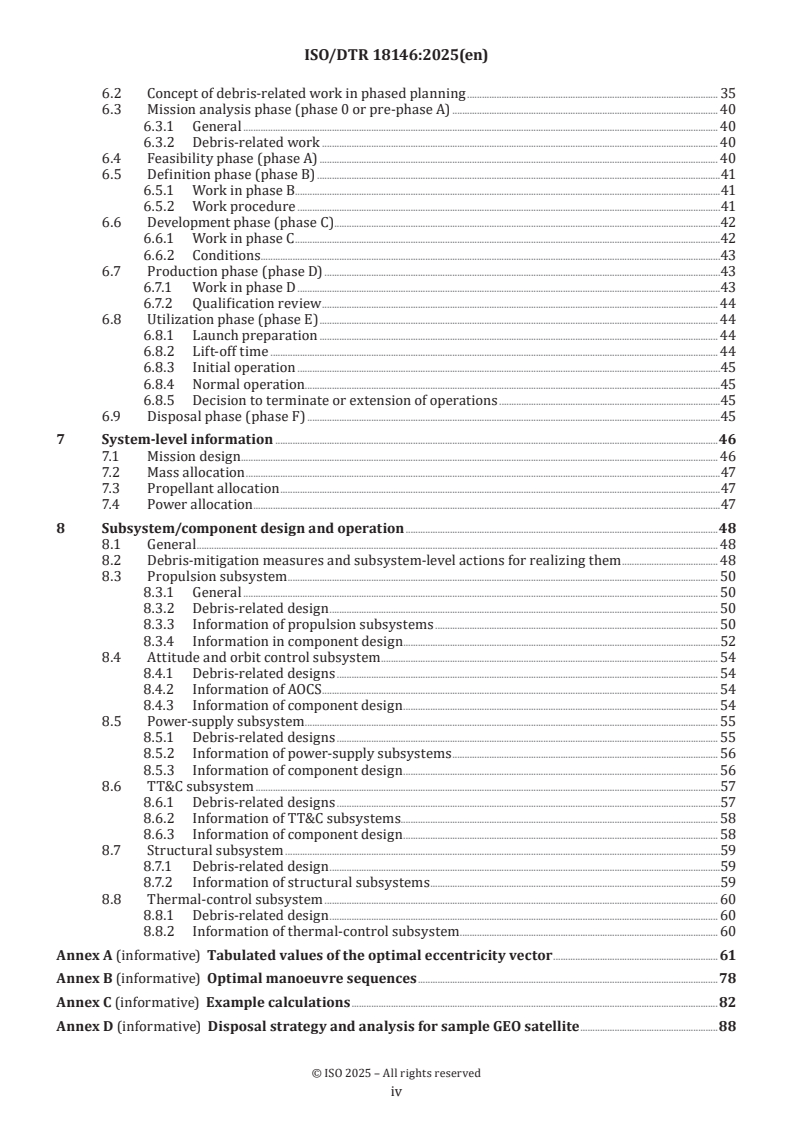
Annex A (informative) Tabulated values of the optimal eccentricity vector . 61
Annex B (informative) Optimal manoeuvre sequences .78
Annex C (informative) Example calculations .82
Annex D (informative) Disposal strategy and analysis for sample GEO satellite .88
iv
Annex E (informative) Sample format of space debris mitigation management plan prepared
by owner (for phase B).95
Annex F (informative) Sample format of space debris mitigation plan prepared by contractor
(for phase C) .103
Bibliography .112
v
Foreword
ISO (the International Organization for Standardization) is a worldwide federation of national standards
bodies (ISO member bodies). The work of preparing International Standards is normally carried out through
ISO technical committees. Each member body interested in a subject for which a technical committee
has been established has the right to be represented on that committee. International organizations,
governmental and non-governmental, in liaison with ISO, also take part in the work. ISO collaborates closely
with the International Electrotechnical Commission (IEC) on all matters of electrotechnical standardization.
The procedures used to develop this document and those intended for its further maintenance are described
in the ISO/IEC Directives, Part 1. In particular, the different approval criteria needed for the different types
of ISO document should be noted. This document was drafted in accordance with the editorial rules of the
ISO/IEC Directives, Part 2 (see www.iso.org/directives).
ISO draws attention to the possibility that the implementation of this document may involve the use of (a)
patent(s). ISO takes no position concerning the evidence, validity or applicability of any claimed patent
rights in respect thereof. As of the date of publication of this document, ISO had not received notice of (a)
patent(s) which may be required to implement this document. However, implementers are cautioned that
this may not represent the latest information, which may be obtained from the patent database available at
www.iso.org/patents. ISO shall not be held responsible for identifying any or all such patent rights.
Any trade name used in this document is information given for the convenience of users and does not
constitute an endorsement.
For an explanation of the voluntary nature of standards, the meaning of ISO specific terms and expressions
related to conformity assessment, as well as information about ISO's adherence to the World Trade
Organization (WTO) principles in the Technical Barriers to Trade (TBT), see www.iso.org/iso/foreword.html.
This document was prepared by Technical Committee ISO/TC 20, Aircraft and space vehicles, Subcommittee
SC 14, Space systems and operations.
This third edition cancels and replaces the second edition (ISO/TR 18146:2020), which has been technically
revised.
The main changes compared to the previous edition are as follows:
[1]
— text has been updated to be aligned with ISO 24113:2023 ;
— ISO 16127 was cancelled and requirements relating to prevention of break-up have been transferred to
[4] [4]
ISO 23312 ; references to ISO 16127 have been replaced by ISO 23312 ;
— ISO 16164 was cancelled and requirements relating to disposal of satellites operating in or crossing
[4]
low Earth orbit have been transferred to ISO 23312 ; references to ISO 16164 have been replaced by
[4]
ISO 23312 ;
— ISO 23339 was cancelled and requirements relating to mass estimation for residual propellant for
[4]
disposal manoeuvres have been transferred to ISO 23312 ; references to ISO 23339 have been replaced
[4]
by ISO 23312 ;
— ISO 26872 was cancelled and requirements relating to disposal of satellites operating at geosynchronous
[4] [4]
altitude have been transferred to ISO 23312 ; references to ISO 26872 have been replaced by ISO 23312
and ISO 26872:2019, Annexes A, B, C and D have been transferred to this document;
— in 5.3.2, the rationale to restrict anti-satellite missile testing as a mean of intentional destruction has
been added;
— in 5.3.4, the methods to assess the probability of break-up caused by impact of debris have been added
[1]
corresponding to the requirement of ISO 24113:2023, 7.3.1.2;
— characteristics of the space debris mitigation plan have been explained in detailed and Annexes E and F
have been added to show the examples;
vi
[1]
— other information relating to the changes in ISO 24113 has been added.
Any feedback or questions on this document should be directed to the user’s national standards body. A
complete listing of these bodies can be found at www.iso.org/members.html.
vii
Introduction
Coping with debris is essential to preventing the deterioration of the orbital environment and ensuring the
sustainability of space activities. Effective actions are also taken to ensure the safety of those on the ground
from re-entering objects that were disposed of from low Earth orbit.
Recently, the orbital environment has become so deteriorated by debris that actions are taken to prevent
damage due to the impact. Collision avoidance manoeuvres are taken to avoid large debris (e.g. larger than
10 cm), which can be observed from the ground. Spacecraft design protects against micro-debris (even
smaller than 1 mm) that can cause critical damage to vulnerable components.
[1]
This document explains the rationale of requirements in ISO 24113 and provides information on the
process or works to conform to those requirements. Clause 5 informs the major space debris mitigation
requirements.
In Clause 6, the information of life-cycle implementation of space debris mitigation related activities is
provided.
In Clause 7, the system level aspects stemming from the space debris mitigation requirements are
highlighted; while in Clause 8, the impacts at subsystem and component levels are detailed.
This document provides comprehensive information on the requirements and recommendations from ISO
documents on the design and operation of the launch vehicles.
viii
FINAL DRAFT Technical Report ISO/DTR 18146:2025(en)
Space systems — Space debris mitigation design and
operation manual for spacecraft
1 Scope
This document contains information on the design and operational practices for launch vehicle orbital stages
for mitigating space debris.
This document provides information to engineers on what are required or recommended in documents on
space debris mitigation developed by ISO/TC 20/SC 14 to reduce the growth of space debris by ensuring that
spacecraft is designed, operated, and disposed of in a manner that prevents them from generating debris
throughout their orbital lifetime.
2 Normative reference
There are no normative references in this document.
3 Terms and definitions
No terms and definitions are listed in this document.
ISO and IEC maintain terminology databases for use in standardization at the following addresses:
— ISO Online browsing platform: available at https:// www .iso .org/ obp
— IEC Electropedia: available at https:// www .electropedia .org/
4 Abbreviated terms
A/M area-to-mass
AOCS attitude and orbit control system
CDR critical design review
CFRP carbon-fibre-reinforced plastic
CNES Centre National d'Etudes Spatiales
CSpOC Combined Space Operations Center (USA)
DAS debris assessment software (NASA)
COTS commercial off-the-shelf
DRAMA debris risk assessment and mitigation analysis (ESA)
ESA European Space Agency
FDIR failure detection, isolation, and recovery
FMEA failure mode and effect analysis
GEO geosynchronous Earth orbit
GPSR global positioning system receiver
IADC Inter-Agency Space Debris Coordination Committee
IRU inertial reference unit
LEO low Earth orbit
MASTER meteoroid and space debris terrestrial environment reference
NOTAM notice to airmen and notice to mariners
OLI operation time limited item
ORDEM orbital debris engineering model
PDR preliminary design review
PNF probability of no failures
QA quality assurance
QR qualification review
RCS reaction control system
SDA Space Data Association
SDR system definition review
SDMP space-debris-mitigation plan
STELA semi-analytic tool for end of life analysis (CNES)
USSTRATCOM United States strategic command
TCBM transparency and confidence building measures
TLE two-line element set
TT&C telemetry tracking and command
UN United Nations
5 System-level activities
5.1 General
To accomplish comprehensive activities for debris mitigation and protection work, the following steps are
considered:
a) identifying debris-related requirements, recommendations, and best practices;
b) determining how to conform to these requirements, recommendations, and best practices;
c) applying those methods early and throughout development and manufacturing to ensure sound debris
mitigation capability in the final product;
d) applying appropriate quality assurance and qualification program to ensure conformity with debris
mitigation requirements;
e) applying appropriate procedures during operation/utilisation and disposal to implement proper space
debris mitigation and protection.
This clause provides information useful for taking comprehensive actions at the system level. More detailed
information for actions at subsystem and component levels is provided in Clause 6. The following specific
subjects are emphasized:
— limiting the release of objects in protected orbital regions;
— preventing fragmentation in orbit (including intentional break-ups, and accidental break-ups caused by
collision with trackable objects, impact of tiny debris, and stored energy);
— proper disposal at the end of operation;
— minimization of hazard on the ground from re-entering debris;
— quality, safety, and reliability assurance.
5.2 Design for limiting the release of objects
[1]
5.2.1 Intents of requirements in ISO 24113
[1]
ISO 24113:2023, 7.1 requires avoiding the intentional release of space debris into Earth orbit during
normal operations, including general objects such as fasteners, fragments from pyrotechnics, slag from solid
rocket motors, etc.
The following objects are of concern from an orbital debris mitigation standpoint:
[1]
a) objects released as directed by mission requirements (not directly indicated in ISO 24113:2023,
7.1.1.1);
[1]
b) mission-related objects, such as fasteners, apogee motor cases (ISO 24113:2023, 7.1.1.1);
[1]
c) fragments and combustion products from pyrotechnic devices (ISO 24113:2023, 7.1.2.1);
[1]
d) slag ejected from solid motors (ISO 24113:2023, 7.1.2.2).
[1]
It implies that if objects are unavoidably released despite requirements in ISO 24113:2023, 7.1.1.1, the
[1]
orbital lifetime of such objects in LEO and interference with GEO is limited as described in ISO 24113:2023,
7.1.1.3.
5.2.2 Work breakdown
Table 1 shows the work breakdown for the actions required to prevent the releasing of debris.
Table 1 — Work breakdown for preventing the release of objects
Process Subjects Major work
Preventive Identification of a) In the mission, which releases objects required by mission objectives,
measures released objects the effect on the orbital environment and the expected benefit for the
and mission are assessed.”
design
b) Taking preventive design to avoid releasing objects turning into space
measures
[1]
debris (ISO 24113:2023, 7.1).
c) If objects might be released unintentionally, designers investigate
design problems and take appropriate action during design phase (e.g.
insulators).
d) If release is unavoidable, designers estimate the orbital lifetime of
[1]
released objects and check conformity with ISO 24113:2023, 7.1.1.3.
e) When applying the solid motors, the possible generation of slag and its
risk posed to space activities are assessed.
Risk detection Monitoring a) Confirming that the orbiting characteristics of released parts are as
during estimated, if needed.
operation
b) If an unexpected object is detected, the origin of the objects is confirmed.
Countermeasures Preventive If an object is released unexpectedly, it is investigated, and appropriate
measures action is taken to avoid repeating the release in the following missions.
5.2.3 Identification of released objects and design measures
The designed parts that are released are identified. Their orbital lifetimes are estimated. The propriety of
their release is determined.
a) Mission requirements that require dispersing objects
Assessing the effects of proposed mission requirements on the environment. If the proposed mission
can deteriorate the environment more than justified by its benefit, system engineering can suggest
alternative approaches.
Examples are:
1) The experiment called “WESTFORD NEEDLES,” conducted in 1961 and 1963, scattered 480 million
needles in orbit. More than 100 clumps of needles have been registered and many of them are still
[2]
in orbit. NASA, JSC, Orbital Debris Quarterly News, Volume 17 reported that :"the legacy of Project
West Ford can still be found in international policies, including the first major United Nations
accord on activities in outer space that calls for international consultations before undertaking
an experiment which might cause potentially harmful interference with activities of other State
Parties in the peaceful exploration and use of outer space."
2) Missions that conduct intentional fragmentation (one of the major causes of deterioration of the
orbital environment).
b) Mission-related objects
Release of the following objects are avoided by appropriate mission and spacecraft design
[1]
(ISO 24113:2023, 7.1.1):
1) fasteners for deploying and holding devices for panels or antennas;
2) nozzle closures and igniters of solid motors;
3) clamp bands that tie spacecraft and launch vehicles (usually as launch vehicle components).
NOTE The structural elements which support upper spacecraft used in the multi-payloads launching
missions can be released due to their unavoidability. Disposal orbits of these elements are in accordance with
[1]
ISO 24113:2023, 7.1.1.2. (These elements usually belong to the launch vehicle, not the spacecraft.)
c) Fragments and combustion products from pyrotechnic devices
Devices are selected and/or designed to avoid the production and release of the fragments of parts or
the combustion by-products. Employing vehicle components that trap all fragments and combustion
[1]
products inside for segregation (ISO 24113:2023, 7.1.2.1).
d) Combustion products from solid motors
Solid motors are designed not to generate slag in both GEO and LEO protected regions (higher than the
[1]
manned orbit, approximately 400 km). (ISO 24113:2023, 7.1.2.2)
5.2.4 Design measures
In general, only devices that do not release parts into the space environment are selected.
CSpOC sometimes detects released cases of the apogee kick motors. The solid motors are not used for the
apogee kick motors if they generate slag. Furthermore, it is refrained from disposing the motor cases into
the orbit crossing the GEO protected region.
If parts would be released due to unavoidable reasons, the orbital lifetime of the parts and the risk of impact
[3]
on another spacecraft are assessed. The orbital lifetime can be assessed according to ISO 27852 , which
does not designate a specific analysis tool but rather expects that the users employ their reliable techniques
[3]
depending upon orbit regime, so that designers can select any tool(s) which adhere to ISO 27852 approved
techniques. Available simplified tools that can be used to estimate the long term orbital lifetime are, for
instance: NASA DAS (https:// orbitaldebris .jsc .nasa .gov/ mitigation/ debris -assessment -software .html), ESA
DRAMA (after creating an account at https:// sdup .esoc .esa .int/ one can obtain a license before downloading),
or CNES STELA (https:// www .connectbycnes .fr/ stela).
5.2.5 Monitoring during operation
The released objects, if they are larger than 10 cm, are confirmed with ground-based space tracking facilities
to ensure that they are released as expected and that their orbital lifetimes are sufficiently short. The space
situation report provided by the CSpOC provides a good reference.
5.2.6 Preventing failure
If objects are released unexpectedly, the origin of the objects can be identified to help prevent recurrence
in future missions. Because such phenomena can indicate a malfunction, the situation is reviewed carefully,
and appropriate action taken to prevent further abnormal conditions.
5.3 Prevention of break-up
5.3.1 General
[1]
ISO 24113:2023, 7.2 requires the prevention of break-ups caused by intentional behaviour, stored energy,
collision with catalogued objects, and impact of debris or meteoroid. In 5.3.2, the first two subjects are
discussed. The collision with catalogued objects is addressed in 5.3.3; and the impact of debris and meteoroid
in 5.3.4.
[4]
ISO 23312:2022, 6.2 provides detailed requirements and procedures.
5.3.2 Break-up caused by intentional behaviour or stored energy
5.3.2.1 Work breakdown for preventing orbital break-up caused by intentional behaviour or
stored energy
Table 2 shows the work breakdown for preventing orbital break-up caused by intentional behaviour or
stored energy.
Table 2 — Work breakdown for preventing orbital break-ups caused by intentional behaviour or
stored energy
Process Subjects Major work
Preventive Mission Mission which involves the intentional break-up is assessed to justify its
measures assessment intention is essential for peaceful use of space, and its effect on the envi-
ronment can be controllable.
However, according to the resolution of G7 2023 held in Hiroshima, it is
recognised that destructive direct-ascent anti-satellite missile testing can
be refrained in terms of preservation of orbital environment and TCBM.
Identification of Identifying components that can cause fragmentation during or after oper-
sources of breakup ation.
Design a) Missions that involve intentional break-ups are not designed.
measures
b) Taking preventive design to limit the probability of accidental break-
up. Confirm it in FMEA.
c) Providing functions for to prevent break-ups after disposal.
Risk detection Monitoring a) Providing functions to monitor symptoms of break-up.
during
b) Monitoring the critical parameters periodically.
operation
c) Taking immediate actions if the symptom of a malfunction that can
lead to a breakup is detected.
Countermeasures Preventive meas- Performing the disposal operations to eliminate the risk of break-ups.
ures for break-up
5.3.2.2 Identification of the sources of break-up
[4]
For post-operation break-ups, ISO 23312:2022 .6.2.2, identifies the following components as the most likely
causes of the break-up of spacecraft:
a) batteries in the electrical subsystem;
b) propulsion mechanisms and associated components (such as engines, thrusters);
c) pressurized components (such as tanks or bottles in the propulsion subsystems, or pneumatic control
system, and heat pipes);
d) rotating mechanisms.
5.3.2.3 Design measures
a) Intentional break-up
Missions that involve intentional break-ups are prohibited if the fragments would be ejected outer space.
This includes attacks from the ground or airplane as well as self-destruction in orbit. For the case that
there would be justification to conduct intentional destruction to improve ground safety, IADC Space
[5]
Debris Mitigation Guidelines state that it is conducted at sufficiently low altitudes so that orbital
fragments are short-lived.
However, it is recognised that the Leaders of the Group of Seven (G7), met in Hiroshima for annual
Summit on May 19- 21, 2023, agreed to commit not to conducting destructive direct-ascent anti-satellite
missile testing and encourage others to follow suit.
b) Accidental break-up during operation
[1] –3
According to ISO 24113:2023 ,7.2.2.1, the probability of accidental break-up is no greater than 10
until its end of life. The causes of break-ups are identified in FMEA, and preventive measures are
incorporated in the design. Causes of break-ups are typically controlled by FDIR concept in system-
[4]
safety management. More detailed assessment procedures are presented in ISO 23312:2022, Annex A.
For engineers wondering how to cope with rotating mechanism or complicated subsystems such as
[4]
apogee engines, ISO 23312:2022, Annex A provides the instructions.
NOTE Quality and reliability management are emphasized, as well as design for debris mitigation.
c) Break-ups that occur after the end of operation
Many break-ups have occurred long after the end of operation life (e.g. 10 years after disposal). 5.3.2
shows the concept for preventive works in design and operation, and Clause 8 in
...
ISO TC20/SC14/WG7/TC 20/SC 14
Date: 2024-12-09
Secretariat: ANSI/AIAA
Date: 2025-04-04
Space systems — Space debris mitigation design and operation
manual for spacecraft
Systèmes spatiaux — Conception de réduction des débris spatiaux et manuel d’utilisation pour les engins
spatiaux
All rights reserved. Unless otherwise specified, or required in the context of its implementation, no part of this publication
may be reproduced or utilized otherwise in any form or by any means, electronic or mechanical, including photocopying,
or posting on the internet or an intranet, without prior written permission. Permission can be requested from either ISO
at the address below or ISO’s member body in the country of the requester.
ISO copyright office
CP 401 • Ch. de Blandonnet 8
CH-1214 Vernier, Geneva
Phone: + 41 22 749 01 11
E-mail: copyright@iso.org
Website: www.iso.orgDraft Edition 3
Published in Switzerland
Contents page
Foreword . v
Introduction . vii
1 Scope . 1
2 Normative reference . 1
3 Terms and definitions . 1
4 Abbreviated terms . 1
5 System-level activities . 2
5.1 General . 2
5.2 Design for limiting the release of objects . 3
5.3 Prevention of break-up . 5
5.4 Disposal after the end of mission to minimize interference with the protected regions . 20
5.5 Ground safety from re-entering objects . 33
5.6 Space debris mitigation plan . 36
5.7 Quality and reliability assurance . 39
6 Debris-related work in the development cycle . 41
6.1 General . 41
6.2 Concept of debris-related work in phased planning . 41
6.3 Mission analysis phase (phase 0 or pre-phase A) . 5
6.4 Feasibility phase (phase A) . 6
6.5 Definition phase (phase B) . 6
6.6 Development phase (phase C) . 7
6.7 Production phase (phase D) . 9
6.8 Utilization phase (phase E) . 9
6.9 Disposal phase (phase F) . 11
7 System-level information . 12
7.1 Mission design . 12
7.2 Mass allocation . 12
7.3 Propellant allocation . 13
7.4 Power allocation . 13
8 Subsystem/component design and operation . 14
8.1 General . 14
8.2 Debris-mitigation measures and subsystem-level actions for realizing them . 14
8.3 Propulsion subsystem . 1
8.4 Attitude and orbit control subsystem . 5
8.5 Power-supply subsystem . 7
8.6 TT&C subsystem . 9
8.7 Structural subsystem . 11
8.8 Thermal-control subsystem . 12
Annex A (informative) Tabulated values of the optimal eccentricity vector . 13
Annex B (informative) Optimal manoeuvre sequences . 49
Annex C (informative) Example calculations . 54
Annex D (informative) Disposal strategy and analysis for sample GEO satellite . 62
Annex E (informative) Sample format of space debris mitigation management plan prepared by
owner (for phase B) . 74
iii
Annex F (informative) Sample format of space debris mitigation plan prepared by contractor
(for phase C) . 84
Bibliography . 95
iv
Foreword
ISO (the International Organization for Standardization) is a worldwide federation of national standards
bodies (ISO member bodies). The work of preparing International Standards is normally carried out through
ISO technical committees. Each member body interested in a subject for which a technical committee has been
established has the right to be represented on that committee. International organizations, governmental and
non-governmental, in liaison with ISO, also take part in the work. ISO collaborates closely with the
International Electrotechnical Commission (IEC) on all matters of electrotechnical standardization.
The procedures used to develop this document and those intended for its further maintenance are described
in the ISO/IEC Directives, Part 1. In particular, the different approval criteria needed for the different types of
ISO documentsdocument should be noted. This document was drafted in accordance with the editorial rules
of the ISO/IEC Directives, Part 2 (see www.iso.org/directives).
Attention is drawnISO draws attention to the possibility that some of the elementsimplementation of this
document may beinvolve the subjectuse of (a) patent(s). ISO takes no position concerning the evidence,
validity or applicability of any claimed patent rights in respect thereof. As of the date of publication of this
document, ISO had not received notice of (a) patent(s) which may be required to implement this document.
However, implementers are cautioned that this may not represent the latest information, which may be
obtained from the patent database available at www.iso.org/patents. ISO shall not be held responsible for
identifying any or all such patent rights. Details of any patent rights identified during the development of the
document are in the Introduction and/or on the ISO list of patent declarations received (see ).
Any trade name used in this document is information given for the convenience of users and does not
constitute an endorsement.
For an explanation of the voluntary nature of standards, the meaning of ISO specific terms and expressions
related to conformity assessment, as well as information about ISO's adherence to the World Trade
Organization (WTO) principles in the Technical Barriers to Trade (TBT), see www.iso.org/iso/foreword.html.
This document was prepared by Technical Committee ISO/TC 20, Aircraft and space vehicles, Subcommittee
SC 14, Space systems and operations.
This third edition cancels and replaces the second edition (ISO/TR 18146:2020), which has been technically
revised.
The main changes compared to the previous edition are as follows:
[ [1] ]
— — text has been updated to be aligned with ISO 24113:2023 1 ; ;
— — ISO 16127 was cancelled and requirements relating to prevention of break-up have been transferred
[ [4] ] [
to ISO 23312 4ISO23312 . So that ; references to ISO 16127 hashave been replaced by ISO 23312 4to
[4] ]
ISO23312 in this document. ;
— — ISO 16164 was cancelled and requirements relating to disposal of satellites operating in or crossing
[ [4] ]
Lowlow Earth Orbitorbit have been transferred to ISO 23312 4ISO23312 . So that ; references to ISO
[ [4] ]
16164 hashave been replaced by ISO 23312 4to ISO23312 in this document. ;
— — ISO 23339 was cancelled and requirements relating to mass estimation for residual propellant for
[ [4] ]
disposal manoeuvres have been transferred to ISO 23312 4ISO23312 . So that ; references to ISO 23339
[ [4] ]
hashave been replaced by ISO 23312 4to ISO23312 in this document. ;
— — ISO 26872 was cancelled and requirements relating to disposal of satellites operating at
[4] [ ]
geosynchronous altitude have been transferred to ISO23312 . So that ISO 23312 4 ; references to ISO
v
[ [4]]
26872 hashave been replaced toby ISO 23312 4 and appendixISO 26872:2019, Annexes A, B, C and D of
ISO 26872 have been transferred to this document,;
— — in 5.3.2sub-clause 5.3.2,, the rationale to restrict anti-satellite missile testing as a mean of intentional
destruction has been added,;
— — in 5.3.4sub-clause 5.3.4,, the methods to assess the probability of break-up caused by impact of debris
[ [1] ]
hashave been added corresponding to the requirement of ISO 24113:2023, 1 , 7.3.1.2,;
— — characteristics of Space Debris Mitigation Plan hasthe space debris mitigation plan have been explained
in detailed and Annexes EAppendix E and FF have been added to show the examples.;
[ [1]]
— — other information relating to the changes in ISO 24113 1 has been added.
Any feedback or questions on this document should be directed to the user’s national standards body. A
complete listing of these bodies can be found at www.iso.org/members.html.
vi
Introduction
Coping with debris is essential to preventing the deterioration of the orbital environment and ensuring the
sustainability of space activities. Effective actions are also taken to ensure the safety of those on the ground
from re-entering objects that were disposed of from low -Earth orbit.
Recently, the orbital environment has become so deteriorated by debris that action isactions are taken to
prevent damage due to the impact. Collision avoidance manoeuvres are taken to avoid large debris (e.g. larger
than 10 cm, for example), which can be observed from the ground. Spacecraft design protects against micro-
debris (even smaller than 1 mm) that can cause critical damage to vulnerable components.
[
This TR was designed to explaindocument explains the rationale of requirements in ISO 24113 1of
[1]]
ISO24113 and provideprovides information ofon the process or works to comply withconform to those
requirements. Clause 5 In Clause 5, informs the major space debris mitigation requirements are informed.
In Clause 6Clause 6,, the information of life-cycle implementation of space debris mitigation related activities
is provided.
In Clause 7Clause 7,, the system level aspects stemming from the space debris mitigation requirements are
highlighted; while in Clause 8Clause 8,, the impacts at subsystem and component levels are detailed.
This document provides comprehensive information on what ISO requires to do forthe requirements and
recommendations from ISO documents on the design and operation of the launch vehicles, and where such
requirements and recommendations are registered in a set of ISO documents.
vii
Space systems — Design — Space debris mitigation design and
operation manual for spacecraft
1 Scope
This document contains information on the design and operational practices for launch vehicle orbital stages
for mitigating space debris.
This document provides information to engineers on what are required or recommended in the family
ofdocuments on space debris mitigation standardsdeveloped by ISO/TC 20/SC 14 to reduce the growth of
space debris by ensuring that spacecraft is designed, operated, and disposed of in a manner that prevents them
from generating debris throughout their orbital lifetime.
2 Normative reference
There are no normative references in this document.
3 Terms and definitions
No terms and definitions are listed in this document.
ISO and IEC maintain terminologicalterminology databases for use in standardization at the following
addresses:
— — ISO Online browsing platform: available at https://www.iso.org/obp
— — IEC Electropedia: available at https://www.electropedia.org/
4 Symbols and abbreviatedAbbreviated terms
A/M area-to-mass
AOCS attitude and orbit control system
CDR critical design review
CFRP carbon-fibre-reinforced plastic
CNES Centre National d'Etudes Spatiales
CSpOC Combined Space Operations Center (USA)
DAS debris assessment software (NASA)
COTS commercial off-the-shelf
DRAMA debris risk assessment and mitigation analysis (ESA)
EOMDP end-of-mission (operation) disposal plan
ESA European Space Agency
FDIR failure detection, isolation, and recovery
FMEA failure mode and effect analysis
GEO geosynchronous Earth orbit
GPSR global positioning system receiver
IADC Inter-Agency Space Debris Coordination Committee
IRU inertial reference unit
LEO low Earth orbit
MASTER meteoroid and space debris terrestrial environment reference
MIDAS MASTER (-based) impact flux and damage assessment software
NOTAM notice to airmen and notice to mariners
OLI operation time limited item
ORDEM orbital debris engineering model
PDR preliminary design review
PNF probability of no failures
QA quality assurance
QR qualification review
RCS reaction control system
SDA Space Data Association
SDR system definition review
SDMP space-debris-mitigation plan
STELA semi-analytic tool for end of life analysis (CNES)
USSTRATCOM United States strategic command
Transparency and Confidence Building Measurestransparency and confidence building
TCBM
measures
TLE two-line element set
TT&C telemetry tracking and command
UN United Nations
5 System-level activities
5.1 General
To accomplish comprehensive activities for debris mitigation and protection work, the following steps are
considered:
a) a) identifying debris-related requirements, recommendations, and best practices.;
b) b) determining how to comply withconform to these requirements, recommendations, and best
practices.;
c) c) Applyingapplying those methods early and throughout development and manufacturing to ensure
sound debris mitigation capability in the final product.;
d) d) Applyingapplying appropriate quality assurance and qualification program to ensure
complianceconformity with debris mitigation requirements;
e) e) Applyingapplying appropriate procedures during operation/utilisation and disposal to implement
proper space debris mitigation and protection.
This subclauseclause provides information useful for taking comprehensive actionactions at the system level.
More detailed information for action ofactions at subsystem and component levels is provided in
Clause 6Clause 6. The following specific subjects are emphasized:
— — limiting the release of objects in protected orbital regions;
— — preventing fragmentation in orbit (including intentional break-ups, and accidental break-ups caused
by collision with trackable objects, impact of tiny debris, and stored energy);
— — proper disposal at the end of operation;
— — minimization of hazard on the ground from re-entering debris;
— — quality, safety, and reliability assurance.
5.2 Design for limiting the release of objects
[ [1] ]
5.2.1 Intents of requirements in ISO 24113 1
[ [1] ]
ISO 24113:2023, 1 , 7.1 requires avoiding the intentional release of space debris into Earth orbit during
normal operations, including general objects such as fasteners, fragments from pyrotechnics, slag from solid
rocket motors, etc.
The following objects are of concern from an orbital debris mitigation standpoint:
a) a) objects released as directed by mission requirements (not directorydirectly indicated in
[ [1] ]
ISO 24113:2023, 1 , 7.1.1.1, though);
[ [1] ]
b) b) mission-related objects, such as fasteners, apogee motor cases, etc. (ISO 24113:2023, 1 , 7.1.1.1);
[ [1] ]
c) c) fragments and combustion products from pyrotechnic devices (ISO 24113:2023, 1 , 7.1.2.1);
[ [1] ]
d) d) slag ejected from solid motors (ISO 24113:2023, 1 , 7.1.2.2).
[ [1] ]
It implies that if objects are unavoidably released despite requirements in ISO 24113:2023, 1 , 7.1.1.1, the
orbital lifetime of such objects in LEO and interference with GEO is limited as described in
[ [1] ]
ISO 24113:2023, 1 , 7.1.1.3.
5.2.2 5.2.2 Work breakdown
Table 1Table 1 shows the work breakdown for the actions required to prevent the releasing of debris.
Table 1 — Work breakdown for preventing the release of objects
Process Subjects Major work
a) a) In the mission, which releases objects required by mission
Preventive Identification
objectives, the effect on the orbital environment and the expected
measures of released
benefit for the mission are assessed.”
objects and
design
b) b) Taking preventive design to avoid releasing objects turning into
measures
[ [1] ]
space debris (ISO 24113:2023, 1 , 7.1).
c) c) If objects might be released unintentionally, designers investigate
design problems and take appropriate action during design phase (e.g.
insulators).
Process Subjects Major work
d) d) If release is unavoidable, designers estimate the orbital lifetime of
released objects and check complianceconformity with
[ [1] ]
ISO 24113:2023, 1 , 7.1.1.3.
e) e) When applying the solid motors, the possible generation of slag and
its risk posed to space activities are assessed.
a) a) Confirming that the orbiting characteristics of released parts are as
Risk detection Monitoring
estimated, if needed.
during
operation
b) b) If an unexpected object is detected, the origin of the objects is
confirmed.
Countermeasures Preventive If an object is released unexpectedly, it is investigated, and appropriate
measures action is taken to avoid repeating the release in the following missions.
5.2.3 Identification of released objects and design measures
The designed parts that are released are identified. Their orbital lifetimes are estimated. The propriety of their
release is determined.
a) a) Mission requirements that require dispersing objects
AssessAssessing the effects of proposed mission requirements on the environment. If the proposed
mission can deteriorate the environment more than justified by its benefit, system engineering can
suggest alternative approaches.
Examples are:
1) 1) The experiment called “WESTFORD NEEDLES,” conducted in 1961 and 1963, scattered 480
million needles in orbit. More than 100 clumps of needles have been registered and many of them are
[ [2]]
still in orbit. NASA, JSC, Orbital Debris Quarterly News, Volume 17 2 reported that :"the legacy of
Project West Ford can still be found in international policies, including the first major United Nations
accord on activities in outer space that calls for international consultations before undertaking an
experiment which might cause “potentially harmful interference with activities of other State Parties
in the peaceful exploration and use of outer space."
2) 2) Missions that conduct intentional fragmentation (one of the major causes of deterioration of
the orbital environment).
b) b) Mission-related objects
Release of the following objects are avoided by appropriate mission and spacecraft design
[ [1] ]
(ISO 24113:2023, 1 , 7.1.1):
1) 1) fasteners for deploying and holding devices for panels or antennas;
2) 2) nozzle closures and igniters of solid motors;
3) 3) clamp bands that tie spacecraft and launch vehicles (usually as launch vehicle components).
NOTE The structural elements which support upper spacecraft used in the multi-payloads launching missions
can be released due to their unavoidability. Disposal orbits of these elements are compliedin accordance with
[ [1] ]
ISO 24113:2023, 1 , 7.1.1.2. (These elements usually belong to the launch vehicle, not the spacecraft.)
c) c) Fragments and combustion products from pyrotechnic devices
Devices are selected and/or designed to avoid the production and release of the fragments of parts or the
combustion by-products. Employing vehicle components that trap all fragments and combustion products
[ [1] ]
inside for segregation (ISO 24113:2023, 1 , 7.1.2.1).
d) d) Combustion products from solid motors
Solid motors are designed not to generate slag in both GEO and LEO protected regions (higher than the
[ [1] ]
manned orbit [≒, approximately 400 km]).). (ISO 24113:2023, 1 , 7.1.2.2)
5.2.4 Design measures
In general, only devices that do not release parts into the space environment are selected.
CSpOC sometimes detects released cases of the apogee kick motors. The solid motors are not used for the
apogee kick motors if they generate slag. Furthermore, it is refrained from disposing the motor cases into the
orbit crossing the GEO protected region.
If parts would be released due to unavoidable reasons, the orbital lifetime of the parts and the risk of impact
[ [3] ]
on another spacecraft are assessed. The orbital lifetime can be assessed according to ISO 27852 3 . , which
does not designate a specific analysis tool but rather expects that the users employ their reliable techniques
[ [3]]
depending upon orbit regime, so that designers can select any tool(s) which adhere to ISO 27852 3
approved techniques. Available simplified tools that can be used to estimate the long term orbital lifetime are,
for instance: NASA DAS (https://orbitaldebris.jsc.nasa.gov/mitigation/debris-assessment-software.html),
ESA DRAMA (after creating an account at https://sdup.esoc.esa.int/ one can obtain a license before
downloading), or CNES STELA (https://www.connectbycnes.fr/stela).
5.2.5 Monitoring during operation
The released objects, if they are larger than 10 cm, are confirmed with ground-based space tracking facilities
to ensure that they are released as expected and that their orbital lifetimes are sufficiently short. The space
situation report provided by the CSpOC provides a good reference.
5.2.6 Preventing failure
If objects are released unexpectedly, the origin of the objects can be identified to help prevent recurrence in
future missions. Because such phenomena can indicate a malfunction, the situation is reviewed carefully, and
appropriate action taken to prevent further abnormal conditions.
5.3 Prevention of break-up
5.3.1 General
[ [1] ]
ISO 24113:2023, 1 , 7.2 requires the prevention of break-ups caused by intentional behaviour, stored
energy, collision with catalogued objects, and impact of debris or meteoroid. In 5.3.25.3.2,, the first two
subjects are discussed. The collision with catalogued objects is addressed in 5.3.35.3.3,; and the impact of
debris and meteoroid in 5.3.45.3.4.
[ [4] ]
ISO 23312:2022, 4 , 6.2 provides more detailed requirements and procedures for complying with them.
5.3.2 5.3.2 Break-up caused by intentional behaviour, or stored energy
5.3.2.1 Work breakdown for preventing orbital break-up caused by intentional behaviour, or
stored energy
Table 2Table 2 shows the work breakdown for preventing orbital break-up caused by intentional behaviour,
or stored energy.
Table 2 — Work breakdown for preventing orbital break-ups caused by intentional behaviour, or
stored energy
Process Subjects Major work
Preventive Mission Mission which involves the intentional break-up is assessed to justify its
measures assessment intention is essential for peaceful use of space, and its effect on the
environment can be controllable.
However, according to the resolution of G7 2023 held in Hiroshima, it is
recognised that destructive direct-ascent anti-satellite missile testing can
be refrained in terms of preservation of orbital environment and TCBM.
Identification of Identifying components that can cause fragmentation during or after
sources of operation.
breakup
a) a) Missions that involve intentional break-ups are not designed.
Design
measures
b) b) Taking preventive design to limit the probability of accidental
break-up. Confirm it in FMEA.
c) c) Providing functions for to prevent break-ups after disposal.
a) a) Providing functions to monitor symptoms of break-up.
Risk detection Monitoring
during
b) b) Monitoring the critical parameters periodically.
operation
c) c) Taking immediate actions if the symptom of a malfunction that can
lead to a breakup is detected.
Countermeasures Preventive Performing the disposal operations to eliminate the risk of break-ups.
measures for
break-up
5.3.2.2 Identification of the sources of break-up
[ [4] ]
For post-operation break-ups, ISO 23312:2022 4 . .6.2.2, identifies the following components as the most
likely causes of the break-up of spacecraft:
a) a) batteries in the electrical subsystem;
b) b) propulsion mechanisms and associated components (such as engines, thrusters, etc.););
c) c) pressurized components (such as tanks or bottles in the propulsion subsystems, or pneumatic control
system, and heat pipes);
d) d) rotating mechanisms.
5.3.2.3 Design measures
a) a) Intentional break-up
Missions that involve intentional break-ups are prohibited if the fragments would be ejected outer space.
This includes attacks from the ground or airplane as well as self-destruction in orbit. For the case that
there would be justification to conduct intentional destruction to improve ground safety, IADC Space
[ [5]]
Debris Mitigation Guidelines 5 state that it is conducted at sufficiently low altitudes so that orbital
fragments are short-lived.
However, it is recognised that the Leaders of the Group of Seven (G7), met in Hiroshima for annual Summit
on May 19- 21, 2023, agreed to commit not to conducting destructive direct-ascent anti-satellite missile
testing and encourage others to follow suit.
b) b) Accidental break-up during operation
[ [1] ] –3
According to ISO 24113:2023 1 , ,7.2.2.1, the probability of accidental break-up is no greater than 10
until its end of life. The causes of break-ups are identified in FMEA, and preventive measures are
incorporated in the design. Causes of break-ups are typically controlled by FDIR concept in system-safety
[ [4] ]
management. More detailed assessment procedures are presented in ISO 23312:2022, 4 , Annex A. For
engineers wondering how to cope with rotating mechanism or complicated subsystems such as apogee
[ [4] ]
engines, ISO 23312:2022, 4 , Annex A provides good instructionthe instructions.
Note that qualityNOTE Quality and reliability management are emphasized, as well as design for debris
mitigation.
c) c) Break-ups that occur after the end of operation
Many break-ups have occurred long after the end of operation life (e.g. 10 years after disposal). 5.3.2Sub-
clause 5.3.2 shows the concept for preventive works in design and operation, and Clause 8clause 8
introduces the preventive design for each sub-system. The key points are to provide venting mechanisms
for residual fluids and shut-off functions for charging lines for battery-cells, etc. Historically, for example,
separating propellant tank design combined fuel and oxygen tanks only by a common bulkhead in a way
caused many explosions.
5.3.2.4 Monitoring during operations
[ [1] ] [ [4] ]
ISO 24113:2023, 1 , 7.2.2.3 and ISO 23312:2022, 4 , 6.2.1.2requires2 require monitoring of critical
parameters to detect the symptoms that can lead to a) :
a) break-up, b) ;
a)b) loss of mission capability,; or
c) c) the loss of orbit and attitude control function and requires.
They also require immediate action when any symptoms are detected.
To prevent the occurrence of a break-up, a detection mechanism and operation procedures are designed to
monitor and facilitate immediate mitigation once any possible detection of malfunction is observed to prevent
break-ups.
5.3.2.5 Disposal operations
Sources of break-ups listed in 5.3.2.25.3.2.2 are mitigated (vented or operated in safe mode) according to
[ [4] ]
ISO 23312:2022, 4 , 6.2.2.2.
5.3.3 Break-up caused by a collision with catalogued objects
[ [1]]
5.3.3.1 Intents or requirements in ISO 24113 1
[ [1] ]
ISO 24113:2023, 1 , 7.2.3.1 to 7.2.3.3 require collision avoidance to prevent from generating fragments.
[ [1] ]
(Fragmentation caused by impact with orbital objects is mentioned in ISO 24113:2023, 1 , 7.2.3.4 and
explained in 5.3.45.3.4.).)
Collision with a large object (observable from the ground; typically, larger than approximately 10 cm) causes
critical damage to spacecraft and poses significant risk to other intact spacecraft when thousands of fragments
are dispersed within a range of a thousand of kilometres. Therefore, the UN Space Debris Mitigation Guidelines
[ [6]] [ [7]]
6 recommend conducting the collision avoidance. ISO/TR 16158 7 addresses best practices to evaluate
and avoid collisions among orbital objects.
NOTE To conduct collision avoidance, space operators need a propulsion system (such as actuators in AOCS),
technology for conjunction assessment, and the capability to conduct avoidance and returning manoeuvres. Each
operator defines its philosophy, policy, and strategy for collision avoidance. The philosophy for collision avoidance,
including the following, is described in the system specification to avoid the risk of insufficient propellant or manoeuvre
function when needed.
a) a) a basic concept for collision avoidance (determination of allowable criteria for collision probability, apply
functions in design to avoid collision, prepare propellant for avoidance manoeuvre, etc.);
b) b) collision detection measures (including self-analysis, or analysis performed by external collision service
providers at present they are, for example, CSpOC, the Space Data Association, etc.)
https://www.space-data.org/sda/;);
c) c) criteria for notification (conjunction distance, probability of collision, etc.);
d) d) criteria for conducting avoidance manoeuvres (conjunction distance, features of approaching objects, etc.);
e) e) method of estimating the number of manoeuvres, amount of propellant for avoidance and returning
manoeuvres, and how to ensure the propellant;
f) f) a sequence for avoidance and returning manoeuvre (methods of avoidance, concepts for avoidance by altitude
change or phase shift);
g) g) how to access contact points to plan coordinated avoidance manoeuvres, data exchanging rules, etc.
5.3.3.2 General information
[ [7]]
ISO/TR 16158 7 describes the workflow for perceiving and avoiding collisions among orbiting objects, the
data requirements for these tasks, the techniques that can be used to estimate the probability of collision, and
guidance for executing avoidance manoeuvres.
5.3.3.31.1.1.1 Work breakdown
5.3.3.3 Table 3Work breakdown
Table 3 shows the work breakdown for avoiding collisions with catalogued objects.
Table 3 — Work breakdown for avoiding collision with catalogued objects
Process Subjects Major work
Preventive Estimation of Estimating collision probability by debris population models.
measures probability
Process Subjects Major work
a) a) If the collision probability cannot be ignored, the function to avoid
Design measures
collision is incorporated in design.
b) b) Defining the criteria of decision-making for avoidance and estimate the
expected number of collision avoidance manoeuvres during mission
operations. It is reflected in the design of the mass of propellant.
Standardize the The criteria of collision avoidance and the standard procedure for collision
procedures avoidance is documented.
a) a) If warning of close approach comes from USSTRATCOM/CSpOC, check
Risk Receipt of warning
the conjunction risk and identify the approaching object in detail.
detection from the collision
Reconfirm that the up-to-date, authoritative orbit ephemerides are
avoidance services
provided to CSpOC for re-analysis.
b) b) Operators can also use commercial services (e.g. the Space Data
Association’s conjunction assessment process) or one provided by other
agencies.
c) c) Determining the necessity of collision avoidance based on the result of
re-analysis conducted by collision avoidance service and, if possible, by
internal analysis.
Internal If the operators have their own observation data and conjunction analysis
detection of risk systems, they can be capable of performing their own analysis.
a) a) Deciding to conduct avoidance manoeuvres, if necessary.
Countermea Avoidance and
sures returning
b) b) Ahead of time, developing an avoidance manoeuvre plan (include
manoeuvres
return plan, if needed).
c) c) Communicate avoidance manoeuvre plan to collision avoidance service
and if any to the operator of the approaching spacecraft.
d) d) Developing the avoidance manoeuvre plan (include returning
manoeuvre, if needed) coordinating with them.
e) e) Confirming conjunction probability during avoidance and returning
manoeuvres.
f) f) Executing avoidance and returning manoeuvres.
5.3.3.4 5.3.3.4 Estimation of collision probability
Collision probability can be roughly estimated using the following databases and models:
a) a) information on in-orbit objects from the "Space-Track" website posted by the United States
(https://www.space-track.org/auth/login);
b) b) ESA-MASTER provides statistical debris population (an account at;:
https://www.esa.int/ESA_Multimedia/Images/2013/04/ESA_s_MASTER_software_tool);
c) c) NASA-ORDEM provides statistical debris population; the point of contact can be known from the user’s
guide available at: https://ntrs.nasa.gov/citations/20230014989;.
d) d) ESA-DRAMA has dedicated routines based on MASTER to assess statistically the number of expected
collision / avoidance manoeuvres (an account at https://sdup.esoc.esa.int/).
NOTE The expected number of avoidance manoeuvres during operational life can be estimated from the probability
of conjunction with the allowable distance of conjunction or allowable probability of collision.
[ [7] ]
The procedure to determine the probability is described in ISO/TR 16158:2021, 72024 , Clause 8.
5.3.3.5 5.3.3.5 Design measures
If the probability cannot be ignored, considering mission importance and the impact of collision on orbital
environment, the decision is made to incorporate the function of collision avoidance in design.
The criteria of decision-making for avoidance are defined, and the expected number of collision avoidance
manoeuvres during mission operations is defined. They are reflected in the design of the mass of propellant.
If the spacecraft has an enough orbit and attitude control function, the practice of collision avoidance
manoeuvres would be possible without any design changes. If high-risk conjunction events are identified early
enough using actionable data, a timely manoeuvre can be conducted such that propellant required for collision
avoidance is minimized, and it would not affect the planned mission operation.
5.3.3.6 5.3.3.6 Procedures for collision avoidance
The criteria of collision avoidance and the standard procedure for collision avoidance are documented. It
includes:
a) a) criteria of warning for conjunction;
b) b) criteria to conduct re-analysis with up-to-dated authoritative orbit ephemerides;
c) c) criteria to decide the collision manoeuvre;
d) d) standard collision manoeuvre planning.
Procedures are facilitated timely avoidance manoeuvres.
5.3.3.7 5.3.3.7 Detection of risk
5.3.3.7.1 5.3.3.7.1 Receipt of warning from the collision avoidance services
The CSpOC provides ready access to a conjunction warning service. When conjunctions involve actively
manoeuvring satellites (particularly in GEO), an approach such as the SDA's, which incorporates authoritative
operator data (planned manoeuvres, momentum dumps, high-fidelity 3 degrees of freedom and 6 degrees of
freedom attitude and orbit propagation, and active transponder ranging across the orbital arc) is more
actionable and credible. Both CSpOC and SDA sides recommend applying both services in a complementary
fashion.
When notified of an upcoming close approach, current orbital characteristics from operational data, including
potential avoidance manoeuvre(s), are submitted for re-analysis.
[ [7] ]
ISO/TR 16158:2021, 72024 , Clause 12 specifies the minimum content of warning information.
5.3.3.7.2 5.3.3.7.2 Internal conjunction analysis
To determine the orbital characteristics for an operator’s own satellites, see the procedures defined in
[ ]
ISO 26900 25/TR 11233:2014. .
If the operators have their own observation data and conjunction analysis systems, they can be able to perform
their own analysis.
NOTE Orbital data for other satellites and debris can be obtained via public sources (e.g. CSpOC’s TLEs and
Conjunction Data Messages) or the services providers such as the SDA which aggregates actionable operator
ephemerides to provide the most actionable and timely analyses for operator-on-operator spacecraft conjunctions.
5.3.3.8 5.3.3.8 Avoidance and return manoeuvres
5.3.3.8.1 5.3.3.8.1 Determine if avoidance manoeuvres are necessary
Operators specify criteria for conjunction warnings and decide how to conduct avoidance manoeuvres. These
criteria affect the consumption of the propellant for avoidance manoeuvres through its operation life.
[ [7] ]
ISO/TR 16158:2021, 72024 , Clause 9 lists points that are considered when determining avoidance
manoeuvres.
Operators also estimate the impact of avoidance manoeuvres on mission operations, and if the effect can’t be
ignored it is better to warn the mission users of the effects.
5.3.3.8.2 5.3.3.8.2 Communication with the collision avoidance service
Operators communicate with the collision avoidance service, send up-to-dated orbital data (ephemeris data,
etc.) obtained through spacecraft operation, and request re-analysis for final decision. Also, the risk of collision
during avoidance and returning manoeuvre is assessed on the process to develop an avoidance plan.
5.3.3.8.3 5.3.3.8.3 Communication with the operator of the approaching spacecraft
In parallel with developing an avoidance manoeuvre plan, operators confirm, for the approaching object, the
following:
a) a) the owner of the approaching object and the owner’s contact information;
b) b) the operational status (under operation or disposed of) of the objects and the manoeuvrability of the
objects;
c) c) the feasibility of coordinated mutual avoidance manoeuvres;
d) d) a manoeuvre plan for preventing collision during avoidance manoeuvres due to lack of coordination.
NOTE Officially, operation statuses are identified by the UN database
(https://www.unoosa.org/oosa/osoindex/search-ng.jspx?lf_id=).
5.3.3.8.4 5.3.3.8.4 Collision-avoidance plan
[ [7] ]
ISO/TR 16158:2021, 72024 , Clause 12 addresses the development of an avoidance plan. This avoidance
manoeuvre plan includes a return manoeuvre plan. It is to determine conjunction probability during
avoidance and returning manoeuvres, the effects of avoidance on mission operation, and a compensation plan
for any damage caused to other spacecraft.
NOTE A variety of methods and services exist for detecting and monitoring upcoming conjunction events. But in any
cases, methods which yield the most timely and actionable reports are most preferable, since significant propellant
savings and collision risk mitigation can be achieved using such timely and actionable services.
5.3.4 Break-up caused by the impact of debris or meteoroid
[ [1]]
5.3.4.1 5.3.4.1 Contents of requirements in ISO 24113 1
[ ]
ISO 24113:2023, 1[1], 7.3.1.2 requires assessing the risk that a space debris or meteoroid impact prevent the
[ ]
successful disposal (see 5.4.12”. [See 5.4.12],; and ISO 24113:2023, 1its sub-clause 7.2.3.4 requires assessment
for the risk that a space debris or meteoroid impact causes th
...
Questions, Comments and Discussion
Ask us and Technical Secretary will try to provide an answer. You can facilitate discussion about the standard in here.
Loading comments...