


ISO 11891:2012
(Main)Hot formed helical compression springs — Technical specifications
Hot formed helical compression springs — Technical specifications
This International Standard specifies the materials, shapes, spring characteristics, tolerances, manufacturing requirements and test methods for common helical compression springs, which are made from hot coiled round section steel bar, and then quenched and tempered (hereinafter simply "springs"). The following limit values apply to springs conforming to this International Standard: — free length: ≤ 900 mm; — spring index: 3 to 12; — slenderness ratio: 0,8 to 4; — active coils: ≥ 3; — spring pitch: D; — wire diameter: 8 mm to 60 mm; — mean diameter of coil: ≤ 460 mm. This International Standard is not applicable to coil springs with special performance requirements, such as railway and automotive suspensions.
Ressorts de compression hélicoïdaux formés à chaud — Spécifications techniques
General Information
- Status
- Published
- Publication Date
- 10-Apr-2012
- Technical Committee
- ISO/TC 227 - Springs
- Drafting Committee
- ISO/TC 227 - Springs
- Current Stage
- 9093 - International Standard confirmed
- Start Date
- 23-Nov-2023
- Completion Date
- 14-Feb-2026
Overview
ISO 11891:2012 - Hot formed helical compression springs - Technical specifications defines engineering and quality requirements for hot formed helical compression springs made from quenched-and‑tempered hot‑coiled round steel bar. The standard covers materials, geometry, manufacturing, tolerances and test methods for common compression springs within defined size and performance limits. It is not intended for heavy-duty special‑performance coil springs (for example, railway or automotive suspensions).
Key limits specified
- Free length ≤ 900 mm
- Wire diameter 8 mm to 60 mm
- Mean coil diameter ≤ 460 mm
- Spring index 3 to 12
- Slenderness ratio 0.8 to 4
- Active coils ≥ 3
- Spring pitch < 0.5 D
Key topics and technical requirements
- Materials and bar tolerances: Default material per ISO 683‑14; hot‑rolled and cold‑worked bar diameter tolerances referenced (ISO 1035‑4 and tables in ISO 11891).
- Spring construction: Helix direction, common coil‑end types (closed/ open, ground, tapered) and guidance for nested springs.
- Geometry & characteristics: Free length, solid length, coil diameters, total coils, pitch and limits on irregularity so coils do not contact when compressed to 80% of total deflection.
- Spring rate & measurement: Spring rate is defined as force per unit deflection; rate calculation uses load points at 30–70% of total deflection. Specified lengths/loads should correspond to 20–80% of nominal deflection.
- Tolerances: Three tolerance grades (Grade 1–3) for dimensions (free length, diameter, coils), perpendicularity and parallelism, plus explicit numeric tables for limits.
- Manufacturing requirements & tests: Heat treatment, hardness, decarburization, grain size (ISO 643), surface condition, end machining, shot peening, setting/presetting and surface protection. Test methods are defined for all key properties (sections 9.x).
Applications and users
ISO 11891 is practical for:
- Spring manufacturers producing hot‑formed compression springs for industrial machinery, valves, pressure vessels, actuators and heavy equipment components.
- Design engineers specifying springs for assemblies where hot‑formed steel springs are appropriate.
- Quality and inspection teams verifying tolerances, heat treatment and surface treatments.
- Procurement and contract teams referencing standard requirements in purchase orders.
Keywords: ISO 11891, hot formed helical compression springs, spring tolerances, spring materials, manufacturing requirements, test methods, spring rate.
Related standards
- ISO 683‑14 (steel material grades)
- ISO 26909 (spring vocabulary)
- ISO 643 (grain size)
- ISO 1035‑4 (bar tolerances)
- ISO 7500‑1, ISO 18265 and ISO 80000‑1 (referenced measurement/calculation standards)
Frequently Asked Questions
ISO 11891:2012 is a standard published by the International Organization for Standardization (ISO). Its full title is "Hot formed helical compression springs — Technical specifications". This standard covers: This International Standard specifies the materials, shapes, spring characteristics, tolerances, manufacturing requirements and test methods for common helical compression springs, which are made from hot coiled round section steel bar, and then quenched and tempered (hereinafter simply "springs"). The following limit values apply to springs conforming to this International Standard: — free length: ≤ 900 mm; — spring index: 3 to 12; — slenderness ratio: 0,8 to 4; — active coils: ≥ 3; — spring pitch: D; — wire diameter: 8 mm to 60 mm; — mean diameter of coil: ≤ 460 mm. This International Standard is not applicable to coil springs with special performance requirements, such as railway and automotive suspensions.
This International Standard specifies the materials, shapes, spring characteristics, tolerances, manufacturing requirements and test methods for common helical compression springs, which are made from hot coiled round section steel bar, and then quenched and tempered (hereinafter simply "springs"). The following limit values apply to springs conforming to this International Standard: — free length: ≤ 900 mm; — spring index: 3 to 12; — slenderness ratio: 0,8 to 4; — active coils: ≥ 3; — spring pitch: D; — wire diameter: 8 mm to 60 mm; — mean diameter of coil: ≤ 460 mm. This International Standard is not applicable to coil springs with special performance requirements, such as railway and automotive suspensions.
ISO 11891:2012 is classified under the following ICS (International Classification for Standards) categories: 21.160 - Springs. The ICS classification helps identify the subject area and facilitates finding related standards.
ISO 11891:2012 is available in PDF format for immediate download after purchase. The document can be added to your cart and obtained through the secure checkout process. Digital delivery ensures instant access to the complete standard document.
Standards Content (Sample)
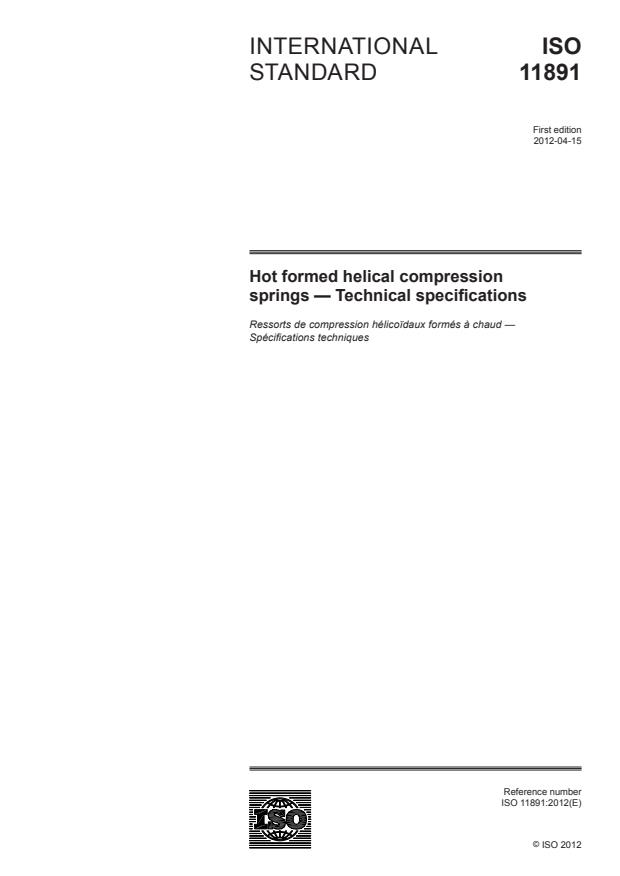
INTERNATIONAL ISO
STANDARD 11891
First edition
2012-04-15
Hot formed helical compression
springs — Technical specifications
Ressorts de compression hélicoïdaux formés à chaud —
Spécifications techniques
Reference number
©
ISO 2012
All rights reserved. Unless otherwise specified, no part of this publication may be reproduced or utilized in any form or by any means,
electronic or mechanical, including photocopying and microfilm, without permission in writing from either ISO at the address below or ISO’s
member body in the country of the requester.
ISO copyright office
Case postale 56 • CH-1211 Geneva 20
Tel. + 41 22 749 01 11
Fax + 41 22 749 09 47
E-mail copyright@iso.org
Web www.iso.org
Published in Switzerland
ii © ISO 2012 – All rights reserved
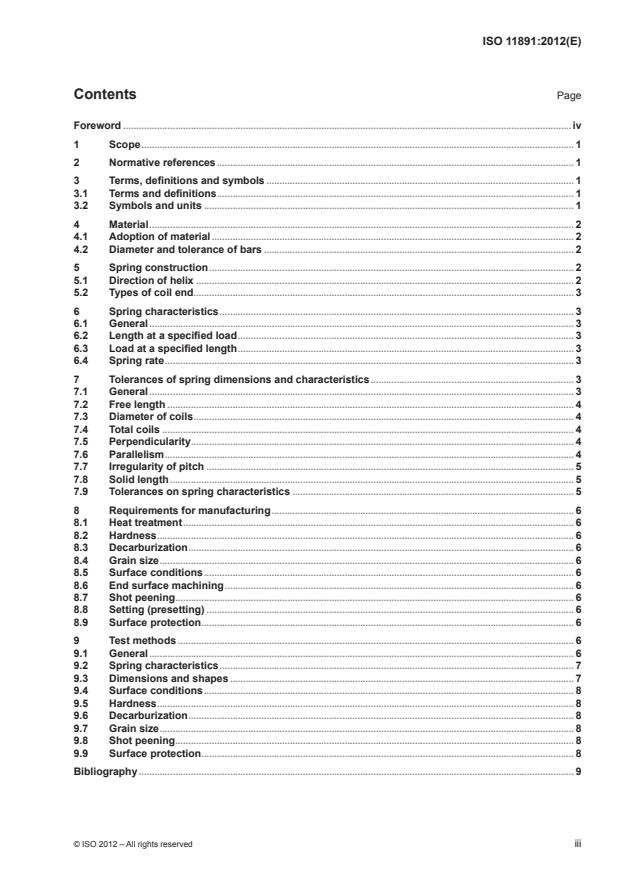
Contents Page
Foreword .iv
1 Scope . 1
2 Normative references . 1
3 Terms, definitions and symbols . 1
3.1 Terms and definitions . 1
3.2 Symbols and units . 1
4 Material . 2
4.1 Adoption of material . 2
4.2 Diameter and tolerance of bars . 2
5 Spring construction . 2
5.1 Direction of helix . 2
5.2 Types of coil end . 3
6 Spring characteristics . 3
6.1 General . 3
6.2 Length at a specified load . 3
6.3 Load at a specified length . 3
6.4 Spring rate . 3
7 Tolerances of spring dimensions and characteristics . 3
7.1 General . 3
7.2 Free length . 4
7.3 Diameter of coils . 4
7.4 Total coils . 4
7.5 Perpendicularity . 4
7.6 Parallelism . 4
7.7 Irregularity of pitch . 5
7.8 Solid length . 5
7.9 Tolerances on spring characteristics . 5
8 Requirements for manufacturing . 6
8.1 Heat treatment . 6
8.2 Hardness . 6
8.3 Decarburization . 6
8.4 Grain size . 6
8.5 Surface conditions . 6
8.6 End surface machining . 6
8.7 Shot peening . 6
8.8 Setting (presetting) . 6
8.9 Surface protection . 6
9 Test methods . 6
9.1 General . 6
9.2 Spring characteristics . 7
9.3 Dimensions and shapes . 7
9.4 Surface conditions . 8
9.5 Hardness . 8
9.6 Decarburization . 8
9.7 Grain size . 8
9.8 Shot peening . 8
9.9 Surface protection . 8
Bibliography . 9
Foreword
ISO (the International Organization for Standardization) is a worldwide federation of national standards bodies
(ISO member bodies). The work of preparing International Standards is normally carried out through ISO
technical committees. Each member body interested in a subject for which a technical committee has been
established has the right to be represented on that committee. International organizations, governmental and
non-governmental, in liaison with ISO, also take part in the work. ISO collaborates closely with the International
Electrotechnical Commission (IEC) on all matters of electrotechnical standardization.
International Standards are drafted in accordance with the rules given in the ISO/IEC Directives, Part 2.
The main task of technical committees is to prepare International Standards. Draft International Standards
adopted by the technical committees are circulated to the member bodies for voting. Publication as an
International Standard requires approval by at least 75 % of the member bodies casting a vote.
Attention is drawn to the possibility that some of the elements of this document may be the subject of patent
rights. ISO shall not be held responsible for identifying any or all such patent rights.
ISO 11891 was prepared by Technical Committee ISO/TC 227, Springs.
iv © ISO 2012 – All rights reserved
INTERNATIONAL STANDARD ISO 11891:2012(E)
Hot formed helical compression springs — Technical
specifications
1 Scope
This International Standard specifies the materials, shapes, spring characteristics, tolerances, manufacturing
requirements and test methods for common helical compression springs, which are made from hot coiled
round section steel bar, and then quenched and tempered (hereinafter simply “springs”).
The following limit values apply to springs conforming to this International Standard:
— free length: ≤ 900 mm;
— spring index: 3 to 12;
— slenderness ratio: 0,8 to 4;
— active coils: ≥ 3;
— spring pitch: < 0,5D;
— wire diameter: 8 mm to 60 mm;
— mean diameter of coil: ≤ 460 mm.
This International Standard is not applicable to coil springs with special performance requirements, such as
railway and automotive suspensions.
2 Normative references
The following referenced documents are indispensable for the application of this document. For dated
references, only the edition cited applies. For undated references, the latest edition of the referenced document
(including any amendments) applies.
ISO 643, Steels — Micrographic determination of the apparent grain size
ISO 7500-1, Metallic materials — Verification of static uniaxial testing machines — Part 1: Tension/compression
testing machines — Verification and calibration of the force-measuring system
ISO 18265, Metallic materials — Conversion of hardness values
ISO 26909, Springs — Vocabulary
3 Terms, definitions and symbols
3.1 Terms and definitions
For the purposes of this document, the terms and definitions given in ISO 26909 apply.
3.2 Symbols and units
For the purposes of this document, the symbols and units given in Table 1 apply.
Table 1 — Symbols and units
Symbol Parameter Unit
D mean diameter of coil mm
D outside diameter of spring mm
e
d diameter of wire mm
d maximum diameter of wire (or bar) mm
max
F spring load N
L solid length mm
c
L free length mm
n total coils —
t
R
spring rate N/mm
s
deflection mm
e perpendicularity mm
e parallelism mm
4 Material
4.1 Adoption of material
Unless otherwise agreed by the purchaser and the supplier, springs should be made from the material
conforming to ISO 683-14.
4.2 Diameter and tolerance of bars
4.2.1 Hot rolled bars
The tolerances of the dimensions and shapes of specified hot rolled bars should be according to ISO 1035-4,
unless otherwise agreed between the purchaser and the supplier.
4.2.2 Bars with cold-worked surface
Tolerances of the dimensions and shapes of cold-worked surface bars (i.e. with cold-drawn, turned, peeled,
ground or a combination thereof) specified should be as specified in Table 2, unless otherwi
...
Questions, Comments and Discussion
Ask us and Technical Secretary will try to provide an answer. You can facilitate discussion about the standard in here.
Loading comments...