

ISO/IEC 19794-2:2011
(Main)Information technology — Biometric data interchange formats — Part 2: Finger minutiae data
General Information
- Abstract
ISO/IEC 19794-2:2011 specifies a concept and data formats for representation of fingerprints using the fundamental notion of minutiae. It is generic, in that it may be applied and used in a wide range of application areas where automated fingerprint recognition is involved. It contains definitions of relevant terms, a description of how minutiae are to be determined, data formats for containing the data for both general use and for use with cards, and conformance information. Guidelines and values for matching and decision parameters are provided. ISO/IEC 19794-2:2011 specifies the following: the fundamental data elements used for minutiae-based representation of a fingerprint; three data formats for interchange and storage of this data: a record-based format, and normal and compact formats for use on a smart card in a match-on-card application; optional extended data formats for including additional data such as ridge counts and core and delta location. ISO/IEC 19794-2:2011 provides for interchange of finger minutiae data between sensing, storage and matching systems.
- Status
- Published
- Publication Date
- 13-Dec-2011
- Technical Committee
- ISO/IEC JTC 1/SC 37 - Biometrics
- Drafting Committee
- ISO/IEC JTC 1/SC 37 - Biometrics
- Current Stage
- 9093 - International Standard confirmed
- Start Date
- 06-Sep-2024
- Completion Date
- 29-Aug-2026

Overview
ISO/IEC 19794-2:2011 - "Information technology - Biometric data interchange formats - Part 2: Finger minutiae data" defines a standardized, interoperable representation for fingerprint minutiae used in automated fingerprint recognition systems. The standard specifies the concept, data elements, and file/card formats to represent minutiae (ridge endings, bifurcations, etc.), plus rules for extraction, encoding, and conformance. It enables interchange of finger minutiae data between sensing, storage and matching systems while providing guidance for matching parameters and decision thresholds.
Key topics and technical requirements
- Minutiae definition and extraction: Precise descriptions of minutiae types, how minutiae locations and directions are determined, and the coordinate system used.
- Data elements: Fundamental data elements for minutiae-based fingerprint representation (location, direction, type, quality indicators).
- Three interchange formats:
- Record-based format for general interchange and storage.
- Normal on-card format for match-on-card applications.
- Compact on-card format optimized for smart cards.
- Extended data options: Optional fields for additional features such as ridge counts and core/delta positions to support enhanced matching.
- On-card comparison: Formats and rules to support biometric comparison performed on smart cards (match-on-card).
- Conformance and interoperability: Rules for data structure, value relationships, and the Implementation Conformance Statement (ICS) model; conformance testing methodology and capture device certification examples are included in annexes.
- Guidelines for matching: Recommended values and parameters to guide matching and decision-making (thresholds, truncation rules, minutiae ordering).
Applications and who uses it
ISO/IEC 19794-2:2011 is widely used where reliable, interoperable fingerprint minutiae exchange is required:
- Law enforcement and forensic systems (AFIS interoperability)
- Border control and immigration systems
- Government ID programs and national identity databases
- Smart card / eID implementations (match-on-card and on-card storage)
- Biometric SDK and sensor manufacturers (data output format, device certification)
- System integrators and software vendors building fingerprint matching, enrollment, or verification solutions
- Certification labs and standards bodies validating conformance and performance
Related standards
Part of the ISO/IEC 19794 series. Relevant companion documents include:
- ISO/IEC 19794-1 (Framework)
- ISO/IEC 19794-3, -4, -5, etc. (other biometric modalities, image and spectral formats)
ISO/IEC 19794-2:2011 promotes interoperability of minutiae-based biometric templates, reduces vendor lock-in, and is essential for any organization implementing robust fingerprint recognition or match-on-card solutions.
Relations
- Effective Date
- 09-Feb-2026
- Effective Date
- 09-Feb-2026
- Effective Date
- 14-Aug-2021
- Effective Date
- 25-Apr-2020
- Effective Date
- 01-Jan-2022
- Effective Date
- 16-Oct-2025
- Effective Date
- 16-Oct-2025
- Effective Date
- 15-Apr-2008
Get Certified
Connect with accredited certification bodies for this standard

BSI Group
BSI (British Standards Institution) is the business standards company that helps organizations make excellence a habit.

NYCE
Mexican standards and certification body.
Sponsored listings
Frequently Asked Questions
ISO/IEC 19794-2:2011 is a standard published by the International Organization for Standardization (ISO). Its full title is "Information technology — Biometric data interchange formats — Part 2: Finger minutiae data". This standard covers: ISO/IEC 19794-2:2011 specifies a concept and data formats for representation of fingerprints using the fundamental notion of minutiae. It is generic, in that it may be applied and used in a wide range of application areas where automated fingerprint recognition is involved. It contains definitions of relevant terms, a description of how minutiae are to be determined, data formats for containing the data for both general use and for use with cards, and conformance information. Guidelines and values for matching and decision parameters are provided. ISO/IEC 19794-2:2011 specifies the following: the fundamental data elements used for minutiae-based representation of a fingerprint; three data formats for interchange and storage of this data: a record-based format, and normal and compact formats for use on a smart card in a match-on-card application; optional extended data formats for including additional data such as ridge counts and core and delta location. ISO/IEC 19794-2:2011 provides for interchange of finger minutiae data between sensing, storage and matching systems.
ISO/IEC 19794-2:2011 specifies a concept and data formats for representation of fingerprints using the fundamental notion of minutiae. It is generic, in that it may be applied and used in a wide range of application areas where automated fingerprint recognition is involved. It contains definitions of relevant terms, a description of how minutiae are to be determined, data formats for containing the data for both general use and for use with cards, and conformance information. Guidelines and values for matching and decision parameters are provided. ISO/IEC 19794-2:2011 specifies the following: the fundamental data elements used for minutiae-based representation of a fingerprint; three data formats for interchange and storage of this data: a record-based format, and normal and compact formats for use on a smart card in a match-on-card application; optional extended data formats for including additional data such as ridge counts and core and delta location. ISO/IEC 19794-2:2011 provides for interchange of finger minutiae data between sensing, storage and matching systems.
ISO/IEC 19794-2:2011 is classified under the following ICS (International Classification for Standards) categories: 35.040 - Information coding; 35.240.15 - Identification cards. Chip cards. Biometrics. The ICS classification helps identify the subject area and facilitates finding related standards.
ISO/IEC 19794-2:2011 has the following relationships with other standards: It is inter standard links to CEN/TS 15480-2:2012, EN 419212-1:2014, ISO/IEC 19794-2:2011/Amd 2:2015, ISO/IEC 19794-2:2011/Amd 1:2013, ISO/IEC 19794-2:2011/Cor 1:2012, ISO/IEC 19794-2:2005/Amd 1:2010, ISO/IEC 19794-2:2005/Cor 1:2009, ISO/IEC 19794-2:2005. Understanding these relationships helps ensure you are using the most current and applicable version of the standard.
ISO/IEC 19794-2:2011 is available in PDF format for immediate download after purchase. The document can be added to your cart and obtained through the secure checkout process. Digital delivery ensures instant access to the complete standard document.
Standards Content (Sample)
INTERNATIONAL ISO/IEC
STANDARD 19794-2
Second edition
2011-12-15
Information technology — Biometric data
interchange formats —
Part 2:
Finger minutiae data
Technologies de l'information — Formats d'échange de données
biométriques —
Partie 2: Données du point caractéristique du doigt
Reference number
©
ISO/IEC 2011
© ISO/IEC 2011
All rights reserved. Unless otherwise specified, no part of this publication may be reproduced or utilized in any form or by any means,
electronic or mechanical, including photocopying and microfilm, without permission in writing from either ISO at the address below or
ISO's member body in the country of the requester.
ISO copyright office
Case postale 56 • CH-1211 Geneva 20
Tel. + 41 22 749 01 11
Fax + 41 22 749 09 47
E-mail copyright@iso.org
Web www.iso.org
Published in Switzerland
ii © ISO/IEC 2011 – All rights reserved
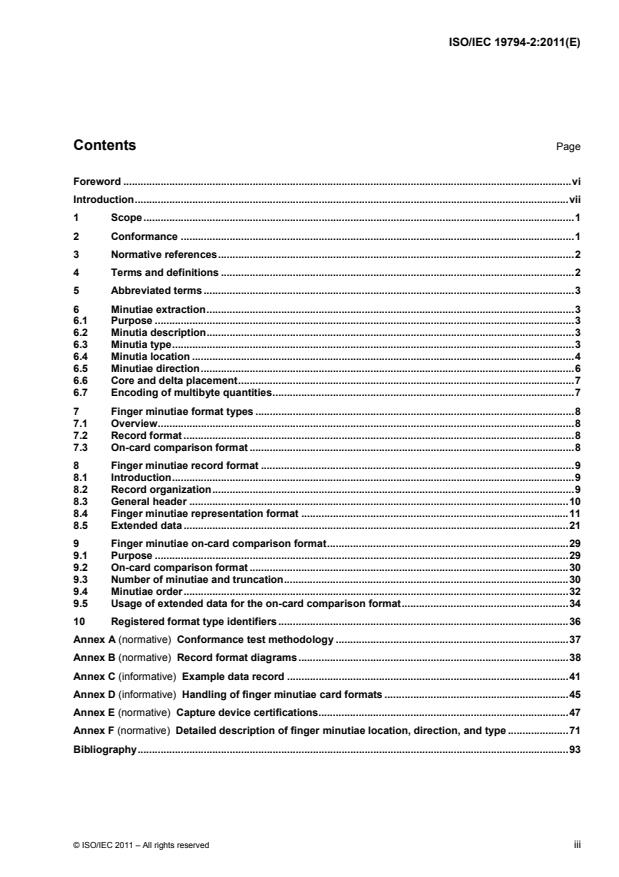
Contents Page
Foreword .vi
Introduction.vii
1 Scope.1
2 Conformance .1
3 Normative references.2
4 Terms and definitions .2
5 Abbreviated terms .3
6 Minutiae extraction.3
6.1 Purpose .3
6.2 Minutia description.3
6.3 Minutia type.3
6.4 Minutia location .4
6.5 Minutiae direction.6
6.6 Core and delta placement.7
6.7 Encoding of multibyte quantities.7
7 Finger minutiae format types .8
7.1 Overview.8
7.2 Record format .8
7.3 On-card comparison format .8
8 Finger minutiae record format .9
8.1 Introduction.9
8.2 Record organization.9
8.3 General header .10
8.4 Finger minutiae representation format .11
8.5 Extended data .21
9 Finger minutiae on-card comparison format.29
9.1 Purpose .29
9.2 On-card comparison format .30
9.3 Number of minutiae and truncation.30
9.4 Minutiae order.32
9.5 Usage of extended data for the on-card comparison format.34
10 Registered format type identifiers .36
Annex A (normative) Conformance test methodology .37
Annex B (normative) Record format diagrams.38
Annex C (informative) Example data record .41
Annex D (informative) Handling of finger minutiae card formats .45
Annex E (normative) Capture device certifications.47
Annex F (normative) Detailed description of finger minutiae location, direction, and type .71
Bibliography.93
© ISO/IEC 2011 – All rights reserved iii
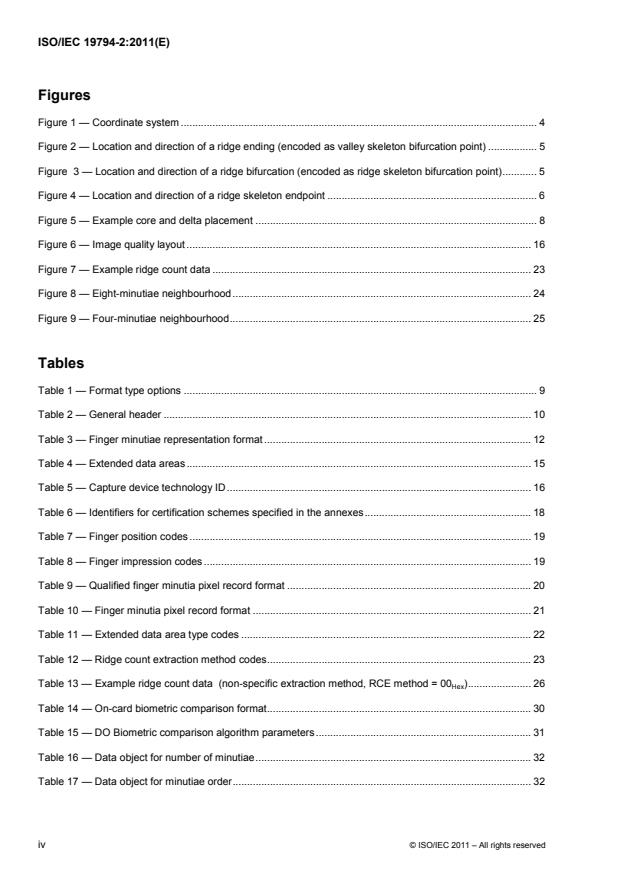
Figures
Figure 1 — Coordinate system . 4
Figure 2 — Location and direction of a ridge ending (encoded as valley skeleton bifurcation point) . 5
Figure 3 — Location and direction of a ridge bifurcation (encoded as ridge skeleton bifurcation point). 5
Figure 4 — Location and direction of a ridge skeleton endpoint . 6
Figure 5 — Example core and delta placement . 8
Figure 6 — Image quality layout . 16
Figure 7 — Example ridge count data . 23
Figure 8 — Eight-minutiae neighbourhood. 24
Figure 9 — Four-minutiae neighbourhood. 25
Tables
Table 1 — Format type options . 9
Table 2 — General header . 10
Table 3 — Finger minutiae representation format. 12
Table 4 — Extended data areas. 15
Table 5 — Capture device technology ID. 16
Table 6 — Identifiers for certification schemes specified in the annexes. 18
Table 7 — Finger position codes . 19
Table 8 — Finger impression codes . 19
Table 9 — Qualified finger minutia pixel record format . 20
Table 10 — Finger minutia pixel record format . 21
Table 11 — Extended data area type codes . 22
Table 12 — Ridge count extraction method codes. 23
Table 13 — Example ridge count data (non-specific extraction method, RCE method = 00 ). 26
Hex
Table 14 — On-card biometric comparison format. 30
Table 15 — DO Biometric comparison algorithm parameters. 31
Table 16 — Data object for number of minutiae. 32
Table 17 — Data object for minutiae order. 32
iv © ISO/IEC 2011 – All rights reserved
Table 18 — Values for minutiae order indication .32
Table 19 — Biometric data template .35
Table 20 — Encoding of feature handling indicator .36
Table 21 — Format type identifiers .36
Table E.1 — Preferred capture sizes .48
Table E.2 — MTF Requirement using sine wave target .50
Table E.3 — CTF Requirement using bar target (nominal test frequencies) .50
Table E.4 — Basic requirements.55
Table E.5 — CTF and MTF Requirements at nominal test frequencies .57
Table E.6 — Minimum and maximum modulation.66
Table E.7 — Dimensions of the target structures.67
© ISO/IEC 2011 – All rights reserved v
Foreword
ISO (the International Organization for Standardization) and IEC (the International Electrotechnical
Commission) form the specialized system for worldwide standardization. National bodies that are members of
ISO or IEC participate in the development of International Standards through technical committees
established by the respective organization to deal with particular fields of technical activity. ISO and IEC
technical committees collaborate in fields of mutual interest. Other international organizations, governmental
and non-governmental, in liaison with ISO and IEC, also take part in the work. In the field of information
technology, ISO and IEC have established a joint technical committee, ISO/IEC JTC 1.
International Standards are drafted in accordance with the rules given in the ISO/IEC Directives, Part 2.
The main task of the joint technical committee is to prepare International Standards. Draft International
Standards adopted by the joint technical committee are circulated to national bodies for voting. Publication as
an International Standard requires approval by at least 75 % of the national bodies casting a vote.
Attention is drawn to the possibility that some of the elements of this document may be the subject of patent
rights. ISO and IEC shall not be held responsible for identifying any or all such patent rights.
ISO/IEC 19794-2 was prepared by Joint Technical Committee ISO/IEC JTC 1, Information technology,
Subcommittee SC 37, Biometrics.
This second edition cancels and replaces the first edition (ISO/IEC 19794-2:2005). It reflects the
harmonization across the second generation of ISO/IEC 19794. A new Clause 7 has been added to describe
the finger minutiae format types; Clause 8 contains descriptions of the harmonized general and representation
headers; and Clauses 8 and 9 have been technically revised. All annexes have been technically revised.
Annex A is under development and will contain an amendment for conformance testing methodology for this
part of ISO/IEC 19794. The former Annex B “Fingerprint Image Quality Specifications” has been removed.
Annex E contains three examples of capture device certifications. Annex F provides descriptions of fingerprint
minutiae location, direction, and type.
ISO/IEC 19794 consists of the following parts, under the general title Information technology — Biometric data
interchange formats:
⎯ Part 1: Framework
⎯ Part 2: Finger minutiae data
⎯ Part 3: Finger pattern spectral data
⎯ Part 4: Finger image data
⎯ Part 5: Face image data
⎯ Part 6: Iris image data
⎯ Part 7: Signature/sign time series data
⎯ Part 8: Finger pattern skeletal data
⎯ Part 9: Vascular image data
⎯ Part 10: Hand geometry silhouette data
⎯ Part 11: Signature/sign processed dynamic data
⎯ Part 13: Voice data
⎯ Part 14: DNA data
vi © ISO/IEC 2011 – All rights reserved
Introduction
ISO/IEC 19794 is a series of International Standards being developed by ISO/IEC JTC 1/SC 37 that supports
interoperability and data interchange among biometric applications and systems. The ISO/IEC 19794 series
specifies requirements that solve the complexities of applying biometrics to a wide variety of personal
recognition applications, whether such applications operate in an open systems environment or consist of a
single, closed system. Additional information regarding the series is provided in ISO/IEC 19794-1.
In the interest of implementing interoperable biometric recognition systems, this part of ISO/IEC 19794
establishes a data interchange format for minutiae. It is relevant for systems or components dealing with
generating, processing, and storing minutiae data. Representation of fingerprint data using minutiae is a
widely used technique in many application areas.
This part of ISO/IEC 19794 defines specifics of the extraction of key points (called minutiae) from fingerprint
ridge patterns. These specifics include a description of the types of minutiae identified, the method used for
the placement of minutiae on an image, a definition of the coordinate system used, and the methods used to
calculate the angle associated with each minutia.
© ISO/IEC 2011 – All rights reserved vii
INTERNATIONAL STANDARD ISO/IEC 19794-2:2011(E)
Information technology — Biometric data interchange
formats —
Part 2:
Finger minutiae data
1 Scope
This part of ISO/IEC 19794 specifies a concept and data formats for representation of fingerprints using the
fundamental notion of minutiae. It is generic, in that it may be applied and used in a wide range of application
areas where automated fingerprint recognition is involved. This part of ISO/IEC 19794 contains definitions of
relevant terms, a description of how minutiae are to be determined, data formats for containing the data for
both general use and for use with cards, and conformance information. Guidelines and values for comparing
and decision parameters are provided.
NOTE Although ISO/IEC 19794-4 covers both finger and palm image data, this part of ISO/IEC 19794 only covers
finger minutiae and is not applicable to palms.
2 Conformance
A biometric data record conforms to this part of ISO/IEC 19794 if it satisfies all of the normative requirements
related to:
a) its data structure, data values and the relationships between its data elements, as specified throughout
Clause 8 for the finger minutiae record format and Clause 9 for the finger minutiae on-card biometric
comparison format of this part of ISO/IEC 19794;
b) the relationship between its data values and the input biometric data from which the biometric data record
was generated, as specified throughout Clause 8 for the finger minutiae record format and Clause 9 for
the finger minutiae on-card biometric comparison format of this part of ISO/IEC 19794.
A system that produces biometric data records is conformant to this part of ISO/IEC 19794 if all biometric data
records that it outputs conform to this part of ISO/IEC 19794 (as defined above) as claimed in the
Implementation Conformance Statement (ICS) associated with that system. A system does not need to be
capable of producing biometric data records that cover all possible aspects of this part of ISO/IEC 19794, but
only those that are claimed to be supported by the system in the ICS.
A system that uses biometric data records is conformant to this part of ISO/IEC 19794 if it can read, and use
for the purpose intended by that system, all biometric data records that conform to this part of ISO/IEC 19794
(as defined above) as claimed in the ICS associated with that system. A system does not need to be capable
of using biometric data records that cover all possible aspects of this part of ISO/IEC 19794, but only those
that are claimed to be supported by the system in an ICS.
© ISO/IEC 2011 – All rights reserved 1
3 Normative references
The following referenced documents are indispensable for the application of this document. For dated
references, only the edition cited applies. For undated references, the latest edition of the referenced
document (including any amendments) applies.
ISO/IEC 19785-3:2007, Information technology — Common Biometric Exchange Formats Framework —
Part 3: Patron format specifications
ISO/IEC 19794-1:2011, Information technology — Biometric data interchange formats — Part 1: Framework
ISO/IEC 7816-11:2004, Identification cards — Integrated circuit cards — Part 11: Personal verification through
biometric methods
4 Terms and definitions
For the purposes of this document, the terms and definitions given in ISO/IEC 19794-1 and the following apply.
4.1
algorithm
sequence of instructions that tell a biometric system how to solve a particular problem
NOTE An algorithm will have a finite number of steps and is typically used by the biometric engine (i.e., the biometric
system software) to compute whether a biometric sample and template are the same.
4.2
end user
person who interacts with a biometric system to enrol or have his/her identity checked
NOTE Compare with the definition of “user” in ISO/IEC 19794-1.
4.3
live-scan print
fingerprint image that is produced by scanning or imaging a live finger to generate an image of the friction
ridges
4.4
population
set of end users for the application
4.5
ridge skeleton endpoint
minutia assigned to the location at which a ridge skeleton ends
NOTE A ridge skeleton endpoint is defined as the ending of the skeleton of a ridge.
4.6
template/reference template
data, which represents the biometric measurement of an enrollee, used by a biometric system for comparison
against subsequently submitted biometric samples
NOTE This term is not restricted to mean only data used in any particular recognition method, such as template
comparison.
4.7
valley bifurcation
point at which a valley splits into two valleys or, alternatively, where two separate valleys combine into one
2 © ISO/IEC 2011 – All rights reserved
5 Abbreviated terms
For the purposes of this document, the abbreviated terms given in ISO/IEC 19794-1 and the following apply.
BIT biometric information template
DO data object
FAR false acceptance rate
FRR false rejection rate
RCE ridge count extraction
RFU reserved for future use
6 Minutiae extraction
6.1 Purpose
This clause defines the placement of minutiae on the fingerprint. Compatible minutiae extraction is required for
interoperability between different finger comparators for the purposes of comparing an individual against a
previously collected and stored finger record. Interoperability is based on the definition of the finger minutiae
extraction rules, variations of the record format (Clause 7.2), and the on-card biometric comparison format
(Clause 7.3) that are common to many finger comparators for acceptable comparing accuracy, while allowing
for extended data to be attached for use with equipment that is compatible with it.
6.2 Minutia description
Establishment of a common feature-based representation shall rest on agreement on the fundamental notion
for representing a fingerprint. Minutiae are points located at the places in the fingerprint image where friction
ridges end or split into two ridges. Describing a fingerprint in terms of the location and direction of these ridge
endings and bifurcations provides sufficient information to reliably determine whether two fingerprint records
are from the same finger.
The specifications of minutia location and minutia direction described below accomplish this. See Figures 2
through 4 for an illustration of the definitions below.
6.3 Minutia type
6.3.1 General
Each minutia has a “type” associated with it. There are two major types of minutiae: a “ridge skeleton end
point” and a “ridge skeleton bifurcation point” or split point. There are other types of “points of interest” in the
friction ridges that occur much less frequently and are more difficult to define precisely. More complex types of
minutiae are usually a combination of the basic types defined above. Some points are neither a ridge ending
nor a bifurcation. This part of ISO/IEC 19794 therefore defines an additional type named “other”, which shall
be used for such a case. The “other” minutiae type shall not be used for minutiae that are ridge endings or
ridge bifurcations.
Therefore, the following types are distinguished:
- ridge ending
- ridge bifurcation
- other.
A ridge ending may — alternatively — be referred to as a valley bifurcation depending on the method to
determine its position (Clause 6.4.3 and 6.4.5). The format type of the biometric information template indicates
the use of ridge endings or valley bifurcations.
© ISO/IEC 2011 – All rights reserved 3
6.3.2 Unique minutia
A minutia point shall be encoded once. A minutia point is uniquely identified by the location and angle.
6.3.3 Encoding trifurcations
The location at which a ridge splits into three separate ridges is a trifurcation. If it is encoded, it shall be
encoded as two bifurcations with identical (x,y) values and different orientation angle values.
6.4 Minutia location
6.4.1 General
The minutia location is represented by its horizontal and vertical position. The minutiae determination strategy
considered in this document relies on skeletons derived from a digital fingerprint image. The ridge skeleton is
computed by thinning down the ridge area to single pixel wide lines. The valley skeleton is computed by
thinning down the valley area to single pixel wide lines. If other methods are applied, they should approximate
the skeleton method, i.e. location and angle of the minutia should be equivalent to the skeleton method.
6.4.2 Coordinate system
The coordinate system used to express the minutiae of a fingerprint shall be a Cartesian coordinate system.
Points shall be represented by their X and Y coordinates. The origin of the coordinate system shall be the
upper left corner of the original image with X increasing to the right and Y increasing downward. Note that this
is in agreement with most imaging and image processing use. When viewed on the finger, X increases from
right to left as shown in Figure 1. All X and Y values are non-negative.
xx
xx
yy
yy
llaattentent pri prinntt
ffiingernger
Figure 1 — Coordinate system
For the finger minutiae record format, clause 7.2, the X and Y coordinates of the minutiae shall be measured
in pixel units, with the spatial sampling rate of a pixel given in the “X Spatial sampling rate” and “Y Spatial
sampling rate” fields of the record header. The spatial sampling rates are stated separately as described in
clauses 8.4.11 and 8.4.12.
4 © ISO/IEC 2011 – All rights reserved
For the on-card biometric comparison format, clause 7.3, the X and Y coordinates shall be measured in fixed
-1
metrical units of one bit per one tenth of a millimetre or 10 mm as described in clause 9.2.3.
6.4.3 Minutia placement on a ridge ending (encoded as valley skeleton bifurcation point)
The minutia for a ridge ending shall be defined as the point of forking of the medial skeleton of the valley area
immediately in front of the ridge ending. If the valley area were thinned down to a single-pixel-wide skeleton,
the point where the three skeletal line intersect is the location of the minutia. In simpler terms, it is the point
where the valley bifurcates, or (equivalently) where the three thinned valley lines intersect (see Figure 2).
θ
valley
ridge
Figure 2 — Location and direction of a ridge ending (encoded as valley skeleton bifurcation point)
6.4.4 Minutia placement on a ridge bifurcation (encoded as a ridge skeleton bifurcation point)
The minutia for a ridge bifurcation shall be defined as the point of forking of the medial skeleton of the ridge. If
the ridges were thinned down to a single-pixel-wide skeleton, the point where the three skeletal lines intersect
is the location of the minutia. In simpler terms, it is the point where the ridge bifurcates, or (equivalently) where
the three skeletal lines of the thinned ridge intersect (see Figure 3).
θ
valley
ridge
Figure 3 — Location and direction of a ridge bifurcation (encoded as ridge skeleton bifurcation point)
© ISO/IEC 2011 – All rights reserved 5
6.4.5 Minutia placement on a ridge skeleton endpoint
The minutia for a ridge skeleton endpoint shall be defined as the center point of the ending ridge. If the ridges
in the digital fingerprint image were thinned down to a single-pixel-wide skeleton, the position of the minutia
would be the coordinates of the skeleton point with only one neighbour pixel belonging to the skeleton (see
Figure 4).
θ
valley
ridge
Figure 4 — Location and direction of a ridge skeleton endpoint
6.4.6 Usage of the minutia placement by the record and on-card biometric comparison formats
Depending on the specific algorithms implemented, both the record format and the on-card biometric
comparison format use
• valley skeleton bifurcations or ridge skeleton endpoints for locating minutiae on ridge endings, and
• ridge skeleton bifurcations for locating minutiae on ridge bifurcations
For on-card biometric comparison, a card will request from the card usage system biometric verification data
in the format compliant to its algorithm. The requested format is either implicitly known to the card usage
system or can be retrieved in the Biometric Information Template (see ISO/IEC 19785-3 and
ISO/IEC 7816-11).
6.5 Minutiae direction
6.5.1 Angle conventions
The minutia angle is measured increasing counter-clockwise starting from the horizontal axis to the right.
In the finger minutiae record format, the angle of a minutia is scaled to fit the granularity of 1.40625 (360/256)
degrees per least significant bit as described in clause 8.4.19.1.4.
The angle coding for the on-card biometric comparison formats is scaled to fit the granularity of 5.625 (360/64)
degrees per least significant bit as described in clause 9.2.5.
6.5.2 Minutia direction of a ridge ending (encoded as valley skeleton bifurcation point)
A ridge ending (encoded as valley skeleton bifurcation point) has three arms of valleys meeting in one point.
Two valleys enclosing the ridge ending line encompass an acute angle. The direction of a valley bifurcation is
defined by the mean direction of their tangents and is measured as the angle the tangent of the ending ridge
forms with the horizontal axis to the right (see Figure 2).
6 © ISO/IEC 2011 – All rights reserved
6.5.3 Minutia direction of a ridge bifurcation (encoded as ridge skeleton bifurcation point)
A ridge bifurcation (encoded as ridge skeleton bifurcation point) has three arms of ridges meeting in one point.
Two ridges enclosing the ending valley encompass an acute angle. The direction of a valley bifurcation is
defined by the mean direction of their tangents and is measured as the angle the tangent of the ending valley
forms with the horizontal axis to the right (see Figure 3).
6.5.4 Minutia direction of a ridge skeleton end point
The direction of a ridge skeleton endpoint is defined as the angle that the tangent to the ending ridge
encompasses with the horizontal axis to the right (see Figure 4).
6.6 Core and delta placement
Core and delta points are designated points of interest in a fingerprint. A fingerprint may have 0, 1 or more
cores and 0, 1 or more deltas. The core and delta are defined in ISO/IEC 19794-1. The location of the core
and delta positions are defined as follows:
Core position: If there are ridge endings enclosed by the innermost recurving ridgeline, the ending nearest to
the maximal curvature of the recurving ridgeline defines the core position. If the core is a u-turn of a ridgeline
not enclosing ridge endings, the valley end defines the core position.
Delta position: Three points of divergence are each placed between the two ridges at the location where the
ridges begin to diverge; that is, where the ridges that have been parallel or nearly parallel begin to spread
apart as they approach the delta. The position of the delta is defined by the spatial mean of these three points.
The position is at the point on a ridge at or in front of and nearest the center of the divergence of the ridges
that start parallel, diverge, and surround or tend to surround the pattern area of the fingerprint image.
Core and delta point placement is illustrated in Figure 5.
NOTE Cores and deltas represent singularities in the ordinary direction field of the fingerprint image. Hence, angle
information of cores and deltas cannot fit smoothly into the direction values of all points in the neighbourhood.
6.7 Encoding of multibyte quantities
All multibyte quantities are represented in Big-Endian format; that is, the more significant bytes of any
multibyte quantity are stored at lower addresses in memory than (and are transmitted before) less significant
bytes. All numeric values are fixed-length integer quantities, and are unsigned quantities.
© ISO/IEC 2011 – All rights reserved 7
Figure 5 — Example core and delta placement
7 Finger minutiae format types
7.1 Overview
This part of 19794 defines two format types for minutiae encoding. These format types have been derived
from those listed in Version 2 of this part of ISO/IEC 19794 (ISO/IEC 19794-2:2005). The first record format is
designed for general storage, data interchange, or card based system. The second is an on-card biometric
comparison format intended for the comparison-on-card application as described in ISO/IEC 24787. Table 1
provides a tabular illustration of the two format types and the options available for each type.
7.2 Record format
This record format (Clause 8) requires the use of a general header for each finger record and a representation
header for each representation of the finger. This format is also designed to accommodate ridge count data,
core and delta data, zonal quality data, or vendor-defined extended data. Within the representation header
parameters shall be set to indicate whether five or six bytes are needed for each minutiae (the latter includes
a 1 byte quality field for each minutia). A second field in the representation header is used to differentiate
between ridge ending minutiae determined by ridge skeleton end points, and those determined using valley
bifurcations. A third field encodes the vendor of the minutiae extraction algorithm. The fourth field is a vendor-
assigned identification of the feature extraction algorithm used by the vendor.
7.3 On-card comparison format
This on-card biometric comparison format (Clause 9) precludes the use of a general or representation header.
Unlike the record format, the on-card biometric comparison format does not have a header and only has
provision for a single representation record of the finger. This corresponds to the compact-size card format
types that existed in ISO/IEC 19794-2:2005, which require three bytes to describe each minutiae. This format
locates ridge endings using either the ridge skeleton end-points or valley bifurcation points. As with the record
8 © ISO/IEC 2011 – All rights reserved
Table 1 — Format type options
Extended data Ridge minutiae size
Ridge
Format
bifurcation
(Option)
ending (per minutiae)
Ridge valley
Finger Minutia bifurcation
Ridge
Qualified Pixel Supported 6 byte
bifurcation
Record Format
Ridge Skeleton
end point
Finger Minutiae
Record Format
Ridge valley
Finger Minutia bifurcation
Ridge
Pixel Record Supported 5 byte
bifurcation
Format
Ridge Skeleton
end point
Ridge valley Ridge
3 byte
bifurcation bifurcation
Finger Minutiae On-Card Biometric Supported with
Comparison Format DOs
Ridge skeleton Ridge
3 byte
end point bifurcation
format, bifurcations are located using ridge skeleton bifurcation points. Whether the ridge endings are
represented by ridge skeleton end-points or valley skeleton bifurcation points shall be indicated by different
CBEFF BDB format type identifiers (see Clause 10).
8 Finger minutiae record format
8.1 Introduction
The finger minutiae record format shall be used to achieve interoperability between finger minutiae extraction
and comparison subsystems. The record format requires a general header. The minutiae data are
represented by different variations and may contain extended data in addition to the basic data. The formats
differ in two respects: the size of the encoded minutia, and whether ridge endings are determined by valley
skeleton bifurcation or ridge skeleton end points. With the exception of the Format Identifier and the Version
number for the standard, which are null-terminated ASCII character strings, all data is represented in binary
format. There are no record separators or field tags; fields are parsed by byte count.
8.2 Record organization
The organization of the record is as follows:
• A single fixed-length (15-byte) general header containing information about the overall record,
including the number of finger representations and the overall record length in bytes;
• A single finger record for each finger representation, consisting of:
o A variable-length finger minutiae representation header containing information about the data
for a single finger representation, including the number of minutiae;
Note 1 For each quality block of information recorded the length will be increased by 5 bytes
Note 2 When capture device certification information is present, one byte for the count of
certifications is required plus an additional 3 bytes for each specific certification
© ISO/IEC 2011 – All rights reserved 9
o A variable-length finger minutiae representation body containing
ƒ A series of fixed-length (6-byte, or 5-byte) minutia descriptions, including the position,
type, and angle (quality of the minutia is also included for the 6-byte record format);
and
ƒ One required extended data block for each finger representation containing zero or
more extended data areas describing optional or vendor specific information.
8.3 General header
There shall be one and only one general header for the minutiae record. Table 2 contains a summary of the
general record header fields.
Table 2 — General header
Field Size Valid Values Notes
Format Identifier 4 bytes 464D5200 “FMR ” – finger minutiae record
Hex
(‘F’ ‘M’ ‘R’ 00 )
Hex
Version Number 4 bytes 30333000 Version = 030
Hex
(‘0’ ‘3’ ‘0’ 00 )
Hex
Length of record 4 bytes 36 to Minimum length is 15 for the general
Hex
FFFFFFFFHex header plus 39 for each representation
(1 minutiae) = 54 to 2 -1
Number of Finger Representations 2 bytes 0001 to (10 fingers + 1 unknown + 11 multiple
Hex
0160 finger combinations) times 16 = 352
Hex
Device Certification Block Flag 1 byte 00 or 01 Indicates the presence of any device
Hex Hex
certification blocks within the
representation headers
8.3.1 Format identifier
The format identifier shall be recorded in four bytes. The format identifier shall consist of three characters
“FMR” followed by a zero byte as a NULL string terminator.
8.3.2 Version number
The number for the version of this part of ISO/IEC 19794 used for constructing the finger minutiae BDIR shall
be placed in four bytes. This version number shall consist of three ASCII numerals followed by a zero byte as
a NULL string terminator. The first and second character will represent the major version number and the third
character will represent the minor revision number. Upon approval of this specification, the version number
shall be “030” – Version 3 revision 0.
8.3.3 Length of record
The length (in bytes) of the entire finger minutiae BDIR shall be recorded in four bytes. This count shall be the
total length of the BDIR including the general record header and one or more representation records. The
length of the record is dependent on several factors.
8.3.4 Number of finger representations
The total number of representations contained in the BDIR shall be recorded in two bytes. A minimum of one
representation is required. In cases where there is more than one representation of any finger, this number
will be greater than the number of fingers.
10 © ISO/IEC 2011 – All rights reserved
One per Record
8.3.5 Device certification block flag
The one-byte certification flag shall indicate whether each representation header includes a certification record.
A value of 00 shall indicate that none of the representations contains a certification record. A value of 01
Hex Hex
shall indicate that all representations contain a certification record.
NOTE A certification record that is present may contain 0 certifications (in that case the number-of-certifications field
in the certification record has the value 0).
8.4 Finger minutiae representation format
8.4.1 Finger minutiae representation header
A finger minutiae representation header shall precede each representation of finger minutiae data providing
information for that finger representation. There shall be one finger representation header for each finger
representation contained in the finger minutiae record. The finger representation header will occupy a
minimum of 39 bytes as described below. As the number of finger image quality blocks, capture device
certification blocks, and extended data areas are added, the length of the finger header will increase. Table 3
contains a summary of the fields for the finger representation format. Table 4 describes the contents of
extended data areas. These two tables list the header fields, and all fields that may occur in a representation
including the finger minutiae data fields and extended data fields.
NOTE It is permissible to have multiple finger representations of the same finger in the same finger minutia record
provided that each representation’s data is derived from a unique capture of the same finger.
8.4.2 Representation length
The representation-length field denotes the length in bytes of the representation including the representation
header fields.
8.4.3 Capture date-time
The capture date and time field shall indicate when the capture of this representation started in Coordinated
Universal Time (UTC). This field is not intended to encode the time the record was instantiated. The capture
date and time field shall be encoded in accordance to the requirements given in ISO/IEC 19794-1.
8.4.4 Capture device technology ID
The capture device technology ID shall be encoded in one byte. This field shall indicate the class of capture
device technology used to acquire the captured biometric sample. A value of 00 indicates unknown or
Hex
unspecified technology. See Table 5 for the list of possible values.
8.4.5 Capture device vendor identifier
The capture device vendor identifier shall identify the biometric organization that owns the product that
created the BDIR. The capture device algorithm vendor identifier shall be encoded in two bytes carrying a
CBEFF biometric organization identifier (registered by IBIA or other approved registration authority). A value
of all zeros shall indicate that the capture device vendor is unreported.
© ISO/IEC 2011 – All rights reserved 11
Table 3 — Finger minutiae representation format
Field Size Valid Values Notes
Representation length 4 bytes 27 to FFFFFFFF Denotes the length in bytes of the
Hex Hex
representation including the representation
header fields
Capture date and time 9 bytes See ISO/IEC 19794-1 The capture date and time field shall indicate
when the capture of this representation
stated in Coordinated Universal Time (UTC).
The capture date and time field shall consist
of 9 bytes. Its value shall be encoded in the
form given in ISO/IEC 19794-1.
Capture device technology 1 byte 0 to 20 The capture device technology ID shall be
identifier encoded in one byte. This field shall indicate
the class of capture device technology used
to acquire the captured biometric sample. A
value of 00Hex indicates unknown or
unspecified technology. See Table 5 for the
list of possible values.
Capture device vendor 2 bytes 0000 to FFFF The capture device vendor identifier shall
...