

ISO 8760:1990/Cor 1:2009
(Corrigendum)Work-place air — Determination of mass concentration of carbon monoxide — Method using detector tubes for short-term sampling with direct indication — Technical Corrigendum 1
General Information
- Abstract
Specifies a method for concentrations greater than 10 mg/m. The method is suitable for personal, breathing-zone sampling as well as for the general area sampling. Information on performance characteristics is given. In applications requiring better precision or freedom from interferences, the use of classical chemical or instrumental methods is recommended.
- Status
- Published
- Publication Date
- 08-Jul-2009
- Technical Committee
- ISO/TC 146/SC 2 - Workplace atmospheres
- Drafting Committee
- ISO/TC 146/SC 2 - Workplace atmospheres
- Current Stage
- 6060 - International Standard published
- Start Date
- 09-Jul-2009
- Completion Date
- 29-Aug-2026
Buy Documents


ISO 8760:1990/Cor 1:2009 - Work-place air — Determination of mass concentration of carbon monoxide — Method using detector tubes for short-term sampling with direct indication — Technical Corrigendum 1 Released:7/9/2009



Overview
ISO 8760:1990/Cor 1:2009 is a technical corrigendum to the international standard ISO 8760:1990, issued by the International Organization for Standardization (ISO). This document specifically addresses the method for determining the mass concentration of carbon monoxide (CO) in workplace air using detector tubes designed for short-term sampling with direct indication. The corrigendum updates key technical aspects of the method to improve accuracy and reliability in industrial hygiene and occupational health monitoring.
Key Topics
- Workplace Air Quality: The standard focuses on assessing CO levels in occupational environments, ensuring safe air quality for workers.
- Carbon Monoxide Measurement: Provides a precise method for detecting mass concentration of CO, a critical toxic gas.
- Detector Tubes Method: Utilizes direct reading tubes for short-term sampling, offering quick and practical analysis without complex instrumentation.
- Technical Corrections:
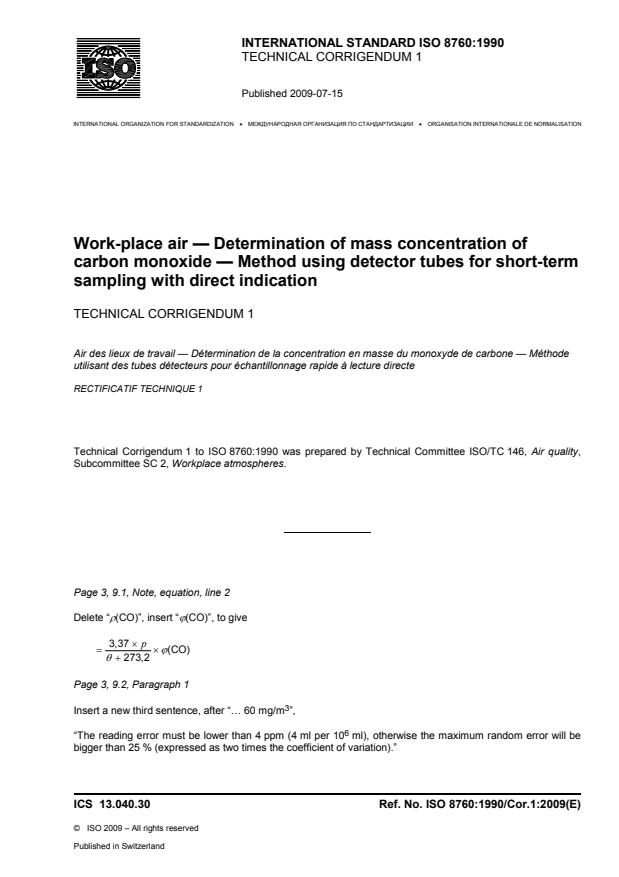
- Equation Adjustment: Corrects the symbol from “ρ(CO)” to “ϕ(CO)” in the concentration calculation formula for accurate representation.
- Measurement Accuracy: Specifies that the reading error must be less than 4 ppm to keep the maximum random error under 25%, enhancing the method’s reliability.
- Standardization Committee: Developed by ISO Technical Committee 146 (Air Quality), Subcommittee SC 2 (Workplace Atmospheres), emphasizing its focus on occupational health.
Applications
This standard is essential for:
- Industrial Hygiene Monitoring: Enables environmental and safety professionals to measure CO exposure levels in factories, workshops, and other workplaces.
- Occupational Health and Safety Compliance: Helps organizations comply with regulatory requirements by providing a reliable and standardized method for CO detection.
- Short-Term Sampling Needs: Ideal for quick assessments of air quality to identify immediate hazards related to carbon monoxide poisoning.
- Risk Management: Supports hazard identification and control in environments where combustion processes or machinery may emit CO.
- Air Quality Research: Facilitates scientific studies related to workplace atmosphere contamination by carbon monoxide.
Related Standards
Professionals using ISO 8760:1990/Cor 1:2009 may also consider these complementary standards for comprehensive workplace air quality management:
- ISO 7546: Sampling methods for airborne contaminants.
- ISO 4225: General principles for air quality measurement.
- ISO 10882: Methods for measurement of other toxic gases in workplace atmospheres.
- ISO/T 146: General guidance on occupational environment air handling and ventilation systems.
Keywords: ISO 8760:1990, carbon monoxide measurement, workplace air quality, detector tubes, occupational health, short-term sampling, CO mass concentration, air quality standard, industrial hygiene, technical corrigendum.
Relations
- Effective Date
- 01-Jan-2022
Buy Documents
ISO 8760:1990/Cor 1:2009 - Work-place air — Determination of mass concentration of carbon monoxide — Method using detector tubes for short-term sampling with direct indication — Technical Corrigendum 1 Released:7/9/2009
Get Certified
Connect with accredited certification bodies for this standard

CIS Institut d.o.o.
Personal Protective Equipment (PPE) certification body. Notified Body NB-2890 for EU Regulation 2016/425 PPE.

Kiwa BDA Testing
Building and construction product certification.
Kmetijski inštitut Slovenije
Agricultural Institute of Slovenia. Soil testing, plant health, agricultural product analysis.
Sponsored listings
Frequently Asked Questions
ISO 8760:1990/Cor 1:2009 is a standard published by the International Organization for Standardization (ISO). Its full title is "Work-place air — Determination of mass concentration of carbon monoxide — Method using detector tubes for short-term sampling with direct indication — Technical Corrigendum 1". This standard covers: Specifies a method for concentrations greater than 10 mg/m. The method is suitable for personal, breathing-zone sampling as well as for the general area sampling. Information on performance characteristics is given. In applications requiring better precision or freedom from interferences, the use of classical chemical or instrumental methods is recommended.
Specifies a method for concentrations greater than 10 mg/m. The method is suitable for personal, breathing-zone sampling as well as for the general area sampling. Information on performance characteristics is given. In applications requiring better precision or freedom from interferences, the use of classical chemical or instrumental methods is recommended.
ISO 8760:1990/Cor 1:2009 is classified under the following ICS (International Classification for Standards) categories: 13.040.30 - Workplace atmospheres. The ICS classification helps identify the subject area and facilitates finding related standards.
ISO 8760:1990/Cor 1:2009 has the following relationships with other standards: It is inter standard links to ISO 8760:1990. Understanding these relationships helps ensure you are using the most current and applicable version of the standard.
ISO 8760:1990/Cor 1:2009 is available in PDF format for immediate download after purchase. The document can be added to your cart and obtained through the secure checkout process. Digital delivery ensures instant access to the complete standard document.
Standards Content (Sample)
INTERNATIONAL STANDARD ISO 8760:1990
TECHNICAL CORRIGENDUM 1
Published 2009-07-15
INTERNATIONAL ORGANIZATION FOR STANDARDIZATION • МЕЖДУНАРОДНАЯ ОРГАНИЗАЦИЯ ПО СТАНДАРТИЗАЦИИ • ORGANISATION INTERNATIONALE DE NORMALISATION
Work-place air — Determination of mass concentration of
carbon monoxide — Method using detector tubes for short-term
sampling with direct indication
TECHNICAL CORRIGENDUM 1
Air des lieux de travail — Détermination de la concentration en masse du monoxyde de carbone — Méthode
utilisant des tubes détecteurs pour échantillonnage rapide à lecture directe
RECTIFICATIF TECHNIQUE 1
Technical Corrigendum 1 to ISO 8760:1990 was prep
...
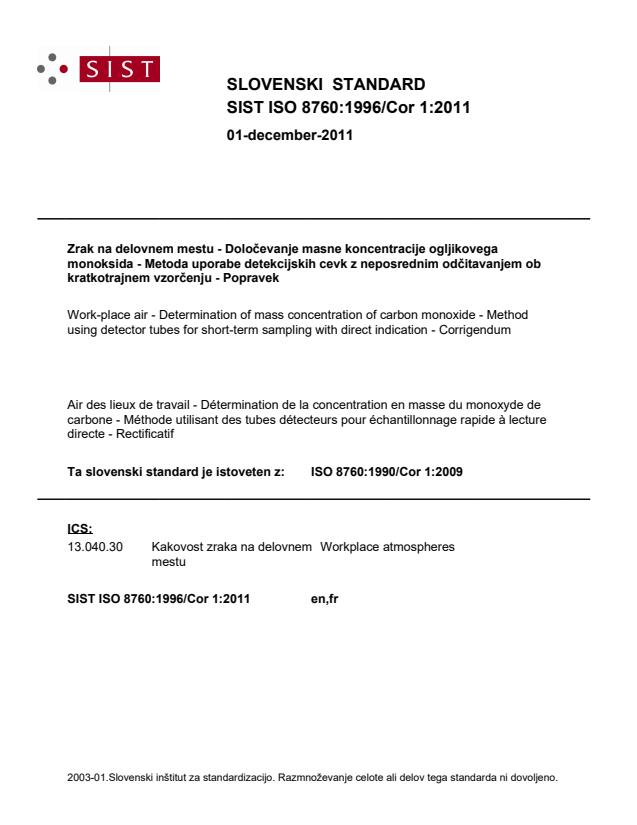
2003-01.Slovenski inštitut za standardizacijo. Razmnoževanje celote ali delov tega standarda ni dovoljeno.HJDAir des lieux de travail - Détermination de la concentration en masse du monoxyde de carbone - Méthode utilisant des tubes détecteurs pour échantillonnage rapide à lecture directe - RectificatifWork-place air - Determination of mass concentration of carbon monoxide - Method using detector tubes for short-term sampling with direct indication - Corrigendum13.040.30Kakovost zraka na delovnem mestuWorkplace atmospheresICS:Ta slovenski standard je istoveten z:ISO 8760:1990/Cor 1:2009SIST ISO 8760:1996/Cor 1:2011en,fr01-december-2011SIST ISO 8760:1996/Cor 1:2011SLOVENSKI
STANDARD
ICS
13.040.30 Ref. No. ISO 8760:1990/Cor.1:2009(E)©
ISO 2009 – All rights reserved Published in Switzerland
INTERNATIONAL STANDARD ISO 8760:1990 TECHNICAL CORRIGENDUM 1 Published 2009-07-15 INTERNATIONAL ORGANIZATION FOR STANDARD
...