

ISO/IEC 29180:2012
(Main)Information technology — Telecommunications and information exchange between systems — Security framework for ubiquitous sensor networks
General Information
- Abstract
The recent advancement of wireless-based communication technology and electronics has facilitated the implementation of a low-cost, low-power sensor network. Basically, a ubiquitous sensor network (USN) consists of three parts: a sensor network consisting of a large number of sensor nodes, a base station (also known as a gateway) interfacing between the sensor network and an application server, and the application server controlling the sensor node in the sensor network or collecting the sensed information from the sensor nodes in the sensor network. ISO/IEC 29180:2012 describes the security threats to and security requirements of the USN. In addition, it categorizes the security technologies according to the security functions that satisfy the said security requirements and where the security technologies are applied in the security model of the USN. Finally, the security functional requirements and security technologies for the USN are presented.
- Status
- Published
- Publication Date
- 29-Nov-2012
- Drafting Committee
- ISO/IEC JTC 1/SC 6/WG 7 - Network, transport and future network
- Current Stage
- 9093 - International Standard confirmed
- Start Date
- 23-Dec-2024
- Completion Date
- 29-Aug-2026


Overview
ISO/IEC 29180:2012 - "Security framework for ubiquitous sensor networks" defines a security architecture, threat models, and functional requirements for ubiquitous sensor networks (USNs). A USN typically comprises large numbers of sensor nodes, a base station/gateway, and an application server. The standard describes security threats across the sensor, IP and application domains, categorizes security technologies by function and location in the USN security model, and lists mandatory, recommended and optional security functions.
Key technical topics and requirements
ISO/IEC 29180 organizes security guidance around practical functions and threats:
- Threat models and security model: Threats in sensor networks and IP networks, plus a unified USN security model.
- Key management and key establishment: Secure procedures for pair-wise, group-wise and bootstrapped keys (Annex A).
- Authenticated broadcast: Mechanisms for trustworthy multicast/broadcast in constrained nodes (Annex B describes µTPC schemes).
- Secure data aggregation: Techniques to preserve integrity of aggregated sensor data and detect malicious aggregators (Annex D).
- Data freshness and replay protection: Requirements to prevent reuse of old sensor messages.
- Sensor node authentication and authorization: Methods for ensuring node identity and secure access control (Annex C covers several authentication mechanisms).
- Tamper-resistance and cryptographic module guidance: Use of tamper-resistant modules to protect keys and credentials.
- USN middleware and IP network security: Interfaces between sensor networks and application servers; interaction with IP-domain security.
- Privacy protection and intrusion detection: Requirements to protect personal and contextual information and detect anomalies.
- Functional requirements classification: Mandatory, recommended and optional security functions tailored to USN constraints.
Practical applications and users
ISO/IEC 29180 is intended for:
- IoT / USN architects and system designers building large-scale sensor deployments (smart cities, environmental monitoring, industrial sensing).
- Security engineers and integrators implementing key management, authentication, aggregation integrity and gateway security.
- Product developers of low-power sensor nodes, gateways and USN middleware seeking interoperable security baselines.
- Standards adopters and compliance teams mapping system security to international best practices. Practical benefits include guidance to reduce threats like node compromise, data tampering, replay attacks and privacy leakage while respecting resource constraints of sensor hardware.
Related standards
- ITU‑T Rec. X.1311 (identical text)
- ITU‑T X.800 / ISO/IEC 7498‑2 (security architecture)
- ITU‑T X.805 / ISO/IEC 18028‑2 (network security architecture)
- ITU‑T Y.2221 (USN requirements), FIPS 140‑2 (cryptographic module requirements)
Use ISO/IEC 29180:2012 as a reference when designing secure, privacy-aware ubiquitous sensor networks that bridge constrained devices and IP-based services.
Get Certified
Connect with accredited certification bodies for this standard

BSI Group
BSI (British Standards Institution) is the business standards company that helps organizations make excellence a habit.

NYCE
Mexican standards and certification body.
Sponsored listings
Frequently Asked Questions
ISO/IEC 29180:2012 is a standard published by the International Organization for Standardization (ISO). Its full title is "Information technology — Telecommunications and information exchange between systems — Security framework for ubiquitous sensor networks". This standard covers: The recent advancement of wireless-based communication technology and electronics has facilitated the implementation of a low-cost, low-power sensor network. Basically, a ubiquitous sensor network (USN) consists of three parts: a sensor network consisting of a large number of sensor nodes, a base station (also known as a gateway) interfacing between the sensor network and an application server, and the application server controlling the sensor node in the sensor network or collecting the sensed information from the sensor nodes in the sensor network. ISO/IEC 29180:2012 describes the security threats to and security requirements of the USN. In addition, it categorizes the security technologies according to the security functions that satisfy the said security requirements and where the security technologies are applied in the security model of the USN. Finally, the security functional requirements and security technologies for the USN are presented.
The recent advancement of wireless-based communication technology and electronics has facilitated the implementation of a low-cost, low-power sensor network. Basically, a ubiquitous sensor network (USN) consists of three parts: a sensor network consisting of a large number of sensor nodes, a base station (also known as a gateway) interfacing between the sensor network and an application server, and the application server controlling the sensor node in the sensor network or collecting the sensed information from the sensor nodes in the sensor network. ISO/IEC 29180:2012 describes the security threats to and security requirements of the USN. In addition, it categorizes the security technologies according to the security functions that satisfy the said security requirements and where the security technologies are applied in the security model of the USN. Finally, the security functional requirements and security technologies for the USN are presented.
ISO/IEC 29180:2012 is classified under the following ICS (International Classification for Standards) categories: 35.110 - Networking. The ICS classification helps identify the subject area and facilitates finding related standards.
ISO/IEC 29180:2012 is available in PDF format for immediate download after purchase. The document can be added to your cart and obtained through the secure checkout process. Digital delivery ensures instant access to the complete standard document.
Standards Content (Sample)
INTERNATIONAL ISO/IEC
STANDARD 29180
First edition
2012-12-01
Information technology —
Telecommunications and information
exchange between systems — Security
framework for ubiquitous sensor
networks
Technologies de l'information — Télécommunications et échange
d'informations entre systèmes — Cadre de sécurité pour réseaux de
capteurs ubiquitaires
Reference number
©
ISO/IEC 2012
© ISO/IEC 2012
All rights reserved. Unless otherwise specified, no part of this publication may be reproduced or utilized in any form or by any means,
electronic or mechanical, including photocopying and microfilm, without permission in writing from either ISO at the address below or
ISO's member body in the country of the requester.
ISO copyright office
Case postale 56 CH-1211 Geneva 20
Tel. + 41 22 749 01 11
Fax + 41 22 749 09 47
E-mail copyright@iso.org
Web www.iso.org
Published in Switzerland
ii © ISO/IEC 2012 – All rights reserved
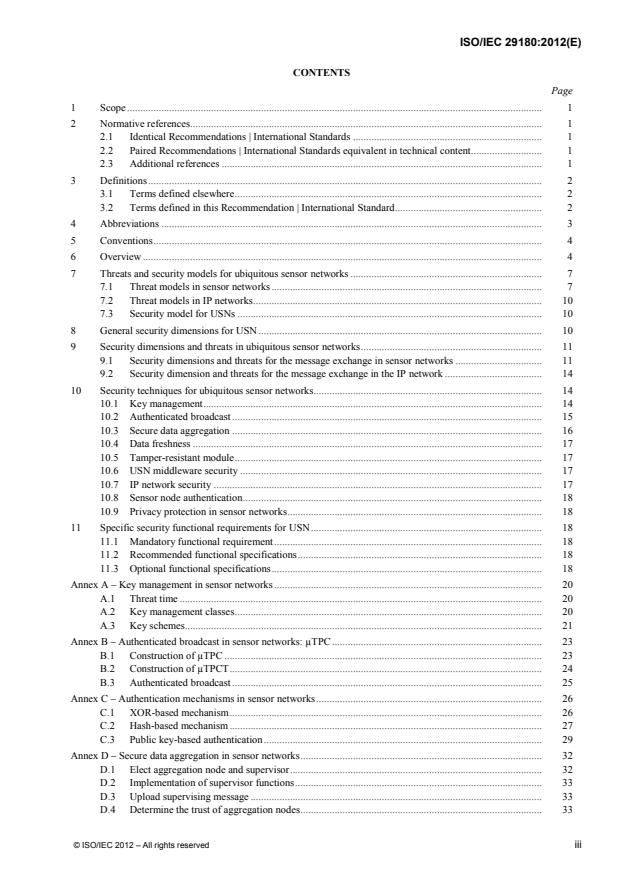
CONTENTS
Page
1 Scope . 1
2 Normative references. 1
2.1 Identical Recommendations | International Standards . 1
2.2 Paired Recommendations | International Standards equivalent in technical content . 1
2.3 Additional references . 1
3 Definitions . 2
3.1 Terms defined elsewhere . 2
3.2 Terms defined in this Recommendation | International Standard . 2
4 Abbreviations . 3
5 Conventions . 4
6 Overview . 4
7 Threats and security models for ubiquitous sensor networks . 7
7.1 Threat models in sensor networks . 7
7.2 Threat models in IP networks . 10
7.3 Security model for USNs . 10
8 General security dimensions for USN . 10
9 Security dimensions and threats in ubiquitous sensor networks . 11
9.1 Security dimensions and threats for the message exchange in sensor networks . 11
9.2 Security dimension and threats for the message exchange in the IP network . 14
10 Security techniques for ubiquitous sensor networks . 14
10.1 Key management . 14
10.2 Authenticated broadcast . 15
10.3 Secure data aggregation . 16
10.4 Data freshness . 17
10.5 Tamper-resistant module . 17
10.6 USN middleware security . 17
10.7 IP network security . 17
10.8 Sensor node authentication . 18
10.9 Privacy protection in sensor networks . 18
11 Specific security functional requirements for USN . 18
11.1 Mandatory functional requirement . 18
11.2 Recommended functional specifications . 18
11.3 Optional functional specifications . 18
Annex A – Key management in sensor networks . 20
A.1 Threat time . 20
A.2 Key management classes . 20
A.3 Key schemes. 21
Annex B – Authenticated broadcast in sensor networks: µTPC . 23
B.1 Construction of µTPC . 23
B.2 Construction of µTPCT . 24
B.3 Authenticated broadcast . 25
Annex C – Authentication mechanisms in sensor networks . 26
C.1 XOR-based mechanism . 26
C.2 Hash-based mechanism . 27
C.3 Public key-based authentication . 29
Annex D – Secure data aggregation in sensor networks . 32
D.1 Elect aggregation node and supervisor . 32
D.2 Implementation of supervisor functions . 33
D.3 Upload supervising message . 33
D. 4 Determine the trust of aggregation nod es. 33
© ISO/IEC 2012 – All rights reserved iii
Page
D.5 Send revocation message . 33
Bibliography . 34
iv © ISO/IEC 2012 – All rights reserved
Foreword
ISO (the International Organization for Standardization) and IEC (the International Electrotechnical
Commission) form the specialized system for worldwide standardization. National bodies that are members of
ISO or IEC participate in the development of International Standards through technical committees
established by the respective organization to deal with particular fields of technical activity. ISO and IEC
technical committees collaborate in fields of mutual interest. Other international organizations, governmental
and non-governmental, in liaison with ISO and IEC, also take part in the work. In the field of information
technology, ISO and IEC have established a joint technical committee, ISO/IEC JTC 1.
International Standards are drafted in accordance with the rules given in the ISO/IEC Directives, Part 2.
The main task of the joint technical committee is to prepare International Standards. Draft International
Standards adopted by the joint technical committee are circulated to national bodies for voting. Publication as
an International Standard requires approval by at least 75 % of the national bodies casting a vote.
Attention is drawn to the possibility that some of the elements of this document may be the subject of patent
rights. ISO and IEC shall not be held responsible for identifying any or all such patent rights.
ISO/IEC 29180 was prepared by Joint Technical Committee ISO/IEC JTC 1, Information technology,
Subcommittee SC 6, Telecommunications and information exchange between systems, in collaboration with
ITU-T. The identical text is published as Rec. ITU-T X.1311 (02/2011).
© ISO/IEC 2012 – All rights reserved v
Introduction
This Recommendation | International Standard describes the security threats to and security requirements of the
ubiquitous sensor network. In addition, this Recommendation | International Standard categorizes the security
technologies according to the security functions that satisfy the said security requirements and where the security
technologies are applied in the security model of ubiquitous sensor networks. Finally, the security functional
requirements and security technologies for the ubiquitous sensor networks are presented.
vi © ISO/IEC 2012 – All rights reserved
INTERNATIONAL STANDARD
RECOMMENDATION ITU-T
Information technology – Security framework for ubiquitous sensor networks
1 Scope
The recent advancement of wireless-based communication technology and electronics has facilitated the
implementation of a low-cost, low-power sensor network. Basically, a ubiquitous sensor network (USN) consists of
three parts: a sensor network consisting of a large number of sensor nodes, a base station (also known as a gateway)
interfacing between the sensor networks and an application server, and the application server controlling the sensor
node in the sensor network or collecting the sensed information from the sensor nodes in the sensor network.
USN can be an intelligent information infrastructure of advanced e-Life society, which delivers user-oriented
information and provides knowledge services to anyone anytime, anywhere and wherein information and knowledge are
developed using context awareness by detecting, storing, processing, and integrating the situational and environmental
information gathered from sensor tags and/or sensor nodes affixed to anything. Since there are many security and
privacy threats in transferring and storing information in the USN, appropriate security mechanisms may be needed to
protect against those threats in the USN.
This Recommendation | International Standard describes the security threats to and security requirements of the
ubiquitous sensor network. In addition, this Recommendation | International Standard categorizes the security
technologies according to the security functions that satisfy the said security requirements and where the security
technologies are applied in the security model of the USN. Finally, the security requirements and security technologies
for the USN are presented.
2 Normative references
The following Recommendations and International Standards contain provisions which, through reference in this text,
constitute provisions of this Recommendation | International Standard. At the time of publication, the editions indicated
were valid. All Recommendations and Standards are subject to revision, and parties to agreements based on this
Recommendation | International Standard are encouraged to investigate the possibility of applying the most recent
edition of the Recommendations and Standards listed below. Members of IEC and ISO maintain registers of currently
valid International Standards. The Telecommunication Standardization Bureau of the ITU maintains a list of currently
valid ITU-T Recommendations.
2.1 Identical Recommendations | International Standards
None.
2.2 Paired Recommendations | International Standards equivalent in technical content
– Recommendation ITU-T X.800 (1991), Security architecture for Open Systems Interconnection for CCITT
applications.
ISO/IEC 7498-2:1989, Information processing systems – Open Systems Interconnection – Basic Reference
Model – Part 2: Security Architecture.
– Recommendation ITU-T X.805 (2003), Security architecture for systems providing end-to-end
communications.
ISO/IEC 18028-2:2006, Information technology – Security techniques – IT network security Part 2:
Network security architecture.
2.3 Additional references
– Recommendation ITU-T H.235.0 (2005), H.323 security: Framework for security in H-series (H.323 and
other H.245-based) multimedia systems.
– Recommendation ITU-T X.1111 (2007), Framework of security technologies for home network.
– Recommendation ITU-T X.1191 (2009), Functional requirements and architecture for IPTV security aspects.
Rec. ITU-T X.1311 (02/2011) 1
– Recommendation ITU-T Y.2221 (2010), Requirements for support of ubiquitous sensor network (USN)
applications and services in the NGN environment.
– Recommendation ITU-T Y.2701 (2007), Security requirements for NGN release 1.
– FIPS PUB 140-2 (2001), Security Requirements for Cryptographic Modules.
3 Definitions
3.1 Terms defined elsewhere
This Recommendation | International Standard uses the following terms defined elsewhere:
3.1.1 Terms from FIPS PUB 140-2
a) key transport
b) tamper detection
c) tamper evidence
d) tamper response.
3.1.2 Terms from Rec. ITU-T Y.2221
a) sensor
b) sensor network
c) USN middleware
d) ubiquitous sensor network (USN).
3.1.3 Terms from Rec. ITU-T H.235.0
a) attack.
3.1.4 Terms from Rec. ITU-T X.1191
a) tamper-resistant.
3.1.5 Terms from Rec. ITU-T X.800 | ISO/IEC 7498-2
This Recommendation | International Standard uses the following terms, which are defined elsewhere:
a) access control
b) authentication
c) authorization
d) confidentiality
e) data origin authentication
f) denial of service
g) digital signature
h) integrity
i) key
j) key management
k) peer-entity authentication
l) privacy
m) repudiation
n) security policy
o) threat.
3.2 Terms defined in this Recommendation | International Standard
For the purposes of this Recommendation | International Standard, the following definitions apply:
3.2.1 aggregator node: Sensor node that performs the data aggregation function in a sensor network.
2 Rec. ITU-T X.1311 (02/2011)
3.2.2 bootstrapping: Refers to a process performed in a secure context prior to the deployment of the sensor node
to establish a security association between the sensor nodes that may have been initialized with credentials, enabling a
sensor node to communicate securely with other sensor nodes after their deployment.
3.2.3 credentials: Set of security-related information consisting of keys, keying materials, and cryptographic
algorithm-related parameters permitting a successful interaction with a security system.
3.2.4 data aggregation: In-network process that transfers the aggregation value to the sink node by combining the
sensed values sent by a number of sensor nodes into concise digest.
3.2.5 group-wise key: Refers to a key that is used to protect multicast communications among a set of sensor nodes
over a shared wireless link.
3.2.6 intrusion detection: Process of monitoring the events occurring in a computer system or a network and
analysing them for intrusions.
3.2.7 key agreement: A key establishment procedure (either manual or electronic) where the resultant key is a
function of information by two or more participants, so that no party can predetermine the value of the key
independently of the other party's contribution.
3.2.8 key establishment: Process by which cryptographic keys are securely established among sensor nodes using
key transport and/or key agreement procedures.
3.2.9 pair-wise key: It refers to a key that is used to protect unicast communication between a pair of sensor nodes
over a single wireless link.
3.2.10 resilience: Ability to recover from security compromises or attacks.
3.2.11 secure data aggregation: Data aggregation that ensures the integrity of the results in the presence of a small
number of malicious aggregation nodes that may be attempting to influence the result.
3.2.12 tamper-resistant module: A device designed to make it difficult for attackers to gain access to sensitive
information contained in the module.
4 Abbreviations
For the purposes of this Recommendation | International Standard, the following abbreviations apply:
BNode Broadcast Node
BS Base Station
CDMA Code Division Multiple Access
DDoS Distributed Denial of Service
DoS Denial of Service
ECDH Elliptic Curve Diffie-Hellman
FP Feature Parameters
GSM Global System for Mobile Communications
HSDPA High Speed Downlink Packet Access
ID Identity
MAC Medium Access Control; Message Authentication Code
NGN Next-Generation Network
PHY physical layer
RFID Radio-Frequency IDentification
SN Sensor Network
TPM Trusted Platform Module
USN Ubiquitous Sensor Network
WCDMA Wideband CDMA
WiMAX Worldwide Interoperability for Microwave Access
WLAN Wireless Local Area Network
WSN Wireless Sensor Network
Rec. ITU-T X.1311 (02/2011) 3
5 Conventions
In this Recommendation | International Standard:
The keywords "is required to" indicate a requirement which must be strictly followed and from which no deviation is
permitted, if conformance to this Recommendation | International Standard is to be claimed.
The keywords "is recommended" indicate a requirement which is recommended but which is not absolutely required.
Thus this requirement need not be present to claim conformance.
The keywords "is prohibited from" indicate a requirement which must be strictly followed and from which no
deviation is permitted, if conformance to this Recommendation | International Standard is to be claimed.
The keywords "can optionally" indicate an optional requirement which is permissible, without implying any sense of
being recommended. This term is not intended to imply that the vendor's implementation must provide the option and
the feature can be optionally enabled by the network operator/service provider. Rather, it means the vendor may
optionally provide the feature and still claim conformance with this Recommendation | International Standard.
6 Overview
Figure 1 shows the major application areas for USN including home network application, pollution monitoring, fire
monitoring, telemetry applications for utility companies (electricity, gas, water, etc.), urban resource
monitoring/management applications (e.g., smart city infrastructure), and flood monitoring.
Structural health
monitoring Home utility control Pollution monitoring
Disaster/crisis
management
Home network
Fire monitoring
Telematics, ITS
USN
Flood monitoring
Agricultural control
Logistics, SCM
Military fields
Mobile RFID/USN Sensor node
Figure 1 – Application areas for USN
Figure 2 describes the overall structure of USN. Based on such a basic structure, the security model should be defined
for USN security.
4 Rec. ITU-T X.1311 (02/2011)
USN Disaster/crisis
services management
USN applications
Logistics, Structural health Agricultural
SCM monitoring control Disaster surveillance Military field U-health care
Ubiquitous Context modelling
and management
web services USN middleware
Service
Management Contents management orchestration
USN
directory service
NGN
Access Access
Access
network
Access
Access
network network
network
Access gateway
network
USN gateway USN gateway
Mobile
RFID
Sensor networks
Sensor node
RFID
reader
reader
Sensor Sink node
USN gateway
networks
Figure 2 – Overall structure of USN
The sensor networking domain of USN usually corresponds to the sensor node (SN) but includes wire-line sensor
networks as well. Thus, many kinds of wired and wireless networking technologies may be used according to the
service characteristics and requirements. That is, sensor nodes use different PHY/MAC (e.g., IEEE 802.15.4) layers or
operate differently in IP-based or non-IP based networks.
Sensor networks are not isolated but are usually connected to customer networks via various access networks and core
networks as shown in Figure 2. The access networking domain corresponds to many access networking technologies,
e.g., WLAN, mobile WiMAX, or cellular networks. Core networks include NGN, the Internet, etc. USN may require
some extensions and/or additions to core network architectures to cover new functional capability requirements
extracted from USN applications and services. For instance, home security monitoring application requires some
application-specific functional capability specifications. The USN middleware will consist of many software
functionalities such as context models and processing, sensory information gathering, data filtering, contents
management, web services functions, network and software management, sensor profile management, directory
services, interworking gateways, etc. Based on all these functions, USN applications and services can be established
and provided to customers as well as enterprises, organizations, and government.
The security model for USN can be divided into 2 parts: one for the IP network and the other for the wireless sensor
network. This Recommendation | International Standard seeks to develop the security model for the SN as well as the
IP network.
The communication patterns within our SN fall into five categories:
• Node-to-base station communication, e.g., sensor readings or special alerts.
• Base station-to-node communication, e.g., specific requests.
• Communication between a base station to all sensor nodes, e.g., routing beacons, queries, or
reprogramming of the entire sensor network.
• Node-to-node communications including communications among a defined cluster of sensor nodes, e.g.,
communications between a sensor node and all its neighbours.
• Communications between a base station and a group of nodes wherein the group is defined by nodes
sharing a common property (e.g., location, software version, etc.).
Rec. ITU-T X.1311 (02/2011) 5
The following assumptions can be made:
• The base station is computationally robust, having the requisite processor speed, memory, and power to
support the cryptographic and routing requirements of the sensor network. The base station, a gateway
which interconnects sensor networks with other networks, may be part of a trusted computing
environment.
• Communication is from base station to sensor, from sensor to base station, from sensor to its neighbours,
and from node to node.
Therefore, how security technologies are integrated should be taken into account.
Figure 3 – USN network configuration
The following are the characteristics of the sensor network:
• The sensor network consists of many sensor nodes interconnected by a wireless medium.
• Sensor nodes are deployed densely in a wide area or a hostile context.
• Sensor nodes are vulnerable to failure.
• The communication from the base station (BS) to the sensor node would be of the broadcast type or
point-to-point type.
• A sensor node has limited power, computational capacity, and memory.
• A sensor node may not have global identification.
There are three components in the SN: the application server communicating with the sink node; the sink node called
the base station, which interfaces the sensor network and the application server, and the collection of sensor nodes using
wireless communication to communicate with each other. The sink may communicate with the application server via
the Internet or a satellite. Security architecture in the IP-based network is very similar to that in Rec. ITU-T X.805 |
ISO/IEC 18028-2. Therefore, this Recommendation | International Standard focuses on the security of the wireless
sensor network (SN) consisting of a set of sensor nodes using wireless transmission.
To communicate information between sensor nodes, a secure association between sensor nodes needs to be established
before secure communication between them can be realized. Note, however, that the following characteristics of the
sensor network render the design of secure communication very difficult:
• Difficulty of using public key cryptosystems: The limited computational power, memory size, and
power supply make it very difficult to use a public key cryptosystem – such as Diffie-Hellman key
agreement or RSA encryption and signature. Even though a specific sensor node may have enough
resources to perform the very complex operations required for a public key cryptosystem, it may become
vulnerable to a denial of service attack as described in clause 7.1.1.
• Vulnerability of sensor nodes: Since sensor nodes may be deployed in hostile locations, their security
may be compromised. After obtaining physical access to the sensor node, the attacker is able to access
sensitive information such as key information or sensed information. This attack can be prevented by
using a tamper-resistant sensor node, which entails a high cost. Moreover, a large number of sensor
nodes render the employment of the tamper-resistant sensor node very difficult since it may result in a
6 Rec. ITU-T X.1311 (02/2011)
high-cost network. For some applications (e.g., military, safety-critical applications, etc.), however, the
higher costs incurred in employing tamper-resistant sensor nodes may be acceptable.
• Difficulty in obtaining post-deployment knowledge: In most cases, the sensor nodes will be deployed
in a randomly scattered manner; hence, the difficulty for the security protocol to know the location of
neighbouring nodes.
• Limited memory size, transmission power, and transmission bandwidth: Since the memory in sensor
nodes is limited, storing the unique keys used with other sensor nodes in the network is very difficult.
Moreover, a typical sensor node has low capability in terms of transmission bandwidth and power to
communicate with neighbour nodes.
• Single point of failure of a base station: In sensor networks, a base station is a gateway to communicate
the sensed information to an application server through the IP-based core network. The security of the
sensor network relies on that of the base station. Therefore, base stations could become an appealing
target for various types of attack.
Figure 4 presents a general model of an end-to-end communication between a sensor node in the SN and an AS. There
may be cases wherein the application server resides in the gateway.
Gateway
Sensor
node
Application
server
(AS)
Sensor network Open network
Figure 4 – General model of an end-to-end communication between a sensor node in the SN and an AS
The potential layers for implementing the security function in USNs is shown in Figure 5. The basic security layer,
corresponding to MAC or link layer, is responsible for the link-by-link data transfer between sensor nodes or between
the sensor node and a gateway. The service layer, corresponding to the network layer, is responsible for network data
transfer between sensor nodes and between a sensor node and a gateway. Typical examples of the service layer include
the transfer of broadcast messages from the gateway to the sensor node and vice versa. The security of the service layer
and the basic function layer should implement the security functions described in clause 10, corresponding to the
network layer and link layer security, respectively. Note that for some applications, the application security function
resides in a gateway rather than in an application server.
Server Gateway Sensor node
Security for Security for
application layer application layer
Security for Security for
Broadcast/routing
transport layer transport layer Security for
Security for
service layer
service layer
Security for Security for
network layer network layer
Security for
Security for
Hop-by-hop security
Security Security
basic function
basic function
for link layer for link layer
layer
layer
Figure 5 – Layers implementing security functions for USN
7 Threats and security models for ubiquitous sensor networks
The threats to USNs can be classified into threats to the IP network and threats to the SN.
7.1 Threat models in sensor networks
There are two types of attackers in the SN: a mote-type attacker and a laptop-type attacker. In the former, the attacker
has a capability similar to the sensor node; it can have access to a few sensor nodes. An attacker with a mote-type
device may be able to jam the radio link in its vicinity. In the latter, an attacker may have access to more powerful
devices such as a laptop computer. An attacker with a laptop-type device may eavesdrop on the communication in the
Rec. ITU-T X.1311 (02/2011) 7
sensor network and have high-bandwidth, low-latency communications channel; it can also jam the entire sensor
network using a high-power transmitter. There are two types of threats for the SN: general threats and routing-related
threats. The threats in the SN are applied to the communication between the base station and the sensor node and
between the nodes, as described in clause 7.1.1. Routing-related threats are applied to the routing message exchange, as
described in clause 7.1.2.
7.1.1 General threats in sensor networks
Rec. ITU-T X.800 | ISO/IEC 7498-2 and Rec. ITU-T X.805 | ISO/IEC 18028-2 cite the following security threats to the
networks (note that these are also security threats applicable to the SN):
• Destruction of information and/or other resources
• Corruption or modification of information
• Theft, removal, or loss of information and/or other resources
• Disclosure of information
• Interruption of services.
In addition to these, there are many sensor node-specific threats such as sensor node vulnerability, eavesdropping,
privacy of sensed data, denial of service attack, and malicious use of commodity network (see Chan et al. in the
Bibliography).
• Vulnerability of sensor nodes: Sensor networks are expected to consist of hundreds or thousands of
sensor nodes. Each node represents a potential point of attack, rendering the monitoring and protection of
each individual sensor from either a physical or a logical attack impractical. The networks may be
dispersed over a large area, further exposing them to attackers capturing and reprogramming individual
sensor nodes. Attackers can also obtain their own commodity sensor nodes and induce the network to
accept them as legitimate nodes, or they can claim multiple identities for an altered node. Once in control
of a few nodes inside the network, the attacker can then mount a variety of attacks such as falsification of
sensor data, extraction of private sensed information from sensor network readings, and denial of service.
Addressing the problem of sensor node vulnerability requires technological solutions. For example,
cheap tamper-resistant hardware could pose a challenge to reprogramming the captured sensor nodes.
Still, making nodes robust to tampering is not economically viable. Therefore, we should assume that an
attacker can compromise a subset of the sensor nodes. As such, at the software level, sensor networks
need new capabilities to ensure secure operation even in the presence of a small number of malicious
network nodes. Node-to-node authentication is one basic building block for enabling network nodes to
prove their identity to each other. Node revocation can then exclude malicious nodes. Achieving these
goals, given the resource-limited hardware, will require lightweight security protocols. Furthermore, all
communication and data-processing protocols used in sensor networks must be made resilient, i.e., be
able to function at high effectiveness even with a small number of malicious nodes. For example, routing
protocols must be resilient against compromised nodes that behave maliciously.
• Eavesdropping: In wireless sensor network communications, an adversary can gain access to private
information by monitoring transmissions between nodes. For example, a few wireless receivers placed
outside a house may be able to monitor the light and temperature readings of sensor networks inside the
house, thus revealing detailed information on the occupants' personal daily activities. Encrypting sensor
node communications partly solves eavesdropping problems, but requires a robust key exchange and
distribution scheme. The scheme must be simple for the network owner to execute and be feasible for the
limited sensor node hardware to implement. It must also maintain secrecy in the rest of the network when
an adversary compromises a few sensor nodes and exposes their secret keys. Ideally, these schemes
would also allow the revocation of known exposed keys and rekeying of sensor nodes. The large number
of communicating nodes makes end-to-end encryption usually impractical since sensor node hardware
can rarely store a large number of unique encryption keys. Instead, sensor network designers may choose
hop-by-hop encryption wherein each sensor node stores only encryption keys shared with its immediate
neighbours. In this case, adversary control of a communication node eliminates the encryption's
effectiveness for any communication directed through the compromised node. This situation could be
exacerbated if an adversary manipulates the routing infrastructure to send many communications through
a malicious node. More robust routing protocols serve as one solution to this problem. Another solution
is multipath routing, which routes parts of a message over multiple disjoint paths and reassembles them
at the destination. Multipath routing may enhance USN's resilience to attacks or compromises. The
efficient discovery of the best disjoint paths to use for such an operation poses another research
challenge. Note that this threat happens in the fixed core network and has relevance to privacy
infringement in a sensor network.
8 Rec. ITU-T X.1311 (02/2011)
• Secrecy of sensed data: Sensor networks are tools for collecting information; an adversary can gain
access to sensitive information either by accessing stored sensor data or by querying or eavesdropping on
the network. Adversaries can use even seemingly innocuous data to derive sensitive information if they
know how to correlate multiple sensor inputs. For example, an adversary gaining access to both indoor
and outdoor sensors of a home may be able to isolate internal noise from external noise and consequently
extract details of the inhabitants' private activities. However, the fact that sensor networks enable the
collection of information that would otherwise be impossible to collect is not the main privacy problem.
In fact, a lot of information from sensor networks could probably be collected through direct site
surveillance. Sensor networks exacerbate the privacy problem because they make large volumes of
information easily available through remote access. Thus, attackers need not be physically present to
maintain surveillance. They can gather information in a low-risk, anonymous manner. Remote access
also allows a single adversary to monitor multiple sites simultaneously. Ensuring that sensed information
stays within the sensor network and remains accessible only to trusted parties is an essential step to
ensuring privacy. Data encryption and access control serve as one approach. Another way is to restrict
the network's ability to gather data in details in such a way that could compromise privacy. For example,
a sensor network might anonymize data by reporting only aggregate temperatures over a wide area or
approximate locations of the sensed individuals. A system stores the sensed data in an anonymized
database, removing details that an adversary might find useful. Another approach is to process queries in
the sensor network in a distributed manner so that no single node can observe the query results in their
entirety. This approach guards against potential system abuse by compromised malicious nodes.
• DoS attacks: As safety-critical applications use more sensor networks, the potential damage of
operational disruptions becomes significant. Defending against denial-of-service attacks – which aim to
destroy network functionality rather than subverting it or using the sensed information – is extremely
difficult. DoS attacks can occur at the physical layer, e.g., via radio jamming. They can also involve
malicious transmissions into the network to interfere with sensor network protocols or physically destroy
central network nodes. Attackers can induce battery discharge in sensor nodes – for example, by sending
a sustained series of useless communications that make the targeted nodes expend energy in processing
them and forwarding them to other nodes as well. More insidious attacks can occur from inside the
sensor network if attackers can compromise the sensor nodes. For instance, they could create routing
loops that will eventually exhaust all nodes in the loop. Potential defenses against denial-of service
attacks are as varied as the attacks themselves. Techniques such as spread-spectrum communication or
frequency hopping can counter jamming attacks. Proper authentication can also prevent injected
messages from being accepted by the network. Note, however, that the protocols involved must be
efficient so that they themselves do not become targets of an energy-exhaustion attack. For example,
using signatures based on asymmetric cryptography can provide message authentication. However, the
creation and verification of asymmetric signatures are highly computationally intensive, and attackers
that can induce a large number of these operations can mount an effective energy-exhaustion attack.
• Malicious use of commodity networks: The proliferation of sensor networks will inevitably extend to
criminals who can use them for illegal purposes. For example, thieves can hack home automation sensors
or even simply eavesdrop on their activity to gain private information on the presence, location, etc., of
the owners and act accordingly. If the sensors are small enough, they can also be planted on computers
and cell phones to extract private information and passwords. Such widespread use will lower the cost
and availability barriers that are supposed to discourage such attacks. Sensor detectors offer one possible
defense against such attacks. A detector must not only be able to detect the presence of potentially hostile
wireless communications within an area that may have significant levels of radio interference but also be
able to differentiate between the transmissions of authorized and unauthorized sensor networks and other
devices. Although such technologies may not prevent unauthorized parties from deploying sensor
networks in sensitive areas, they would make them more costly, thus alleviating the problem.
7.1.2 Routing-specific threats
Rec. ITU-T X.800 | ISO/IEC 7498-2 and Rec. ITU-T X.805 | ISO/IEC 18028-2 identify five threats that are applicable
to routing-related message exchange in the SN. In addition to these, seven threats are identified in (see Karlrof et al. in
the Bibliography) with regard to the routing messages exchanged between sensor nodes.
• Spoofed, altered, replayed routing information: The attacker is able to spoof, alter, and replay the
routing information, enabling the creation of a routing loop, attracting network traffic, extending source
routing, and increasing end-to-end latency.
• Selective forwarding: It refers to the attack wherein a compromised node by an attacker may refuse to
forward certain messages and drop them, stopping further propagation.
• Sinkhole attack: It pertains to the attack wherein the attacker attracts all the traffic from a particular area
through a compromised node.
Rec. ITU-T X.1311 (02/2011) 9
• Sybil attacks: It refers to the attack wherein a single node presents multiple identities to other nodes in
the network, convincing every node that an adversary exists in more than one place at once.
• Wormhole attacks: In a wormhole attack, an adversary tunnels messages received in one part over a
low-latency link and replays them in a different part. Wormhole attacks will involve two distinct
malicious nodes colluding to understate their distance from each other by replaying the packet along an
out-of-band channel available only to the attackers.
• HELLO flood attacks: It pertains to the attack wherein a laptop-type attacker broadcasts HELLO
packets convincing every node in the network that the adversary is its neighbour.
• Acknowledgment spoofing: In acknowledgment spoofing, an adversary can spoof link layer
acknowledgment for "overheard" packet addressed to the neighbouring node, convincing the sender that
a weak link is strong, or a dead or a disabled node is alive.
Note that simple attacks exploiting any of the threats described above may even be used in combination to create more
complex attacks (e.g., combination of Sybil and Sinkhole or Wormhole).
7.2 Threat models in IP networks
The threat models developed in Rec. ITU-T X.805 | ISO/IEC 18028-2 can be applied to the IP network. Therefore, refer
to Rec. ITU-T X.805 | ISO/IEC 18028-2 for the details of those threats.
7.3 Security model for USNs
The security model shown in Figure 6 demonstrates a general framework of USN security based on the application area
of the USN, the overall structure of the USN, and the USN network configuration. The model is based on
ISO/IEC 15408-1 to help establish security concepts and relationships in USN security. When the USN is threatened,
appropriate security policies should be selected
...