

ISO 19455-1:2019
(Main)Planning for functional performance testing for building commissioning — Part 1: Secondary hydronic pump, system and associated controls
General Information
- Abstract
This document specifies a planning method for functional performance testing (FPT). This document is applicable to the planning of the FPT during the design phase of new buildings and retrofit projects, which is defined in ISO 16813. This document establishes how to design building environmental systems when the FPT is being carried out. This document defines the following: — what kind of information regarding the system is required (for example, design documents, drawings and product specifications); — what kind of data should be measured (though concrete measurement techniques are not specified in this document); — how the measured data is analysed. Such clear definition of the FPT makes it possible for building designers to prepare and plan for FPT throughout the design process. This document specifies an FPT method for secondary hydronic pump, system and associated controls in heating, ventilation and air conditioning (HVAC) systems.
- Status
- Published
- Publication Date
- 14-Nov-2019
- Technical Committee
- ISO/TC 205 - Building environment design
- Drafting Committee
- ISO/TC 205/WG 10 - Commissioning
- Current Stage
- 9093 - International Standard confirmed
- Start Date
- 05-Mar-2025
- Completion Date
- 29-Aug-2026
Buy Documents
ISO 19455-1:2019 - Planning for functional performance testing for building commissioning
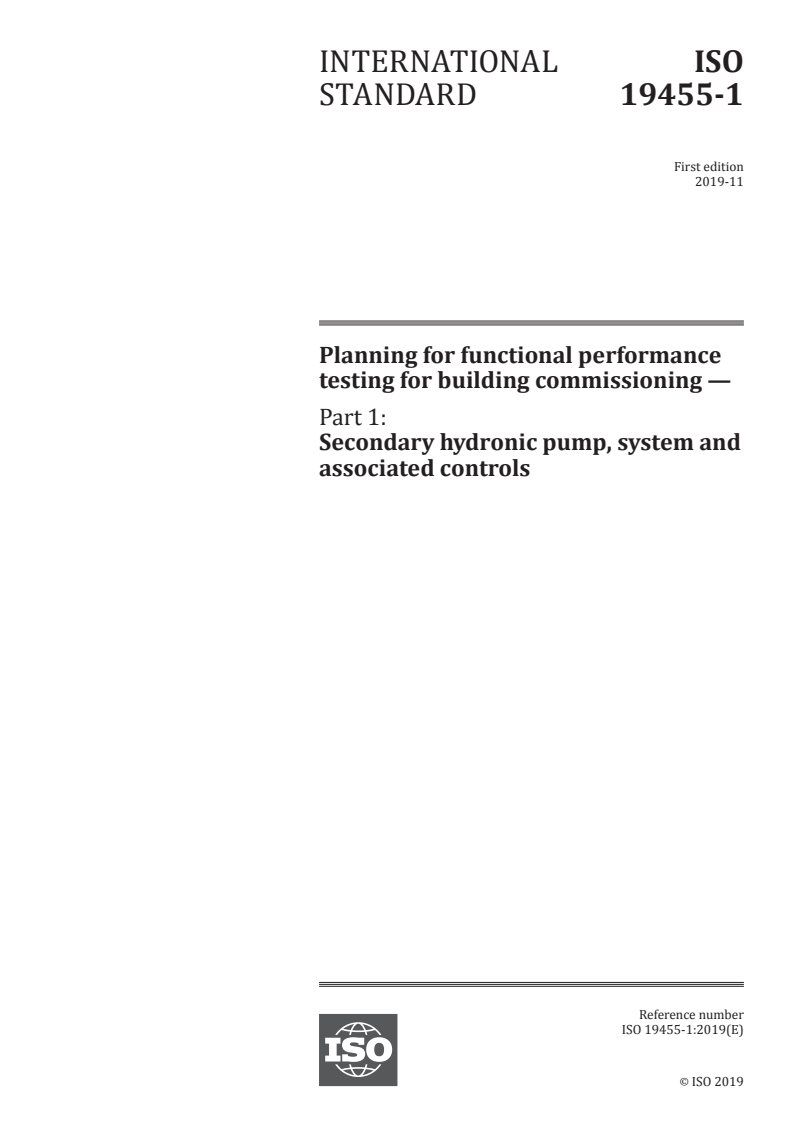
ISO 19455-1:2019 - Planning for functional performance testing for building commissioning — Part 1: Secondary hydronic pump, system and associated controls/15/2019
Overview
ISO 19455-1:2019 - "Planning for functional performance testing for building commissioning - Part 1: Secondary hydronic pump, system and associated controls" defines a planning methodology for Functional Performance Testing (FPT) of secondary hydronic pumps and their controls in HVAC systems. Intended for use in the design phase of new buildings and retrofit projects, this standard clarifies what information is required, what operational data should be recorded, and how measured data is to be analysed - without prescribing concrete measurement techniques.
Keywords: ISO 19455-1:2019, functional performance testing, FPT, building commissioning, secondary hydronic pump, HVAC.
Key topics and technical requirements
- Scope & purpose: Establishes how to design building environmental systems to enable effective FPT and verification of design intent and energy-saving functions.
- Required information: Basis of design (BoD), design documents, drawings and product specifications to support commissioning and FPT planning.
- Data acquisition: Identifies required data (e.g., water flow rates, energy consumption or electrical current, inverter frequency, supply-side or pump pressure difference, and heat exchanged in air handling units). For new buildings, data can come from the Building Automation and Control System (BACS); retrofits may use temporary loggers. (See Annex A for data acquisition planning.)
- Pump control types: Defines multi-unit pump staging and rotation-speed control strategies:
- Type A (constant delivery pressure) - A1 (supply‑side pressure control) and A2 (pump pressure-difference control).
- Type B (variable delivery pressure) - B1/B2 variants tied to end-pressure difference.
- FPT methods: Structured test procedures and analysis steps for:
- Test 1 - relationship between water flow rate and number of operating pumps.
- Tests 2 & 3 - relationship between water flow rate and pressure.
- Test 4 - relationship between water flow rate and energy consumption.
Each test follows measurement, calculation, analysis, clarification of design specification and comparison to design values.
Applications
- Integration of commissioning requirements into the design documents and BoD.
- Verification of hydronic pump staging, control algorithms and actual energy performance after handover.
- Supporting energy-efficiency validation, troubleshooting of system behavior, and retrofit performance checks.
Who should use this standard
- Building designers, HVAC engineers and system integrators
- Commissioning providers and contractors
- Building owners/clients and facility managers
- Government officials and researchers involved in building performance and energy efficiency
Related standards
- ISO 16813 - Building environment design - General principles (defines commissioning context).
- ISO 16484-1 - Building automation and control systems - Project specification and implementation.
ISO 19455-1:2019 provides a practical, design-phase framework for planning FPT of secondary hydronic pump systems, helping stakeholders ensure reliable, energy-efficient HVAC operation through structured testing and data-driven verification.
Buy Documents
ISO 19455-1:2019 - Planning for functional performance testing for building commissioning
ISO 19455-1:2019 - Planning for functional performance testing for building commissioning — Part 1: Secondary hydronic pump, system and associated controls/15/2019
Get Certified
Connect with accredited certification bodies for this standard

DIBt (Deutsches Institut für Bautechnik)
German Institute for Building Technology.
DIN CERTCO
DIN Group product certification.

Aboma Certification B.V.
Specialized in construction, metal, and transport sectors.
Sponsored listings
Frequently Asked Questions
ISO 19455-1:2019 is a standard published by the International Organization for Standardization (ISO). Its full title is "Planning for functional performance testing for building commissioning — Part 1: Secondary hydronic pump, system and associated controls". This standard covers: This document specifies a planning method for functional performance testing (FPT). This document is applicable to the planning of the FPT during the design phase of new buildings and retrofit projects, which is defined in ISO 16813. This document establishes how to design building environmental systems when the FPT is being carried out. This document defines the following: — what kind of information regarding the system is required (for example, design documents, drawings and product specifications); — what kind of data should be measured (though concrete measurement techniques are not specified in this document); — how the measured data is analysed. Such clear definition of the FPT makes it possible for building designers to prepare and plan for FPT throughout the design process. This document specifies an FPT method for secondary hydronic pump, system and associated controls in heating, ventilation and air conditioning (HVAC) systems.
This document specifies a planning method for functional performance testing (FPT). This document is applicable to the planning of the FPT during the design phase of new buildings and retrofit projects, which is defined in ISO 16813. This document establishes how to design building environmental systems when the FPT is being carried out. This document defines the following: — what kind of information regarding the system is required (for example, design documents, drawings and product specifications); — what kind of data should be measured (though concrete measurement techniques are not specified in this document); — how the measured data is analysed. Such clear definition of the FPT makes it possible for building designers to prepare and plan for FPT throughout the design process. This document specifies an FPT method for secondary hydronic pump, system and associated controls in heating, ventilation and air conditioning (HVAC) systems.
ISO 19455-1:2019 is classified under the following ICS (International Classification for Standards) categories: 91.040.01 - Buildings in general. The ICS classification helps identify the subject area and facilitates finding related standards.
ISO 19455-1:2019 is available in PDF format for immediate download after purchase. The document can be added to your cart and obtained through the secure checkout process. Digital delivery ensures instant access to the complete standard document.
Standards Content (Sample)
INTERNATIONAL ISO
STANDARD 19455-1
First edition
2019-11
Planning for functional performance
testing for building commissioning —
Part 1:
Secondary hydronic pump, system and
associated controls
Reference number
©
ISO 2019
© ISO 2019
All rights reserved. Unless otherwise specified, or required in the context of its implementation, no part of this publication may
be reproduced or utilized otherwise in any form or by any means, electronic or mechanical, including photocopying, or posting
on the internet or an intranet, without prior written permission. Permission can be requested from either ISO at the address
below or ISO’s member body in the country of the requester.
ISO copyright office
CP 401 • Ch. de Blandonnet 8
CH-1214 Vernier, Geneva
Phone: +41 22 749 01 11
Fax: +41 22 749 09 47
Email: copyright@iso.org
Website: www.iso.org
Published in Switzerland
ii © ISO 2019 – All rights reserved
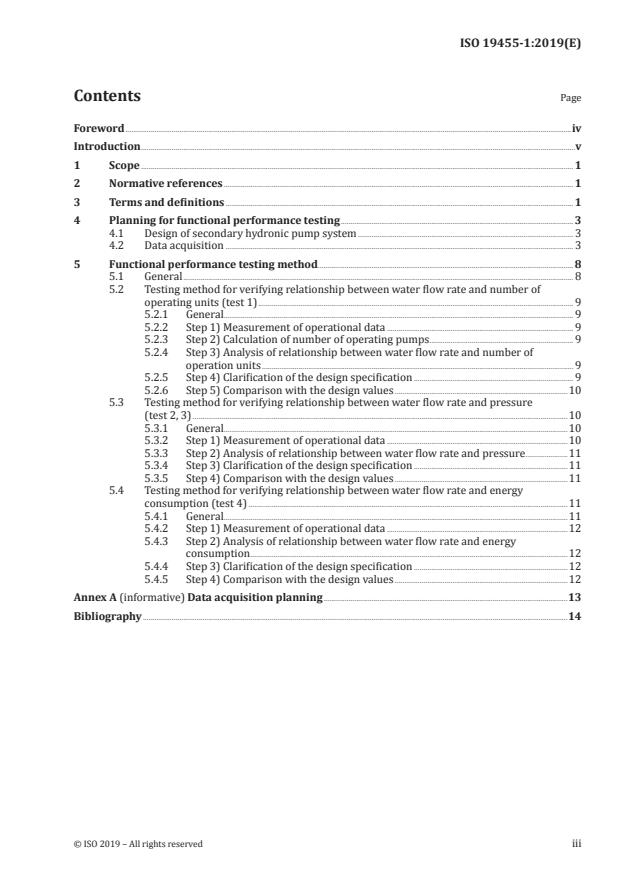
Contents Page
Foreword .iv
Introduction .v
1 Scope . 1
2 Normative references . 1
3 Terms and definitions . 1
4 Planning for functional performance testing . 3
4.1 Design of secondary hydronic pump system . 3
4.2 Data acquisition . 3
5 Functional performance testing method. 8
5.1 General . 8
5.2 Testing method for verifying relationship between water flow rate and number of
operating units (test 1) . 9
5.2.1 General. 9
5.2.2 Step 1) Measurement of operational data . 9
5.2.3 Step 2) Calculation of number of operating pumps . 9
5.2.4 Step 3) Analysis of relationship between water flow rate and number of
operation units . 9
5.2.5 Step 4) Clarification of the design specification . 9
5.2.6 Step 5) Comparison with the design values .10
5.3 Testing method for verifying relationship between water flow rate and pressure
(test 2, 3) .10
5.3.1 General.10
5.3.2 Step 1) Measurement of operational data .10
5.3.3 Step 2) Analysis of relationship between water flow rate and pressure .11
5.3.4 Step 3) Clarification of the design specification .11
5.3.5 Step 4) Comparison with the design values .11
5.4 Testing method for verifying relationship between water flow rate and energy
consumption (test 4) .11
5.4.1 General.11
5.4.2 Step 1) Measurement of operational data .12
5.4.3 Step 2) Analysis of relationship between water flow rate and energy
consumption .12
5.4.4 Step 3) Clarification of the design specification .12
5.4.5 Step 4) Comparison with the design values .12
Annex A (informative) Data acquisition planning .13
Bibliography .14
Foreword
ISO (the International Organization for Standardization) is a worldwide federation of national standards
bodies (ISO member bodies). The work of preparing International Standards is normally carried out
through ISO technical committees. Each member body interested in a subject for which a technical
committee has been established has the right to be represented on that committee. International
organizations, governmental and non-governmental, in liaison with ISO, also take part in the work.
ISO collaborates closely with the International Electrotechnical Commission (IEC) on all matters of
electrotechnical standardization.
The procedures used to develop this document and those intended for its further maintenance are
described in the ISO/IEC Directives, Part 1. In particular, the different approval criteria needed for the
different types of ISO documents should be noted. This document was drafted in accordance with the
editorial rules of the ISO/IEC Directives, Part 2 (see www .iso .org/ directives).
Attention is drawn to the possibility that some of the elements of this document may be the subject of
patent rights. ISO shall not be held responsible for identifying any or all such patent rights. Details of
any patent rights identified during the development of the document will be in the Introduction and/or
on the ISO list of patent declarations received (see www .iso .org/ patents).
Any trade name used in this document is information given for the convenience of users and does not
constitute an endorsement.
For an explanation of the voluntary nature of standards, the meaning of ISO specific terms and
expressions related to conformity assessment, as well as information about ISO's adherence to the
World Trade Organization (WTO) principles in the Technical Barriers to Trade (TBT) see www .iso .org/
iso/ foreword .html.
This document was prepared by Technical Committee ISO/TC 205, Building environment design.
A list of all parts in the ISO 19455 series can be found on the ISO website.
Any feedback or questions on this document should be directed to the user’s national standards body. A
complete listing of these bodies can be found at www .iso .org/ members .html.
iv © ISO 2019 – All rights reserved
Introduction
This document gives a methodology of planning for functional performance testing of secondary
hydronic pump, system and associated controls for building commissioning, and has been prepared for
building designers, i.e. architects, environmental designers and building system designers, as well as
building clients, contractors, commissioning providers, government officials, and academic staff.
The aim of this document is to assist the building designers in applying a commissioning plan and a
commissioning test, which are defined in ISO 16813. In order to achieve effective energy saving
in building equipment systems that consume a large amount of energy, it is important not only to
introduce energy efficient technologies to the system but also to verify their functional performance by
tests and adjustments after the completion whether the system works properly according to its design
intent. This document makes it possible to verify performance of secondary hydronic pump, system
and associated controls with clear and specific processes.
As well as the intended usage for heating, ventilation and air conditioning (HVAC) systems, the
secondary hydronic pump system targeted by this document is described in Figure 1.
Key
A farthest air handling unit 1 dPw_AHU: end-pressure difference (in Pa)
B air handling units 2 Tw_AHUin: inlet water temperature of air handling
o
units (in C)
C valve 3 Tw_AHUout: outlet water temperature of air handling
o
units (in C)
D secondary hydronic pumps 4 Vw_AHUout: water flow rate of air handling units
(in kg/s)
E reserve hydronic pumps 5 Qw _AHU: amount of heat exchanged in air handling
units (in kW)
F inverter 6 Pw_PSout: supply-side pressure (in Pa)
G heat source equipment 7 dPw_PS: pump pressure difference (in Pa)
H primary hydronic pump 8 Vw_PS: water flow rate of each secondary hydronic
pump (in kg/s)
9 E_PS: energy consumption of each secondary
hydronic pump (in kW)
Figure 1 — Secondary hydronic pump system targeted by this document
vi © ISO 2019 – All rights reserved
INTERNATIONAL STANDARD ISO 19455-1:2019(E)
Planning for functional performance testing for building
commissioning —
Part 1:
Secondary hydronic pump, system and associated controls
1 Scope
This document specifies a planning method for functional performance testing (FPT). This document
is applicable to the planning of the FPT during the design phase of new buildings and retrofit projects,
which is defined in ISO 16813.
This document establishes how to design building environmental systems when the FPT is being
carried out. This document defines the following:
— what kind of information regarding the system is required (for example, design documents,
drawings and product specifications);
— what kind of data should be measured (though concrete measurement techniques are not specified
in this document);
— how the measured data is analysed.
Such clear definition of the FPT makes it possible for building designers to prepare and plan for FPT
throughout the design process.
This document specifies an FPT method for secondary hydronic pump, system and associated controls
in heating, ventilation and air conditioning (HVAC) systems.
2 Normative references
The following documents are referred to in the text in such a way that some or all of their content
constitutes requirements of this document. For dated references, only the edition cited applies. For
undated references, the latest edition of the referenced document (including any amendments) applies.
ISO 16813, Building environment design — Indoor environment — General principles
ISO 16484-1, Building automation and control systems (BACS) — Part 1: Project specification and
implementation
3 Terms and definitions
For the purposes of this document, the terms and definitions given in ISO 16813, ISO 16484-1 and the
following apply.
ISO and IEC maintain terminological databases for use in standardization at the following addresses:
— ISO Online browsing platform: available at https:// www .iso .org/ obp
— IEC Electropedia: available at http:// www .electropedia .org/
3.1
basis of design
BoD
document that bridges the objectives conveyed in the owner project requirements (3.5) and the contract
documents (construction drawings and project specifications) which records through narrative, lists
and calculations, the technical concepts, performance, assumptions, decisions, and product selections
that fulfil the requirements of the owner project requirements
3.2
building control system
measures taken to ensure the system operates in accordance with the specified conditions
3.3
commissioning
quality-focused process for enhancing the delivery of a project which focuses upon verifying and
documenting that all of the commissioned systems and assemblies are planned, designed, installed,
tested, operated, and maintained to meet the owner project requirements (3.5)
3.4
design document
written description of the essential factors of every design stage, to be retained for future reference
3.5
owner project requirement
OPR
written document that details the ideas, concepts, and criteria that are required by the owner and
outlines the requirements upon which the pre-design, design and construction phases are executed
3.6
function performance testing
FPT
testing process to demonstrate the correct installation and operation of each component, system, and
associated controls in accordance with the owner project requirements (3.5)
3.7
supply-side pressure
hydronic pressure of pump outlet
Note 1 to entry: This is illustrated in Figure 1.
3.8
pump pressure difference
hydronic pressure difference between pump inlet and outlet
Note 1 to entry: This is illustrated in Figure 1.
3.9
end-pressure difference
hydronic pressure difference between inlet and outlet of the farthest air handling unit
Note 1 to entry: This is illustrated in Figure 1.
3.10
multiple-unit pump staging control
number of operating pumps, which changes according to the water flow rate of air handling units or the
amount of heat exchanged in air handling units
Note 1 to entry: The water flow rate of air handling units and the amount of heat exchanged in air handling units
are illustrated in Figure 1.
2 © ISO 2019 – All rights reserved
3.11
rotation speed control with constant delivery pressure
rotation speed of pumps is changed with inverters according to supply-side pressure (3.7) or pump
pressure difference (3.8) with the set point of the supply-side water pressure or the pump pressure
difference being constant
Note 1 to entry: The supply-side pressure and the pump pressure difference are illustrated in Figure 1.
3.12
rotation speed control with variable delivery pressure
rotation speed of pumps is changed with inverters according to supply-side pressure (3.7) or pump
pressure difference (3.8) with the set point of the supply-side water pressure or the pump pressure
differen
...
INTERNATIONAL ISO
STANDARD 19455-1
First edition
2019-11
Planning for functional performance
testing for building commissioning —
Part 1:
Secondary hydronic pump, system and
associated controls
Reference number
©
ISO 2019
© ISO 2019
All rights reserved. Unless otherwise specified, or required in the context of its implementation, no part of this publication may
be reproduced or utilized otherwise in any form or by any means, electronic or mechanical, including photocopying, or posting
on the internet or an intranet, without prior written permission. Permission can be requested from either ISO at the address
below or ISO’s member body in the country of the requester.
ISO copyright office
CP 401 • Ch. de Blandonnet 8
CH-1214 Vernier, Geneva
Phone: +41 22 749 01 11
Fax: +41 22 749 09 47
Email: copyright@iso.org
Website: www.iso.org
Published in Switzerland
ii © ISO 2019 – All rights reserved
Contents Page
Foreword .iv
Introduction .v
1 Scope . 1
2 Normative references . 1
3 Terms and definitions . 1
4 Planning for functional performance testing . 3
4.1 Design of secondary hydronic pump system . 3
4.2 Data acquisition . 3
5 Functional performance testing method. 8
5.1 General . 8
5.2 Testing method for verifying relationship between water flow rate and number of
operating units (test 1) . 9
5.2.1 General. 9
5.2.2 Step 1) Measurement of operational data . 9
5.2.3 Step 2) Calculation of number of operating pumps . 9
5.2.4 Step 3) Analysis of relationship between water flow rate and number of
operation units . 9
5.2.5 Step 4) Clarification of the design specification . 9
5.2.6 Step 5) Comparison with the design values .10
5.3 Testing method for verifying relationship between water flow rate and pressure
(test 2, 3) .10
5.3.1 General.10
5.3.2 Step 1) Measurement of operational data .10
5.3.3 Step 2) Analysis of relationship between water flow rate and pressure .11
5.3.4 Step 3) Clarification of the design specification .11
5.3.5 Step 4) Comparison with the design values .11
5.4 Testing method for verifying relationship between water flow rate and energy
consumption (test 4) .11
5.4.1 General.11
5.4.2 Step 1) Measurement of operational data .12
5.4.3 Step 2) Analysis of relationship between water flow rate and energy
consumption .12
5.4.4 Step 3) Clarification of the design specification .12
5.4.5 Step 4) Comparison with the design values .12
Annex A (informative) Data acquisition planning .13
Bibliography .14
Foreword
ISO (the International Organization for Standardization) is a worldwide federation of national standards
bodies (ISO member bodies). The work of preparing International Standards is normally carried out
through ISO technical committees. Each member body interested in a subject for which a technical
committee has been established has the right to be represented on that committee. International
organizations, governmental and non-governmental, in liaison with ISO, also take part in the work.
ISO collaborates closely with the International Electrotechnical Commission (IEC) on all matters of
electrotechnical standardization.
The procedures used to develop this document and those intended for its further maintenance are
described in the ISO/IEC Directives, Part 1. In particular, the different approval criteria needed for the
different types of ISO documents should be noted. This document was drafted in accordance with the
editorial rules of the ISO/IEC Directives, Part 2 (see www .iso .org/ directives).
Attention is drawn to the possibility that some of the elements of this document may be the subject of
patent rights. ISO shall not be held responsible for identifying any or all such patent rights. Details of
any patent rights identified during the development of the document will be in the Introduction and/or
on the ISO list of patent declarations received (see www .iso .org/ patents).
Any trade name used in this document is information given for the convenience of users and does not
constitute an endorsement.
For an explanation of the voluntary nature of standards, the meaning of ISO specific terms and
expressions related to conformity assessment, as well as information about ISO's adherence to the
World Trade Organization (WTO) principles in the Technical Barriers to Trade (TBT) see www .iso .org/
iso/ foreword .html.
This document was prepared by Technical Committee ISO/TC 205, Building environment design.
A list of all parts in the ISO 19455 series can be found on the ISO website.
Any feedback or questions on this document should be directed to the user’s national standards body. A
complete listing of these bodies can be found at www .iso .org/ members .html.
iv © ISO 2019 – All rights reserved
Introduction
This document gives a methodology of planning for functional performance testing of secondary
hydronic pump, system and associated controls for building commissioning, and has been prepared for
building designers, i.e. architects, environmental designers and building system designers, as well as
building clients, contractors, commissioning providers, government officials, and academic staff.
The aim of this document is to assist the building designers in applying a commissioning plan and a
commissioning test, which are defined in ISO 16813. In order to achieve effective energy saving
in building equipment systems that consume a large amount of energy, it is important not only to
introduce energy efficient technologies to the system but also to verify their functional performance by
tests and adjustments after the completion whether the system works properly according to its design
intent. This document makes it possible to verify performance of secondary hydronic pump, system
and associated controls with clear and specific processes.
As well as the intended usage for heating, ventilation and air conditioning (HVAC) systems, the
secondary hydronic pump system targeted by this document is described in Figure 1.
Key
A farthest air handling unit 1 dPw_AHU: end-pressure difference (in Pa)
B air handling units 2 Tw_AHUin: inlet water temperature of air handling
o
units (in C)
C valve 3 Tw_AHUout: outlet water temperature of air handling
o
units (in C)
D secondary hydronic pumps 4 Vw_AHUout: water flow rate of air handling units
(in kg/s)
E reserve hydronic pumps 5 Qw _AHU: amount of heat exchanged in air handling
units (in kW)
F inverter 6 Pw_PSout: supply-side pressure (in Pa)
G heat source equipment 7 dPw_PS: pump pressure difference (in Pa)
H primary hydronic pump 8 Vw_PS: water flow rate of each secondary hydronic
pump (in kg/s)
9 E_PS: energy consumption of each secondary
hydronic pump (in kW)
Figure 1 — Secondary hydronic pump system targeted by this document
vi © ISO 2019 – All rights reserved
INTERNATIONAL STANDARD ISO 19455-1:2019(E)
Planning for functional performance testing for building
commissioning —
Part 1:
Secondary hydronic pump, system and associated controls
1 Scope
This document specifies a planning method for functional performance testing (FPT). This document
is applicable to the planning of the FPT during the design phase of new buildings and retrofit projects,
which is defined in ISO 16813.
This document establishes how to design building environmental systems when the FPT is being
carried out. This document defines the following:
— what kind of information regarding the system is required (for example, design documents,
drawings and product specifications);
— what kind of data should be measured (though concrete measurement techniques are not specified
in this document);
— how the measured data is analysed.
Such clear definition of the FPT makes it possible for building designers to prepare and plan for FPT
throughout the design process.
This document specifies an FPT method for secondary hydronic pump, system and associated controls
in heating, ventilation and air conditioning (HVAC) systems.
2 Normative references
The following documents are referred to in the text in such a way that some or all of their content
constitutes requirements of this document. For dated references, only the edition cited applies. For
undated references, the latest edition of the referenced document (including any amendments) applies.
ISO 16813, Building environment design — Indoor environment — General principles
ISO 16484-1, Building automation and control systems (BACS) — Part 1: Project specification and
implementation
3 Terms and definitions
For the purposes of this document, the terms and definitions given in ISO 16813, ISO 16484-1 and the
following apply.
ISO and IEC maintain terminological databases for use in standardization at the following addresses:
— ISO Online browsing platform: available at https:// www .iso .org/ obp
— IEC Electropedia: available at http:// www .electropedia .org/
3.1
basis of design
BoD
document that bridges the objectives conveyed in the owner project requirements (3.5) and the contract
documents (construction drawings and project specifications) which records through narrative, lists
and calculations, the technical concepts, performance, assumptions, decisions, and product selections
that fulfil the requirements of the owner project requirements
3.2
building control system
measures taken to ensure the system operates in accordance with the specified conditions
3.3
commissioning
quality-focused process for enhancing the delivery of a project which focuses upon verifying and
documenting that all of the commissioned systems and assemblies are planned, designed, installed,
tested, operated, and maintained to meet the owner project requirements (3.5)
3.4
design document
written description of the essential factors of every design stage, to be retained for future reference
3.5
owner project requirement
OPR
written document that details the ideas, concepts, and criteria that are required by the owner and
outlines the requirements upon which the pre-design, design and construction phases are executed
3.6
function performance testing
FPT
testing process to demonstrate the correct installation and operation of each component, system, and
associated controls in accordance with the owner project requirements (3.5)
3.7
supply-side pressure
hydronic pressure of pump outlet
Note 1 to entry: This is illustrated in Figure 1.
3.8
pump pressure difference
hydronic pressure difference between pump inlet and outlet
Note 1 to entry: This is illustrated in Figure 1.
3.9
end-pressure difference
hydronic pressure difference between inlet and outlet of the farthest air handling unit
Note 1 to entry: This is illustrated in Figure 1.
3.10
multiple-unit pump staging control
number of operating pumps, which changes according to the water flow rate of air handling units or the
amount of heat exchanged in air handling units
Note 1 to entry: The water flow rate of air handling units and the amount of heat exchanged in air handling units
are illustrated in Figure 1.
2 © ISO 2019 – All rights reserved
3.11
rotation speed control with constant delivery pressure
rotation speed of pumps is changed with inverters according to supply-side pressure (3.7) or pump
pressure difference (3.8) with the set point of the supply-side water pressure or the pump pressure
difference being constant
Note 1 to entry: The supply-side pressure and the pump pressure difference are illustrated in Figure 1.
3.12
rotation speed control with variable delivery pressure
rotation speed of pumps is changed with inverters according to supply-side pressure (3.7) or pump
pressure difference (3.8) with the set point of the supply-side water pressure or the pump pressure
differen
...