

ISO 28703:2011
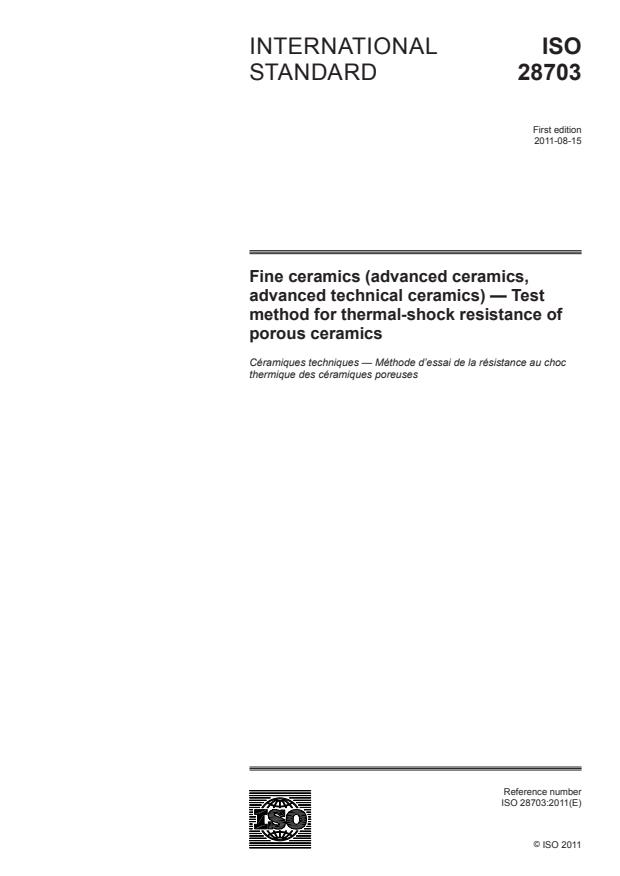
(Main)Fine ceramics (advanced ceramics, advanced technical ceramics) — Test method for thermal-shock resistance of porous ceramics
- Abstract
ISO 28703:2011 specifies a test method for determining the thermal-shock resistance of porous ceramics by water quenching using the bending strength. This test method can be used for selection of materials during design.
- Status
- Published
- Publication Date
- 04-Aug-2011
- Technical Committee
- ISO/TC 206 - Fine ceramics
- Drafting Committee
- ISO/TC 206/WG 12 - Engineering applications and porous ceramics
- Current Stage
- 9093 - International Standard confirmed - 90 Review
- Start Date
- 17-Mar-2022
Overview
ISO 28703:2011 is an international standard developed by the International Organization for Standardization (ISO) that specifies a precise test method for evaluating the thermal-shock resistance of porous ceramics, commonly known as fine ceramics or advanced technical ceramics. This test method employs water quenching combined with bending strength measurements to assess how porous ceramics withstand rapid temperature changes. Designed primarily for materials selection during the design phase, this standard is indispensable for industries relying on ceramics with high thermal stability.
This document defines clear procedures and apparatus requirements to ensure reproducibility and accuracy during thermal-shock testing of ceramics with porosities typically ranging from 30% to 60%, with pore diameters from 1 µm to 100 µm. It emphasizes rapid cooling as the testing approach, using water as the cooling medium to simulate severe thermal stress conditions.
Key Topics
Test Methodology
The thermal-shock resistance is determined by heating porous ceramic specimens in an electric furnace and rapidly quenching them in controlled-temperature water, followed by measuring residual bending strength through a four-point bending test.Specimen Preparation
Specimens must be prismatic with defined geometric dimensions and surface finishes, ensuring consistent test results. Minimum numbers of specimens per test condition guarantee statistical validity.Thermal Shock Definition
Thermal shock refers to the generation of impulsive thermal stress caused by rapid temperature variation, which can induce cracking or strength degradation in porous ceramics.Measurement Techniques
Includes use of vernier and micrometer calipers for dimension accuracy, thermocouples for precise temperature measurements, and a standardized bending test fixture to measure strength changes after thermal shock.Evaluation Criteria
Identification of the maximum permissible temperature difference-the largest temperature gradient a porous ceramic can endure without significant strength reduction-is key for assessing thermal-shock resistance.Test Reporting
ISO 28703:2011 outlines comprehensive reporting requirements that include test conditions, material details, specimen dimensions, residual strength results, and graphical data illustrating strength degradation relative to temperature differences.
Applications
This ISO standard applies to the evaluation of porous ceramics used in various high-technology fields, including but not limited to:
Filtration Systems - Porous ceramics used as filters require robust thermal-shock resistance to maintain structural integrity during temperature fluctuations.
Catalyst Carriers - Thermal stability is crucial for ceramics serving as catalyst supports in automotive and industrial chemical processes.
Sensors and Molecular Sieves - Devices such as humidity sensors depend on advanced ceramics that resist thermal shock to ensure long-term accuracy and reliability.
Material Selection and Design - Engineers and materials scientists utilize this standardized thermal-shock testing method to select ceramics optimized for thermal cycling performance in demanding operational environments.
Implementing ISO 28703:2011 ensures that thermal-shock performance data are reliable and comparable internationally, aiding in the development of safer, more efficient ceramic-based components.
Related Standards
ISO 28703:2011 aligns and references several key standards pertinent to fine ceramics testing and measurement:
ISO 14704 - Test method for flexural strength of monolithic ceramics at room temperature, providing the bending test procedure foundational to thermal-shock resistance assessment.
ISO 20507 - Vocabulary for fine ceramics, offering standardized terminology to support clear communication in technical documentation.
ISO 1101, ISO 3599, ISO 3611 - Geometrical product specifications and measurement equipment standards ensuring specimen dimensional accuracy.
ISO 4287 - Surface texture parameters defining roughness requirements for test specimens.
IEC 60584-1 - Thermocouple reference tables ensuring precise and accurate temperature measurement during tests.
These associated standards complement ISO 28703:2011 by covering dimensional control, terminology, and instrumentation essential for conducting rigorous thermal-shock tests on porous ceramics.
By adhering to ISO 28703:2011, stakeholders in ceramics manufacturing and research can confidently evaluate materials for thermal-shock durability, aiding in the design of advanced ceramics that meet stringent thermal performance requirements in industrial and technological applications.
Frequently Asked Questions
ISO 28703:2011 is a standard published by the International Organization for Standardization (ISO). Its full title is "Fine ceramics (advanced ceramics, advanced technical ceramics) — Test method for thermal-shock resistance of porous ceramics". This standard covers: ISO 28703:2011 specifies a test method for determining the thermal-shock resistance of porous ceramics by water quenching using the bending strength. This test method can be used for selection of materials during design.
ISO 28703:2011 specifies a test method for determining the thermal-shock resistance of porous ceramics by water quenching using the bending strength. This test method can be used for selection of materials during design.
ISO 28703:2011 is classified under the following ICS (International Classification for Standards) categories: 81.060.30 - Advanced ceramics. The ICS classification helps identify the subject area and facilitates finding related standards.
ISO 28703:2011 is available in PDF format for immediate download after purchase. The document can be added to your cart and obtained through the secure checkout process. Digital delivery ensures instant access to the complete standard document.
Standards Content (Sample)
INTERNATIONAL ISO
STANDARD 28703
First edition
2011-08-15
Fine ceramics (advanced ceramics,
advanced technical ceramics) — Test
method for thermal-shock resistance of
porous ceramics
Céramiques techniques — Méthode d’essai de la résistance au choc
thermique des céramiques poreuses
Reference number
©
ISO 2011
All rights reserved. Unless otherwise specified, no part of this publication may be reproduced or utilized in any form or by any means,
electronic or mechanical, including photocopying and microfilm, without permission in writing from either ISO at the address below or ISO’s
member body in the country of the requester.
ISO copyright office
Case postale 56 • CH-1211 Geneva 20
Tel. + 41 22 749 01 11
Fax + 41 22 749 09 47
E-mail copyright@iso.org
Web www.iso.org
Published in Switzerland
ii © ISO 2011 – All rights reserved
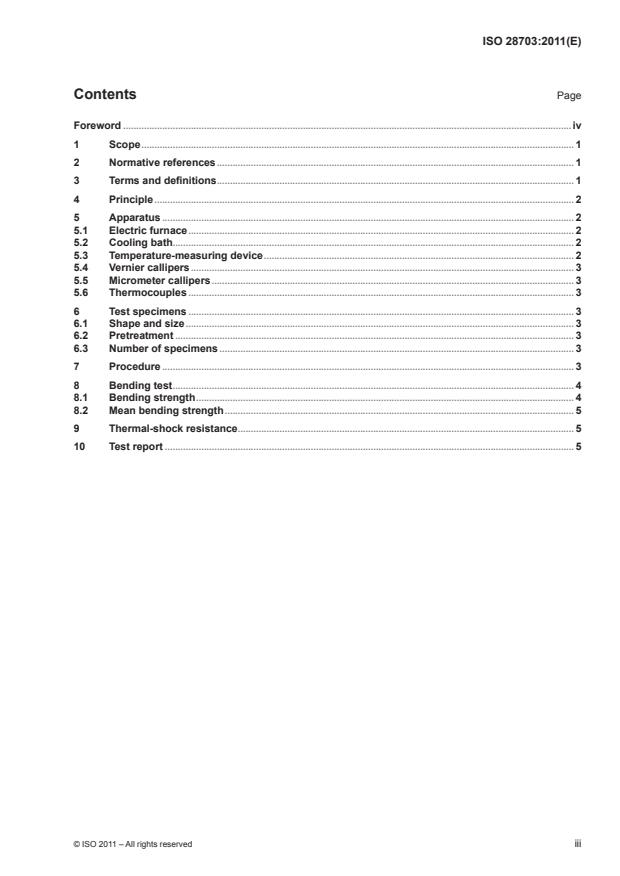
Contents Page
Foreword .iv
1 Scope . 1
2 Normative references . 1
3 Terms and definitions . 1
4 Principle . 2
5 Apparatus . 2
5.1 Electric furnace . 2
5.2 Cooling bath. 2
5.3 Temperature-measuring device . 2
5.4 Vernier callipers . 3
5.5 Micrometer callipers . 3
5.6 Thermocouples . 3
6 Test specimens . 3
6.1 Shape and size . 3
6.2 Pretreatment . 3
6.3 Number of specimens . 3
7 Procedure . 3
8 Bending test . 4
8.1 Bending strength . 4
8.2 Mean bending strength . 5
9 Thermal-shock resistance . 5
10 Test report . 5
Foreword
ISO (the International Organization for Standardization) is a worldwide federation of national standards bodies
(ISO member bodies). The work of preparing International Standards is normally carried out through ISO
technical committees. Each member body interested in a subject for which a technical committee has been
established has the right to be represented on that committee. International organizations, governmental and
non-governmental, in liaison with ISO, also take part in the work. ISO collaborates closely with the International
Electrotechnical Commission (IEC) on all matters of electrotechnical standardization.
International Standards are drafted in accordance with the rules given in the ISO/IEC Directives, Part 2.
The main task of technical committees is to prepare International Standards. Draft International Standards
adopted by the technical committees are circulated to the member bodies for voting. Publication as an
International Standard requires approval by at least 75 % of the member bodies casting a vote.
Attention is drawn to the possibility that some of the elements of this document may be the subject of patent
rights. ISO shall not be held responsible for identifying any or all such patent rights.
ISO 28703 was prepared by Technical Committee ISO/TC 206, Fine ceramics.
iv © ISO 2011 – All rights reserved
INTERNATIONAL STANDARD ISO 28703:2011(E)
Fine ceramics (advanced ceramics, advanced technical
ceramics) — Test method for thermal-shock resistance of
porous ceramics
1 Scope
This International Standard specifies a test method for determining the thermal-shock resistance of porous
ceramics by water quenching using the bending strength. This test method can be used for selection of
materials during design.
NOTE 1 There are three kinds of test methods for thermal shock, namely a rapid cooling method, a rapid heating
method, and the rapid heating-cooling method. Ceramics are sensitive to tensile stress, and the surface region has
many defects which act as the starting points to which strength falls. For this reason, the rapid cooling method where the
maximum tensile stress is generated on the surface serves as the severest test condition for ceramics. Therefore, this
International Standard specifies the rapid cooling method.
NOTE 2 In many thermal-shock test methods, liquid or gas is needed as a cooling medium, and liquid is more efficient
than gas in the cooling capability. Therefore, in this International Standard, water is specified as a cooling medium.
2 Normative references
The following referenced documents are indispensable for the application of this document. For dated
references, only the edition cited applies. For undated references, the latest edition of the referenced document
(including any amendments) applies.
ISO 1101, Geometrical Product Specifications (GPS) — Geometrical tolerancing — Tolerances of form,
orientation, location and run-out
ISO 3599, Vernier callipers reading to 0,1 and 0,05 mm
ISO 3611, Geometrical product specifications (GPS) — Dimensional measuring equipment: Micrometers for
external measurements — Design and metrological characteristics
ISO 4287, Geometrical Product Specifications (GPS) — Surface texture: Profile method — Terms, definitions
and surface texture parameters
ISO 14704, Fine ceramics (advanced ceramics, advanced technical ceramics) — Test method for flexural
strength of monolithic ceramics at room temperature
ISO 20507, Fine ceramics (advanced ceramics, advanced technical ceramics) — Vocabulary
IEC 60584-1, Thermocouples — Part 1: Reference tables
3 Terms and definitions
For the purposes of this document, the terms and definitions in ISO 20507 and the following apply.
3.1
porous ceramics
ceramics with a porosity of typically 30 % to 60 % and a pore diameter of 1 µm to 100 µm, for applications such as
filters, catalyst carriers, humidity sensors or molecular sieves, excluding structural honeycomb cellular channels
3.2
thermal shock
phenomenon generating impulsive thermal stress due to the large temperature difference in a material by rapid
heating or cooling
3.3
thermal-shock temperature difference
temperature difference between a material and the environment at thermal shock
3.4
residual bending strength
bending strength of a material after the thermal-shock test
3.5
decreasing ratio of residual bending strength
ratio of the amount of reduced bending strength after testing to the mean bending strength before testing
3.6
maximum permissible temperature difference
maximum thermal-shock temperature difference that does not significantly reduce the residual bending
strength after thermal-shock testing
4 Principle
The resistance of a material to thermal shock is estimated by the maximum thermal-shock temperature
difference which the material can withstand without its residual bending strength being significantly affected.
The data such as residual bending strength and maximum permissible temperature difference shall not be
used directly f
...