

ISO 3941:2026
(Main)Classification of fires
General Information
- Abstract
This document classifies, into categories, the different kinds of fires each defined by the nature of the fuel. Such a classification is particularly useful in the context of equipment for fire protection and firefighting.
- Status
- Published
- Publication Date
- 20-Jan-2026
- Technical Committee
- ISO/TC 21/SC 2 - Manually transportable fire extinguishers
- Drafting Committee
- ISO/TC 21/SC 2 - Manually transportable fire extinguishers
- Current Stage
- 6060 - International Standard published
- Start Date
- 21-Jan-2026
- Due Date
- 30-Oct-2026
- Completion Date
- 21-Jan-2026

Overview
ISO 3941:2026 - Classification of Fires is an international standard developed by the International Organization for Standardization (ISO). This document classifies fires into distinct categories based on the nature of the fuel involved. Standard fire classifications support the selection and use of appropriate fire protection and firefighting equipment, contribute to effective emergency response planning, and ensure consistency across the fire safety industry. The 2026 edition introduces updates, including the addition of a fire class for lithium-ion batteries, reflecting current risks in modern environments.
Key Topics
Fire Classes Defined by Fuel Type:
ISO 3941:2026 organizes fires into clear categories, each associated with typical fuel examples:
- Class A: Fires involving solid materials such as wood, cloth, paper, rubber, and many plastics, generally producing glowing embers.
- Class B: Fires involving flammable liquids or liquefiable solids.
- Class C: Fires involving flammable gases.
- Class D: Fires involving metals.
- Class F: Fires involving cooking media-specifically oils and fats in kitchen appliances.
- Class L: Fires involving lithium-ion cells and batteries (without elemental lithium).
Hazard Considerations:
Each fire class is accompanied by specific hazards that inform firefighting strategy and equipment selection:
- All classes require attention to the toxicity of combustion products.
- Class A fires may be surface or deep-seated, affecting extinguishing techniques.
- Class B fires demand understanding of fuel containment and liquid properties (e.g., polar vs. non-polar).
- Class C fires pose explosion risks if gas flow cannot be controlled.
- Class D fires are unique to each metal type and require situation-specific responses.
- Class F fires can lead to explosions or dangerous splashing when water is misapplied.
- Class L fires from lithium-ion batteries present added risks such as rapid thermal runaway, explosive gas venting, toxic emissions, projectiles, and the potential for electric shock and re-ignition due to stranded energy.
Applications
ISO 3941:2026 is foundational for diverse fire safety and firefighting applications:
- Equipment Design and Certification: Manufacturers rely on the fire classification system to develop and test fire extinguishers and suppression systems labeled for specific fire classes.
- Fire Safety Training: Provides essential knowledge for fire wardens, emergency responders, and facility managers to identify fire types and select the proper extinguishing method.
- Building and Industrial Safety: Supports regulatory compliance, risk assessment, and emergency planning by defining potential fire scenarios.
- Lithium-ion Battery Risk Management: The new Class L addresses the growing prevalence of battery-powered devices, helping organizations implement targeted controls for electrochemical fires.
Related Standards
Professionals using ISO 3941:2026 may also reference these related international standards to develop comprehensive fire safety strategies:
- ISO 7165: Fire extinguishers - Performance and construction standards
- ISO 14520: Gaseous fire-extinguishing systems - Design and installation
- ISO 21927: Smoke and heat control systems
- IEC 60079: Electrical apparatus for explosive atmospheres
By applying ISO 3941:2026, organizations can ensure accurate classification of fires, select effective firefighting equipment, and strengthen overall fire protection measures. This standard is a key resource for safety compliance across commercial, industrial, and residential environments.
Relations
- Effective Date
- 04-Nov-2023
Get Certified
Connect with accredited certification bodies for this standard

CIS Institut d.o.o.
Personal Protective Equipment (PPE) certification body. Notified Body NB-2890 for EU Regulation 2016/425 PPE.

Kiwa BDA Testing
Building and construction product certification.
Kmetijski inštitut Slovenije
Agricultural Institute of Slovenia. Soil testing, plant health, agricultural product analysis.
Sponsored listings
Frequently Asked Questions
ISO 3941:2026 is a standard published by the International Organization for Standardization (ISO). Its full title is "Classification of fires". This standard covers: This document classifies, into categories, the different kinds of fires each defined by the nature of the fuel. Such a classification is particularly useful in the context of equipment for fire protection and firefighting.
This document classifies, into categories, the different kinds of fires each defined by the nature of the fuel. Such a classification is particularly useful in the context of equipment for fire protection and firefighting.
ISO 3941:2026 is classified under the following ICS (International Classification for Standards) categories: 13.220.01 - Protection against fire in general. The ICS classification helps identify the subject area and facilitates finding related standards.
ISO 3941:2026 has the following relationships with other standards: It is inter standard links to ISO 3941:2007. Understanding these relationships helps ensure you are using the most current and applicable version of the standard.
ISO 3941:2026 is available in PDF format for immediate download after purchase. The document can be added to your cart and obtained through the secure checkout process. Digital delivery ensures instant access to the complete standard document.
Standards Content (Sample)
International
Standard
ISO 3941
Third edition
Classification of fires
2026-01
Classes de feux
Reference number
© ISO 2026
All rights reserved. Unless otherwise specified, or required in the context of its implementation, no part of this publication may
be reproduced or utilized otherwise in any form or by any means, electronic or mechanical, including photocopying, or posting on
the internet or an intranet, without prior written permission. Permission can be requested from either ISO at the address below
or ISO’s member body in the country of the requester.
ISO copyright office
CP 401 • Ch. de Blandonnet 8
CH-1214 Vernier, Geneva
Phone: +41 22 749 01 11
Email: copyright@iso.org
Website: www.iso.org
Published in Switzerland
ii
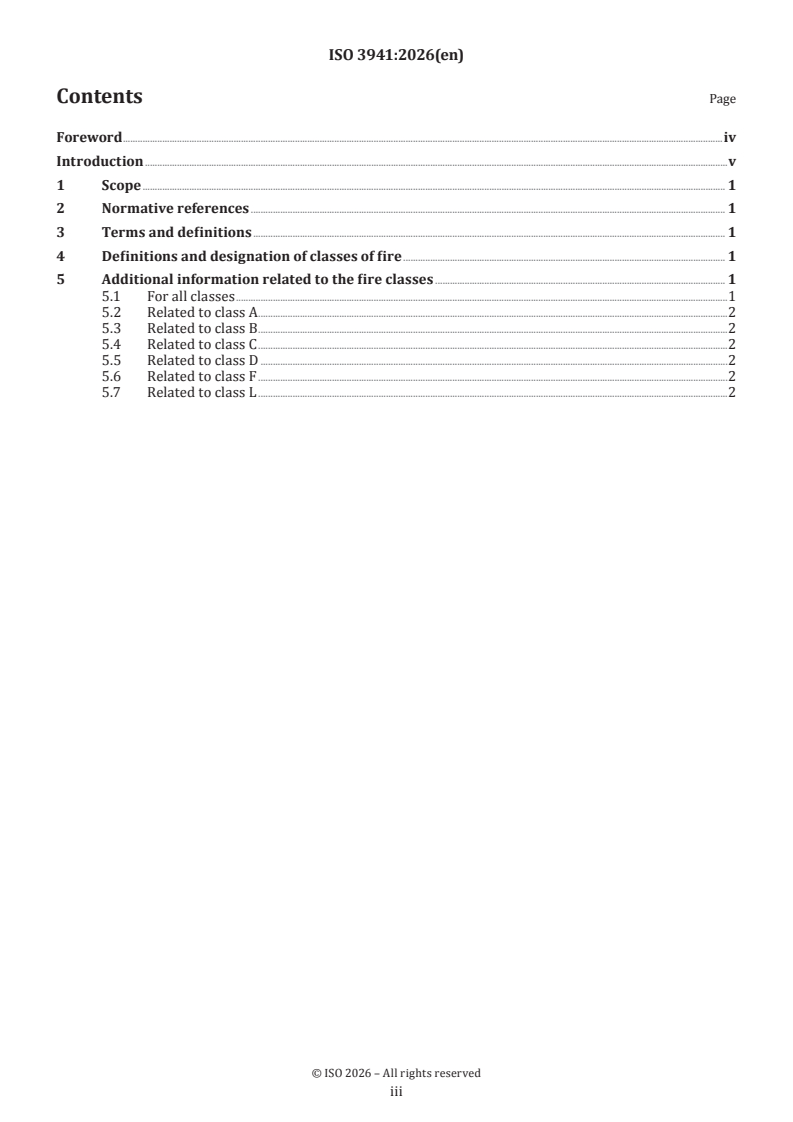
Contents Page
Foreword .iv
Introduction .v
1 Scope . 1
2 Normative references . 1
3 Terms and definitions . 1
4 Definitions and designation of classes of fire . 1
5 Additional information related to the fire classes . 1
5.1 For all classes .1
5.2 Related to class A .2
5.3 Related to class B .2
5.4 Related to class C .2
5.5 Related to class D .2
5.6 Related to class F .2
5.7 Related to class L .2
iii
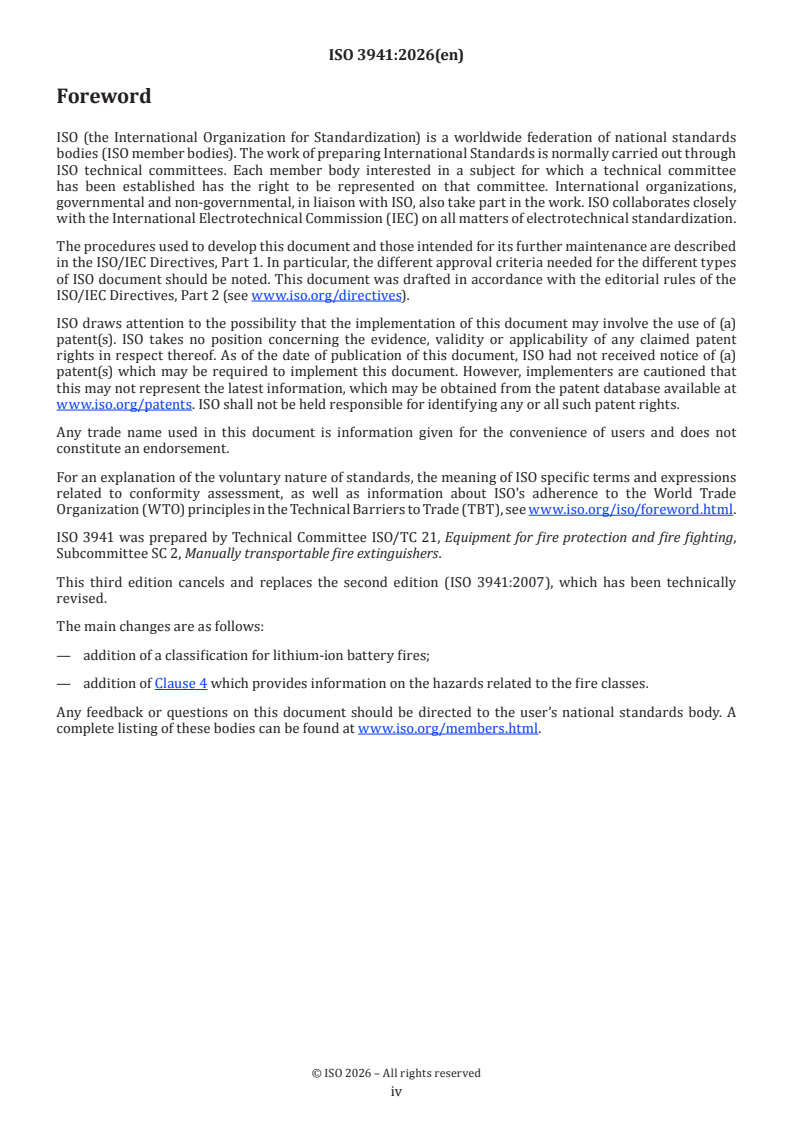
Foreword
ISO (the International Organization for Standardization) is a worldwide federation of national standards
bodies (ISO member bodies). The work of preparing International Standards is normally carried out through
ISO technical committees. Each member body interested in a subject for which a technical committee
has been established has the right to be represented on that committee. International organizations,
governmental and non-governmental, in liaison with ISO, also take part in the work. ISO collaborates closely
with the International Electrotechnical Commission (IEC) on all matters of electrotechnical standardization.
The procedures used to develop this document and those intended for its further maintenance are described
in the ISO/IEC Directives, Part 1. In particular, the different approval criteria needed for the different types
of ISO document should be noted. This document was drafted in accordance with the editorial rules of the
ISO/IEC Directives, Part 2 (see www.iso.org/directives).
ISO draws attention to the possibility that the implementation of this document may involve the use of (a)
patent(s). ISO takes no position concerning the evidence, validity or applicability of any claimed patent
rights in respect thereof. As of the date of publication of this document, ISO had not received notice of (a)
patent(s) which may be required to implement this document. However, implementers are cautio
...