


ISO 3941
(Main)Classification of fires
Classification of fires
ISO 3941:2007 classifies, into five categories, the different kinds of fires defined in terms of the nature of the fuel. Such a classification is particularly useful in the context of fire-fighting by means of an extinguisher.
Classes de feux
General Information
- Status
- Not Published
- Technical Committee
- ISO/TC 21/SC 2 - Manually transportable fire extinguishers
- Drafting Committee
- ISO/TC 21/SC 2 - Manually transportable fire extinguishers
- Current Stage
- 6000 - International Standard under publication
- Start Date
- 18-Dec-2025
- Completion Date
- 17-Jan-2026
Relations
- Effective Date
- 04-Nov-2023
Overview
ISO 3941:2025 is the international standard that provides a clear classification system for different types of fires based on the nature of the fuel involved. Published by ISO (International Organization for Standardization), this standard is essential for professionals in fire protection, firefighting, and safety management. It categorizes fires into distinct classes to improve communication and guide the appropriate use of fire extinguishing equipment. The 2025 revision includes updated classifications with the addition of lithium-ion battery fires, reflecting contemporary fire safety challenges.
Key Topics
Fire Classification by Fuel Type
ISO 3941 categorizes fires into six classes according to the fuel:- Class A: Fires involving solid materials such as wood, cloth, paper, rubber, and many organic plastics that typically burn with glowing embers.
- Class B: Fires involving liquids or liquefiable solids, requiring consideration of fuel containment and chemical properties (polar or non-polar).
- Class C: Fires involving gases, where extinguishing requires caution, especially if the gas supply cannot be stopped to avoid explosion risks.
- Class D: Fires involving metals, which are highly specific in nature; each metal fire needs separate assessment for firefighting.
- Class F: Fires involving cooking media including vegetable or animal oils and fats, with risks such as oil splashing or explosive reactions if water is used incorrectly.
- Class L: Newly added class for fires involving lithium-ion cells and batteries, which have unique hazards like rapid energy release, toxic and explosive gases, and potential for electric shock and reignition.
Hazards and Special Considerations
The standard provides important safety information related to each fire class, emphasizing the toxicity of combustion products, explosion risks, and the need for tailored firefighting approaches depending on the fire’s fuel source.Practical Use in Fire Protection Equipment
ISO 3941’s classification is widely used to design, test, and select fire extinguishing equipment to ensure compatibility with the fire class, enhancing safety and effectiveness during firefighting operations.
Applications
Firefighter Training and Operations
Enables firefighters to quickly identify fire types and apply suitable extinguishing methods, improving response times and safety.Fire Extinguisher Labeling and Selection
Guides manufacturers and safety managers in labeling fire extinguishers and recommending appropriate extinguisher types for different environments.Industrial and Residential Fire Safety Planning
Facilitates risk assessment and fire prevention in workplaces, kitchens, laboratories, and facilities handling flammable materials or lithium-ion batteries.Safety Standards Compliance
Supports compliance with fire safety regulations by providing internationally recognized classifications essential for certifications and audits.Battery Storage and Transport Safety
With the addition of lithium-ion battery fire classification, ISO 3941 helps in managing fire risks related to modern energy storage technologies.
Related Standards
ISO/IEC Directives Part 1 and 2
Provide the procedural and editorial framework for developing ISO standards such as ISO 3941.ISO 11601
Related to portable fire extinguishers, complementing ISO 3941 by specifying testing and performance requirements.IEC Electropedia and ISO Online Browsing Platform
Offer terminology databases referenced for consistent use of fire safety terms.National Fire Protection Association (NFPA) Standards
While specific to the US, NFPA 10 and related standards align with ISO classifications for fire extinguisher use and classification.Battery Safety Standards (e.g., IEC 62660 and UL 9540-1)
Provide detailed safety requirements for lithium-ion batteries, supporting the fire classification updates for Class L fires.
Keywords: ISO 3941, fire classification, fire safety standard, fire classes, fire extinguisher classification, lithium-ion battery fires, firefighting, fire protection equipment, Class A fire, Class B fire, Class C fire, Class D fire, Class F fire, Class L fire, combustible materials, fire hazards.
Frequently Asked Questions
ISO 3941 is a draft published by the International Organization for Standardization (ISO). Its full title is "Classification of fires". This standard covers: ISO 3941:2007 classifies, into five categories, the different kinds of fires defined in terms of the nature of the fuel. Such a classification is particularly useful in the context of fire-fighting by means of an extinguisher.
ISO 3941:2007 classifies, into five categories, the different kinds of fires defined in terms of the nature of the fuel. Such a classification is particularly useful in the context of fire-fighting by means of an extinguisher.
ISO 3941 is classified under the following ICS (International Classification for Standards) categories: 13.220.01 - Protection against fire in general. The ICS classification helps identify the subject area and facilitates finding related standards.
ISO 3941 has the following relationships with other standards: It is inter standard links to ISO 3941:2007. Understanding these relationships helps ensure you are using the most current and applicable version of the standard.
ISO 3941 is available in PDF format for immediate download after purchase. The document can be added to your cart and obtained through the secure checkout process. Digital delivery ensures instant access to the complete standard document.
Standards Content (Sample)
FINAL DRAFT
International
Standard
ISO/FDIS 3941
ISO/TC 21/SC 2
Classification of fires
Secretariat: KATS
Classes de feux
Voting begins on:
2025-10-22
Voting terminates on:
2025-12-17
RECIPIENTS OF THIS DRAFT ARE INVITED TO SUBMIT,
WITH THEIR COMMENTS, NOTIFICATION OF ANY
RELEVANT PATENT RIGHTS OF WHICH THEY ARE AWARE
AND TO PROVIDE SUPPOR TING DOCUMENTATION.
IN ADDITION TO THEIR EVALUATION AS
BEING ACCEPTABLE FOR INDUSTRIAL, TECHNO
LOGICAL, COMMERCIAL AND USER PURPOSES, DRAFT
INTERNATIONAL STANDARDS MAY ON OCCASION HAVE
TO BE CONSIDERED IN THE LIGHT OF THEIR POTENTIAL
TO BECOME STAN DARDS TO WHICH REFERENCE MAY BE
MADE IN NATIONAL REGULATIONS.
Reference number
ISO/FDIS 3941:2025(en) © ISO 2025
FINAL DRAFT
ISO/FDIS 3941:2025(en)
International
Standard
ISO/FDIS 3941
ISO/TC 21/SC 2
Classification of fires
Secretariat: KATS
Classes de feux
Voting begins on:
Voting terminates on:
RECIPIENTS OF THIS DRAFT ARE INVITED TO SUBMIT,
WITH THEIR COMMENTS, NOTIFICATION OF ANY
RELEVANT PATENT RIGHTS OF WHICH THEY ARE AWARE
AND TO PROVIDE SUPPOR TING DOCUMENTATION.
© ISO 2025
IN ADDITION TO THEIR EVALUATION AS
All rights reserved. Unless otherwise specified, or required in the context of its implementation, no part of this publication may
BEING ACCEPTABLE FOR INDUSTRIAL, TECHNO
LOGICAL, COMMERCIAL AND USER PURPOSES, DRAFT
be reproduced or utilized otherwise in any form or by any means, electronic or mechanical, including photocopying, or posting on
INTERNATIONAL STANDARDS MAY ON OCCASION HAVE
the internet or an intranet, without prior written permission. Permission can be requested from either ISO at the address below
TO BE CONSIDERED IN THE LIGHT OF THEIR POTENTIAL
or ISO’s member body in the country of the requester.
TO BECOME STAN DARDS TO WHICH REFERENCE MAY BE
MADE IN NATIONAL REGULATIONS.
ISO copyright office
CP 401 • Ch. de Blandonnet 8
CH-1214 Vernier, Geneva
Phone: +41 22 749 01 11
Email: copyright@iso.org
Website: www.iso.org
Published in Switzerland Reference number
ISO/FDIS 3941:2025(en) © ISO 2025
ii
ISO/FDIS 3941:2025(en)
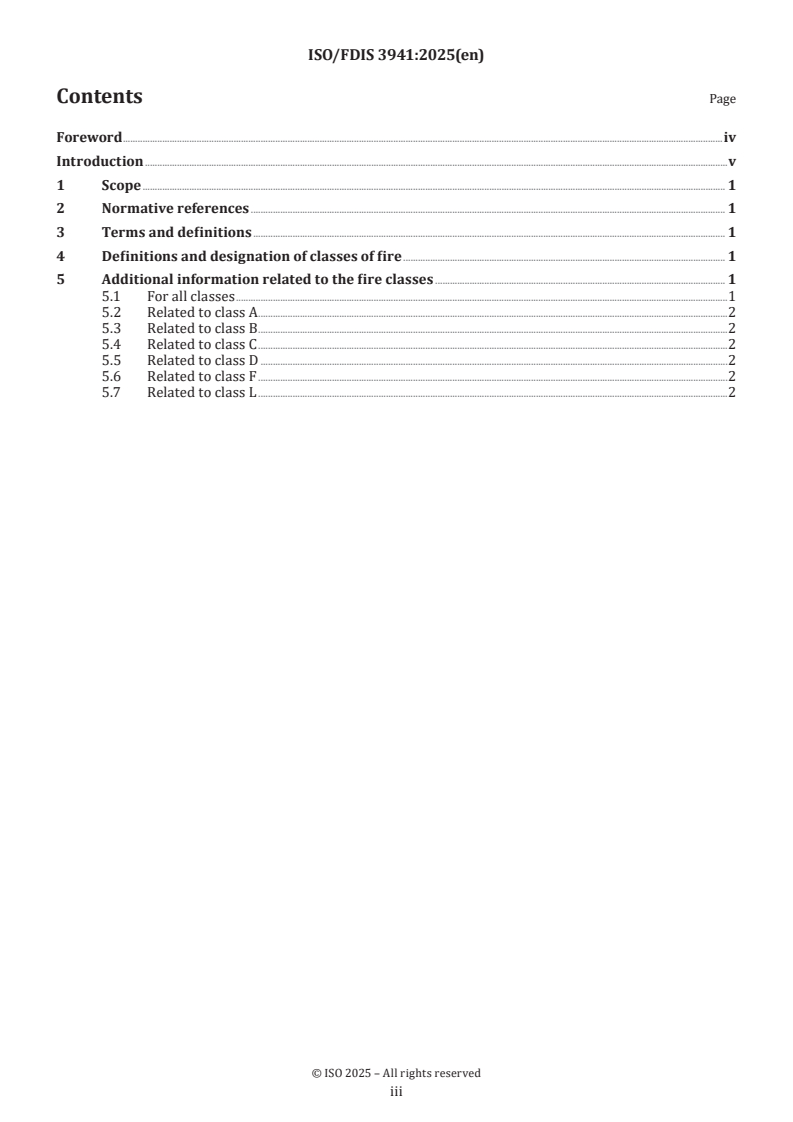
Contents Page
Foreword .iv
Introduction .v
1 Scope . 1
2 Normative references . 1
3 Terms and definitions . 1
4 Definitions and designation of classes of fire . 1
5 Additional information related to the fire classes . 1
5.1 For all classes .1
5.2 Related to class A .2
5.3 Related to class B .2
5.4 Related to class C .2
5.5 Related to class D .2
5.6 Related to class F .2
5.7 Related to class L .2
iii
ISO/FDIS 3941:2025(en)
Foreword
ISO (the International Organization for Standardization) is a worldwide federation of national standards
bodies (ISO member bodies). The work of preparing International Standards is normally carried out through
ISO technical committees. Each member body interested in a subject for which a technical committee
has been established has the right to be represented on that committee. International organizations,
governmental and non-governmental, in liaison with ISO, also take part in the work. ISO collaborates closely
with the International Electrotechnical Commission (IEC) on all matters of electrotechnical standardization.
The procedures used to develop this document and those intended for its further maintenance are described
in the ISO/IEC Directives, Part 1. In particular, the different
...
ISO/FDIS 3941:2025(en)
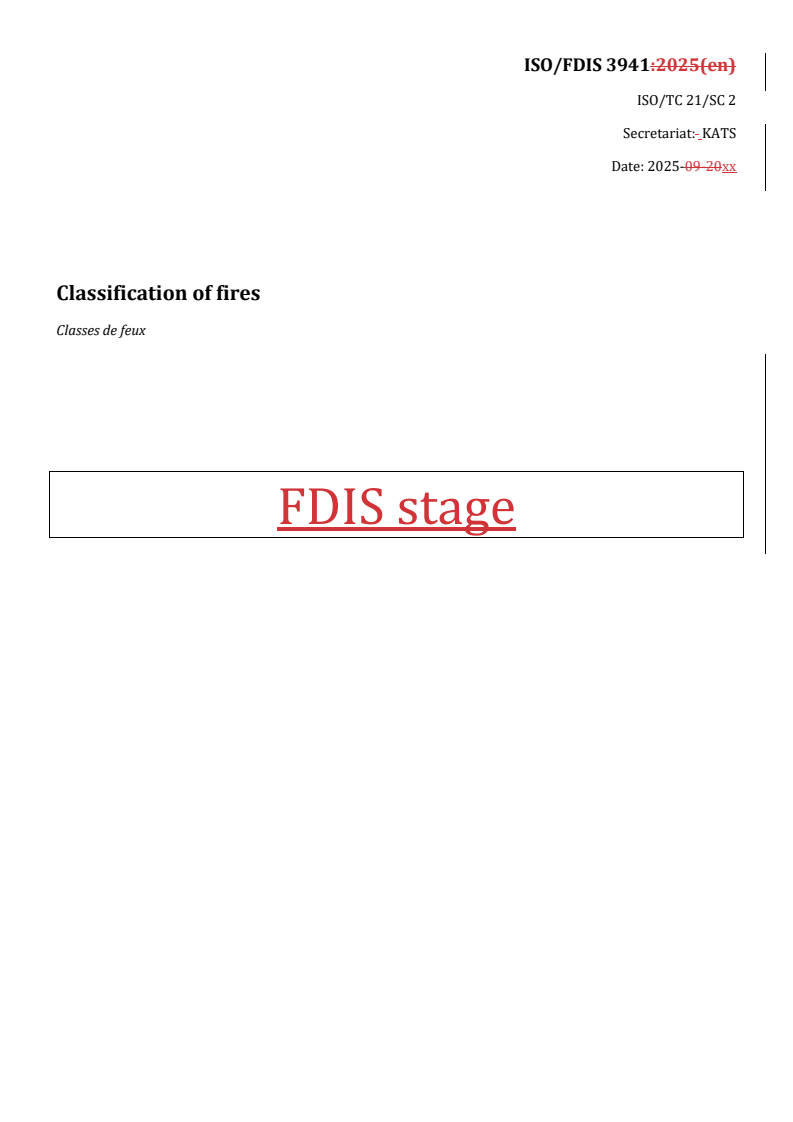
ISO/TC 21/SC 2
Secretariat: KATS
Date: 2025-09-20xx
Classification of fires
Classes de feux
FDIS stage
ISO/FDIS 3941:2025(en)
All rights reserved. Unless otherwise specified, or required in the context of its implementation, no part of this publication
may be reproduced or utilized otherwise in any form or by any means, electronic or mechanical, including photocopying,
or posting on the internet or an intranet, without prior written permission. Permission can be requested from either ISO
at the address below or ISO’s member body in the country of the requester.
ISO copyright office
CP 401 • Ch. de Blandonnet 8
CH-1214 Vernier, Geneva
Phone: + 41 22 749 01 11
EmailE-mail: copyright@iso.org
Website: www.iso.org
Published in Switzerland
ii
ISO/FDIS 3941:2025(en)
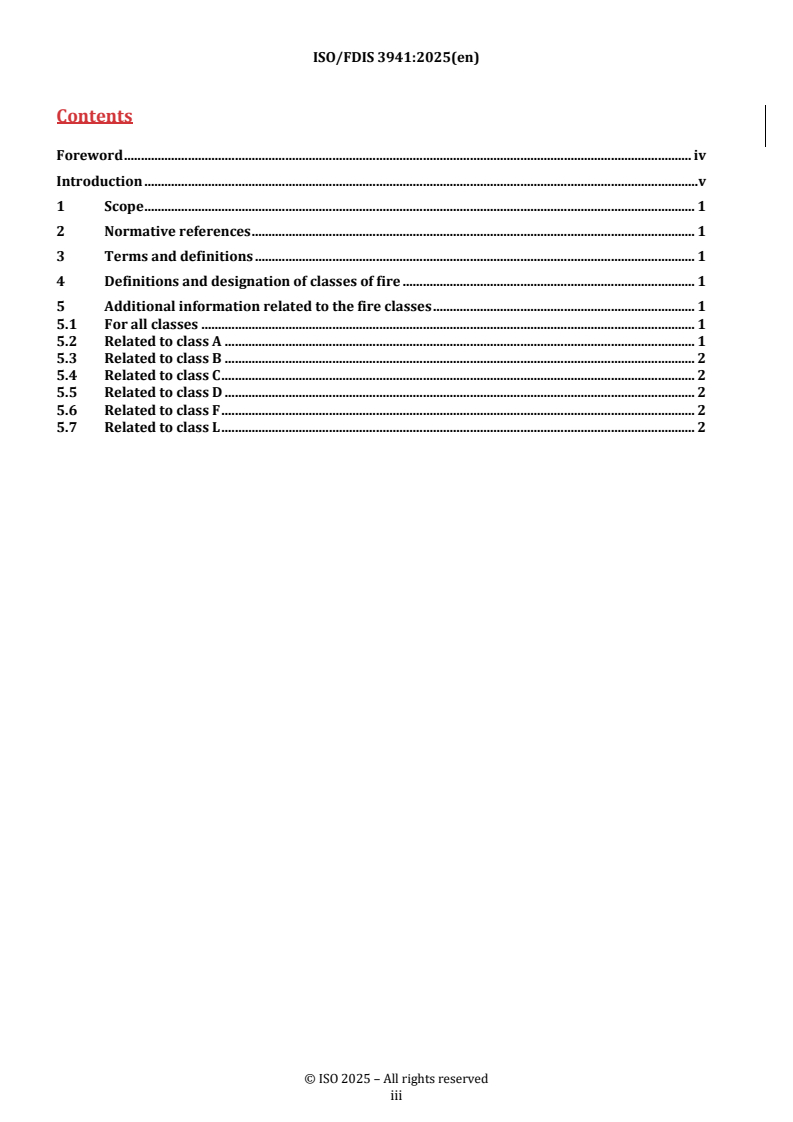
Contents
Foreword . iv
Introduction . v
1 Scope . 1
2 Normative references . 1
3 Terms and definitions . 1
4 Definitions and designation of classes of fire . 1
5 Additional information related to the fire classes . 1
5.1 For all classes . 1
5.2 Related to class A . 1
5.3 Related to class B . 2
5.4 Related to class C . 2
5.5 Related to class D . 2
5.6 Related to class F . 2
5.7 Related to class L . 2
iii
ISO/FDIS 3941:2025(en)
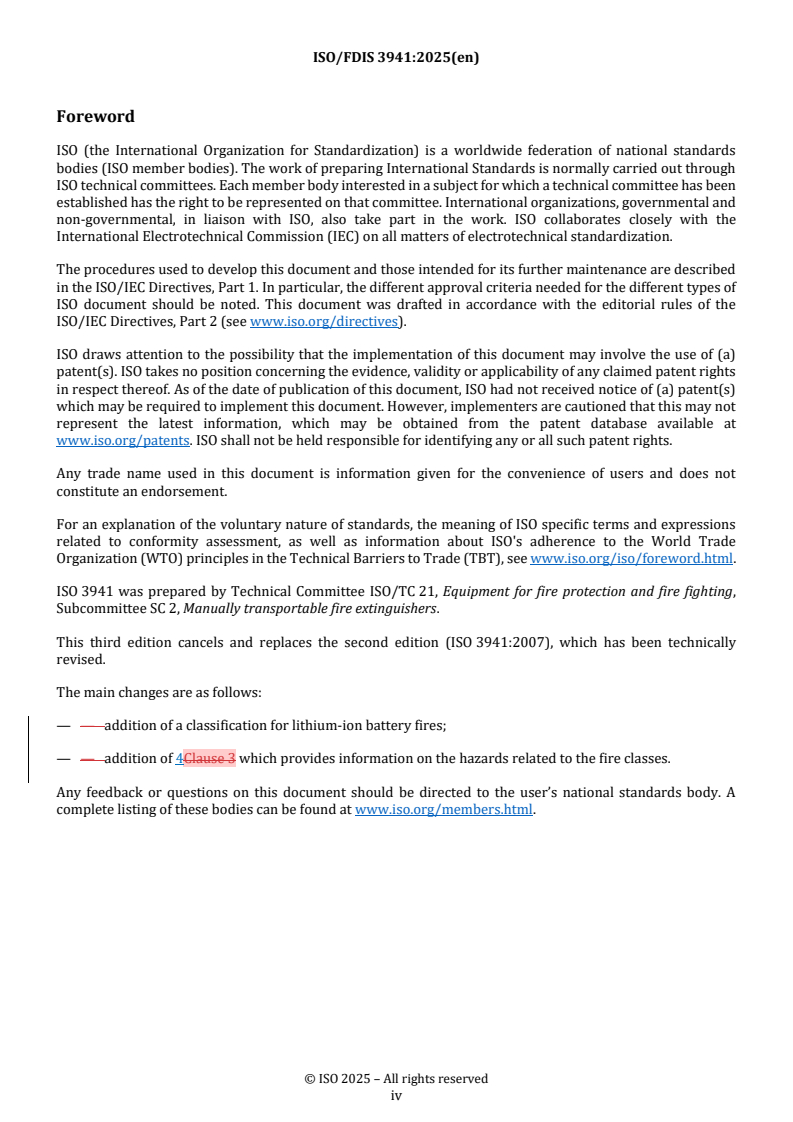
Foreword
ISO (the International Organization for Standardization) is a worldwide federation of national standards
bodies (ISO member bodies). The work of preparing International Standards is normally carried out through
ISO technical committees. Each member body interested in a subject for which a technical committee has been
established has the right to be represented on that committee. International organizations, governmental and
non-governmental, in liaison with ISO, also take part in the work. ISO collaborates closely with the
International Electrotechnical Commission (IEC) on all matters of electrotechnical standardization.
The procedures used to develop this document and those intended for its further maintenance are described
in the ISO/IEC Directives, Part 1. In particular, the different approval criteria needed for the different types of
ISO document should be noted. This document was drafted in accordance with the editorial rules of the
ISO/IEC Directives, Part 2 (see www.iso.org/directives).
ISO draws attention to the possibility that the implementation of this document may involve the use of (a)
patent(s). ISO takes no position concerning the evidence, validity or applicability of any claimed patent rights
in respect thereof. As of the date of publication of this document, ISO had not received notice of (a) patent(s)
which may be required to implement this document. However, implementers are cautioned that this may not
represent the latest information, which may be obtained from the patent database available at
www.iso.org/patents. ISO shall not be held responsible for identifying any or all such patent rights.
Any trade name used in this document is information given for the convenience of users and does not
constitute an endorsement.
Fo
...
Questions, Comments and Discussion
Ask us and Technical Secretary will try to provide an answer. You can facilitate discussion about the standard in here.
Loading comments...