

ISO 10788:2014
(Main)Space systems — Lunar simulants
General Information
- Abstract
ISO 10788:2014 is a reference for quantitative measures of lunar simulants.
- Status
- Published
- Publication Date
- 18-May-2014
- Technical Committee
- ISO/TC 20/SC 14 - Space systems and operations
- Drafting Committee
- ISO/TC 20/SC 14/WG 4 - Space environment (natural and artificial)
- Current Stage
- 9093 - International Standard confirmed
- Start Date
- 05-Mar-2025
- Completion Date
- 29-Aug-2026
Overview
ISO 10788:2014 - Space systems - Lunar simulants is an international reference standard that defines quantitative measures for lunar regolith simulants. The standard is explicitly intended for regolith particles 10 cm and smaller and ties simulant characterization to measured lunar samples from the Apollo and Lunakhod missions. ISO 10788 provides a common, normalized framework to compare simulants and to communicate their geological quality between developers, operators and test laboratories.
Key topics and technical requirements
- Figures of Merit (FoM): The standard centers on four core Figures of Merit that quantify how well a simulant matches lunar material:
- Composition FoM - weighted, normalized comparison of constituent concentrations (normalized to a 0–1 scale where 1 = perfect match).
- Size Distribution FoM - quantitative comparison of particle size distributions across defined size bands.
- Shape FoM - includes particle-shape metrics (e.g., Feret diameter, aspect ratio, sphericity, Heywood circularity factor) to quantify morphological similarity.
- Density FoM - bulk and specific gravity comparisons and measurement requirements.
- Comparative baseline: All FoMs must be stated against a single, explicit baseline (e.g., a specific Apollo sample set). If multiple baselines are used, a complete FoM set is required for each baseline.
- Impurities and contamination: Simulant impurity must be reported as percent mass; contamination must be reported as percent volume with characterization of contaminant types when analyzed.
- Validation and re-use: FoMs must be calculated for each use; if a simulant volume is re-used, FoMs must be re-evaluated and recorded.
- Normative references: The standard references key background sources such as the Lunar Sourcebook and recognized geologic glossaries for terminology and context.
Practical applications
ISO 10788 is practical for any organization needing quantitative, repeatable assessment of lunar simulants, including:
- Development and testing of space systems and hardware exposed to lunar regolith or dust
- Simulant producers validating product quality against lunar baselines
- Test laboratories performing materials, dust mitigation, mobility, and excavator performance testing
- Mission planners and operations teams that require documented, comparable simulant properties for verification and acceptance
Using ISO 10788 helps ensure consistent expectations for simulant performance in engineering tests, reduces ambiguity in procurement and reporting, and supports traceable comparison to Apollo/Lunakhod sample data.
Related standards and bodies
- Prepared by ISO/TC 20 / SC 14 (Space systems and operations)
- Normative background: Heiken et al., “Lunar Sourcebook” and geological glossaries cited in the draft standard
Keywords: ISO 10788:2014, lunar simulants, lunar regolith, figures of merit, composition, size distribution, particle shape, density, Apollo, Lunakhod, space systems.
Get Certified
Connect with accredited certification bodies for this standard

BUREAU VERITAS Certification Germany
Bureau Veritas certification in Germany.

Element Materials Technology
Materials testing and product certification.

AQMS Ltd.
AQMS provides ISO certification to SMEs across the UK.
Sponsored listings
Frequently Asked Questions
ISO 10788:2014 is a standard published by the International Organization for Standardization (ISO). Its full title is "Space systems — Lunar simulants". This standard covers: ISO 10788:2014 is a reference for quantitative measures of lunar simulants.
ISO 10788:2014 is a reference for quantitative measures of lunar simulants.
ISO 10788:2014 is classified under the following ICS (International Classification for Standards) categories: 49.140 - Space systems and operations. The ICS classification helps identify the subject area and facilitates finding related standards.
ISO 10788:2014 is available in PDF format for immediate download after purchase. The document can be added to your cart and obtained through the secure checkout process. Digital delivery ensures instant access to the complete standard document.
Standards Content (Sample)
INTERNATIONAL ISO
STANDARD 10788
First edition
2014-05-15
Space systems — Lunar simulants
Systèmes spatiaux — Simulation de la poussiére lunaire
Reference number
©
ISO 2014
© ISO 2014
All rights reserved. Unless otherwise specified, no part of this publication may be reproduced or utilized otherwise in any form
or by any means, electronic or mechanical, including photocopying, or posting on the internet or an intranet, without prior
written permission. Permission can be requested from either ISO at the address below or ISO’s member body in the country of
the requester.
ISO copyright office
Case postale 56 • CH-1211 Geneva 20
Tel. + 41 22 749 01 11
Fax + 41 22 749 09 47
E-mail copyright@iso.org
Web www.iso.org
Published in Switzerland
ii © ISO 2014 – All rights reserved
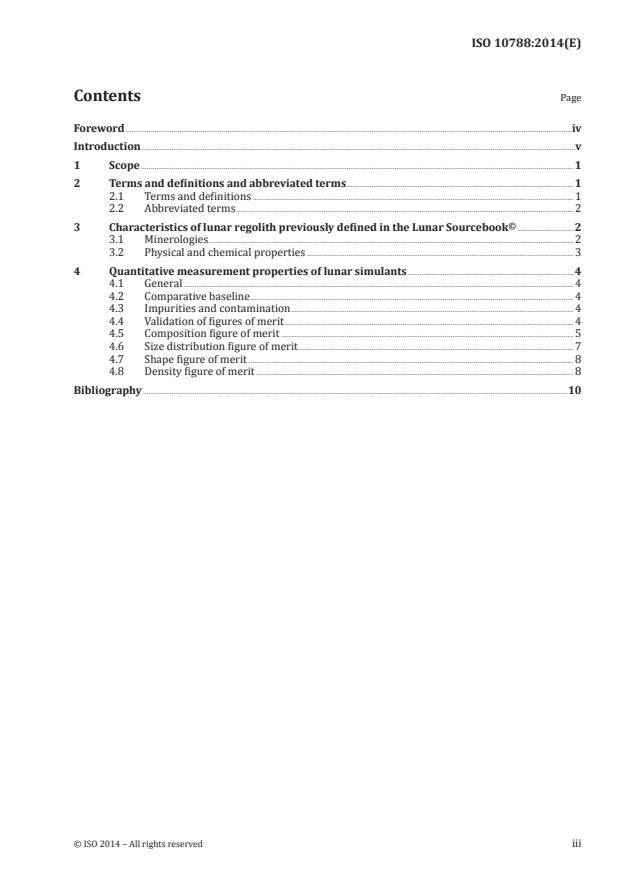
Contents Page
Foreword .iv
Introduction .v
1 Scope . 1
2 Terms and definitions and abbreviated terms . 1
2.1 Terms and definitions . 1
2.2 Abbreviated terms . 2
©
3 Characteristics of lunar regolith previously defined in the Lunar Sourcebook .2
3.1 Minerologies . . 2
3.2 Physical and chemical properties . 3
4 Quantitative measurement properties of lunar simulants . 4
4.1 General . 4
4.2 Comparative baseline . 4
4.3 Impurities and contamination . 4
4.4 Validation of figures of merit . 4
4.5 Composition figure of merit . 5
4.6 Size distribution figure of merit . 7
4.7 Shape figure of merit . 8
4.8 Density figure of merit . 8
Bibliography .10
Foreword
ISO (the International Organization for Standardization) is a worldwide federation of national standards
bodies (ISO member bodies). The work of preparing International Standards is normally carried out
through ISO technical committees. Each member body interested in a subject for which a technical
committee has been established has the right to be represented on that committee. International
organizations, governmental and non-governmental, in liaison with ISO, also take part in the work.
ISO collaborates closely with the International Electrotechnical Commission (IEC) on all matters of
electrotechnical standardization.
The procedures used to develop this document and those intended for its further maintenance are
described in the ISO/IEC Directives, Part 1. In particular the different approval criteria needed for the
different types of ISO documents should be noted. This document was drafted in accordance with the
editorial rules of the ISO/IEC Directives, Part 2 (see www.iso.org/directives).
Attention is drawn to the possibility that some of the elements of this document may be the subject of
patent rights. ISO shall not be held responsible for identifying any or all such patent rights. Details of
any patent rights identified during the development of the document will be in the Introduction and/or
on the ISO list of patent declarations received (see www.iso.org/patents).
Any trade name used in this document is information given for the convenience of users and does not
constitute an endorsement.
For an explanation on the meaning of ISO specific terms and expressions related to conformity
assessment, as well as information about ISO’s adherence to the WTO principles in the Technical Barriers
to Trade (TBT) see the following URL: Foreword - Supplementary information
The committee responsible for this document is ISO/TC 20, Aircraft and space vehicles, Subcommittee
SC 14, Space systems and operations.
iv © ISO 2014 – All rights reserved
Introduction
This International Standard provides lunar systems developers and operators with a specific quantitative
measure for lunar regolith simulants in comparison to other simulants and with relation to sampled
lunar materials from Apollo and Lunakhod missions. Developers of lunar systems will use simulants as
test materials. This International Standard is a reference for quantitative measures of lunar simulants
finer than 10 cm. It describes four properties (composition, size, shape, and density) which are the
minimum number of properties needed for such uses as comparative testing involving simulants or civil
engineering. The quantitative measures of lunar dust simulants are based on the quantitative measures
of lunar regolith samples collected at multiple lunar landing sites of the Apollo missions.
This International Standard provides communication of the geological quality of the simulant between
developing organizations and systems operations organizations.
INTERNATIONAL STANDARD ISO 10788:2014(E)
Space systems — Lunar simulants
1 Scope
This International Standard is a reference for quantitative measures of lunar simulants.
2 Terms and definitions and abbreviated terms
2.1 Terms and definitions
For the purposes of this document, the following terms and definitions apply.
2.1.1
agglutinate
vesiculated glass bonded particle containing other particles (lithic fragments), of which the bonding
glass contains spherical particles of iron
Note 1 to entry: The lunar spherules are typically 3 – 100 nanometers in diameter and formed contemporaneous
with the glass.
Note 2 to entry: Six features characterize lunar agglutinates: size, surface area with relation to volume,
composition, nanophase iron content, flow banding, and multiple generations.
2.1.2
angularity
an expression of roundness
EXAMPLE A poorly rounded grain is described as angular.
Note 1 to entry: This definition has been taken from the Glossary of Geology (see Reference [5]).
2.1.3
aspect ratio
ratio of the maximum Feret diameter divided into the orthogonal Feret diameter
Note 1 to entry: Values range from > 0 to 1 and equal to 1 for a circle.
2.1.4
Feret diameter
distance between two parallel lines which are tangent to the perimeter of a particle
Note 1 to entry: The maximum Feret diameter is defined as the greatest distance between two parallel lines
which are still tangent to the perimeter of the particle.
2.1.5
figure of merit
degree to which a sample matches a reference
Note 1 to entry: Scaling (normalization) forces the norm of the difference of two composition vectors to lie between
0 and 1, and subtraction from unity results in a figure of merit of 1 for a perfect match and 0 for not match at all.
2.1.6
Heywood circularity factor
expression of the complexity of a particle’s perimeter
Note 1 to entry: Formally, the Heywood circularity factor is equal to 1 divided by particle perimeter divided by
the circumference of a circle with the same area as the particle. This is numerically equal to the “circularity”
defined by Waddell (1933). It is expressed in this manner to make it apparent that the Heywood factor is the
inverse of a common definition of “circularity”, another common measure.
Note 2 to entry: Values range from > 0 to 1 and equal 1 for a circle.
2.1.7
lithic fragments
physically discrete solids of any rock type whose normative composition is within the range of the target
terrain
Note 1 to entry: Lithic fragments have texture and mineralogy. Texture is a more important feature than
mineralogy for lithic fragments. Texture describes the grain to grain connectivity boundary. Lunar textures
cannot be replicated on Earth.
2.1.8
lunar terrains
mare and highlands
2.1.9
regolith
all particulate surface material including rocks, soils, and dust
Note 1 to entry: As stated in the Introduction, this International Standard is limited in scope to regolith 10 cm and
smaller. Rocks, soils, and dust are not differentiated on the basis of size.
2.1.10
re-use
after a simulant volume is used (any sequence of events in which a simulant volume is removed from a
storage container) then placed back into storage, any future use constitutes re-use
2.1.11
sphericity
degree to which the shape of a particle approaches a sphere
2.2 Abbreviated terms
th
c concentration or portion of a sample for the x item in the sample
x
FoM Figure of Merit
RFD Relative Frequency Distribution
w weighting factor. w is a value between one and zero. i is an index which refers to the charac-
i
teristic being weighted, such as glass (a grain type)
©
3 Characteristics of lunar regolith previously defined in the Lunar Sour
...