

ISO 20351:2024
(Main)Fine ceramics (advanced ceramics, advanced technical ceramics) — Test method for optical properties of ceramic phosphors for white light-emitting diodes using an integrating sphere
General Information
- Abstract
This document specifies test methods for the use of an integrating sphere to measure the optical properties of ceramic phosphor powders, which are used in white light-emitting diodes (LEDs) and emit visible light when excited by UV or blue light. This document specifies an absolute method to measure internal quantum efficiency and a substitution method to measure external quantum efficiency and absorptance. The substitution method uses reference materials whose external quantum efficiency and absorptance have been obtained in accordance with ISO 23946.
- Status
- Published
- Publication Date
- 15-Oct-2024
- Technical Committee
- ISO/TC 206 - Fine ceramics
- Drafting Committee
- ISO/TC 206 - Fine ceramics
- Current Stage
- 6060 - International Standard published
- Start Date
- 16-Oct-2024
- Due Date
- 09-Aug-2025
- Completion Date
- 16-Oct-2024
Buy Documents


ISO 20351:2024 - Fine ceramics (advanced ceramics, advanced technical ceramics) — Test method for optical properties of ceramic phosphors for white light-emitting diodes using an integrating sphere Released:16. 10. 2024
Overview
ISO 20351:2024 - "Fine ceramics (advanced ceramics, advanced technical ceramics) - Test method for optical properties of ceramic phosphors for white light-emitting diodes using an integrating sphere" defines standardized laboratory methods to measure the optical performance of ceramic phosphor powders used in white LEDs. The second edition retains an absolute integrating-sphere method for measuring internal quantum efficiency (IQE) and adds a substitution method (using reference materials characterized by ISO 23946) to determine external quantum efficiency (EQE) and absorptance. The standard targets measurements when phosphors are excited by UV or blue light and emit visible light.
Key topics and requirements
- Measurement scope: Optical characterization of ceramic phosphors for white LEDs - IQE, EQE and absorptance.
- Two complementary methods:
- Absolute method (integrating sphere) for internal quantum efficiency.
- Substitution method (integrating sphere with reference materials) for external quantum efficiency and absorptance; reference values traceable to ISO 23946.
- Apparatus and components: Detailed requirements for apparatus configuration, including light source unit, sample cell and diffuser, integrating sphere, directing optics, spectrometer/detector, amplifier and data processing.
- Calibration and maintenance: Procedures for wavelength calibration, spectral responsivity correction, integrating sphere and diffuser inspection, and cell handling to ensure repeatable results.
- Sample preparation: Guidance on reference materials, storage, pre-processing and filling cells with ceramic phosphor powders.
- Measurement procedures: Step-by-step instructions for measurement environments, spectral acquisition (with and without phosphor), conversion to photon-number spectra, calculation of fluorescence spectra, IQE, EQE and absorptance.
- Reporting: Required data and formats for test reports to support comparability and traceability.
Applications and users
ISO 20351:2024 is practical for:
- Phosphor manufacturers validating product performance and comparing materials.
- LED and SSL (solid-state lighting) developers selecting phosphors for color rendering and luminous efficiency.
- Test laboratories and QA/QC teams performing routine and accredited measurements for product specifications.
- R&D groups and materials scientists characterizing new ceramic phosphors and optimizing formulations.
- Regulatory and standards bodies harmonizing optical property reporting across suppliers.
Benefits include standardized, repeatable measurements for product qualification, competitive benchmarking, and integration with quality management and certification workflows.
Related standards
- ISO 23946 - gonio-spectrofluorometer methods and reference-material characterization (used for substitution method reference values).
- ISO 13915 - substitution measurement methods using fluorescence spectrophotometers (contextual relevance).
- CIE S 017/E:2020 - international lighting vocabulary referenced for definitions.
Keywords: ISO 20351:2024, integrating sphere, ceramic phosphors, white LEDs, internal quantum efficiency, external quantum efficiency, absorptance, ISO 23946.
Relations
- Effective Date
- 29-Apr-2023
Buy Documents
ISO 20351:2024 - Fine ceramics (advanced ceramics, advanced technical ceramics) — Test method for optical properties of ceramic phosphors for white light-emitting diodes using an integrating sphere Released:16. 10. 2024
Frequently Asked Questions
ISO 20351:2024 is a standard published by the International Organization for Standardization (ISO). Its full title is "Fine ceramics (advanced ceramics, advanced technical ceramics) — Test method for optical properties of ceramic phosphors for white light-emitting diodes using an integrating sphere". This standard covers: This document specifies test methods for the use of an integrating sphere to measure the optical properties of ceramic phosphor powders, which are used in white light-emitting diodes (LEDs) and emit visible light when excited by UV or blue light. This document specifies an absolute method to measure internal quantum efficiency and a substitution method to measure external quantum efficiency and absorptance. The substitution method uses reference materials whose external quantum efficiency and absorptance have been obtained in accordance with ISO 23946.
This document specifies test methods for the use of an integrating sphere to measure the optical properties of ceramic phosphor powders, which are used in white light-emitting diodes (LEDs) and emit visible light when excited by UV or blue light. This document specifies an absolute method to measure internal quantum efficiency and a substitution method to measure external quantum efficiency and absorptance. The substitution method uses reference materials whose external quantum efficiency and absorptance have been obtained in accordance with ISO 23946.
ISO 20351:2024 is classified under the following ICS (International Classification for Standards) categories: 81.060.30 - Advanced ceramics. The ICS classification helps identify the subject area and facilitates finding related standards.
ISO 20351:2024 has the following relationships with other standards: It is inter standard links to ISO 20351:2017. Understanding these relationships helps ensure you are using the most current and applicable version of the standard.
ISO 20351:2024 is available in PDF format for immediate download after purchase. The document can be added to your cart and obtained through the secure checkout process. Digital delivery ensures instant access to the complete standard document.
Standards Content (Sample)
International
Standard
ISO 20351
Second edition
Fine ceramics (advanced ceramics,
2024-10
advanced technical ceramics) —
Test method for optical properties
of ceramic phosphors for white
light-emitting diodes using an
integrating sphere
Reference number
© ISO 2024
All rights reserved. Unless otherwise specified, or required in the context of its implementation, no part of this publication may
be reproduced or utilized otherwise in any form or by any means, electronic or mechanical, including photocopying, or posting on
the internet or an intranet, without prior written permission. Permission can be requested from either ISO at the address below
or ISO’s member body in the country of the requester.
ISO copyright office
CP 401 • Ch. de Blandonnet 8
CH-1214 Vernier, Geneva
Phone: +41 22 749 01 11
Email: copyright@iso.org
Website: www.iso.org
Published in Switzerland
ii
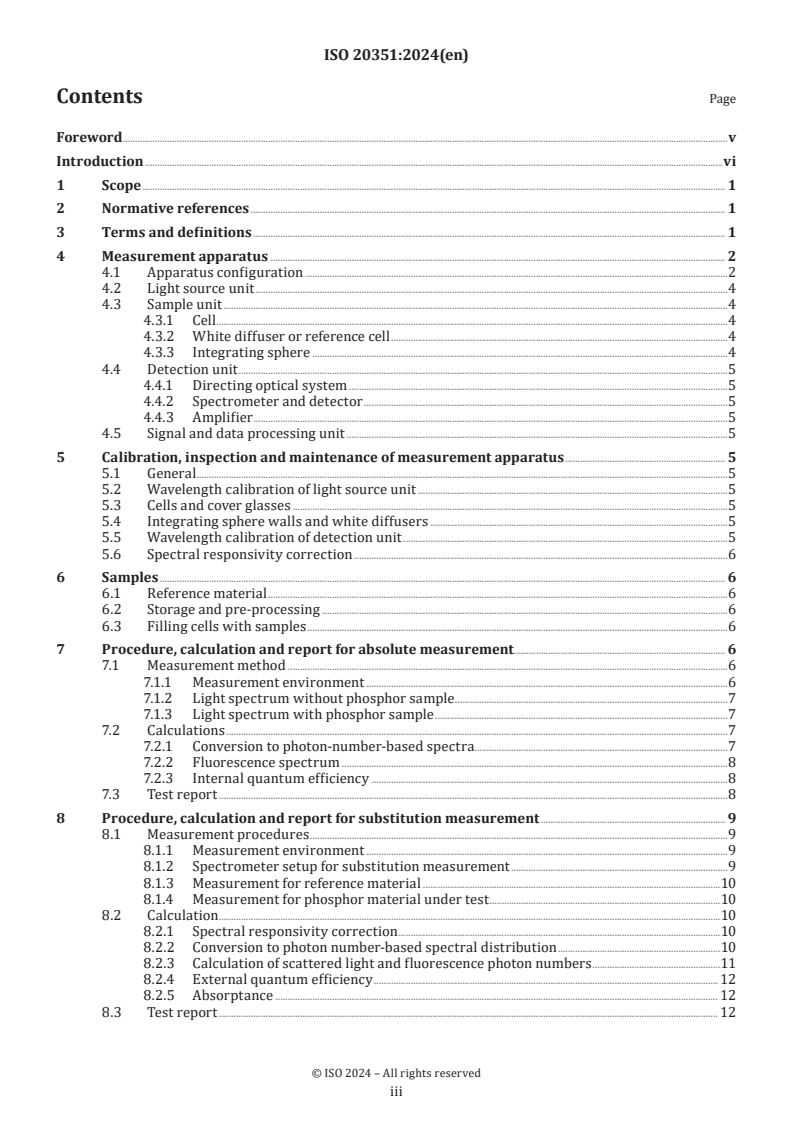
Contents Page
Foreword .v
Introduction .vi
1 Scope . 1
2 Normative references . 1
3 Terms and definitions . 1
4 Measurement apparatus . 2
4.1 Apparatus configuration .2
4.2 Light source unit .4
4.3 Sample unit .4
4.3.1 Cell .4
4.3.2 White diffuser or reference cell .4
4.3.3 Integrating sphere .4
4.4 Detection unit .5
4.4.1 Directing optical system .5
4.4.2 Spectrometer and detector .5
4.4.3 Amplifier .5
4.5 Signal and data processing unit .5
5 Calibration, inspection and maintenance of measurement apparatus . 5
5.1 General .5
5.2 Wavelength calibration of light source unit .5
5.3 Cells and cover glasses .5
5.4 Integrating sphere walls and white diffusers .5
5.5 Wavelength calibration of detection unit .5
5.6 Spectral responsivity correction .6
6 Samples . 6
6.1 Reference material .6
6.2 Storage and pre-processing .6
6.3 Filling cells with samples .6
7 Procedure, calculation and report for absolute measurement . 6
7.1 Measurement method .6
7.1.1 Measurement environment .6
7.1.2 Light spectrum without phosphor sample .7
7.1.3 Light spectrum with phosphor sample .7
7.2 Calculations .7
7.2.1 Conversion to photon-number-based spectra .7
7.2.2 Fluorescence spectrum .8
7.2.3 Internal quantum efficiency .8
7.3 Test report .8
8 Procedure, calculation and report for substitution measurement . 9
8.1 Measurement procedures .9
8.1.1 Measurement environment .9
8.1.2 Spectrometer setup for substitution measurement .9
8.1.3 Measurement for reference material .10
8.1.4 Measurement for phosphor material under test .10
8.2 Calculation .10
8.2.1 Spectral responsivity correction .10
8.2.2 Conversion to photon number-based spectral distribution .10
8.2.3 Calculation of scattered light and fluorescence photon numbers .11
8.2.4 External quantum efficiency . 12
8.2.5 Absorptance . 12
8.3 Test report . 12
iii
Bibliography . 14
iv
Foreword
ISO (the International Organization for Standardization) is a worldwide federation of national standards
bodies (ISO member bodies). The work of preparing International Standards is normally carried out through
ISO technical committees. Each member body interested in a subject for which a technical committee
has been established has the right to be represented on that committee. International organizations,
governmental and non-governmental, in liaison with ISO, also take part in the work. ISO collaborates closely
with the International Electrotechnical Commission (IEC) on all matters of electrotechnical standardization.
The procedures used to develop this document and those intended for its further maintenance are described
in the ISO/IEC Directives, Part 1. In particular, the different approval criteria needed for the different types
of ISO document should be noted. This document was drafted in accordance with the editorial rules of the
ISO/IEC Directives, Part 2 (see www.iso.org/directives).
ISO draws attention to the possibility that the implementation of this document may involve the use of (a)
patent(s). ISO takes no position concerning the evidence, validity or applicability of any claimed patent
rights in respect thereof. As of the date of publication of this document, ISO had not received notice of (a)
patent(s) which may be required to implement this document. However, implementers are cautioned that
this may not represent the latest information, which may be obtained from the patent database available at
www.iso.org/patents. ISO shall not be held responsible for identifying any or all such patent rights.
Any trade name used in this document is information given for the convenience of users and does not
constitute an endorsement.
For an explanation of the voluntary nature of standards, the meaning of ISO specific terms and expressions
related to conformity assessment, as well as information about ISO's adherence to the World Trade
Organization (WTO) principles in the Technical Barriers to Trade (TBT), see www.iso.org/iso/foreword.html.
This document was prepared by Technical Committee ISO/TC 206, Fine ceramics.
This second edition cancels and replaces the first edition (ISO 20351:2017), which has been technically
revised.
The main changes are as follows:
— scope of the document is expanded by additionally implementing the reference material-based
substitution measurement method to measure external quantum efficiency and absorptance.
Any feedback or questions on this document should be directed to the user’s national standards body. A
complete listing of these bodies can be found at www.iso.org/members.html.
v
Introduction
White light-emitting diode (LED) based solid-state lighting (SSL) has been widely used for a variety of
applications as alternatives for incandescent and fluorescent lamps. Initially, white LEDs (comprising blue
LEDs and yellow phosphors) became popular as backlight sources for small-size liquid-crystal displays
(LCDs) used in mobile phones and digital cameras. These were followed by white LEDs (consisting of
blue LEDs combined with green and red phosphors) applied to backlight sources for large-area LCDs.
Subsequently, LED lamps were commercialised for general lighting, replacing conventional luminaires and
capitalising on their advantages, such as compactness, high luminous efficiency, high brightness below 0 °C
or higher ambient temperatures, long life, and controllability of light intensity and colour temperature.
The previous edition of this document (ISO 20351:2017) was developed based on the need for standardizing
a test method for internal quantum efficiency of phosphors using an integrating sphere. This standard test
method has the advantage of a short measurement time and being available to those with no expertise in
precise optical measurement. The external quantum efficiency and absorptance were out of the scope of
ISO 20351:2017 due to an insufficient understanding of the source of variation in these measurement values.
ISO 23946 was then developed to provide alternative absolute measurement methods for the external
quantum efficiency, internal quantum efficiency and absorptance using a gonio-spectrofluorometer.
The application of ISO 23946 is assumed to be limited to those who intend to determine the optical
properties of phosphor materials to be utilized as reference materials due to its complicated equipment
and time-consuming procedure. ISO 13915 was developed following ISO 23946 and provides substitution
measurement methods comparing with reference materials with values evaluated in accordance with
ISO 23946 to provide external quantum efficiency, internal quantum efficiency and absorptance by using a
commercially available fluorescence spectrophotometer.
It was found that the external quantum efficiency and absorptance of a phosphor material under test can
also be appropriately obtained using and integrating sphere-based spectrometer with the substitution
measurement method as described in ISO 13915, where the measurement using and integrating sphere-
based equipment is excluded.
Therefore, the revised second edition of this document is intended to expand the scope by additionally
implementing the substitution measurement method for obtaining external quantum efficiency and
absorptance using an integrating sphere to the existing absolute method to obtain internal quantum
efficiency. This expanded scope will benefit those who routinely use integrating sphere-based equipment.
In this document, measurement conditions and procedures that can affect the measurement values are
described in detail, helping those who address high-performance phosphors for competitive SSL products to
obtain appropriate information on their competitiveness.
This document can also be adopted for phosphors used in non-white LEDs, e.g. green, orange, pink and purple.
vi
International Standard ISO 20351:2024(en)
Fine ceramics (advanced ceramics, advanced technical
ceramics) — Test method for optical properties of ceramic
phosphors for white light-emitting diodes using an
integrating sphere
1 Scope
This document specifies test methods for the use of an integrating sphere to measure the optical properties
of ceramic phosphor powders, which are used in white light-emitting diodes (LEDs) and emit visible
light when excited by UV or blue light. This document specifies an absolute method to measure internal
quantum efficiency and a substitution method to measure external quantum efficiency and absorptance.
The substitution method uses reference materials whose external quantum efficiency and absorptance have
been obtained in accordance with ISO 23946.
2 Normative references
The following documents are referred to in the text in such a way that some or all of their content constitutes
requirements of this document. For dated references, only the edition cited applies. For undated references,
the latest edition of the referenced document (including any amendments) applies.
ISO 23946, Fine ceramics (advanced ceramics, advanced technical ceramics) — Test methods for optical
properties of ceramic phosphors for white light-emitting diodes using a gonio-spectrofluorometer
CIE S 017/E:2020, ILV: International Lighting Vocabulary, 2nd edition
3 Terms and definitions
For the purposes of this document, the terms and definitions given in ISO 23946 and CIE S 017/E and the
following apply.
ISO and IEC maintain terminology databases for use in standardization at the following addresses:
— ISO Online browsing platform: available at https:// www .iso .org/ obp
— IEC Electropedia: available at https:// www .electropedia .org/
3.1
internal quantum efficiency
ratio of the number of photons emitted in free space from the phosphor to the number of excitation light
photons absorbed by the phosphor
3.2
external quantum efficiency
ratio of the number of photons emitted in free space from the phosphor to the number of excitation light
photons incident on the phosphor
3.3
absorptance
ratio of the number of excitation light photons absorbed by the phosphor to the number of excitation light
photons incident on the phosphor
3.4
cell
container filled with a sample or a white material such as barium sulfate
Note 1 to entry: A cell is typically a flat plate sample holder with a cylindrical hollow, a petri dish or a rectangular cell
used in a spectrophotometer.
3.5
reference cell
cell filled with a white powder which has a high spectral diffuse reflectance over the whole visible spectrum
(such as barium sulfate or alumina), used when measuring the excitation light spectrum
Note 1 to entry: This term is only for use in the absolute method.
3.6
white diffuser
white plate which has a high spectral diffuse reflectance over the whole visible spectrum (such as barium
sulfate or polytetrafluoroethylene (PTFE)), used when measuring the excitation light spectrum
Note 1 to entry: This term is only for use in the absolute method.
3.7
secondary absorption
absorption of indirect incident light from every direction of the sphere wall by the phosphor sample
Note 1 to entry: The excitation light illuminating the sample is not entirely absorbed by the sample but is partially
scattered or reflected and then repeatedly reflected on the sphere wall. Some of the scattered/reflected light can
illuminate the sample again and be absorbed.
3.8
self absorption
absorption of photoluminescent photons emitted by the sample itself
4 Measurement apparatus
4.1 Apparatus configuration
The apparatus includes a light source unit, a sample unit, a detection unit and a signal and data processing
unit. Figure 1 and Figure 2 illustrate the typical configurations of a measurement apparatus.
The light source unit generates monochromatic excitation light and comprises a white light source, a power
supply for the light source, a focusing optical system, a wavelength selection unit (monochromator for the
white light source) and an optical system for irradiation. A collimated laser beam can also be used as the
monochromatic light source.
The sample unit comprises a cell and an integrating sphere.
The detecting unit comprises directing optics for collecting light, a spectrometer, a detector and an amplifier.
A fluorescence spectrophotometer equipped with a sample unit (including an integrating sphere), and
equipment combining a light source unit and an array spectrometer together with the sample unit, are
typical examples.
Key
A light source unit 1 light source
B sample unit 2 excitation monochromator
C detecting unit 3 integrating sphere
4 cell (sample)
5 emission monochromator
6 detector
Figure 1 — Example configuration of measuring equipment (fluorescence spectrophotometer type)
Key
A light source unit 1 light source
B sample unit 2 monochromator
C detecting unit 3 optical fibre
4 integrating sphere
5 cell (sample)
6 optical fibre
7 array spectrometer
Figure 2 — Example configuration of measuring equipment (array spectrometer type)
4.2 Light source unit
The spectral width of the excitation light is limited by the monochromator. The half-width of the excitation
light spectrum should be 15 nm or less.
The generated excitation light is introduced into the integrating sphere via the excitation light
...