

ISO/IEC 11694-2:2012
(Main)Identification cards — Optical memory cards — Linear recording method — Part 2: Dimensions and location of the accessible optical area
General Information
- Abstract
ISO/IEC 11694-2:2012 defines the dimensions and location of the accessible optical area of optical memory cards with ID-1 dimensions using the linear recording method.
- Status
- Published
- Publication Date
- 03-Dec-2012
- Technical Committee
- ISO/IEC JTC 1/SC 17 - Cards and security devices for personal identification
- Current Stage
- 9093 - International Standard confirmed
- Start Date
- 14-May-2018
- Completion Date
- 29-Aug-2026
Overview
ISO/IEC 11694-2:2012 is an international standard issued by ISO and IEC that specifies the dimensions and location of the accessible optical area on optical memory identification cards using the linear recording method. This standard applies to optical memory cards with ID-1 physical dimensions-the most common size for identification cards, such as credit cards and driver's licenses.
The document ensures interoperability and consistency in how the optical memory area is positioned and sized, enabling compatibility across various applications and industries relying on optical memory technology for secure data storage.
Key Topics
Accessible Optical Area
The standard precisely defines the physical area of the card that is optically accessible for linear recording and reading. It covers aspects including:- Dimension C: Adjustable by user groups to meet specific interchange requirements, but must be between 9.5 mm and 49.2 mm.
- Dimension X: Maximum 1.0 mm tolerance for lateral positioning.
- Dimension Y: Must be at least 1.0 mm less than the card’s side dimension D to ensure proper placement.
- Skew: The angle of the reference data track relative to the card edge shall not exceed 0.2°, ensuring accurate data reading.
Reference Edge and Track
Defines the card orientation by using a "reference edge" (lower horizontal or left vertical edge) and a "reference track," critical for alignment during reading and writing operations.Optional Layouts
Annex A provides guidelines for optional card layouts, allowing flexibility in the accessible optical area's location on either face of the card and its coexistence with other machine-readable technologies, without interference.Compatibility with Other Technologies
The standard references ISO/IEC 11693-2 to ensure the coexistence of optical memory areas alongside other identification technologies on a single card, promoting multi-functionality.
Applications
Secure Identification Cards
Utilized in government, banking, and corporate ID cards requiring robust storage of encrypted or sensitive digital data.Access Control Systems
Cards compliant with ISO/IEC 11694-2 can be reliably used in access management, where precise optical data reading is critical.Multi-Technology Cards
Enables integration of optical memory with contact or contactless chips and barcodes, supporting comprehensive security and data interchange solutions in a single card.Data Interchange and Storage
Suitable for industries where standardized optical memory storage on ID-1 cards facilitates interoperability between systems and devices.
Related Standards
ISO/IEC 7810 - Defines the physical characteristics and dimensions of identification cards, including the ID-1 format referenced in ISO/IEC 11694-2.
ISO/IEC 11693-1 - Specifies general characteristics for optical memory cards, providing a base framework for the linear recording method.
ISO/IEC 11694-4 - Details logical data structures for optical memory cards using the linear recording method.
ISO/IEC 11693-2 - Focuses on the coexistence of optical memory with other machine-readable technologies to avoid interference.
Practical Value
Adhering to ISO/IEC 11694-2:2012 ensures that manufacturers and users of optical memory cards achieve high levels of interoperability, accuracy, and reliability in card design and data accessibility. This standardization helps reduce errors in reading data due to misalignment or improper sizing, supports integration with additional technologies, and underpins the consistent performance expected in secure identification and data interchange systems globally.
Relations
- Effective Date
- 05-Mar-2011
Get Certified
Connect with accredited certification bodies for this standard

BSI Group
BSI (British Standards Institution) is the business standards company that helps organizations make excellence a habit.

NYCE
Mexican standards and certification body.
Sponsored listings
Frequently Asked Questions
ISO/IEC 11694-2:2012 is a standard published by the International Organization for Standardization (ISO). Its full title is "Identification cards — Optical memory cards — Linear recording method — Part 2: Dimensions and location of the accessible optical area". This standard covers: ISO/IEC 11694-2:2012 defines the dimensions and location of the accessible optical area of optical memory cards with ID-1 dimensions using the linear recording method.
ISO/IEC 11694-2:2012 defines the dimensions and location of the accessible optical area of optical memory cards with ID-1 dimensions using the linear recording method.
ISO/IEC 11694-2:2012 is classified under the following ICS (International Classification for Standards) categories: 35.240.15 - Identification cards. Chip cards. Biometrics. The ICS classification helps identify the subject area and facilitates finding related standards.
ISO/IEC 11694-2:2012 has the following relationships with other standards: It is inter standard links to ISO/IEC 11694-2:2005. Understanding these relationships helps ensure you are using the most current and applicable version of the standard.
ISO/IEC 11694-2:2012 is available in PDF format for immediate download after purchase. The document can be added to your cart and obtained through the secure checkout process. Digital delivery ensures instant access to the complete standard document.
Standards Content (Sample)
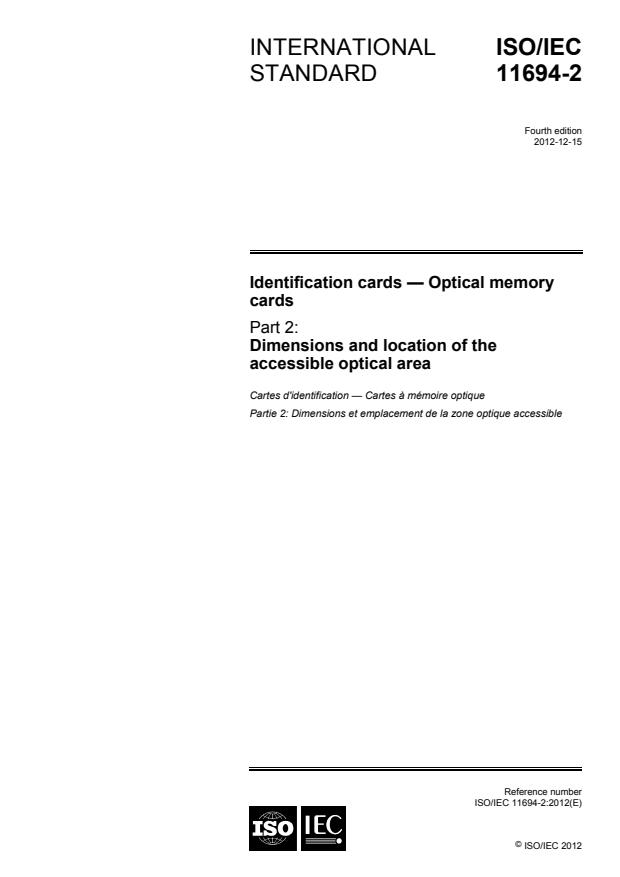
INTERNATIONAL ISO/IEC
STANDARD 11694-2
Fourth edition
2012-12-15
Identification cards — Optical memory
cards
Part 2:
Dimensions and location of the
accessible optical area
Cartes d'identification — Cartes à mémoire optique
Partie 2: Dimensions et emplacement de la zone optique accessible
Reference number
©
ISO/IEC 2012
© ISO/IEC 2012
All rights reserved. Unless otherwise specified, no part of this publication may be reproduced or utilized in any form or by any means,
electronic or mechanical, including photocopying and microfilm, without permission in writing from either ISO at the address below or
ISO's member body in the country of the requester.
ISO copyright office
Case postale 56 CH-1211 Geneva 20
Tel. + 41 22 749 01 11
Fax + 41 22 749 09 47
E-mail copyright@iso.org
Web www.iso.org
Published in Switzerland
ii © ISO/IEC 2012 – All rights reserved
Contents Page
Foreword . iv
Introduction . v
1 Scope . 1
2 Normative references . 1
3 Terms and definitions . 1
4 Dimensions and location . 1
4.1 General . 1
4.2 Accessible optical area . 1
4.2.1 Dimension C . 1
4.2.2 Dimension X . 1
4.2.3 Dimension Y . 2
4.2.4 Skew . 2
Annex A (informative) Optional card layouts . 3
A.1 General . 3
A.2 Accessible optical area . 3
A.2.1 Location . 3
A.2.2 Reference track . 3
A.2.3 Size . 3
A.2.4 Co-existence . 3
Bibliography . 4
© ISO/IEC 2012 – All rights reserved iii
Foreword
ISO (the International Organization for Standardization) and IEC (the International Electrotechnical
Commission) form the specialized system for worldwide standardization. National bodies that are members of
ISO or IEC participate in the development of International Standards through technical committees
established by the respective organization to deal with particular fields of technical activity. ISO and IEC
technical committees collaborate in fields of mutual interest. Other international organizations, governmental
and non-governmental, in liaison with ISO and IEC, also take part in the work. In the field of information
technology, ISO and IEC have established a joint technical committee, ISO/IEC JTC 1.
International Standards are drafted in accordance with the rules given in the ISO/IEC Directives, Part 2.
The main task of the joint technical committee is to prepare International Standards. Draft International
Standards adopted by the joint technical committee are circulated to national bodies for voting. Publication as
an International Standard requires approval by at least 75 % of the national bodies casting a vote.
Attention is drawn to the possibility that some of the elements of this document may be the subject of patent
rights. ISO and IEC shall not be held responsible for identifying any or all such patent rights.
ISO/IEC 11694-2 was prepared by Joint Technical Committee ISO/IEC JTC 1, Information technology,
Subcommittee SC 17, Cards and persona
...