

ISO 20188:2025
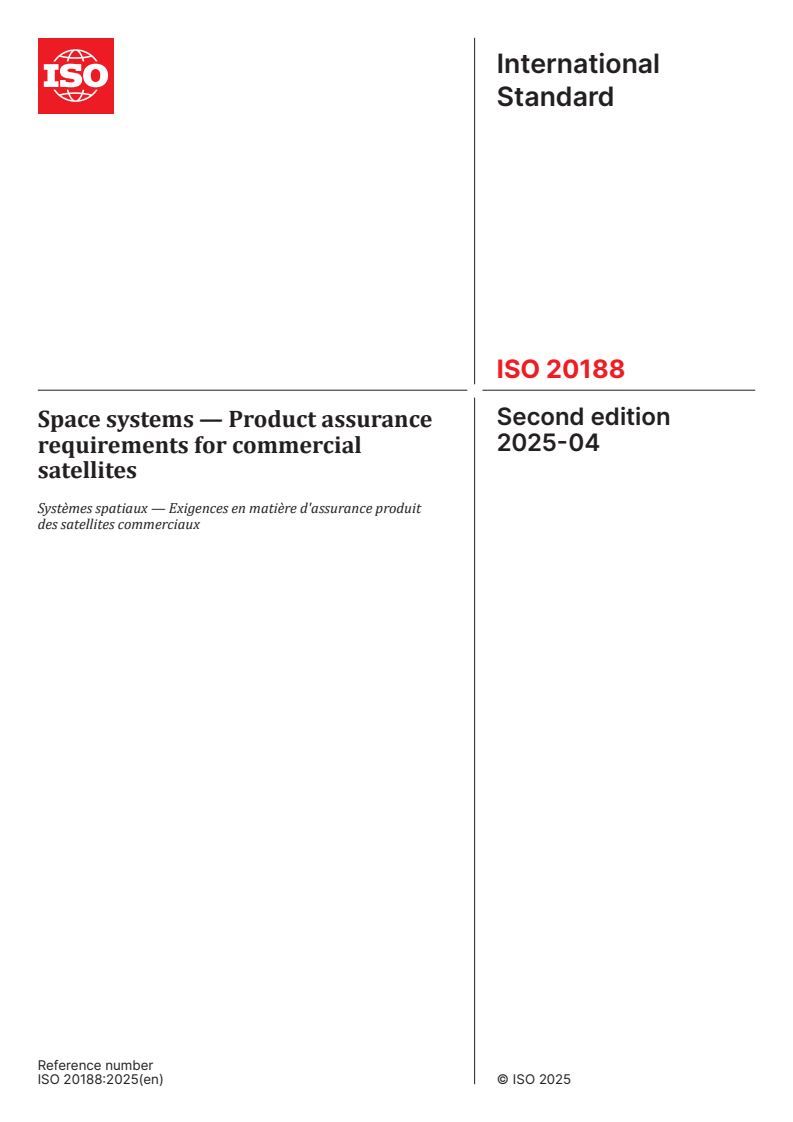
(Main)Space systems — Product assurance requirements for commercial satellites
General Information
- Abstract
This document provides product assurance requirements and recommendations for commercial satellites throughout all phases. This document is applicable to the prime contractor, subcontractors and suppliers.
- Status
- Published
- Publication Date
- 07-Apr-2025
- Technical Committee
- ISO/TC 20/SC 14 - Space systems and operations
- Drafting Committee
- ISO/TC 20/SC 14/WG 5 - Space System Program Management and Quality
- Current Stage
- 6060 - International Standard published
- Start Date
- 08-Apr-2025
- Due Date
- 23-Jan-2026
- Completion Date
- 08-Apr-2025

Overview
ISO 20188:2025 - Space systems - Product assurance requirements for commercial satellites - defines product assurance (PA) and quality requirements for commercial satellite programs across all phases of the lifecycle. Applicable to prime contractors, subcontractors and suppliers, the standard consolidates product assurance, quality assurance, dependability, safety, EEE parts control, materials/mechanical/processes (MMPP) and software product assurance into a single, program-level framework.
Keywords: ISO 20188:2025, product assurance, commercial satellites, space systems, quality assurance, EEE parts, software product assurance
Key topics and technical requirements
ISO 20188:2025 addresses a broad set of PA and QA topics (summarized from the standard’s contents):
- PA management & planning
- PA plan, audits, customer right of access, PA progress reporting and risk management.
- Quality assurance (QA) processes
- QA programme, design and manufacturing readiness reviews, pre‑shipment and flight readiness reviews, in‑process inspection, process control and workmanship standards.
- Procurement & supply chain control
- Procurement document review, sub‑tier source selection, incoming inspection, sub‑tier surveillance and traceability requirements.
- Testing and test control
- Test facilities, test documentation, performance monitoring and test reviews.
- EEE parts management
- Parts programme planning, parts selection, screening, lot acceptance (LAT/QCI), radiation considerations, destructive physical analysis (DPA), traceability and non‑conforming parts handling. (References include space‑qualified part regimes such as MIL, ESA/SCC, JAXA where applicable.)
- Materials, mechanical parts and processes (MMPP)
- Selection and control policies, special processes, and process control boards.
- Software product assurance
- Software development controls, configuration management and non‑conformity reporting.
- Dependability, safety and configuration
- Requirements for reliability, safety assessments and QA role in configuration management.
- Operational controls
- Handling, storage, packaging, shipping, ground support equipment certification, electrostatic discharge (ESD) and contamination/cleanliness control plans.
Practical applications and users
ISO 20188:2025 is intended for organizations involved in design, manufacture, assembly, test, integration and delivery of commercial satellites, including:
- Prime contractors and systems integrators
- Subcontractors, parts suppliers and manufacturers
- QA/PA managers, procurement and supply‑chain teams
- EEE parts engineers, materials/process engineers and software assurance teams
- Program managers conducting reviews (design, manufacturing, flight readiness)
Implementing ISO 20188 helps reduce program risk, improve traceability, ensure supplier control, and align QA and PA practices for commercial satellite missions.
Related standards
- ISO/IEC Directives (editorial and development procedures referenced in the foreword)
- Space agency qualification regimes cited in the standard (e.g., MIL, ESA/SCC, JAXA) for parts qualification and LAT/QCI requirements
For program implementation, ISO 20188:2025 is used alongside contractual, national and agency-specific requirements to ensure comprehensive product assurance for commercial space systems.
Relations
- Effective Date
- 27-Jan-2024
Get Certified
Connect with accredited certification bodies for this standard

BUREAU VERITAS Certification Germany
Bureau Veritas certification in Germany.

Element Materials Technology
Materials testing and product certification.

AQMS Ltd.
AQMS provides ISO certification to SMEs across the UK.
Sponsored listings
Frequently Asked Questions
ISO 20188:2025 is a standard published by the International Organization for Standardization (ISO). Its full title is "Space systems — Product assurance requirements for commercial satellites". This standard covers: This document provides product assurance requirements and recommendations for commercial satellites throughout all phases. This document is applicable to the prime contractor, subcontractors and suppliers.
This document provides product assurance requirements and recommendations for commercial satellites throughout all phases. This document is applicable to the prime contractor, subcontractors and suppliers.
ISO 20188:2025 is classified under the following ICS (International Classification for Standards) categories: 49.140 - Space systems and operations. The ICS classification helps identify the subject area and facilitates finding related standards.
ISO 20188:2025 has the following relationships with other standards: It is inter standard links to ISO 20188:2018. Understanding these relationships helps ensure you are using the most current and applicable version of the standard.
ISO 20188:2025 is available in PDF format for immediate download after purchase. The document can be added to your cart and obtained through the secure checkout process. Digital delivery ensures instant access to the complete standard document.
Standards Content (Sample)
International
Standard
ISO 20188
Second edition
Space systems — Product assurance
2025-04
requirements for commercial
satellites
Systèmes spatiaux — Exigences en matière d'assurance produit
des satellites commerciaux
Reference number
© ISO 2025
All rights reserved. Unless otherwise specified, or required in the context of its implementation, no part of this publication may
be reproduced or utilized otherwise in any form or by any means, electronic or mechanical, including photocopying, or posting on
the internet or an intranet, without prior written permission. Permission can be requested from either ISO at the address below
or ISO’s member body in the country of the requester.
ISO copyright office
CP 401 • Ch. de Blandonnet 8
CH-1214 Vernier, Geneva
Phone: +41 22 749 01 11
Email: copyright@iso.org
Website: www.iso.org
Published in Switzerland
ii
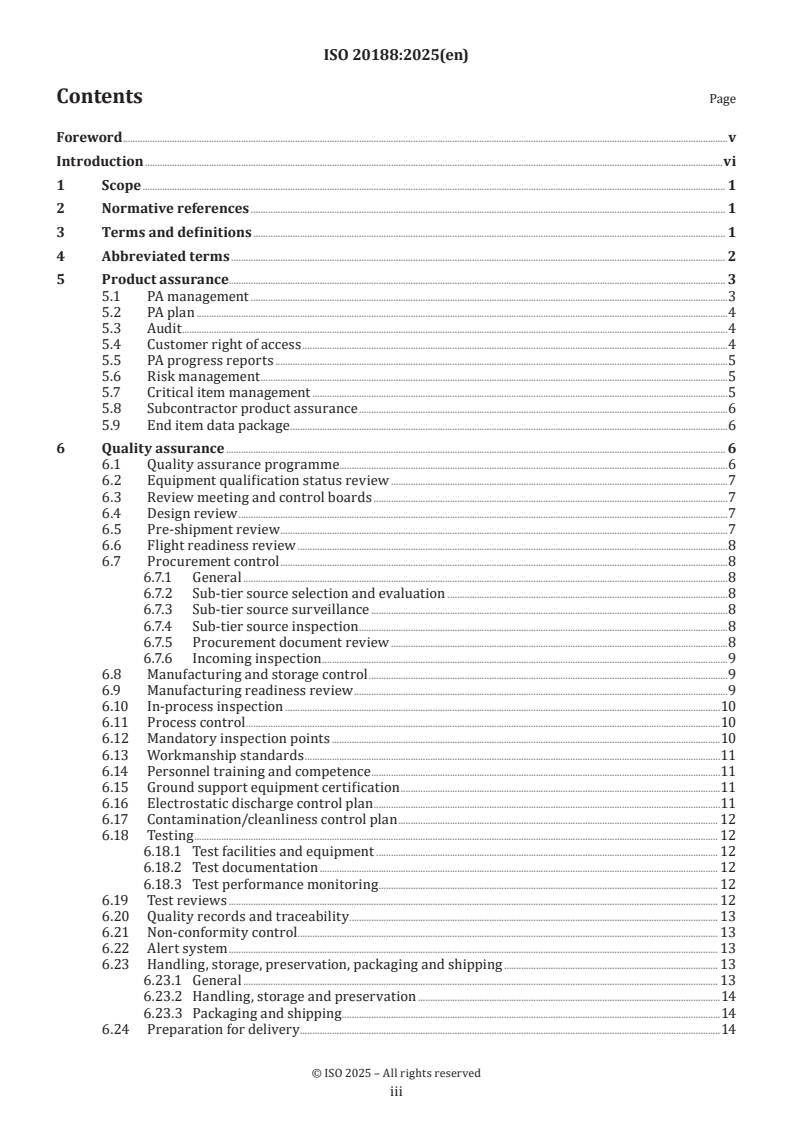
Contents Page
Foreword .v
Introduction .vi
1 Scope . 1
2 Normative references . 1
3 Terms and definitions . 1
4 Abbreviated terms . 2
5 Product assurance. 3
5.1 PA management .3
5.2 PA plan .4
5.3 Audit .4
5.4 Customer right of access .4
5.5 PA progress reports .5
5.6 Risk management .5
5.7 Critical item management .5
5.8 Subcontractor product assurance .6
5.9 End item data package .6
6 Quality assurance . 6
6.1 Quality assurance programme.6
6.2 Equipment qualification status review .7
6.3 Review meeting and control boards .7
6.4 Design review .7
6.5 Pre-shipment review .7
6.6 Flight readiness review .8
6.7 Procurement control .8
6.7.1 General .8
6.7.2 Sub-tier source selection and evaluation .8
6.7.3 Sub-tier source surveillance .8
6.7.4 Sub-tier source inspection .8
6.7.5 Procurement document review .8
6.7.6 Incoming inspection .9
6.8 Manufacturing and storage control .9
6.9 Manufacturing readiness review .9
6.10 In-process inspection .10
6.11 Process control .10
6.12 Mandatory inspection points .10
6.13 Workmanship standards .11
6.14 Personnel training and competence .11
6.15 Ground support equipment certification .11
6.16 Electrostatic discharge control plan .11
6.17 Contamination/cleanliness control plan . 12
6.18 Testing . 12
6.18.1 Test facilities and equipment . 12
6.18.2 Test documentation . 12
6.18.3 Test performance monitoring . 12
6.19 Test reviews . 12
6.20 Quality records and traceability . 13
6.21 Non-conformity control . 13
6.22 Alert system . 13
6.23 Handling, storage, preservation, packaging and shipping . 13
6.23.1 General . 13
6.23.2 Handling, storage and preservation .14
6.23.3 Packaging and shipping .14
6.24 Preparation for delivery .14
iii
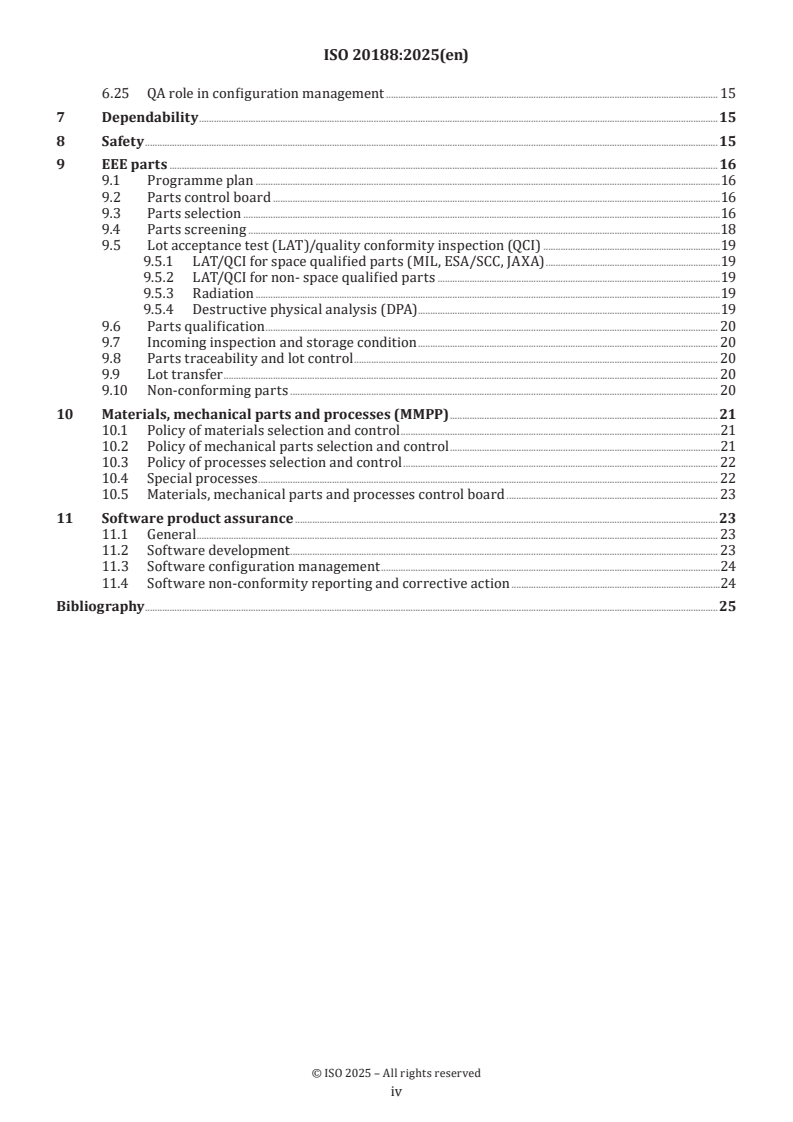
6.25 QA role in configuration management . 15
7 Dependability .15
8 Safety .15
9 EEE parts .16
9.1 Programme plan .16
9.2 Parts control board .16
9.3 Parts selection .16
9.4 Parts screening .18
9.5 Lot acceptance test (LAT)/quality conformity inspection (QCI) .19
9.5.1 LAT/QCI for space qualified parts (MIL, ESA/SCC, JAXA) .19
9.5.2 LAT/QCI for non- space qualified parts .19
9.5.3 Radiation .19
9.5.4 Destructive physical analysis (DPA) .19
9.6 Parts qualification . 20
9.7 Incoming inspection and storage condition . 20
9.8 Parts traceability and lot control . 20
9.9 Lot transfer . 20
9.10 Non-conforming parts . 20
10 Materials, mechanical parts and processes (MMPP) .21
10.1 Policy of materials selection and control .21
10.2 Policy of mechanical parts selection and control .21
10.3 Policy of processes selection and control . 22
10.4 Special processes . 22
10.5 Materials, mechanical parts and processes control board . 23
11 Software product assurance .23
11.1 General . 23
11.2 Software development . 23
11.3 Software configuration management .24
11.4 Software non-conformity reporting and corrective action .24
Bibliography .25
iv
Foreword
ISO (the International Organization for Standardization) is a worldwide federation of national standards
bodies (ISO member bodies). The work of preparing International Standards is normally carried out through
ISO technical committees. Each member body interested in a subject for which a technical committee
has been established has the right to be represented on that committee. International organizations,
governmental and non-governmental, in liaison with ISO, also take part in the work. ISO collaborates closely
with the International Electrotechnical Commission (IEC) on all matters of electrotechnical standardization.
The procedures used to develop this document and those intended for its further maintenance are described
in the ISO/IEC Directives, Part 1. In particular, the different approval criteria needed for the different types
of ISO document should be noted. This document was drafted in accordance with the editorial rules of the
ISO/IEC Directives, Part 2 (see www.iso.org/directives).
ISO draws attention to the possibility that the implementation of this document may involve the use of (a)
patent(s). ISO takes no position concerning the evidence, validity or applicability of any claimed patent
rights in respect thereof. As of the date of publication of this document, ISO had not received notice of (a)
patent(s) which may be required to implement this document. However, implementers are cautioned that
this may not represent the latest information, which may be obtained from the patent database available at
www.iso.org/patents. ISO shall not be held responsible for identifying any or all such patent rights.
Any trade name used in this document is information given for the convenience of users and does not
constitute an endorsement.
For an explanation of the voluntary nature of standards, the meaning of ISO specific terms and expressions
related to conformity assessment, as well as information about ISO's adherence to the World Trade
Organization (WTO) principles in the Technical Barriers to Trade (TBT), see www.iso.org/iso/foreword.html.
This document was prepared by Technical Committee ISO/TC 20, Aircraft and space vehicles, Subcommittee
SC 14, Space systems and operations.
This second edition cancels and replaces the first edition (ISO 20188:2018), which has been technically
revised.
The main changes are as follows:
— normative references with related references in the text have been updated;
— requirement related to the role of product assurance manager has been added;
— requirements have been updated in 6.21 (non-conformity control), in 6.25 (quality assurance role in
configuration management, in Clause 7 (dependability) and in Clause 8 (safety);
— the Bibliography has been updated.
Any feedback or questions on this document should be directed to the user’s national standards body. A
complete listing of these bodies can be found at www.iso.org/members.html.
v
Introduction
This document specifies the product assurance (PA) activities from the standpoint of commercial business
during each phase of the project such as design, procurement, manufacturing, assembly, integration, test,
and launch. These product assurance requirements are requested by customers for accomplishing the
mission successfully and can lead to customer satisfaction.
The responsibility of the prime contractor is to allocate these requirements to subcontractors and suppliers,
and to ensure their implementation.
The prime objective of PA is to ensure that commercial satellites accomplish their defined mission objectives
and that they are safe and reliable.
A further objective is to achieve more cost-effective space projects and thereby to promote competitiveness
by coordinating the development and implementation of appropriate PA methods and standards.
PA requirements defined in this document have been established to prevent potential problems. PA
programmes also ensure that hardware and software of ground support equipment are also safe, reliable
and do not degrade the flight hardware in any way.
This document intends to clarify the best practices and typical requirements dealing with product assurance
activities in commercial business and realize quality improvement especially for customers having less
experience.
The requirements described in this document are created by comparing and mixing experience and
practical management methodologies used by main actors of aerospace industry in the world. The
[ ]
framework of PA policy and principles are based on ISO 14300-2, 24 ISO 27025, ISO 14620-1, ISO 23460,
ISO 10794 and ISO 14621-2 and unified as one PA process. Detailed requirements of PA, quality assurance
(QA), dependability, electrical, electronic, and electromechanical (EEE) parts, material, mechanical parts
and processes, software product assurance and ground support equipment are referenced from relevant
standards.
vi
International Standard ISO 20188:2025(en)
Space systems — Product assurance requirements for
commercial satellites
1 Scope
This document provides product assurance requirements and recommendations for commercial satellites
throughout all phases. This document is applicable to the prime contractor, subcontractors and suppliers.
2 Normative references
The following documents are referred to in the text in such a way that some or all of their content constitutes
requirements of this document. For dated references, only the edition cited applies. For undated references,
the latest edition of the referenced document (including any amendments) applies.
ISO 10007, Quality management — Guidelines for configuration management
ISO 10794:2018, Space systems — Programme management — Material, mechanical parts and processes
ISO 10795, Space systems — Programme management and quality — Vocabulary
ISO 14620-1, Space systems — Safety requirements — Part 1: System safety
ISO 14621-1, Space systems — Electrical, electronic and electromechanical (EEE) parts — Part 1: Parts
management
ISO 14621-2, Space systems — Electrical, electronic and electromechanical (EEE) parts — Part 2: Control
programme requirements
ISO 16192, Space systems — Lessons learned — Principles and guidelines
ISO 17666, Space systems — Risk management
ISO 21886, Space systems — Configuration management
ISO 23460, Space projects — Programme management — Dependability assurance requirements
ISO 23461:2010, Space systems — Programme management — Non-conformance control system
ISO 27025, Space systems — Programme management — Product quality assurance requirements
3 Terms and definitions
For the purpose of this document, the terms and definitions given in ISO 10795 and the following apply.
ISO and IEC maintain terminology databases for use in standardization at the following addresses:
— IEC Electropedia: available at https:// www .electropedia .org/
— ISO Online browsing platform: available at https:// www .iso .org/ obp
3.1
commercial satellite
satellite used for private business
Note 1 to entry: Non-commercial satellites are military satellites or civil satellites developed on behalf of government
organizations, space agencies and/or research organizations.
4 Abbreviated terms
CDR critical design review
CIL critical item list
DMPL declared mechanical parts list
DPA destructive physical analysis
EEE electrical, electronic, and electromechanical
EIDP end item data package
EQSR equipment qualification status review
ESD electrostatic discharge
FRR flight readiness review
GSE ground support equipment
LAT lot acceptance test
MIP mandatory inspection point
MMPP materials, mechanical parts and processes
MMPPCB materials, mechanical parts and processes control board
MRB material review board
MRR manufacturing readiness review
PAD parts approval document
PCB parts control board
PDA percent defective allowable
PDR preliminary design review
PIND particle impact noise detection
PSR pre-shipment review
QCI quality conformity inspection
RVT radiation verification test
SCCB software configuration control board
SCM software configuration management
SCMS software configuration management system
SEE single event effect
SEU single event upset
SET single event transient
SDR special design review
TRB test review board
TRR test readiness review
5 Product assurance
5.1 PA management
The PA programme shall be implemented throughout all phases with coordination of all parties involved. It
shall be managed in such a way as to:
a) ensure that the project and PA organization, requirements, methods, tools and resources are well-
defined before development and implemented at each level from system down to piece part;
b) ensure that aspects are identified, which can affect project requirements having major impacts on
safety, mission success and the related cost and schedule consequences;
c) ensure that adverse consequences of these aspects are prevented by the early detection, characterization,
elimination, minimization and containment of problem contributors and initiators;
d) ensure that risks are assessed and controlled, and that acceptability of the residual ones is evaluated;
e) provide at any time the necessary visibility of the quality status of the product;
f) ensure that the end product conforms to its specifications and that observed non-conformities are
properly disposed.
The contractor shall designate a PA manager who shall have the prime responsibility for the management
and direction of the PA programme. In addition, the PA manager shall ensure that waivers or deviations
are acceptable to the customer for the non-conformity, if the non-conformity needs to be accepted by the
customer.
The PA manager shall act as the focal point of contact within the project for the customer.
The PA manager, irrespective of other responsibilities, shall have sufficient organizational authority and
independence:
— to propose, establish and implement the product assurance programme in accordance with project
product assurance requirements;
— to have unimpeded access to the top management through the company PA executive to fulfil the duties.
The contractor shall report on a regular basis on the status of the product assurance programme
implementation. The contractor shall plan and perform quality audits using established and maintained
procedures. The contractor shall prepare and implement a project product assurance plan that shall be
maintained throughout the project life cycle.
The role of the PA manager is to provide to the top management and to the customer the guaranties (i.e.
confidence) of the conformity of the product at each stage of product life cycle (i.e. specified, designed,
manufactured, in use). In addition, the PA manager should not only inform the top management and the customer,
but also provide the status to the project, programme manager and team to allow measures to be taken.
5.2 PA plan
The detailed implementation of this programme shall be defined in PA plan which shall meet the
[ ]
requirements in this document. Conformity with AS 9100 21 standards should be indicated. This plan shall
describe the task descriptions, responsibilities and implementation methods in accordance with product
assurance requirements. The plan shall also identify any relevant specifications, procedures, standards and
manuals that are applicable to the implementation of this plan. The plan shall clearly identify and define the
contractor’s product assurance organization and its relationship with the contractor’s overall organizational
interfacing functions and activities.
The PA plan should cover, as a minimum, the following disciplines:
a) product assurance management;
b) quality assurance;
c) dependability;
d) safety;
e) selection, procurement and control of materials, EEE parts, mechanical parts and processes;
f) software product assurance;
g) ground support equipment (design reviews and controls including dependability and safety).
5.3 Audit
The contractor shall perform internal and external audits to ensure appropriate implementation of the
requirements of the PA programme. The customer shall be informed of the conclusion of the audits initiated
in the area of the project. Audit reports shall be delivered to the customer for review on site.
The contractor shall perform external audits over the facilities of the supplier, sub-tier supplier, parts/
materials manufacturer, and/or outside manufacturer facilities to confirm the procured items. However,
audits should not be limited to facilities, but also include relevant processes. The representative of the
contractor shall confirm the following items as the surveillance:
a) contents of each design, quality assurance programme task and performance meet these PA
requirements;
b) the activities of supplier satisfy the requirements in this document.
The contractor shall cooperate when the customer personnel or its designated representatives perform
surveillance of the contractor’s facilities. The contractor shall include provisions to accommodate such
representatives.
The contractor shall perform audits of subcontractors and suppliers to ensure that the required quality
standards and contractual requirements are appropriately implemented.
The customer should participate in the surveillance.
The contractor shall establish and maintain an audit plan for procurement activities on the project,
designating the lower-tier subcontractors and suppliers to be audited, the current status and the schedule
for auditing. In addition to the planned audits, extra audits shall be performed when necessary to overcome
failure, inconsistent poor quality, or other problems.
5.4 Customer right of access
Authorized representatives of the customer shall have the right of access at any reasonable time to all
areas where the work is performed under the contract. This includes access to relevant documentation and
records.
If the contract is for the entire satellite system or subsystem level rather than at unit level, then a visibility
agreement which defines the implementation procedure of the customer’s right of access to the test witness,
document review and material review board is identified project to project.
5.5 PA progress reports
The contractor shall prepare and submit a periodic progress report.
The PA progress report should include the following items:
a) current status of dependability and safety programmes;
b) status summary of critical items control;
c) review board activities;
d) status of parts, materials, and processes concerns;
e) significant problems in hardware quality assurance, software development, design reviews,
configuration management and the safety programme;
f) programme product assurance audits and action items status;
g) class I (major) changes and waiver/deviation status;
h) summary of any planned activities in the forthcoming period.
The PA progress status can be tracked by meetings and/or reviews, not only by reports, with the project
manager, PA manager and customer participation, depending on the subjects concerned.
5.6 Risk management
The contractor shall perform a systematic risk assessment, reduction and control in achievement of
required technical performance, within the project cost and schedule constraints. The methodology for risk
management shall cover all areas of the project such as technology, management, customer relationship,
supplier relationship, manufacturing, design, parts, materials, processes, qualification and resources.
Risk management of PA shall be restricted within the range of risk related to the product as defined in 5.7 to
ensure the independence of PA activities from the management of organization which belong to PA.
Risk management shall be in accordance with ISO 17666.
5.7 Critical item management
The following items will be classified as critical items for the project:
a) items not qualified;
b) items with highly sensitive processes;
c) items which are difficult to test on ground;
d) items containing limited life parts;
e) items which are radiation-sensitive;
f) items using new technologies;
g) items causing critical or catastrophic hazards;
h) critical single point failures;
i) other items identified by the risk assessment analysis;
j) excessive long lead parts;
k) EEE components subject to export licence constraints;
l) EEE components containing dangerous elements;
m) material with particular constraints for storage;
n) software critical items.
The contractor shall submit a critical item list (CIL) and update issues periodically and at least for each
design review. As part of the CIL, the PA programme shall be defined to establish provisions to ensure
proper control of critical items.
5.8 Subcontractor product assurance
The contractor shall establish and maintain the subcontractor PA programme which shall ensure that the
subcontractors'/suppliers' requirements are clearly defined and consistent with the overall PA programme
requirements. Subcontractors shall ensure that programme PA requirements, including configuration
control requirements, are achieved during design, procurement, manufacture, assembly and test phases.
Subcontractors/suppliers shall be selected in accordance with the contractor’s requirements for quality
and management systems and facilities. When there is a change of subcontractor/supplier for a critical
deliverable item, the customer's formal concurrence shall be requested with respect to the contractor’s
intended choice of replacement.
5.9 End item data package
The contractor shall compile the end item data package (EIDP) for each unit. These data packages shall be
maintained during manufacturing and test activities and shall be delivered to the customer on satisfactory
completion of testing after the approval by PA. The data which shall be controlled in accordance with
ISO 27025 shall be accepted to be handled as electronic data. Each end item delivered to the customer shall
be accompanied by EIDP containing the following as a minimum:
a) configuration identification list;
b) mate/de-mate log;
c) log sheets (including turn-on time for each unit);
d) non-conformity list and MRB;
e) deviations/waivers;
f) test data (includes electrical and mechanical test data);
g) MIP reports, photos and final inspection reports;
h) test procedures.
A copy of the original EIDP shall remain with the equipment at all times. Updates for EIDPs shall be provided
if units are returned for any modification/corrective action.
Following pre-shipment review (PSR), an addendum shall be provided to cover the launch site activities.
6 Quality assurance
6.1 Quality assurance programme
As part of the PA programme, the contractor shall document and maintain an effective and timely quality
assurance programme in accordance with ISO 27025, which will be planned in conjunction with other
project functions. The QA programme shall be implemented in a manner which permits the detection and
correction of deficiencies and other associated non-conformities at the earliest practical point. Inclusion
of provisions for ascertaining product quality from procurement through fabrication and testing, and the
delivery of the completed deliverable system, as well as launch activities, shall be incorporated. The quality
assurance programme shall provide recorded evidence of quality in the form of inspection and test results
as well as systematic audit findings. This record should be documented in sufficient detail, accuracy and
completeness to permit analysis. Records of detected discrepancies shall include root causes and corrective
actions implemented as remedy. This record shall be made readily available for review by the customer's
representative. The subcontractor quality reports are reviewed at the subcontractor’s sites when not
available at the contractor’s site.
6.2 Equipment qualification status review
The contractor shall convene equipment qualification status review (EQSR) to verify qualification status
of heritage designs with mission requirements. These reviews shall be held at the beginning of the project
after categorization of equipment has been determined according to the categories defined in 7.12. The EQSR
shall assess qualification status of equipment with particular attention given to any possible design and
process changes since the last qualification and to mission-specific requirements. When mutually agreed,
the requirement for a unit PDR and/or CDR may be waived by the customer in exchange of the delivery of
a data package and holding an EQSR with mutually acceptable contents. Qualification or proto-flight test
reports, and qualification by similarity reports shall be provided to the customer upon request.
6.3 Review meeting and control boards
The contractor shall conduct a series of formal technical review meetings and establish control boards to
ensure the identification and resolution of issues and verify that appropriate controls are implemented.
These meetings shall include reviews and control boards such as a design review.
The contractor PA shall participate in review meetings and control boards as required to verify appropriate
actions have been implemented to satisfy all quality issues and concerns. The control board and review
meetings records shall be maintained, signed off and appropriately distributed. The representative of the
customer shall be invited to participate in all programme-specific PA review meetings and control boards.
6.4 Design review
The contractor shall conduct preliminary and critical design reviews. The contractor PA shall participate
in all design reviews to verify that reliability, quality, and safety requirements under all expected
environments are appropriately addressed, and to assess that adequate evaluations of the hardware
capability in meeting the specified performance requirements have been conducted. The contractor PA
shall verify that, in accordance with the design review plan for the project, preliminary design reviews
(PDR) are basically conducted from system level down to unit level concurrently with the release of design
specifications to evaluate the conformity of the conceptual design to performance and environmental
requirements. Critical design reviews (CDR) shall be basically conducted from unit level up to system level
to verify the completeness of detailed design and planning for fabrication and test of the flight hardware.
When required, a special design review (SDR) shall be called to solve or evaluate special or unique design
problems that present unusual difficulties for which solution(s) must be found. Any proposed design change
after completion of CDR shall be formally evaluated to determine if the modified item should be resubmitted
to the design review cycle and/or be subject to a new series of qualification tests.
6.5 Pre-shipment review
A pre-shipment review (PSR) shall be convened by the contractor. The contractor PA manager shall
participate in the PSR.
The objective of the review shall be to verify, as a minimum, the satisfactory completion of the test
programme, status of open issues, reconcile the as-built to the as-designed status, and verify that contractual
requirements have been met. The PA shall also participate in all major subsystem/component PSRs as
required.
The PSR is held at the factory of the contractor before shipment of the commercial satellite to customer’s
designated launch site. At the completion of PSR, the customer authorizes at the completion of PSR for
contractor to ship the commercial satellite to the customer’s designated launch site.
6.6 Flight readiness review
A flight readiness review (FRR) shall be convened by the contractor. The contractor PA shall participate in
the FRR to verify that all quality issues have been satisfactorily resolved, all relevant product assurance
data required by contract has been provided, and to concur that the delivered commercial satellite is ready
for launch.
6.7 Procurement control
6.7.1 General
The contractor shall implement a system for the selection, evaluation and approval of procurement sources.
The supplier’s quality records shall be made available for review on site. Qualified procurement sources
shall be documented in the contractor's list of qualified suppliers. In cases where the contractor’s intended
suppliers are not recorded in these documents, a survey on the performance of a supplier shall be a
mandatory quality assurance task prior to the selection.
6.7.2 Sub-tier source selection and evaluation
Prior to awarding a subcontract, the contractor evaluates and documents each prospective supplier or
sub-tier subcontractor of sub-assemblies with regard to their manufacturing and test facilities, reliability
procedures used, drawing and material controls, incoming inspections, and quality control methods
employed. Prior to awarding a subcontract, improper performance on previous procurements may disqualify
a lower-tier subcontractor.
The contractor should evaluate and approve these suppliers based on:
a) previous satisfactory quality assurance level; or
b) survey of supplier's facility and quality assurance system.
6.7.3 Sub-tier source surveillance
The contractor should conduct quality surveys and quality audits to ensure that sub-tier (subcontractor or
supplier) maintains a quality control system that meets the requirements of quality assurance programme,
as well as close-out surveys by reports and follow-ups to ensure that proper corrective actions are taken.
In case the contractual document requires sub-tier quality audits, the customer should be invited to the
contractor’s sub-tier quality audits for major subcontractors from which contractor procures subsystem or
critical units.
6.7.4 Sub-tier source inspection
The contractor should perform source inspections based on purchasing specifications. Inspections should
be performed at the sub-tier facility for the following items:
a) items that cannot have inspections or tests performed at the contractor's facility;
b) equipme
...