


ISO/FDIS 23402-1
(Main)Dentistry — Portable dental equipment for use in non‐permanent healthcare environments — Part 1: General requirements
Dentistry — Portable dental equipment for use in non‐permanent healthcare environments — Part 1: General requirements
This document specifies general requirements and test methods for portable dental equipment for use in non-permanent healthcare environments. Portable dental equipment within the scope of this document includes portable dental units, portable patient chairs, portable operator's stools, portable operating lights, portable suction source equipment, portable air compressors and other portable dental equipment in instances where these devices are designed and constructed to be transported for use in non-permanent healthcare environments. NOTE Particular requirements for specific types of portable dental equipment for use in non-permanent healthcare environments are specified in subsequent parts of this document. This document does not apply to stationary dental equipment, wearable equipment (such as headlamps and loupes), mobile dental equipment or portable dental equipment that is not intended to be used in non-permanent healthcare environments or not designed to be disassembled, folded or packed for human transport between non-permanent healthcare environments. Also, requirements for stationary dental equipment that can be installed in a dental mobile medical facility (e.g. vehicular or containerized mobile dental clinic) are not considered in this document.
Médecine bucco-dentaire — Matériel dentaire portatif utilisable dans des environnements de soins de santé non permanents — Partie 1: Exigences générales
Le présent document spécifie les exigences générales et les méthodes d'essai applicables au matériel dentaire portatif utilisable dans des environnements de soins de santé non permanents. Le matériel dentaire portatif du domaine d'application du présent document comprend les units dentaires portatifs, les fauteuils portatifs pour patients, les tabourets portatifs pour opérateurs, les lampes d'opération portatives, le matériel d'aspiration portatif, les compresseurs d'air portatifs et d'autres matériels dentaires portatifs dans les cas où ces dispositifs sont conçus et fabriqués pour être transportés en vue d'une utilisation dans des environnements de soins de santé non permanents. NOTE Les exigences particulières applicables aux types spécifiques de matériel dentaire portatif utilisable dans des environnements de soins de santé non permanents sont indiquées dans les parties ultérieures du présent document. Le présent document ne s'applique pas au matériel dentaire fixe, au matériel de poche (tel que les lampes frontales et les loupes), le matériel dentaire mobile ou le matériel dentaire portatif qui n'est pas destiné à être utilisé dans des environnements de soins de santé non permanents ou qui n'est pas conçu pour être démonté, plié ou rangé pour être transporté par des hommes entre des environnements de soins de santé non permanents. De plus, les exigences relatives au matériel dentaire fixe qui peut être installé dans un établissement médical dentaire mobile (par exemple, clinique dentaire mobile dans un véhicule ou un conteneur) ne sont pas abordées dans le présent document.
General Information
- Status
- Not Published
- Technical Committee
- ISO/TC 106/SC 6 - Dental equipment
- Drafting Committee
- ISO/TC 106/SC 6/WG 2 - Dental patient chair and dental unit
- Current Stage
- 5020 - FDIS ballot initiated: 2 months. Proof sent to secretariat
- Start Date
- 19-Feb-2026
- Completion Date
- 19-Feb-2026
Relations
- Effective Date
- 12-Feb-2026
- Effective Date
- 29-Jun-2024
Overview
ISO/FDIS 23402-1: Dentistry - Portable dental equipment for use in non‐permanent healthcare environments - Part 1: General requirements is an international standard published by ISO Technical Committee 106, Subcommittee 6 (ISO/TC 106/SC 6). This standard specifies the general requirements and test methods for portable dental equipment intended for use in non-permanent healthcare environments. The standard covers a wide range of transportable dental devices-including portable dental units, patient chairs, operator’s stools, operating lights, suction equipment, and air compressors-that are designed for easy transport and deployment in settings outside conventional, permanent dental clinics.
Non-permanent healthcare environments referenced in the standard include field operations (such as military and humanitarian missions), public health outreach, patient residences, care facilities, prisons, schools, and workplaces. ISO/FDIS 23402-1 ensures that portable dental equipment can be safely and efficiently handled, transported, and used in these diverse conditions, meeting rigorous requirements for durability, usability, and hygiene.
Key Topics
- Scope of Application: The standard applies exclusively to portable dental equipment designed for efficient transport, disassembly, folding, or packing for mobility between non-permanent healthcare settings.
- Exclusions: Stationary dental equipment, wearable dental devices (like loupes and headlamps), mobile dental equipment, and equipment not meant for repeated transport or non-permanent environments are not covered.
- Product Classification: The standard outlines classifications based on:
- Electrical operation (with reference to IEC standards)
- Intended use environment (indoor or outdoor)
- Supply source dependence (externally supplied vs self-contained)
- Transport exposure (limited or rugged/extended)
- General Requirements:
- Transportability: Max weight and dimension limits for modules carried by one or more people; ergonomic handling features.
- Durability and Safety: Resistance to impact, drop, vibration, and ingress of foreign objects or liquids, based on the mode and harshness of transport.
- Usability: Requirements for clear user instructions, labeling, and ease of assembly/disassembly.
- Operational Reliability: Specifications for performance under varying environmental conditions, including temperature, humidity, and supply quality.
- Hygiene and Disinfection: Compatibility with standard cleaning agents and disinfectants, and surface durability during repeated processing.
Applications
ISO/FDIS 23402-1 is essential for manufacturers, purchasers, and users of portable dental equipment designed for use in non-permanent or mobile dental settings. Typical applications include:
- Field Dentistry: Supporting dental care in military deployments, disaster relief, and humanitarian missions where traditional clinics are unavailable.
- Public Health Outreach: Delivering dental services to underserved populations in schools, remote communities, or temporary healthcare setups.
- Long-term and Home Care: Providing dental treatment in assisted living facilities, nursing homes, and patient residences where permanent installations are impractical.
- Correctional and Educational Facilities: Deploying dental care solutions in prisons and schools to enhance accessibility.
- Research & Education: Facilitating off-site dental education programs and field research that require mobile setups.
The standard guides manufacturers in developing robust, user-friendly, and safe portable dental equipment, while helping organizations select appropriate products for field use, ensuring patient and operator safety and maintaining quality of care.
Related Standards
ISO/FDIS 23402-1 references and complements several other international and IEC standards to ensure comprehensive coverage of safety, usability, and hygiene:
- IEC 60601-1: Medical electrical equipment - General requirements for basic safety and essential performance.
- IEC 80601-2-60: Particular requirements for the safety of dental equipment.
- IEC 60529: Degrees of protection provided by enclosures (IP Code).
- ISO 1942: Dentistry - Vocabulary.
- ISO 9687: Dentistry - Graphical symbols for dental equipment.
- ISO 15223-1: Medical devices - Symbols to be used with information to be supplied by the manufacturer.
- ISO 21530: Dentistry - Materials used for dental equipment surfaces - Resistance to chemical disinfectants.
- ISO 4180: Packaging - Rules for compiling performance test schedules.
- IEC 62366-1: Usability engineering process for medical devices.
For specific types of portable dental equipment, refer to subsequent parts of the ISO 23402 series, which detail particular requirements beyond the general framework established in Part 1.
Buy Documents
ISO/FDIS 23402-1 - Dentistry — Portable dental equipment for use in non-permanent healthcare environments — Part 1: General requirements Released:5. 02. 2026
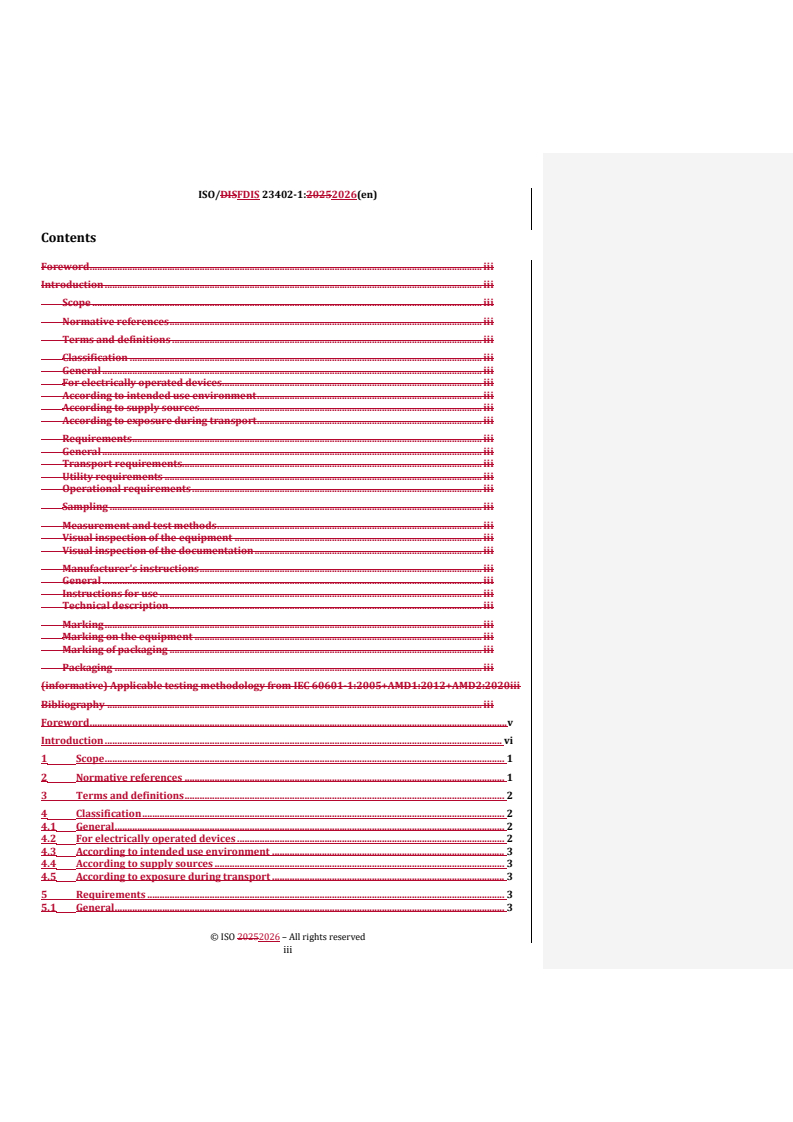
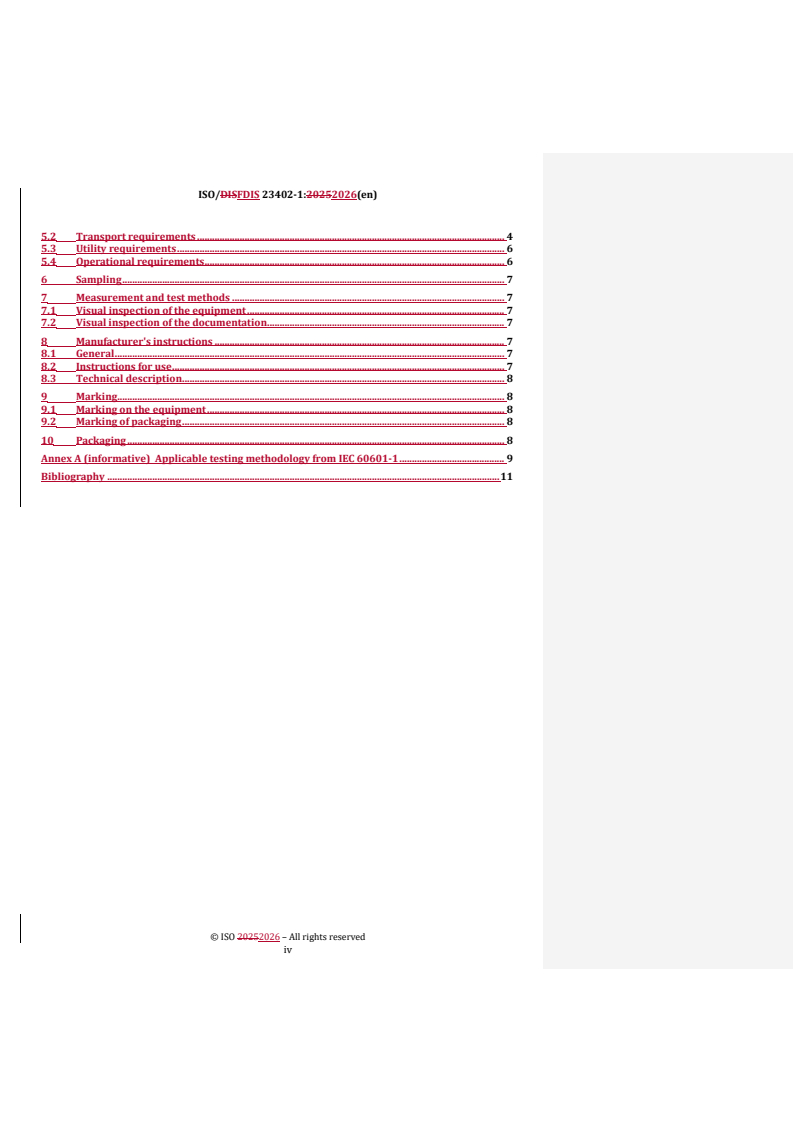
REDLINE ISO/FDIS 23402-1 - Dentistry — Portable dental equipment for use in non-permanent healthcare environments — Part 1: General requirements Released:5. 02. 2026


ISO/FDIS 23402-1 - Médecine bucco-dentaire — Matériel dentaire portatif utilisable dans des environnements de soins de santé non permanents — Partie 1: Exigences générales
Get Certified
Connect with accredited certification bodies for this standard

BSI Group
BSI (British Standards Institution) is the business standards company that helps organizations make excellence a habit.

TÜV Rheinland
TÜV Rheinland is a leading international provider of technical services.

TÜV SÜD
TÜV SÜD is a trusted partner of choice for safety, security and sustainability solutions.
Sponsored listings
Frequently Asked Questions
ISO/FDIS 23402-1 is a draft published by the International Organization for Standardization (ISO). Its full title is "Dentistry — Portable dental equipment for use in non‐permanent healthcare environments — Part 1: General requirements". This standard covers: This document specifies general requirements and test methods for portable dental equipment for use in non-permanent healthcare environments. Portable dental equipment within the scope of this document includes portable dental units, portable patient chairs, portable operator's stools, portable operating lights, portable suction source equipment, portable air compressors and other portable dental equipment in instances where these devices are designed and constructed to be transported for use in non-permanent healthcare environments. NOTE Particular requirements for specific types of portable dental equipment for use in non-permanent healthcare environments are specified in subsequent parts of this document. This document does not apply to stationary dental equipment, wearable equipment (such as headlamps and loupes), mobile dental equipment or portable dental equipment that is not intended to be used in non-permanent healthcare environments or not designed to be disassembled, folded or packed for human transport between non-permanent healthcare environments. Also, requirements for stationary dental equipment that can be installed in a dental mobile medical facility (e.g. vehicular or containerized mobile dental clinic) are not considered in this document.
This document specifies general requirements and test methods for portable dental equipment for use in non-permanent healthcare environments. Portable dental equipment within the scope of this document includes portable dental units, portable patient chairs, portable operator's stools, portable operating lights, portable suction source equipment, portable air compressors and other portable dental equipment in instances where these devices are designed and constructed to be transported for use in non-permanent healthcare environments. NOTE Particular requirements for specific types of portable dental equipment for use in non-permanent healthcare environments are specified in subsequent parts of this document. This document does not apply to stationary dental equipment, wearable equipment (such as headlamps and loupes), mobile dental equipment or portable dental equipment that is not intended to be used in non-permanent healthcare environments or not designed to be disassembled, folded or packed for human transport between non-permanent healthcare environments. Also, requirements for stationary dental equipment that can be installed in a dental mobile medical facility (e.g. vehicular or containerized mobile dental clinic) are not considered in this document.
ISO/FDIS 23402-1 is classified under the following ICS (International Classification for Standards) categories: 11.060.20 - Dental equipment. The ICS classification helps identify the subject area and facilitates finding related standards.
ISO/FDIS 23402-1 has the following relationships with other standards: It is inter standard links to FprEN ISO 23402-1, ISO 23402-1:2020. Understanding these relationships helps ensure you are using the most current and applicable version of the standard.
ISO/FDIS 23402-1 is available in PDF format for immediate download after purchase. The document can be added to your cart and obtained through the secure checkout process. Digital delivery ensures instant access to the complete standard document.
Standards Content (Sample)
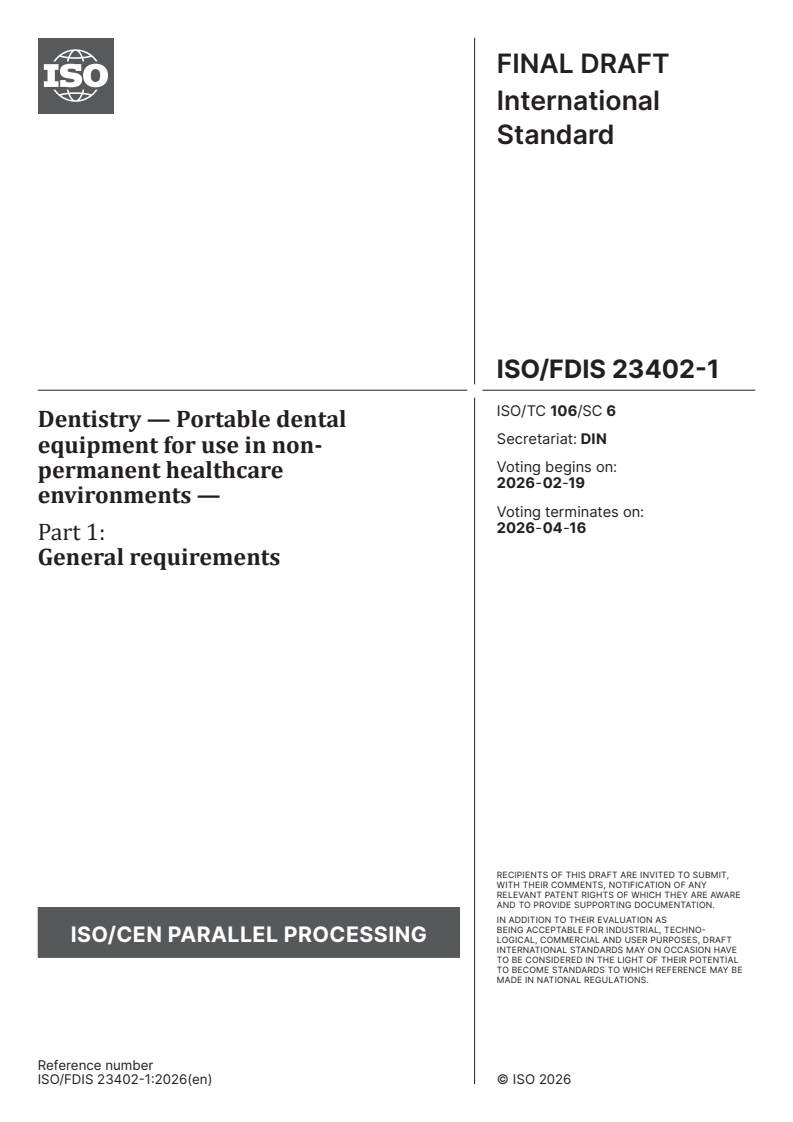
FINAL DRAFT
International
Standard
ISO/TC 106/SC 6
Dentistry — Portable dental
Secretariat: DIN
equipment for use in non‐
Voting begins on:
permanent healthcare
2026-02-19
environments —
Voting terminates on:
2026-04-16
Part 1:
General requirements
RECIPIENTS OF THIS DRAFT ARE INVITED TO SUBMIT,
WITH THEIR COMMENTS, NOTIFICATION OF ANY
RELEVANT PATENT RIGHTS OF WHICH THEY ARE AWARE
AND TO PROVIDE SUPPOR TING DOCUMENTATION.
IN ADDITION TO THEIR EVALUATION AS
BEING ACCEPTABLE FOR INDUSTRIAL, TECHNO-
ISO/CEN PARALLEL PROCESSING LOGICAL, COMMERCIAL AND USER PURPOSES, DRAFT
INTERNATIONAL STANDARDS MAY ON OCCASION HAVE
TO BE CONSIDERED IN THE LIGHT OF THEIR POTENTIAL
TO BECOME STAN DARDS TO WHICH REFERENCE MAY BE
MADE IN NATIONAL REGULATIONS.
Reference number
FINAL DRAFT
International
Standard
ISO/TC 106/SC 6
Dentistry — Portable dental
Secretariat: DIN
equipment for use in non‐
Voting begins on:
permanent healthcare
environments —
Voting terminates on:
Part 1:
General requirements
RECIPIENTS OF THIS DRAFT ARE INVITED TO SUBMIT,
WITH THEIR COMMENTS, NOTIFICATION OF ANY
RELEVANT PATENT RIGHTS OF WHICH THEY ARE AWARE
AND TO PROVIDE SUPPOR TING DOCUMENTATION.
© ISO 2026
IN ADDITION TO THEIR EVALUATION AS
All rights reserved. Unless otherwise specified, or required in the context of its implementation, no part of this publication may
BEING ACCEPTABLE FOR INDUSTRIAL, TECHNO-
ISO/CEN PARALLEL PROCESSING
LOGICAL, COMMERCIAL AND USER PURPOSES, DRAFT
be reproduced or utilized otherwise in any form or by any means, electronic or mechanical, including photocopying, or posting on
INTERNATIONAL STANDARDS MAY ON OCCASION HAVE
the internet or an intranet, without prior written permission. Permission can be requested from either ISO at the address below
TO BE CONSIDERED IN THE LIGHT OF THEIR POTENTIAL
or ISO’s member body in the country of the requester.
TO BECOME STAN DARDS TO WHICH REFERENCE MAY BE
MADE IN NATIONAL REGULATIONS.
ISO copyright office
CP 401 • Ch. de Blandonnet 8
CH-1214 Vernier, Geneva
Phone: +41 22 749 01 11
Email: copyright@iso.org
Website: www.iso.org
Published in Switzerland Reference number
ii
ISO/FDIS 23402‐1:2026(en)
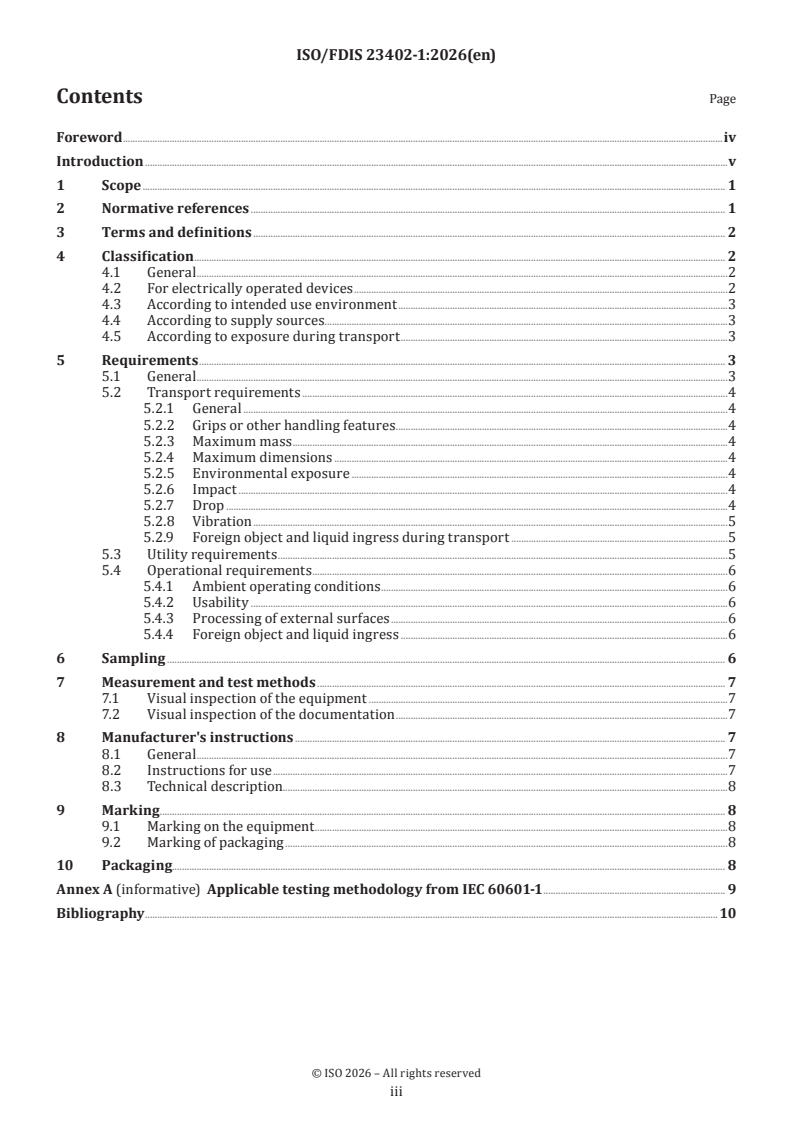
Contents Page
Foreword .iv
Introduction .v
1 Scope . 1
2 Normative references . 1
3 Terms and definitions . 2
4 Classification . 2
4.1 General .2
4.2 For electrically operated devices .2
4.3 According to intended use environment .3
4.4 According to supply sources.3
4.5 According to exposure during transport .3
5 Requirements . 3
5.1 General .3
5.2 Transport requirements .4
5.2.1 General .4
5.2.2 Grips or other handling features .4
5.2.3 Maximum mass .4
5.2.4 Maximum dimensions .4
5.2.5 Environmental exposure .4
5.2.6 Impact .4
5.2.7 Drop .4
5.2.8 Vibration .5
5.2.9 Foreign object and liquid ingress during transport .5
5.3 Utility requirements .5
5.4 Operational requirements .6
5.4.1 Ambient operating conditions .6
5.4.2 Usability .6
5.4.3 Processing of external surfaces .6
5.4.4 Foreign object and liquid ingress .6
6 Sampling . 6
7 Measurement and test methods . 7
7.1 Visual inspection of the equipment .7
7.2 Visual inspection of the documentation .7
8 Manufacturer's instructions . 7
8.1 General .7
8.2 Instructions for use .7
8.3 Technical description.8
9 Marking . . 8
9.1 Marking on the equipment .8
9.2 Marking of packaging .8
10 Packaging. 8
Annex A (informative) Applicable testing methodology from IEC 60601‐1 . 9
Bibliography .10
iii
ISO/FDIS 23402‐1:2026(en)
Foreword
ISO (the International Organization for Standardization) is a worldwide federation of national standards
bodies (ISO member bodies). The work of preparing International Standards is normally carried out through
ISO technical committees. Each member body interested in a subject for which a technical committee
has been established has the right to be represented on that committee. International organizations,
governmental and non-governmental, in liaison with ISO, also take part in the work. ISO collaborates closely
with the International Electrotechnical Commission (IEC) on all matters of electrotechnical standardization.
The procedures used to develop this document and those intended for its further maintenance are described
in the ISO/IEC Directives, Part 1. In particular, the different approval criteria needed for the different types
of ISO document should be noted. This document was drafted in accordance with the editorial rules of the
ISO/IEC Directives, Part 2 (see www.iso.org/directives).
ISO draws attention to the possibility that the implementation of this document may involve the use of (a)
patent(s). ISO takes no position concerning the evidence, validity or applicability of any claimed patent
rights in respect thereof. As of the date of publication of this document, ISO [had/had not] received notice of
(a) patent(s) which may be required to implement this document. However, implementers are cautioned that
this may not represent the latest information, which may be obtained from the patent database available at
www.iso.org/patents. ISO shall not be held responsible for identifying any or all such patent rights.
Any trade name used in this document is information given for the convenience of users and does not
constitute an endorsement.
For an explanation of the voluntary nature of standards, the meaning of ISO specific terms and expressions
related to conformity assessment, as well as information about ISO's adherence to the World Trade
Organization (WTO) principles in the Technical Barriers to Trade (TBT), see www.iso.org/iso/foreword.html.
This document was prepared by Technical Committee ISO/TC 106, Dentistry, Subcommittee SC 6, Dental
equipment, in collaboration with the European Committee for Standardization (CEN) Technical Committee
CEN/TC 55, Dentistry, in accordance with the Agreement on technical cooperation between ISO and CEN
(Vienna Agreement).
This second edition cancels and replaces the first edition (ISO 23402-1:2020), which has been technically
revised.
The main changes are as follows:
— 5.2.7, 5.2.8 and 5.2.9 have been updated to specify requirements for impact, drop and vibration according
to the classification for exposure during transport;
— 5.4.4 has been added;
— Clause 8.3, list item e) and Clause 8.3, list item f) have been added to include classification level for drop
height and classification level for rough road transport distance;
— general editorial updates have been made.
A list of all parts in the ISO 23402 series can be found on the ISO website.
Any feedback or questions on this document should be directed to the user’s national standards body. A
complete listing of these bodies can be found at www.iso.org/members.html.
iv
ISO/FDIS 23402‐1:2026(en)
Introduction
Transportable dental equipment is used by dental professionals to provide care to patients in a variety of
settings. Because the intended use applications and intended means for transporting such equipment vary
considerably, a wide variety of transportable dental equipment is commercially available. For example,
certain transportable equipment is designed and constructed to be carried or rolled on its own wheels
between rooms within a healthcare facility, while other transportable dental equipment is made to be folded
and packed to carry over terrain which can be rugged and used in transient dental care settings which can
have only limited shelter and utility services.
Transportable equipment that can be moved from one location to another while being carried by one or
more persons is referred to as portable equipment. The term "portable equipment" applies to equipment
that can be carried from room to room in a given facility or to remote parts of the world. This document
focuses on portable dental equipment which is specifically designed and constructed to be transported
between non-clinical environments and used by dental professionals to provide dental care in such settings,
including temporary field clinics.
Such portable dental equipment for use in non-permanent healthcare environments enables dental
professionals to provide a high standard of care to patients who do not have access to, or are not able
to, travel to traditional health care facilities. Settings in which this equipment is commonly used include
military field environments, humanitarian aid field clinics, public health outreach clinics, patient residences,
long-term care facilities, prisons, schools and workplaces.
A number of trends in health care have driven increased utilization of portable dental equipment in non-
permanent healthcare environments. Military forces use portable dental equipment in support of mobilized
forces or for humanitarian outreach. A variety of government and non-government organizations are
increasingly providing humanitarian dental care to underserved populations and populations affected
by disasters. Civilian health care workers are also increasingly providing dental services to a growing
population who are simply unable to visit traditional dental clinics due to age, disability or income. Academic
and research bodies regularly conduct dental education programmes (e.g. dentistry, dental hygiene and
dental assisting), particularly at external/off-site locations.
The transport and end-use conditions for portable dental equipment used in non-permanent healthcare
environments drive certain unique requirements which generally do not apply to portable, mobile or
stationary dental equipment used in traditional dental clinics or hospitals. Because portable equipment
used in non-permanent healthcare environments is intended to be moved between venues, and in some
cases carried over rugged terrain or in inclement conditions, it needs to be designed and constructed to
be safely transported by humans without damage, be efficiently assembled and disassembled, and deliver
reliable service at the point of use. Special consideration is given to the austerity of the environment in which
the equipment can be used and the availability and quality of utility supplies (e.g. electrical power, water,
compressed air). In order for the equipment to be sufficiently portable and capable of operating in extreme
conditions, certain requirements for dental equipment intended for use in traditional clinical settings can be
impractical and should be reconsidered for portable dental equipment for use in non-permanent healthcare
environments. There can also be unique safety and infection control concerns to consider.
The ISO 23402 series aims to standardize requirements for portable dental equipment for use in non-
permanent healthcare environments.
v
FINAL DRAFT International Standard ISO/FDIS 23402‐1:2026(en)
Dentistry — Portable dental equipment for use in non‐
permanent healthcare environments —
Part 1:
General requirements
1 Scope
This document specifies general requirements and test methods for portable dental equipment for use in
non-permanent healthcare environments.
This document applies to portable dental units, portable patient chairs, portable operator’s stools, portable
operating lights, portable suction source equipment, portable air compressors and other portable dental
equipment in instances where these devices are designed and constructed to be transported for use in non-
permanent healthcare environments.
NOTE Particular requirements for specific types of portable dental equipment for use in non-permanent
healthcare environments are specified in subsequent parts of this document.
This document does not apply to stationary dental equipment, wearable equipment (e.g. headlamps and
loupes), mobile dental equipment or portable dental equipment that is not intended to be used in non-
permanent healthcare environments or not designed to be disassembled, folded or packed for human
transport between non-permanent healthcare environments. Requirements for stationary dental equipment
that can be installed in a dental mobile medical facility (e.g. vehicular or containerized mobile dental clinic)
are not considered in this document.
2 Normative references
The following documents are referred to in the text in such a way that some or all of their content constitutes
requirements of this document. For dated references, only the edition cited applies. For undated references,
the latest edition of the referenced document (including any amendments) applies.
ISO 1942, Dentistry — Vocabulary
ISO 4180:2019, Packaging — Complete, filled transport packages — General rules for the compilation of
performance test schedules
ISO 4180, Packaging — Complete, filled transport packages — General rules for the compilation of performance
test schedules
ISO 9687, Dentistry — Graphical symbols for dental equipment
ISO 15223-1, Medical devices — Symbols to be used with information to be supplied by the manufacturer — Part
1: General requirements
ISO 21530, Dentistry — Materials used for dental equipment surfaces — Determination of resistance to
chemical disinfectants
IEC 60601-1, Medical electrical equipment - Part 1: General requirements for basic safety and essential
performance
IEC 62366-1, Medical devices — Part 1: Application of usability engineering to medical devices
ISO/FDIS 23402‐1:2026(en)
IEC 80601-2-60, Me
...
Formatted: French (Switzerland)
ISO/DISFDIS 23402-1
Formatted: French (Switzerland)
ISO/TC 106/SC 6
Secretariat: DIN
Date: 2025-12-122026-02-04
Dentistry — Portable dental equipment for use in non-permanent
healthcare environments —
Part 1:
General requirements
DISFDIS stage
TTTTTTThhhhhhhiiiiiiisssssss dr dr dr dr dr drdraaaaaaafffffffttttttt i i i i i i isssssss sususususususubbbbbbbmmmmmmmiiiiiiitttttttttttttteeeeeeed d d d d d d tttttttooooooo aaaaaaa pppppppaaaaaaarrrrrrraaaaaaallellellellellellellel l l l l l l vvvvvvvooooooottttttteeeeeee i i i i i i innnnnnn IIIIIIISSSSSSSOOOOOOO,,,,,,, CCCCCCCEEEEEEEN.N.N.N.N.N.N.
VVVVoooottttiiiinnnng bg bg bg beeeegigigiginsnsnsns o o o on:n:n:n: 2 2 2 2020202025555----00003333----28282828
VoVoVoVottttinininingggg teteteterrrrminminminminaaaatetetetessss o o o onnnn:::: 2 2 2 2000022225555----00006666----22220000
ISO/DISFDIS 23402-1:20252026(en)
All rights reserved. Unless otherwise specified, or required in the context of its implementation, no part of this publication
may be reproduced or utilized otherwise in any form or by any means, electronic or mechanical, including photocopying,
or posting on the internet or an intranet, without prior written permission. Permission can be requested from either ISO
at the address below or ISO’s member body in the country of the requester.
ISO copyright office
CP 401 • Ch. de Blandonnet 8
CH-1214 Vernier, Geneva
Phone: + 41 22 749 01 11
Formatted: French (Switzerland)
E-mail: copyright@iso.org
Website: www.iso.org
Published in Switzerland
ii
ISO/DISFDIS 23402-1:20252026(en)
Contents
Foreword . iii
Introduction . iii
Scope . iii
Normative references . iii
Terms and definitions . iii
Classification . iii
General . iii
For electrically operated devices . iii
According to intended use environment . iii
According to supply sources . iii
According to exposure during transport . iii
Requirements . iii
General . iii
Transport requirements . iii
Utility requirements . iii
Operational requirements . iii
Sampling . iii
Measurement and test methods . iii
Visual inspection of the equipment . iii
Visual inspection of the documentation . iii
Manufacturer's instructions . iii
General . iii
Instructions for use . iii
Technical description . iii
Marking . iii
Marking on the equipment . iii
Marking of packaging . iii
Packaging . iii
(informative) Applicable testing methodology from IEC 60601-1:2005+AMD1:2012+AMD2:2020iii
Bibliography . iii
Foreword . v
Introduction . vi
1 Scope . 1
2 Normative references . 1
3 Terms and definitions . 2
4 Classification . 2
4.1 General . 2
4.2 For electrically operated devices . 2
4.3 According to intended use environment . 3
4.4 According to supply sources . 3
4.5 According to exposure during transport . 3
5 Requirements . 3
5.1 General . 3
iii
ISO/DISFDIS 23402-1:20252026(en)
5.2 Transport requirements . 4
5.3 Utility requirements . 6
5.4 Operational requirements . 6
6 Sampling . 7
7 Measurement and test methods . 7
7.1 Visual inspection of the equipment . 7
7.2 Visual inspection of the documentation . 7
8 Manufacturer's instructions . 7
8.1 General . 7
8.2 Instructions for use . 7
8.3 Technical description . 8
9 Marking . 8
9.1 Marking on the equipment . 8
9.2 Marking of packaging . 8
10 Packaging . 8
Annex A (informative) Applicable testing methodology from IEC 60601-1 . 9
Bibliography . 11
iv
ISO/DISFDIS 23402-1:20252026(en)
Foreword
ISO (the International Organization for Standardization) is a worldwide federation of national standards
bodies (ISO member bodies). The work of preparing International Standards is normally carried out through
ISO technical committees. Each member body interested in a subject for which a technical committee has been
established has the right to be represented on that committee. International organizations, governmental and
non-governmental, in liaison with ISO, also take part in the work. ISO collaborates closely with the
International Electrotechnical Commission (IEC) on all matters of electrotechnical standardization.
The procedures used to develop this document and those intended for its further maintenance are described
in the ISO/IEC Directives, Part 1. In particular, the different approval criteria needed for the different types of
ISO document should be noted. This document was drafted in accordance with the editorial rules of the
ISO/IEC Directives, Part 2 (see www.iso.org/directives).
ISO draws attention to the possibility that the implementation of this document may involve the use of (a)
patent(s). ISO takes no position concerning the evidence, validity or applicability of any claimed patent rights
in respect thereof. As of the date of publication of this document, ISO [had/had not] received notice of (a)
patent(s) which may be required to implement this document. However, implementers are cautioned that this
may not represent the latest information, which may be obtained from the patent database available at
www.iso.org/patents. ISO shall not be held responsible for identifying any or all such patent rights.
Any trade name used in this document is information given for the convenience of users and does not
constitute an endorsement.
For an explanation of the voluntary nature of standards, the meaning of ISO specific terms and expressions
related to conformity assessment, as well as information about ISO's adherence to the World Trade
Organization (WTO) principles in the Technical Barriers to Trade (TBT), see www.iso.org/iso/foreword.html.
This document was prepared by Technical Committee ISO/TC 106, Dentistry, Subcommittee SC 6, Dental
equipment, in collaboration with the European Committee for Standardization (CEN) Technical Committee
CEN/TC 55, Dentistry, in accordance with the Agreement on technical cooperation between ISO and CEN
(Vienna Agreement).
This second edition cancels and replaces the first edition (ISO 23402-1:2020), which has been technically
revised.
The main changes are as follows:
— Update of 5.2.75.2.7, 5.2.85.2.8 and 5.2.95.2.9 have been updated to specify requirements for impact, drop
and vibration according to the classification for exposure during transport;
— Addition of 5.4.45.4.4, Foreign body and liquid ingress;
— Addition of has been added;
— Clause 8.3, list item e)Clause 8.3, list item e) and Clause 8.3, list item f)Clause 8.3, list item f) have been
added to include classification level for drop height and classification level for rough road transport
distance;
— Generalgeneral editorial updates have been made.
A list of all parts in the ISO 23402 series can be found on the ISO website.
Any feedback or questions on this document should be directed to the user’s national standards body. A
complete listing of these bodies can be found at www.iso.org/members.html.
v
ISO/DISFDIS 23402-1:20252026(en)
Introduction
Transportable dental equipment is used by dental professionals to provide care to patients in a variety of
settings. Because the intended use applications and intended means for transporting such equipment vary
considerably, a wide variety of transportable dental equipment is commercially available. For example, certain
transportable equipment is designed and constructed to be carried or rolled on its own wheels between rooms
within a healthcare facility, while other transportable dental equipment is made to be folded and packed to
carry over terrain which can be rugged and used in transient dental care settings which can have only limited
shelter and utility services.
Transportable equipment that can be moved from one location to another while being carried by one or more
persons is referred to as portable equipment. The term, "portable equipment," applies to equipment that can
be carried from room to room in a given facility or to remote parts of the world. This document focuses on
portable dental equipment which is specifically designed and constructed to be transported between non-
clinical environments and used by dental professionals to provide dental care in such settings, including
temporary field clinics.
Such portable dental equipment for use in non-permanent healthcare environments enables dental
professionals to provide a high standard of care to patients who do not have access to, or are not able to, travel
to traditional health care facilities. Settings in which this equipment is commonly used include military field
environments, humanitarian aid field clinics, public health outreach clinics, patient residences, long-term care
facilities, prisons, schools and workplaces.
A number of trends in health care have driven increased utilization of portable dental equipment in non-
permanent healthcare environments. Military forces use portable dental equipment in support of mobilized
forces or for humanitarian outreach. A variety of government and non-government organizations are
increasingly providing humanitarian dental care to underserved populations and populations affected by
disasters. Civilian health care workers are also increasingly providing dental services to a growing population
who are simply unable to visit traditional dental clinics due to age, disability, or income. Academic and
research bodies regularly conduct dental education programs,programmes (e.g. dentistry, dental hygiene and
dental assisting), particularly at external/off-site locations (including dentistry, dental hygiene, dental
assisting).
The transport and end-use conditions for portable dental equipment used in non-permanent healthcare
environments drive certain unique requirements which generally do not apply to portable, mobile or
stationary dental equipment used in traditional dental clinics or hospitals. Because portable equipment used
in non-permanent healthcare environments is intended to be moved between venues, and in some cases
carried over rugged terrain or in inclement conditions, it needs to be designed and constructed to be safely
transported by humans without damage, be efficiently assembled and disassembled, and deliver reliable
service at the point of use. Special consideration is given to the austerity of the environment in which the
equipment can be used and the availability and quality of utility supplies (such ase.g. electrical power, water,
compressed air). In order for the equipment to be sufficiently portable and capable of operating in extreme
conditions, certain requirements for dental equipment intended for use in traditional clinical settings may
notcan be practicalimpractical and should be reconsidered for portable dental equipment for use in non-
permanent healthcare environments. There can also be unique safety and infection control concerns to
consider.
This document is one in a series with the objective of standardizingThe ISO 23402 series aims to standardize
requirements for portable dental equipment for use in non-permanent healthcare environments.
vi
ISO/DISFDIS 23402-1:20252026(en)
Dentistry — Portable dental equipment for use in non-permanent
healthcare environments —
Part 1:
General requirements
1 Scope
This document specifies general requirements and test methods for portable dental equipment for use in non-
permanent healthcare environments.
Portable dental equipment within the scope of thisThis document includesapplies to portable dental units,
portable patient chairs, portable operator’s stools, portable operating lights, portable suction source
equipment, portable air compressors and other portable dental equipment in instances where these devices
are designed and constructed to be transported for use in non-permanent healthcare environments.
NOTE Particular requirements for specific types of portable dental equipment for use in non-permanent healthcare
environments are specified in subsequent parts of this document.
This document does not apply to stationary dental equipment, wearable equipment (such ase.g. headlamps
and loupes), mobile dental equipment or portable dental equipment that is not intended to be used in non-
permanent healthcare environments or not designed to be disassembled, folded or packed for human
transport between non-permanent healthcare environments. Also, requirementsRequirements for stationary
dental equipment that can be installed in a dental mobile medical facility (e.g.,. vehicular or containerized
mobile dental clinic) are not considered in this document.
2 Normative references
The following documents are referred to in the text in such a way that some or all of their content constitutes
requirements of this document. For dated references, only the edition cited applies. For undated references,
the latest edition of the referenced document (including any amendments) applies.
ISO 1942, Dentistry — Vocabulary
ISO 4180:2019, Packaging — Complete, filled transport packages — General rules for the compilation of
performance test schedules
ISO 4180, Packaging — Complete, filled transport packages — General rules for the compilation of performance
test schedules
ISO 9687, Dentistry — Graphical symbols for dental equipment
ISO 15223-1, Medical devices — Symbols to be used with information to be supplied by the manufacturer — Part
1: General requirements
ISO 21530, Dentistry — Materials used for dental equipment surfaces — Determination of resistance to chemical
disinfectants
IEC 60601-1, Medical electrical equipment - Part 1: General requirements for basic safety and essential
performance
IEC 62366-1, Medical devices — Part 1: Application of usability engineering to medical devices
ISO/DISFDIS 23402-1:20252026(en)
IEC 80601-2-60, Medical electrical equipment — Part 2-60: Particular requirements for the basic safety and
essential performance of dental equipment
IEC 60529:1989+AMD 1:1999+AMD2:2013, Degrees of protection provided by enclosures (IP Code)
IEC 60601 1:2005+AMD1:2012+AMD2:2020, Medical electrical equipment – Part 1: General requirements for
basic safety and essential performance
3 Terms and definitions
For the purposes of this document, the terms and definitions given in IEC 60601-1 and ISO 1942 as well as the
following apply.
ISO and IEC maintain terminologicalterminology databases for use in sta
...
PROJET FINAL
Norme
internationale
ISO/TC 106/SC 6
Médecine bucco-dentaire —
Secrétariat: DIN
Matériel dentaire portatif utilisable
Début de vote:
dans des environnements de soins
2026-02-19
de santé non permanents —
Vote clos le:
2026-04-16
Partie 1:
Exigences générales
Dentistry — Portable dental equipment for use in non‐permanent
healthcare environments —
Part 1: General requirements
LES DESTINATAIRES DU PRÉSENT PROJET SONT
INVITÉS À PRÉSENTER, AVEC LEURS OBSERVATIONS,
NOTIFICATION DES DROITS DE PROPRIÉTÉ DONT ILS
AURAIENT ÉVENTUELLEMENT CONNAISSANCE ET À
FOURNIR UNE DOCUMENTATION EXPLICATIVE.
OUTRE LE FAIT D’ÊTRE EXAMINÉS POUR
ÉTABLIR S’ILS SONT ACCEPTABLES À DES FINS
INDUSTRIELLES, TECHNOLOGIQUES ET COM-MERCIALES,
AINSI QUE DU POINT DE VUE DES UTILISATEURS, LES
PROJETS DE NORMES
TRAITEMENT PARALLÈLE ISO/CEN
INTERNATIONALES DOIVENT PARFOIS ÊTRE CONSIDÉRÉS
DU POINT DE VUE DE LEUR POSSI BILITÉ DE DEVENIR DES
NORMES POUVANT
SERVIR DE RÉFÉRENCE DANS LA RÉGLEMENTATION
NATIONALE.
Numéro de référence
PROJET FINAL
Norme
internationale
ISO/TC 106/SC 6
Médecine bucco-dentaire —
Secrétariat: DIN
Matériel dentaire portatif utilisable
Début de vote:
dans des environnements de soins
2026-02-19
de santé non permanents —
Vote clos le:
2026-04-16
Partie 1:
Exigences générales
Dentistry — Portable dental equipment for use in non‐permanent
healthcare environments —
Part 1: General requirements
LES DESTINATAIRES DU PRÉSENT PROJET SONT
INVITÉS À PRÉSENTER, AVEC LEURS OBSERVATIONS,
NOTIFICATION DES DROITS DE PROPRIÉTÉ DONT ILS
AURAIENT ÉVENTUELLEMENT CONNAISSANCE ET À
FOURNIR UNE DOCUMENTATION EXPLICATIVE.
DOCUMENT PROTÉGÉ PAR COPYRIGHT
OUTRE LE FAIT D’ÊTRE EXAMINÉS POUR
ÉTABLIR S’ILS SONT ACCEPTABLES À DES FINS
© ISO 2026 INDUSTRIELLES, TECHNOLOGIQUES ET COM-MERCIALES,
AINSI QUE DU POINT DE VUE DES UTILISATEURS, LES
Tous droits réservés. Sauf prescription différente ou nécessité dans le contexte de sa mise en œuvre, aucune partie de cette
PROJETS DE NORMES
TRAITEMENT PARALLÈLE ISO/CEN
INTERNATIONALES DOIVENT PARFOIS ÊTRE CONSIDÉRÉS
publication ne peut être reproduite ni utilisée sous quelque forme que ce soit et par aucun procédé, électronique ou mécanique,
DU POINT DE VUE DE LEUR POSSI BILITÉ DE DEVENIR DES
y compris la photocopie, ou la diffusion sur l’internet ou sur un intranet, sans autorisation écrite préalable. Une autorisation peut
NORMES POUVANT
être demandée à l’ISO à l’adresse ci-après ou au comité membre de l’ISO dans le pays du demandeur.
SERVIR DE RÉFÉRENCE DANS LA RÉGLEMENTATION
NATIONALE.
ISO copyright office
Case postale 401 • Ch. de Blandonnet 8
CH-1214 Vernier, Genève
Tél.: +41 22 749 01 11
E-mail: copyright@iso.org
Web: www.iso.org
Publié en Suisse Numéro de référence
ii
Sommaire Page
Avant-propos .iv
Introduction .v
1 Domaine d'application . 1
2 Références normatives . 1
3 Termes et définitions . 2
4 Classification . 2
4.1 Généralités .2
4.2 Pour les dispositifs à commande électrique.2
4.3 Selon l'environnement d'utilisation prévu.3
4.4 Selon les sources d'alimentation .3
4.5 Selon l'exposition pendant le transport .3
5 Exigences . 3
5.1 Généralités .3
5.2 Exigences de transport .4
5.2.1 Généralités .4
5.2.2 Poignées ou autres dispositifs de manipulation .4
5.2.3 Masse maximale.4
5.2.4 Dimensions maximales .4
5.2.5 Exposition à l'environnement .4
5.2.6 Impact .4
5.2.7 Chute .5
5.2.8 Vibrations .5
5.2.9 Pénétration de corps étrangers et de liquide pendant le transport .5
5.3 Exigences d'utilité .6
5.4 Exigences de fonctionnement .6
5.4.1 Conditions ambiantes de fonctionnement .6
5.4.2 Aptitude à l'utilisation .6
5.4.3 Traitement des surfaces externes .6
5.4.4 Pénétration de corps étrangers et de liquide .7
6 Échantillonnage . 7
7 Méthodes de mesure et d'essai . 7
7.1 Inspection visuelle de l'équipement .7
7.2 Examen visuel de la documentation . .7
8 Instructions du fabricant . 7
8.1 Généralités .7
8.2 Instructions d'utilisation.8
8.3 Description technique .8
9 Marquage . 8
9.1 Marquage sur l'équipement .8
9.2 Marquage de l'emballage .9
10 Emballage . 9
Annexe A (informative) Méthodologie d'essai applicable de l'IEC 60601-1 .10
Bibliographie .11
iii
Avant-propos
L'ISO (Organisation internationale de normalisation) est une fédération mondiale d'organismes nationaux
de normalisation (comités membres de l'ISO). Le travail d'élaboration des Normes internationales est
normalement effectué par l'intermédiaire des comités d'études de l'ISO. Chaque comité membre intéressé
par un sujet pour lequel un comité technique a été créé a le droit d'être représenté au sein de ce comité. Des
organisations internationales, gouvernementales et non gouvernementales, en liaison avec l'ISO, participent
également aux travaux. L'ISO collabore étroitement avec la Commission électrotechnique internationale
(IEC) sur toutes les questions de normalisation électrotechnique.
Les procédures utilisées pour élaborer le présent document et celles destinées à sa mise à jour sont décrites
dans les directives ISO/IEC, Partie 1. En particulier, il convient de noter les différents critères d'approbation
nécessaires pour les différents types de documents ISO. Le présent document a été rédigé conformément
aux règles de rédaction des directives ISO/IEC, Partie 2 (voir www.iso.org/directives).
L'ISO attire l'attention sur le fait que la mise en œuvre du présent document peut impliquer l'utilisation
d'un ou de plusieurs brevets. L'ISO ne prend pas position quant à la preuve, à la validité ou à l'applicabilité
des droits de propriété revendiqués à cet égard. À la date de publication du présent document, l'ISO [avait/
n'avait pas] reçu notification d'un ou de plusieurs brevets qui pourraient être nécessaires pour mettre en
œuvre le présent document. Toutefois, les responsables de la mise en œuvre sont avertis que cela peut ne pas
représenter les informations les plus récentes, qui peuvent être obtenues à partir de la base de données sur
les brevets disponible à l'adresse www.iso.org/patents. L'ISO ne saurait être tenue pour responsable d'avoir
identifié tout ou partie de tels droits de propriété.
Toute appellation commerciale utilisée dans le présent document est donnée par souci de commodité à
l'intention des utilisateurs et ne saurait constituer un engagement.
Pour une explication de la nature volontaire des normes, la signification des termes et expressions
spécifiques de l'ISO liés à l'évaluation de la conformité, ou pour toute information au sujet de l'adhésion de
l'ISO aux principes de l'Organisation mondiale du commerce (OMC) concernant les obstacles techniques au
commerce (OTC), voir le site www.iso.org/iso/foreword.html.
Le présent document a été élaboré par le comité technique ISO/TC 106, Médecine bucco‐dentaire, sous-comité
SC 6, Matériel dentaire, en collaboration avec le comité technique CEN/TC 55, Médecine bucco‐dentaire, du
Comité européen de normalisation (CEN), conformément à l'Accord de coopération technique entre l'ISO et
le CEN (Accord de Vienne).
Cette deuxième édition annule et remplace la première édition (ISO 23402-1:2020), qui a fait l'objet d'une
révision technique.
Les principales modifications sont les suivantes:
— 5.2.7, 5.2.8 et 5.2.9 ont été mis à jour pour spécifier les exigences relatives aux chocs, chutes et vibrations
selon la classification pour l'exposition pendant le transport;
— 5.4.4 a été ajouté;
— l'Article 8.3, point e) et l'Article 8.3, point f) ont été ajoutés pour inclure le niveau de classification pour
la hauteur de chute et le niveau de classification pour la distance de transport routier accidenté;
— des mises à jour rédactionnelles générales ont été effectuées.
Une liste de toutes les parties de la série ISO 23402 est disponible sur le site web de l'ISO.
Il convient que tout retour d'information ou toute question concernant le présent document soit adressé
à l'organisme national de normalisation de l'utilisateur. Une liste complète de ces organismes peut être
consultée à l'adresse www.iso.org/members.html.
iv
Introduction
Le matériel dentaire transportable est utilisé par les professionnels dentaires pour prodiguer des soins aux
patients dans divers milieux. Étant donné que les applications prévues et les moyens prévus pour transporter
de tels équipements varient considérablement, une grande variété de matériel dentaire transportable est
disponible dans le commerce. Par exemple, certains équipements transportables sont conçus et construits
pour être transportés ou roulés sur leurs propres roues entre les pièces d’un établissement de santé, tandis
que d’autres équipements dentaires transportables sont conçus pour être pliés et emballés pour transporter
un terrain qui peut être accidenté et utilisé dans des environnements de soins dentaires transitoires qui ne
peuvent avoir que des abris et des services publics limités.
L'équipement transportable qui peut être déplacé d'un emplacement à un autre tout en étant porté par
une ou plusieurs personnes est appelé équipement portatif. Le terme «équipement portatif» s'applique à
l'équipement qui peut être transporté d'une pièce à l'autre dans une installation donnée ou dans des régions
éloignées du monde. Le présent document porte sur le matériel dentaire portatif qui est spécifiquement
conçu et construit pour être transporté entre des environnements non cliniques et utilisé par les
professionnels dentaires pour prodiguer des soins dentaires dans de tels environnements, y compris les
cliniques temporaires sur le terrain.
Ce type de matériel dentaire portatif destiné à être utilisé dans des environnements de soins de santé non
permanents permet aux professionnels dentaires de fournir des soins de qualité aux patients qui n’ont pas
accès aux établissements de soins de santé traditionnels ou qui ne peuvent pas s’y rendre. Les milieux dans
lesquels cet équipement est couramment utilisé comprennent les environnements militaires sur le terrain,
les cliniques d'aide humanitaire sur le terrain, les cliniques de santé publique, les résidences pour patients,
les établissements de soins de longue durée, les prisons, les écoles et les lieux de travail.
Un certain nombre de tendances en matière de soins de santé ont entraîné une utilisation accrue du matériel
dentaire portatif dans des environnements de soins de santé non permanents. Les forces militaires utilisent
du matériel dentaire portatif pour soutenir les forces mobilisées ou pour des actions humanitaires. Diverses
organisations gouvernementales et non gouvernementales fournissent de plus en plus de soins dentaires
humanitaires aux populations mal desservies et aux populations touchées par des catastrophes. Les
travailleurs de la santé civils fournissent également de plus en plus de services dentaires à une population
croissante qui ne peut tout simplement pas se rendre dans les cliniques dentaires traditionnelles en raison de
l'âge, d'un handicap ou d'un revenu. Les organismes universitaires et de recherche organisent régulièrement
des programmes de formation dentaire (par exemple, médecine bucco-dentaire, hygiène dentaire et
assistance dentaire), en particulier sur des sites externes/hors site.
Les conditions de transport et d’utilisation finale du matériel dentaire portatif utilisé dans des
environnements de soins de santé non permanents entraînent certaines exigences uniques qui ne s’appliquent
généralement pas au matériel dentaire portatif, mobile ou fixe utilisé dans les cliniques dentaires ou les
hôpitaux traditionnels. Étant donné que l’équipement portatif utilisé dans des environnements de soins
de santé non permanents est destiné à être déplacé entre des sites et, dans certains cas, transporté sur
un terrain accidenté ou dans des conditions inclinées, il doit être conçu et construit pour être transporté
en toute sécurité par des personnes sans dommage, être assemblé et démonté efficacement et fournir un
service fiable au point d’utilisation. Une attention particulière est accordée à l'austérité de l'environnement
dans lequel l'équipement peut être utilisé ainsi qu'à la disponibilité et à la qualité des alimentations (par
exemple, électricité, eau, air comprimé). Pour que le matériel soit suffisamment portable et capable de
fonctionner dans des conditions extrêmes, certaines exigences relatives au matériel dentaire destiné à
être utilisé dans des environnements cliniques traditionnels peuvent être irréalisables et il convient de les
reconsidérer pour le matériel dentaire portatif destiné à être utilisé dans des environnements de soins de
santé non permanents. Il peut également y avoir des préoccupations uniques en matière de sécurité et de
contrôle des infections à prendre en compte.
La série ISO 23402 vise à normaliser les exigences relatives au matériel dentaire portatif destiné à être
utilisé dans des environnements de soins de santé non permanents.
v
PROJET FINAL Norme internationale ISO/FDIS 23402-1:2026(fr)
Médecine bucco-dentaire — Matériel dentaire portatif
utilisable dans des environnements de soins de santé non
permanents —
Partie 1:
Exigences générales
1 Domaine d'application
Le présent document spécifie les exigences générales et les méthodes d’essai applicables au matériel dentaire
portatif destiné à être utilisé dans des environnements de soins de santé non permanents.
Le présent document s’applique aux units dentaires portables, aux fauteuils patient portables, aux tabourets
d’opérateur portables, aux lampes d’opération portables, aux équipements de source d’aspiration portables,
aux compresseurs d’air portables et autres équipements dentaires portables dans les cas où ces dispositifs
sont conçus et construits pour être transportés en vue d’une utilisation dans des environnements de soins
de santé non permanents.
NOTE Les exigences particulières pour les types spécifiques de matériel dentaire portatif destiné à être utilisé
dans des environnements de soins de santé non permanents sont spécifiées dans les parties ultérieures du présent
document.
Le présent document ne s’applique pas au matériel dentaire fixe, au matériel prêt-à-porter (par exemple,
lampes frontales et loupes), au matériel dentaire mobile ou au matériel dentaire portatif qui n’est pas destiné
à être utilisé dans des environnements de soins de santé non permanents ou qui n’est pas conçu pour être
démonté, plié ou emballé pour le transport de personnes entre des environnements de soins de santé non
permanents. Les exigences relatives au matériel dentaire fixe qui peut être installé dans un établissement
médical dentaire mobile (par exemple, clinique dentaire mobile véhiculée ou conteneurisée) ne sont pas
prises en compte dans le présent document.
2 Références normatives
Les documents suivants sont cités dans le texte de telle sorte qu'ils constituent, pour tout ou partie de leur
contenu, des exigences du présent document. Pour les références datées, seule l'édition citée s'applique. Pour
les références non datées, la dernière édition du document de référence s'applique (y compris les éventuels
amendements).
ISO 1942, Médecine bucco‐dentaire — Vocabulaire
ISO 4180:2019, Emballages — Emballages d'expédition complets et pleins — Règles générales pour
l'établissement de programmes d'essais de performance
ISO 4180, Emballages — Emballages d'expédition complets et pleins — Règles générales pour l'établissement de
programmes d'essais de performance
ISO 9687, Médecine bucco‐dentaire — Symboles graphiques pour matériel dentaire
ISO 15223-1, Dispositifs médicaux — Symboles à utiliser avec les informations à fournir par le fabricant —
Partie 1: Exigences générales
ISO 21530, Art dentaire — Matériaux utilisés pour les surfaces du matériel dentaire — Détermination de la
résistance aux désinfectants chimiques
IEC 60601-1, Appareils électromédicaux — Partie 1: Exigences générales pour la sécurité de base et les
performances essentielles
IEC 62366-1, Dispositifs médicaux — Partie 1: Application de l'ingénierie de l'aptitude à l'utilisation aux
dispositifs médicaux
IEC 80601-2-60, Appareils électromédicaux — Partie 2‐60: Exigences particulières pour la sécurité de base et
les performances essentielles des équipements dentaires
IEC 60529:1989+AMD 1:1999+AMD2:2013, Degrés de protection procurés par les enveloppes (Code IP)
IEC 60601-1:2005+AMD1:2012+AMD2:2020, Appareils électromédicaux — Partie 1: Exigences générales pour
la sécurité de base et les performances essentielles
3 Termes et définitions
Pou
...
Questions, Comments and Discussion
Ask us and Technical Secretary will try to provide an answer. You can facilitate discussion about the standard in here.
Loading comments...