

ISO 16354:2013
(Main)Guidelines for knowledge libraries and object libraries
General Information
- Abstract
The aim of ISO 16354:2013 is to distinguish categories of knowledge libraries and to lay the foundation for uniform structures and content of such knowledge libraries and for commonality in their usage. By drawing up a number of guidelines, a guiding principle is provided for new libraries as well as for upgrading existing libraries. Without these guidelines there is an undesirable amount of freedom, so that the various libraries may become too heterogeneous. This would render the comparison, linking and integrated usage of these libraries very complex, if not impossible. The objective of ISO 16354:2013 is to categorize knowledge libraries and object libraries and to provide recommendations for the creation of such libraries. Libraries that are compliant with the guidelines of ISO 16354:2013 may be more easily linked to, or integrated with other libraries. The target audience of ISO 16354:2013 consists of developers of knowledge libraries, builders of translation software or interfaces between knowledge libraries, certifying bodies and builders of applications who must base their work on the knowledge libraries laid down.
- Status
- Published
- Publication Date
- 14-Mar-2013
- Current Stage
- 9093 - International Standard confirmed
- Start Date
- 16-Jan-2024
- Completion Date
- 29-Aug-2026


Overview - ISO 16354:2013 (Guidelines for knowledge libraries and object libraries)
ISO 16354:2013 provides guidance to create, structure and harmonize knowledge libraries and object libraries - databases of modelled knowledge about kinds of things (physical and non‑physical). The standard’s aim is to reduce heterogeneity between libraries so they can be compared, linked and integrated more easily. It focuses on harmonizing concepts and information models rather than prescribing exact terminology.
Key topics and technical requirements
- Scope and objectives: Categorizes types of knowledge/object libraries and recommends guidelines for building or upgrading them to enhance interoperability.
- Concepts and building blocks: Defines core terms such as knowledge model, fact, definition, concept, and relation types used across libraries.
- Functional framework (Clause 7): Describes functional units commonly used in libraries:
- Vocabularies / lists of terms
- Dictionaries
- Taxonomies
- Aspect models
- Composition models
- Collections
- Relations between functional units
- Guidelines for functional units (Clause 8): Recommends how each unit should be structured, documented and related to others to enable consistent, machine‑interpretable information models.
- Quality and reference material:
- Annex A (informative): Quality labels for libraries
- Annex B (normative): Reference model to support implementation
- Annexes C and D: scrutiny notes and an index
- Design principle: Harmonize concepts and models to facilitate linking, translation, and integrated use - not to impose single naming conventions.
Practical applications and users
ISO 16354:2013 is practical for organizations that need consistent, interoperable knowledge repositories:
- Developers of knowledge and object libraries - for library design, classification and governance
- Builders of translation software and interfaces - to map and integrate heterogeneous libraries
- Application developers and system integrators - to consume standardized knowledge models in design, procurement, construction, operation and maintenance workflows
- Certifying bodies and data managers - to define validation and quality labels
Benefits:
- Improved interoperability and easier integration of disparate libraries
- Reduced cost and complexity when linking or translating datasets
- Clearer guidance for building reusable, machine‑readable information models
Related standards
ISO 16354 references or complements other initiatives and standards used in product and construction information management, including IEC 61360, ISO 13584, ISO 12006‑3, ISO/TS 15926‑4, and industry efforts such as the BuildingSMART IFD and ETIM systems.
Keywords: ISO 16354:2013, knowledge libraries, object libraries, knowledge models, interoperability, taxonomy, dictionaries, information models, library guidelines.
Get Certified
Connect with accredited certification bodies for this standard

DIBt (Deutsches Institut für Bautechnik)
German Institute for Building Technology.
DIN CERTCO
DIN Group product certification.

Aboma Certification B.V.
Specialized in construction, metal, and transport sectors.
Sponsored listings
Frequently Asked Questions
ISO 16354:2013 is a standard published by the International Organization for Standardization (ISO). Its full title is "Guidelines for knowledge libraries and object libraries". This standard covers: The aim of ISO 16354:2013 is to distinguish categories of knowledge libraries and to lay the foundation for uniform structures and content of such knowledge libraries and for commonality in their usage. By drawing up a number of guidelines, a guiding principle is provided for new libraries as well as for upgrading existing libraries. Without these guidelines there is an undesirable amount of freedom, so that the various libraries may become too heterogeneous. This would render the comparison, linking and integrated usage of these libraries very complex, if not impossible. The objective of ISO 16354:2013 is to categorize knowledge libraries and object libraries and to provide recommendations for the creation of such libraries. Libraries that are compliant with the guidelines of ISO 16354:2013 may be more easily linked to, or integrated with other libraries. The target audience of ISO 16354:2013 consists of developers of knowledge libraries, builders of translation software or interfaces between knowledge libraries, certifying bodies and builders of applications who must base their work on the knowledge libraries laid down.
The aim of ISO 16354:2013 is to distinguish categories of knowledge libraries and to lay the foundation for uniform structures and content of such knowledge libraries and for commonality in their usage. By drawing up a number of guidelines, a guiding principle is provided for new libraries as well as for upgrading existing libraries. Without these guidelines there is an undesirable amount of freedom, so that the various libraries may become too heterogeneous. This would render the comparison, linking and integrated usage of these libraries very complex, if not impossible. The objective of ISO 16354:2013 is to categorize knowledge libraries and object libraries and to provide recommendations for the creation of such libraries. Libraries that are compliant with the guidelines of ISO 16354:2013 may be more easily linked to, or integrated with other libraries. The target audience of ISO 16354:2013 consists of developers of knowledge libraries, builders of translation software or interfaces between knowledge libraries, certifying bodies and builders of applications who must base their work on the knowledge libraries laid down.
ISO 16354:2013 is classified under the following ICS (International Classification for Standards) categories: 91.010.01 - Construction industry in general. The ICS classification helps identify the subject area and facilitates finding related standards.
ISO 16354:2013 is available in PDF format for immediate download after purchase. The document can be added to your cart and obtained through the secure checkout process. Digital delivery ensures instant access to the complete standard document.
Standards Content (Sample)
INTERNATIONAL ISO
STANDARD 16354
First edition
2013-03-15
Guidelines for knowledge libraries
and object libraries
Lignes directrices pour les bibliothèques de connaissance et les
bibliothèques d’objets
Reference number
©
ISO 2013
© ISO 2013
All rights reserved. Unless otherwise specified, no part of this publication may be reproduced or utilized otherwise in any form
or by any means, electronic or mechanical, including photocopying, or posting on the internet or an intranet, without prior
written permission. Permission can be requested from either ISO at the address below or ISO’s member body in the country of
the requester.
ISO copyright office
Case postale 56 • CH-1211 Geneva 20
Tel. + 41 22 749 01 11
Fax + 41 22 749 09 47
E-mail copyright@iso.org
Web www.iso.org
Published in Switzerland
ii © ISO 2013 – All rights reserved
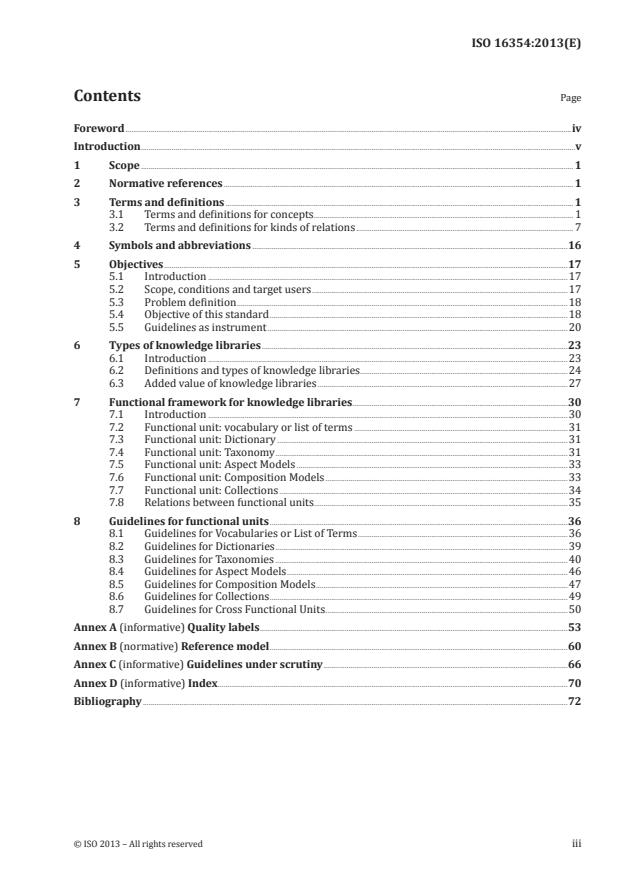
Contents Page
Foreword .iv
Introduction .v
1 Scope . 1
2 Normative references . 1
3 Terms and definitions . 1
3.1 Terms and definitions for concepts . 1
3.2 Terms and definitions for kinds of relations . 7
4 Symbols and abbreviations .16
5 Objectives .17
5.1 Introduction .17
5.2 Scope, conditions and target users .17
5.3 Problem definition .18
5.4 Objective of this standard .18
5.5 Guidelines as instrument .20
6 Types of knowledge libraries .23
6.1 Introduction .23
6.2 Definitions and types of knowledge libraries .24
6.3 Added value of knowledge libraries .27
7 Functional framework for knowledge libraries .30
7.1 Introduction .30
7.2 Functional unit: vocabulary or list of terms .31
7.3 Functional unit: Dictionary .31
7.4 Functional unit: Taxonomy .31
7.5 Functional unit: Aspect Models .33
7.6 Functional unit: Composition Models .33
7.7 Functional unit: Collections .34
7.8 Relations between functional units.35
8 Guidelines for functional units .36
8.1 Guidelines for Vocabularies or List of Terms .36
8.2 Guidelines for Dictionaries .39
8.3 Guidelines for Taxonomies .40
8.4 Guidelines for Aspect Models .46
8.5 Guidelines for Composition Models .47
8.6 Guidelines for Collections .49
8.7 Guidelines for Cross Functional Units .50
Annex A (informative) Quality labels .53
Annex B (normative) Reference model .60
Annex C (informative) Guidelines under scrutiny .66
Annex D (informative) Index .70
Bibliography .72
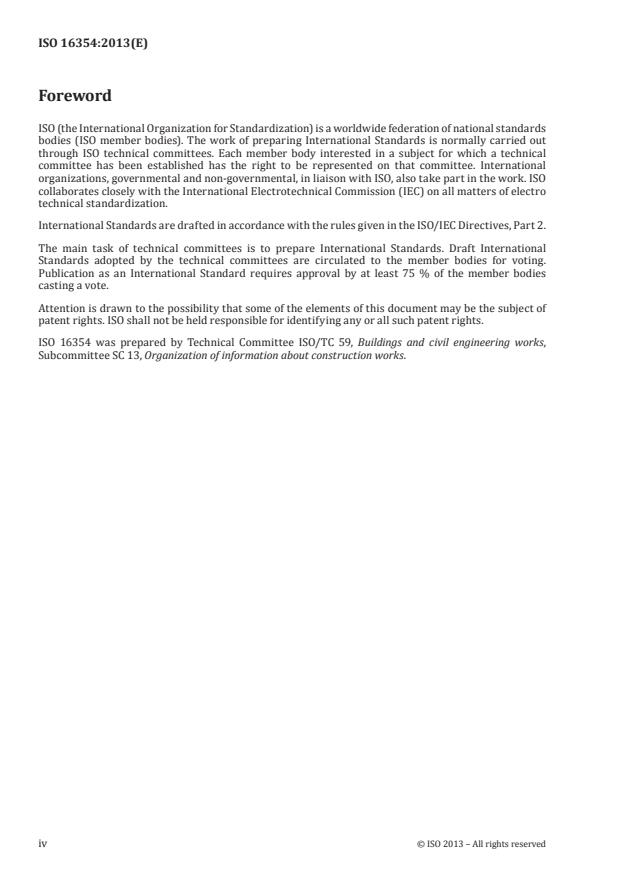
Foreword
ISO (the International Organization for Standardization) is a worldwide federation of national standards
bodies (ISO member bodies). The work of preparing International Standards is normally carried out
through ISO technical committees. Each member body interested in a subject for which a technical
committee has been established has the right to be represented on that committee. International
organizations, governmental and non-governmental, in liaison with ISO, also take part in the work. ISO
collaborates closely with the International Electrotechnical Commission (IEC) on all matters of electro
technical standardization.
International Standards are drafted in accordance with the rules given in the ISO/IEC Directives, Part 2.
The main task of technical committees is to prepare International Standards. Draft International
Standards adopted by the technical committees are circulated to the member bodies for voting.
Publication as an International Standard requires approval by at least 75 % of the member bodies
casting a vote.
Attention is drawn to the possibility that some of the elements of this document may be the subject of
patent rights. ISO shall not be held responsible for identifying any or all such patent rights.
ISO 16354 was prepared by Technical Committee ISO/TC 59, Buildings and civil engineering works,
Subcommittee SC 13, Organization of information about construction works.
iv © ISO 2013 – All rights reserved
Introduction
Knowledge libraries are databases that contain modelled knowledge about kinds of things.
Knowledge libraries are intended to support business processes concerning any kind of products during
their lifetime, for example to support their design, procurement, construction, operation or maintenance.
There is an increasing awareness of the high potential value of knowledge libraries and of the drawbacks
of the inconsistencies and lack of interoperability between different knowledge libraries.
This standard is based on Netherlands Technical Agreement NTA 8611:2008 (en), Guidelines for
Knowledge Libraries and Object Libraries, Version 3.0.
On both a national and international level knowledge libraries exist or are being developed, such as the
Gellish English Dictionary-Taxonomy (previously called STEPlib), UNETO-VNI ETIM system, LexiCon
and the GWW Objectenbibliotheek [Civil Object Library] and International Framework for Dictionaries
(IFD) developed by the Building Smart consortium. International efforts include IEC 61360, ISO 13584,
ISO/TS 15926-4, and ISO 12006-3.
Historically, most libraries have had their own unique structure and methodology for defining their
objects and they use their own naming conventions. For instance, the structure of the article classes laid
down in ISO 13584-42 notably differs from that of the UNETO-VNI component classes (publication 8)
or LexiCon, based on ISO 12006-3. In most cases the intrinsic definition of objects will also be different.
The major ICT developments with regard to the Internet and XML technology have increased the
possibility for uniformity. From a technical point of view, it has become much easier to exchange
data, which increases the need and support for this within the industry. Organizations launching new
initiatives for the creation of knowledge libraries may also greatly benefit from enhanced uniformity.
They may come up with questions such as: “Which existing libraries should be used?”, “Will these
libraries receive sufficient support?”, “Do they fulfil my information needs?” and “Is there international
support for such libraries?”
INTERNATIONAL STANDARD ISO 16354:2013(E)
Guidelines for knowledge libraries and object libraries
1 Scope
The aim of this standard is to distinguish categories of knowledge libraries and to lay the foundation
for uniform structures and content of such knowledge libraries and for commonality in their usage.
By drawing up a number of guidelines, a guiding principle is provided for new libraries as well as for
upgrading existing libraries. Without these guidelines there is an undesirable amount of freedom, so
that the various libraries may become too heterogeneous. This would render the comparison, linking
and integrated usage of these libraries very complex, if not impossible.
— The objective of the standard is to categorize knowledge libraries and object libraries and to provide
recommendations for the creation of such libraries. Libraries that are compliant with the guidelines
of this standard may be more easily linked to, or integrated with other libraries.
— The target audience of the standard consists of developers of knowledge libraries, builders of
translation software or interfaces between knowledge libraries, certifying bodies and builders of
applications who must base their work on the knowledge libraries laid down.
NOTE 1 Knowledge libraries are databases or files that contain modelled knowledge about kinds of things.
They are intended to support business processes concerning any kind of products during their lifetime, for
example to support their design, procurement, construction, operation or maintenance. There is an increasing
awareness of the high potential value of knowledge libraries and of the drawbacks of the inconsistencies and lack
of interoperability between different knowledge libraries.
NOTE 2 This standard does not aim to standardize terminology, but to harmonize and standardize concepts.
Thus the use of synonyms and synonymous phrases and one-to-one translations are allowed or even recommended,
provided that alternative terms denote the same concepts and reference is made to the corresponding synonymous
terms in this standard.
2 Normative references
The following documents, in whole or in part, are normatively referenced in this document and are
indispensable for its application. For dated references, only the edition cited applies. For undated
references, the latest edition of the referenced document (including any amendments) applies.
None.
3 Terms and definitions
3.1 Terms and definitions for concepts
For the purposes of this document, the following terms and definitions of concepts apply.
NOTE The guidelines in this standard are expressed by using two kinds of building blocks: concepts and
relation types (which are a special kind of concepts). In this clause, the definitions of those building blocks are
provided. The overall description method of the building blocks bears great resemblance to the description
method used in several other ISO standards, e.g. the ISO 10303 series.
For each concept a number, a term (which may be a multi-word term or phrase) and a definition is given, usually
followed by an explanation in a Note and one or more examples. Each term denotes a concept in English in the
context (language community) of this standard.
3.1.1
knowledge library
collection of information models that express knowledge (which may include also definition models
and requirements models) about kinds of things (concepts) and that are stored and retrieved as
electronic information
Note 1 to entry: A knowledge library may contain knowledge about physical objects as well as about non-physical
objects, such as occurrences, activities, processes and events, or about properties, relationships, scales (units of
measure), mathematical objects, etc. Each information model in a knowledge library should be retrievable as a
separate model, although the content of the various models may overlap. It is not required that every information
model has a separate unique identifier as a model may also be retrieved on the basis of a query.
An object library (in the context of this standard) is a special kind of knowledge library as it is a collection of
knowledge models (possibly also including definitions and requirements) about kinds of physical objects.
3.1.2
knowledge model
information model that expresses knowledge in a computer interpretable structure
Note 1 to entry: A knowledge model consists of a number of expressions of facts about a concept, each of which
expressions expresses something that can be the case. Those expressions should comply with the guidelines in
this standard. A requirements model is a subtype of a knowledge model. It expresses what shall be the case in a
particular context.
Note 2 to entry: Knowledge models typically define further subtypes of the concepts that are defined in this
standard.
Information models are expressions of meaning in a formal language that is computer interpretable.
3.1.3
fact
state of being the case
Note 1 to entry: A fact can be represented by a fact identifier (see the concept ‘unique identifier’). Something that is
the case may be expressed by an expression. Such an expression may consist of a relation between representatives
of related things, whereas typically that relation is classified by a kind of relation. A fact may be stated, denied or
questioned or confirmed in the expression.
3.1.4
definition
representation of a concept by a descriptive statement which serves to differentiate it from related concepts
[ISO 1087-1:2000]
Note 1 to entry: A definition may be expressed as natural language text (a textual definition) or as a definition
model. A textual definition should comply with the applicable guideline(s) in this standard. A definition expresses
what is by definition the case for all things of the defined kind and if such an expressed constraint is not the case
for a thing, then that thing is not a thing of the defined kind.
A definition model is a subtype of a knowledge model and consists of a number of expressions of facts about the
defined concept. Those expressions should comply with the guidelines in this standard.
3.1.5
concept
(1)unit of knowledge created by a unique combination of aspects and/or components
[adapted from ISO 1087-1:2000]
(2)commonality between individual things that is defined by one or more constraints that describe the
limits for the inclusion of individual things to conform to the concept
Note 1 to entry: A concept is a human idea used to categorize phenomena and to allocate knowledge that is
common about those phenomena. All concepts in a knowledge library are specializations (subtypes) of concept.
2 © ISO 2013 – All rights reserved
A concept can be defined or described or it can be used to define or describe other concepts.
The above two definitions define the same concept from different perspectives.
This standard makes a distinction between a concept (itself) and the definition model (knowledge model) that
defines the concept. The term ‘unit of knowledge’ should therefore be interpreted as the concept itself. In this
standard characteristics are aspects that are distinguished from components.
EXAMPLE Concepts with names such as road, building, bicycle, repairing, length, organization, centimetre.
3.1.6
physical object
individual thing that has a physical nature with a limited lifespan; it may be materialized (and then may
be observable and touchable) or it may be imagined (having deemed aspects, as-if observable)
Note 1 to entry: Physical objects (i.e. the concept ‘physical object’) is a core kind of object (or object type) with
which this standard is concerned (see 5.2). The guidelines that have been included in this standard are therefore
concerned mainly with knowledge libraries geared towards the description of physical matters. A physical object
is to be distinguished from the stuff, such as steel, that specifies the material of construction aspect of a physical
object. Physical objects may be solid or liquid or gaseous, but also electronic or electromagnetic, such as software
or radiation.
EXAMPLE Subtypes of physical object are concepts such as ones that have the following names: bridge,
switch, ventilator, pump, chair, ship, airplane, nut and bolt as well as liquid stream, application software, data
file, document and beam of light. Examples of (individual) physical objects (exemplars) are the Eiffel Tower, Paris,
V-6060 (a particular real vessel), D-101 (a particular copy of a document).
3.1.7
organization
social entity which is a physical object that consists of people in a structure that is controlled to
meet some purpose
Note 1 to entry: People can be defined as living physical objects, although this does not exclude that they might
have non-physical characteristics. An organization, defined as an arrangement of people, is therefore also defined
as a subtype of physical object, so that all guidelines for physical objects are also applicable for organizations. An
organization can possess or use material, such as equipment, machines, and buildings. The materials possessed
by an organization are owned by, but not defined as parts of the organization.
EXAMPLE Subtypes of physical object are kinds of organizations such as department, project team,
contractor. Examples of individual organizations that are classified by such a kind are: the United Nations,
Microsoft, department X.
3.1.8
occurrence
state that is dynamic and is an interaction over time between involved things, each with its own role
Note 1 to entry: May also be called ‘happening’. An occurrence can be an activity that is performed by a person
or a process or an event. Essential is that an occurrence takes time. The involved objects are in begin conditions
(state) at the start of the occurrence and are in end conditions (state) at the termination of the occurrence. The
begin conditions and end conditions may be the same, but are usually different. An occurrence can also be called
a state transition. An event usually has a very short duration. For some processes it seems as if nothing happens,
apart from at their atomic scale.
EXAMPLE Subtypes of occurrence are: inspecting, pumping, flowing, fabricating, measuring, maintaining,
control, project, earthquake, etc.
3.1.9
term
(1)verbal designation of a concept or individual thing in a specific subject field
[adapted from ISO 1087-1:2000]
(2)role of a physical character string or sound that may include spaces and silences, respectively, that is
used to designate a concept (e.g. a kind of physical object or aspect) or to designate an individual thing
in a particular language (coding system) and language community
Note 1 to entry: A spoken sound or written character string is an utterance or written or printed physical object
that is used in a certain context (language community) as a linguistic designation of a concept or of an individual
thing. In this standard such a concept or individual thing is assumed to be represented by a unique identifier.
A term usually consists of a particular sequence of characters or sound, one or more words, abbreviations or
symbols, possibly separated by spaces or silences.
A name is a term that is neither a code nor a symbol or abbreviation. A name is a role of a character string in a
naming relation, which denotes how something is called in a particular language and language community.
Note 2 to entry: A character string is a physical object; it is a sequence of characters of a standardized shape,
typically ink on paper.
A term does not necessarily uniquely denote a particular concept, thus homonyms are not excluded. A term only
uniquely denotes a particular concept in a particular language and language community.
The above two definitions are two expressions that intend to define the same concept.
EXAMPLE Terms such as road, room, bicycle, length, price, centrifugal pump, inspection, and kg that are used in
English to refer to concepts; and terms such as Eiffel Tower and New York that are used to refer to individual things.
3.1.10
language
coding system of spoken and/or written words and sentences (expressions and phrases) that is used to
communicate between people or systems
Note 1 to entry: There are natural languages and artificial languages. The latter may be a formal language (being
explicitly defined and computer interpretable).
EXAMPLE English, German, and Mandarin are examples of natural languages. Gellish Formal English is an
example of a formal artificial language, although its vocabulary consists of normal English terms.
3.1.11
language community
community that shares terminology (terms, names, abbreviations and codes) to unambiguously refer to
concepts and to individual things
Note 1 to entry: A language community, also called a speech community, does not use homonyms within their
shared community vocabulary, but may include synonyms. Terms from different language communities may
include homonyms.
EXAMPLE Civil engineering, finance, and control engineering are examples of language communities.
3.1.12
unique identifier
UID
role of a character string when used for unambiguous reference to a concept or to an individual thing
(e.g. a physical object or an aspect or a fact or a relation type) and that is unique within a particular
common context, preferably in a universal context
Note 1 to entry: The function of a unique identifier is that it is a unique, language independent, reference to a
concept, relation or individual thing. Ranges or conventions for unique identifiers shall be agreed between parties
to avoid overlap with other parties when data exchange or data integration is intended.
4 © ISO 2013 – All rights reserved
A UID of a concept is different from UIDs for particular quantities of information about that concept. A UID for a
concept refers to the concept itself. Thus a UID for a pump is different from a UID for the information (collection
of facts) that is expressed by an entity with its attributes in a database.
A UID for a fact (a relation) is independent of the expression (the way a fact is expressed).
The inverse expression of a relation denotes the same fact (and thus shall be indicated by the same UID).
EXAMPLE The UID 130206 in Gellish Formal English refers to the concept ‘pump’. The UID 570039 refers to
the concept ‘kg’ in the same context. In such a formal language, UIDs or ranges for unique identifiers are issued on
request for individual things as well as for proprietary extensions of the concepts that are defined in the language.
IFC and IFD and others use an algorithm for generating Globally Unique Identifiers. The algorithm guarantees
the uniqueness of the UID, independent of the application by which it is generated. However, every system may
generate its own GUID for the same concept.
3.1.13
aspect
concept by which the existence and appearance of a thing is experienced and that cannot exist without
the existence of its possessor and which is either an intrinsic non-separable facet of its possessor or a
role of its possessor
Note 1 to entry: Aspects are the phenomena by which people experience the existence and appearance or value
of things. Subtypes of aspects are: characteristic, with further subtypes: physical property and quality, such
as material of construction (stuff), but also economic value, risk or social importance. Physical properties are
quantifiable, whereas qualities are non-quantifiable. The nature of such a phenomenon is called a conceptual
aspect. Its extent, intensity or size is called a qualitative aspect, also called an aspect value or property value.
The concept ‘role’ is an extrinsic subtype of aspect.
EXAMPLE Subtypes of aspect are: kinds of physical properties, such as the concept’s shape, length and colour,
and kinds of qualities (which are usually not quantified), such as flammability and corrosivity. Such kinds are
called conceptual aspects. Generic values for those conceptual aspects are called qualitative aspects. Examples
are: ‘cylindrical shape’, ‘stainless steel’, the length ‘3 m’, the colour ‘red’ and the qualities ‘flammable’, ‘inflammable’
and ‘corrosive’. Also numbers and ranges, such as 0, 1, 1.5, 1/8, ‘3 to 5’ and ‘ > 10’ are qualitative aspects.
3.1.14
scale
kind of relation that is used to classify relations between physical properties and numbers, thus
indicating a method for quantifying sizes or extents of aspects by mathematical values or ranges
Note 1 to entry: A scale is meant to provide a mechanism to relate quantitative aspects (physical properties) to
numbers or ranges that represent the sizes or intensities of the aspects on the scale. The number 1 on a scale is a
unit of measure that refers to a (standard) reference value of the kind of aspect for which the scale is meant.
EXAMPLE length scale, velocity scale, temperature scale
Note 2 to entry: Qualitative scales are usually called units of measure. They are subtypes of scale.
3.1.15
unit of measure
scale that specifies how the size or extent of an aspect is unambiguously quantified by a value on a
mathematical range
Note 1 to entry: A unit of measure provides a specific mechanism to relate an aspect to a number or range that
represents the size or intensity of the aspect.
EXAMPLE mm, cm, m, km, bar, mbar, mmHg, psi, °C
Note 2 to entry: In fact, the term ‘unit of measure’ refers to a standard value on a particular scale that is used
for comparison. For example, it could be argued that ‘1 m’ is the ‘unit of measure’, being a standard value on the
metre scale, whereas the latter is indicated just as ‘m’. That standard value is (approximately) the length of the
standard bar in the ‘Musée de Mesures’ (Museum of Measures) in Paris that was originally used to measure length
by comparison.
3.1.16
role
extrinsic aspect that is possessed by a possessor as long as the possessor participates in a relation that
requires that role
Note 1 to entry: A role is played by something when participating in a relation with something else. Typically roles
are based on temporal situations. Thus they are extrinsic and not on intrinsic aspects. Physical objects can play
various kinds of roles: they can play roles in relations with other physical objects, they can play a role as a possessor
of an aspect and they can play a role in an occurrence, which is then called a kind of usage, etc. Kinds of roles of
physical objects can be distinguished from kinds of physical objects by the fact that an actual role disappears when
the physical object is taken away from its normal position and, for example, is put in stock in a warehouse.
Note 2 to entry: Aspects can also play various kinds of roles: they can play a role of being possessed and can play
a role in a qualification relation, in a correlation or in some other kind of relation.
EXAMPLE The concepts part, whole, relator, related, involver, involved.
See also: examples of ‘role of physical object‘ and examples of ‘intrinsic aspect‘ (a kind of role of aspect).
3.1.17
role of physical object
role that a physical object plays in a relationship or the contribution that a physical object delivers in
an occurrence
Note 1 to entry: A role of physical object is a role that is played by a physical object. Typically it is their usage.
Roles of physical objects shall be distinguished from the physical objects that play the roles. A physical object
typically loses its role when it is taken out of the context that is typical for that role. Therefore, whether a concept
is a kind of role or a kind of physical object (is specifically designed with particular intrinsic aspects) can usually
be determined by the answer to the question, “Is the thing on a shelf in stock still recognizable as such?”. If not,
then the concept denotes a role.
EXAMPLE ‘chairman‘ is a kind of role that can be played by a person; ‘left hand wheel’ is a kind of role that
can be played by a wheel; ‘player’, ‘performer’, ‘subject’, ‘tool’, usage’, ‘customer’, ‘supplier’, ‘part’, ‘whole’, are other
examples of kinds of roles of physical objects.
3.1.18
intrinsic aspect
role that an aspect plays in a relationship with a possessor and that is dependent on the aspect as well
as on the possessing object
Note 1 to entry: Typically the name as well as the definition of an intrinsic aspect’ includes the kind of physical
object that possesses the aspect. It may also be that the aspect is possessed by a part of the assembly that is
denoted as the possessor. Possessed aspect is a synonym of intrinsic aspect.
EXAMPLE 1 ‘Pipe diameter’ is an intrinsic aspect that is defined as a diameter that is by definition
possessed by a pipe.
EXAMPLE 2 ‘Shaft length’ is an intrinsic aspect that is defined as a length that is by definition possessed by
a shaft. ‘Motor power’ may be recorded as an intrinsic aspect of a car, although the power is an aspect that is
possessed by a motor, which is a part of a car.
3.1.19
function
role of an occurrence that is intended to be performed or enabled by a physical object
Note 1 to entry: An occurrence (activity, process or event) typically has a relation with a player of a performer and
possibly an enabler role. The occurrence has a role as the function (to be performed or enabled) in such a relation.
The physical object will play a role as performer or enabler in that relation. So, the function denotes the occurrence.
Note 2 to entry: Sometimes the performer role of the physical object is also called its function. However, this is
another concept, being a homonym.
EXAMPLE Pumping is a kind of occurrence that can be performed by a pump. In other words: pumping can
be a function of a pump.
6 © ISO 2013 – All rights reserved
3.1.20
objective
role of a state that is intended to be achieved or that is intended to be prevented
Note 1 to entry: Something has a role as objective when it is wanted to be in that state. Typically the objective of
an activity. The state can be described by information or by a number of facts that shall be the case.
EXAMPLE An example of an objective might be: ‘product A is being produced’. This might be the objective
of project P.
3.1.21
collection
concept that indicates a plurality, consisting of a number of things without a particular structure
between the elements and not necessarily with a common discriminator
Note 1 to entry: A collection is the result of bringing items together (or as if). Collections shall be distinguished
from arrangements, assemblies and classes, kinds or categories. The reason for being element of a collection
should therefore not be based on being connected or having a common discriminating aspect alone. Note, the
number of elements in a collection may vary over time, and may consist of zero, one or more elements, while
nevertheless remaining the same collection.
Note 2 to entry: Apart from this concept ‘collection’ there also exists a collection relation that relates an element
to the collection of which the element is a component.
Note 3 to entry: In the context of knowledge libraries, collections are always collections of concepts.
EXAMPLE Stock items, such as a ‘stock of bolts’, or a pair of items. Not systems, such as ‘sewer system’,
because a system is not a collection of parts, but an assembly or arrangement, which means that it is composed
of (physically or functionally) connected or arranged parts. An organization is an example of an arrangement of
people which is not a pure collection, because the persons have a relative position towards each other.
3.1.22
individual thing
concept that classifies any real world or imaginary thing that has an individuality that is not dependent
on a commonality between things
Note 1 to entry: This standard is about kinds of things that are defined as commonalities between things, defined
by the constraints on aspects or ranges of values for aspects of individual things. Those kinds of things can be
used to classify individual things or to derive constraining aspects for individual things.
The concept that classifies all those individual things is called ‘individual thing’. The concept ‘individual thing’ is
the supertype of all kinds of individual things.
EXAMPLE Well known individual things are: the earth, the Eiffel Tower, New York, my car, V-6060 in the Shell
Pernis refinery. However, planet, tower, city, car, vessel and refinery are not individual things, but kinds of things.
3.2 Terms and definitions for kinds of relations
For the purposes of this document, the following terms and definitions of kinds of relations apply.
NOTE Kinds of relations are also called relation types or fact types. Each of the definitions of binary relation
types is accompanied by the following information:
— the definition of which kinds of objects are related in such a relation (the R1 role player and the R2 role player);
— the kinds of roles that those concepts by definition play in such a relation (the R1 role and the R2 role);
— the expressions (phrases) that represent the relation type in natural language (the R1-R2 expression and the
inverse R2-R1 expression).
Furthermore one or more example instances are given that illustrate the use of the relation type to express facts.
Note that the kinds of related objects and the kinds of roles they play are characterizing the relation type.
3.2.1
relation
concept that expresses a fact or opinion about a fact by specifying the things that are involved in the fact
and the roles that the various involved things play in the fact
Note 1 to entry: Each fact or state of affairs can be modelled as and expressed by a relation (relationship) between
related things. The kind of relation (also called relation type or fact type) specifies how something relates to
something else. The related objects specify what is related. Binary relations relate two things. Higher order
relations relate more than two things. Each related thing has its own role of its own kind in the relation. Thus a
relation indicates that a number of things are related to each other. If one of the related things is a plurality, then
the relation implies multiple facts.
EXAMPLE The Eiffel Tower and Paris are related to each other. The relation is of the kind .
The Eiffel tower has a role as located in the relation and Paris has a role as locator in the relation. Activities and
processes are typical examples of things that can be expressed as higher order relations.
3.2.2
relation between individual things
relation that relates an individual thing with another individual thing
Note 1 to entry: A fact in which individual things are involved can be modelled by a relation between individual
things. The kind of relation specifies how the things are related.
EXAMPLE The fact that the Eiffel Tower is located in Paris is a fact that can be expressed by a relation
between individual things (the Eiffel Tower and Paris), whereas the relation can be classified by a kind of relation
called ‘is located in’.
3.2.3
relation between kinds of things
relation that specifies knowledge or requirements or permissions in general terms about what can be
the case, shall be the case, is allowed to be the case or is by definition the case
Note 1 to entry: A fact about kinds of things can be expressed by a relation between kinds of things. Such a
fact typically expresses what can be the case for all things of those kinds, possibly within a specified context.
Specializations of this kind of relation can constrain what can be the case to what shall be, is allowed to be or is
by definition the case.
EXAMPLE All general knowledge, such as about possible compositions of things of a kind and about kinds of
aspects that all things of a kind share.
3.2.4
relation between an individual thing and a kind of thing
relation that relates an individual thing with a kind of individual thing
Note 1 to entry: A kind of relation that specifies that an individual thing has a relation with a kind of thing or can
have a relation with things of a particular kind. A classification relation is an example of a subtype of this relation.
EXAMPLE The fact that Paris is classified as a city and the fact that the individual object V-6060 is classified
as a horizontal vessel. The fact that T-6000 can be used for storage of drinking water.
3.2.5
binary relation
relation that specifies a relationship between two things, each of which is playing its own role that is of
a kind that is typical for the relation type
Note 1 to entry: Facts can be expressed as a binary relation or as a collection of binary relations between things.
Most kinds of facts can be expressed using a single binary relation. Some facts require ternary or higher order
relations. Those relations can be expressed using multiple binary elementary relations.
Note 2 to entry: This relation type is the top of the specialization hierarchy of binary relation types. It can be used
to record that things are related without knowing how they are related, but usually more specialized relation
types are used.
8 © ISO 2013 – All rights reserved
EXAMPLE The fact that The Eiffel Tower is located in Paris is a fact that can be expressed as a binary relation
between The Eiffel Tower and Paris, whereas the relation type is ‘being located in’.
A composition relation is a binary relation type that relates two things. One of those things plays a role as part and
the other plays a role as whole. Each binary relation type can be denoted by a phrase, such as ‘can be a part of a’.
In the inverse sequence the same relation type can be denoted by an inverse phrase, such as ‘can be a whole for a’.
Activities are higher order relations that can be expressed by a number of binary elementary relations, where
each binary relation specifies the role of an involved thing in the activity.
Example instances:
John is related to Peter
force is related to acceleration
3.2.6
specialization relation
relation between kinds of things that relates two concepts whereby the subtype concept is a more
specific concept than the supertype concept and has all the aspects that define the supertype concept
R1 role player: concept R2 role player: concept
R1 role: subtype R2 role: supertype
R1-R2 expression: is a specialization of R2-R1 expression: is a generalization of
is a kind of has as subtype
is a subtype of is a supertype of
Note 1 to entry: The constraints by which a supertype concept is defined are also applicable for its subtype
concepts. A subtype concept is distinguished from its supertype and its neighbouring subtype concepts by being
defined by additional constraints. A concept may be a subtype of more than one supertype concept. An aspect
(value) by which a supertype concept is defined is also an aspect of all of its subtype concepts (the aspects are
‘inherited’). The aspects of a concept shall also be applicable for the individual things that are classified by the
kind. An individual thing that is classified by a concept (thus satisfying its defining constraints), is implicitly also
classified by the supertypes of the concept. Knowledge about options for a concept is also knowledge about its
subtypes, unless the knowledge is further constrained by the definition of the subtype.
The phrase ‘is a specialization of’ has as synonyms ‘is a kind of’ and ’is a subtype of’. The inverse phrase ‘is a
generalization of’ has as synonyms ‘has as subtype’ and ‘is a supertype of’.
Thus, the expression A is a kind of B, means that the concept A is a subtype of the concept B. For example,
...