

ISO 17170:2015
(Main)Fine ceramics (advanced ceramics, advanced technical ceramics) — Test method for spherical indentation of porous ceramics
- Abstract
ISO 17170:2015 describes the test methods for determining spherical indentation strength of porous ceramics, such as those employed for filters and catalyst carriers, that are carried out in air at room temperature.
- Status
- Published
- Publication Date
- 24-Nov-2015
- Technical Committee
- ISO/TC 206 - Fine ceramics
- Drafting Committee
- ISO/TC 206/WG 12 - Engineering applications and porous ceramics
- Current Stage
- 9093 - International Standard confirmed - 90 Review
- Start Date
- 05-Jun-2026
Overview
ISO 17170:2015 specifies a standardized test method - the spherical indentation (sphere indentation) test - for determining the indentation (compressive) strength of porous ceramics (advanced/technical ceramics) used in applications such as filters and catalyst carriers. Tests are carried out in air at room temperature and provide a repeatable way to quantify fracture strength under a localized spherical load.
Key topics and technical requirements
- Material scope: Porous ceramics with porosity ~30–60% and pore diameters from 1 μm to 100 μm; excludes structured honeycomb channels.
- Specimen geometry: Flat plate, nominal 20.0 × 20.0 × 10.0 mm (±0.1 mm); parallelism between faces ≤ 0.01 mm. Minimum of 10 specimens per test series.
- Surface preparation: Surface finish by grinding with abrasive grain number ≥ 800; remove any wax contamination.
- Indenter and pedestal:
- Sphere indenter: steel sphere, 3/4 inch diameter per ISO 3290.
- Pedestal: carbon steel (0.4–0.6 % C) or equally hard material, thickness ≥ 10 mm; contact area ≥ 4× specimen cross-section; surface roughness ≤ 0.40 μm Ra and parallelism ≤ 0.01 mm.
- Testing machine & measurement:
- Machine must apply compressive load at constant crosshead speed with load accuracy ≤ ±1% of maximum load.
- Crosshead speed: 0.5 mm/min.
- Measure load and load-point displacement continuously from test start to fracture using displacement meters or dial gauges (precision 0.01 mm).
- Definitions:
- Fracture: specimen separation into more than two pieces, many flakes, or a large sudden load drop.
- Sphere indentation strength: maximum load recorded before fracture.
- Result treatment: Record load vs. displacement curve; calculate mean and standard deviation per ISO 31-0. Reuse of pedestal/sphere permitted only after removing dimples or changing contact surface as required.
- Reporting: Material ID, specimen dimensions, indenter/pedestal materials, machine type, loading conditions, number of specimens, individual results, mean & standard deviation, and curves. Preferred additions include porosity, pore size, composition and manufacturing details.
Applications and users
- Quality control and R&D for porous ceramic filters, catalyst carriers, molecular sieves, humidity sensors.
- Materials testing laboratories characterizing mechanical integrity and localized compressive strength.
- Ceramic manufacturers, product qualification engineers, and standards compliance teams seeking reproducible comparative data.
Related standards
Referenced documents include ISO 4287 (surface texture), ISO 1101 (geometrical tolerancing), ISO 3290 (balls/indenter dimensions), ISO 3611 (micrometers), ISO/R 463 (dial gauges), ISO 683‑1 / 683‑11 (steel grades for pedestal), and ISO 31‑0 (quantities & units).
Keywords: ISO 17170:2015, sphere indentation test, porous ceramics, indentation strength, fine ceramics, catalyst carriers, ceramic filters, material testing.
Frequently Asked Questions
ISO 17170:2015 is a standard published by the International Organization for Standardization (ISO). Its full title is "Fine ceramics (advanced ceramics, advanced technical ceramics) — Test method for spherical indentation of porous ceramics". This standard covers: ISO 17170:2015 describes the test methods for determining spherical indentation strength of porous ceramics, such as those employed for filters and catalyst carriers, that are carried out in air at room temperature.
ISO 17170:2015 describes the test methods for determining spherical indentation strength of porous ceramics, such as those employed for filters and catalyst carriers, that are carried out in air at room temperature.
ISO 17170:2015 is classified under the following ICS (International Classification for Standards) categories: 81.060.30 - Advanced ceramics. The ICS classification helps identify the subject area and facilitates finding related standards.
ISO 17170:2015 is available in PDF format for immediate download after purchase. The document can be added to your cart and obtained through the secure checkout process. Digital delivery ensures instant access to the complete standard document.
Standards Content (Sample)
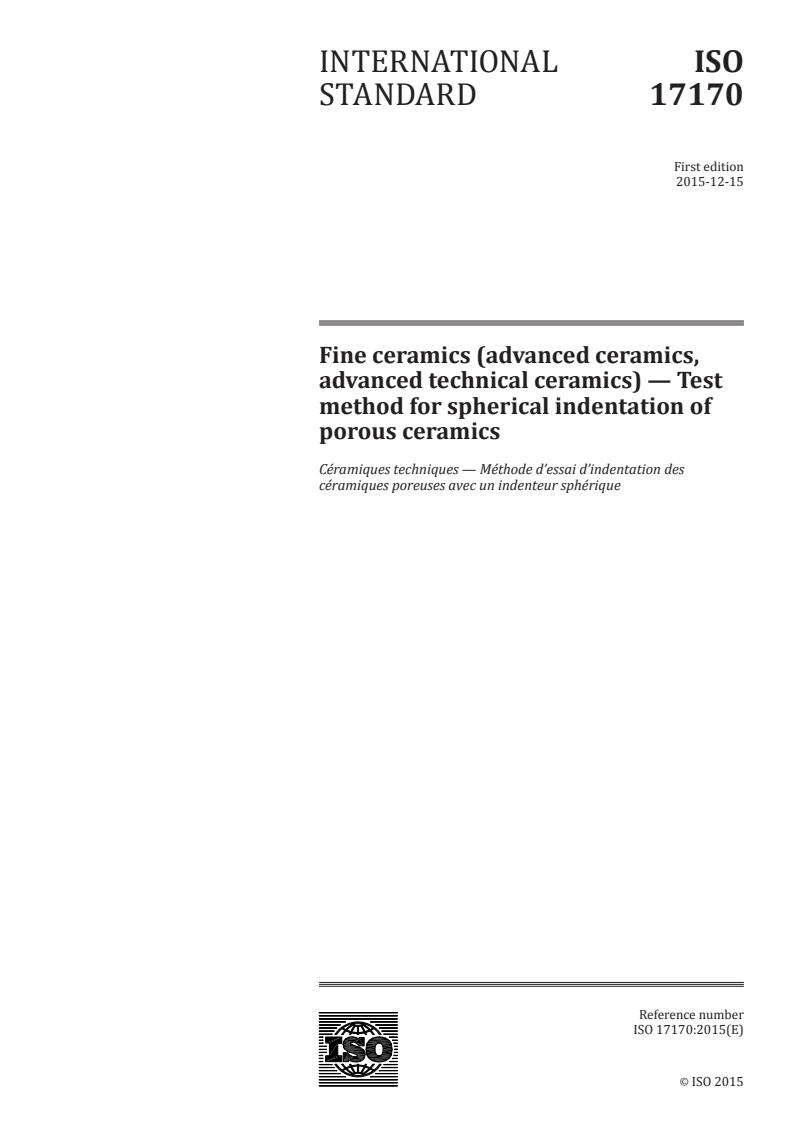
INTERNATIONAL ISO
STANDARD 17170
First edition
2015-12-15
Fine ceramics (advanced ceramics,
advanced technical ceramics) — Test
method for spherical indentation of
porous ceramics
Céramiques techniques — Méthode d’essai d’indentation des
céramiques poreuses avec un indenteur sphérique
Reference number
©
ISO 2015
© ISO 2015, Published in Switzerland
All rights reserved. Unless otherwise specified, no part of this publication may be reproduced or utilized otherwise in any form
or by any means, electronic or mechanical, including photocopying, or posting on the internet or an intranet, without prior
written permission. Permission can be requested from either ISO at the address below or ISO’s member body in the country of
the requester.
ISO copyright office
Ch. de Blandonnet 8 • CP 401
CH-1214 Vernier, Geneva, Switzerland
Tel. +41 22 749 01 11
Fax +41 22 749 09 47
copyright@iso.org
www.iso.org
ii © ISO 2015 – All rights reserved
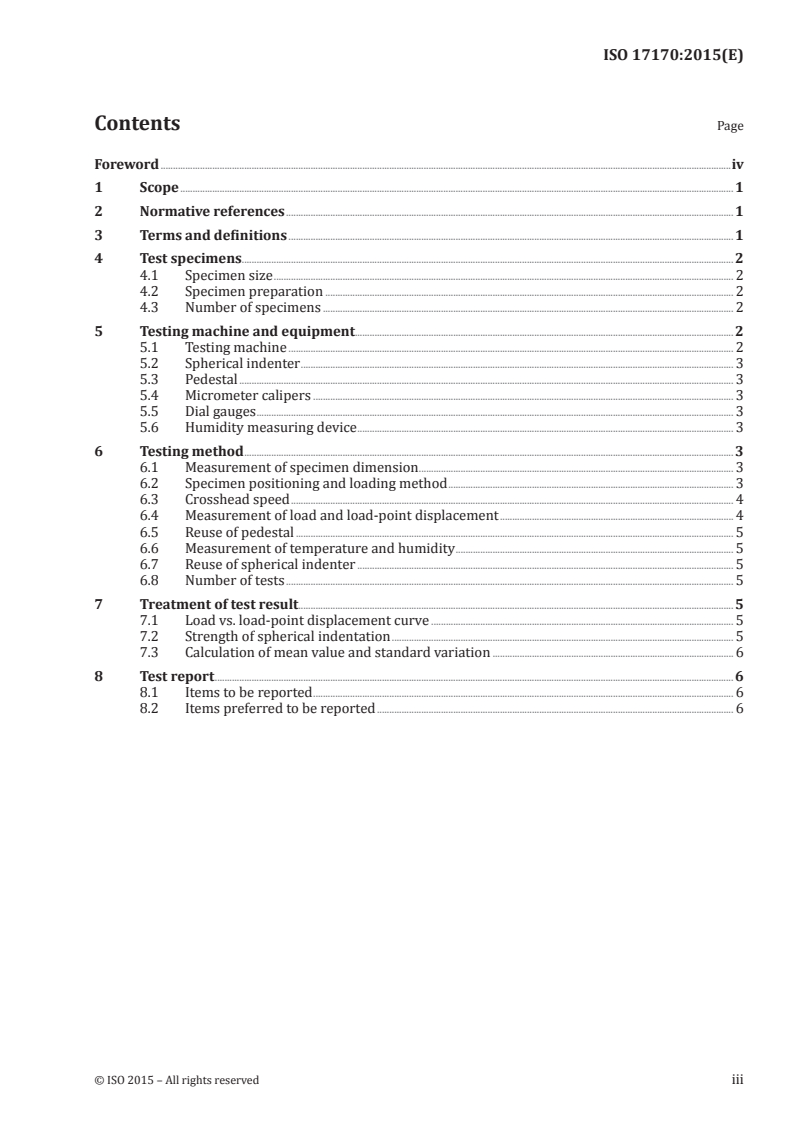
Contents Page
Foreword .iv
1 Scope . 1
2 Normative references . 1
3 Terms and definitions . 1
4 Test specimens. 2
4.1 Specimen size . 2
4.2 Specimen preparation . 2
4.3 Number of specimens . 2
5 Testing machine and equipment. 2
5.1 Testing machine . 2
5.2 Spherical indenter . 3
5.3 Pedestal . 3
5.4 Micrometer calipers . 3
5.5 Dial gauges . 3
5.6 Humidity measuring device . 3
6 Testing method . 3
6.1 Measurement of specimen dimension . 3
6.2 Specimen positioning and loading method . 3
6.3 Crosshead speed . 4
6.4 Measurement of load and load-point displacement . 4
6.5 Reuse of pedestal . 5
6.6 Measurement of temperature and humidity . 5
6.7 Reuse of spherical indenter . 5
6.8 Number of tests . 5
7 Treatment of test result. 5
7.1 Load vs. load-point displacement curve . 5
7.2 Strength of spherical indentation . 5
7.3 Calculation of mean value and standard variation . 6
8 Test report . 6
8.1 Items to be reported . 6
8.2 Items preferred to be reported . 6
Foreword
ISO (the International Organization for Standardization) is a worldwide federation of national standards
bodies (ISO member bodies). The work of preparing International Standards is normally carried out
through ISO technical committees. Each member body interested in a subject for which a technical
committee has been established has the right to be represented on that committee. International
organizations, governmental and non-governmental, in liaison with ISO, also take part in the work.
ISO collaborates closely with the International Electrotechnical Commission (IEC) on all matters of
electrotechnical standardization.
The procedures used to develop this document and those intended for its further maintenance are
described in the ISO/IEC Directives, Part 1. In particular the different approval criteria needed for the
different types of ISO documents should be noted. This document was drafted in accordance with the
editorial rules of the ISO/IEC Directives, Part 2 (see www.iso.org/directives).
Attention is drawn to the possibility that some of the elements of this document may be the subject of
patent rights. ISO shall not be held responsible for identifying any or all such patent rights. Details of
any patent rights identified during the development of the document will be in the Introduction and/or
on the ISO list of patent declarations received (see www.iso.org/patents).
Any trade name used in this document is information given for the convenience of users and does not
constitute an endorsement.
For an explanation on the meaning of ISO specific terms and expressions related to conformity
assessment, as well as information about ISO’s adherence to the WTO principles in the Technical
Barriers to Trade (TBT) see the following URL: Foreword - Supplementary information
The committee responsible for this document is ISO/TC 206, Fine ceramics.
iv © ISO 2015 – All rights reserved
INTERNATIONAL STANDARD ISO 17170:2015(E)
Fine ceramics (advanced ceramics, advanced technical
ceramics) — Test method for spherical indentation of
porous ceramics
1 Scope
This International Standard describes the test methods for determining spherical indentation strength
of porous ceramics, such as those employed for filters and catalyst carriers, that are carried out in air at
room temperature.
2 Normative references
The following documents, in whole or in part, are normatively referenced in this document and are
in
...