


ISO/IEC FDIS 14496-31
(Main)Information technology — Coding of audio-visual objects — Part 31: Video coding for browsers
Information technology — Coding of audio-visual objects — Part 31: Video coding for browsers
Technologies de l'information — Codage des objets audiovisuels — Partie 31: Codage video pour navigateurs
General Information
- Status
- Withdrawn
- Current Stage
- 5098 - Project deleted
- Start Date
- 03-May-2019
- Completion Date
- 14-Feb-2026
Relations
- Effective Date
- 06-Jun-2022

Get Certified
Connect with accredited certification bodies for this standard

BSI Group
BSI (British Standards Institution) is the business standards company that helps organizations make excellence a habit.

NYCE
Mexican standards and certification body.
Sponsored listings
Frequently Asked Questions
ISO/IEC FDIS 14496-31 is a draft published by the International Organization for Standardization (ISO). Its full title is "Information technology — Coding of audio-visual objects — Part 31: Video coding for browsers". This standard covers: Information technology — Coding of audio-visual objects — Part 31: Video coding for browsers
Information technology — Coding of audio-visual objects — Part 31: Video coding for browsers
ISO/IEC FDIS 14496-31 is classified under the following ICS (International Classification for Standards) categories: 35.040 - Information coding; 35.040.40 - Coding of audio, video, multimedia and hypermedia information. The ICS classification helps identify the subject area and facilitates finding related standards.
ISO/IEC FDIS 14496-31 has the following relationships with other standards: It is inter standard links to ISO 80601-2-56:2017/Amd 1:2018. Understanding these relationships helps ensure you are using the most current and applicable version of the standard.
ISO/IEC FDIS 14496-31 is available in PDF format for immediate download after purchase. The document can be added to your cart and obtained through the secure checkout process. Digital delivery ensures instant access to the complete standard document.
Standards Content (Sample)
FINAL
INTERNATIONAL ISO/IEC
DRAFT
STANDARD FDIS
14496-31
ISO/IEC JTC 1/SC 29
Information technology — Coding of
Secretariat: JISC
audio-visual objects —
Voting begins on:
2017-07-27
Part 31:
Voting terminates on:
Video coding for browsers
2017-09-21
Technologies de l’information — Codage des objets audiovisuels —
Partie 31: Titre manque
RECIPIENTS OF THIS DRAFT ARE INVITED TO
SUBMIT, WITH THEIR COMMENTS, NOTIFICATION
OF ANY RELEVANT PATENT RIGHTS OF WHICH
THEY ARE AWARE AND TO PROVIDE SUPPOR TING
DOCUMENTATION.
IN ADDITION TO THEIR EVALUATION AS
Reference number
BEING ACCEPTABLE FOR INDUSTRIAL, TECHNO-
LOGICAL, COMMERCIAL AND USER PURPOSES,
DRAFT INTERNATIONAL STANDARDS MAY ON
OCCASION HAVE TO BE CONSIDERED IN THE
LIGHT OF THEIR POTENTIAL TO BECOME STAN-
DARDS TO WHICH REFERENCE MAY BE MADE IN
©
NATIONAL REGULATIONS. ISO/IEC 2017
© ISO/IEC 2017, Published in Switzerland
All rights reserved. Unless otherwise specified, no part of this publication may be reproduced or utilized otherwise in any form
or by any means, electronic or mechanical, including photocopying, or posting on the internet or an intranet, without prior
written permission. Permission can be requested from either ISO at the address below or ISO’s member body in the country of
the requester.
ISO copyright office
Ch. de Blandonnet 8 • CP 401
CH-1214 Vernier, Geneva, Switzerland
Tel. +41 22 749 01 11
Fax +41 22 749 09 47
copyright@iso.org
www.iso.org
ii © ISO/IEC 2017 – All rights reserved
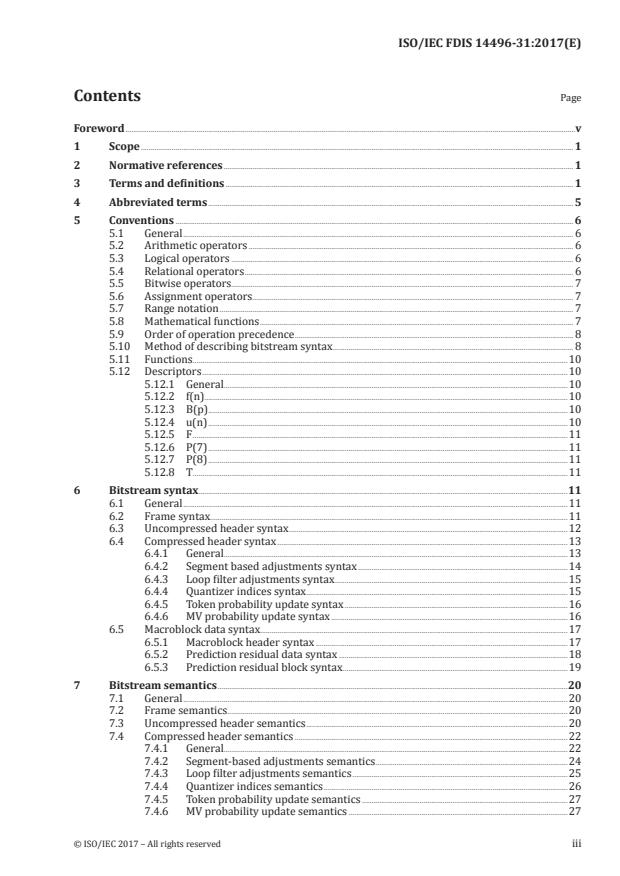
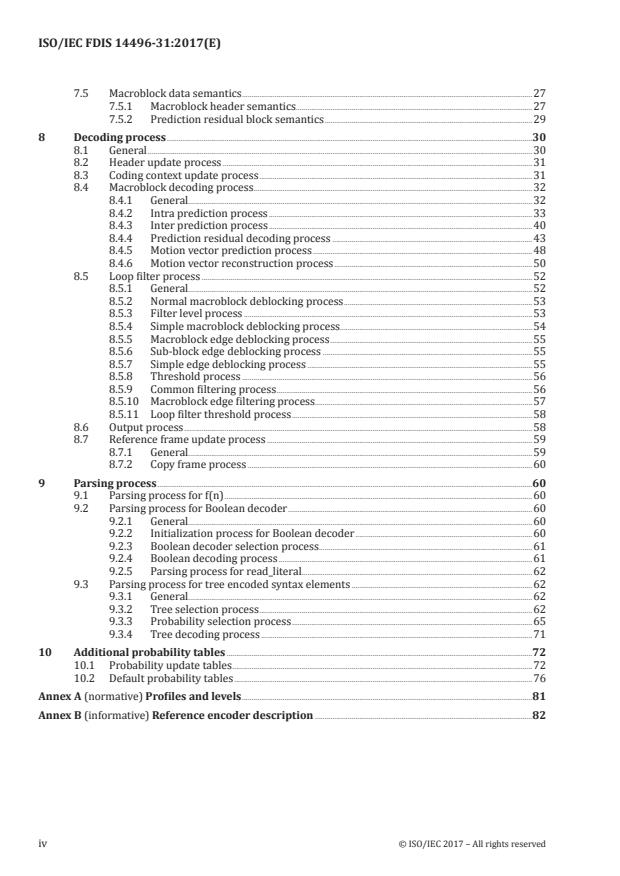
Contents Page
Foreword .v
1 Scope . 1
2 Normative references . 1
3 Terms and definitions . 1
4 Abbreviated terms . 5
5 Conventions . 6
5.1 General . 6
5.2 Arithmetic operators . 6
5.3 Logical operators . 6
5.4 Relational operators . 6
5.5 Bitwise operators. 7
5.6 Assignment operators . 7
5.7 Range notation . 7
5.8 Mathematical functions . 7
5.9 Order of operation precedence . 8
5.10 Method of describing bitstream syntax . 8
5.11 Functions .10
5.12 Descriptors .10
5.12.1 General.10
5.12.2 f(n).10
5.12.3 B(p) .10
5.12.4 u(n) .10
5.12.5 F .11
5.12.6 P(7) .11
5.12.7 P(8) .11
5.12.8 T .11
6 Bitstream syntax .11
6.1 General .11
6.2 Frame syntax.11
6.3 Uncompressed header syntax .12
6.4 Compressed header syntax .13
6.4.1 General.13
6.4.2 Segment based adjustments syntax .14
6.4.3 Loop filter adjustments syntax .15
6.4.4 Quantizer indices syntax .15
6.4.5 Token probability update syntax .16
6.4.6 MV probability update syntax .16
6.5 Macroblock data syntax.17
6.5.1 Macroblock header syntax .17
6.5.2 Prediction residual data syntax .18
6.5.3 Prediction residual block syntax .19
7 Bitstream semantics .20
7.1 General .20
7.2 Frame semantics .20
7.3 Uncompressed header semantics .20
7.4 Compressed header semantics .22
7.4.1 General.22
7.4.2 Segment-based adjustments semantics .24
7.4.3 Loop filter adjustments semantics .25
7.4.4 Quantizer indices semantics .26
7.4.5 Token probability update semantics .27
7.4.6 MV probability update semantics .27
© ISO/IEC 2017 – All rights reserved iii
7.5 Macroblock data semantics .27
7.5.1 Macroblock header semantics.27
7.5.2 Prediction residual block semantics .29
8 Decoding process .30
8.1 General .30
8.2 Header update process .31
8.3 Coding context update process .31
8.4 Macroblock decoding process .32
8.4.1 General.32
8.4.2 Intra prediction process .33
8.4.3 Inter prediction process .40
8.4.4 Prediction residual decoding process .43
8.4.5 Motion vector prediction process .48
8.4.6 Motion vector reconstruction process .50
8.5 Loop filter process .52
8.5.1 General.52
8.5.2 Normal macroblock deblocking process .53
8.5.3 Filter level process .53
8.5.4 Simple macroblock deblocking process . .54
8.5.5 Macroblock edge deblocking process .55
8.5.6 Sub-block edge deblocking process .55
8.5.7 Simple edge deblocking process .55
8.5.8 Threshold process .56
8.5.9 Common filtering process .56
8.5.10 Macroblock edge filtering process .57
8.5.11 Loop filter threshold process .58
8.6 Output process .58
8.7 Reference frame update process .59
8.7.1 General.59
8.7.2 Copy frame process .60
9 Parsing process .60
9.1 Parsing process for f(n) .60
9.2 Parsing process for Boolean decoder .60
9.2.1 General.60
9.2.2 Initialization process for Boolean decoder .60
9.2.3 Boolean decoder selection process.61
9.2.4 Boolean decoding process .61
9.2.5 Parsing process for read_literal.62
9.3 Parsing process for tree encoded syntax elements .62
9.3.1 General.62
9.3.2 Tree selection process .62
9.3.3 Probability selection process .65
9.3.4 Tree decoding process .71
10 Additional probability tables .72
10.1 Probability update tables .72
10.2 Default probability tables .76
Annex A (normative) Profiles and levels .81
Annex B (informative) Reference encoder description .82
iv © ISO/IEC 2017 – All rights reserved
Foreword
ISO (the International Organization for Standardization) and IEC (the International Electrotechnical
Commission) form the specialized system for worldwide standardization. National bodies that are
members of ISO or IEC participate in the development of International Standards through technical
committees established by the respective organization to deal with particular fields of technical
activity. ISO and IEC technical committees collaborate in fields of mutual interest. Other international
organizations, governmental and non-governmental, in liaison with ISO and IEC, also take part in the
work. In the field of information technology, ISO and IEC have established a joint technical committee,
ISO/IEC JTC 1.
The procedures used to develop this document and those intended for its further maintenance are
described in the ISO/IEC Directives, Part 1. In particular the different approval criteria needed for the
different types of ISO documents should be noted. This document was drafted in accordance with the
editorial rules of the ISO/IEC Directives, Part 2 (see www .iso .org/ directives).
Attention is drawn to the possibility that some of the elements of this document may be the subject of
patent rights. ISO shall not be held responsible for identifying any or all such patent rights. Details of
any patent rights identified during the development of the document will be in the Introduction and/or
on the ISO list of patent declarations received (see www .iso .org/ patents).
Any trade name used in this document is information given for the convenience of users and does not
constitute an endorsement.
For an explanation on the voluntary nature of standards, the meaning of ISO specific terms and
expressions related to conformity assessment, as well as information about ISO’s adherence to the
World Trade Organization (WTO) principles in the Technical Barriers to Trade (TBT) see the following
URL: w w w . i s o .org/ iso/ foreword .html.
This document was prepared by Technical Committee ISO/IEC JTC 1, Information technology,
Subcommittee SC 29, Coding of audio, picture, multimedia and hypermedia information.
A list of all parts in the ISO/IEC 14496 series can be found on the ISO website.
© ISO/IEC 2017 – All rights reserved v
FINAL DRAFT INTERNATIONAL STANDARD ISO/IEC FDIS 14496-31:2017(E)
Information technology — Coding of audio-visual
objects —
Part 31:
Video coding for browsers
1 Scope
This document specifies the video coding for browsers (VCB) syntax format and decoding process.
2 Normative references
There are no normative references in this document.
3 Terms and definitions
For the purposes of this document, the following terms and definitions apply.
ISO and IEC maintain terminological databases for use in standardization at the following addresses:
— IEC Electropedia: available at http:// www .electropedia .org/
— ISO Online browsing platform: available at http:// www .iso .org/ obp
3.1
4:2:0 colour format
colour format with two chroma arrays that each have half the height and half the width of the luma array
3.2
AC transform coefficient
transform coefficient (3.55) for which the frequency index (3.23) in at least one of the two dimensions is
non-zero
3.3
bitstream
sequence of bits that forms the representation of coded frames (3.11)
3.4
bit string
ordered string with a limited number of bits, in which the left-most bit is the most significant bit (MSB)
and the right-most bit is the least significant bit (LSB)
3.5
block
MxN (M-column by N-row) array of sample values (3.22) or MxN array of transform coefficients (3.55)
3.6
Boolean decoder
arithmetic decoder that processes one Boolean element at a time, wherein each Boolean element
indicates how to refine the segmentation of a number line and hence specifies the decoded bits
© ISO/IEC 2017 – All rights reserved 1
3.7
Boolean decoding
process of decoding a syntax element (3.54) using a Boolean decoder (3.6)
3.8
byte
8-bit bit string (3.4)
3.9
byte aligned
position that is an integer multiple of eight, such that the first bit in the bitstream (3.3) has position 0
and the position of other bits is stated relative to this position
3.10
chroma
sample array or single sample (3.51), denoted by the symbols Cb and Cr, representing one of the two
colour difference signals related to the primary colours
3.11
coded frame
set of syntax elements (3.54) that represents a frame (3.22) in the bitstream (3.3)
3.12
component
array or single sample (3.51) from one of the three arrays [luma (3.32) and two chroma (3.10)] that
compose a picture in 4:2:0 colour format (3.1)
3.13
control partition
partition containing the frame header and all of the macroblock headers for a coded frame (3.11)
3.14
DC transform coefficient
transform coefficient (3.55) for which the frequency index (3.23) in both of the two dimensions is zero
3.15
decoded frame
frame (3.22) reconstructed from a coded frame (3.11) by a decoder (3.16)
3.16
decoder
embodiment of the decoding process (3.17)
3.17
decoding process
process that derives decoded frames (3.15) from syntax elements (3.54)
3.18
dequantization
process in which transform coefficients (3.55) are obtained by scaling the quantized transform
coefficients (3.45)
3.19
encoder
embodiment of an encoding process (3.20)
2 © ISO/IEC 2017 – All rights reserved
3.20
encoding process
process that generates a bitstream (3.3)
Note 1 to entry: Other than establishing criteria for conformance of bitstreams produced by an encoder, the
encoding process is not specified in this document (although an example encoding process is informatively
described in Annex B).
3.21
flag
binary variable
3.22
frame
array of luma samples (Y) and two corresponding arrays of chroma samples (Cb and Cr) in 4:2:0 colour
format (3.1)
3.23
frequency index
one-dimensional or two-dimensional index associated with a transform coefficient (3.55) prior to an
inverse transform (3.29) part of the decoding process (3.17)
3.24
inter coding
macroblock (3.33) or frame (3.22) coded using inter prediction (3.25)
3.25
inter prediction
process of deriving the prediction (3.37) for the current frame (3.22) using previously decoded
frames (3.15)
3.26
intra coding
macroblock (3.33) or frame (3.22) coded using intra prediction (3.28)
3.27
I frame
frame (3.22) that may be decoded using only intra prediction (3.28)
3.28
intra prediction
process of deriving the prediction value (3.42) for the current sample (3.51) using previously decoded
sample values (3.52) in the same decoded frame (3.15)
3.29
inverse transform
part of the decoding process (3.17) by which a set of transform coefficients (3.55) are converted into
spatial-domain values
3.30
key frame
frame (3.22) where the decoding process (3.17) is reset, such that a key frame and all following frames
are always decodable without access to preceding frames and such that a frame is a key frame if and
only if it is an I frame (3.27)
3.31
level
specified set of constraints on the permissible values for the syntax elements (3.54) and other
characteristics of the bitstreams (3.3) produced by conforming encoders (3.19) established in
combination with defined profiles (3.43) for ensuring interoperability of the bitsreams produced by
conforming encoders with the decoding process (3.17) specified by conforming decoders (3.16)
© ISO/IEC 2017 – All rights reserved 3
3.32
luma
sample array or single sample (3.51), represented by the symbol Y, that ordinarily represents the
brightness signal related to the primary colours
3.33
macroblock
16x16 luma sample value block (3.5) and its two corresponding 8x8 chroma sample value blocks
3.34
motion vector
two-dimensional vector used for inter prediction (3.25) that provides an offset from the coordinates in
the decoded frame (3.15) to the coordinates in a reference frame (3.49)
3.35
parse
process of extracting a syntax element (3.54) from a bitstream (3.3)
3.36
partitioning
process of dividing a set into subsets such that each element in the set belongs to only one subset
3.37
prediction
prediction process consisting of either inter (3.25) or intra prediction (3.28)
3.38
prediction frame
P frame
frame (3.22) decoded by referencing another frame
3.40
prediction process
process of estimating the decoded sample value (3.52) or data element using a predictor
3.41
prediction residual
difference between the reconstructed samples (3.51) and the corresponding prediction values (3.42)
3.42
prediction value
combination of the previously decoded sample values (3.52) or data elements, used in the prediction
process (3.40) of the next sample value or data element
3.43
profile
specified subset of syntax, semantics and processes established in combination with defined levels
(3.31) for ensuring interoperability of the bitstreams (3.3) produced by conforming encoders (3.19) with
the decoding process (3.17) specified for conforming decoders (3.16)
3.44
quantization parameter
variable used for scaling the quantized coefficients (3.45) in the decoding process (3.17)
3.45
quantized coefficient
transform coefficient (3.55) before dequantization (3.18)
4 © ISO/IEC 2017 – All rights reserved
3.46
random access point
point, other than the beginning of the bitstream (3.3), for starting the decoding process (3.17) for the
remainder of a bitstream
3.47
raster scan
mapping of a two-dimensional pattern to a one-dimensional pattern such that the first entries in the
one-dimensional pattern are from the top row of the two-dimensional pattern scanned from left to
right, followed similarly by the second, third, etc. rows of the pattern (going down) each scanned from
left to right
3.48
reconstruction
addition of the decoded prediction residual (3.41) and the corresponding prediction values (3.42)
3.49
reference frame
previously decoded frame (3.15) used during inter prediction (3.25)
3.50
reserved
syntax element (3.54) value which may be used to extend this specification in the future
Note 1 to entry: Such values are not allowed to be present in bitstreams conforming to this document.
3.51
sample
basic element of the array of the decoded frame (3.15)
3.52
sample value
value of a sample (3.51), which is an integer in the range of 0 to 255, inclusive
3.53
sub-block
4x4 block (3.5)
3.54
syntax element
element of data represented in the bitstream (3.3)
3.55
transform coefficient
scalar quantity, considered to be in a frequency domain, that is associated with a particular one-
dimensional or two-dimensional frequency index (3.23) in an inverse transform (3.29) part of the
decoding process (3.17)
4 Abbreviated terms
DCT Discrete cosine transform
LSB Least significant bit
MB Macroblock
MSB Most significant bit
© ISO/IEC 2017 – All rights reserved 5
SB Sub-block
VCB Video coding for browsers
WHT Walsh hadamard transform
5 Conventions
5.1 General
The mathematical operators and their precedence rules used in this document are similar to those
used in the C programming language. However, the operation of integer division with truncation is
specifically defined.
In addition, an array with two elements used to hold a motion vector (such as Mv) can be accessed using
either normal array notation (e.g. Mv[ 0 ] and Mv[ 1 ]), or by name (i.e. Mv). The only operations defined
when using the name are assignment and equality testing. The assignment of an array is represented
using the normal notation A = B and is specified to mean the same as doing both the individual
assignments A[ 0 ] = B[ 0 ] and A[ 1 ] = B[ 1 ]. Equality testing of two motion vectors is represented
using the notation A == B and is specified to mean the same as (A[ 0 ] == B[ 0 ] && A[ 1 ] == B[ 1 ]).
5.2 Arithmetic operators
+ Addition
− Subtraction (as a binary operator) or negation (as a unary prefix operator)
* Multiplication
/ Integer division with truncation of the result toward zero. For example, 7/4 and (−7)/(−4) are
truncated to 1, and −7/4 and 7/(−4) are truncated to −1.
÷ Used to denote division in mathematical equations where no truncation or rounding is intended.
a % b Remainder of a divided by b, defined only for a >= 0 and b > 0.
5.3 Logical operators
a && b Logical AND operation between a and b
a || b Logical OR operation between a and b
! Logical NOT operation
5.4 Relational operators
> Greater than
>= Greater than or equal to
< Less than
<= Less than or equal to
== Equal to
!= Not equal to
6 © ISO/IEC 2017 – All rights reserved
5.5 Bitwise operators
& AND operation
| OR operation
~ Negation operation
a >> b Shift a in 2’s complement binary integer representation format to the right by b bit positions.
This operator is only used with b being a non-negative integer. Bits shifted into the MSBs as a
result of the right shift have a value equal to the MSB of a prior to the shift operation.
a << b Shift a in 2’s complement binary integer representation format to the left by b bit positions.
This operator is only used with b being a non-negative integer. Bits shifted into the LSBs as a
result of the left shift have a value equal to 0.
5.6 Assignment operators
= Assignment operator
++ Increment, x++ is equivalent to x = x + 1. When this operator is used for an array index, the
variable value is obtained before the increment operation.
−− Decrement, i.e. x−− is equivalent to x = x − 1. When this operator is used for an array index, the
variable value is obtained before the decrement operation.
+= Addition assignment operator, for example:
x += 3 corresponds to x = x + 3, and,
x += (−3) is equivalent to x = x + (−3).
−= Subtraction assignment operator, for example:
x −= 3 corresponds to x = x − 3, and,
x −= (−3) is equivalent to x = x − (−3).
5.7 Range notation
x = y.z x takes on integer values starting from y to z, inclusive, with x, y and z being integer numbers
and z being greater than y.
5.8 Mathematical functions
The following mathematical functions are defined as follows:
xx; >=0
Abs(x)=
−
Clip1C()xx= lip3(,0 255,)
xz;
Clip3(,xy,)z = yz; > y
z; otherwise
© ISO/IEC 2017 – All rights reserved 7
xx; <= y
Min(xy,) =
yx; > y
xx; >= y
Max(xy,) =
yx; < y
5.9 Order of operation precedence
When order of precedence in an expression is not indicated explicitly by the use of parentheses, the
following rules apply.
— Operations of a higher precedence are evaluated before any operation of a lower precedence.
— Operations of the same precedence are evaluated sequentially from left to right.
Table 1 specifies the precedence of operations from highest to lowest; a higher position in the table
indicates a higher precedence.
NOTE For those operators that are also used in the C programming language, the order of precedence used
in this document is the same as used in the C programming language.
Table 1 — Operation precedence from highest (at top of the table) to lowest (at the bottom of
the table)
operations (with operands x, y, and z)
”x++”, “x−−”
”!x”, “−x” (as a unary prefix operator)
y
x
x
”x * y”, “x / y”, “x ÷ y”, “ ”, “x % y”
y
y
”x + y”, “x − y” (as a two argument operator), fi()
∑
ix=
”x << y”, “x >> y”
”x < y”, “x <= y”, “x > y”, “x >= y”
”x == y”, “x != y”
”x & y”
”x | y”
”x || y”
”x ? y : z”
”x.y”
”x = y”, “x += y”, “x −= y”
5.10 Method of describing bitstream syntax
The bitstream syntax is specified in Clause 6 in a style similar to the C programming language. A
syntax element is completely described by its name together with either one or two descriptors for
its method of coded representation. Syntax element names consist of descriptive groups of lowercase
letters separated by an underscore character. The decoding process behaves according to the value of
the syntax element and to the values of previously decoded syntax elements.
8 © ISO/IEC 2017 – All rights reserved
A syntax element is represented in bold type in two places; where it is read from the bitstream (in
Clause 6) and where it is defined (in Clause 7). Otherwise, syntax elements are represented in non-bold
type throughout.
In some cases, the syntax tables may use the values of other variables derived from syntax elements
values. Such variables appear in the syntax tables, or text, named by a mixture of lowercase and
uppercase letters without any underscore characters. Variables starting with an uppercase letter are
derived for the decoding of the current syntax structure and all depending syntax structures. Variables
starting with an uppercase letter may be used in the decoding process for later syntax structures
without mentioning the originating syntax structure of the variable. Variables starting with a lowercase
letter are only used within the subclause from which they are derived.
The association of values and names is specified in the text. In some cases, “mnemonic” names for
syntax elements or variables are used interchangeably with their numerical values. The names are
constructed from one or more groups of letters separated by an underscore character. Each group
starts with an uppercase letter and may contain more uppercase letters.
Hexadecimal notation, indicated by prefixing the hexadecimal number by “0x”, may be used when the
number of bits is an integer multiple of 4. For example, “0x1a” represents a bit-string “0001 1010”.
A value equal to 0 represents a FALSE condition in a test statement. The value TRUE is represented by
any value other than zero.
Table 2 lists examples of the syntax specification format. When syntax_element appears (with bold
face font), it specifies that a syntax element is parsed from a bitstream.
Table 2 — Examples of syntax specification formats
syntax type
/* A statement can be a syntax element with an associated descriptor or can be an
expression used to specify its existence, type and value, as in the following examples */
syntax_element ue(v)
conditioning statement
/* A group of statements enclosed in brackets is a compound statement and is treated
functionally as a single statement. */
{
statement
statement
…
}
/* A “while” structure specifies that the statement is to be evaluated repeatedly
while the condition remains true. */
while (condition)
statement
/* A “do … while” structure executes the statement once and then tests the condition.
It repeatedly evaluates the statement while the condition remains true. */
do
statement
while (condition)
© ISO/IEC 2017 – All rights reserved 9
Table 2 (continued)
syntax type
/* An “if … else” structure tests the condition first. If it is true, the primary statement
is evaluated. Otherwise, the alternative statement is evaluated. If the alternative
statement is unnecessary to be evaluated, the “else” and corresponding alternative
statement can be omitted. */
if (condition)
primary statement
else
alternative statement
/* A “for” structure evaluates the initial statement at the beginning, then tests the
condition. If it is true, the primary and subsequent statements are evaluated until
the condition becomes false. */
for ( initial statement; condition; subsequent statement )
primary statement
5.11 Functions
Functions used for syntax specification are defined in this subclause.
The specification of these functions makes use of a bitstream position indicator. This bitstream position
indicator locates the position of the bit that is going to be read next.
get_position( ): Return the value of a bitstream position indicator.
init_bool( b, sz ): Initialize the decoding process for Boolean decoder b with a size of sz as specified
in 9.2.2.
set_bool( b ): Change to using Boolean decoder b as specified in 9.2.3.
5.12 Descriptors
5.12.1 General
The following descriptors specify the parsing process of each syntax element.
5.12.2 f(n)
An unsigned n-bit number appearing directly in a bitstream. The bits are read from high to low order.
The parsing process specified in 9.1 is invoked and the syntax element is set equal to the return value.
5.12.3 B(p)
A single Boolean encoded bit with estimated probability p÷256 of being 0. The syntax element is set
equal to the return value of read_bool( p ) (see 9.2.4 for a specification of this process).
NOTE p might be equal to 0, but there is no special treatment of this case.
5.12.4 u(n)
An unsigned Boolean encoded n-bit number encoded as n flags (a “literal”). The bits are read from high
to low order. The syntax element is set equal to the return value of read_literal( n ) (see 9.2.5 for a
specification of this process).
10 © ISO/IEC 2017 – All rights reserved
5.12.5 F
A single Boolean encoded bit with estimated probability 50% of being 0. The syntax element is set equal
to the return value of read_bool( 128 ).
NOTE A flag is the same as B(128) or u(1).
5.12.6 P(7)
A Boolean encoded 7-bit specification of an 8-bit estimated probability. Coded as an u(7) number x; the
resulting 8-bit estimated probability is x ? x << 1 : 1.
5.12.7 P(8)
A Boolean encoded 8-bit estimated probability. This is the same as u(8), but this notation is used to
emphasize that an estimated probability is being coded.
5.12.8 T
A Boolean tree-encoded value from an alphabet. Such values represent the leaves of a binary tree.
The non-leaf nodes of the tree have associated probabilities p and are represented by B(p). A zero
represents choosing the left branch below the current node and a one represents choosing the right
branch. Each element of this type has an associated table of estimated node probability values defined
in this document. Reference is made to those tables when required.
Every leaf value whose tree depth is x is decoded using x B(p) values.
There are many ways that a given alphabet can be so represented. The choice of tree has little impact on
data rate but does affect decoder performance.
6 Bitstream syntax
6.1 General
This clause specifies the bitstream syntax in a tabular form. The meaning of each of the syntax elements
is presented in Clause 7.
6.2 Frame syntax
A bitstream consists of a sequence of one or more coded frames ordered in decoding order. Methods
of framing the coded frames in a container format are outside the scope of this document. Each coded
frame in turn is given to the decoding process as a bit string together with a variable, named “sz” in
Table 3, that specifies the total number of bytes in the coded frame.
Table 3 — Frame syntax
frame( sz ) { Type
uncompressed_header( )
sz −= ControlPartitionSize + HeaderSize
init_bool( 0, ControlPartitionSize )
set_bool( 0 )
compressed_header( )
for ( i = 0; i < NbrPartitions − 1; i++ ) {
partition_size_low f(8)
partition_size_mid f(8)
© ISO/IEC 2017 – All rights reserved 11
Table 3 (continued)
partition_size_high f(8)
sz −= partitionSize[ i ] + 3
}
partitionSize[ NbrPartitions − 1 ] = sz
for ( b = 0; b < NbrPartitions; b++ )
init_bool( b + 1, partitionSize[ b ] )
for ( col = 0; col < MbCols; col++ ) {
for ( i = 0; i < 9; i++ )
AboveToken[ col ][ i ] = 0
MbRefFrame[ −1 ][ col ] = 0
MbSplit[ −1 ][ col ] = 0
}
MbRefFrame[ −1 ][ −1 ] = 0
MbSplit[ −1 ][ −1 ] = 0
for ( row = 0; row < MbRows; row++ ) {
for ( i = 0; i < 9; i++ )
LeftToken[ i ] = 0
MbRefFrame[ row ][ −1 ] = 0
MbSplit[ row ][ −1 ] = 0
for ( col = 0; col < MbCols; col++ ) {
set_bool( 0 )
mb_header( row, col )
set_bool( 1 + (row % Nb
...
Questions, Comments and Discussion
Ask us and Technical Secretary will try to provide an answer. You can facilitate discussion about the standard in here.
Loading comments...