

ISO 11668:1997
(Main)Binders for paints and varnishes — Chlorinated polymerization resins — General methods of test
General Information
- Abstract
- Status
- Published
- Publication Date
- 12-Nov-1997
- Technical Committee
- ISO/TC 35 - Paints and varnishes
- Drafting Committee
- ISO/TC 35 - Paints and varnishes
- Current Stage
- 9093 - International Standard confirmed
- Start Date
- 28-Jun-2022
- Completion Date
- 29-Aug-2026
Buy Documents

ISO 11668:1997 - Binders for paints and varnishes — Chlorinated polymerization resins — General methods of test Released:11/13/1997
ISO 11668:1997 - Liants pour peintures et vernis — Résines polymérisées chlorées — Méthodes générales d'essai Released:11/13/1997
Overview
ISO 11668:1997 specifies general methods of test for chlorinated polymerization resins used as binders in paints, varnishes, and similar products. This standard covers two main types of resins: chlorinated rubber and vinyl chloride copolymers. It provides standardized procedures to evaluate key physical and chemical properties such as colour, viscosity, density, and chlorine content of these binders. Developed by ISO Technical Committee ISO/TC 35, this document ensures consistency and reliability in testing practices within the coatings industry.
Key Topics
- Scope: Defines general test methods applicable to chlorinated rubber (chlorine content 64%-68%) and vinyl chloride copolymers.
- Sampling: Refers to ISO 842 for representative sampling of binders to ensure accurate testing.
- Colour Determination:
- Uses ISO 4630 (Gardner colour scale) for resin solutions with higher colour numbers.
- Uses ISO 6271 (Platinum-cobalt scale) for low-colour resin solutions.
- Viscosity Measurement:
- Conducted according to ISO 3219 using rotational viscometers under defined shear conditions.
- Alternative falling-ball viscometer method per ISO 12058-1 may be used if agreed.
- Density Testing: Utilizes gas comparison pyknometer method described in ISO 8130-2 for accurate density measurements of resin samples.
- Chlorine Content Analysis:
- For chlorine content greater than 50%, ISO 1158 method is used.
- For chlorine content less than or equal to 50%, a combustion and titration method (Wickbold method) detailed in annex A is applied.
- Test Reporting: Specifies minimum information to be included in reports such as identification, methods, results, and any deviations from procedures.
Applications
ISO 11668:1997 is essential for quality control and product development in industries manufacturing or using chlorinated polymer binders. It applies primarily to:
- Paints and Varnishes Production: Ensuring binder properties meet technical and regulatory requirements.
- Coatings Testing Laboratories: Standardizing test protocols for chlorinated resins used in paints and related coatings.
- Material Suppliers and Buyers: Facilitating uniform communication and specification compliance for chlorinated binders.
- Research and Development: Providing accurate, repeatable test methods to optimize binder formulations.
Adoption of these methods helps improve product consistency, performance predictability, and regulatory compliance in coatings manufacturing.
Related Standards
ISO 11668:1997 references several complementary standards that support and expand upon its test methods:
- ISO 842 – Sampling procedures for raw materials in paints and varnishes.
- ISO 4630 – Estimation of colour of clear liquids using the Gardner colour scale.
- ISO 6271 – Colour estimation by the platinum-cobalt scale.
- ISO 3219 – Viscosity determination of polymers and resin solutions using rotational viscometers.
- ISO 12058-1 – Viscosity measurement using falling-ball viscometers (inclined-tube method).
- ISO 8130-2 – Determination of density of coating powders by gas comparison pyknometer.
- ISO 1158 – Determination of chlorine content in vinyl chloride homopolymers and copolymers.
By aligning with these standards, ISO 11668 ensures comprehensive and harmonized testing procedures that are widely accepted in the international paint and coatings industry.
Keywords: ISO 11668, chlorinated polymerization resins, binders for paints, chlorinated rubber, vinyl chloride copolymers, test methods, colour number, viscosity measurement, density testing, chlorine content determination, Wickbold method, paint and varnish binders, coatings industry standards.
Buy Documents
ISO 11668:1997 - Binders for paints and varnishes — Chlorinated polymerization resins — General methods of test Released:11/13/1997
ISO 11668:1997 - Liants pour peintures et vernis — Résines polymérisées chlorées — Méthodes générales d'essai Released:11/13/1997
Frequently Asked Questions
ISO 11668:1997 is a standard published by the International Organization for Standardization (ISO). Its full title is "Binders for paints and varnishes — Chlorinated polymerization resins — General methods of test". This standard covers: La présente Norme internationale prescrit des méthodes générales d'essais pour a) les caoutchoucs chlorés, et b) les copolymères de chlorure de vinyle pour emploi dans les peintures, vernis et produits assimilés. Les méthodes d'essai à appliquer dans chaque cas individuel doivent faire l'objet d'un accord entre les parties intéressées.
La présente Norme internationale prescrit des méthodes générales d'essais pour a) les caoutchoucs chlorés, et b) les copolymères de chlorure de vinyle pour emploi dans les peintures, vernis et produits assimilés. Les méthodes d'essai à appliquer dans chaque cas individuel doivent faire l'objet d'un accord entre les parties intéressées.
ISO 11668:1997 is classified under the following ICS (International Classification for Standards) categories: 87.060.20 - Binders. The ICS classification helps identify the subject area and facilitates finding related standards.
ISO 11668:1997 is available in PDF format for immediate download after purchase. The document can be added to your cart and obtained through the secure checkout process. Digital delivery ensures instant access to the complete standard document.
Standards Content (Sample)
SLOVENSKI STANDARD
01-maj-1998
Veziva za barve in lake - Klorirane polimerizacijske smole - Splošne metode
preskušanja
Binders for paints and varnishes -- Chlorinated polymerization resins -- General methods
of test
Liants pour peintures et vernis -- Résines polymérisées chlorées -- Méthodes générales
d'essai
Ta slovenski standard je istoveten z: ISO 11668:1997
ICS:
87.060.20 Veziva Binders
2003-01.Slovenski inštitut za standardizacijo. Razmnoževanje celote ali delov tega standarda ni dovoljeno.
INTERNATIONAL ISO
STANDARD 11668
First edition
1997-11-15
Binders for paints and varnishes —
Chlorinated polymerization resins —
General methods of test
Liants pour peintures et vernis — Résines polymérisées chlorées —
Méthodes générales d'essai
A
Reference number
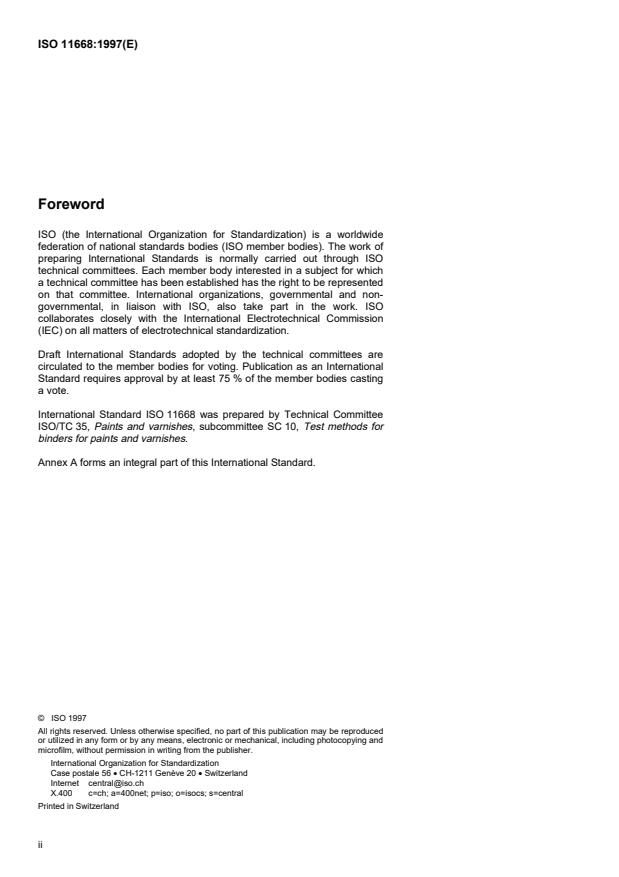
Foreword
ISO (the International Organization for Standardization) is a worldwide
federation of national standards bodies (ISO member bodies). The work of
preparing International Standards is normally carried out through ISO
technical committees. Each member body interested in a subject for which
a technical committee has been established has the right to be represented
on that committee. International organizations, governmental and non-
governmental, in liaison with ISO, also take part in the work. ISO
collaborates closely with the International Electrotechnical Commission
(IEC) on all matters of electrotechnical standardization.
Draft International Standards adopted by the technical committees are
circulated to the member bodies for voting. Publication as an International
Standard requires approval by at least 75 % of the member bodies casting
a vote.
International Standard ISO 11668 was prepared by Technical Committee
ISO/TC 35, Paints and varnishes, subcommittee SC 10, Test methods for
binders for paints and varnishes.
Annex A forms an integral part of this International Standard.
© ISO 1997
All rights reserved. Unless otherwise specified, no part of this publication may be reproduced
or utilized in any form or by any means, electronic or mechanical, including photocopying and
microfilm, without permission in writing from the publisher.
International Organization for Standardization
Case postale 56 • CH-1211 Genève 20 • Switzerland
Internet central@iso.ch
X.400 c=ch; a=400net; p=iso; o=isocs; s=central
Printed in Switzerland
ii
©
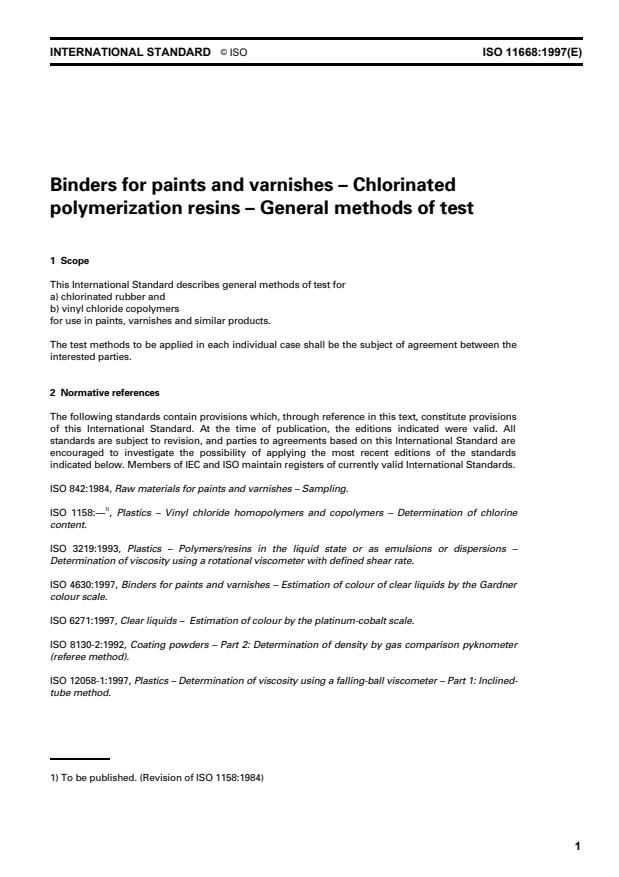
INTERNATIONAL STANDARD ISO ISO 11668:1997(E)
Binders for paints and varnishes – Chlorinated
polymerization resins – General methods of test
1 Scope
This International Standard describes general methods of test for
a) chlorinated rubber and
b) vinyl chloride copolymers
for use in paints, varnishes and similar products.
The test methods to be applied in each individual case shall be the subject of agreement between the
interested parties.
2 Normative references
The following standards contain provisions which, through reference in this text, constitute provisions
of this International Standard. At the time of publication, the editions indicated were valid. All
standards are subject to revision, and parties to agreements based on this International Standard are
encouraged to investigate the possibility of applying the most recent editions of the standards
indicated below. Members of IEC and ISO maintain registers of currently valid International Standards.
ISO 842:1984, Raw materials for paints and varnishes – Sampling.
1)
ISO 1158:— , Plastics – Vinyl chloride homopolymers and copolymers – Determination of chlorine
content.
ISO 3219:1993, Plastics – Polymers/resins in the liquid state or as emulsions or dispersions –
Determination of viscosity using a rotational viscometer with defined shear rate.
ISO 4630:1997, Binders for paints and varnishes – Estimation of colour of clear liquids by the Gardner
colour scale.
ISO 6271:1997, Clear liquids – Estimation of colour by the platinum-cobalt scale.
ISO 8130-2:1992, Coating powders – Part 2: Determination of density by gas comparison pyknometer
(referee method).
ISO 12058-1:1997, Plastics – Determination of viscosity using a falling-ball viscometer – Part 1: Inclined-
tube method.
1) To be published. (Revision of ISO 1158:1984)
©
ISO
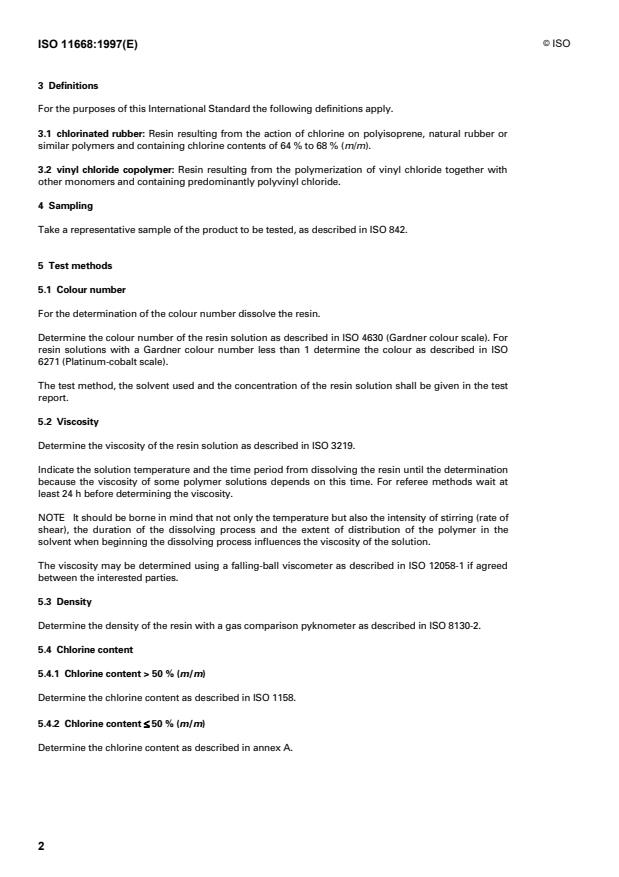
3 Definitions
For the purposes of this International Standard the following definitions apply.
3.1 chlorinated rubber: Resin resulting from the action of chlorine on polyisoprene, natural rubber or
similar polymers and containing chlorine contents of 64 % to 68 % (m/m).
3.2 vinyl chloride copolymer: Resin resulting from the polymerization of vinyl chloride together with
other monomers and containing predominantly polyvinyl chloride.
4 Sampling
Take a representative sample of the product to be tested, as described in ISO 842.
5 Test methods
5.1 Colour number
For the determination of the colour number dissolve the resin.
Determine the colour number of the resin solution as described in ISO 4630 (Gardner colour scale). For
resin solutions with a Gardner colour number less than 1 determine the colour as described in ISO
6271 (Platinum-cobalt scale).
The test method, the solvent used and the concentration of the resin solution shall be given in the test
report.
5.2 Viscosity
Determine the viscosity of the resin solution as described in ISO 3219.
Indicate the solution temperature and the time period from dissolving the resin until the determination
because the viscosity of some polymer solutions depends on this time. For referee methods wait at
least 24 h before determining the viscosity.
NOTE It should be
...
INTERNATIONAL ISO
STANDARD 11668
First edition
1997-11-15
Binders for paints and varnishes —
Chlorinated polymerization resins —
General methods of test
Liants pour peintures et vernis — Résines polymérisées chlorées —
Méthodes générales d'essai
A
Reference number
Foreword
ISO (the International Organization for Standardization) is a worldwide
federation of national standards bodies (ISO member bodies). The work of
preparing International Standards is normally carried out through ISO
technical committees. Each member body interested in a subject for which
a technical committee has been established has the right to be represented
on that committee. International organizations, governmental and non-
governmental, in liaison with ISO, also take part in the work. ISO
collaborates closely with the International Electrotechnical Commission
(IEC) on all matters of electrotechnical standardization.
Draft International Standards adopted by the technical committees are
circulated to the member bodies for voting. Publication as an International
Standard requires approval by at least 75 % of the member bodies casting
a vote.
International Standard ISO 11668 was prepared by Technical Committee
ISO/TC 35, Paints and varnishes, subcommittee SC 10, Test methods for
binders for paints and varnishes.
Annex A forms an integral part of this International Standard.
© ISO 1997
All rights reserved. Unless otherwise specified, no part of this publication may be reproduced
or utilized in any form or by any means, electronic or mechanical, including photocopying and
microfilm, without permission in writing from the publisher.
International Organization for Standardization
Case postale 56 • CH-1211 Genève 20 • Switzerland
Internet central@iso.ch
X.400 c=ch; a=400net; p=iso; o=isocs; s=central
Printed in Switzerland
ii
©
INTERNATIONAL STANDARD ISO ISO 11668:1997(E)
Binders for paints and varnishes – Chlorinated
polymerization resins – General methods of test
1 Scope
This International Standard describes general methods of test for
a) chlorinated rubber and
b) vinyl chloride copolymers
for use in paints, varnishes and similar products.
The test methods to be applied in each individual case shall be the subject of agreement between the
interested parties.
2 Normative references
The following standards contain provisions which, through reference in this text, constitute provisions
of this International Standard. At the time of publication, the editions indicated were valid. All
standards are subject to revision, and parties to agreements based on this International Standard are
encouraged to investigate the possibility of applying the most recent editions of the standards
indicated below. Members of IEC and ISO maintain registers of currently valid International Standards.
ISO 842:1984, Raw materials for paints and varnishes – Sampling.
1)
ISO 1158:— , Plastics – Vinyl chloride homopolymers and copolymers – Determination of chlorine
content.
ISO 3219:1993, Plastics – Polymers/resins in the liquid state or as emulsions or dispersions –
Determination of viscosity using a rotational viscometer with defined shear rate.
ISO 4630:1997, Binders for paints and varnishes – Estimation of colour of clear liquids by the Gardner
colour scale.
ISO 6271:1997, Clear liquids – Estimation of colour by the platinum-cobalt scale.
ISO 8130-2:1992, Coating powders – Part 2: Determination of density by gas comparison pyknometer
(referee method).
ISO 12058-1:1997, Plastics – Determination of viscosity using a falling-ball viscometer – Part 1: Inclined-
tube method.
1) To be published. (Revision of ISO 1158:1984)
©
ISO
3 Definitions
For the purposes of this International Standard the following definitions apply.
3.1 chlorinated rubber: Resin resulting from the action of chlorine on polyisoprene, natural rubber or
similar polymers and containing chlorine contents of 64 % to 68 % (m/m).
3.2 vinyl chloride copolymer: Resin resulting from the polymerization of vinyl chloride together with
other monomers and containing predominantly polyvinyl chloride.
4 Sampling
Take a representative sample of the product to be tested, as described in ISO 842.
5 Test methods
5.1 Colour number
For the determination of the colour number dissolve the resin.
Determine the colour number of the resin solution as described in ISO 4630 (Gardner colour scale). For
resin solutions with a Gardner colour number less than 1 determine the colour as described in ISO
6271 (Platinum-cobalt scale).
The test method, the solvent used and the concentration of the resin solution shall be given in the test
report.
5.2 Viscosity
Determine the viscosity of the resin solution as described in ISO 3219.
Indicate the solution temperature and the time period from dissolving the resin until the determination
because the viscosity of some polymer solutions depends on this time. For referee methods wait at
least 24 h before determining the viscosity.
NOTE It should be borne in mind that not only the temperature but also the intensity of stirring (rate of
shear), the duration of the dissolving process and the extent of distribution of the polymer in the
solvent when beginning the dissolving process influences the viscosity of the solution.
The viscosity may be determined using a falling-ball viscometer as described in ISO 12058-1 if agreed
between the interested parties.
5.3 Density
Determine the density of the resin with a gas comparison pyknometer as
...
NORME ISO
INTERNATIONALE 11668
Première édition
1997-11-15
Liants pour peintures et vernis — Résines
polymérisées chlorées — Méthodes
générales d'essai
Binders for paints and varnishes — Chlorinated polymerization resins —
General methods of test
A
Numéro de référence
Avant-propos
L'ISO (Organisation internationale de normalisation) est une fédération
mondiale d'organismes nationaux de normalisation (comités membres de
l'ISO). L'élaboration des Normes internationales est en général confiée aux
comités techniques de l'ISO. Chaque comité membre intéressé par une
étude a le droit de faire partie du comité technique créé à cet effet. Les
organisations internationales, gouvernementales et non gouvernementales,
en liaison avec l'ISO participent également aux travaux. L'ISO collabore
étroitement avec la Commission électrotechnique internationale (CEI) en
ce qui concerne la normalisation électrotechnique.
Les projets de Normes internationales adoptés par les comités techniques
sont soumis aux comités membres pour vote. Leur publication comme
Normes internationales requiert l'approbation de 75 % au moins des
comités membres votants.
La Norme internationale ISO 11668 a été élaborée par le comité technique
ISO/TC 35, Peintures et vernis, sous-comité SC 10, Méthodes d'essai des
liants pour peintures et vernis.
L'annexe A fait partie intégrante de la présente Norme internationale.
© ISO 1997
Droits de reproduction réservés. Sauf prescription différente, aucune partie de cette publi-
cation ne peut être reproduite ni utilisée sous quelque forme que ce soit et par aucun pro-
cédé, électronique ou mécanique, y compris la photocopie et les microfilms, sans l'accord
écrit de l'éditeur.
Organisation internationale de normalisation
Case postale 56 • CH-1211 Genève 20 • Suisse
Internet central@iso.ch
X.400 c=ch; a=400net; p=iso; o=isocs; s=central
Imprimé en Suisse
ii
©
NORME INTERNATIONALE ISO ISO 11668:1997(F)
Liants pour peintures et vernis — Résines polymérisées
chlorées — Méthodes générales d'essai
1 Domaine d'application
La présente Norme internationale prescrit des méthodes générales d'essais pour
a) les caoutchoucs chlorés, et
b) les copolymères de chlorure de vinyle
pour emploi dans les peintures, vernis et produits assimilés.
Les méthodes d'essai à appliquer dans chaque cas individuel doivent faire l'objet d'un accord
entre les parties intéressées.
2 Références normatives
Les normes suivantes contiennent des dispositions qui, par suite de la référence qui en est faite,
constituent des dispositions valables pour la présente Norme internationale. Au moment de la
publication, les éditions indiquées étaient en vigueur. Toute norme est sujette à révision et les
parties prenantes des accords fondés sur la présente Norme internationale sont invitées à
rechercher la possibilité d'appliquer les éditions les plus récentes des normes indiquées ci-après.
Les membres de la CEI et de l'ISO possèdent le registre des Normes internationales en vigueur à
un moment donné.
ISO 842:1984, Matières premières pour peintures et vernis – Échantillonnage.
1)
ISO 1158:— , Plastiques – Homopolymères et copolymères de chlorure de vinyle – Détermination
de la teneur en chlore.
ISO 3219:1993, Plastiques – Polymères/résines à l'état liquide, en émulsion ou en dispersion –
Détermination de la viscosité au moyen d'un viscosimètre rotatif à gradient de vitesse de
cisaillement défini.
Liants pour peintures et vernis – Estimation de la couleur des liquides non
ISO 4630:1997,
opaques à l'aide de l'échelle de couleur Gardner.
Liquides clairs – Évaluation de la couleur au moyen de l'échelle
ISO 6271:1997,
platine-cobalt.
ISO 8130-2:1992, Poudres pour revêtement – Partie 2: Détermination de la masse volumique à
l'aide d'un pycnomètre à gaz (méthode de référence).
ISO 12058-1:1997, Plastiques – Détermination de la viscosité au moyen d'un viscosimètre à chute
de bille – Partie 1: Méthode du plan incliné.
1)
À publier. (Révision de l’ISO 1158:1984)
©
3 Définitions
Pour les besoins de la présente Norme internationale, les définitions suivantes s'appliquent:
3.1 caoutchouc chloré: Résine résultant de l'action du chlore sur le polyisoprène, le
caoutchouc naturel ou des polymères similaires et contenant des teneurs en chlore comprises
entre 64 % (m/m) et 68 % (m/m).
3.2 copolymère de chlorure de vinyle: Résine résultant de la polymérisation du chlorure de
vinyle avec d'autres monomères et contenant principalement du chlorure de polyvinyle.
4 Échantillonnage
Prélever un échantillon représentatif du produit à essayer, selon l'ISO 842.
5 Méthodes d'essai
5.1 Indice de couleur
Pour la détermination de l'indice de couleur, dissoudre la résine.
Déterminer l'indice de couleur de la solution selon l'ISO 4630 (échelle de couleur Gardner). Pour
des solutions de résines avec un indice de couleur Gardner inférieur à 1, déterminer la couleur
selon l'ISO 6271 (échelle platine-cobalt).
La méthode d'essai, le solvant utilisé et la concentration de la solution de résine doivent être
indiqués dans le rapport d'essai.
5.2 Viscosité
Déterminer la viscosité de la solution de résine selon l'ISO 3219.
Indiquer la température de la solution et la durée depuis la dissolution de la résine jusqu'à la
détermination, parce que la viscosité de certaines solutions de polymère dépend de cette durée.
Pour des méthodes de référence, attendre au moins 24 h avant de déterminer la viscosité.
NOTE – Il faut garder à l’esprit le fait que non seulement la température mais également la
force d'agitation (taux de cisaillement), la durée du procédé de dissolution et l’étendue de la
répartition du polymère dans le solvant lors du début du procédé de dissolution influent sur
la viscosité de la solution.
La viscosité peut être déterminée à l'aide du viscosimètre à chute de bille, comme décrit dans
l'ISO 12058:1, après accord entre les parties intéressées.
5.3 Masse volumique
Déterminer la masse volumique de la résine avec un pycnomètre de comparaison
...