


ISO/TR 15801:2004
(Main)Electronic imaging — Information stored electronically — Recommendations for trustworthiness and reliability
Electronic imaging — Information stored electronically — Recommendations for trustworthiness and reliability
ISO 15801:2004 describes the implementation and operation of information management systems which store information electronically and where the issues of trustworthiness, reliability, authenticity and integrity are important. The whole life cycle of a stored electronic document is covered, from initial capture to eventual destruction. ISO 15801:2004 is for use with any information management system, including traditional document imaging, workflow and COLD/ERM technologies, and using any type of electronic storage medium including WORM and rewritable technologies. ISO 15801:2004 does not cover processes used to evaluate the authenticity of information prior to it being stored or imported into the system. However, it can be used to demonstrate that output from the system is a true reproduction of the original document.
Images électroniques — Stockage électronique d'informations — Recommandations pour les informations de valeur et leur fiabilité
General Information
- Status
- Withdrawn
- Publication Date
- 15-Jan-2004
- Withdrawal Date
- 15-Jan-2004
- Technical Committee
- ISO/TC 171 - Document management applications
- Drafting Committee
- ISO/TC 171 - Document management applications
- Current Stage
- 9599 - Withdrawal of International Standard
- Start Date
- 09-Oct-2009
- Completion Date
- 14-Feb-2026
Relations
- Effective Date
- 28-Feb-2009
Frequently Asked Questions
ISO/TR 15801:2004 is a technical report published by the International Organization for Standardization (ISO). Its full title is "Electronic imaging — Information stored electronically — Recommendations for trustworthiness and reliability". This standard covers: ISO 15801:2004 describes the implementation and operation of information management systems which store information electronically and where the issues of trustworthiness, reliability, authenticity and integrity are important. The whole life cycle of a stored electronic document is covered, from initial capture to eventual destruction. ISO 15801:2004 is for use with any information management system, including traditional document imaging, workflow and COLD/ERM technologies, and using any type of electronic storage medium including WORM and rewritable technologies. ISO 15801:2004 does not cover processes used to evaluate the authenticity of information prior to it being stored or imported into the system. However, it can be used to demonstrate that output from the system is a true reproduction of the original document.
ISO 15801:2004 describes the implementation and operation of information management systems which store information electronically and where the issues of trustworthiness, reliability, authenticity and integrity are important. The whole life cycle of a stored electronic document is covered, from initial capture to eventual destruction. ISO 15801:2004 is for use with any information management system, including traditional document imaging, workflow and COLD/ERM technologies, and using any type of electronic storage medium including WORM and rewritable technologies. ISO 15801:2004 does not cover processes used to evaluate the authenticity of information prior to it being stored or imported into the system. However, it can be used to demonstrate that output from the system is a true reproduction of the original document.
ISO/TR 15801:2004 is classified under the following ICS (International Classification for Standards) categories: 37.080 - Document imaging applications. The ICS classification helps identify the subject area and facilitates finding related standards.
ISO/TR 15801:2004 has the following relationships with other standards: It is inter standard links to ISO/TR 15801:2009. Understanding these relationships helps ensure you are using the most current and applicable version of the standard.
ISO/TR 15801:2004 is available in PDF format for immediate download after purchase. The document can be added to your cart and obtained through the secure checkout process. Digital delivery ensures instant access to the complete standard document.
Standards Content (Sample)
TECHNICAL ISO/TR
REPORT 15801
First edition
2004-02-01
Electronic imaging — Information stored
electronically — Recommendations for
trustworthiness and reliability
Images électroniques — Stockage électronique d'informations —
Recommandations pour les informations de valeur et leur fiabilité
Reference number
©
ISO 2004
PDF disclaimer
This PDF file may contain embedded typefaces. In accordance with Adobe's licensing policy, this file may be printed or viewed but
shall not be edited unless the typefaces which are embedded are licensed to and installed on the computer performing the editing. In
downloading this file, parties accept therein the responsibility of not infringing Adobe's licensing policy. The ISO Central Secretariat
accepts no liability in this area.
Adobe is a trademark of Adobe Systems Incorporated.
Details of the software products used to create this PDF file can be found in the General Info relative to the file; the PDF-creation
parameters were optimized for printing. Every care has been taken to ensure that the file is suitable for use by ISO member bodies. In
the unlikely event that a problem relating to it is found, please inform the Central Secretariat at the address given below.
© ISO 2004
All rights reserved. Unless otherwise specified, no part of this publication may be reproduced or utilized in any form or by any means,
electronic or mechanical, including photocopying and microfilm, without permission in writing from either ISO at the address below or
ISO's member body in the country of the requester.
ISO copyright office
Case postale 56 • CH-1211 Geneva 20
Tel. + 41 22 749 01 11
Fax + 41 22 749 09 47
E-mail copyright@iso.org
Web www.iso.org
Published in Switzerland
ii © ISO 2004 – All rights reserved
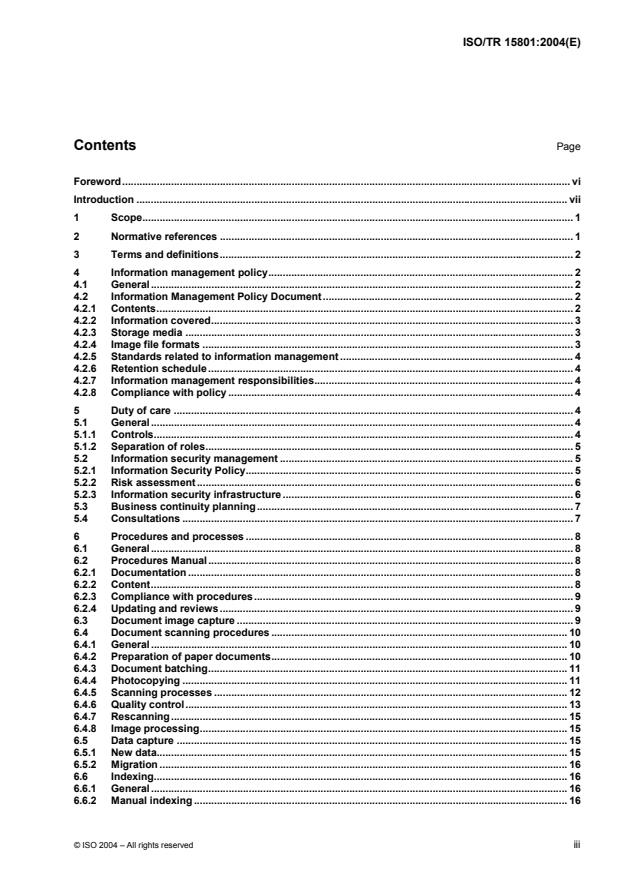
Contents Page
Foreword. vi
Introduction . vii
1 Scope. 1
2 Normative references. 1
3 Terms and definitions. 2
4 Information management policy. 2
4.1 General. 2
4.2 Information Management Policy Document. 2
4.2.1 Contents. 2
4.2.2 Information covered. 3
4.2.3 Storage media. 3
4.2.4 Image file formats . 3
4.2.5 Standards related to information management . 4
4.2.6 Retention schedule. 4
4.2.7 Information management responsibilities. 4
4.2.8 Compliance with policy . 4
5 Duty of care. 4
5.1 General. 4
5.1.1 Controls. 4
5.1.2 Separation of roles. 5
5.2 Information security management . 5
5.2.1 Information Security Policy. 5
5.2.2 Risk assessment. 6
5.2.3 Information security infrastructure . 6
5.3 Business continuity planning. 7
5.4 Consultations. 7
6 Procedures and processes . 8
6.1 General. 8
6.2 Procedures Manual. 8
6.2.1 Documentation. 8
6.2.2 Content. 8
6.2.3 Compliance with procedures. 9
6.2.4 Updating and reviews. 9
6.3 Document image capture . 9
6.4 Document scanning procedures . 10
6.4.1 General. 10
6.4.2 Preparation of paper documents. 10
6.4.3 Document batching. 11
6.4.4 Photocopying. 11
6.4.5 Scanning processes. 12
6.4.6 Quality control. 13
6.4.7 Rescanning. 15
6.4.8 Image processing. 15
6.5 Data capture. 15
6.5.1 New data. 15
6.5.2 Migration. 16
6.6 Indexing. 16
6.6.1 General. 16
6.6.2 Manual indexing. 16
6.6.3 Automatic indexing.16
6.6.4 Index storage.16
6.6.5 Index amendments.17
6.6.6 Index accuracy.17
6.7 Authenticated output procedures.17
6.8 File transmission.18
6.8.1 Intra-system data file transfer .18
6.8.2 External transmission of files .18
6.9 Document retention.19
6.10 Information destruction.20
6.11 Backup and system recovery.20
6.12 System maintenance.21
6.12.1 General.21
6.12.2 Scanning systems.21
6.13 Security and protection .21
6.13.1 Security procedures.21
6.13.2 Encryption keys and digital signatures .22
6.14 Use of contracted services.22
6.14.1 General.22
6.14.2 Procedural considerations.23
6.14.3 Transportation of documents .24
6.14.4 Use of trusted remote archives.24
6.15 Workflow.24
6.16 Date and time stamps .25
6.17 Version control.25
6.17.1 Information.25
6.17.2 Documentation.25
6.17.3 Procedures and processes .26
6.18 Maintenance of documentation .26
7 Enabling technologies.26
7.1 General.26
7.2 System Description Manual .27
7.3 Storage media and sub-system considerations .27
7.4 Access levels.28
7.5 System integrity checks .28
7.5.1 General.28
7.5.2 Digital and electronic signatures (including biometric signatures).29
7.6 Image processing.29
7.7 Compression techniques.30
7.8 Form overlays and form removal.31
7.9 Environmental considerations.31
7.10 Migration.32
7.11 Information deletion and/or expungement .32
8 Audit trails.32
8.1 General.32
8.1.1 Audit trail data .32
8.1.2 Creation.33
8.1.3 Date and time .33
8.1.4 Storage.34
8.1.5 Access.34
8.1.6 Security and protection .34
8.2 System.35
8.2.1 General.35
8.2.2 Audit trail information.35
8.2.3 Migration and conversion.35
8.3 Stored information.35
8.3.1 General.35
8.3.2 Information capture.36
8.3.3 Batch information.37
iv © ISO 2004 – All rights reserved
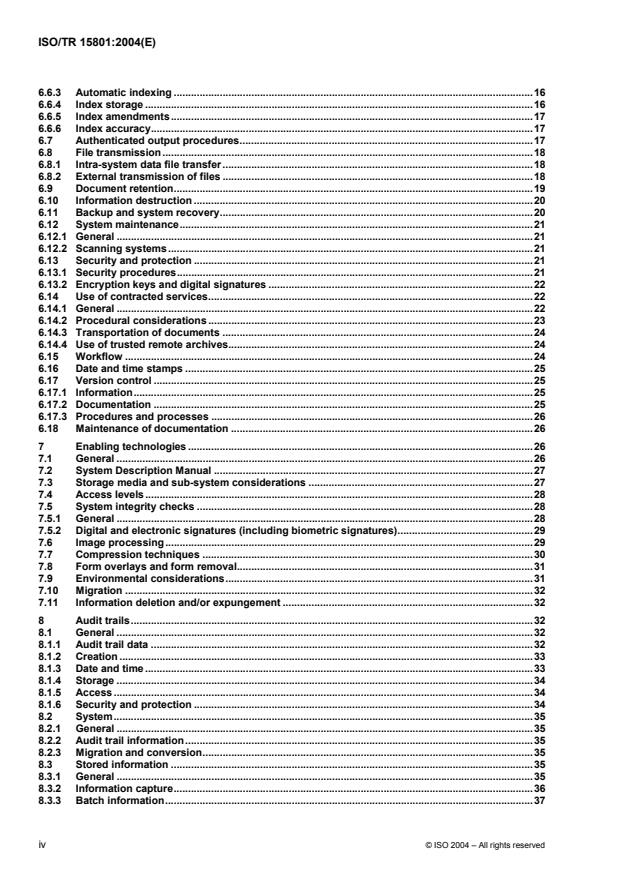
8.3.4 Indexing. 37
8.3.5 Change control. 38
8.3.6 Digital signatures. 38
8.3.7 Destruction of information. 38
8.3.8 Workflow. 38
Bibliography . 39
Foreword
ISO (the International Organization for Standardization) is a worldwide federation of national standards bodies
(ISO member bodies). The work of preparing International Standards is normally carried out through ISO
technical committees. Each member body interested in a subject for which a technical committee has been
established has the right to be represented on that committee. International organizations, governmental and
non-governmental, in liaison with ISO, also take part in the work. ISO collaborates closely with the
International Electrotechnical Commission (IEC) on all matters of electrotechnical standardization.
International Standards are drafted in accordance with the rules given in the ISO/IEC Directives, Part 2.
The main task of technical committees is to prepare International Standards. Draft International Standards
adopted by the technical committees are circulated to the member bodies for voting. Publication as an
International Standard requires approval by at least 75 % of the member bodies casting a vote.
In exceptional circumstances, when a technical committee has collected data of a different kind from that
which is normally published as an International Standard (“state of the art”, for example), it may decide by a
simple majority vote of its participating members to publish a Technical Report. A Technical Report is entirely
informative in nature and does not have to be reviewed until the data it provides are considered to be no
longer valid or useful.
Attention is drawn to the possibility that some of the elements of this document may be the subject of patent
rights. ISO shall not be held responsible for identifying any or all such patent rights.
ISO/TR 15801 was prepared by Technical Committee ISO/TC 171, Document management applications,
Subcommittee SC 3, General issues.
vi © ISO 2004 – All rights reserved
Introduction
Increasingly, information that has been created, captured and stored electronically is used as evidence of
business activities. Such evidence might be required in contract discussions, or in courts of law. This
Technical Report defines recommended practices for electronic storage of business or other information in
image form. As such, complying with its recommendations is of value to organizations even when the
trustworthiness of the stored information is not being challenged.
Users of this Technical Report should be aware that the implementation of these recommendations does not
automatically ensure acceptability of the evidence encapsulated by the information. Where stored electronic
information may be required in court, implementers of this Technical Report are advised to seek legal advice
to ascertain the precise situation within their relevant legal environment.
This Technical Report describes means by which it may be demonstrated, at any time, that the contents of a
specific electronic image file created or existing within a computer system have not changed since it was
created within the system or imported into it. Where such a data file contains a digitized image of a physical
source document, it will be possible to demonstrate that the digitized image is a true facsimile of that source
document. The issue being addressed is essentially one of authentication.
Other versions of the information may legitimately develop; e.g. revision of a contract. In these cases the new
versions are treated as new image files.
The same principle can be applied when a significant change is made to a document in a workflow
environment.
This Technical Report describes procedures whereby an electronic copy may be demonstrated to be a true
copy of the original, whether that original was itself an electronic data file or a physical source document.
The recommendations in this Technical Report are a mixture of items that are broad and general and items
that are specific and detailed. Readers are advised to use this Technical Report in conjunction with other local
sources, particularly with relevance to governmental and legal requirements in their respective jurisdictions.
Organizations that implement most of the recommendations described in this Technical Report will be in a
good position to be able to demonstrate authenticity. However, there may be good economic reasons where a
particular recommendation is not implemented. In such situations, the risk taken by such non-implementation
decisions should be assessed.
TECHNICAL REPORT ISO/TR 15801:2004(E)
Electronic imaging — Information stored electronically —
Recommendations for trustworthiness and reliability
1 Scope
This Technical Report describes the implementation and operation of information management systems which
store information electronically and where the issues of trustworthiness, reliability, authenticity and integrity
are important. The whole life cycle of a stored electronic document is covered, from initial capture to eventual
destruction.
This Technical Report is for use with any information management system, including traditional document
imaging, workflow and COLD/ERM technologies, and using any type of electronic storage medium including
WORM and rewritable technologies.
Image files may potentially contain any type of data: for example, correspondence, forms, drawings. This
Technical Report covers all such image files, whether created and/or imported directly or through a network,
from the time at which the system assumes control of the image file.
This Technical Report does not cover processes used to evaluate the authenticity of information prior to it
being stored or imported into the system. However, it can be used to demonstrate that output from the system
is a true reproduction of the original document.
Where in this document the term system is used, it should be taken as meaning the information management
system that is being reviewed, unless otherwise stated.
2 Normative references
The following referenced documents are indispensable for the application of this document. For dated
references, only the edition cited applies. For undated references, the latest edition of the referenced
document (including any amendments) applies.
ISO 9000 (all parts), Quality management and quality assurance standards
ISO/TR 12037:1998, Electronic imaging — Recommendations for the expungement of information recorded
on write-once optical media
ISO 12651:1999, Electronic imaging — Vocabulary
ISO 12653-2:2000, Electronic imaging — Test target for the black-and-white scanning of office documents —
Part 2: Method of use
3 Terms and definitions
For the purposes of this document, the terms and definitions given in ISO 12651 and the following apply.
3.1
information type
groups of related documents
NOTE In specific applications, “groups” may be identified as “sets”, “files”, “collections” or other similar terms.
EXAMPLES Invoices, financial document, data sheets, correspondence.
4 Information management policy
4.1 General
Information is one of the most important assets that any organization has at its disposal. Everything an
organization does involves using information in some way. The quantity of information can be vast, and there
are many different ways of representing and storing it. The value of information used and the manner in which
it is applied and moved within and between organizations may determine the success or failure of those
organizations.
Information, like any other asset, needs to be classified, structured, validated, valued, secured, monitored,
measured and managed efficiently and effectively.
This clause describes documentation that states the organization’s information management policy.
Availability of this documentation will demonstrate that information management is part of normal business
procedures.
Where a system stores records, compliance with ISO 15489 should be considered. Such compliance will
ensure that many of the elements of this Technical Report will be implemented. Where a system stores
information that may be used as evidence in court, your legal advisors should be consulted (see 5.4) to
ensure that you comply with relevant legal or regulatory requirements. As legal and regulatory requirements
vary from country to country (and sometimes within a country), the legal advice you obtain should cover all
relevant jurisdictions.
4.2 Information Management Policy Document
4.2.1 Contents
An Information Management Policy Document (the Policy Document) should be produced, documenting the
organization’s policy on information management and storage, as applicable to the information management
system.
The Policy Document should contain sections which:
specify what information is covered (see 4.2.2);
state policy regarding storage media (see 4.2.3);
state policy regarding image file formats and version control (see 4.2.4);
state policy regarding relevant information management standards (see 4.2.5);
define retention and destruction policies (see 4.2.6);
define responsibilities for information management functions (see 4.2.7);
define responsibilities for monitoring compliance with this policy (see 4.2.8).
2 © ISO 2004 – All rights reserved
The Policy Document should be approved by senior management of the organization, and should be reviewed
at regular intervals.
Essential to this Technical Report is the agreement and implementation of a Retention Schedule for stored
information. Where reference is made to the Policy Document in the rest of this Technical Report, the
Retention Schedule is included in such a reference.
4.2.2 Information covered
In order to define the organization’s information management policy, information should be grouped into types,
the policy for all information within a type being consistent. For example information types may be specified
either by reference to application (e.g. financial projections, invoices, customer address list), or to generic
group (e.g. accounting data, customer documents, manufacturing documents).
During the drafting of the Policy Document, specific information may need to be moved from one type to
another to ensure consistency of Policy within an information type.
The Policy Document should list all types of information which are to be stored. The Policy Document should
include as an information type all documents produced in compliance with the Policy.
4.2.3 Storage media
Different types of media have different long-term storage characteristics. Most organizations will store
information on a variety of media types: paper; microform; electronic (write-once and rewritable/erasable). In
some applications, specific pieces of information may, throughout its retention period, be stored on different
media types at different times.
The organization should have policies regarding the use of specific types of media for different information
storage requirements (e.g. access requirements, retention periods, and security requirements). These policies
should be detailed in the Policy Document.
NOTE In some countries, only certain media types can be used where stored information may be required as
evidence. For example, in France, rewritable media cannot be used in evidential matters.
The media type on which each information type (see 4.2.2) may be stored should be specified.
It should be possible, where copies of image files exist, to be able to trace back to the earliest such files, in
order to be able to determine that no changes have occurred to any purported copy. Note that, in the case of
files that exist in different versions, each version should be treated as a new source or original file for the
purposes of this Technical Report.
The policy for tracking copies of image files should be detailed in the Policy Document.
4.2.4 Image file formats
The Policy Document should contain details of the approved image file formats that may be used for each
information type.
All information stored on a computer system requires software for retrieval and display. This software is
subject to change, either by the implementation of new releases, or by changes to operating systems and/or
hardware. By implementing a policy of approved storage formats, the necessary data migration or alternative
procedures can be implemented satisfactorily to ensure long-term retrieval of the stored information.
Where compression techniques are available, policy on their use should be documented.
Where multiple versions of a document may be stored, a policy is required which ensures that all relevant
versions are stored, and their relationship maintained. The Policy Document should contain details of policy
on the storage of versions of documents.
For additional information on this, see 6.5.2, 7.10, and 8.2.3.
4.2.5 Standards related to information management
Where the organization operates a quality management system (such as the ISO 9000 series), whose scope
includes part or all of the information management system, then all relevant procedural documentation should
be included in the quality system.
Where National or International regulatory requirements are mandatory, or where National or International
Standards are applicable, they should be complied with.
4.2.6 Retention schedule
A Retention Schedule should be established for each information type.
Retention periods should be agreed by all relevant departments and personnel within the organization.
Retention periods should be agreed upon after taking relevant advice to ensure that legal or regulatory issues,
or both, are resolved.
All relevant system and procedural documentation that is produced should be covered by the Retention
Schedule.
The Retention Schedule should include the organization’s policy for its periodic review.
The Retention Schedule should include the organization’s policy for the controlled destruction of information.
4.2.7 Information management responsibilities
Individual or job function responsibilities for the Policy Document should be defined in the Policy Document.
Individual or job function responsibilities for each information type should be identified and included in the
Policy Document.
Individual or job function responsibilities should include the need to seek relevant advice when creating or
updating the contents of the Policy Document.
4.2.8 Compliance with policy
Where it is important that compliance with the Policy Document can be demonstrated, the individual or job
function responsibilities for obtaining and maintaining such compliance should be identified and defined.
5 Duty of care
5.1 General
5.1.1 Controls
It is essential that the organization is aware of the value of information that it stores, and executes its
responsibility under the duty of care principle.
To fulfil this objective, the organization needs to:
establish a chain of accountability and assign responsibility for activities involving management of
electronic information at all levels;
be aware of legislative and regulatory bodies pertinent to its business;
4 © ISO 2004 – All rights reserved
keep abreast of technical, procedural, regulatory and legislative developments by maintaining contact
with the appropriate bodies and organizations;
implement an Information Security Policy.
5.1.2 Separation of roles
The separation of roles is a fundamental aspect of duty of care. It provides a check on errors and on the
deliberate falsification of records (in this respect separation of roles is particularly important in systems where
there is risk of fraud or other malicious action).
There are several aspects of information management where a separation of roles is considered:
input reconciliation (see 6.4.3);
quality control (see 6.4.6);
data entry (see 6.6.2);
information deletion (see 6.9);
information security (see 5.2).
It is also important to ensure that the physical and managerial separations that exist around a system are
mirrored by the logical access controls within it.
The separation of roles between initial operations and checking should be reviewed and implemented where
appropriate.
5.2 Information security management
5.2.1 Information Security Policy
All information, irrespective of the media on which it is stored, is vulnerable to loss or change, whether
accidental or malicious. To protect information stored electronically, security measures need to be developed
and implemented to reduce the risk of a successful challenge to its authenticity. These security measures
need to be aligned to any information classification categories that are used.
Traditionally, information security is considered a matter of confidentiality, to ensure that information is not
accessible outside the requirements of the organization. However, whilst this is important (in some cases vital)
to the operation of the organization, it is not the most important security issue relevant to this Technical Report.
A key objective of the Information Security Policy is to ensure the protection of the integrity of stored
information. When developing security measures, it is necessary to compare the risk of integrity being
compromised with the cost of implementation of such measures. Security measures need to include backup
and other copies of stored information, as their integrity is of importance in circumstances where they have
been used as replacements for live data.
Also of importance is availability. In some cases, it may be necessary to be able to demonstrate that all
information on a specific topic is available for review at any time. In this category, topics such as indexing
accuracy and business continuity planning are key.
Security is not singularly a concern of computer systems. Security and availability of the operating
environment (including buildings, temperature controls, network links, etc) and the auditable implementation of
procedures by all staff are both key elements.
The organization should adopt an Information Security Policy, covering all elements of the information
management system.
Where the organization has an Information Security Policy for other systems, then the use of the information
management system should be incorporated within its scope.
The Information Security Policy Document should contain, as a minimum:
scope of policy;
statement of management objectives in respect of security;
specific policy statements;
requirements for different information classification categories;
definition and allocation of information security responsibilities;
policy for dealing with breaches of security;
policy regarding compliance with relevant standards.
The Information Security Policy Document should be approved by the organization’s senior management.
That approval should be documented.
The organization should agree and document appropriate levels of security for managing its information, in
compliance with its Information Security Policy Document.
5.2.2 Risk assessment
Security measures are often developed using an ad hoc approach, reacting to security incidents or to
available computer software tools. Such procedures frequently leave gaps in security, which are only filled at
some later date. A more structured approach is to review the information assets of the organization, and
assign risk factors (based on asset value, system vulnerability and likelihood of attack). An Information
Security Policy can then be produced and approved, against which security measures can be audited.
The organization should undertake an information security risk analysis, and document the results obtained.
Of particular importance are the security measures implemented to control the information storage media,
both the live media and the backup media. The risk analysis needs to include vulnerability risk factors
consistent with the type of media being used (e.g. WORM or rewritable).
Where different types of storage media are used, their impact on the risk analysis results should be reviewed.
Once the risk analysis has been completed, it needs to be acted upon as part of a review of implemented
security measures. Factors such as the balance between the cost of implementation, security achieved and
risk evaluation need to be taken into consideration during the review process.
Based on the results of the risk analysis, existing security measures should be reviewed for effectiveness.
Where the review indicates that changes to security procedures are appropriate, the changes should be
implemented.
5.2.3 Information security infrastructure
A management framework should be established to initiate and control the implementation of information
security within the organization. The framework should have as its objectives:
approval and review of the Information Security Policy;
monitoring of threats to information security;
6 © ISO 2004 – All rights reserved
monitoring and review of security breaches;
approval of major initiatives to enhance information security.
5.3 Business continuity planning
From time to time, problems arise with information management systems that require emergency procedures
to be implemented, to recover from the problem. Such procedures may involve the temporary use of additional
or third-party resources. In order to ensure that the integrity of information is not compromised during these
operations, an agreed and approved Business Continuity Plan (sometimes known as a Disaster Recovery
Plan) may be implemented.
Procedures to be used in cases of major equipment, environmental or personnel failure should be developed,
tested and maintained. Such procedures should ensure that the integrity of stored information is not
compromised during their implementation.
5.4 Consultations
The implications of using electronic information management systems may be significant to other
organizations, such as:
regulatory bodies;
government bodies;
external audit bodies;
legal advisors (such as the organization's lawyers).
The organization should determine the levels to which consultations should be made.
These levels may include the following:
national and international law;
industry sector;
community;
organization;
department;
individual.
The organization should consult with relevant organizations prior to implementing the Information
Management Policy Document.
These consultations may include the following topics:
legal issues;
government regulations;
financial regulations (such as payment of taxes);
special regulations (applicable to particular sectors).
The results of all consultations, including actions agreed, planned or implemented, should be referenced or
included in the Policy Document.
Where appropriate regulations and/or laws exist, they should be complied with.
The Policy Document should state whether all or part of any relevant national or international standards
should be complied with.
Where the organization complies with relevant national or international standards, such compliance should
include the information management system.
6 Procedures and processes
6.1 General
This clause deals with the operating procedures that the organization needs to review and, where appropriate,
implement. It refers to a single information management system. Where the organization has multiple
information management systems, procedures related to each such system can be produced separately or in
combination.
6.2 Procedures Manual
6.2.1 Documentation
The organization should maintain a Procedures Manual for each information management system, describing
all procedures related to the operation and use of the system, including input to, operation of and output from
the system.
Where in this section documentation is required, this documentation can either be included in the Procedures
Manual, or referenced by it. This Manual may include references to other controlled documentation as
appropriate.
The relevant procedures detailed in, or referenced by, the Procedures Manual should be readily accessible to
all appropriate users of the system.
6.2.2 Content
The Procedures Manual should
...
Questions, Comments and Discussion
Ask us and Technical Secretary will try to provide an answer. You can facilitate discussion about the standard in here.
Loading comments...