

ISO/IEC/IEEE 8802-1AC:2018/Amd 1:2023
(Amendment)Information technology — Telecommunications and information exchange between systems — Local and metropolitan area networks — Part 1AC: Media access control (MAC) service definition — Amendment 1: Support for ISO/IEC/IEEE 8802-15-3
General Information
- Abstract
- Status
- Published
- Publication Date
- 30-Mar-2023
- Current Stage
- 6060 - International Standard published
- Start Date
- 31-Mar-2023
- Due Date
- 11-Apr-2024
- Completion Date
- 31-Mar-2023
Buy Documents


ISO/IEC/IEEE 8802-1AC:2018/Amd 1:2023 - Information technology — Telecommunications and information exchange between systems — Local and metropolitan area networks — Part 1AC: Media access control (MAC) service definition — Amendment 1: Support for ISO/IEC/IEEE 8802-15-3 Released:3/31/2023
Overview
ISO/IEC/IEEE 8802-1AC:2018/Amd 1:2023 is an important amendment to the international standard specifying the Media Access Control (MAC) service definition for local and metropolitan area networks. This amendment introduces support for the ISO/IEC/IEEE 8802-15-3 standard, which is focused on wireless personal area networks (WPANs) under IEEE 802.15.3. It enhances interoperability and service definition consistency in network communications by integrating the Internal Sublayer Service specific to IEEE 802.15.3 MAC entities.
Developed collaboratively by ISO, IEC, and IEEE, this standard ensures that equipment and systems within telecommunications and IT environments meet rigorous requirements for MAC services-especially within diverse network types such as wireless and multimedia communication.
Key Topics
Media Access Control (MAC) Service Definition: Establishes the framework and protocols for accessing transmission media at the MAC sublayer, critical for managing data flow and collision avoidance in network systems.
IEEE 802.15.3 Support: Adds mechanisms to accommodate IEEE 802.15.3 WPAN standards, facilitating wireless multimedia and ad-hoc network integration.
Internal Sublayer Service Definition: Specifies the interaction and service functionality between MAC sublayers in IEEE 802.15.3 entities for improved system interoperability.
Network Interoperability: Focused on seamless exchange of data within local and metropolitan area networks through standardized MAC control protocols.
Wireless and Multimedia Applications: Addresses the specific requirements for multi-media data transmission over wireless networks, enabling efficient handling of diverse data types.
Applications
Wireless Personal Area Networks (WPANs): Supports the deployment and management of WPAN devices, critical for consumer electronics, industrial automation, and IoT implementations that require high-throughput and low-latency media access.
Local and Metropolitan Area Networks: Provides enhanced MAC services and interoperability for organizations deploying network infrastructures in both local settings (office or campus networks) and broader metropolitan environments.
Multimedia Communication Systems: Facilitates quality of service (QoS) improvements necessary for multimedia transmission, such as video streaming, live audio, and conferencing over wireless networks.
Ad-hoc Network Configurations: Enables dynamic communication setups where network topology changes rapidly, important for emergency response, military communications, and smart city applications.
Telecommunications Infrastructure: Enables telecom providers and network equipment manufacturers to design standards-compliant products ensuring consistency and reliability across network layers.
Related Standards
ISO/IEC/IEEE 8802-15-3: Defines MAC and physical layer specifications for wireless personal area networks supporting multimedia services.
ISO/IEC/IEEE 8802-1AC:2018: The base standard defining MAC service, now enhanced with this 2023 amendment to incorporate WPAN support.
IEEE 802.1ACct-2021: IEEE's version of this amendment which provides similar MAC service definition updates.
ISO/IEC 8802 Series: A comprehensive set of standards related to local and metropolitan area networks that work together to define layered network protocol functionalities.
IEEE 802 Family Standards: Including IEEE 802.3 (Ethernet), IEEE 802.11 (Wi-Fi), and others that define various LAN and WLAN protocols interacting seamlessly with MAC service definitions.
This amendment under ISO/IEC/IEEE 8802-1AC:2018/Amd 1:2023 is essential for industry professionals involved in network design, wireless communications, and multi-media data exchange, ensuring up-to-date, standard-compliant implementations that support evolving WPAN requirements. The document enhances network efficiency, interoperability, and the ability to manage a diverse array of data types across wired and wireless platforms.
Relations
- Effective Date
- 06-Jun-2022
Buy Documents
ISO/IEC/IEEE 8802-1AC:2018/Amd 1:2023 - Information technology — Telecommunications and information exchange between systems — Local and metropolitan area networks — Part 1AC: Media access control (MAC) service definition — Amendment 1: Support for ISO/IEC/IEEE 8802-15-3 Released:3/31/2023
Get Certified
Connect with accredited certification bodies for this standard

BSI Group
BSI (British Standards Institution) is the business standards company that helps organizations make excellence a habit.

NYCE
Mexican standards and certification body.
Sponsored listings
Frequently Asked Questions
ISO/IEC/IEEE 8802-1AC:2018/Amd 1:2023 is a standard published by the International Organization for Standardization (ISO). Its full title is "Information technology — Telecommunications and information exchange between systems — Local and metropolitan area networks — Part 1AC: Media access control (MAC) service definition — Amendment 1: Support for ISO/IEC/IEEE 8802-15-3". This standard covers: Information technology — Telecommunications and information exchange between systems — Local and metropolitan area networks — Part 1AC: Media access control (MAC) service definition — Amendment 1: Support for ISO/IEC/IEEE 8802-15-3
Information technology — Telecommunications and information exchange between systems — Local and metropolitan area networks — Part 1AC: Media access control (MAC) service definition — Amendment 1: Support for ISO/IEC/IEEE 8802-15-3
ISO/IEC/IEEE 8802-1AC:2018/Amd 1:2023 is classified under the following ICS (International Classification for Standards) categories: 35.110 - Networking. The ICS classification helps identify the subject area and facilitates finding related standards.
ISO/IEC/IEEE 8802-1AC:2018/Amd 1:2023 has the following relationships with other standards: It is inter standard links to ISO/IEC/IEEE 8802-1AC:2018. Understanding these relationships helps ensure you are using the most current and applicable version of the standard.
ISO/IEC/IEEE 8802-1AC:2018/Amd 1:2023 is available in PDF format for immediate download after purchase. The document can be added to your cart and obtained through the secure checkout process. Digital delivery ensures instant access to the complete standard document.
Standards Content (Sample)
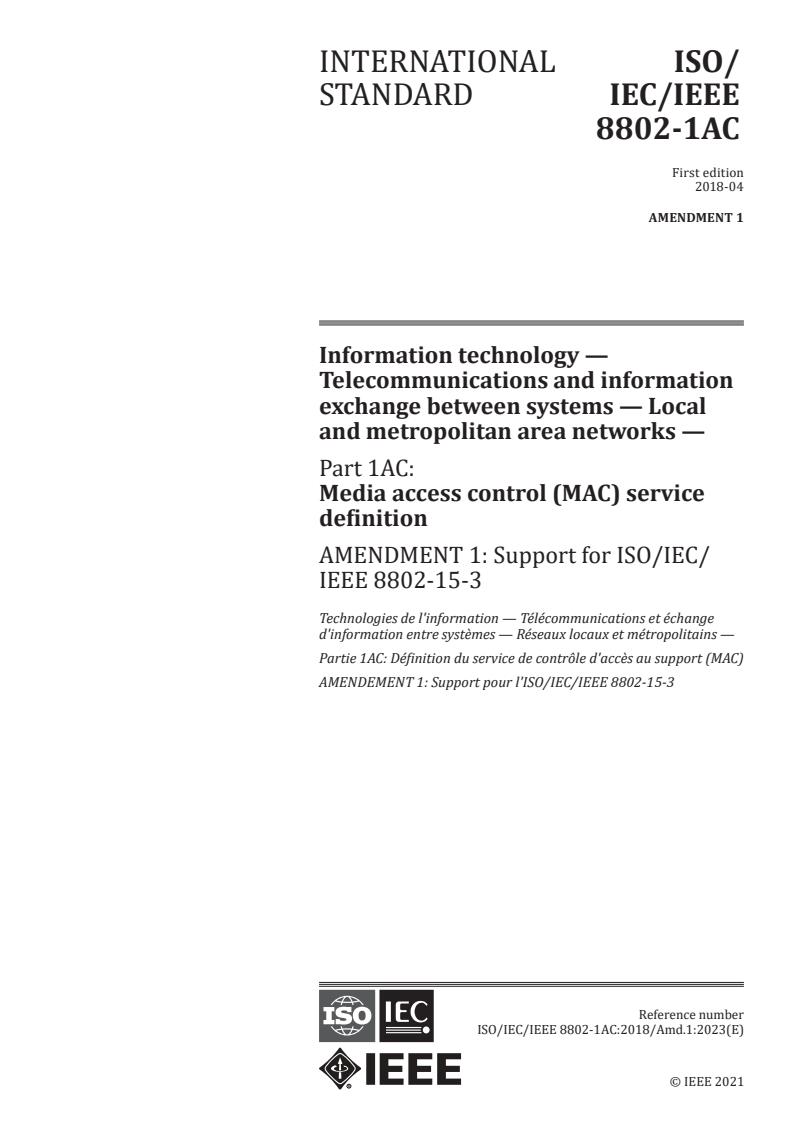
INTERNATIONAL ISO/
STANDARD IEC/IEEE
8802-1AC
First edition
2018-04
AMENDMENT 1
Information technology —
Telecommunications and information
exchange between systems — Local
and metropolitan area networks —
Part 1AC:
Media access control (MAC) service
definition
AMENDMENT 1: Support for ISO/IEC/
IEEE 8802-15-3
Technologies de l'information — Télécommunications et échange
d'information entre systèmes — Réseaux locaux et métropolitains —
Partie 1AC: Définition du service de contrôle d'accès au support (MAC)
AMENDEMENT 1: Support pour l'ISO/IEC/IEEE 8802-15-3
Reference number
ISO/IEC/IEEE 8802-1AC:2018/Amd.1:2023(E)
© IEEE 2021
ISO/IEC/IEEE 8802-1AC:2018/Amd.1:2023(E)
© IEEE 2023
All rights reserved. Unless otherwise specified, or required in the context of its implementation, no part of this publication may
be reproduced or utilized otherwise in any form or by any means, electronic or mechanical, including photocopying, or posting on
the internet or an intranet, without prior written permission. Permission can be requested from IEEE at the address below.
Institute of Electrical and Electronics Engineers, Inc
3 Park Avenue, New York
NY 10016-5997, USA
Email: stds.ipr@ieee.org
Website: www.ieee.org
Published in Switzerland
ii
© IEEE 2021 – All rights reserved
ISO/IEC/IEEE 8802-1AC:2018/Amd.1:2023(E)
Foreword
ISO (the International Organization for Standardization) and IEC (the International Electrotechnical
Commission) form the specialized system for worldwide standardization. National bodies that are
members of ISO or IEC participate in the development of International Standards through technical
committees established by the respective organization to deal with particular fields of technical activity.
ISO and IEC technical committees collaborate in fields of mutual interest. Other international
organizations, governmental and non-governmental, in liaison with ISO and IEC, also take part in the
work.
The procedures used to develop this document and those intended for its further maintenance are
described in the ISO/IEC Directives, Part 1. In particular, the different approval criteria needed for the
different types of ISO/IEC documents should be noted. (see www.iso.org/directives or
www.iec.ch/members_experts/refdocs).
IEEE Standards documents are developed within the IEEE Societies and the Standards Coordinating
Committees of the IEEE Standards Association (IEEE-SA) Standards Board. The IEEE develops its
standards through a consensus development process, approved by the American National Standards
Institute, which brings together volunteers representing varied viewpoints and interests to achieve the
final product. Volunteers are not necessarily members of the Institute and serve without compensation.
While the IEEE administers the process and establishes rules to promote fairness in the consensus
development process, the IEEE does not independently evaluate, test, or verify the accuracy of any of the
information contained in its standards.
Attention is drawn to the possibility that some of the elements of this document may be the subject of
patent rights. ISO and IEC shall not be held responsible for identifying any or all such patent rights. Details
of any patent rights identified during the development of the document will be in the Introduction and/or
on the ISO list of patent declarations received (see www.iso.org/patents) or the IEC list of patent
declarations received (see https://patents.iec.ch).
Any trade name used in this document is information given for the convenience of users and does not
constitute an endorsement.
For an explanation of the voluntary nature of standards, the meaning of ISO specific terms and
expressions related to conformity assessment, as well as information about ISO's adherence to the World
Trade Organization (WTO) principles in the Technical Barriers to Trade (TBT), see
www.iso.org/iso/foreword.html. In the IEC, see www.iec.ch/understanding-standards.
ISO/IEC/IEEE 8802-1AC:2018/Amd.1 was prepared by the LAN/MAN of the IEEE Computer Society (as
IEEE Std 802.1ACct-2021) and drafted in accordance with its editorial rules. It was adopted, under the
“fast-track procedure” defined in the Partner Standards Development Organization cooperation
agreement between ISO and IEEE, by Joint Technical Committee ISO/IEC JTC 1, Information technology,
Subcommittee SC 6, Telecommunications and information exchange between systems.
A list of all parts in the ISO/IEC/IEEE 8802 series can be found on the ISO and IEC websites.
Any feedback or questions on this document should be directed to the user’s national standards body. A
complete listing of these bodies can be found at www.iso.org/members.html and www.iec.ch/national-
committees.
© IEEE 2021 – All rights reserved iii
IEEE Std 802.1ACct™-2021
(Amendment to EEE Std 802.1AC™-2016
as amended by IEEE Std 802.1AC-2016/Cor 1-2018)
IEEE Standard for
Local and Metropolitan Area networks—
Media Access Control (MAC)
Service Definition
Amendment 1: Support for
IEEE Std 802.15.3
Developed by the
LAN/MAN Standards Committee
of the
IEEE Computer Society
Approved 8 December 2021
IEEE SA Standards Board
ISO/IEC/IEEE 8802-1AC:2018/Amd.1:2023(E)
Abstract: The Internal Sublayer Service for the IEEE 802.15.3 MAC entity is defined in this
amendment.
Keywords: ad-hoc network, IEEE 802.1AC, IEEE 802.15.3, Internal Sublayer Service, multi-media,
wireless
The Institute of Electrical and Electronics Engineers, Inc.
3 Park Avenue, New York, NY 10016-5997, USA
All rights reserved. Published 17 December 2021. Printed in the United States of America.
IEEE and 802 are registered trademarks in the U.S. Patent & Trademark Office, owned by The Institute of Electrical and
Electronics Engineers, Incorporated.
PDF: ISBN 978-1-5044-8216-5 STD25119
Print: ISBN 978-1-5044-8217-2 STDPD25119
IEEE prohibits discrimination, harassment and bullying.
For more information, visit http://www.ieee.org/web/aboutus/whatis/policies/p9-26.html.
No part of this publication may be reproduced in any form, in an electronic retrieval system or otherwise, without the prior
written permission of the publisher.
ISO/IEC/IEEE 8802-1AC:2018/Amd.1:2023(E)
Important Notices and Disclaimers Concerning IEEE Standards
Documents
IEEE Standards documents are made available for use subject to important notices and legal disclaimers.
These notices and disclaimers, or a reference to this page (https://standards.ieee.org/ipr/disclaimers.html),
appear in all standards and may be found under the heading “Important Notices and Disclaimers Concerning
IEEE Standards Documents.”
Notice and Disclaimer of Liability Concerning the Use of IEEE Standards
Documents
IEEE Standards documents are developed within the IEEE Societies and the Standards Coordinating
Committees of the IEEE Standards Association (IEEE SA) Standards Board. IEEE develops its standard s
through an accredited consensus development process, which brings together volunteers representing varied
viewpoints and interests to achieve the final product. IEEE Standards are documents developed by
volunteers with scientific, academic, and industry-based expertise in technical working groups. Volunteers
are not necessarily members of IEEE or IEEE SA, and participate without compensation from IEEE. While
IEEE administers the process and establishes rules to promote fairness in the consensus developmen t
process, IEEE does not independently evaluate, test, or verify the accuracy of any of the information or the
soundness of any judgments contained in its standards.
IEEE makes no warranties or representations concerning its standards, and expressly disclaims all
warranties, express or implied, concerning this standard, including but not limited to the warranties o f
merchantability, fitness for a particular purpose and non-infringement. In addition, IEEE does not warrant or
represent that the use of the material contained in its standards is free from patent infringement. IEEE
standards documents are supplied “AS IS” and “WITH ALL FAULTS.”
Use of an IEEE standard is wholly voluntary. The existence of an IEEE Standard does not imply that there
are no other ways to produce, test, measure, purchase, market, or provide other goods and services related t o
the scope of the IEEE standard. Furthermore, the viewpoint expressed at the time a standard is approved and
issued is subject to change brought about through developments in the state of the art and comments
received from users of the standard.
In publishing and making its standards available, IEEE is not suggesting or rendering professional or other
services for, or on behalf of, any person or entity, nor is IEEE undertaking to perform any duty owed by any
other person or entity to another. Any person utilizing any IEEE Standards document, should rely upon his
or her own independent judgment in the exercise of reasonable care in any given circumstances or, as
appropriate, seek the advice of a competent professional in determining the appropriateness of a given IEEE
standard.
IN NO EVENT SHALL IEEE BE LIABLE FOR ANY DIRECT, INDIRECT, INCIDENTAL, SPECIAL,
EXEMPLARY, OR CONSEQUENTIAL DAMAGES (INCLUDING, BUT NOT LIMITED TO: THE
NEED TO PROCURE SUBSTITUTE GOODS OR SERVICES; LOSS OF USE, DATA, OR PROFITS;
OR BUSINESS INTERRUPTION) HOWEVER CAUSED AND ON ANY THEORY OF LIABILITY,
WHETHER IN CONTRACT, STRICT LIABILITY, OR TORT (INCLUDING NEGLIGENCE OR
OTHERWISE) ARISING IN ANY WAY OUT OF THE PUBLICATION, USE OF, OR RELIANCE
UPON ANY STANDARD, EVEN IF ADVISED OF THE POSSIBILITY OF SUCH DAMAGE AND
REGARDLESS OF WHETHER SUCH DAMAGE WAS FORESEEABLE.
ISO/IEC/IEEE 8802-1AC:2018/Amd.1:2023(E)
Translations
The IEEE consensus development process involves the review of documents in English only. In the even t
that an IEEE standard is translated, only the English version published by IEEE is the approved IEEE
standard.
Official statements
A statement, written or oral, that is not processed in accordance with the IEEE SA Standards Board
Operations Manual shall not be considered or inferred to be the official position of IEEE or any of its
committees and shall not be considered to be, nor be relied upon as, a formal position of IEEE. At lectures,
symposia, seminars, or educational courses, an individual presenting information on IEEE standards shall
make it clear that the presenter's views should be considered the personal views of that individual rather than
the formal position of IEEE, IEEE SA, the Standards Committee, or the Working Group.
Comments on standards
Comments for revision of IEEE Standards documents are welcome from any interested party, regardless of
membership affiliation with IEEE or IEEE SA. However, IEEE does not provide interpretations,
consulting information, or advice pertaining to IEEE Standards documents.
Suggestions for changes in documents should be in the form of a proposed change of text, together wit h
appropriate supporting comments. Since IEEE standards represent a consensus of concerned interests, it is
important that any responses to comments and questions also receive the concurrence of a balance of
interests. For this reason, IEEE and the members of its Societies and Standards Coordinating Committees
are not able to provide an instant response to comments, or questions except in those cases where the matter
has previously been addressed. For the same reason, IEEE does not respond to interpretation requests. Any
person who would like to participate in evaluating comments or in revisions to an IEEE standard is welcome
to join the relevant IEEE working group. You can indicate interest in a working group using the Interests tab
in the Manage Profile & Interests area of the IEEE SA myProject system. An IEEE Account is needed to
access the application.
Comments on standards should be submitted using the Contact Us form.
Laws and regulations
Users of IEEE Standards documents should consult all applicable laws and regulations. Compliance with the
provisions of any IEEE Standards document does not constitute compliance to any applicable regulatory
requirements. Implementers of the standard are responsible for observing or referring to the applicable
regulatory requirements. IEEE does not, by the publication of its standards, intend to urge action that is not
in compliance with applicable laws, and these documents may not be construed as doing so.
Data privacy
Users of IEEE Standards documents should evaluate the standards for considerations of data privacy and
data ownership in the context of assessing and using the standards in compliance with applicable laws and
regulations.
Available at: https://development.standards.ieee.org/myproject-web/public/view.html#landing.
Available at: https://standards.ieee.org/content/ieee-standards/en/about/contact/index.html.
ISO/IEC/IEEE 8802-1AC:2018/Amd.1:2023(E)
Copyrights
IEEE draft and approved standards are copyrighted by IEEE under US and international copyright laws.
They are made available by IEEE and are adopted for a wide variety of both public and private uses. These
include both use, by reference, in laws and regulations, and use in private self-regulation, standardization,
and the promotion of engineering practices and methods. By making these documents available for use and
adoption by public authorities and private users, IEEE does not waive any rights in copyright to the
documents.
Photocopies
Subject to payment of the appropriate licensing fees, IEEE will grant users a limited, non-exclusive license
to photocopy portions of any individual standard for company or organizational internal use or individual,
non-commercial use only. To arrange for payment of licensing fees, please contact Copyright Clearance
Center, Customer Service, 222 Rosewood Drive, Danvers, MA 01923 USA; +1 978 750 8400;
https://www.copyright.com/. Permission to photocopy portions of any individual standard for educational
classroom use can also be obtained through the Copyright Clearance Center.
Updating of IEEE Standards documents
Users of IEEE Standards documents should be aware that these documents may be superseded at any time
by the issuance of new editions or may be amended from time to time through the issuance of amendments,
corrigenda, or errata. An official IEEE document at any point in time consists of the current edition of the
document together with any amendments, corrigenda, or errata then in effect.
Every IEEE standard is subjected to review at least every 10 years. When a document is more than 10 years
old and has not undergone a revision process, it is reasonable to conclude that
...