

ISO 14620-2:2019
(Main)Space systems — Safety requirements — Part 2: Launch site operations
General Information
- Abstract
This document specifies requirements for the safety liabilities of countries undertaking space activities or allowing operators to perform space activities on or from their territory under outer-space treaties adopted by the United Nations. It defines the safety responsibilities for the operators involved in commercial or non-commercial space launch activities. This document establishes the overall safety requirements to be observed on a launch site for prelaunch (integration, test, checking, preparation, etc.) and launch operations of a space object. It provides the basic principles to enable any operator to implement its own safety methods, tools and procedures to ensure the safety of people and personnel, public and private property, and the environment, in a consistent and uniform manner. The safety requirements for system safety are defined in ISO 14620-1, and the requirements for the flight safety systems in ISO 14620-3.
- Status
- Published
- Publication Date
- 17-Dec-2019
- Technical Committee
- ISO/TC 20/SC 14 - Space systems and operations
- Drafting Committee
- ISO/TC 20/SC 14/WG 5 - Space System Program Management and Quality
- Current Stage
- 9093 - International Standard confirmed
- Start Date
- 24-Jul-2025
- Completion Date
- 29-Aug-2026
Buy Documents


ISO 14620-2:2019 - Space systems -- Safety requirements
ISO 14620-2:2019 - Space systems — Safety requirements — Part 2: Launch site operations/18/2019
Overview
ISO 14620-2:2019 - Space systems - Safety requirements - Part 2: Launch site operations defines safety requirements and operator responsibilities for prelaunch and launch activities conducted on or from a launch site. Aligned with UN outer‑space treaty liabilities, the standard establishes principles and processes to protect people, property and the environment during integration, testing, preparation and launch of manned or unmanned space vehicles. It enables operators and authorities to implement consistent safety methods, tools and procedures for launch site operations.
Key topics and technical requirements
- Operator safety responsibilities: allocation of duties between operators and responsible authorities, including occupational safety and health obligations.
- Ground safety and flight safety: distinct arrangements for reducing risks during ground operations (integration, testing, fueling) and for in‑flight hazards during the launch phase.
- Safety risk management: requirements for expressing safety risks, defining severity classes and establishing quantitative safety objectives and qualitative safety principles to control unacceptable risks.
- Launch safety process: lifecycle requirements for launch safety including risk control, documented procedures, safety submission and processing of nonconformities.
- Training and accreditation: structured safety training requirements (general, site‑specific, specialty), and accreditation for personnel assigned safety responsibilities.
- Mishap investigation and documentation: processes for investigating incidents and maintaining a safety documentation structure (regulations, rules, application documents).
- Environmental and public protection: provisions to protect the natural environment and public/private property in line with national regulatory laws and international treaty liabilities.
Practical applications and users
ISO 14620-2 is applied to design and operate safe launch sites and launch campaigns. Practical uses include:
- Developing launch site safety management systems, rules and procedures
- Preparing safety submissions and regulatory authorizations for launch operations
- Defining roles for ground safety operators and flight safety operators
- Designing training programs and accreditation for safety personnel
- Structuring mishap investigation and nonconformity handling processes
Typical users: national authorities, launch service providers, space agencies, facility operators, manufacturers, systems integrators, designers and customers involved in commercial and non‑commercial launches.
Related standards
- ISO 14620-1 - System safety requirements (system‑level safety design)
- ISO 14620-3 - Flight safety systems (flight‑phase safety)
- ISO 10795 - Vocabulary for space programme management and quality
Keywords: ISO 14620-2, launch site operations, launch safety requirements, space systems safety, ground safety, flight safety, launch operator responsibilities, safety management for launches.
Relations
- Effective Date
- 08-Jul-2017
Buy Documents
ISO 14620-2:2019 - Space systems -- Safety requirements
ISO 14620-2:2019 - Space systems — Safety requirements — Part 2: Launch site operations/18/2019
Get Certified
Connect with accredited certification bodies for this standard

BUREAU VERITAS Certification Germany
Bureau Veritas certification in Germany.

Element Materials Technology
Materials testing and product certification.

AQMS Ltd.
AQMS provides ISO certification to SMEs across the UK.
Sponsored listings
Frequently Asked Questions
ISO 14620-2:2019 is a standard published by the International Organization for Standardization (ISO). Its full title is "Space systems — Safety requirements — Part 2: Launch site operations". This standard covers: This document specifies requirements for the safety liabilities of countries undertaking space activities or allowing operators to perform space activities on or from their territory under outer-space treaties adopted by the United Nations. It defines the safety responsibilities for the operators involved in commercial or non-commercial space launch activities. This document establishes the overall safety requirements to be observed on a launch site for prelaunch (integration, test, checking, preparation, etc.) and launch operations of a space object. It provides the basic principles to enable any operator to implement its own safety methods, tools and procedures to ensure the safety of people and personnel, public and private property, and the environment, in a consistent and uniform manner. The safety requirements for system safety are defined in ISO 14620-1, and the requirements for the flight safety systems in ISO 14620-3.
This document specifies requirements for the safety liabilities of countries undertaking space activities or allowing operators to perform space activities on or from their territory under outer-space treaties adopted by the United Nations. It defines the safety responsibilities for the operators involved in commercial or non-commercial space launch activities. This document establishes the overall safety requirements to be observed on a launch site for prelaunch (integration, test, checking, preparation, etc.) and launch operations of a space object. It provides the basic principles to enable any operator to implement its own safety methods, tools and procedures to ensure the safety of people and personnel, public and private property, and the environment, in a consistent and uniform manner. The safety requirements for system safety are defined in ISO 14620-1, and the requirements for the flight safety systems in ISO 14620-3.
ISO 14620-2:2019 is classified under the following ICS (International Classification for Standards) categories: 49.140 - Space systems and operations. The ICS classification helps identify the subject area and facilitates finding related standards.
ISO 14620-2:2019 has the following relationships with other standards: It is inter standard links to ISO 14620-2:2011. Understanding these relationships helps ensure you are using the most current and applicable version of the standard.
ISO 14620-2:2019 is available in PDF format for immediate download after purchase. The document can be added to your cart and obtained through the secure checkout process. Digital delivery ensures instant access to the complete standard document.
Standards Content (Sample)
INTERNATIONAL ISO
STANDARD 14620-2
Third edition
2019-12
Space systems — Safety
requirements —
Part 2:
Launch site operations
Systèmes spatiaux — Exigences de sécurité —
Partie 2: Opérations sur le site de lancement
Reference number
©
ISO 2019
© ISO 2019
All rights reserved. Unless otherwise specified, or required in the context of its implementation, no part of this publication may
be reproduced or utilized otherwise in any form or by any means, electronic or mechanical, including photocopying, or posting
on the internet or an intranet, without prior written permission. Permission can be requested from either ISO at the address
below or ISO’s member body in the country of the requester.
ISO copyright office
CP 401 • Ch. de Blandonnet 8
CH-1214 Vernier, Geneva
Phone: +41 22 749 01 11
Fax: +41 22 749 09 47
Email: copyright@iso.org
Website: www.iso.org
Published in Switzerland
ii © ISO 2019 – All rights reserved
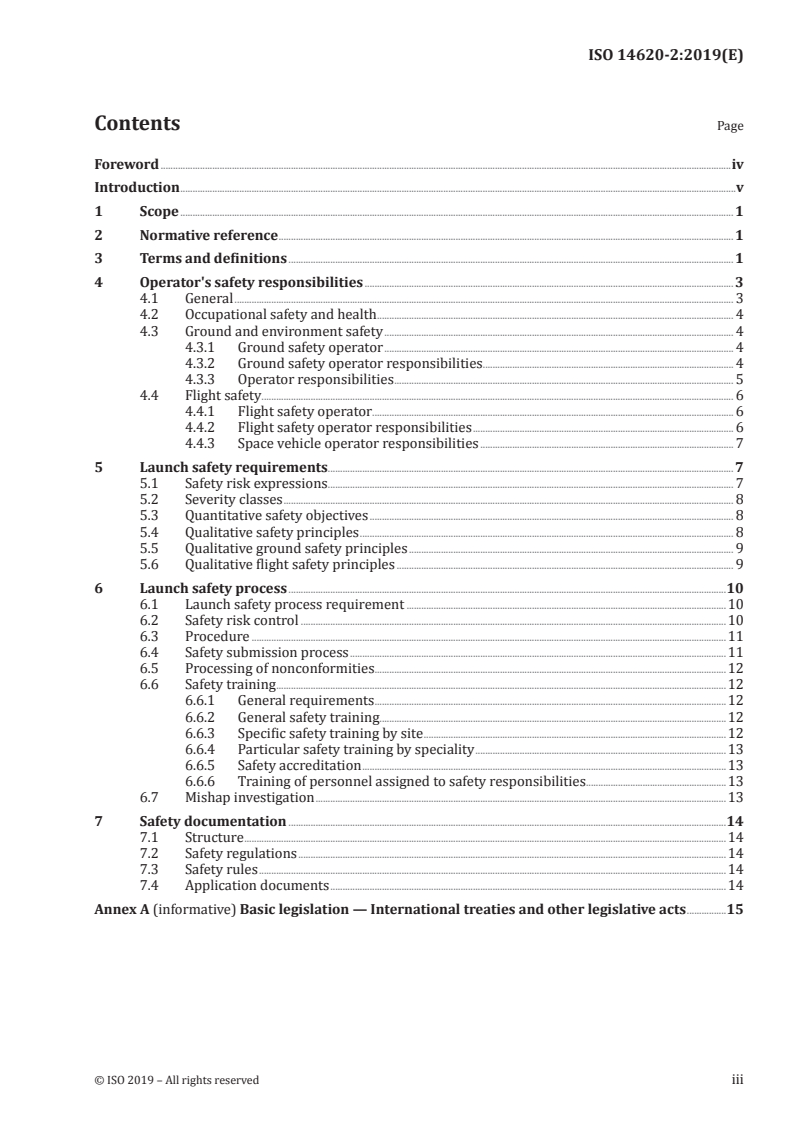
Contents Page
Foreword .iv
Introduction .v
1 Scope . 1
2 Normative reference . 1
3 Terms and definitions . 1
4 Operator's safety responsibilities . 3
4.1 General . 3
4.2 Occupational safety and health . 4
4.3 Ground and environment safety . 4
4.3.1 Ground safety operator . 4
4.3.2 Ground safety operator responsibilities . 4
4.3.3 Operator responsibilities . 5
4.4 Flight safety . 6
4.4.1 Flight safety operator. 6
4.4.2 Flight safety operator responsibilities . 6
4.4.3 Space vehicle operator responsibilities . 7
5 Launch safety requirements . 7
5.1 Safety risk expressions . 7
5.2 Severity classes . 8
5.3 Quantitative safety objectives . 8
5.4 Qualitative safety principles . 8
5.5 Qualitative ground safety principles . 9
5.6 Qualitative flight safety principles . 9
6 Launch safety process .10
6.1 Launch safety process requirement .10
6.2 Safety risk control .10
6.3 Procedure .11
6.4 Safety submission process .11
6.5 Processing of nonconformities.12
6.6 Safety training .12
6.6.1 General requirements .12
6.6.2 General safety training . .12
6.6.3 Specific safety training by site .12
6.6.4 Particular safety training by speciality .13
6.6.5 Safety accreditation .13
6.6.6 Training of personnel assigned to safety responsibilities .13
6.7 Mishap investigation .13
7 Safety documentation .14
7.1 Structure .14
7.2 Safety regulations .14
7.3 Safety rules .14
7.4 Application documents .14
Annex A (informative) Basic legislation — International treaties and other legislative acts .15
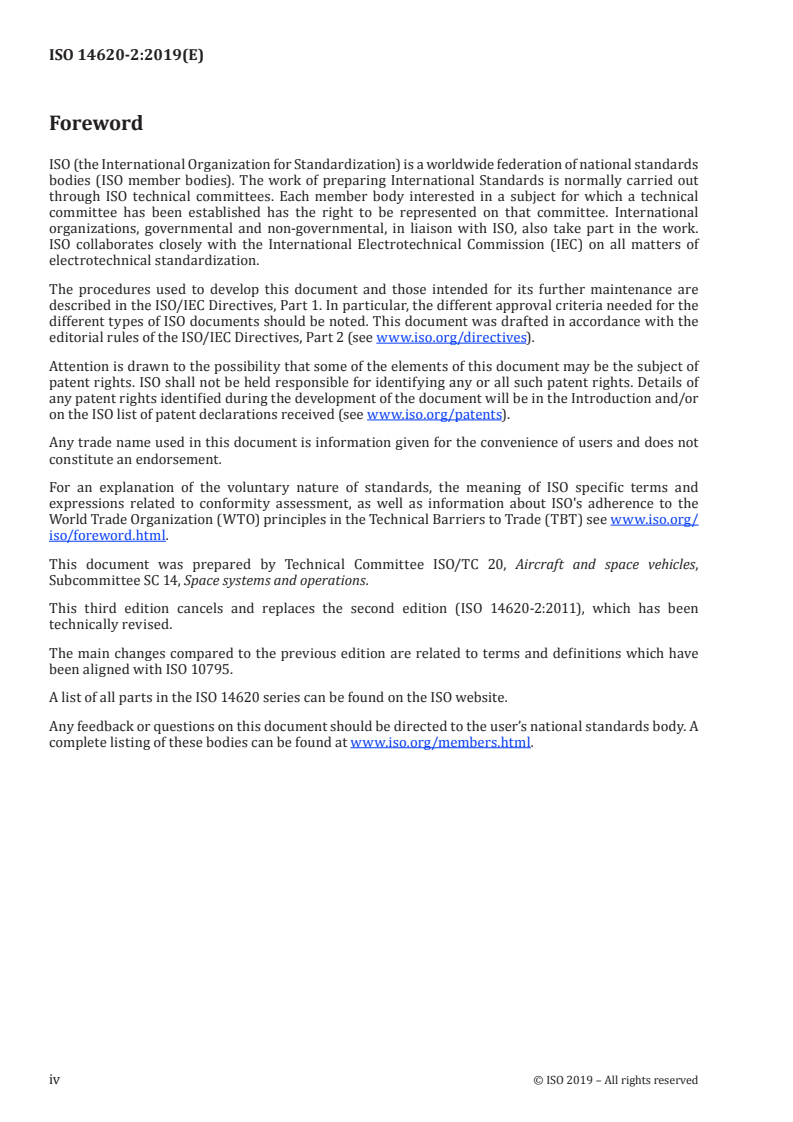
Foreword
ISO (the International Organization for Standardization) is a worldwide federation of national standards
bodies (ISO member bodies). The work of preparing International Standards is normally carried out
through ISO technical committees. Each member body interested in a subject for which a technical
committee has been established has the right to be represented on that committee. International
organizations, governmental and non-governmental, in liaison with ISO, also take part in the work.
ISO collaborates closely with the International Electrotechnical Commission (IEC) on all matters of
electrotechnical standardization.
The procedures used to develop this document and those intended for its further maintenance are
described in the ISO/IEC Directives, Part 1. In particular, the different approval criteria needed for the
different types of ISO documents should be noted. This document was drafted in accordance with the
editorial rules of the ISO/IEC Directives, Part 2 (see www .iso .org/ directives).
Attention is drawn to the possibility that some of the elements of this document may be the subject of
patent rights. ISO shall not be held responsible for identifying any or all such patent rights. Details of
any patent rights identified during the development of the document will be in the Introduction and/or
on the ISO list of patent declarations received (see www .iso .org/ patents).
Any trade name used in this document is information given for the convenience of users and does not
constitute an endorsement.
For an explanation of the voluntary nature of standards, the meaning of ISO specific terms and
expressions related to conformity assessment, as well as information about ISO's adherence to the
World Trade Organization (WTO) principles in the Technical Barriers to Trade (TBT) see www .iso .org/
iso/ foreword .html.
This document was prepared by Technical Committee ISO/TC 20, Aircraft and space vehicles,
Subcommittee SC 14, Space systems and operations.
This third edition cancels and replaces the second edition (ISO 14620-2:2011), which has been
technically revised.
The main changes compared to the previous edition are related to terms and definitions which have
been aligned with ISO 10795.
A list of all parts in the ISO 14620 series can be found on the ISO website.
Any feedback or questions on this document should be directed to the user’s national standards body. A
complete listing of these bodies can be found at www .iso .org/ members .html.
iv © ISO 2019 – All rights reserved
Introduction
Space activities, carried out within the framework of outer space treaties adopted by the United Nations,
may cause harm to people and create damage to public and private property and the environment.
The variety of professional disciplines linked to space activities and the legal liabilities incumbent on
countries require international regulations to protect Earth populations against the consequences of
a possible mishap caused by these activities. The international treaties listed in Annex A define the
liabilities for damage related to space activities.
This document pertains to exposed people (including populations and personnel), launch systems,
manned or unmanned space vehicles, operations carried out on or from a launch site and associated
procedures, natural environment, etc., during prelaunch (integration, test, checking, preparation, etc.)
and launch activities.
This document is intended to be applied by any country, by any international organization, whether
governmental or non-governmental, and by any operator undertaking space activities within the
framework of outer space treaties adopted by the United Nations.
This document is intended to be applied by agencies, enterprises, manufacturers, customers, designers,
operators, facility authorities, launch service providers, etc., participating in the activities carried out
on or from a launch site, unless more restrictive requirements are imposed by the national regulations
in effect on the launch site.
INTERNATIONAL STANDARD ISO 14620-2:2019(E)
Space systems — Safety requirements —
Part 2:
Launch site operations
1 Scope
This document specifies requirements for the safety liabilities of countries undertaking space activities
or allowing operators to perform space activities on or from their territory under outer-space treaties
adopted by the United Nations. It defines the safety responsibilities for the operators involved in
commercial or non-commercial space launch activities. This document establishes the overall safety
requirements to be observed on a launch site for prelaunch (integration, test, checking, preparation,
etc.) and launch operations of a space object. It provides the basic principles to enable any operator to
implement its own safety methods, tools and procedures to ensure the safety of people and personnel,
public and private property, and the environment, in a consistent and uniform manner.
The safety requirements for system safety are defined in ISO 14620-1, and the requirements for the
flight safety systems in ISO 14620-3.
2 Normative reference
The following documents are referred to in the text in such a way that some or all of their content
constitutes requirements of this document. For dated references, only the edition cited applies. For
undated references, the latest edition of the referenced document (including any amendments) applies.
ISO 10795, Space systems — Programme management and quality — Vocabulary
ISO 14620-1, Space systems — Safety requirements — Part 1: System safety
ISO 14620-3, Space systems — Safety requirements — Part 3: Flight safety systems
3 Terms and definitions
For the purposes of this document, the terms and definitions given in ISO 10795 and the following apply.
ISO and IEC maintain terminological databases for use in standardization at the following addresses:
— ISO Online browsing platform: available at https:// www .iso .org/ obp
— IEC Electropedia: available at http:// www .electropedia .org/
3.1
authorization
permission granted to an operator (3.15) by a responsible authority (3.17) to perform specified space
activities
Note 1 to entry: Space activities include conducting space operations, conducting launch (3.8) operations,
operating one or more sites, and operating one or more space vehicles on or from one or more launch sites (3.11).
3.2
damage
loss of human life, personal injury or other health impairments, occupational illness, total or partial loss
of public or private property, or degradations caused to the aforesaid property or to the environment
3.3
dangerous area
area associated with a mishap or a potential mishap, inside which the consequences are catastrophic or
critical
3.4
flight plan
plan related to the in-flight launch (3.8) vehicle, including data directly or indirectly related to launch
site (3.11) safety
3.5
flight safety
arrangements intended to control safety risks (3.19) from launch (3.8) through the flight of a space object
(3.20), and to protect people, public and private property, and the environment, against any damage
(3.2) that could be caused by in-flight manœuvres of this space object
3.6
ground safety
arrangements intended to reduce and control safety risks (3.19) identified in ground prelaunch and
launch (3.8) activities of a manned or unmanned space vehicle
Note 1 to entry: Arrangements include protecting people, public and private property, and the environment, and
completing and adjusting the national regulatory laws (3.14) related to occupational safety and health, workers,
environment, space, etc.
3.7
inhibit
verifiable design feature intended to prevent a hazardous situation from occurring, that provides an
interruption between an energy source and a function actuator
EXAMPLE An inhibit can be a function, a product, a hardware, a software, a physical property, or a
technological device.
3.8
launch
initial action to place, or attempt to place, a launch vehicle and payload, if any, in a suborbital trajectory,
in Earth orbit in outer space, or otherwise in outer space
3.9
launch complex
site assigned to or owned by a launch (3.8) vehicle operator (3.15) to operate a launch vehicle
3.10
launch phase
period which begins when the launch (3.8) vehicle is no longer in physical contact with the launch
complex (3.9) or the carrier aircraft and continues up to the end of the mission assigned to it including
disposal and passivation actions
Note 1 to entry: The launch phase ends when any planned and unplanned physical contact with the ground or
destruction or breakdown of the vehicle takes place.
3.11
launch site
site necessary for the prelaunch and launch (3.8) operations of a space vehicle and for the in-flight
operations during the launch phase (3.10)
3.12
launch site country
country that has jurisdiction over a specified launch site (3.11)
2 © ISO 2019 – All rights reserved
3.13
launch system
system made up of a launch (3.8) vehicle, the associated launch complex (3.9), launch site (3.11), payload,
ground support equipment and associated airborne equipment (including software), control systems,
navigation system, trajectories, procedures, necessary personnel, and any other associated items
3.14
national regulatory laws
set of official statutes of a country
Note 1 to entry: The official statutes include constitution, law, decree, administrative order, code, regulation, etc.
3.15
operator
governmental or non-governmental entities, international organization, or natural person carrying out
a space operation independently and under its responsibility
3.16
residual safety risk
safety risk (3.19) associated with the hazards and/or hazardous situations remaining in a space system
after eliminating hazards and hazardous situations as much as practical, and reducing the unacceptable
safety risks
3.17
responsible authority
ministry, department, agency, subsection, or office of a government or international governmental
organization, which is responsible for space activities including, but not limited to, launch (3.8)
operations in a specified location or country
3.18
safe
property of an item and its environment that limits its potential for damage (3.2) to an acceptable risk
3.19
safety risk
measure of the potential consequences of a hazard considering the probability of the associated
mishap, the harm caused to people and the damage (3.2) caused to public and private property and the
environment
Note 1 to entry: The safety risk is defined to be differentiated from political, financial, industrial, project, and
other risks.
Note 2 to entry: An example of a safety risk is the expected number of casualties.
3.20
space object
space vehicle of artificial earthly origin and any of its component parts, except space debris, if any
3.21
specific authorized operator
entity allowed or licensed to conduct a space operation in an independent way according to relevant
applicable space law
4 Operator's safety responsibilities
4.1 General
The following subclauses define the general allocation of the safety responsibilities and requirements
for the prelaunch (integration, test, checking, preparation, etc.) and launch operations related to a
launch system. It is understood, in this document, that each operator is either duly authorized or
entered into an appropriate contract (specific agreement, commercial contract, etc.) with a responsible
authority or an authorized operator. Several operators (e.g. launch site operator, site operator, launch
vehicle operator, payload operator) can operate simultaneously on the same launch site. They can be
concerned either with the same launch system or with different systems.
4.2 Occupational safety and health
It is presupposed that any operator carrying out operations on a launch site respects and applies the
occupational safety and health requirements of the launch site country.
4.3 Ground and environment safety
4.3.1 Ground safety operator
Ground safety responsibilities and requirements vary among operators. Generally, the different
operators should determine themselves how safety concerns should be met. However, on the same
launch site, the following conditions or criteria may exist:
a) several operators can carry out hazardous operations simultaneously;
b) hazardous operations can cause harm to personnel or damage to private or public property
(external to the launch site facilities) or the environment;
c) hazardous operations carried out by one operator can cause harm to personnel or property damage
to another operator;
d) some hazardous operations are performed by several operators.
Therefore, ground safety responsibilities and requirements shall be allocated between a specific
operator selected from all the authorized operators, the ground safety operator in this document,
and other operators carrying out prelaunch (integration, test, checking, preparation, etc.) or launch
operations on the launch site.
4.3.2 Ground safety operator responsibilities
Some ground safety responsibilities are general enough to be specified in this document.
The ground safety operator shall be approved by the national responsible authority of the launch site
country to perform the activities related to its ground safety responsibilities.
The ground safety operator shall be responsible for:
a) identifying, supervising and coordinating the allocation of ground safety responsibilities and
requirements among the operators;
b) specifying ground safety rules to be applied by the operators meeting one or more of the previous
criteria (as described in 4.3.1) associated with the hazardous operations;
c) verifying the application of the specified rules;
e) reviewing and approving the procedures of hazardous operations meeting one or more of the
previous criteria b), c) and d) and as described in 4.3.1;
f) supervising and coordinating hazardous operations meeting one or more of the previous criteria
(as described in 4.3.1);
g) verifying that the emergency plans of the operators performing hazardous operations meeting one
or more of the previous criteria (as described in 4.3.1) are consistent and in accordance with the
approved emergency procedures;
h) defining the general safety training (as required in 6.6.2);
4 © ISO 2019 – All rights reserved
i) verifying and ensuring that the safety training of each operator is consistent and homogeneous
with all the other training;
j) implementing resolutions for conflicts arising among the operators from hazardous operations;
k) coordinating with, and notifying, local government authorities, as appropriate, on all matters
affecting public safety and environmental protection;
l) reporting any incident or accident to affected authorities (including local government authorities),
and participating in mishap investigations and finding documentation;
m) communicating the safety lessons learned to the other operators;
n) setting up a ground safety organization capable of performing ground safety responsibilities;
o) developing and maintaining a consistent environmental safety policy that meets the regulatory
requirements of the launch site country.
4.3.3 Operator responsibilities
Each operator (e.g. launch site operator, specific site operator, launch vehicle operator, payload operator)
on a launch site shall be responsible for:
a) protecting personnel, property and the environment from any damage caused by its own
hazardous items;
b) applying the ground safety rules issued from the ground safety operator;
c) developing, implementing, maintaining, taking into account, and abiding by its own ground safety
rules, consistent with the other ground safety rules and the applicable requirements (occupational
safety and health, workers, environment, space, etc.);
d) accepting the allocation of the appropriate ground safety responsibilities from the ground safety
operator;
e) defining and implementing the associated ground safety arrangements that ensure the ground
safety risks inherent in its operations are compatible with the stated safety objectives (as required
in 5.3) and are safely controlled;
f) identifying the hazards and hazardous situations and assessing the associated ground safety risks
by performing hazard analysis on its space vehicles, sites and operations, and eliminating the
hazards and hazardous situations or reducing the unacceptable ground safety risks;
g) managing the residual ground safety risks inherent in its space vehicles, sites and operations
(including procedures and personnel) to achieve safe operations;
h) performing the necessary functions to ensure safe operations;
i) developing, verifying, implementing and maintaining an emergency plan for the mishaps that can
occur during its own hazardous operations;
j) participating in mishap investigations as required by the ground or flight safety operator;
k) defining and providing the specific safety training by site (as required in 6.6.3) related to its
operations;
l) verifying that any worker has a valid safety accreditation (as required in 6.6.5) before beginning
any hazardous operation;
m) setting up a ground safety organization capable of performing its ground safety responsibilities.
If the ground safety rules of a launch site and the occupational safety and health regulations of the
country of a foreign operator performing space activities on this launch site are in conflict, then the
former takes precedence over the latter for this operator and its workers participating in activities
carried out on or from the launch site. However, exceptions can be made for specific cases duly accepted
by the suitable national responsible authority of the launch site country.
Ground safety rules of an operator performing space activities on or from a launch site may exceed the
launch site country's own occupational safety and health regulations.
It is presupposed that any operator carrying out operations on a launch site respects and applies the
territorial and national relevant regulations.
4.4 Flight safety
4.4.1 Flight safety operator
The allocation of the flight safety responsibilities and requirements among various operators may vary.
However, on the same launch site, the flight safety responsibilities and requirements shall be allocated
only between a specific authorized operator, the flight safety operator in this document, and each
space vehicle operator carrying out prelaunch (integration, test, checking, preparation, etc.) or launch
operations on the launch site.
4.4.2 Flight safety operator responsibilities
Some flight safety responsibilities are general enough to be specified in this document.
The flight safety operator shall be approved by the national responsible authority of the launch site
country to perform in-flight safety activities related to its responsibilities during the launch phase of a
space vehicle.
The flight safety operator shall be responsible for:
a) protecting personnel, property and the environment from damage that may arise from a space
vehicle (whether manned or unmanned) during its launch phase;
b) controlling the flight safety risks during the launch phase of a space vehicle (e.g. by using the flight
safety systems required in ISO 14620-3);
c) developing and maintaining the flight safety rules to be applied to each space vehicle, taking into
consideration the national regulatory laws (health, environment, space, etc.) and the concerned
ground safety rules;
d) allocating, in accordance with the concerned space vehicle operators, the flight safety
responsibilities and requirements;
e) developing, implementing, maintaining, taking into account and abiding by its own flight safety
rules
...
INTERNATIONAL ISO
STANDARD 14620-2
Third edition
2019-12
Space systems — Safety
requirements —
Part 2:
Launch site operations
Systèmes spatiaux — Exigences de sécurité —
Partie 2: Opérations sur le site de lancement
Reference number
©
ISO 2019
© ISO 2019
All rights reserved. Unless otherwise specified, or required in the context of its implementation, no part of this publication may
be reproduced or utilized otherwise in any form or by any means, electronic or mechanical, including photocopying, or posting
on the internet or an intranet, without prior written permission. Permission can be requested from either ISO at the address
below or ISO’s member body in the country of the requester.
ISO copyright office
CP 401 • Ch. de Blandonnet 8
CH-1214 Vernier, Geneva
Phone: +41 22 749 01 11
Fax: +41 22 749 09 47
Email: copyright@iso.org
Website: www.iso.org
Published in Switzerland
ii © ISO 2019 – All rights reserved
Contents Page
Foreword .iv
Introduction .v
1 Scope . 1
2 Normative reference . 1
3 Terms and definitions . 1
4 Operator's safety responsibilities . 3
4.1 General . 3
4.2 Occupational safety and health . 4
4.3 Ground and environment safety . 4
4.3.1 Ground safety operator . 4
4.3.2 Ground safety operator responsibilities . 4
4.3.3 Operator responsibilities . 5
4.4 Flight safety . 6
4.4.1 Flight safety operator. 6
4.4.2 Flight safety operator responsibilities . 6
4.4.3 Space vehicle operator responsibilities . 7
5 Launch safety requirements . 7
5.1 Safety risk expressions . 7
5.2 Severity classes . 8
5.3 Quantitative safety objectives . 8
5.4 Qualitative safety principles . 8
5.5 Qualitative ground safety principles . 9
5.6 Qualitative flight safety principles . 9
6 Launch safety process .10
6.1 Launch safety process requirement .10
6.2 Safety risk control .10
6.3 Procedure .11
6.4 Safety submission process .11
6.5 Processing of nonconformities.12
6.6 Safety training .12
6.6.1 General requirements .12
6.6.2 General safety training . .12
6.6.3 Specific safety training by site .12
6.6.4 Particular safety training by speciality .13
6.6.5 Safety accreditation .13
6.6.6 Training of personnel assigned to safety responsibilities .13
6.7 Mishap investigation .13
7 Safety documentation .14
7.1 Structure .14
7.2 Safety regulations .14
7.3 Safety rules .14
7.4 Application documents .14
Annex A (informative) Basic legislation — International treaties and other legislative acts .15
Foreword
ISO (the International Organization for Standardization) is a worldwide federation of national standards
bodies (ISO member bodies). The work of preparing International Standards is normally carried out
through ISO technical committees. Each member body interested in a subject for which a technical
committee has been established has the right to be represented on that committee. International
organizations, governmental and non-governmental, in liaison with ISO, also take part in the work.
ISO collaborates closely with the International Electrotechnical Commission (IEC) on all matters of
electrotechnical standardization.
The procedures used to develop this document and those intended for its further maintenance are
described in the ISO/IEC Directives, Part 1. In particular, the different approval criteria needed for the
different types of ISO documents should be noted. This document was drafted in accordance with the
editorial rules of the ISO/IEC Directives, Part 2 (see www .iso .org/ directives).
Attention is drawn to the possibility that some of the elements of this document may be the subject of
patent rights. ISO shall not be held responsible for identifying any or all such patent rights. Details of
any patent rights identified during the development of the document will be in the Introduction and/or
on the ISO list of patent declarations received (see www .iso .org/ patents).
Any trade name used in this document is information given for the convenience of users and does not
constitute an endorsement.
For an explanation of the voluntary nature of standards, the meaning of ISO specific terms and
expressions related to conformity assessment, as well as information about ISO's adherence to the
World Trade Organization (WTO) principles in the Technical Barriers to Trade (TBT) see www .iso .org/
iso/ foreword .html.
This document was prepared by Technical Committee ISO/TC 20, Aircraft and space vehicles,
Subcommittee SC 14, Space systems and operations.
This third edition cancels and replaces the second edition (ISO 14620-2:2011), which has been
technically revised.
The main changes compared to the previous edition are related to terms and definitions which have
been aligned with ISO 10795.
A list of all parts in the ISO 14620 series can be found on the ISO website.
Any feedback or questions on this document should be directed to the user’s national standards body. A
complete listing of these bodies can be found at www .iso .org/ members .html.
iv © ISO 2019 – All rights reserved
Introduction
Space activities, carried out within the framework of outer space treaties adopted by the United Nations,
may cause harm to people and create damage to public and private property and the environment.
The variety of professional disciplines linked to space activities and the legal liabilities incumbent on
countries require international regulations to protect Earth populations against the consequences of
a possible mishap caused by these activities. The international treaties listed in Annex A define the
liabilities for damage related to space activities.
This document pertains to exposed people (including populations and personnel), launch systems,
manned or unmanned space vehicles, operations carried out on or from a launch site and associated
procedures, natural environment, etc., during prelaunch (integration, test, checking, preparation, etc.)
and launch activities.
This document is intended to be applied by any country, by any international organization, whether
governmental or non-governmental, and by any operator undertaking space activities within the
framework of outer space treaties adopted by the United Nations.
This document is intended to be applied by agencies, enterprises, manufacturers, customers, designers,
operators, facility authorities, launch service providers, etc., participating in the activities carried out
on or from a launch site, unless more restrictive requirements are imposed by the national regulations
in effect on the launch site.
INTERNATIONAL STANDARD ISO 14620-2:2019(E)
Space systems — Safety requirements —
Part 2:
Launch site operations
1 Scope
This document specifies requirements for the safety liabilities of countries undertaking space activities
or allowing operators to perform space activities on or from their territory under outer-space treaties
adopted by the United Nations. It defines the safety responsibilities for the operators involved in
commercial or non-commercial space launch activities. This document establishes the overall safety
requirements to be observed on a launch site for prelaunch (integration, test, checking, preparation,
etc.) and launch operations of a space object. It provides the basic principles to enable any operator to
implement its own safety methods, tools and procedures to ensure the safety of people and personnel,
public and private property, and the environment, in a consistent and uniform manner.
The safety requirements for system safety are defined in ISO 14620-1, and the requirements for the
flight safety systems in ISO 14620-3.
2 Normative reference
The following documents are referred to in the text in such a way that some or all of their content
constitutes requirements of this document. For dated references, only the edition cited applies. For
undated references, the latest edition of the referenced document (including any amendments) applies.
ISO 10795, Space systems — Programme management and quality — Vocabulary
ISO 14620-1, Space systems — Safety requirements — Part 1: System safety
ISO 14620-3, Space systems — Safety requirements — Part 3: Flight safety systems
3 Terms and definitions
For the purposes of this document, the terms and definitions given in ISO 10795 and the following apply.
ISO and IEC maintain terminological databases for use in standardization at the following addresses:
— ISO Online browsing platform: available at https:// www .iso .org/ obp
— IEC Electropedia: available at http:// www .electropedia .org/
3.1
authorization
permission granted to an operator (3.15) by a responsible authority (3.17) to perform specified space
activities
Note 1 to entry: Space activities include conducting space operations, conducting launch (3.8) operations,
operating one or more sites, and operating one or more space vehicles on or from one or more launch sites (3.11).
3.2
damage
loss of human life, personal injury or other health impairments, occupational illness, total or partial loss
of public or private property, or degradations caused to the aforesaid property or to the environment
3.3
dangerous area
area associated with a mishap or a potential mishap, inside which the consequences are catastrophic or
critical
3.4
flight plan
plan related to the in-flight launch (3.8) vehicle, including data directly or indirectly related to launch
site (3.11) safety
3.5
flight safety
arrangements intended to control safety risks (3.19) from launch (3.8) through the flight of a space object
(3.20), and to protect people, public and private property, and the environment, against any damage
(3.2) that could be caused by in-flight manœuvres of this space object
3.6
ground safety
arrangements intended to reduce and control safety risks (3.19) identified in ground prelaunch and
launch (3.8) activities of a manned or unmanned space vehicle
Note 1 to entry: Arrangements include protecting people, public and private property, and the environment, and
completing and adjusting the national regulatory laws (3.14) related to occupational safety and health, workers,
environment, space, etc.
3.7
inhibit
verifiable design feature intended to prevent a hazardous situation from occurring, that provides an
interruption between an energy source and a function actuator
EXAMPLE An inhibit can be a function, a product, a hardware, a software, a physical property, or a
technological device.
3.8
launch
initial action to place, or attempt to place, a launch vehicle and payload, if any, in a suborbital trajectory,
in Earth orbit in outer space, or otherwise in outer space
3.9
launch complex
site assigned to or owned by a launch (3.8) vehicle operator (3.15) to operate a launch vehicle
3.10
launch phase
period which begins when the launch (3.8) vehicle is no longer in physical contact with the launch
complex (3.9) or the carrier aircraft and continues up to the end of the mission assigned to it including
disposal and passivation actions
Note 1 to entry: The launch phase ends when any planned and unplanned physical contact with the ground or
destruction or breakdown of the vehicle takes place.
3.11
launch site
site necessary for the prelaunch and launch (3.8) operations of a space vehicle and for the in-flight
operations during the launch phase (3.10)
3.12
launch site country
country that has jurisdiction over a specified launch site (3.11)
2 © ISO 2019 – All rights reserved
3.13
launch system
system made up of a launch (3.8) vehicle, the associated launch complex (3.9), launch site (3.11), payload,
ground support equipment and associated airborne equipment (including software), control systems,
navigation system, trajectories, procedures, necessary personnel, and any other associated items
3.14
national regulatory laws
set of official statutes of a country
Note 1 to entry: The official statutes include constitution, law, decree, administrative order, code, regulation, etc.
3.15
operator
governmental or non-governmental entities, international organization, or natural person carrying out
a space operation independently and under its responsibility
3.16
residual safety risk
safety risk (3.19) associated with the hazards and/or hazardous situations remaining in a space system
after eliminating hazards and hazardous situations as much as practical, and reducing the unacceptable
safety risks
3.17
responsible authority
ministry, department, agency, subsection, or office of a government or international governmental
organization, which is responsible for space activities including, but not limited to, launch (3.8)
operations in a specified location or country
3.18
safe
property of an item and its environment that limits its potential for damage (3.2) to an acceptable risk
3.19
safety risk
measure of the potential consequences of a hazard considering the probability of the associated
mishap, the harm caused to people and the damage (3.2) caused to public and private property and the
environment
Note 1 to entry: The safety risk is defined to be differentiated from political, financial, industrial, project, and
other risks.
Note 2 to entry: An example of a safety risk is the expected number of casualties.
3.20
space object
space vehicle of artificial earthly origin and any of its component parts, except space debris, if any
3.21
specific authorized operator
entity allowed or licensed to conduct a space operation in an independent way according to relevant
applicable space law
4 Operator's safety responsibilities
4.1 General
The following subclauses define the general allocation of the safety responsibilities and requirements
for the prelaunch (integration, test, checking, preparation, etc.) and launch operations related to a
launch system. It is understood, in this document, that each operator is either duly authorized or
entered into an appropriate contract (specific agreement, commercial contract, etc.) with a responsible
authority or an authorized operator. Several operators (e.g. launch site operator, site operator, launch
vehicle operator, payload operator) can operate simultaneously on the same launch site. They can be
concerned either with the same launch system or with different systems.
4.2 Occupational safety and health
It is presupposed that any operator carrying out operations on a launch site respects and applies the
occupational safety and health requirements of the launch site country.
4.3 Ground and environment safety
4.3.1 Ground safety operator
Ground safety responsibilities and requirements vary among operators. Generally, the different
operators should determine themselves how safety concerns should be met. However, on the same
launch site, the following conditions or criteria may exist:
a) several operators can carry out hazardous operations simultaneously;
b) hazardous operations can cause harm to personnel or damage to private or public property
(external to the launch site facilities) or the environment;
c) hazardous operations carried out by one operator can cause harm to personnel or property damage
to another operator;
d) some hazardous operations are performed by several operators.
Therefore, ground safety responsibilities and requirements shall be allocated between a specific
operator selected from all the authorized operators, the ground safety operator in this document,
and other operators carrying out prelaunch (integration, test, checking, preparation, etc.) or launch
operations on the launch site.
4.3.2 Ground safety operator responsibilities
Some ground safety responsibilities are general enough to be specified in this document.
The ground safety operator shall be approved by the national responsible authority of the launch site
country to perform the activities related to its ground safety responsibilities.
The ground safety operator shall be responsible for:
a) identifying, supervising and coordinating the allocation of ground safety responsibilities and
requirements among the operators;
b) specifying ground safety rules to be applied by the operators meeting one or more of the previous
criteria (as described in 4.3.1) associated with the hazardous operations;
c) verifying the application of the specified rules;
e) reviewing and approving the procedures of hazardous operations meeting one or more of the
previous criteria b), c) and d) and as described in 4.3.1;
f) supervising and coordinating hazardous operations meeting one or more of the previous criteria
(as described in 4.3.1);
g) verifying that the emergency plans of the operators performing hazardous operations meeting one
or more of the previous criteria (as described in 4.3.1) are consistent and in accordance with the
approved emergency procedures;
h) defining the general safety training (as required in 6.6.2);
4 © ISO 2019 – All rights reserved
i) verifying and ensuring that the safety training of each operator is consistent and homogeneous
with all the other training;
j) implementing resolutions for conflicts arising among the operators from hazardous operations;
k) coordinating with, and notifying, local government authorities, as appropriate, on all matters
affecting public safety and environmental protection;
l) reporting any incident or accident to affected authorities (including local government authorities),
and participating in mishap investigations and finding documentation;
m) communicating the safety lessons learned to the other operators;
n) setting up a ground safety organization capable of performing ground safety responsibilities;
o) developing and maintaining a consistent environmental safety policy that meets the regulatory
requirements of the launch site country.
4.3.3 Operator responsibilities
Each operator (e.g. launch site operator, specific site operator, launch vehicle operator, payload operator)
on a launch site shall be responsible for:
a) protecting personnel, property and the environment from any damage caused by its own
hazardous items;
b) applying the ground safety rules issued from the ground safety operator;
c) developing, implementing, maintaining, taking into account, and abiding by its own ground safety
rules, consistent with the other ground safety rules and the applicable requirements (occupational
safety and health, workers, environment, space, etc.);
d) accepting the allocation of the appropriate ground safety responsibilities from the ground safety
operator;
e) defining and implementing the associated ground safety arrangements that ensure the ground
safety risks inherent in its operations are compatible with the stated safety objectives (as required
in 5.3) and are safely controlled;
f) identifying the hazards and hazardous situations and assessing the associated ground safety risks
by performing hazard analysis on its space vehicles, sites and operations, and eliminating the
hazards and hazardous situations or reducing the unacceptable ground safety risks;
g) managing the residual ground safety risks inherent in its space vehicles, sites and operations
(including procedures and personnel) to achieve safe operations;
h) performing the necessary functions to ensure safe operations;
i) developing, verifying, implementing and maintaining an emergency plan for the mishaps that can
occur during its own hazardous operations;
j) participating in mishap investigations as required by the ground or flight safety operator;
k) defining and providing the specific safety training by site (as required in 6.6.3) related to its
operations;
l) verifying that any worker has a valid safety accreditation (as required in 6.6.5) before beginning
any hazardous operation;
m) setting up a ground safety organization capable of performing its ground safety responsibilities.
If the ground safety rules of a launch site and the occupational safety and health regulations of the
country of a foreign operator performing space activities on this launch site are in conflict, then the
former takes precedence over the latter for this operator and its workers participating in activities
carried out on or from the launch site. However, exceptions can be made for specific cases duly accepted
by the suitable national responsible authority of the launch site country.
Ground safety rules of an operator performing space activities on or from a launch site may exceed the
launch site country's own occupational safety and health regulations.
It is presupposed that any operator carrying out operations on a launch site respects and applies the
territorial and national relevant regulations.
4.4 Flight safety
4.4.1 Flight safety operator
The allocation of the flight safety responsibilities and requirements among various operators may vary.
However, on the same launch site, the flight safety responsibilities and requirements shall be allocated
only between a specific authorized operator, the flight safety operator in this document, and each
space vehicle operator carrying out prelaunch (integration, test, checking, preparation, etc.) or launch
operations on the launch site.
4.4.2 Flight safety operator responsibilities
Some flight safety responsibilities are general enough to be specified in this document.
The flight safety operator shall be approved by the national responsible authority of the launch site
country to perform in-flight safety activities related to its responsibilities during the launch phase of a
space vehicle.
The flight safety operator shall be responsible for:
a) protecting personnel, property and the environment from damage that may arise from a space
vehicle (whether manned or unmanned) during its launch phase;
b) controlling the flight safety risks during the launch phase of a space vehicle (e.g. by using the flight
safety systems required in ISO 14620-3);
c) developing and maintaining the flight safety rules to be applied to each space vehicle, taking into
consideration the national regulatory laws (health, environment, space, etc.) and the concerned
ground safety rules;
d) allocating, in accordance with the concerned space vehicle operators, the flight safety
responsibilities and requirements;
e) developing, implementing, maintaining, taking into account and abiding by its own flight safety
rules
...