

ISO 12985-1:2018
(Main)Carbonaceous materials used in the production of aluminium — Baked anodes and cathode blocks — Part 1: Determination of apparent density using a dimensions method
General Information
- Abstract
This document specifies a dimensions method for the determination of the apparent density of carbonaceous products used in the production of aluminium. This method is applicable to samples with a simple or well-defined geometry (for example cylindrical, rectangular parallelepipedical or cubic) and a smooth surface profile. The accuracy of measurement is strongly influenced by the equipment used for sampling, i.e. the drilling and sawing machines.
- Status
- Published
- Publication Date
- 22-May-2018
- Technical Committee
- ISO/TC 226 - Materials for the production of primary aluminium
- Drafting Committee
- ISO/TC 226/WG 6 - Anodes and coke
- Current Stage
- 9093 - International Standard confirmed
- Start Date
- 13-Mar-2024
- Completion Date
- 29-Aug-2026
Buy Documents

ISO 12985-1:2018 - Carbonaceous materials used in the production of aluminium -- Baked anodes and cathode blocks
ISO 12985-1:2018 - Carbonaceous materials used in the production of aluminium — Baked anodes and cathode blocks — Part 1: Determination of apparent density using a dimensions method/23/2018
Overview
ISO 12985-1:2018 is an international standard developed by ISO that specifies a dimensions method for determining the apparent density of carbonaceous materials used in aluminium production, specifically baked anodes and cathode blocks. This standard covers procedures for samples with simple or well-defined geometries such as cylindrical, rectangular parallelepiped, or cubic shapes with smooth surfaces.
The determination of apparent density using this method is critical for quality control in aluminium manufacturing, impacting the physical properties and performance of carbonaceous materials during smelting. Precise sampling and measurement techniques are essential to ensure accurate and reproducible density values, reflecting the material's compactness and integrity.
Key Topics
Scope and Application
Applicable to carbonaceous products with defined geometry and smooth surfaces used in aluminium electrolysis.Sampling Procedures
Samples must be taken according to ISO 8007 series (ISO 8007-1 for cathode blocks and ISO 8007-2 for prebaked anodes) to guarantee representativeness.Measurement Equipment
- Precision balance: Accuracy depends on sample weight, 0.1 g resolution for samples over 100 g, 0.01 g otherwise.
- Callipers: Measuring to 0.05 mm or 0.01 mm depending on dimension size.
Measurement Procedure
Includes multiple dimension measurements of the sample to calculate volume, drying the specimen to constant mass (commonly at 110 ± 5 °C), and weighing under controlled conditions.Calculation Method
Apparent density is calculated using the formula:
[ \rho_a = \frac{m}{V} ]
where ( m ) is the dry mass in grams and ( V ) is the sample volume in cubic centimeters (cm³). Results are reported to three decimal places.Precision and Reproducibility
- Repeatability limit: 0.004 g/cm³
- Reproducibility limit: 0.008 g/cm³
These values ensure consistency of measurements within and across laboratories.
Test Reporting Requirements
Test reports must include sample identification, reference to the ISO standard, method description, test date, results, any deviations or unusual observations.
Applications
Quality Control in Aluminium Industry
Ensures carbonaceous baked anodes and cathode blocks meet density specifications critical for efficient electrolysis and operational lifespan.Material Development and Research
Supports R&D in improving carbonaceous product manufacturing by providing a reliable density determination technique.Process Monitoring
Assists in monitoring density variations that could indicate defects or inconsistencies in production batches.Supplier and Customer Compliance
Enables benchmarks for verifying compliance with contractual and regulatory quality requirements in supply chains.
Related Standards
ISO 8007-1 & ISO 8007-2
Standards for sampling cathode blocks and prebaked anodes, respectively, complementing the density determination process.ISO 5725 Series
Covers accuracy (trueness and precision) of measurement methods, providing foundational principles related to repeatability and reproducibility referenced in ISO 12985-1.ISO/IEC Directives, Part 1 & 2
Editorial and procedural rules are important for document preparation and maintenance.
Keywords: ISO 12985-1:2018, carbonaceous materials, aluminium production, baked anodes, cathode blocks, apparent density, dimensions method, density determination, aluminium electrolysis, quality control, sample measurement, precision, reproducibility, ISO standards.
Relations
- Effective Date
- 04-Nov-2015
Buy Documents
ISO 12985-1:2018 - Carbonaceous materials used in the production of aluminium -- Baked anodes and cathode blocks
ISO 12985-1:2018 - Carbonaceous materials used in the production of aluminium — Baked anodes and cathode blocks — Part 1: Determination of apparent density using a dimensions method/23/2018
Get Certified
Connect with accredited certification bodies for this standard

ECOCERT
Organic and sustainability certification.

Eurofins Food Testing Global
Global leader in food, environment, and pharmaceutical product testing.

Intertek Bangladesh
Intertek certification and testing services in Bangladesh.
Sponsored listings
Frequently Asked Questions
ISO 12985-1:2018 is a standard published by the International Organization for Standardization (ISO). Its full title is "Carbonaceous materials used in the production of aluminium — Baked anodes and cathode blocks — Part 1: Determination of apparent density using a dimensions method". This standard covers: This document specifies a dimensions method for the determination of the apparent density of carbonaceous products used in the production of aluminium. This method is applicable to samples with a simple or well-defined geometry (for example cylindrical, rectangular parallelepipedical or cubic) and a smooth surface profile. The accuracy of measurement is strongly influenced by the equipment used for sampling, i.e. the drilling and sawing machines.
This document specifies a dimensions method for the determination of the apparent density of carbonaceous products used in the production of aluminium. This method is applicable to samples with a simple or well-defined geometry (for example cylindrical, rectangular parallelepipedical or cubic) and a smooth surface profile. The accuracy of measurement is strongly influenced by the equipment used for sampling, i.e. the drilling and sawing machines.
ISO 12985-1:2018 is classified under the following ICS (International Classification for Standards) categories: 71.100.10 - Materials for aluminium production. The ICS classification helps identify the subject area and facilitates finding related standards.
ISO 12985-1:2018 has the following relationships with other standards: It is inter standard links to ISO 12985-1:2000. Understanding these relationships helps ensure you are using the most current and applicable version of the standard.
ISO 12985-1:2018 is available in PDF format for immediate download after purchase. The document can be added to your cart and obtained through the secure checkout process. Digital delivery ensures instant access to the complete standard document.
Standards Content (Sample)
INTERNATIONAL ISO
STANDARD 12985-1
Second edition
2018-05
Carbonaceous materials used in the
production of aluminium — Baked
anodes and cathode blocks —
Part 1:
Determination of apparent density
using a dimensions method
Produits carbonés utilisés pour la production de l'aluminium —
Anodes cuites et blocs cathodiques —
Partie 1: Détermination de la masse volumique apparente par une
méthode de mesurage dimensionnel
Reference number
©
ISO 2018
© ISO 2018
All rights reserved. Unless otherwise specified, or required in the context of its implementation, no part of this publication may
be reproduced or utilized otherwise in any form or by any means, electronic or mechanical, including photocopying, or posting
on the internet or an intranet, without prior written permission. Permission can be requested from either ISO at the address
below or ISO’s member body in the country of the requester.
ISO copyright office
CP 401 • Ch. de Blandonnet 8
CH-1214 Vernier, Geneva
Phone: +41 22 749 01 11
Fax: +41 22 749 09 47
Email: copyright@iso.org
Website: www.iso.org
Published in Switzerland
ii © ISO 2018 – All rights reserved
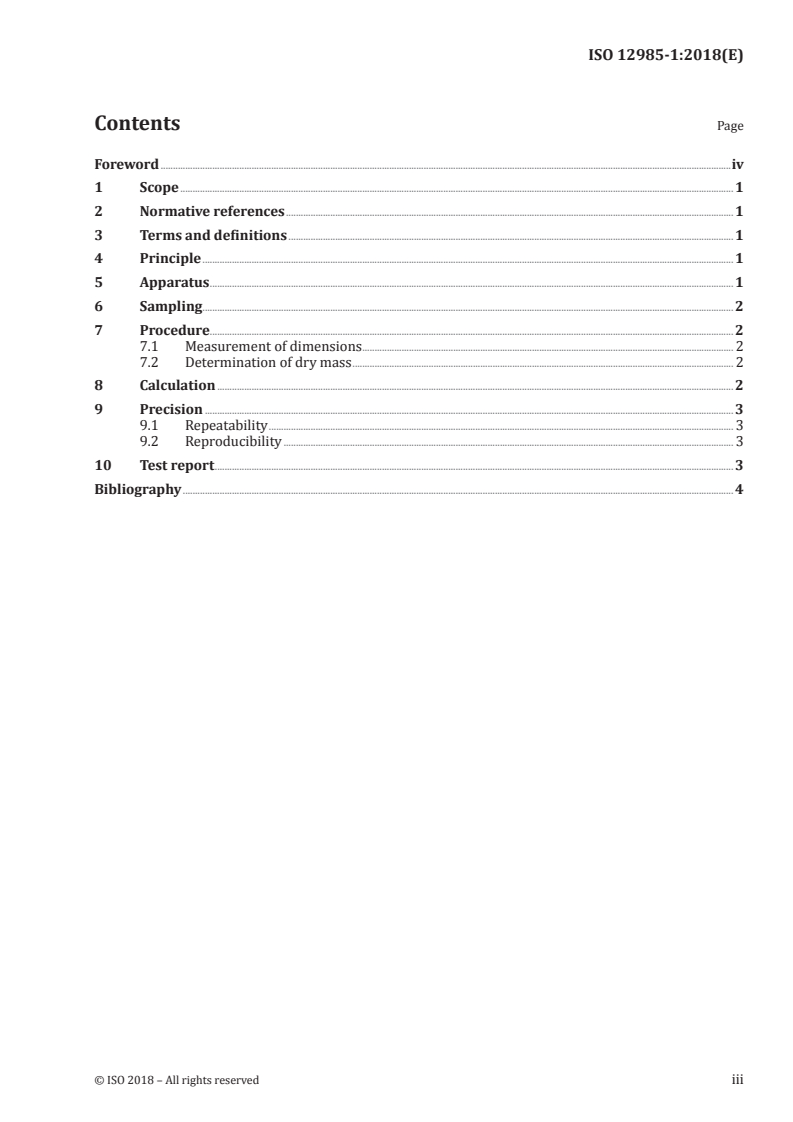
Contents Page
Foreword .iv
1 Scope . 1
2 Normative references . 1
3 Terms and definitions . 1
4 Principle . 1
5 Apparatus . 1
6 Sampling . 2
7 Procedure. 2
7.1 Measurement of dimensions . 2
7.2 Determination of dry mass . 2
8 Calculation . 2
9 Precision . 3
9.1 Repeatability . 3
9.2 Reproducibility . 3
10 Test report . 3
Bibliography . 4
Foreword
ISO (the International Organization for Standardization) is a worldwide federation of national standards
bodies (ISO member bodies). The work of preparing International Standards is normally carried out
through ISO technical committees. Each member body interested in a subject for which a technical
committee has been established has the right to be represented on that committee. International
organizations, governmental and non-governmental, in liaison with ISO, also take part in the work.
ISO collaborates closely with the International Electrotechnical Commission (IEC) on all matters of
electrotechnical standardization.
The procedures used to develop this document and those intended for its further maintenance are
described in the ISO/IEC Directives, Part 1. In particular the different approval criteria needed for the
different types of ISO documents should be noted. This document was drafted in accordance with the
editorial rules of the ISO/IEC Directives, Part 2 (see www .iso .org/directives).
Attention is drawn to the possibility that some of the elements of this document may be the subject of
patent rights. ISO shall not be held responsible for identifying any or all such patent rights. Details of
any patent rights identified during the development of the document will be in the Introduction and/or
on the ISO list of patent declarations received (see www .iso .org/patents).
Any trade name used in this document is information given for the convenience of users and does not
constitute an endorsement.
For an explanation on the voluntary nature of standards, the meaning of ISO specific terms and
expressions related to conformity assessment, as well as information about ISO's adherence to the
World Trade Organization (WTO) principles in the Technical Barriers to Trade (TBT) see the following
URL: www .iso .org/iso/foreword .ht
...
INTERNATIONAL ISO
STANDARD 12985-1
Second edition
2018-05
Carbonaceous materials used in the
production of aluminium — Baked
anodes and cathode blocks —
Part 1:
Determination of apparent density
using a dimensions method
Produits carbonés utilisés pour la production de l'aluminium —
Anodes cuites et blocs cathodiques —
Partie 1: Détermination de la masse volumique apparente par une
méthode de mesurage dimensionnel
Reference number
©
ISO 2018
© ISO 2018
All rights reserved. Unless otherwise specified, or required in the context of its implementation, no part of this publication may
be reproduced or utilized otherwise in any form or by any means, electronic or mechanical, including photocopying, or posting
on the internet or an intranet, without prior written permission. Permission can be requested from either ISO at the address
below or ISO’s member body in the country of the requester.
ISO copyright office
CP 401 • Ch. de Blandonnet 8
CH-1214 Vernier, Geneva
Phone: +41 22 749 01 11
Fax: +41 22 749 09 47
Email: copyright@iso.org
Website: www.iso.org
Published in Switzerland
ii © ISO 2018 – All rights reserved
Contents Page
Foreword .iv
1 Scope . 1
2 Normative references . 1
3 Terms and definitions . 1
4 Principle . 1
5 Apparatus . 1
6 Sampling . 2
7 Procedure. 2
7.1 Measurement of dimensions . 2
7.2 Determination of dry mass . 2
8 Calculation . 2
9 Precision . 3
9.1 Repeatability . 3
9.2 Reproducibility . 3
10 Test report . 3
Bibliography . 4
Foreword
ISO (the International Organization for Standardization) is a worldwide federation of national standards
bodies (ISO member bodies). The work of preparing International Standards is normally carried out
through ISO technical committees. Each member body interested in a subject for which a technical
committee has been established has the right to be represented on that committee. International
organizations, governmental and non-governmental, in liaison with ISO, also take part in the work.
ISO collaborates closely with the International Electrotechnical Commission (IEC) on all matters of
electrotechnical standardization.
The procedures used to develop this document and those intended for its further maintenance are
described in the ISO/IEC Directives, Part 1. In particular the different approval criteria needed for the
different types of ISO documents should be noted. This document was drafted in accordance with the
editorial rules of the ISO/IEC Directives, Part 2 (see www .iso .org/directives).
Attention is drawn to the possibility that some of the elements of this document may be the subject of
patent rights. ISO shall not be held responsible for identifying any or all such patent rights. Details of
any patent rights identified during the development of the document will be in the Introduction and/or
on the ISO list of patent declarations received (see www .iso .org/patents).
Any trade name used in this document is information given for the convenience of users and does not
constitute an endorsement.
For an explanation on the voluntary nature of standards, the meaning of ISO specific terms and
expressions related to conformity assessment, as well as information about ISO's adherence to the
World Trade Organization (WTO) principles in the Technical Barriers to Trade (TBT) see the following
URL: www .iso .org/iso/foreword .ht
...