


ISO 9554:2010
(Main)Fibre ropes — General specifications
Fibre ropes — General specifications
ISO 9554:2010 specifies the general characteristics of fibre ropes and their constituent materials. It is intended to be used in conjunction with the standards for the individual types of fibre rope, which cover the physical properties and specific requirements for that particular product type. ISO 9554:2010 also gives some information on the use of fibre ropes and also on their inspection and retirement criteria. ISO 9554:2010 does not intend to address all of the safety matters associated with its use. It is the responsibility of the user to select a rope type of the size and with the physical properties to meet the requirements of the application and to determine the applicability of regulatory limitations prior to its use.
Cordages en fibres — Spécifications générales
L'ISO 9554:2010 spécifie les caractéristiques générales des cordages en fibres et de leurs matières constitutives. Elle est destinée à être utilisée conjointement avec les normes particulières à chaque type de cordage en fibre qui traitent des propriétés physiques et des exigences particulières à chacun des types de produit. L'ISO 9554:2010 donne en outre quelques indications sur l'utilisation des cordages en fibres, ainsi que sur leur inspection et les critères de réforme. L'ISO 9554:2010 n'a pas pour objectif d'aborder toutes les questions de sécurité liées à son utilisation. Il incombe à l'utilisateur de choisir un type de cordage dont la taille et les propriétés physiques correspondent aux exigences qui s'appliquent à son cas et de déterminer l'applicabilité des restrictions réglementaires avant utilisation.
General Information
- Status
- Withdrawn
- Publication Date
- 01-Aug-2010
- Withdrawal Date
- 01-Aug-2010
- Technical Committee
- ISO/TC 38 - Textiles
- Drafting Committee
- ISO/TC 38/WG 21 - Ropes, cordage, slings and netting
- Current Stage
- 9599 - Withdrawal of International Standard
- Start Date
- 17-Jul-2019
- Completion Date
- 12-Feb-2026
Relations
- Referred By
EN ISO 1140:2012 - Fibre ropes - Polyamide - 3-, 4-, 8- and 12-strand ropes (ISO 1140:2012) - Effective Date
- 09-Feb-2026
- Effective Date
- 09-Feb-2026
- Effective Date
- 09-Feb-2026
- Effective Date
- 09-Feb-2026
- Effective Date
- 09-Feb-2026
- Referred By
EN ISO 1141:2012 - Fibre ropes - Polyester - 3-, 4-, 8- and 12-strand ropes (ISO 1141:2012) - Effective Date
- 09-Feb-2026
- Effective Date
- 12-Feb-2026
- Effective Date
- 30-Jul-2016
- Effective Date
- 14-Aug-2008
Get Certified
Connect with accredited certification bodies for this standard

Control Union Certifications
Global certification for agriculture and sustainability.

Bureau Veritas Bangladesh
Bureau Veritas certification services in Bangladesh.

ECOCERT France
Leader in organic and sustainability certification worldwide.
Sponsored listings
Frequently Asked Questions
ISO 9554:2010 is a standard published by the International Organization for Standardization (ISO). Its full title is "Fibre ropes — General specifications". This standard covers: ISO 9554:2010 specifies the general characteristics of fibre ropes and their constituent materials. It is intended to be used in conjunction with the standards for the individual types of fibre rope, which cover the physical properties and specific requirements for that particular product type. ISO 9554:2010 also gives some information on the use of fibre ropes and also on their inspection and retirement criteria. ISO 9554:2010 does not intend to address all of the safety matters associated with its use. It is the responsibility of the user to select a rope type of the size and with the physical properties to meet the requirements of the application and to determine the applicability of regulatory limitations prior to its use.
ISO 9554:2010 specifies the general characteristics of fibre ropes and their constituent materials. It is intended to be used in conjunction with the standards for the individual types of fibre rope, which cover the physical properties and specific requirements for that particular product type. ISO 9554:2010 also gives some information on the use of fibre ropes and also on their inspection and retirement criteria. ISO 9554:2010 does not intend to address all of the safety matters associated with its use. It is the responsibility of the user to select a rope type of the size and with the physical properties to meet the requirements of the application and to determine the applicability of regulatory limitations prior to its use.
ISO 9554:2010 is classified under the following ICS (International Classification for Standards) categories: 59.080.50 - Ropes. The ICS classification helps identify the subject area and facilitates finding related standards.
ISO 9554:2010 has the following relationships with other standards: It is inter standard links to EN ISO 1140:2012, EN ISO 2307:2010, EN ISO 2307:2019, EN ISO 1346:2012, EN ISO 10325:2018, EN ISO 1141:2012, EN ISO 9554:2010, ISO 9554:2019, ISO 9554:2005. Understanding these relationships helps ensure you are using the most current and applicable version of the standard.
ISO 9554:2010 is available in PDF format for immediate download after purchase. The document can be added to your cart and obtained through the secure checkout process. Digital delivery ensures instant access to the complete standard document.
Standards Content (Sample)
INTERNATIONAL ISO
STANDARD 9554
Third edition
2010-08-15
Fibre ropes — General specifications
Cordages en fibres — Spécifications générales
Reference number
©
ISO 2010
PDF disclaimer
This PDF file may contain embedded typefaces. In accordance with Adobe's licensing policy, this file may be printed or viewed but
shall not be edited, unless the typefaces which are embedded are licensed to and installed on the computer performing the editing. In
downloading this file, parties accept therein the responsibility of not infringing Adobe's licensing policy. The ISO Central Secretariat
accepts no liability in this area.
Adobe is a trademark of Adobe Systems Incorporated.
Details of the software products used to create this PDF file can be found in the General Info relative to the file; the PDF-creation
parameters were optimized for printing. Every care has been taken to ensure that the file is suitable for use by ISO member bodies. In
the unlikely event that a problem relating to it is found, please inform the Central Secretariat at the address given below.
© ISO 2010
All rights reserved. Unless otherwise specified, no part of this publication may be reproduced or utilized in any form or by any means,
electronic or mechanical, including photocopying and microfilm, without permission in writing from either ISO at the address below or
ISO's member body in the country of the requester.
ISO copyright office
Case postale 56 • CH-1211 Geneva 20
Tel. + 41 22 749 01 11
Fax + 41 22 749 09 47
E-mail copyright@iso.org
Web www.iso.org
Published in Switzerland
ii © ISO 2010 – All rights reserved
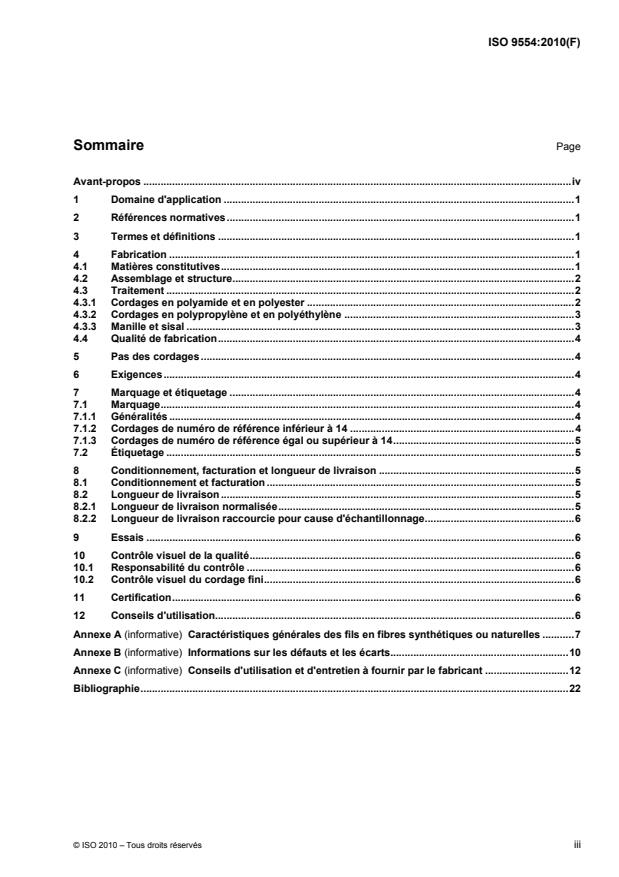
Contents Page
Foreword .iv
1 Scope.1
2 Normative references.1
3 Terms and definitions .1
4 Manufacture .1
4.1 Constituent materials.1
4.2 Construction and structure .2
4.3 Treatment .2
4.3.1 Polyamide and polyester ropes .2
4.3.2 Polypropylene and polyethylene ropes .3
4.3.3 Manila and sisal .3
4.4 Workmanship.3
5 Lay length or braid pitch.4
6 Requirements.4
7 Marking and labelling.4
7.1 Marking.4
7.1.1 General .4
7.1.2 Ropes of reference number less than 14.4
7.1.3 Ropes of reference number equal to or greater than 14 .4
7.2 Labelling.5
8 Packaging, invoicing and delivered length.5
8.1 Packaging and invoicing .5
8.2 Delivered length.5
8.2.1 Standard delivered length .5
8.2.2 Shorter delivered length due to sampling .5
9 Testing.6
10 Visual quality control .6
10.1 Responsibility for inspection .6
10.2 Finished-rope visual control .6
11 Certification.6
12 Instructions for use .6
Annex A (informative) Typical characteristics of the yarns for man-made and natural fibres .7
Annex B (informative) Information on defects and variances.10
Annex C (informative) Information for use and maintenance to be provided by the manufacturer.12
Bibliography.22
Foreword
ISO (the International Organization for Standardization) is a worldwide federation of national standards bodies
(ISO member bodies). The work of preparing International Standards is normally carried out through ISO
technical committees. Each member body interested in a subject for which a technical committee has been
established has the right to be represented on that committee. International organizations, governmental and
non-governmental, in liaison with ISO, also take part in the work. ISO collaborates closely with the
International Electrotechnical Commission (IEC) on all matters of electrotechnical standardization.
International Standards are drafted in accordance with the rules given in the ISO/IEC Directives, Part 2.
The main task of technical committees is to prepare International Standards. Draft International Standards
adopted by the technical committees are circulated to the member bodies for voting. Publication as an
International Standard requires approval by at least 75 % of the member bodies casting a vote.
Attention is drawn to the possibility that some of the elements of this document may be the subject of patent
rights. ISO shall not be held responsible for identifying any or all such patent rights.
ISO 9554 was prepared by Technical Committee ISO/TC 38, Textiles.
This third edition cancels and replaces the second edition (ISO 9554:2005), which has been technically
revised.
iv © ISO 2010 – All rights reserved
INTERNATIONAL STANDARD ISO 9554:2010(E)
Fibre ropes — General specifications
1 Scope
This International Standard specifies the general characteristics of fibre ropes and their constituent materials.
It is intended to be used in conjunction with the standards for the individual types of fibre rope, which cover the
physical properties and specific requirements for that particular product type.
This International Standard also gives some information on the use of fibre ropes and also on their inspection
and retirement criteria.
This International Standard does not intend to address all of the safety matters associated with its use. It is the
responsibility of the user to select a rope type of the size and with the physical properties to meet the
requirements of the application and to determine the applicability of regulatory limitations prior to its use.
2 Normative references
The following referenced documents are indispensable for the application of this document. For dated
references, only the edition cited applies. For undated references, the latest edition of the referenced
document (including any amendments) applies.
ISO 1140, Fibre ropes — Polyamide — 3-, 4- and 8-strand ropes
ISO 1141, Fibre ropes — Polyester — 3-, 4- and 8-strand ropes
ISO 1968, Fibre ropes and cordage — Vocabulary
ISO 2307, Fibre ropes — Determination of certain physical and mechanical properties
3 Terms and definitions
For the purposes of this document, the terms and definitions given in ISO 1968 apply.
4 Manufacture
4.1 Constituent materials
The following materials are considered in this International Standard:
a) natural fibres:
⎯ sisal;
⎯ manila;
⎯ hemp;
b) man-made fibres:
⎯ polyamide;
⎯ polyester;
⎯ polypropylene;
⎯ polyethylene;
⎯ mixed polyolefin;
⎯ polyester/polyolefin dual fibres;
⎯ high modulus polyethylene.
Typical characteristics for these materials are given in Annex A. Specific applications should involve technical
discussions with rope manufacturers.
4.2 Construction and structure
Unless otherwise specified, 3-, 4- and 6-strand laid ropes shall be Z-twist (right-hand lay), their strands S-twist
and their roping yarns Z-twist.
The 8-strand braided ropes shall consist of four S-twist strands and four Z-twist strands arranged so that
S-twist strands alternate (individually or in pairs) with Z-twist strands (individually or in pairs).
The 12-strand braided ropes shall consist of six S-twist strands and six Z-twist strands arranged so that
S-twist strands alternate (individually or in pairs) with Z-twist strands (individually or in pairs).
A double-braided rope shall consist of a number of strands that are braided to form a core, around which
additional strands are braided to form a sheath. The core lies coaxially within the sheath. The number of
strands varies, based upon the size of the rope.
A parallel rope construction consists of a number of sub-ropes protected by a non-load-bearing cover.
Each strand shall consist of an equal number of rope yarns sufficient to provide the characteristics specified in
the International Standard for the relevant product. For ropes of reference number 36 or higher, the number of
yarns in each strand may differ by one yarn or ±2,5 % from the intended number of yarns in the strand.
The ropes and their strands shall be continuous, without splice for standard delivered lengths or shorter
lengths.
Yarns may be joined as necessary.
The strands can be assembled yarns as well.
NOTE National legislations can place additional requirements concerning rope construction.
4.3 Treatment
4.3.1 Polyamide and polyester ropes
4.3.1.1 Polyamide and polyester laid ropes that are required to have a heat setting on the rope to ensure
lay and dimensional stability are designated as type 1 ropes in ISO 1140 and ISO 1141.
4.3.1.2 In other cases, polyamide and polyester laid ropes that are not required to have a heat setting on
the rope are designated as type 2 ropes in ISO 1140 and ISO 1141.
2 © ISO 2010 – All rights reserved
4.3.1.3 The ropes shall be supplied in their natural state without additives to weight the rope or coating
treatment.
The fibre producer or the rope manufacturer may apply lubricants for enhanced performance. The total
amount of additives or extractable materials shall not exceed 2,5 % in mass.
4.3.1.4 The colour of the rope shall be natural, unless otherwise requested.
Upon request of the purchaser, the manufacturer may use a coating or impregnation of the product for special
applications.
4.3.1.5 The figures for linear density and minimum breaking force in ISO 1140 and in ISO 1141 are the
same for type 1 and type 2 ropes.
4.3.2 Polypropylene and polyethylene ropes
Polypropylene and polyethylene ropes shall be protected against deterioration due to sunlight (UV).
The inhibiting system used should ensure the expected performance in usage under the foreseen
geographical areas for applications, provided that the manufacturer is kept informed by the user.
4.3.3 Manila and sisal
4.3.3.1 General
All ropes of manila and of sisal shall be made exclusively of new fibres.
4.3.3.2 Manila
A cordage oil lubricant of suitable quality shall be applied. The lubricant shall not impart an offensive odour to
the finished rope. The percentage of extractable matter based on the dry weight of the rope shall not be less
than 11,5 % nor more than 16,5 %.
When specified, the rope shall have a mildew-resistant treatment.
Anti-bacterial additives for manila may be added to extend the performance of the natural fibre when
requested by the purchaser.
4.3.3.3 Sisal
A cordage oil lubricant of suitable quality shall be applied. The lubricant shall not impart an offensive odour to
the finished rope. The percentage of extractable matter based on the dry weight of the rope shall not be more
than 11,5 % for an un-oiled product and not more than 16,5 % for an oiled product.
When specified, the rope shall be free from any oils and sold as un-oiled rope.
Anti-bacterial additives for sisal may be added to extend the performance of the natural fibre when requested
by the purchaser.
4.4 Workmanship
4.4.1 The finished rope shall contain no cuts, kinks or soft spots caused by change in lay or pitch length,
hockles, chafed or damaged sections, or broken, loose or projecting ends in the rope or the strands.
4.4.2 The unspliced ends of all ropes shall be cut off squarely and shall be securely whipped, taped or heat-
sealed.
5 Lay length or braid pitch
The manufacturer shall establish the lay length or the braid pitch of the rope according to its intended use, or
based upon the purchaser's acceptance.
NOTE For a given reference number of rope, the smaller the lay length or braid pitch the harder the rope will be; this
hardness can affect the estimated breaking strength of the rope.
6 Requirements
The main requirements shall be those specified in the relevant International Standard for the product and shall
include the following:
a) linear density;
b) minimum breaking force;
c) reference number.
The corresponding test methods are specified in ISO 2307.
Other requirements, for example the lay length, the braid pitch, the diameter of the circumscribed circle, and
the elongation of the rope under specific tensile conditions, may be specified, subject to agreement between
the manufacturer and the purchaser, where applicable with the submission of a sample.
7 Marking and labelling
7.1 Marking
7.1.1 General
The identification of the material, quality and origin of a fibre rope conforming to this International Standard
shall be marked using a tape placed within the article (see 7.1.3) so as to remain recognizable despite soiling,
soaking or discoloration during use.
The tape shall be at least 3 mm wide, and shall be printed with the number of the relevant International
Standard, and a reference identifying the manufacturer. The maximum distance between two consecutive
markings shall be 0,5 m.
7.1.2 Ropes of reference number less than 14
These do not need to be marked, unless specified in a product standard.
7.1.3 Ropes of reference number equal to or greater than 14
A marker tape as defined in 7.1.1 shall be incorporated into the centre of one strand for 3-, 4-, 8- and
12-strand ropes. Double-braided ropes shall have a marker tape in or outside the core.
For covered ropes, the marking tape shall be incorporated between the cover and the core or within the core.
4 © ISO 2010 – All rights reserved
7.2 Labelling
Each coil shall have a label, which is firmly fixed in place, giving the following information:
⎯ constituent material;
⎯ identification of manufacturer and country of origin;
⎯ reference number;
⎯ delivered length;
⎯ declaration of conformity to this International Standard relating to the constituent material (e.g. “in
accordance with ISO 9554”).
8 Packaging, invoicing and delivered length
8.1 Packaging and invoicing
8.1.1 The packaging unit may be a reel, a coil, a hank, a box, a bag or as specified by the purchaser.
8.1.2 The finished rope shall be supplied in a package, so that it can be dispensed freely without
entanglement of any kind.
8.1.3 Either the unit mass or the length may be used to invoice the rope. When the gross mass is used for
invoicing, the mass of the packaging shall not exceed 1,5 % of the gross mass of the rope.
8.2 Delivered length
8.2.1 Standard delivered length
The length of the coil shall be determined by dividing the mass of the coil by the mass per metre of the rope,
determined in accordance with ISO 2307.
The limit deviation on delivered length shall be
⎯ −5 % for ropes with a reference number less than or equal to 14, or
⎯ −3 % for ropes with a reference number greater than 14,
on condition that the gross mass corresponding to the delivered length is not less than the product of the
minimum linear density and the theoretical delivered length.
Standard delivered lengths are the following:
100 m; 183 m; 200 m; 220 m; 366 m.
Other lengths may be supplied for special orders.
8.2.2 Shorter delivered length due to sampling
To carry out testing at the request of the purchaser, test pieces may be taken from the ordered length of rope.
The length of rope delivered shall then be less than the ordered length because of these test pieces (which
are considered to be part of the delivery).
In the event that a specific length is required and testing is required, the purchaser may be invoiced the
additional length or mass of the rope required to perform such testing.
9 Testing
9.1 The testing of the finished rope shall be conducted as specified in the applicable International Standard
and in the purchase order or contract.
9.2 The required length and number of test samples shall be removed from the selected test reels as
outlined in 8.2.2, if required.
9.3 Test reports shall be prepared in accordance with the contract or the purchase order.
10 Visual quality control
10.1 Responsibility for inspection
Unless otherwise specified in the contract or in the purchase order, the rope manufacturer is responsible for
the performance of all quality-control requirements specified in this International Standard and in the
applicable fibre rope standard. The purchaser shall have the option to have a representative present during
the control by the manufacturer. The purchaser, at his/her expense, reserves the right to perform or have a
third party perform any of the controls set forth in the specification where controls are deemed necessary to
ensure that ropes conform to specifications. A representative of the rope manufacturer shall have the option to
be present during these controls.
10.2 Finished-rope visual control
Each sample shall be subject to visual examination. The samples shall be selected at random. If any defects
are noted in the original test units, an equal number of additional test units shall be selected at random and, if
any specified defects are noted, the entire lot shall be rejected. See Annex B.
11 Certification
When requested by the purchaser, the manufacturer of the rope shall issue certificates of conformity with the
relevant International Standard when invoicing. These certificates shall always be available for any of the
phases of the distribution and/or usage of the rope.
If certification is required, it shall be requested at the time of placing the order.
12 Instructions for use
The manufacturer shall provide the purchaser with a set of instructions for the use and maintenance of fibre
ropes.
NOTE Recommendations on information for the use and maintenance of fibre ropes to be provided by the
manufacturer are given in Annex C.
6 © ISO 2010 – All rights reserved
Annex A
(informative)
Typical characteristics of the yarns for man-made and natural fibres
8 © ISO 2010 – All rights reserved
Table A.1 — Typical characteristics of the yarns for man-made and natural fibres
Physical properties Environmental properties
International
Fibre Standard for Sunlight
Approximate Elongation Abrasion Creep Moisture Environmental Effects of chemical
Tenacity (UV)
rope type
ab b bc e
gravity at break resistance resistance regain resistance exposure
bd
resistance
kg/dm gf/denier N/tex % %
f
Polyamide ISO 1140 1,14 7,5 to 10,5 0,66 to 0,93 14 to 28 dry 5 2 to 3 4 to 6 5 4 Resistant to weak acids,
alkalis and organic
SO 10554
I
solvents.
wet 2 Decomposed by strong
mineral acids.
Soluble in phenols and
formic acid.
f
Polyester ISO 1141 1,38 7,5 to 10,0 0,66 to 0,88 10 to 18 4 to 5 4 <1 5 5 Resistant to mineral acids
and organic solvents.
ISO 10547
Decomposed by strong
sulfuric acids and strong
alkalis at a high
temperature.
Soluble in phenols.
Polypropylene ISO 1346 0,91 split 4,5 to 5,0 0,40 to 0,44 8 to 12 2 2 0 3 2 Resistant to acids, alkalis
and organic solvents.
mono 6,0 to 6,5 0,53 to 0,57 12 to 18
oluble i c orinated
S n hl
m 6 0 t 9, 0,53 t 0,57 20 to 24
ulti , o 5 o
hydrocarbons.
g g
0,63 to 0,84 16 to 20
Polyethylene ISO 1969 0,95 5,5 to 9,0 0,49 to 0,79 16 to 24 3 1 0 4 to 5 4 Resistant to acids, alkalis
and organic solvents.
Soluble in chlorinated
hydrocarbons.
Mixed ISO 10572 0,92 6,5 to 8,5 0,57 to 0,75 12 to 18 3 2 0 3
...
NORME ISO
INTERNATIONALE 9554
Troisième édition
2010-08-15
Cordages en fibres — Spécifications
générales
Fibre ropes — General specifications
Numéro de référence
©
ISO 2010
PDF – Exonération de responsabilité
Le présent fichier PDF peut contenir des polices de caractères intégrées. Conformément aux conditions de licence d'Adobe, ce fichier
peut être imprimé ou visualisé, mais ne doit pas être modifié à moins que l'ordinateur employé à cet effet ne bénéficie d'une licence
autorisant l'utilisation de ces polices et que celles-ci y soient installées. Lors du téléchargement de ce fichier, les parties concernées
acceptent de fait la responsabilité de ne pas enfreindre les conditions de licence d'Adobe. Le Secrétariat central de l'ISO décline toute
responsabilité en la matière.
Adobe est une marque déposée d'Adobe Systems Incorporated.
Les détails relatifs aux produits logiciels utilisés pour la création du présent fichier PDF sont disponibles dans la rubrique General Info
du fichier; les paramètres de création PDF ont été optimisés pour l'impression. Toutes les mesures ont été prises pour garantir
l'exploitation de ce fichier par les comités membres de l'ISO. Dans le cas peu probable où surviendrait un problème d'utilisation,
veuillez en informer le Secrétariat central à l'adresse donnée ci-dessous.
DOCUMENT PROTÉGÉ PAR COPYRIGHT
© ISO 2010
Droits de reproduction réservés. Sauf prescription différente, aucune partie de cette publication ne peut être reproduite ni utilisée sous
quelque forme que ce soit et par aucun procédé, électronique ou mécanique, y compris la photocopie et les microfilms, sans l'accord écrit
de l'ISO à l'adresse ci-après ou du comité membre de l'ISO dans le pays du demandeur.
ISO copyright office
Case postale 56 • CH-1211 Geneva 20
Tel. + 41 22 749 01 11
Fax + 41 22 749 09 47
E-mail copyright@iso.org
Web www.iso.org
Publié en Suisse
ii © ISO 2010 – Tous droits réservés
Sommaire Page
Avant-propos .iv
1 Domaine d'application .1
2 Références normatives.1
3 Termes et définitions .1
4 Fabrication .1
4.1 Matières constitutives.1
4.2 Assemblage et structure.2
4.3 Traitement .2
4.3.1 Cordages en polyamide et en polyester .2
4.3.2 Cordages en polypropylène et en polyéthylène .3
4.3.3 Manille et sisal .3
4.4 Qualité de fabrication.4
5 Pas des cordages .4
6 Exigences.4
7 Marquage et étiquetage .4
7.1 Marquage.4
7.1.1 Généralités .4
7.1.2 Cordages de numéro de référence inférieur à 14 .4
7.1.3 Cordages de numéro de référence égal ou supérieur à 14.5
7.2 Étiquetage .5
8 Conditionnement, facturation et longueur de livraison .5
8.1 Conditionnement et facturation .5
8.2 Longueur de livraison.5
8.2.1 Longueur de livraison normalisée.5
8.2.2 Longueur de livraison raccourcie pour cause d'échantillonnage.6
9 Essais .6
10 Contrôle visuel de la qualité.6
10.1 Responsabilité du contrôle .6
10.2 Contrôle visuel du cordage fini.6
11 Certification.6
12 Conseils d'utilisation.6
Annexe A (informative) Caractéristiques générales des fils en fibres synthétiques ou naturelles .7
Annexe B (informative) Informations sur les défauts et les écarts.10
Annexe C (informative) Conseils d'utilisation et d'entretien à fournir par le fabricant .12
Bibliographie.22
Avant-propos
L'ISO (Organisation internationale de normalisation) est une fédération mondiale d'organismes nationaux de
normalisation (comités membres de l'ISO). L'élaboration des Normes internationales est en général confiée
aux comités techniques de l'ISO. Chaque comité membre intéressé par une étude a le droit de faire partie du
comité technique créé à cet effet. Les organisations internationales, gouvernementales et non
gouvernementales, en liaison avec l'ISO participent également aux travaux. L'ISO collabore étroitement avec
la Commission électrotechnique internationale (CEI) en ce qui concerne la normalisation électrotechnique.
Les Normes internationales sont rédigées conformément aux règles données dans les Directives ISO/CEI,
Partie 2.
La tâche principale des comités techniques est d'élaborer les Normes internationales. Les projets de Normes
internationales adoptés par les comités techniques sont soumis aux comités membres pour vote. Leur
publication comme Normes internationales requiert l'approbation de 75 % au moins des comités membres
votants.
L'attention est appelée sur le fait que certains des éléments du présent document peuvent faire l'objet de
droits de propriété intellectuelle ou de droits analogues. L'ISO ne saurait être tenue pour responsable de ne
pas avoir identifié de tels droits de propriété et averti de leur existence.
L'ISO 9554 a été élaborée par le comité technique ISO/TC 38, Textiles.
Cette troisième édition annule et remplace la deuxième édition (ISO 9554:2005), dont elle constitue une
révision technique.
iv © ISO 2010 – Tous droits réservés
NORME INTERNATIONALE ISO 9554:2010(F)
Cordages en fibres — Spécifications générales
1 Domaine d'application
La présente Norme internationale spécifie les caractéristiques générales des cordages en fibres et de leurs
matières constitutives. Elle est destinée à être utilisée conjointement avec les normes particulières à chaque
type de cordage en fibre qui traitent des propriétés physiques et des exigences particulières à chacun des
types de produit.
La présente Norme internationale donne en outre quelques indications sur l'utilisation des cordages en fibres,
ainsi que sur leur inspection et les critères de réforme.
La présente Norme internationale n'a pas pour objectif d'aborder toutes les questions de sécurité liées à son
utilisation. Il incombe à l'utilisateur de choisir un type de cordage dont la taille et les propriétés physiques
correspondent aux exigences qui s'appliquent à son cas et de déterminer l'applicabilité des restrictions
réglementaires avant utilisation.
2 Références normatives
Les documents de référence suivants sont indispensables pour l'application du présent document. Pour les
références datées, seule l'édition citée s'applique. Pour les références non datées, la dernière édition du
document de référence s'applique (y compris les éventuels amendements).
ISO 1140, Cordages en fibres — Polyamide — Cordages à 3, 4 et 8 torons
ISO 1141, Cordages en fibres — Polyester — Cordages à 3, 4 et 8 torons
ISO 1968, Cordages en fibres et articles de corderie — Vocabulaire
ISO 2307, Cordages en fibres — Détermination de certaines caractéristiques physiques et mécaniques
3 Termes et définitions
Pour les besoins du présent document, les termes et définitions donnés dans l'ISO 1968 s'appliquent.
4 Fabrication
4.1 Matières constitutives
Les matières suivantes sont prises en compte dans la présente Norme internationale:
a) fibres naturelles:
⎯ sisal,
⎯ manille,
⎯ chanvre;
b) fibres synthétiques:
⎯ polyamide,
⎯ polyester,
⎯ polypropylène,
⎯ polyéthylène,
⎯ polyoléfines mélangées,
⎯ fibres bi-matériaux en polyester/polyoléfine,
⎯ polyéthylène à haut module.
Les caractéristiques générales de ces matériaux sont indiquées dans l'Annexe A. Pour toute application
spécifique, il convient d'examiner les aspects techniques avec les fabricants de cordages.
4.2 Assemblage et structure
Les cordages câblés à 3, à 4 ou à 6 torons doivent être formés, sauf spécification contraire, de torons câblés
en torsion Z (vers la droite), ces torons étant eux-mêmes constitués de fils simples ou de fils retors en
torsion Z assemblés en torsion S.
Les cordages tressés à 8 torons doivent être formés de quatre torons tordus dans le sens S et de quatre
torons tordus dans le sens Z, entrecroisés de sorte que les torons en torsion S alternent (individuellement ou
par paire) avec les torons en torsion Z (individuellement ou par paire).
Les cordages tressés à 12 torons doivent être formés de six torons tordus dans le sens S et de six torons
tordus dans le sens Z, entrecroisés de sorte que les torons en torsion S alternent (individuellement ou par
paire) avec les torons en torsion Z (individuellement ou par paire).
Un cordage coaxial doit être formé d'un certain nombre de torons tressés pour former une âme autour de
laquelle d'autres torons sont tressés pour former la gaine. L'âme et la gaine sont coaxiales. Le nombre de
torons est variable et dépend de la taille du cordage.
Un assemblage parallèle de cordages se compose d'un certain nombre de sous-cordages protégés par une
couverture non porteuse.
Chaque toron doit comporter un nombre identique de fils, suffisant pour répondre aux caractéristiques
spécifiées dans la Norme internationale pour le produit concerné. Pour des cordages de numéro de référence
égal ou supérieur à 36, le nombre de fils dans chaque toron peut différer d'un fil ou de ±2,5 % par rapport au
nombre prévu de fils par toron.
Les cordages et leurs torons doivent être continus, sans épissure pour les longueurs de livraison courantes ou
raccourcies.
Selon les besoins, les fils peuvent être réunis en faisceaux.
Les torons peuvent également être constitués de fils assemblés.
NOTE Les législations nationales peuvent mettre en place des exigences supplémentaires relatives à l'assemblage
des cordages.
4.3 Traitement
4.3.1 Cordages en polyamide et en polyester
4.3.1.1 Les cordages câblés en polyamide et en polyester qui doivent être thermofixés afin de garantir la
stabilité des dimensions et du pas sont qualifiés de cordage de type 1 dans l'ISO 1140 et l'ISO 1141.
2 © ISO 2010 – Tous droits réservés
4.3.1.2 Dans les autres cas, les cordages câblés en polyamide et en polyester qu'il n'y a pas lieu de
thermofixer sont qualifiés de cordage de type 2 dans l'ISO 1140 et l'ISO 1141.
4.3.1.3 Les cordages doivent être livrés sans additifs, pour ne pas les alourdir, ou sans avoir subi de
traitement d'enduction.
Les producteurs de fibres ou les fabricants de cordages peuvent utiliser des lubrifiants afin d'améliorer les
performances de leurs produits. La quantité totale d'additifs et de matières extractibles ne doit pas
dépasser 2,5 % en masse.
4.3.1.4 Sauf indication contraire, le cordage doit être de couleur écrue.
Sur demande de l'acheteur, le fabricant peut enduire ou imprégner l'article en vue d'utilisations particulières.
4.3.1.5 Les valeurs de la masse linéique et de la force minimale de rupture dans l'ISO 1140 et l'ISO 1141
sont les mêmes pour les cordages de type 1 et de type 2.
4.3.2 Cordages en polypropylène et en polyéthylène
Les cordages en polypropylène et en polyéthylène doivent être protégés contre la dégradation à la lumière
solaire (UV).
Il convient que le système d'inhibition utilisé garantisse, en cours d'usage, le niveau de performance
correspondant à la zone géographique prévue, dans la mesure où le producteur est tenu informé par
l'utilisateur.
4.3.3 Manille et sisal
4.3.3.1 Généralités
Tous les cordages en manille et en sisal doivent être fabriqués exclusivement à partir de fibres neuves.
4.3.3.2 Manille
Un lubrifiant pour cordages d'une qualité appropriée doit être appliqué. Le lubrifiant ne doit conférer au
cordage fini aucune odeur désagréable. Le pourcentage de matière extractible, rapporté à la masse du
cordage à sec, doit être compris entre une valeur minimale de 11,5 % et une valeur maximale de 16,5 %.
Si cela est spécifié, le cordage doit subir un traitement antimoisissure.
Sur demande de l'acheteur, des additifs antibactériens pour manille peuvent être ajoutés afin d'accroître les
performances de la fibre naturelle.
4.3.3.3 Sisal
Un lubrifiant pour cordages d'une qualité appropriée doit être appliqué. Le lubrifiant ne doit conférer au
cordage fini aucune odeur désagréable. Le pourcentage de matière extractible, rapporté à la masse du
cordage à sec, ne doit pas dépasser 11,5 % pour un cordage non ensimé et 16,5 % pour un cordage ensimé.
Si cela est spécifié, le cordage doit être exempt de tout lubrifiant et vendu comme cordage non lubrifié.
Sur demande de l'acheteur, des additifs antibactériens pour sisal peuvent être ajoutés afin d'accroître les
performances de la fibre naturelle.
4.4 Qualité de fabrication
4.4.1 Le cordage fini ne doit comporter aucune entaille, coque ou faiblesse dues à un pas irrégulier, aucune
déformation, partie raguée ou abîmée, aucun brin manquant, flottant ou ressortant du cordage ou de ses
torons.
4.4.2 Les extrémités non épissées de tous les cordages doivent être sectionnées perpendiculairement et
sécurisées par surliure, ruban adhésif ou thermosoudure.
5 Pas des cordages
Le fabricant doit déterminer le pas de commettage ou de tressage des cordages en fonction de l'utilisation
envisagée, ou sous réserve de l'acceptation de l'acheteur.
NOTE Pour un numéro de référence donné, plus le pas est petit, plus le cordage sera dur; cette dureté peut modifier
la résistance à la rupture estimée du cordage.
6 Exigences
Les principales exigences doivent être celles spécifiées dans les Normes internationales de produit
particulières à chaque cordage et concerner:
a) la masse linéique;
b) la force de rupture minimale;
c) le numéro de référence.
Les méthodes d'essai correspondantes sont spécifiées dans l'ISO 2307.
D'autres exigences, par exemple le pas, le diamètre du cercle circonscrit et l'allongement du cordage dans
des conditions de traction déterminées, peuvent être spécifiées et font alors l'objet d'un accord entre le
fabricant et l'acheteur avec, s'il y a lieu, la présentation d'un échantillon.
7 Marquage et étiquetage
7.1 Marquage
7.1.1 Généralités
La désignation de la matière, de la qualité et de l'origine d'un cordage en fibres, conforme à la présente
Norme internationale, doit se faire au moyen d'un ruban placé à l'intérieur de l'article (voir 7.1.3) de sorte que
le marquage demeure reconnaissable malgré les salissures, les dégorgements ou les décolorations
intervenant en cours d'usage.
Le ruban sur lequel doit se trouver imprimé le numéro de la Norme internationale pertinente, ainsi que des
coordonnées permettant d'identifier le fabricant, doit avoir une largeur minimale de 3 mm. L'espacement
maximal entre deux marquages consécutifs doit être de 0,5 m.
7.1.2 Cordages de numéro de référence inférieur à 14
Ces cordages n'ont pas besoin d'être marqués, sauf spécification contraire dans une norme relative au produit.
4 © ISO 2010 – Tous droits réservés
7.1.3 Cordages de numéro de référence égal ou supérieur à 14
Un ruban marqueur, tel que défini en 7.1.1, doit être inclus au centre d'un des torons pour les cordages
tressés à 3, à 4, à 8 et à 12 torons. Les cordages coaxiaux doivent avoir un ruban marqueur à l'intérieur ou à
l'extérieur de l'âme.
Pour les cordages avec couverture, le ruban de marquage doit être inclus entre la couverture et l'âme ou à
l'intérieur de l'âme.
7.2 Étiquetage
Chaque couronne doit porter une étiquette solidement fixée et donnant les renseignements suivants:
⎯ la matière constitutive;
⎯ la désignation du fabricant et du pays d'origine;
⎯ le numéro de référence;
⎯ la longueur de livraison;
⎯ une déclaration de conformité à la Norme internationale relative à la matière constitutive (par exemple
«conforme à l'ISO 9554»).
8 Conditionnement, facturation et longueur de livraison
8.1 Conditionnement et facturation
8.1.1 L'unité de conditionnement peut être la bobine, la couronne, l'écheveau, le carton, le sac ou une
forme spécifiée par l'acheteur.
8.1.2 Le cordage fini doit être livré dans un conditionnement tel qu'il puisse être déroulé sans contrainte et
sans s'emmêler d'aucune façon.
8.1.3 Le cordage peut être facturé soit d'après sa masse unitaire, soit d'après sa longueur. Lorsque la
masse brute sert à la facturation, la masse du conditionnement ne doit pas dépasser 1,5 % de la masse brute
du cordage.
8.2 Longueur de livraison
8.2.1 Longueur de livraison normalisée
La longueur de la couronne doit être obtenue en divisant la masse de la couronne par la masse linéique du
cordage, déterminée conformément à l'ISO 2307.
L'écart limite sur les longueurs de livraison doit être de:
⎯ −5 % pour des cordages de numéro de référence inférieur ou égal à 14, ou
⎯ −3 % pour des cordages de numéro de référence supérieur à 14,
à condition que la masse brute correspondant à la longueur de livraison ne soit pas inférieure au produit de la
masse linéique minimale par la longueur théorique de livraison.
Les longueurs de livraison normalisées sont les suivantes:
100 m; 183 m; 200 m; 220 m; 366 m.
D'autres longueurs peuvent être livrées sur commande spéciale.
8.2.2 Longueur de livraison raccourcie pour cause d'échantillonnage
Pour la réalisation d'essais à la demande de l'acheteur, des prélèvements d'éprouvettes peuvent être
effectués sur la longueur de cordage commandée. La longueur de cordage livrée est alors nécessairement
inférieure à celle commandée (puisque les éprouvettes sont considérées comme étant comprises dans la
livraison).
Dans l'éventualité où une longueur particulière est exigée et où des essais sont requis, l'acheteur peut se voir
facturer en supplément la longueur ou la masse de cordage nécessaire à la réalisation des essais.
9 Essais
9.1 L'essai du cordage fini doit être réalisé comme spécifié dans la Norme internationale applicable et dans
la commande ou le contrat.
9.2 Au besoin, comme prévu en 8.2.2, la longueur et le nombre d'échantillons pour essai requis doivent
être prélevés sur les bobines choisies pour essai.
9.3 Les rapports d'essai doivent être établis conformément au contrat ou à la commande.
10 Contrôle visuel de la qualité
10.1 Responsabilité du contrôle
Sauf spécification contraire dans le contrat ou la commande, le fabricant de cordages est responsable du
respect de toutes les exigences du contrôle de qualité spécifiées dans la présente Norme internationale et
dans le norme de produit applicable. L'acheteur doit avoir la possibilité de se faire représenter par une
personne lors du contrôle effectué par le fabricant. L'acheteur se réserve le droit, à ses propres frais,
d'exécuter ou de faire exécuter par un tiers n'importe quel contrôle énoncé dans les spécifications lorsque des
contrôles sont jugés nécessaires pour établir que des cordages sont conformes à ces spécifications. Un
représentant du fabricant de cordages doit avoir la possibilité d'assister à ces contrôles.
10.2 Contrôle visuel du cordage fini
Chaque échantillon doit être soumis à un examen visuel. Les échantillons doivent être prélevés au hasard. Si
un défaut quelconque est observé dans les échantillons originaux pour essai, un nombre identique
d'échantillons pour essai supplémentaires doit être de nouveau prélevé au hasard et, si l'un des défauts
indiqués est observé, le lot entier doit être rejeté. Voir l'Annexe B.
11 Certification
Sur demande de l'acheteur, le fabricant de cordages doit, lors de la facturation, délivrer des certificats de
conformité à la Norme internationale pertinente. Ces certificats doivent être disponibles en tout temps, quel
que soit le stade de distribution et/ou d'usage du cordage.
Si une certification est requise, elle doit être demandée au moment de passer commande.
12 Conseils d'utilisation
Le fabricant doit fournir à l'acheteur des instructions portant sur l'utilisation et l'entretien des cordages en
fibres.
NOTE Des recommandations relatives aux instructions d'utilisation et d'entretien à fournir par le fabricant sont
données dans l'Annexe C.
6 © ISO 2010 – Tous droits réservés
Annexe A
(informative)
Caractéristiques générales des fils en fibres synthétiques ou naturelles
8 © ISO 2010 – Tous droits réservés
Tableau A.1 — Caractéristiques générales des fils en fibres synthétiques ou naturelles
Propriétés physiques Propriétés liées à l'environnement
Norme
Résistance
internationale
Masse Résistance Résistance à la
Fibre
Allongement Résistance Reprise Effets de l'exposition à
de cordage
volumique Ténacité à environ- lumière
b e
à la rupture au fluage d'humidité des agents chimiques
correspondante ab bc
approximative l'abrasion nementale solaire
bd
(UV)
kg/dm gf/denier N/tex % %
f
Polyamide ISO 1140 1,14 7,5 à 10,5 0,66 à 0,93 14 à 28 Sec 5 2 à 3 4 à 6 5 4 Résistance aux acides
faibles, aux alcalis et aux
ISO 10554
solvants organiques.
Humide 2 Décomposition sous l'action
des acides minéraux forts.
Solubilité dans les phénols
et l'acide formique.
f
Polyester ISO 1141 1,38 7,5 à 10,0 0,66 à 0,88 10 à 18 4 à 5 4 <1 5 5 Rés stance aux ac des
i i
minéraux et aux solvants
ISO 10547
organiques.
Décomposition sous l'action
des acides sulfuriques forts
et des alcalis forts.
Solubilité dans les phénols.
Polypropylène ISO 1346 0,91 fibrillé 4,5 à 5,0 0,40 à 0,44 8 à 12 2 2 0 3 2 Résistance aux acides, aux
alcalis et aux solvants
mono 6,0 à 6,5 0,53 à 0,57 12 à 18
organiques.
multi 6,0 à 9,5 0,53 à 0,57 20 à 24
Solubilité dans les
g g
0,63 à 0,84 16 à 20 hydrocarbures chlorés.
Polyéthylène ISO 1969 0,95 5,5 à 9,0 0,49 à 0,79 16 à 24 3 1 0 4 à 5 4 Rés stanc aux ac des aux
i e i ,
alcalis et aux solvants
organiques.
Solubilité dans les
hydrocarbures chlorés.
Polyoléfine ISO 10572 0,92 6,5 à 8,5 0,57 à 0,75 12 à 18 3 2 0 3 à 4 2 à 3 Résistance aux acides, aux
mélangée alcalis et aux solvants
organiques.
Solubilité dans les
hydrocarbures chlorés.
Tableau A.1 (suite)
Propriétés physiques Propriétés liées à l'environnement
Norme
Résistance
internationale
Masse Résistance Résistance à la
Fibre
Allongement Résistance Reprise Effets de l'exposition à
de cordage
volumique Ténacité à environ- lumière
b e
à la rupture au fluage d'humidité des agents chimiques
correspondante
ab bc
approximative l'abrasion nementale solaire
bd
(UV)
kg/dm gf/denier N/tex % %
Fibres bi- ISO 10556 0,98 à 1,15 6,6 à 7,9 0,58 à 0,69 12 à 18 3 à 5 3 <1 3 à 4 3
...
Questions, Comments and Discussion
Ask us and Technical Secretary will try to provide an answer. You can facilitate discussion about the standard in here.
Loading comments...