

ISO 18504:2017
(Main)Soil quality — Sustainable remediation
General Information
- Abstract
ISO 18504:2017 provides procedures on sustainable remediation. In particular, it provides: - standard methodology, terminology and information about the key components and aspects of sustainable remediation assessment; - informative advice on the assessment of the relative sustainability of alternative remediation strategies. ISO 18504:2017 is intended to inform practitioners about contemporary understanding of sustainable remediation. It is not intended to prescribe which methods of assessment, indicators or weights to use. Rather, it is intended to inform consideration of the concept of sustainable remediation in a local legal, policy, socio-economic and environmental context. The scope of ISO 18504:2017 is restricted to sustainable remediation ? that is demonstrably breaking the source-pathway-receptor linkages ? in a manner that has been shown on a site-specific basis under a specific legal context to be sustainable. The concepts of "green remediation" and "green and sustainable remediation" (so called GSR) that in some parts of the world are conflated with sustainable remediation are neither endorsed nor discussed in ISO 18504:2017.
- Status
- Published
- Publication Date
- 01-Aug-2017
- Technical Committee
- ISO/TC 190/SC 7 - Impact assessment
- Drafting Committee
- ISO/TC 190/SC 7/WG 10 - Contaminated site assessment
- Current Stage
- 9093 - International Standard confirmed
- Start Date
- 16-Oct-2023
- Completion Date
- 29-Aug-2026
Buy Documents




ISO 18504:2017 - Soil quality -- Sustainable remediation


REDLINE ISO 18504:2017 - Soil quality — Sustainable remediation Released:8/2/2017


ISO 18504:2017 - Soil quality — Sustainable remediation/2/2017




ISO 18504:2017 - Qualité du sol -- Remédiation durable


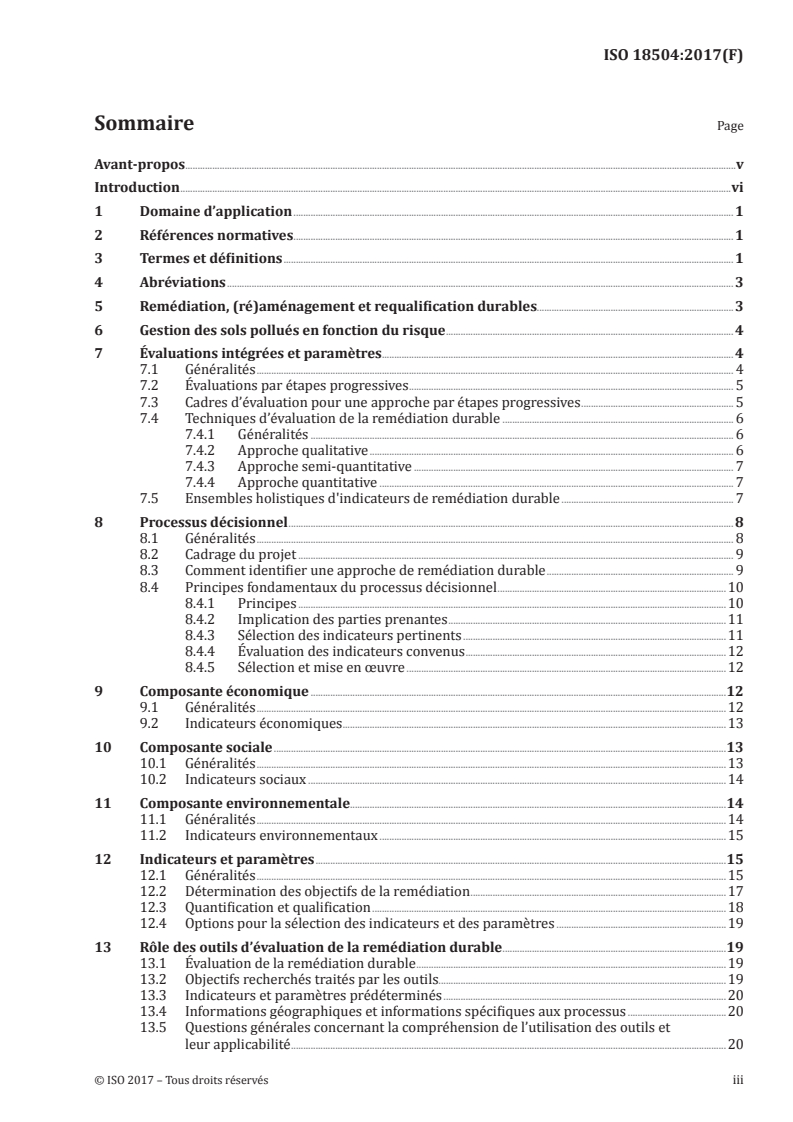

ISO 18504:2017 - Qualité du sol — Remédiation durable/23/2018
Overview
ISO 18504:2017 - Soil quality - Sustainable remediation - provides a standardized methodology and terminology for assessing the sustainability of remediation at contaminated land and brownfield sites. It offers informative guidance on evaluating the relative sustainability of alternative remediation strategies without prescribing specific methods, indicators or weighting. The standard is limited to sustainable remediation that demonstrably breaks source-pathway-receptor linkages on a site‑specific, legally contextual basis. Note: concepts such as “green remediation” or “green and sustainable remediation (GSR)” are not endorsed or discussed in this document.
Key Topics
- Standard methodology & terminology for sustainable remediation assessment, including definitions (e.g., indicator, metric, remediation strategy).
- Tiered assessment approaches - qualitative, semiquantitative and quantitative techniques to compare options.
- Integrated assessments covering the three sustainability dimensions: economic, social, and environmental.
- Indicators and metrics - guidance on selecting, quantifying and setting thresholds for indicators (not prescriptive).
- Decision making and project framing - stakeholder engagement, selection and assessment of indicators, and choosing implementation options.
- Assessment tools - considerations for tool applicability, pre-determined indicators and geographic/process specificity.
- Communication, governance and promotion - guidance on reporting results and embedding sustainable remediation in local legal and institutional contexts.
Practical applications
ISO 18504:2017 helps practitioners consistently evaluate and document sustainability trade-offs when selecting remediation options for contaminated sites:
- Compare remediation strategies (technologies, institutional controls) using common indicators.
- Frame site-specific sustainability objectives within local legal/policy contexts.
- Support brownfield redevelopment and sustainable regeneration by linking remediation outcomes to social and economic benefits.
- Guide selection and use of assessment tools (e.g., life cycle assessment, multi-criteria analysis) while preserving local flexibility.
Who would use this standard
- Environmental consultants and remediation engineers assessing contaminated land
- Site owners, developers and brownfield project managers
- Regulators and permitting authorities evaluating remediation plans
- Urban planners and sustainability officers integrating redevelopment with socio-economic goals
- Policy makers and institutional stakeholders guiding governance and public engagement
Related standards and references
- ISO 18504 references terminology and concepts aligned with broader sustainability guidance (for example ISO 26000 on social responsibility is cited in definitions).
- It does not contain normative references but complements tools such as LCA and MCA where those are appropriate for site-specific assessments.
Keywords: ISO 18504, sustainable remediation, soil quality, brownfield remediation, remediation strategy, indicators, metrics, sustainability assessment, contaminated land.
Buy Documents
ISO 18504:2017 - Soil quality -- Sustainable remediation
REDLINE ISO 18504:2017 - Soil quality — Sustainable remediation Released:8/2/2017
ISO 18504:2017 - Soil quality — Sustainable remediation/2/2017
ISO 18504:2017 - Qualité du sol -- Remédiation durable
ISO 18504:2017 - Qualité du sol — Remédiation durable/23/2018
Get Certified
Connect with accredited certification bodies for this standard

CIS Institut d.o.o.
Personal Protective Equipment (PPE) certification body. Notified Body NB-2890 for EU Regulation 2016/425 PPE.

Kiwa BDA Testing
Building and construction product certification.
Kmetijski inštitut Slovenije
Agricultural Institute of Slovenia. Soil testing, plant health, agricultural product analysis.
Sponsored listings
Frequently Asked Questions
ISO 18504:2017 is a standard published by the International Organization for Standardization (ISO). Its full title is "Soil quality — Sustainable remediation". This standard covers: ISO 18504:2017 provides procedures on sustainable remediation. In particular, it provides: - standard methodology, terminology and information about the key components and aspects of sustainable remediation assessment; - informative advice on the assessment of the relative sustainability of alternative remediation strategies. ISO 18504:2017 is intended to inform practitioners about contemporary understanding of sustainable remediation. It is not intended to prescribe which methods of assessment, indicators or weights to use. Rather, it is intended to inform consideration of the concept of sustainable remediation in a local legal, policy, socio-economic and environmental context. The scope of ISO 18504:2017 is restricted to sustainable remediation ? that is demonstrably breaking the source-pathway-receptor linkages ? in a manner that has been shown on a site-specific basis under a specific legal context to be sustainable. The concepts of "green remediation" and "green and sustainable remediation" (so called GSR) that in some parts of the world are conflated with sustainable remediation are neither endorsed nor discussed in ISO 18504:2017.
ISO 18504:2017 provides procedures on sustainable remediation. In particular, it provides: - standard methodology, terminology and information about the key components and aspects of sustainable remediation assessment; - informative advice on the assessment of the relative sustainability of alternative remediation strategies. ISO 18504:2017 is intended to inform practitioners about contemporary understanding of sustainable remediation. It is not intended to prescribe which methods of assessment, indicators or weights to use. Rather, it is intended to inform consideration of the concept of sustainable remediation in a local legal, policy, socio-economic and environmental context. The scope of ISO 18504:2017 is restricted to sustainable remediation ? that is demonstrably breaking the source-pathway-receptor linkages ? in a manner that has been shown on a site-specific basis under a specific legal context to be sustainable. The concepts of "green remediation" and "green and sustainable remediation" (so called GSR) that in some parts of the world are conflated with sustainable remediation are neither endorsed nor discussed in ISO 18504:2017.
ISO 18504:2017 is classified under the following ICS (International Classification for Standards) categories: 13.080.01 - Soil quality and pedology in general. The ICS classification helps identify the subject area and facilitates finding related standards.
ISO 18504:2017 is available in PDF format for immediate download after purchase. The document can be added to your cart and obtained through the secure checkout process. Digital delivery ensures instant access to the complete standard document.
Standards Content (Sample)
INTERNATIONAL ISO
STANDARD 18504
First edition
2017-07
Soil quality — Sustainable
remediation
Qualité du sol — Remédiation durable
Reference number
©
ISO 2017
© ISO 2017, Published in Switzerland
All rights reserved. Unless otherwise specified, no part of this publication may be reproduced or utilized otherwise in any form
or by any means, electronic or mechanical, including photocopying, or posting on the internet or an intranet, without prior
written permission. Permission can be requested from either ISO at the address below or ISO’s member body in the country of
the requester.
ISO copyright office
Ch. de Blandonnet 8 • CP 401
CH-1214 Vernier, Geneva, Switzerland
Tel. +41 22 749 01 11
Fax +41 22 749 09 47
copyright@iso.org
www.iso.org
ii © ISO 2017 – All rights reserved
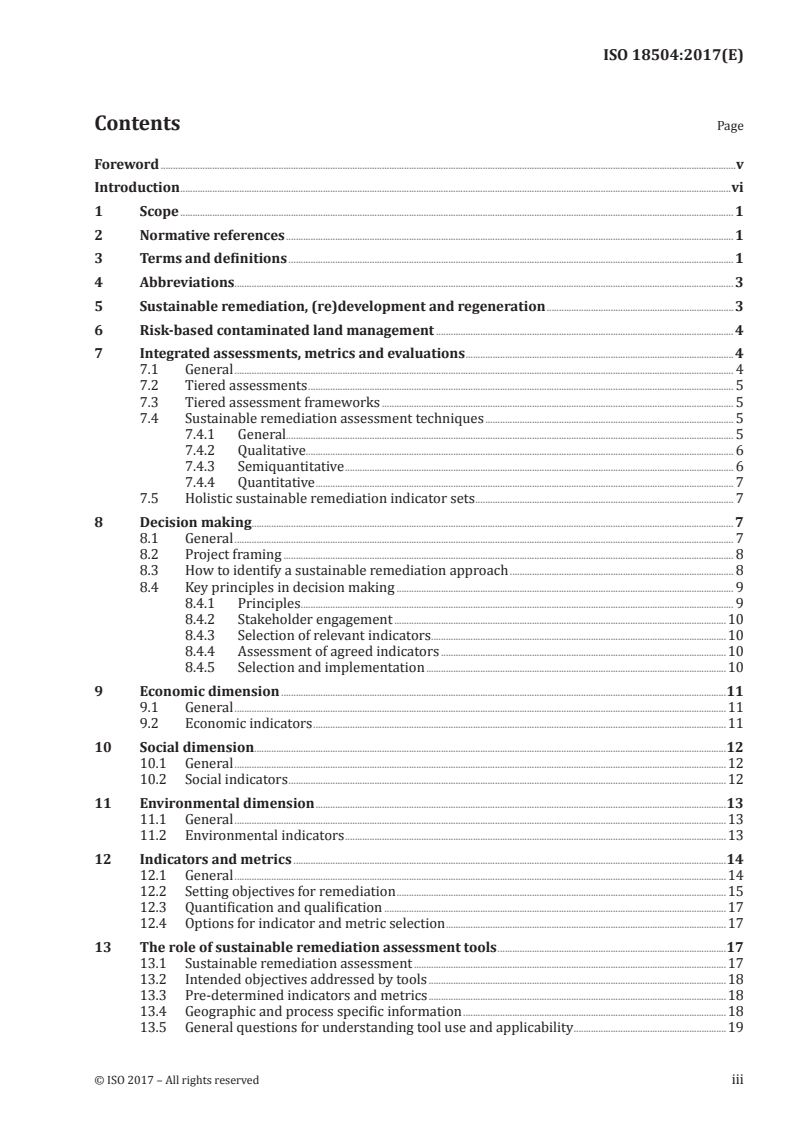
Contents Page
Foreword .v
Introduction .vi
1 Scope . 1
2 Normative references . 1
3 Terms and definitions . 1
4 Abbreviations. 3
5 Sustainable remediation, (re)development and regeneration . 3
6 Risk-based contaminated land management . 4
7 Integrated assessments, metrics and evaluations . 4
7.1 General . 4
7.2 Tiered assessments . 5
7.3 Tiered assessment frameworks . 5
7.4 Sustainable remediation assessment techniques . 5
7.4.1 General. 5
7.4.2 Qualitative. 6
7.4.3 Semiquantitative . 6
7.4.4 Quantitative . 7
7.5 Holistic sustainable remediation indicator sets . 7
8 Decision making . 7
8.1 General . 7
8.2 Project framing . 8
8.3 How to identify a sustainable remediation approach . 8
8.4 Key principles in decision making . 9
8.4.1 Principles . 9
8.4.2 Stakeholder engagement .10
8.4.3 Selection of relevant indicators .10
8.4.4 Assessment of agreed indicators .10
8.4.5 Selection and implementation .10
9 Economic dimension .11
9.1 General .11
9.2 Economic indicators .11
10 Social dimension.12
10.1 General .12
10.2 Social indicators .12
11 Environmental dimension .13
11.1 General .13
11.2 Environmental indicators .13
12 Indicators and metrics .14
12.1 General .14
12.2 Setting objectives for remediation .15
12.3 Quantification and qualification .17
12.4 Options for indicator and metric selection .17
13 The role of sustainable remediation assessment tools .17
13.1 Sustainable remediation assessment .17
13.2 Intended objectives addressed by tools .18
13.3 Pre-determined indicators and metrics .18
13.4 Geographic and process specific information .18
13.5 General questions for understanding tool use and applicability .19
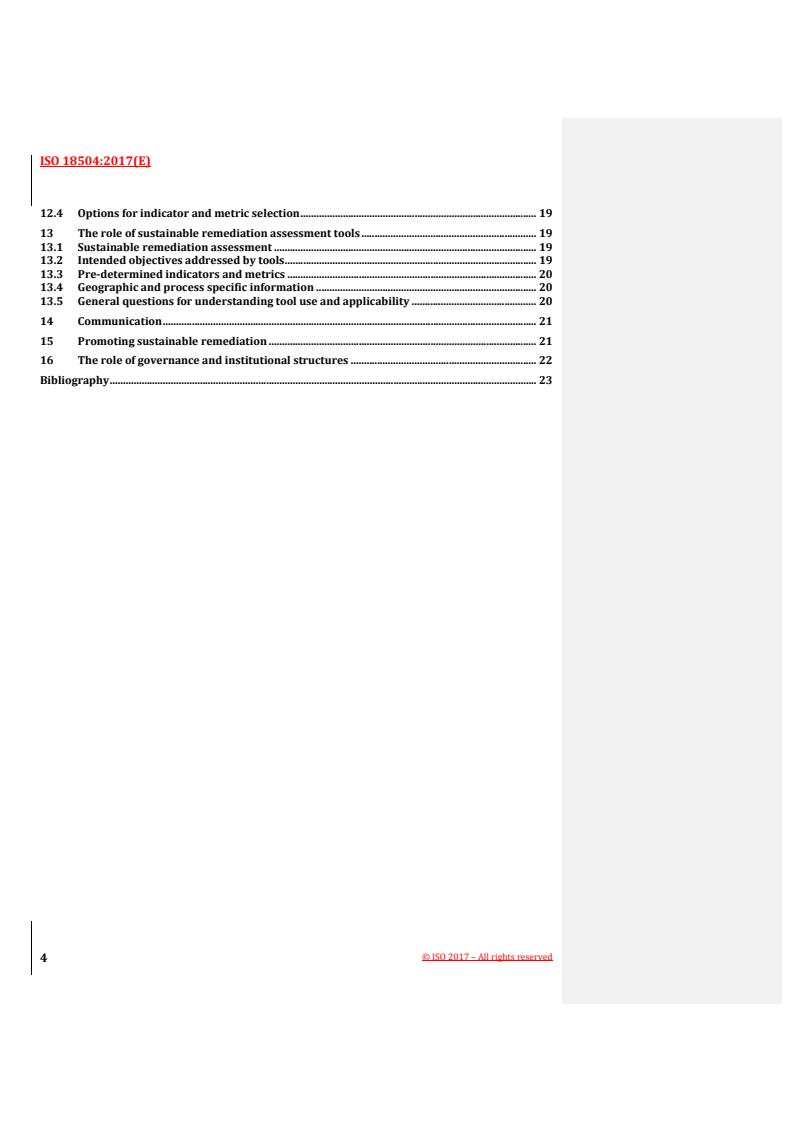
14 Communication .19
15 Promoting sustainable remediation .19
16 The role of governance and institutional structures .20
Bibliography .21
iv © ISO 2017 – All rights reserved
Foreword
ISO (the International Organization for Standardization) is a worldwide federation of national standards
bodies (ISO member bodies). The work of preparing International Standards is normally carried out
through ISO technical committees. Each member body interested in a subject for which a technical
committee has been established has the right to be represented on that committee. International
organizations, governmental and non-governmental, in liaison with ISO, also take part in the work.
ISO collaborates closely with the International Electrotechnical Commission (IEC) on all matters of
electrotechnical standardization.
The procedures used to develop this document and those intended for its further maintenance are
described in the ISO/IEC Directives, Part 1. In particular the different approval criteria needed for the
different types of ISO documents should be noted. This document was drafted in accordance with the
editorial rules of the ISO/IEC Directives, Part 2 (see www .iso .org/ directives).
Attention is drawn to the possibility that some of the elements of this document may be the subject of
patent rights. ISO shall not be held responsible for identifying any or all such patent rights. Details of
any patent rights identified during the development of the document will be in the Introduction and/or
on the ISO list of patent declarations received (see www .iso .org/ patents).
Any trade name used in this document is information given for the convenience of users and does not
constitute an endorsement.
For an explanation on the voluntary nature of standards, the meaning of ISO specific terms and
expressions related to conformity assessment, as well as information about ISO’s adherence to the
World Trade Organization (WTO) principles in the Technical Barriers to Trade (TBT) see the following
URL: w w w . i s o .org/ iso/ foreword .html.
This document was prepared by Technical Committee ISO/TC 190, Soil quality, Subcommittee SC 7, Soil
and site assessment.
Introduction
This document is intended to provide procedures for sustainable remediation. It contains accepted
terminology and understanding of the features of sustainable remediation and of means of assessing
the relative sustainability of site-specific alternative remediation strategies. Determining what is
and is not sustainable remediation at a specific site will be influenced by many local factors and the
governance context. Therefore, this document seeks to preserve local flexibility and freedom of action.
vi © ISO 2017 – All rights reserved
INTERNATIONAL STANDARD ISO 18504:2017(E)
Soil quality — Sustainable remediation
1 Scope
This document provides procedures on sustainable remediation. In particular, it provides:
— standard methodology, terminology and information about the key components and aspects of
sustainable remediation assessment;
— informative advice on the assessment of the relative sustainability of alternative remediation
strategies.
This document is intended to inform practitioners about contemporary understanding of sustainable
remediation. It is not intended to prescribe which methods of assessment, indicators or weights to use.
Rather, it is intended to inform consideration of the concept of sustainable remediation in a local legal,
policy, socio-economic and environmental context.
The scope of this document is restricted to sustainable remediation — that is demonstrably breaking
the source-pathway-receptor linkages — in a manner that has been shown on a site-specific basis under
a specific legal context to be sustainable.
The concepts of “green remediation” and “green and sustainable remediation” (so called GSR) that in
some parts of the world are conflated with sustainable remediation are neither endorsed nor discussed
in this document.
2 Normative references
There are no normative references in this document.
3 Terms and definitions
For the purposes of this document, the following terms and definitions apply.
ISO and IEC maintain terminological databases for use in standardization at the following addresses:
— IEC Electropedia: available at http:// www .electropedia .org/
— ISO Online browsing platform: available at http:// www .iso .org/ obp
3.1
brownfield
sites which
— have been affected by former uses of the site or surrounding land;
— are derelict or underused;
— are mainly in fully or partly developed urban areas;
— require intervention to bring them back to beneficial use;
— may have real or perceived contamination problems
3.2
environmental justice
combination of environmental rights and environmental responsibilities that asserts that everyone has
— a right to healthy places to live, work, play, learn and enjoy themselves;
— a right to a fair share of nature’s benefits and ecosystem services, such as food and water;
— a responsibility to look after the planet for others and for future generations
3.3
indicator
single characteristic that represents a sustainability effect, whether benefit or negative impact, which
may be compared across alternative remediation strategies, comprising one or more remediation
techniques and/or institutional controls, to evaluate their relative performance
EXAMPLE Greenhouse gas emissions.
3.4
metric
measurement of an indicator (3.3)
EXAMPLE Tons/Tonnes CO .
3.5
remediation strategy
one or more remediation technologies and associated works that will meet specified contamination-
related risk reduction objectives
3.6
remediation technology
technology that pre-processes, processes or post-processes the ground or contaminant as part of risk
management
3.7
sustainable development
development that meets the needs of the present without compromising the ability of future generations
to meet their own needs
Note 1 to entry: Sustainable development is about integrating the broader expectations of society as a whole
of a high quality of life, health and prosperity with environmental justice and maintaining Earth’s capacity to
support life in all its diversity. These social, economic and environmental goals are interdependent and mutually
reinforcing.
[SOURCE: ISO 26000:2010, 2.23, modified — The Note has been modified and the last sentence has been
deleted]
3.8
sustainable redevelopment
component of sustainable development (3.7) that results in the return to use of abandoned, derelict,
underused and potentially contaminated sites in a way that increases their environmental, economic,
and social benefits
3.9
sustainable regeneration
component of sustainable development (3.7) that reverses the economic, social and environmental
decline of places
3.10
sustainable remediation
elimination and/or control of unacceptable risks in a safe and timely manner whilst optimising the
environmental, social and economic value of the work
2 © ISO 2017 – All rights reserved
3.11
threshold
limit of acceptability for an indicator that may not be crossed or carries an unacceptable consequence if
it is crossed, such as regulatory non-compliance
3.12
unacceptable risk
level of risk that requires remediation
Note 1 to entry: The level of risk could be evaluated by comparison to a numeric threshold or by benchmarking
against a narrative definition. Different levels of risk are deemed unacceptable in different countries or even by
different laws within a country.
4 Abbreviations
BTU British Thermal Units
CBA cost benefit analysis
CCP climate change potential
ESTCP Environmental Security Technology Certification Program
GHG greenhouse gas
GSR green and sustainable remediation
LCA life cycle assessment
MCA multi-criteria analysis
MNC multi-national corporation
RBLM risk-based land management
SuRF Sustainable Remediation Forum
US EPA United States Environmental Protection Agency
WBCSD World Business Council for Sustainable Development
5 Sustainable remediation, (re)development and regeneration
Development that meets the needs of the present without compromising the ability of future
[1]
generations to meet their own needs is considered to constitute sustainable development. In the
case of brownfield sites, remediation is a prelude to physical redevelopment and ultimately socio-
economic regeneration. Sustainable regeneration provides multiple benefits. For example, it empowers
local communities, provides new employment opportunities, enhances the aesthetics of an area and
supports environmental justice.
Since remediation often links into the beneficial redevelopment and reuse of a site, sustainable
[2]
redevelopment is inherently connected with sustainable remediation. Considering the reuse of a site
from the beginning of a remediation project is a fundamental component of sustainable remediation,
and therefore sustainable remediation may act either as a natural precursor to, or as a subset of,
sustainable redevelopment. Much value may be achieved through successfully integrating remediation
into the redevelopment process to exploit synergies while minimizing costs and environmental impacts
associated with bringing sites back to beneficial use.
6 Risk-based contaminated land management
The concept of RBLM means integrating decisions on the need for remediation, the timeframe
within which it should be implemented and the choice of remediation strategy by considering three
[3]
components :
— fitness for current/intended land use;
— protection of the environment;
— long term care.
RBLM is intended to assist reaching balanced and informed decisions to achieve sustainable land
management. The first decision is whether or not the risk posed by land contamination to human health,
ecosystems, property or natural resources is deemed by law or corporate policy to merit intervention.
Such remediation should be acceptable to those with an interest in its outcome — stakeholders.
Remediation should be reliable and not breakdown uncontrollably in the future. In addition,
remediation should not introduce significant new risks and should be effective over the period in which
the contamination risks need to be managed.
Sustainable remediation is about how to manage risks that merit intervention and should not be seen as
justification for no intervention in the face of such risks.
There might be non-negotiable boundary conditions, such as legal, corporate policy or regulatory
requirements, which have to be taken into consideration. Alternative remediation strategies that meet
them may then form the focus for the sustainable remediation assessment.
7 Integrated assessments, metrics and evaluations
7.1 General
There are many ways to integrate various dimensions in order to provide a holistic measure to
benchmark against the definition of sustainable remediation. A tiered approach allows application of
simple sustainable remediation assessments at less complex sites and more sophisticated, costly and
perhaps presently contested assessments at more complex sites.
Meaningful sustainability assessment of alternative remediation strategies is possible and should
inform robust and reliable project management decisions. This is despite the fact that sustainability
may not be measured in simple units, and that an assessment of the sustainability of remediation
strategies is necessarily a subjective process at a given point in time and space. Stakeholders should be
encouraged to provide their perspectives on the balance of potential impacts and benefits to facilitate
consensus.
[4]-[7]
Sustainability assessment of alternative soil and groundwater remediation strategies is
improved by:
— being limited to those strategies that are likely to achieve site-specific risk-management objectives
(i.e. eliminate and/or control unacceptable risks to human health, property, surface or ground water
and the environment);
— following a framework for assessment that is consistent with sustainable remediation (see 3.10) by:
— considering the environmental, social and economic benefits and impacts associated with
each option;
4 © ISO 2017 – All rights reserved
— identifying which of the remediation strategies being assessed provides the greatest overall
benefits;
— comparing alternative strategies against a relevant common baseline, e.g. pump and treat, excavation
and off-site disposal or do nothing;
— adopting indicators and metrics that capture all significant benefits and impacts while avoiding
double-counting;
— adopting a tiered approach, such that the sustainable remediation assessment is proportional to the
scale of the project/problem being addressed;
— taking stakeholder opinions and perspectives into account and, where it is practical to do so, engage
directly with stakeholders;
— documenting the activities, data, assumptions and decision points to aid transparency (e.g. see
[8]
ASTM E2876: 2013, Clause 8 ).
7.2 Tiered assessments
A tiered approach may be used, in which simple qualitative approaches are the default and most
commonly used tier, and more complex quantitative tiers are applied only when necessary or otherwise
justified.
Simple or relatively clear-cut problems require only simple sustainable remediation assessment. As a
general rule, the simplest form of sustainable remediation assessment that allows a robust decision to
be made should be adopted. On projects where the decision depends on a small number of indicators
that can be measured, a more quantitative approach to sustainable remediation assessment may be
necessary to help reach a robust and reliable decision.
7.3 Tiered assessment frameworks
A tiered approach to sustainable remediation assessment illustrates how a simple qualitative,
semiquantitative or fully quantitative approach may be taken to a given project. In all tiers the initial
considerations are the same:
— confirm the project objectives: what question is the assessment being completed to answer?
— confirm the shortlist of remediation strategies: likely to be effective in meeting project objectives;
— identify the relevant stakeholders: who could affect or be affected by the project?
— identify project boundaries: temporal, spatial and lifecycle limits to the assessment;
— select sustainable remediation indicators: agree on the indicators that will form the basis of the
sustainability assessment;
— determine how each indicator will be characterized or measured: agree on the metrics;
— agree the assessment techniques: sustainable remediation assessment techniques that will be
applied (i.e. the tier and method).
Once these initial issues have been considered, and background information and data collated, the
sustainable remediation assessment proceeds using the agreed assessment technique.
7.4 Sustainable remediation assessment techniques
7.4.1 General
Various qualitative, semiquantitative or quantitative techniques may be used to undertake a sustainable
remediation assessment, either in its entirety, or partially (Table 1). The boundaries between the
tiers are fuzzy. While there may be some overlap between the techniques applied under these three
headings, they serve as a useful classification to emphasize that valid assessments may be completed
using simple, intermediate or more complex approaches. In general, the effort involved increases in
going from qualitative to quantitative assessments. However, users should beware of the danger of
focusing on only those parameters that can (easily) be measured. The inherent flexibility of qualitative
methods means they are easier to apply in a comprehensive manner.
Table 1 — Examples of techniques that may be useful for sustainable remediation assessment
Qualitative Quantitative
Semiquantitative
(simple but comprehensive) (complex but partial)
Narrative analysis Pair-wise comparison CBA
Non-parametric ranking MCA LCA
(Environmental) Footprint Analysis
Cost effectiveness analysis
NOTE This is strictly an economic
analysis.
7.4.2 Qualitative
Qualitative approaches do not attempt to put numbers to different remediation strategies within an
assessment. Instead, non-parametric or even narrative alternatives to metrics may be used:
— ranking of one alternative against others as being “better”, “neutral” or “worse” for a specific
indicator;
— a narrative drawn from discussions between stakeholders where alternative remediation strategies
are considered and a preferred option selected based on performance against a range of sustainable
remediation indicators.
It is generally possible to consider a wide range of sustainable remediation indicators qualitative; but,
quantitative data that may be readily accessible for some indicators is not used to its full extent.
Alphanumeric terms may be used in rankings (e.g. 1, 2, 3 or a, b, c) and may be helpful in rapidly
identifying patterns, and median rankings may then be considered. However, these labels should not
be confused with semiquantitative or quantitative data where some form of estimation (and weighting)
has taken place.
7.4.3 Semiquantitative
“Semiquantitative” approaches quantify some, but not all, indicators or they place values and weightings
on all options but without fully monetising and quantifying every aspect, for example:
— MCA using scores (i.e. relative performance of an option against a sustainable remediation indicator)
and weightings (i.e. stakeholder view on the importance of a particular sustainable remediation
indicator) to rank a number of options — typically, an overall rank is derived from the sum of all
weighted scores, when compared to other options;
— quantitative analysis of a number of aspects may be applied alongside more qualitative assessment
of other factors such as quantitative assessment of the CO footprint and remediation direct cost
combined with qualitative consideration of ecological impact and social aspects within a holistic
assessment;
— pair-wise comparison involves comparing the relative performance for a given indicator of each
candidate strategy against each other and aggregating the outcomes to allow an overall judgment
of the alternatives to be made.
6 © ISO 2017 – All rights reserved
7.4.4 Quantitative
Quantitative approaches require metrics to be applied to the sustainable remediation indicators.
The metric may be some form of common currency within a CBA, or a physical quantification (mass,
energy, time, etc.) within a LCA. While some indicators may be readily quantified, even monetised, it
is more difficult for others. It is not uncommon, therefore, to use simpler assessment methods first
to separate remediation options that are clearly better than others, and then to use partial-CBA or
other quantitative methods to investigate a small number of sustainable remediation indicators that
distinguish the remaining options. Using such a tiered approach may improve the efficiency of the
assessment process.
Example for a quantitative approach:
— [environmental] “footprint analysis” compares the aggregate environmental footprint of the
candidate remediation strategies.
7.5 Holistic sustainable remediation indicator sets
A sustainable remediation assessment undertaken at any tier requires a set of relevant and measureable
indicators to compare remediation options. A holistic set of indicators and their metrics, shall be agreed
by stakeholders early in the process. The indicators shall reflect all three dimensions of sustainable
remediation: environment, society and economy. Example sustainable remediation indicator categories
are presented in Table 2. Having an equal number of categories for each dimension ensures the
assessment gets underway with a balanced consideration of each dimension. Balance is maintained by
not loading the assessment with many categories in one dimension but only a few in another. From
these categories site-specific indicators shall be derived. There may be different numbers of indicators
derived for each category or even dimension.
[7]
Table 2 — Example sustainable remediation indicator categories
Economy Society Environment
Direct economic costs and benefits Human health and safety Air
Indirect economic costs and benefits Ethics and equality Soil and ground conditions
Employment and employment capital Neighbourhood and locality Groundwater and surface water
Communities and community in-
Induced economic costs and benefits Ecology
volvement
Project lifespan and flexibility Uncertainty and evidence Natural resources and waste
8 Decision making
8.1 General
Sustainable remediation can involve decisions on an optimum remediation strategy at several points
during a site’s (re)development or risk-management. The principal points are:
— regional spatial (land-use) planning: consideration of the impact of remediation alongside other
relevant indicators on the sustainability of different land-use allocations during regional spatial
planning and redevelopment activities;
— site specific master planning to ensure the allocated uses on a site are laid out in the most appropriate
and efficient manner;
— searching for possibilities of synergy between land use and remediation (e.g. groundwater
remediation in combination with aquifer thermal energy or soil excavation in combination with
providing underground parking);
— design of site characterization strategies, e.g. by:
— focusing site characterization to aid assessment of possible source-pathway-receptor linkages
by improving the conceptual site model;
— minimizing journeys to site for numerous poorly-planned phases of site investigation;
— using of non-intrusive technologies and preventing new contamination, for example avoid drilling
through low-permeability confining layers;
— remediation strategy design: selection of a remediation strategy (i.e. source treatment, pathway
interception or receptor modification) that can satisfy essential requirements, including an
acceptable level of risk with respect to undertaking the remediation works and long term safety of
the site, and optimizes the net benefits of risk-management actions;
— remediation strategy selection: selection of a strategy that can satisfy essential requirements and
achieve risk-based remediation goals;
— design of remediation verification strategies, including post-remediation monitoring and
communication to the community;
— collection of data to verify a sustainable remediation assessment.
This means that the intention of achieving a remediation outcome that helps optimize the environmental,
social and economic benefits of sustainable redevelopment does not rely only on selecting the most
sustainable remediation technique. The extent to which contamination drives or is subservient to
the decision making varies. In master planning skill sets and professions (e.g. architects, transport
planners, education provision) should be considered in addition to those that consider contamination.
8.2 Project framing
[9]
Project framing involves establishing the project objectives, boundaries and constraints that need to
be met, obeyed and considered respectively in selecting a remediation strategy.
Regulators may specify particular mandatory requirements, such as contamination concentration
remediation goals or deadlines for completion of remediation. Broader requirements may also be
specified in legislation; for example that the land shall be suitable for its next use.
8.3 How to identify a sustainable remediation approach
To maximize the sustainable remediation benefits, sustainability factors should be considered when
making project decisions from the earliest stages of a project. The earlier sustainability is part of
decision making the better. There are two key stages at which sustainability can be considered from
objective setting to execution:
— Goal-setting stage: involves design of law and policies, regional and local spatial plans, and site-
specific master-planning. This stage sets the broad social, economic and/or environmental
aspirations that an individual (remediation) project should contribute towards. Examples could
include requirements to take account of international climate agreements and regional goals on
CO emissions reduction. These aspects are outside the scope of this document and of remediation
as a whole. An assessor should understand the goals to be achieved. The most important steps with
respect to a sustainable remediation project are made here, and the largest sustainability benefits
are created (or lost) at the objective setting stage.
— Design and execution stage: is the stage at which a sustainable remediation strategy is identified
and implemented (i.e. how the risk-management goals can be achieved in a sustainable manner).
This stage is the main focus of this document.
Larger sustainability gains can be achieved by early consideration of sustainability factors, and
inclusion in high-level objectives and policies as well as integrating remediation with other project
activities.
8 © ISO 2017 – All rights reserved
Figure 1 illustrates the phases that form a part of the execution stage. In this subclause, only the
objective setting stage is addressed.
Figure 1 — Stages of sustainable remediation strategy assessment, selection and
implementation
8.4 Key principles in decision making
8.4.1 Principles
Key principles should be met during decision making and implementation in order to be able to claim at
the end of the process that the remediation is as sustainable as it can be, given the project boundaries
and constraints. The following key principles can be defined and should be adhered to:
— the legal requirements for the remediation, and how they apply, have been identified;
— no unacceptable risks, as defined in the relevant law, to human health or the wider environment
remain after completion of the remediation activity;
— no unacceptable risks to worker (or nearby community) safety created by the remediation activity;
— transparent decision making processes based on evidence and sound science have been followed;
— good governance and stakeholder involvement have been adopted.
It is essential that the remediation achieves the defined requirements and, in particular, the application
of any candidate strategy option is able to achieve relevant protection of human health and the
environment.
Remediation strategies are unable to provide an adequate level of protection and should be screened
out early in the decision making process.
8.4.2 Stakeholder engagement
The engagement of stakeholders is an important part of a valid sustainable remediation assessment.
Stakeholders directly or indirectly affect, or are affected by, the site specific remediation activities.
They are an important source of information, and some may be directly involved in decision making
(e.g. the site owner and regulator). Others may not have a direct involvement but may still be influential
(e.g. neighbours and the local community). Inclusive decision-making processes form part of good
governance and reduce the possibility that decisions be revisited in the future. Stakeholder engagement
facilitators can help to provide access to the wider community.
In some instances, stakeholder engagement processes can slow down decision making; increase the
costs of reaching decisions; and result in a need for technical training of non-specialists.
Stakeholder engagement should generally be proportional to the size of the project under consideration
and the breadth of community (or societal) interest. For small and simple projects stakeholder
engagement may be limited to site owner, their professional representatives and local authorities
with decision-making powers (e.g. planning authority, environmental protection agency). For larger,
more complex or controversial projects, much wider stakeholder engagement and dialogue may be
appropriate.
8.4.3 Selection of relevant indicators
The selection of indicators includes individual environmental, economic and social concerns important
for a project. Involving stakeholders in the selection of indicators may increase their commitment
and acceptance of the resulting assessment output. The Bellagio Principles initially proposed by the
[10]
International Institute for Sustainable Development deal with four aspects of assessing progress
toward sustainable development and can be helpful in selecting relevant indicators. During the
assessment, stakeholders may:
— adopt indicators;
— discard indicators;
— add indicators, and place these in groupings of similar or related considerations.
8.4.4 Assessment of agreed indicators
Each point in the site remediation decision making process should include a review for the site
stakeholders and to ensure mandatory requirements are being met. Assuming that these requirements
will be met or are likely to be met, the overall environmental, social and economic impacts associated
with the available options can then be assessed. This assessment can be based on qualitative or
quantitative methods. In this assessment process, the gains and losses are weighted. The factors of
sustainability are usually translated into measurable and comparable indicators (see Figure 2) (see
References [7],[11] and [12]).
8.4.5 Selection and implementation
Once a sustainable remediation strategy has been identified, it may be implemented. Further
sustainability gains may be achieved during the implementation phase by the use of best or sustainable
10 © ISO 2017 – All rights reserved
management practices (see References [9] and [13]). In addition, the use of remediation optimization
techniques may be effective in improving system efficiency in a manner that:
— reduces the environmental footprint of the treatment system and operation;
— reduces the social impacts of the treatment system and operation;
— reduces the life-cycle cost of the remediation.
Sustainability gains can be made at all stages of implementation, which typically includes: design,
procurement, construction; operation, monitoring, maintenance, remediation verification,
decommissioning and closure.
9 Economic dimension
9.1 General
Land contamination is an economic externality arising from historic industrial and waste management
[14]
practices. Recently, a less monetised view of economics has emerged that sees, but struggles to
quantify, the value to society of ecosystem services.
The economic aspects of remediation have traditionally been the focus of both voluntary and enforced
action. Polluters, other responsible parties and/or developers have sought the lowest cost remediation
that fits with their project objectives and framing.
Purely in terms of cost, remediation involves capital expenditure, mobilization and setting up,
maintenance and operation, and finally decommissioning. The costs of verification and ongoing
monitoring are incurred in parallel or after the main remediation effort.
An important aspect is comparing remediation strategies’ economic performance over the lifetime of
the remediation, and how costs are distributed over time by using Net Present Value calculations. Some
technologies involve high short-term expenditure, while others incur lower annual expenditure over a
longer period of time.
In addition, the way project risk is monetised will influence the apparent relative economic performance
of remediation strategies.
9.2 Economic indicators
While there is no universally agreed inventory of economic indicators, the positions of various
authorities and other authors reveals considerable overlap, and are summarized as broad categories of
indicators in Table 2.
In purely cost terms, remediation projects are built up from:
— preparation, design and permitting;
— capital expenditure;
— mobilization and construction;
— operation (including verification);
— waste management;
— importing materials;
— care and maintenance;
— dismantling and decommissioning;
— asset disposal (to recoup costs by selling surplus or redundant equipment).
Other economic factors include, but are not limited to:
— job creation (including issues of local residents, level of skill);
— land use restrictions;
— uplift in land values (on or nearby the remediation site);
— cost of borrowing;
— costs of deferring reuse of land;
— cost of temporary business/industrial interruption;
— cost of temporary relocation;
— (demonstration) value of successfully executing the remediation;
— risk of damaging existing buildings and infrastructure;
— avoidance of fines or punitive action;
— impact on reputation and brand value.
10 Social dimension
10.1 General
The remediation of contaminated sites, from small-scale neighbourhood sites to large urban or peri-
urban sites, very often has an importa
...
ISO/TC 190/SC 7
Deleted: Date: 2017‐05‐17
Date: 2017‐07
ISO/PRF 18504:2017(E)
ISO/TC 190/SC 7/WG 12
Secretariat: DIN
Soil quality — Sustainable remediation
Qualité du sol — Remédiation durable
© ISO 2017 – All rights reserved
i
Moved down [1]: Soil quality —
Sustainable remediation
Deleted: 
Qualité du sol — Remédiation durable
Section Break (Next Page)
COPYRIGHT PROTECTED DOCUMENT
All rights reserved. Unless otherwise
specified, no part of this publication may
be reproduced or utilized otherwise in
any form or by any means, electronic or
mechanical, including photocopying, or
posting on the internet or an intranet,
without prior written permission.
Permission can be requested from either
ISO at the address below or ISO’s
member body in the country of the
requester.
ISO copyright office
Ch. de Blandonnet 8 • CP 401
CH‐1214 Vernier, Geneva, Switzerland
Tel. + 41 22 749 01 11
Fax + 41 22 749 09 47
copyright@iso.org
www.iso.org
© ISO 2017 – All rights reserved
Contents Page
Foreword . 5
Introduction . 6
1 Scope . 1
2 Normative references . 1
3 Terms and definitions . 1
4 Abbreviations . 3
5 Sustainable remediation, (re)development and regeneration . 3
6 Risk-based contaminated land management . 4
7 Integrated assessments, metrics and evaluations . 4
7.1 General . 4
7.2 Tiered assessments . 5
7.3 Tiered assessment frameworks . 5
7.4 Sustainable remediation assessment techniques . 6
7.4.1 General . 6
7.4.2 Qualitative . 6
7.4.3 Semiquantitative . 7
7.4.4 Quantitative . 7
7.5 Holistic sustainable remediation indicator sets . 7
8 Decision making . 8
8.1 General . 8
8.2 Project framing . 9
8.3 How to identify a sustainable remediation approach . 9
8.4 Key principles in decision making . 10
8.4.1 Principles . 10
8.4.2 Stakeholder engagement . 11
8.4.3 Selection of relevant indicators . 11
8.4.4 Assessment of agreed indicators . 11
8.4.5 Selection and implementation . 11
9 Economic dimension . 12
9.1 General . 12
9.2 Economic indicators . 12
10 Social dimension . 13
10.1 General . 13
10.2 Social indicators . 14
11 Environmental dimension . 14
11.1 General . 14
11.2 Environmental indicators . 14
12 Indicators and metrics . 15
12.1 General . 15
12.2 Setting objectives for remediation . 17
12.3 Quantification and qualification . 18
© ISO 2017 – All rights reserved
12.4 Options for indicator and metric selection . 19
13 The role of sustainable remediation assessment tools . 19
13.1 Sustainable remediation assessment . 19
13.2 Intended objectives addressed by tools . 19
13.3 Pre-determined indicators and metrics . 20
13.4 Geographic and process specific information . 20
13.5 General questions for understanding tool use and applicability . 20
14 Communication . 21
15 Promoting sustainable remediation . 21
16 The role of governance and institutional structures . 22
Bibliography . 23
© ISO 2017 – All rights reserved
Deleted: ISO/PRF 18504:2017(E)
Foreword
ISO (the International Organization for Standardization) is a worldwide federation of national
standards bodies (ISO member bodies). The work of preparing International Standards is normally
carried out through ISO technical committees. Each member body interested in a subject for which a
technical committee has been established has the right to be represented on that committee.
International organizations, governmental and non‐governmental, in liaison with ISO, also take part in
the work. ISO collaborates closely with the International Electrotechnical Commission (IEC) on all
matters of electrotechnical standardization.
The procedures used to develop this document and those intended for its further maintenance are
described in the ISO/IEC Directives, Part 1. In particular the different approval criteria needed for the
different types of ISO documents should be noted. This document was drafted in accordance with the
editorial rules of the ISO/IEC Directives, Part 2 (see www.iso.org/directives).
Deleted: www.iso.org/directives
Attention is drawn to the possibility that some of the elements of this document may be the subject of
patent rights. ISO shall not be held responsible for identifying any or all such patent rights. Details of
any patent rights identified during the development of the document will be in the Introduction and/or
on the ISO list of patent declarations received (see www.iso.org/patents). Deleted: www.iso.org/patents
Any trade name used in this document is information given for the convenience of users and does not
constitute an endorsement.
For an explanation on the voluntary nature of standards, the meaning of ISO specific terms and
expressions related to conformity assessment, as well as information about ISO's adherence to the
World Trade Organization (WTO) principles in the Technical Barriers to Trade (TBT) see the following
URL: www.iso.org/iso/foreword.html. Deleted: www.iso.org/iso/forewor
d.html
This document was prepared by Technical Committee ISO/TC 190, Soil quality, Subcommittee SC 7, Soil
and site assessment.
Introduction
This document is intended to provide procedures for sustainable remediation. It contains accepted
terminology and understanding of the features of sustainable remediation and of means of assessing the
relative sustainability of site‐specific alternative remediation strategies. Determining what is and is not
sustainable remediation at a specific site will be influenced by many local factors and the governance
context. Therefore, this document seeks to preserve local flexibility and freedom of action.
Deleted: ISO/PRF 18504:2017(E)
INTERNATIONAL STANDARD ISO 18504:2017(E)
Moved (insertion) [1]
Soil quality — Sustainable remediation
Deleted: Soil quality — Sustainable
remediation
1 Scope
This document provides procedures on sustainable remediation. In particular, it provides:
— standard methodology, terminology and information about the key components and aspects of
sustainable remediation assessment;
— informative advice on the assessment of the relative sustainability of alternative remediation
strategies.
This document is intended to inform practitioners about contemporary understanding of sustainable
remediation. It is not intended to prescribe which methods of assessment, indicators or weights to use.
Rather, it is intended to inform consideration of the concept of sustainable remediation in a local legal,
policy, socio‐economic and environmental context.
The scope of this document is restricted to sustainable remediation — that is demonstrably breaking
the source‐pathway‐receptor linkages — in a manner that has been shown on a site‐specific basis under
a specific legal context to be sustainable.
The concepts of “green remediation” and “green and sustainable remediation” (so called GSR) that in
some parts of the world are conflated with sustainable remediation are neither endorsed nor discussed
in this document.
2 Normative references
There are no normative references in this document.
3 Terms and definitions
For the purposes of this document, the following terms and definitions apply.
ISO and IEC maintain terminological databases for use in standardization at the following addresses:
— IEC Electropedia: available at http://www.electropedia.org/ Deleted: http://www.electropedia
.org/
— ISO Online browsing platform: available at http://www.iso.org/obp
Deleted: http://www.iso.org/obp
3.1
brownfield
sites which
— have been affected by former uses of the site or surrounding land;
— are derelict or underused;
— are mainly in fully or partly developed urban areas;
— require intervention to bring them back to beneficial use;
— may have real or perceived contamination problems
© ISO 2017 – All rights reserved
3.2
environmental justice
combination of environmental rights and environmental responsibilities that asserts that everyone has
— a right to healthy places to live, work, play, learn and enjoy themselves;
— a right to a fair share of nature's benefits and ecosystem services, such as food and water;
— a responsibility to look after the planet for others and for future generations
3.3
indicator
single characteristic that represents a sustainability effect, whether benefit or negative impact, which
may be compared across alternative remediation strategies, comprising one or more remediation
techniques and/or institutional controls, to evaluate their relative performance
EXAMPLE Greenhouse gas emissions.
3.4
metric
measurement of an indicator (3.3)
EXAMPLE Tons/Tonnes CO2.
3.5
remediation strategy
one or more remediation technologies and associated works that will meet specified contamination‐
related risk reduction objectives
3.6
remediation technology
technology that pre‐processes, processes or post‐processes the ground or contaminant as part of risk
management
3.7
sustainable development
development that meets the needs of the present without compromising the ability of future
generations to meet their own needs
Note 1 to entry: Sustainable development is about integrating the broader expectations of society as a whole of a
high quality of life, health and prosperity with environmental justice and maintaining Earth's capacity to support
life in all its diversity. These social, economic and environmental goals are interdependent and mutually
reinforcing.
[SOURCE: ISO 26000:2010, 2.23, modified — The Note has been modified and the last sentence has
been deleted]
3.8
sustainable redevelopment
component of sustainable development (3.7) that results in the return to use of abandoned, derelict,
underused and potentially contaminated sites in a way that increases their environmental, economic,
and social benefits
3.9
© ISO 2017 – All rights reserved
sustainable regeneration
component of sustainable development (3.7) that reverses the economic, social and environmental
decline of places
3.10
sustainable remediation
elimination and/or control of unacceptable risks in a safe and timely manner whilst optimising the
environmental, social and economic value of the work
3.11
threshold
limit of acceptability for an indicator that may not be crossed or carries an unacceptable consequence if
it is crossed, such as regulatory non‐compliance
3.12
unacceptable risk
level of risk that requires remediation
Note 1 to entry: The level of risk could be evaluated by comparison to a numeric threshold or by benchmarking
against a narrative definition. Different levels of risk are deemed unacceptable in different countries or even by
different laws within a country.
Deleted: <#>Abbreviated terms
4 Abbreviations
BTU British Thermal Units
CBA cost benefit analysis
CCP climate change potential
ESTCP Environmental Security Technology Certification Program
GHG greenhouse gas
GSR green and sustainable remediation
LCA life cycle assessment
MCA multi‐criteria analysis
MNC multi‐national corporation
RBLM risk‐based land management
SuRF Sustainable Remediation Forum
US EPA United States Environmental Protection Agency
WBCSD World Business Council for Sustainable Development
5 Sustainable remediation, (re)development and regeneration
Development that meets the needs of the present without compromising the ability of future
[1]
generations to meet their own needs is considered to constitute sustainable development. In the case
of brownfield sites, remediation is a prelude to physical redevelopment and ultimately socio‐economic
regeneration. Sustainable regeneration provides multiple benefits. For example, it empowers local
communities, provides new employment opportunities, enhances the aesthetics of an area and supports
environmental justice.
© ISO 2017 – All rights reserved
Since remediation often links into the beneficial redevelopment and reuse of a site, sustainable
[2]
redevelopment is inherently connected with sustainable remediation. Considering the reuse of a site
from the beginning of a remediation project is a fundamental component of sustainable remediation,
and therefore sustainable remediation may act either as a natural precursor to, or as a subset of,
sustainable redevelopment. Much value may be achieved through successfully integrating remediation
into the redevelopment process to exploit synergies while minimizing costs and environmental impacts
associated with bringing sites back to beneficial use.
6 Risk-based contaminated land management
The concept of RBLM means integrating decisions on the need for remediation, the timeframe within
which it should be implemented and the choice of remediation strategy by considering three
[3]
components :
— fitness for current/intended land use;
— protection of the environment;
— long term care.
RBLM is intended to assist reaching balanced and informed decisions to achieve sustainable land
management. The first decision is whether or not the risk posed by land contamination to human
health, ecosystems, property or natural resources is deemed by law or corporate policy to merit
intervention. Such remediation should be acceptable to those with an interest in its outcome —
stakeholders.
Remediation should be reliable and not breakdown uncontrollably in the future. In addition,
remediation should not introduce significant new risks and should be effective over the period in which
the contamination risks need to be managed.
Sustainable remediation is about how to manage risks that merit intervention and should not be seen as
justification for no intervention in the face of such risks.
There might be non‐negotiable boundary conditions, such as legal, corporate policy or regulatory
requirements, which have to be taken into consideration. Alternative remediation strategies that meet
them may then form the focus for the sustainable remediation assessment.
7 Integrated assessments, metrics and evaluations
7.1 General
There are many ways to integrate various dimensions in order to provide a holistic measure to
benchmark against the definition of sustainable remediation. A tiered approach allows application of
simple sustainable remediation assessments at less complex sites and more sophisticated, costly and
perhaps presently contested assessments at more complex sites.
Meaningful sustainability assessment of alternative remediation strategies is possible and should
inform robust and reliable project management decisions. This is despite the fact that sustainability
may not be measured in simple units, and that an assessment of the sustainability of remediation
strategies is necessarily a subjective process at a given point in time and space. Stakeholders should be
encouraged to provide their perspectives on the balance of potential impacts and benefits to facilitate
consensus.
[4]‐[7]
Sustainability assessment of alternative soil and groundwater remediation strategies is improved
by:
© ISO 2017 – All rights reserved
— being limited to those strategies that are likely to achieve site‐specific risk‐management objectives
(i.e. eliminate and/or control unacceptable risks to human health, property, surface or ground
water and the environment);
— following a framework for assessment that is consistent with sustainable remediation (see 3.10)
by:
— considering the environmental, social and economic benefits and impacts associated with each
option;
— identifying which of the remediation strategies being assessed provides the greatest overall
benefits;
— comparing alternative strategies against a relevant common baseline, e.g. pump and treat,
excavation and off‐site disposal or do nothing;
— adopting indicators and metrics that capture all significant benefits and impacts while avoiding
double‐counting;
— adopting a tiered approach, such that the sustainable remediation assessment is proportional to the
scale of the project/problem being addressed;
— taking stakeholder opinions and perspectives into account and, where it is practical to do so,
engage directly with stakeholders;
— documenting the activities, data, assumptions and decision points to aid transparency (e.g. see
[8]
ASTM E2876:2013, Clause 8 ).
7.2 Tiered assessments
A tiered approach may be used, in which simple qualitative approaches are the default and most
commonly used tier, and more complex quantitative tiers are applied only when necessary or otherwise
justified.
Simple or relatively clear‐cut problems require only simple sustainable remediation assessment. As a
general rule, the simplest form of sustainable remediation assessment that allows a robust decision to
be made should be adopted. On projects where the decision depends on a small number of indicators
that can be measured, a more quantitative approach to sustainable remediation assessment may be
necessary to help reach a robust and reliable decision.
7.3 Tiered assessment frameworks
A tiered approach to sustainable remediation assessment illustrates how a simple qualitative,
semiquantitative or fully quantitative approach may be taken to a given project. In all tiers the initial
considerations are the same:
— confirm the project objectives: what question is the assessment being completed to answer?
— confirm the shortlist of remediation strategies: likely to be effective in meeting project objectives;
— identify the relevant stakeholders: who could affect or be affected by the project?
— identify project boundaries: temporal, spatial and lifecycle limits to the assessment;
© ISO 2017 – All rights reserved
— select sustainable remediation indicators: agree on the indicators that will form the basis of the
sustainability assessment;
— determine how each indicator will be characterized or measured: agree on the metrics;
— agree the assessment techniques: sustainable remediation assessment techniques that will be
applied (i.e. the tier and method).
Once these initial issues have been considered, and background information and data collated, the
sustainable remediation assessment proceeds using the agreed assessment technique.
7.4 Sustainable remediation assessment techniques
7.4.1 General
Various qualitative, semiquantitative or quantitative techniques may be used to undertake a sustainable
remediation assessment, either in its entirety, or partially (Table 1). The boundaries between the tiers
are fuzzy. While there may be some overlap between the techniques applied under these three
headings, they serve as a useful classification to emphasize that valid assessments may be completed
using simple, intermediate or more complex approaches. In general, the effort involved increases in
going from qualitative to quantitative assessments. However, users should beware of the danger of
focusing on only those parameters that can (easily) be measured. The inherent flexibility of qualitative
methods means they are easier to apply in a comprehensive manner.
Table 1 — Examples of techniques that may be useful for sustainable remediation assessment
Qualitative Quantitative
Semiquantitative
(simple but comprehensive) (complex but partial)
Narrative analysis Pair‐wise comparison CBA
Non‐parametric ranking MCA LCA
(Environmental) Footprint
Analysis
Cost effectiveness analysis
NOTE This is strictly an economic
analysis.
7.4.2 Qualitative
Qualitative approaches do not attempt to put numbers to different remediation strategies within an
assessment. Instead, non‐parametric or even narrative alternatives to metrics may be used:
— ranking of one alternative against others as being “better”, “neutral” or “worse” for a specific
indicator;
— a narrative drawn from discussions between stakeholders where alternative remediation strategies
are considered and a preferred option selected based on performance against a range of
sustainable remediation indicators.
It is generally possible to consider a wide range of sustainable remediation indicators qualitative; but,
quantitative data that may be readily accessible for some indicators is not used to its full extent.
Alphanumeric terms may be used in rankings (e.g. 1, 2, 3 or a, b, c) and may be helpful in rapidly
identifying patterns, and median rankings may then be considered. However, these labels should not be
© ISO 2017 – All rights reserved
confused with semiquantitative or quantitative data where some form of estimation (and weighting)
has taken place.
7.4.3 Semiquantitative
“Semiquantitative” approaches quantify some, but not all, indicators or they place values and
weightings on all options but without fully monetising and quantifying every aspect, for example:
— MCA using scores (i.e. relative performance of an option against a sustainable remediation
indicator) and weightings (i.e. stakeholder view on the importance of a particular sustainable
remediation indicator) to rank a number of options — typically, an overall rank is derived from the
sum of all weighted scores, when compared to other options;
— quantitative analysis of a number of aspects may be applied alongside more qualitative assessment
of other factors such as quantitative assessment of the CO footprint and remediation direct cost
combined with qualitative consideration of ecological impact and social aspects within a holistic
assessment;
— pair‐wise comparison involves comparing the relative performance for a given indicator of each
candidate strategy against each other and aggregating the outcomes to allow an overall judgment of
the alternatives to be made.
7.4.4 Quantitative
Quantitative approaches require metrics to be applied to the sustainable remediation indicators. The
metric may be some form of common currency within a CBA, or a physical quantification (mass, energy,
time, etc.) within a LCA. While some indicators may be readily quantified, even monetised, it is more
difficult for others. It is not uncommon, therefore, to use simpler assessment methods first to separate
remediation options that are clearly better than others, and then to use partial‐CBA or other
quantitative methods to investigate a small number of sustainable remediation indicators that
distinguish the remaining options. Using such a tiered approach may improve the efficiency of the
assessment process.
Example for a quantitative approach:
— [environmental] “footprint analysis” compares the aggregate environmental footprint of the
candidate remediation strategies.
7.5 Holistic sustainable remediation indicator sets
A sustainable remediation assessment undertaken at any tier requires a set of relevant and
measureable indicators to compare remediation options. A holistic set of indicators and their metrics,
shall be agreed by stakeholders early in the process. The indicators shall reflect all three dimensions of
sustainable remediation: environment, society and economy. Example sustainable remediation
indicator categories are presented in Table 2. Having an equal number of categories for each dimension
ensures the assessment gets underway with a balanced consideration of each dimension. Balance is
maintained by not loading the assessment with many categories in one dimension but only a few in
another. From these categories site‐specific indicators shall be derived. There may be different numbers
of indicators derived for each category or even dimension.
[7]
Table 2 — Example sustainable remediation indicator categories
Economy Society Environment
Direct economic costs and benefits Human health and safety Air
© ISO 2017 – All rights reserved
Indirect economic costs and
Ethics and equality Soil and ground conditions
benefits
Employment and employment
Neighbourhood and locality Groundwater and surface water
capital
Induced economic costs and Communities and community
Ecology
benefits involvement
Project lifespan and flexibility Uncertainty and evidence Natural resources and waste
8 Decision making
8.1 General
Sustainable remediation can involve decisions on an optimum remediation strategy at several points
during a site’s (re)development or risk‐management. The principal points are:
— regional spatial (land‐use) planning: consideration of the impact of remediation alongside other
relevant indicators on the sustainability of different land‐use allocations during regional spatial
planning and redevelopment activities;
— site specific master planning to ensure the allocated uses on a site are laid out in the most
appropriate and efficient manner;
— searching for possibilities of synergy between land use and remediation (e.g. groundwater
remediation in combination with aquifer thermal energy or soil excavation in combination with
providing underground parking);
— design of site characterization strategies, e.g. by:
— focusing site characterization to aid assessment of possible source‐pathway‐receptor linkages
by improving the conceptual site model;
— minimizing journeys to site for numerous poorly‐planned phases of site investigation;
— using of non‐intrusive technologies and preventing new contamination, for example avoid drilling
through low‐permeability confining layers;
— remediation strategy design: selection of a remediation strategy (i.e. source treatment, pathway
interception or receptor modification) that can satisfy essential requirements, including an
acceptable level of risk with respect to undertaking the remediation works and long term safety of
the site, and optimizes the net benefits of risk‐management actions;
— remediation strategy selection: selection of a strategy that can satisfy essential requirements and
achieve risk‐based remediation goals;
— design of remediation verification strategies, including post‐remediation monitoring and
communication to the community;
— collection of data to verify a sustainable remediation assessment.
This means that the intention of achieving a remediation outcome that helps optimize the
environmental, social and economic benefits of sustainable redevelopment does not rely only on
selecting the most sustainable remediation technique. The extent to which contamination drives or is
© ISO 2017 – All rights reserved
subservient to the decision making varies. In master planning skill sets and professions (e.g. architects,
transport planners, education provision) should be considered in addition to those that consider
contamination.
8.2 Project framing
[9]
Project framing involves establishing the project objectives, boundaries and constraints that need to
be met, obeyed and considered respectively in selecting a remediation strategy.
Regulators may specify particular mandatory requirements, such as contamination concentration
remediation goals or deadlines for completion of remediation. Broader requirements may also be
specified in legislation; for example that the land shall be suitable for its next use.
8.3 How to identify a sustainable remediation approach
To maximize the sustainable remediation benefits, sustainability factors should be considered when
making project decisions from the earliest stages of a project. The earlier sustainability is part of
decision making the better. There are two key stages at which sustainability can be considered from
objective setting to execution:
— Goal‐setting stage: involves design of law and policies, regional and local spatial plans, and site‐
specific master‐planning. This stage sets the broad social, economic and/or environmental
aspirations that an individual (remediation) project should contribute towards. Examples could
include requirements to take account of international climate agreements and regional goals on CO
emissions reduction. These aspects are outside the scope of this document and of remediation as a
whole. An assessor should understand the goals to be achieved. The most important steps with
respect to a sustainable remediation project are made here, and the largest sustainability benefits
are created (or lost) at the objective setting stage.
— Design and execution stage: is the stage at which a sustainable remediation strategy is identified
and implemented (i.e. how the risk‐management goals can be achieved in a sustainable manner).
This stage is the main focus of this document.
Larger sustainability gains can be achieved by early consideration of sustainability factors, and
inclusion in high‐level objectives and policies as well as integrating remediation with other project
activities.
Figure 1 illustrates the phases that form a part of the execution stage. In this subclause, only the
objective setting stage is addressed.
© ISO 2017 – All rights reserved
Figure 1 — Stages of sustainable remediation strategy assessment, selection and
implementation
8.4 Key principles in decision making
8.4.1 Principles
Key principles should be met during decision making and implementation in order to be able to claim at
the end of the process that the remediation is as sustainable as it can be, given the project boundaries
and constraints. The following key principles can be defined and should be adhered to:
— the legal requirements for the remediation, and how they apply, have been identified;
— no unacceptable risks, as defined in the relevant law, to human health or the wider environment
remain after completion of the remediation activity;
— no unacceptable risks to worker (or nearby community) safety created by the remediation activity;
— transparent decision making processes based on evidence and sound science have been followed;
— good governance and stakeholder involvement have been adopted.
© ISO 2017 – All rights reserved
It is essential that the remediation achieves the defined requirements and, in particular, the application
of any candidate strategy option is able to achieve relevant protection of human health and the
environment.
Remediation strategies are unable to provide an adequate level of protection and should be screened
out early in the decision making process.
8.4.2 Stakeholder engagement
The engagement of stakeholders is an important part of a valid sustainable remediation assessment.
Stakeholders directly or indirectly affect, or are affected by, the site specific remediation activities. They
are an important source of information, and some may be directly involved in decision making (e.g. the
site owner and regulator). Others may not have a direct involvement but may still be influential (e.g.
neighbours and the local community). Inclusive decision‐making processes form part of good
governance and reduce the possibility that decisions be revisited in the future. Stakeholder engagement
facilitators can help to provide access to the wider community.
In some instances, stakeholder engagement processes can slow down decision making; increase the
costs of reaching decisions; and result in a need for technical training of non‐specialists.
Stakeholder engagement should generally be proportional to the size of the project under consideration
and the breadth of community (or societal) interest. For small and simple projects stakeholder
engagement may be limited to site owner, their professional representatives and local authorities with
decision‐making powers (e.g. planning authority, environmental protection agency). For larger, more
complex or controversial projects, much wider stakeholder engagement and dialogue may be
appropriate.
8.4.3 Selection of relevant indicators
The selection of indicators includes individual environmental, economic and social concerns important
for a project. Involving stakeholders in the selection of indicators may increase their commitment and
acceptance of the resulting assessment output. The Bellagio Principles initially proposed by the
[10]
International Institute for Sustainable Development deal with four aspects of assessing progress
toward sustainable development and can be helpful in selecting relevant indicators. During the
assessment, stakeholders may:
— adopt indicators;
— discard indicators;
— add indicators, and place these in groupings of similar or related considerations.
8.4.4 Assessment of agreed indicators
Each point in the site remediation decision making process should include a review for the site
stakeholders and to ensure mandatory requirements are being met. Assuming that these requirements
will be met or are likely to be met, the overall environmental, social and economic impacts associated
with the available options can then be assessed. This assessment can be based on qualitative or
quantitative methods. In this assessment process, the gains and losses are weighted. The factors of
sustainability are usually translated into measurable and comparable indicators (see Figure 2) (see
References [7],[11] and [12]).
8.4.5 Selection and implementation
Once a sustainable remediation strategy has been identified, it may be implemented. Further
sustainability gains may be achieved during the implementation phase by the use of best or sustainable
© ISO 2017 – All rights reserved
management practices (see References [9] and [13]). In addition, the use of remediation optimization
techniques may be effective in improving system efficiency in a manner that:
— reduces the environmental footprint of the treatment system and operation;
— reduces the social impacts of the treatment system and operation;
— reduces the life‐cycle cost of the remediation.
Sustainability gains can be made at all stages of implementation, which typically includes: design,
procurement, construction; operation, monitoring, maintenance, remediation verification, Deleted: validation
decommissioning and closure.
9 Economic dimension
9.1 General
Land contamination is an economic externality arising from historic industrial and waste management
[14]
practices. Recently, a less monetised view of economics has emerged that sees, but struggles to
quantify, the value to society of ecosystem services.
The economic aspects of remediation have traditionally been the focus of both voluntary and enforced
action. Polluters, other responsible parties and/or developers have sought the lowest cost remediation
that fits with their project objectives and framing.
Purely in terms of cost, remediation involves capital expenditure, mobilization and setting up,
maintenance and operation, and finally decommissioning. The costs of verification and ongoing
monitoring are incurred in parallel or after the main remediation effort.
An important aspect is comparing remediation strategies’ economic performance over the lifetime of
the remediation, and how costs are distributed over time by using Net Present Value calculations. Some
technologies involve high short‐term expenditure, while others incur lower annual expenditure over a
longer period of time.
In addition, the way project risk is monetised will influence the apparent relative economic
performance of remediation strategies.
9.2 Economic indicators
While there is no universally agreed inventory of economic indicators, the positions of various
authorities and other authors reveals considerable overlap, and are summarized as broad categories of
indicators in Table 2.
In purely cost terms, remediation projects are built up from:
— preparation, design and permitting;
— capital expenditure;
— mobilization and construction;
— operation (including verification);
— waste management;
— importing materials;
© ISO 2017 – All rights reserved
— care and maintenance;
— dismantling and decommissioning;
— asset disposal (to recoup costs by selling surplus or redundant equipment).
Other economic factors include, but are not limited to:
— job creation (including issues of local residents, level of skill);
— land use restrictions;
— uplift in land values (on or nearby the remediation site);
— cost of borrowing;
— costs of deferring reuse of land;
— cost of temporary business/industrial interruption;
— cost of temporary relocation;
— (demonstration) value of successfully executing the remediation;
— risk of damaging existing buildings and infrastructure;
— avoidance of fines or punitive action;
— impact on reputation and brand value.
10 Social dimension
10.1 General
The remediation of contaminated sites, from small‐scale neighbourhood sites to large urban or peri‐
urban sites, very often has an important social impact with significant implications for individuals and
for communities.
Remediation of land contamination is an important public and environmental health protection process
with associated social well–being implications. The contributions of large‐site remediation to urban
renewal, particularly in socio‐economically disadvantaged areas, are well documented (e.g.
References [15] and [16]). Regeneration of the many urban, abandoned former industrial sites located
near transport corridors and waterways, particularly large ones, is an important tool for addressing
societal challenges, such as climate change mitigation through residential and infrastructure
development. Some jurisdictions have national financial incent
...
INTERNATIONAL ISO
STANDARD 18504
First edition
2017-07
Soil quality — Sustainable
remediation
Qualité du sol — Remédiation durable
Reference number
©
ISO 2017
© ISO 2017, Published in Switzerland
All rights reserved. Unless otherwise specified, no part of this publication may be reproduced or utilized otherwise in any form
or by any means, electronic or mechanical, including photocopying, or posting on the internet or an intranet, without prior
written permission. Permission can be requested from either ISO at the address below or ISO’s member body in the country of
the requester.
ISO copyright office
Ch. de Blandonnet 8 • CP 401
CH-1214 Vernier, Geneva, Switzerland
Tel. +41 22 749 01 11
Fax +41 22 749 09 47
copyright@iso.org
www.iso.org
ii © ISO 2017 – All rights reserved
Contents Page
Foreword .v
Introduction .vi
1 Scope . 1
2 Normative references . 1
3 Terms and definitions . 1
4 Abbreviations. 3
5 Sustainable remediation, (re)development and regeneration . 3
6 Risk-based contaminated land management . 4
7 Integrated assessments, metrics and evaluations . 4
7.1 General . 4
7.2 Tiered assessments . 5
7.3 Tiered assessment frameworks . 5
7.4 Sustainable remediation assessment techniques . 5
7.4.1 General. 5
7.4.2 Qualitative. 6
7.4.3 Semiquantitative . 6
7.4.4 Quantitative . 7
7.5 Holistic sustainable remediation indicator sets . 7
8 Decision making . 7
8.1 General . 7
8.2 Project framing . 8
8.3 How to identify a sustainable remediation approach . 8
8.4 Key principles in decision making . 9
8.4.1 Principles . 9
8.4.2 Stakeholder engagement .10
8.4.3 Selection of relevant indicators .10
8.4.4 Assessment of agreed indicators .10
8.4.5 Selection and implementation .10
9 Economic dimension .11
9.1 General .11
9.2 Economic indicators .11
10 Social dimension.12
10.1 General .12
10.2 Social indicators .12
11 Environmental dimension .13
11.1 General .13
11.2 Environmental indicators .13
12 Indicators and metrics .14
12.1 General .14
12.2 Setting objectives for remediation .15
12.3 Quantification and qualification .17
12.4 Options for indicator and metric selection .17
13 The role of sustainable remediation assessment tools .17
13.1 Sustainable remediation assessment .17
13.2 Intended objectives addressed by tools .18
13.3 Pre-determined indicators and metrics .18
13.4 Geographic and process specific information .18
13.5 General questions for understanding tool use and applicability .19
14 Communication .19
15 Promoting sustainable remediation .19
16 The role of governance and institutional structures .20
Bibliography .21
iv © ISO 2017 – All rights reserved
Foreword
ISO (the International Organization for Standardization) is a worldwide federation of national standards
bodies (ISO member bodies). The work of preparing International Standards is normally carried out
through ISO technical committees. Each member body interested in a subject for which a technical
committee has been established has the right to be represented on that committee. International
organizations, governmental and non-governmental, in liaison with ISO, also take part in the work.
ISO collaborates closely with the International Electrotechnical Commission (IEC) on all matters of
electrotechnical standardization.
The procedures used to develop this document and those intended for its further maintenance are
described in the ISO/IEC Directives, Part 1. In particular the different approval criteria needed for the
different types of ISO documents should be noted. This document was drafted in accordance with the
editorial rules of the ISO/IEC Directives, Part 2 (see www .iso .org/ directives).
Attention is drawn to the possibility that some of the elements of this document may be the subject of
patent rights. ISO shall not be held responsible for identifying any or all such patent rights. Details of
any patent rights identified during the development of the document will be in the Introduction and/or
on the ISO list of patent declarations received (see www .iso .org/ patents).
Any trade name used in this document is information given for the convenience of users and does not
constitute an endorsement.
For an explanation on the voluntary nature of standards, the meaning of ISO specific terms and
expressions related to conformity assessment, as well as information about ISO’s adherence to the
World Trade Organization (WTO) principles in the Technical Barriers to Trade (TBT) see the following
URL: w w w . i s o .org/ iso/ foreword .html.
This document was prepared by Technical Committee ISO/TC 190, Soil quality, Subcommittee SC 7, Soil
and site assessment.
Introduction
This document is intended to provide procedures for sustainable remediation. It contains accepted
terminology and understanding of the features of sustainable remediation and of means of assessing
the relative sustainability of site-specific alternative remediation strategies. Determining what is
and is not sustainable remediation at a specific site will be influenced by many local factors and the
governance context. Therefore, this document seeks to preserve local flexibility and freedom of action.
vi © ISO 2017 – All rights reserved
INTERNATIONAL STANDARD ISO 18504:2017(E)
Soil quality — Sustainable remediation
1 Scope
This document provides procedures on sustainable remediation. In particular, it provides:
— standard methodology, terminology and information about the key components and aspects of
sustainable remediation assessment;
— informative advice on the assessment of the relative sustainability of alternative remediation
strategies.
This document is intended to inform practitioners about contemporary understanding of sustainable
remediation. It is not intended to prescribe which methods of assessment, indicators or weights to use.
Rather, it is intended to inform consideration of the concept of sustainable remediation in a local legal,
policy, socio-economic and environmental context.
The scope of this document is restricted to sustainable remediation — that is demonstrably breaking
the source-pathway-receptor linkages — in a manner that has been shown on a site-specific basis under
a specific legal context to be sustainable.
The concepts of “green remediation” and “green and sustainable remediation” (so called GSR) that in
some parts of the world are conflated with sustainable remediation are neither endorsed nor discussed
in this document.
2 Normative references
There are no normative references in this document.
3 Terms and definitions
For the purposes of this document, the following terms and definitions apply.
ISO and IEC maintain terminological databases for use in standardization at the following addresses:
— IEC Electropedia: available at http:// www .electropedia .org/
— ISO Online browsing platform: available at http:// www .iso .org/ obp
3.1
brownfield
sites which
— have been affected by former uses of the site or surrounding land;
— are derelict or underused;
— are mainly in fully or partly developed urban areas;
— require intervention to bring them back to beneficial use;
— may have real or perceived contamination problems
3.2
environmental justice
combination of environmental rights and environmental responsibilities that asserts that everyone has
— a right to healthy places to live, work, play, learn and enjoy themselves;
— a right to a fair share of nature’s benefits and ecosystem services, such as food and water;
— a responsibility to look after the planet for others and for future generations
3.3
indicator
single characteristic that represents a sustainability effect, whether benefit or negative impact, which
may be compared across alternative remediation strategies, comprising one or more remediation
techniques and/or institutional controls, to evaluate their relative performance
EXAMPLE Greenhouse gas emissions.
3.4
metric
measurement of an indicator (3.3)
EXAMPLE Tons/Tonnes CO .
3.5
remediation strategy
one or more remediation technologies and associated works that will meet specified contamination-
related risk reduction objectives
3.6
remediation technology
technology that pre-processes, processes or post-processes the ground or contaminant as part of risk
management
3.7
sustainable development
development that meets the needs of the present without compromising the ability of future generations
to meet their own needs
Note 1 to entry: Sustainable development is about integrating the broader expectations of society as a whole
of a high quality of life, health and prosperity with environmental justice and maintaining Earth’s capacity to
support life in all its diversity. These social, economic and environmental goals are interdependent and mutually
reinforcing.
[SOURCE: ISO 26000:2010, 2.23, modified — The Note has been modified and the last sentence has been
deleted]
3.8
sustainable redevelopment
component of sustainable development (3.7) that results in the return to use of abandoned, derelict,
underused and potentially contaminated sites in a way that increases their environmental, economic,
and social benefits
3.9
sustainable regeneration
component of sustainable development (3.7) that reverses the economic, social and environmental
decline of places
3.10
sustainable remediation
elimination and/or control of unacceptable risks in a safe and timely manner whilst optimising the
environmental, social and economic value of the work
2 © ISO 2017 – All rights reserved
3.11
threshold
limit of acceptability for an indicator that may not be crossed or carries an unacceptable consequence if
it is crossed, such as regulatory non-compliance
3.12
unacceptable risk
level of risk that requires remediation
Note 1 to entry: The level of risk could be evaluated by comparison to a numeric threshold or by benchmarking
against a narrative definition. Different levels of risk are deemed unacceptable in different countries or even by
different laws within a country.
4 Abbreviations
BTU British Thermal Units
CBA cost benefit analysis
CCP climate change potential
ESTCP Environmental Security Technology Certification Program
GHG greenhouse gas
GSR green and sustainable remediation
LCA life cycle assessment
MCA multi-criteria analysis
MNC multi-national corporation
RBLM risk-based land management
SuRF Sustainable Remediation Forum
US EPA United States Environmental Protection Agency
WBCSD World Business Council for Sustainable Development
5 Sustainable remediation, (re)development and regeneration
Development that meets the needs of the present without compromising the ability of future
[1]
generations to meet their own needs is considered to constitute sustainable development. In the
case of brownfield sites, remediation is a prelude to physical redevelopment and ultimately socio-
economic regeneration. Sustainable regeneration provides multiple benefits. For example, it empowers
local communities, provides new employment opportunities, enhances the aesthetics of an area and
supports environmental justice.
Since remediation often links into the beneficial redevelopment and reuse of a site, sustainable
[2]
redevelopment is inherently connected with sustainable remediation. Considering the reuse of a site
from the beginning of a remediation project is a fundamental component of sustainable remediation,
and therefore sustainable remediation may act either as a natural precursor to, or as a subset of,
sustainable redevelopment. Much value may be achieved through successfully integrating remediation
into the redevelopment process to exploit synergies while minimizing costs and environmental impacts
associated with bringing sites back to beneficial use.
6 Risk-based contaminated land management
The concept of RBLM means integrating decisions on the need for remediation, the timeframe
within which it should be implemented and the choice of remediation strategy by considering three
[3]
components :
— fitness for current/intended land use;
— protection of the environment;
— long term care.
RBLM is intended to assist reaching balanced and informed decisions to achieve sustainable land
management. The first decision is whether or not the risk posed by land contamination to human health,
ecosystems, property or natural resources is deemed by law or corporate policy to merit intervention.
Such remediation should be acceptable to those with an interest in its outcome — stakeholders.
Remediation should be reliable and not breakdown uncontrollably in the future. In addition,
remediation should not introduce significant new risks and should be effective over the period in which
the contamination risks need to be managed.
Sustainable remediation is about how to manage risks that merit intervention and should not be seen as
justification for no intervention in the face of such risks.
There might be non-negotiable boundary conditions, such as legal, corporate policy or regulatory
requirements, which have to be taken into consideration. Alternative remediation strategies that meet
them may then form the focus for the sustainable remediation assessment.
7 Integrated assessments, metrics and evaluations
7.1 General
There are many ways to integrate various dimensions in order to provide a holistic measure to
benchmark against the definition of sustainable remediation. A tiered approach allows application of
simple sustainable remediation assessments at less complex sites and more sophisticated, costly and
perhaps presently contested assessments at more complex sites.
Meaningful sustainability assessment of alternative remediation strategies is possible and should
inform robust and reliable project management decisions. This is despite the fact that sustainability
may not be measured in simple units, and that an assessment of the sustainability of remediation
strategies is necessarily a subjective process at a given point in time and space. Stakeholders should be
encouraged to provide their perspectives on the balance of potential impacts and benefits to facilitate
consensus.
[4]-[7]
Sustainability assessment of alternative soil and groundwater remediation strategies is
improved by:
— being limited to those strategies that are likely to achieve site-specific risk-management objectives
(i.e. eliminate and/or control unacceptable risks to human health, property, surface or ground water
and the environment);
— following a framework for assessment that is consistent with sustainable remediation (see 3.10) by:
— considering the environmental, social and economic benefits and impacts associated with
each option;
4 © ISO 2017 – All rights reserved
— identifying which of the remediation strategies being assessed provides the greatest overall
benefits;
— comparing alternative strategies against a relevant common baseline, e.g. pump and treat, excavation
and off-site disposal or do nothing;
— adopting indicators and metrics that capture all significant benefits and impacts while avoiding
double-counting;
— adopting a tiered approach, such that the sustainable remediation assessment is proportional to the
scale of the project/problem being addressed;
— taking stakeholder opinions and perspectives into account and, where it is practical to do so, engage
directly with stakeholders;
— documenting the activities, data, assumptions and decision points to aid transparency (e.g. see
[8]
ASTM E2876: 2013, Clause 8 ).
7.2 Tiered assessments
A tiered approach may be used, in which simple qualitative approaches are the default and most
commonly used tier, and more complex quantitative tiers are applied only when necessary or otherwise
justified.
Simple or relatively clear-cut problems require only simple sustainable remediation assessment. As a
general rule, the simplest form of sustainable remediation assessment that allows a robust decision to
be made should be adopted. On projects where the decision depends on a small number of indicators
that can be measured, a more quantitative approach to sustainable remediation assessment may be
necessary to help reach a robust and reliable decision.
7.3 Tiered assessment frameworks
A tiered approach to sustainable remediation assessment illustrates how a simple qualitative,
semiquantitative or fully quantitative approach may be taken to a given project. In all tiers the initial
considerations are the same:
— confirm the project objectives: what question is the assessment being completed to answer?
— confirm the shortlist of remediation strategies: likely to be effective in meeting project objectives;
— identify the relevant stakeholders: who could affect or be affected by the project?
— identify project boundaries: temporal, spatial and lifecycle limits to the assessment;
— select sustainable remediation indicators: agree on the indicators that will form the basis of the
sustainability assessment;
— determine how each indicator will be characterized or measured: agree on the metrics;
— agree the assessment techniques: sustainable remediation assessment techniques that will be
applied (i.e. the tier and method).
Once these initial issues have been considered, and background information and data collated, the
sustainable remediation assessment proceeds using the agreed assessment technique.
7.4 Sustainable remediation assessment techniques
7.4.1 General
Various qualitative, semiquantitative or quantitative techniques may be used to undertake a sustainable
remediation assessment, either in its entirety, or partially (Table 1). The boundaries between the
tiers are fuzzy. While there may be some overlap between the techniques applied under these three
headings, they serve as a useful classification to emphasize that valid assessments may be completed
using simple, intermediate or more complex approaches. In general, the effort involved increases in
going from qualitative to quantitative assessments. However, users should beware of the danger of
focusing on only those parameters that can (easily) be measured. The inherent flexibility of qualitative
methods means they are easier to apply in a comprehensive manner.
Table 1 — Examples of techniques that may be useful for sustainable remediation assessment
Qualitative Quantitative
Semiquantitative
(simple but comprehensive) (complex but partial)
Narrative analysis Pair-wise comparison CBA
Non-parametric ranking MCA LCA
(Environmental) Footprint Analysis
Cost effectiveness analysis
NOTE This is strictly an economic
analysis.
7.4.2 Qualitative
Qualitative approaches do not attempt to put numbers to different remediation strategies within an
assessment. Instead, non-parametric or even narrative alternatives to metrics may be used:
— ranking of one alternative against others as being “better”, “neutral” or “worse” for a specific
indicator;
— a narrative drawn from discussions between stakeholders where alternative remediation strategies
are considered and a preferred option selected based on performance against a range of sustainable
remediation indicators.
It is generally possible to consider a wide range of sustainable remediation indicators qualitative; but,
quantitative data that may be readily accessible for some indicators is not used to its full extent.
Alphanumeric terms may be used in rankings (e.g. 1, 2, 3 or a, b, c) and may be helpful in rapidly
identifying patterns, and median rankings may then be considered. However, these labels should not
be confused with semiquantitative or quantitative data where some form of estimation (and weighting)
has taken place.
7.4.3 Semiquantitative
“Semiquantitative” approaches quantify some, but not all, indicators or they place values and weightings
on all options but without fully monetising and quantifying every aspect, for example:
— MCA using scores (i.e. relative performance of an option against a sustainable remediation indicator)
and weightings (i.e. stakeholder view on the importance of a particular sustainable remediation
indicator) to rank a number of options — typically, an overall rank is derived from the sum of all
weighted scores, when compared to other options;
— quantitative analysis of a number of aspects may be applied alongside more qualitative assessment
of other factors such as quantitative assessment of the CO footprint and remediation direct cost
combined with qualitative consideration of ecological impact and social aspects within a holistic
assessment;
— pair-wise comparison involves comparing the relative performance for a given indicator of each
candidate strategy against each other and aggregating the outcomes to allow an overall judgment
of the alternatives to be made.
6 © ISO 2017 – All rights reserved
7.4.4 Quantitative
Quantitative approaches require metrics to be applied to the sustainable remediation indicators.
The metric may be some form of common currency within a CBA, or a physical quantification (mass,
energy, time, etc.) within a LCA. While some indicators may be readily quantified, even monetised, it
is more difficult for others. It is not uncommon, therefore, to use simpler assessment methods first
to separate remediation options that are clearly better than others, and then to use partial-CBA or
other quantitative methods to investigate a small number of sustainable remediation indicators that
distinguish the remaining options. Using such a tiered approach may improve the efficiency of the
assessment process.
Example for a quantitative approach:
— [environmental] “footprint analysis” compares the aggregate environmental footprint of the
candidate remediation strategies.
7.5 Holistic sustainable remediation indicator sets
A sustainable remediation assessment undertaken at any tier requires a set of relevant and measureable
indicators to compare remediation options. A holistic set of indicators and their metrics, shall be agreed
by stakeholders early in the process. The indicators shall reflect all three dimensions of sustainable
remediation: environment, society and economy. Example sustainable remediation indicator categories
are presented in Table 2. Having an equal number of categories for each dimension ensures the
assessment gets underway with a balanced consideration of each dimension. Balance is maintained by
not loading the assessment with many categories in one dimension but only a few in another. From
these categories site-specific indicators shall be derived. There may be different numbers of indicators
derived for each category or even dimension.
[7]
Table 2 — Example sustainable remediation indicator categories
Economy Society Environment
Direct economic costs and benefits Human health and safety Air
Indirect economic costs and benefits Ethics and equality Soil and ground conditions
Employment and employment capital Neighbourhood and locality Groundwater and surface water
Communities and community in-
Induced economic costs and benefits Ecology
volvement
Project lifespan and flexibility Uncertainty and evidence Natural resources and waste
8 Decision making
8.1 General
Sustainable remediation can involve decisions on an optimum remediation strategy at several points
during a site’s (re)development or risk-management. The principal points are:
— regional spatial (land-use) planning: consideration of the impact of remediation alongside other
relevant indicators on the sustainability of different land-use allocations during regional spatial
planning and redevelopment activities;
— site specific master planning to ensure the allocated uses on a site are laid out in the most appropriate
and efficient manner;
— searching for possibilities of synergy between land use and remediation (e.g. groundwater
remediation in combination with aquifer thermal energy or soil excavation in combination with
providing underground parking);
— design of site characterization strategies, e.g. by:
— focusing site characterization to aid assessment of possible source-pathway-receptor linkages
by improving the conceptual site model;
— minimizing journeys to site for numerous poorly-planned phases of site investigation;
— using of non-intrusive technologies and preventing new contamination, for example avoid drilling
through low-permeability confining layers;
— remediation strategy design: selection of a remediation strategy (i.e. source treatment, pathway
interception or receptor modification) that can satisfy essential requirements, including an
acceptable level of risk with respect to undertaking the remediation works and long term safety of
the site, and optimizes the net benefits of risk-management actions;
— remediation strategy selection: selection of a strategy that can satisfy essential requirements and
achieve risk-based remediation goals;
— design of remediation verification strategies, including post-remediation monitoring and
communication to the community;
— collection of data to verify a sustainable remediation assessment.
This means that the intention of achieving a remediation outcome that helps optimize the environmental,
social and economic benefits of sustainable redevelopment does not rely only on selecting the most
sustainable remediation technique. The extent to which contamination drives or is subservient to
the decision making varies. In master planning skill sets and professions (e.g. architects, transport
planners, education provision) should be considered in addition to those that consider contamination.
8.2 Project framing
[9]
Project framing involves establishing the project objectives, boundaries and constraints that need to
be met, obeyed and considered respectively in selecting a remediation strategy.
Regulators may specify particular mandatory requirements, such as contamination concentration
remediation goals or deadlines for completion of remediation. Broader requirements may also be
specified in legislation; for example that the land shall be suitable for its next use.
8.3 How to identify a sustainable remediation approach
To maximize the sustainable remediation benefits, sustainability factors should be considered when
making project decisions from the earliest stages of a project. The earlier sustainability is part of
decision making the better. There are two key stages at which sustainability can be considered from
objective setting to execution:
— Goal-setting stage: involves design of law and policies, regional and local spatial plans, and site-
specific master-planning. This stage sets the broad social, economic and/or environmental
aspirations that an individual (remediation) project should contribute towards. Examples could
include requirements to take account of international climate agreements and regional goals on
CO emissions reduction. These aspects are outside the scope of this document and of remediation
as a whole. An assessor should understand the goals to be achieved. The most important steps with
respect to a sustainable remediation project are made here, and the largest sustainability benefits
are created (or lost) at the objective setting stage.
— Design and execution stage: is the stage at which a sustainable remediation strategy is identified
and implemented (i.e. how the risk-management goals can be achieved in a sustainable manner).
This stage is the main focus of this document.
Larger sustainability gains can be achieved by early consideration of sustainability factors, and
inclusion in high-level objectives and policies as well as integrating remediation with other project
activities.
8 © ISO 2017 – All rights reserved
Figure 1 illustrates the phases that form a part of the execution stage. In this subclause, only the
objective setting stage is addressed.
Figure 1 — Stages of sustainable remediation strategy assessment, selection and
implementation
8.4 Key principles in decision making
8.4.1 Principles
Key principles should be met during decision making and implementation in order to be able to claim at
the end of the process that the remediation is as sustainable as it can be, given the project boundaries
and constraints. The following key principles can be defined and should be adhered to:
— the legal requirements for the remediation, and how they apply, have been identified;
— no unacceptable risks, as defined in the relevant law, to human health or the wider environment
remain after completion of the remediation activity;
— no unacceptable risks to worker (or nearby community) safety created by the remediation activity;
— transparent decision making processes based on evidence and sound science have been followed;
— good governance and stakeholder involvement have been adopted.
It is essential that the remediation achieves the defined requirements and, in particular, the application
of any candidate strategy option is able to achieve relevant protection of human health and the
environment.
Remediation strategies are unable to provide an adequate level of protection and should be screened
out early in the decision making process.
8.4.2 Stakeholder engagement
The engagement of stakeholders is an important part of a valid sustainable remediation assessment.
Stakeholders directly or indirectly affect, or are affected by, the site specific remediation activities.
They are an important source of information, and some may be directly involved in decision making
(e.g. the site owner and regulator). Others may not have a direct involvement but may still be influential
(e.g. neighbours and the local community). Inclusive decision-making processes form part of good
governance and reduce the possibility that decisions be revisited in the future. Stakeholder engagement
facilitators can help to provide access to the wider community.
In some instances, stakeholder engagement processes can slow down decision making; increase the
costs of reaching decisions; and result in a need for technical training of non-specialists.
Stakeholder engagement should generally be proportional to the size of the project under consideration
and the breadth of community (or societal) interest. For small and simple projects stakeholder
engagement may be limited to site owner, their professional representatives and local authorities
with decision-making powers (e.g. planning authority, environmental protection agency). For larger,
more complex or controversial projects, much wider stakeholder engagement and dialogue may be
appropriate.
8.4.3 Selection of relevant indicators
The selection of indicators includes individual environmental, economic and social concerns important
for a project. Involving stakeholders in the selection of indicators may increase their commitment
and acceptance of the resulting assessment output. The Bellagio Principles initially proposed by the
[10]
International Institute for Sustainable Development deal with four aspects of assessing progress
toward sustainable development and can be helpful in selecting relevant indicators. During the
assessment, stakeholders may:
— adopt indicators;
— discard indicators;
— add indicators, and place these in groupings of similar or related considerations.
8.4.4 Assessment of agreed indicators
Each point in the site remediation decision making process should include a review for the site
stakeholders and to ensure mandatory requirements are being met. Assuming that these requirements
will be met or are likely to be met, the overall environmental, social and economic impacts associated
with the available options can then be assessed. This assessment can be based on qualitative or
quantitative methods. In this assessment process, the gains and losses are weighted. The factors of
sustainability are usually translated into measurable and comparable indicators (see Figure 2) (see
References [7],[11] and [12]).
8.4.5 Selection and implementation
Once a sustainable remediation strategy has been identified, it may be implemented. Further
sustainability gains may be achieved during the implementation phase by the use of best or sustainable
10 © ISO 2017 – All rights reserved
management practices (see References [9] and [13]). In addition, the use of remediation optimization
techniques may be effective in improving system efficiency in a manner that:
— reduces the environmental footprint of the treatment system and operation;
— reduces the social impacts of the treatment system and operation;
— reduces the life-cycle cost of the remediation.
Sustainability gains can be made at all stages of implementation, which typically includes: design,
procurement, construction; operation, monitoring, maintenance, remediation verification,
decommissioning and closure.
9 Economic dimension
9.1 General
Land contamination is an economic externality arising from historic industrial and waste management
[14]
practices. Recently, a less monetised view of economics has emerged that sees, but struggles to
quantify, the value to society of ecosystem services.
The economic aspects of remediation have traditionally been the focus of both voluntary and enforced
action. Polluters, other responsible parties and/or developers have sought the lowest cost remediation
that fits with their project objectives and framing.
Purely in terms of cost, remediation involves capital expenditure, mobilization and setting up,
maintenance and operation, and finally decommissioning. The costs of verification and ongoing
monitoring are incurred in parallel or after the main remediation effort.
An important aspect is comparing remediation strategies’ economic performance over the lifetime of
the remediation, and how costs are distributed over time by using Net Present Value calculations. Some
technologies involve high short-term expenditure, while others incur lower annual expenditure over a
longer period of time.
In addition, the way project risk is monetised will influence the apparent relative economic performance
of remediation strategies.
9.2 Economic indicators
While there is no universally agreed inventory of economic indicators, the positions of various
authorities and other authors reveals considerable overlap, and are summarized as broad categories of
indicators in Table 2.
In purely cost terms, remediation projects are built up from:
— preparation, design and permitting;
— capital expenditure;
— mobilization and construction;
— operation (including verification);
— waste management;
— importing materials;
— care and maintenance;
— dismantling and decommissioning;
— asset disposal (to recoup costs by selling surplus or redundant equipment).
Other economic factors include, but are not limited to:
— job creation (including issues of local residents, level of skill);
— land use restrictions;
— uplift in land values (on or nearby the remediation site);
— cost of borrowing;
— costs of deferring reuse of land;
— cost of temporary business/industrial interruption;
— cost of temporary relocation;
— (demonstration) value of successfully executing the remediation;
— risk of damaging existing buildings and infrastructure;
— avoidance of fines or punitive action;
— impact on reputation and brand value.
10 Social dimension
10.1 General
The remediation of contaminated sites, from small-scale neighbourhood sites to large urban or peri-
urban sites, very often has an importa
...
NORME ISO
INTERNATIONALE 18504
Première édition
2017-07
Qualité du sol — Remédiation durable
Soil quality — Sustainable remediation
Numéro de référence
©
ISO 2017
DOCUMENT PROTÉGÉ PAR COPYRIGHT
© ISO 2017
Tous droits réservés. Sauf prescription différente ou nécessité dans le contexte de sa mise en oeuvre, aucune partie de cette
publication ne peut être reproduite ni utilisée sous quelque forme que ce soit et par aucun procédé, électronique ou mécanique,
y compris la photocopie, ou la diffusion sur l’internet ou sur un intranet, sans autorisation écrite préalable. Une autorisation peut
être demandée à l’ISO à l’adresse ci-après ou au comité membre de l’ISO dans le pays du demandeur.
ISO copyright office
Case postale 401 • Ch. de Blandonnet 8
CH-1214 Vernier, Geneva
Tél.: +41 22 749 01 11
Fax: +41 22 749 09 47
E-mail: copyright@iso.org
Web: www.iso.org
Publié en Suisse
ii © ISO 2017 – Tous droits réservés
Sommaire Page
Avant-propos .v
Introduction .vi
1 Domaine d’application . 1
2 Références normatives . 1
3 Termes et définitions . 1
4 Abréviations . 3
5 Remédiation, (ré)aménagement et requalification durables. 3
6 Gestion des sols pollués en fonction du risque . 4
7 Évaluations intégrées et paramètres . 4
7.1 Généralités . 4
7.2 Évaluations par étapes progressives . 5
7.3 Cadres d’évaluation pour une approche par étapes progressives . 5
7.4 Techniques d’évaluation de la remédiation durable . 6
7.4.1 Généralités . 6
7.4.2 Approche qualitative . 6
7.4.3 Approche semi-quantitative . 7
7.4.4 Approche quantitative . 7
7.5 Ensembles holistiques d'indicateurs de remédiation durable . 7
8 Processus décisionnel . 8
8.1 Généralités . 8
8.2 Cadrage du projet . 9
8.3 Comment identifier une approche de remédiation durable . 9
8.4 Principes fondamentaux du processus décisionnel .10
8.4.1 Principes .10
8.4.2 Implication des parties prenantes .11
8.4.3 Sélection des indicateurs pertinents .11
8.4.4 Évaluation des indicateurs convenus .12
8.4.5 Sélection et mise en œuvre .12
9 Composante économique .12
9.1 Généralités .12
9.2 Indicateurs économiques .13
10 Composante sociale .13
10.1 Généralités .13
10.2 Indicateurs sociaux .14
11 Composante environnementale .14
11.1 Généralités .14
11.2 Indicateurs environnementaux .15
12 Indicateurs et paramètres .15
12.1 Généralités .15
12.2 Détermination des objectifs de la remédiation .17
12.3 Quantification et qualification .18
12.4 Options pour la sélection des indicateurs et des paramètres .19
13 Rôle des outils d’évaluation de la remédiation durable .19
13.1 Évaluation de la remédiation durable .19
13.2 Objectifs recherchés traités par les outils.19
13.3 Indicateurs et paramètres prédéterminés .20
13.4 Informations géographiques et informations spécifiques aux processus .20
13.5 Questions générales concernant la compréhension de l’utilisation des outils et
leur applicabilité .20
14 Communication .21
15 Promotion de la remédiation durable .21
16 Le rôle de la gouvernance et des structures institutionnelles .22
Bibliographie .24
iv © ISO 2017 – Tous droits réservés
Avant-propos
L'ISO (Organisation internationale de normalisation) est une fédération mondiale d'organismes
nationaux de normalisation (comités membres de l'ISO). L'élaboration des Normes internationales est
en général confiée aux comités techniques de l'ISO. Chaque comité membre intéressé par une étude
a le droit de faire partie du comité technique créé à cet effet. Les organisations internationales,
gouvernementales et non gouvernementales, en liaison avec l'ISO participent également aux travaux.
L'ISO collabore étroitement avec la Commission électrotechnique internationale (IEC) en ce qui
concerne la normalisation électrotechnique.
Les procédures utilisées pour élaborer le présent document et celles destinées à sa mise à jour sont
décrites dans les Directives ISO/IEC, Partie 1. Il convient, en particulier de prendre note des différents
critères d'approbation requis pour les différents types de documents ISO. Le présent document a été
rédigé conformément aux règles de rédaction données dans les Directives ISO/IEC, Partie 2 (voir www
.iso .org/ directives).
L'attention est attirée sur le fait que certains des éléments du présent document peuvent faire l'objet de
droits de propriété intellectuelle ou de droits analogues. L'ISO ne saurait être tenue pour responsable
de ne pas avoir identifié de tels droits de propriété et averti de leur existence. Les détails concernant
les références aux droits de propriété intellectuelle ou autres droits analogues identifiés lors de
l'élaboration du document sont indiqués dans l'Introduction et/ou dans la liste des déclarations de
brevets reçues par l'ISO (voir www .iso .org/ brevets).
Les appellations commerciales éventuellement mentionnées dans le présent document sont données
pour information, par souci de commodité, à l’intention des utilisateurs et ne sauraient constituer un
engagement.
Pour une explication de la nature volontaire des normes, la signification des termes et expressions
spécifiques de l'ISO liés à l'évaluation de la conformité, ou pour toute information au sujet de l'adhésion
de l'ISO aux principes de l’Organisation mondiale du commerce (OMC) concernant les obstacles
techniques au commerce (OTC), voir le lien suivant: www .iso .org/ avant -propos.
Le présent document a été élaborée par le Comité technique ISO/TC 190, Qualité du sol, sous-comité
SC 7, Évaluation des sols et des sites.
Introduction
Le présent document a pour objet de fournir des procédures en matière de remédiation durable. Il
présente une terminologie reconnue et une interprétation des caractéristiques d’une remédiation
durable et les moyens d’évaluer la durabilité relative de stratégies de remédiation envisageables et
spécifiques à un site donné. La détermination de ce qui relève ou non d’une remédiation durable sur un
site donné sera fonction de nombreux facteurs locaux et du contexte en matière de gouvernance. Par
conséquent, le présent document vise à préserver une flexibilité locale et une liberté d’action.
vi © ISO 2017 – Tous droits réservés
NORME INTERNATIONALE ISO 18504:2017(F)
Qualité du sol — Remédiation durable
1 Domaine d’application
Le présent document fournit des procédures en matière de remédiation durable. Il fournit notamment:
— une méthodologie normalisée, une terminologie et des informations sur les composantes et les
aspects essentiels de l’évaluation de la remédiation durable;
— des conseils à des fins informatives sur l’évaluation de la durabilité relative des stratégies de
remédiation envisageables sur un site donné.
Le présent document est destiné à informer les praticiens sur la compréhension actuelle de la
remédiation durable. Il n’a pas pour objet de recommander les méthodes d’évaluation, les indicateurs ou
pondérations à utiliser. Par contre, il a pour objet d’apporter un éclairage sur le concept de remédiation
durable dans un contexte réglementaire, politique, socioéconomique et environnemental local.
Le domaine d’application du présent document se limite à la remédiation durable, qui, de façon
manifeste, brise les liens source-vecteur-cible d’une manière dont le caractère durable, sur un site
donné et dans un cadre juridique spécifique, a été démontré.
Les concepts de «remédiation écologique» et de «remédiation écologique et durable» (Green and
Sustainable Remediation - GSR) qui, dans certaines parties du monde, sont confondus avec la
remédiation durable ne sont ni avalisés ni traités dans le présent document.
2 Références normatives
Le présent document ne contient aucune référence normative.
3 Termes et définitions
Pour les besoins du présent document, les termes et définitions suivants s'appliquent.
L'ISO et l'IEC tiennent à jour des bases de données terminologiques destinées à être utilisées en
normalisation, consultables aux adresses suivantes:
— IEC Electropedia: disponible à l’adresse http:// www .electropedia .org/
— ISO Online browsing platform: disponible à l’adresse https:// www .iso .org/ obp
3.1
friche
sites qui
— ont subi les effets d’utilisations antérieures du site ou des terrains environnants,
— sont dégradés ou sous-utilisés,
— se situent principalement dans des zones urbaines partiellement ou pleinement développées,
— nécessitent une intervention pour être réaffectés à d’autres usages utiles et productifs,
— peuvent présenter des problèmes réels ou perçus de pollution
3.2
justice environnementale
combinaison de droits environnementaux et de responsabilités environnementales qui affirme que
chacun
— a droit à des lieux sains de vie, de travail, de loisirs, d’apprentissage et de distraction,
— a droit à un partage équitable des bienfaits de la nature et des services écosystémiques, comme la
nourriture et l’eau,
— a le devoir de veiller sur la planète pour les autres et pour les générations futures
3.3
indicateur
caractéristique unique qui représente un effet de la durabilité, que cet effet ait un impact bénéfique
ou négatif, et qui peut être comparée dans le cadre de stratégies de remédiation envisageables sur
un site donné, comprenant chacune une ou plusieurs techniques de remédiation et/ou des contrôles
institutionnels, pour évaluer leurs performances relatives
EXEMPLE Émissions de gaz à effet de serre.
3.4
paramètre
mesure d’un indicateur (3.3)
EXEMPLE Tonnes CO .
3.5
stratégie de remédiation
une ou plusieurs technique de dépollution, ainsi que les actions associées, qui répondront à des objectifs
donnés de réduction des risques liés à une pollution
3.6
technique de dépollution
technique de prétraitement, traitement et post-traitement du sol ou d’un polluant dans le cadre d’une
gestion du risque
3.7
développement durable
développement qui répond aux besoins du présent sans compromettre la capacité des générations
futures à répondre à leurs besoins
Note 1 à l'article: Le développement durable vise à combiner les attentes plus larges de la société en général
en matière de haute qualité de vie, de santé et de prospérité avec celles de la justice environnementale, tout en
maintenant la capacité de la Terre à supporter la vie dans toute sa diversité. Ces objectifs sociaux, économiques et
environnementaux sont interdépendants et se renforcent mutuellement.
[SOURCE: ISO 26000:2010, 2.23, modifiée — La Note a été modifiée et la dernière phrase supprimée]
3.8
réaménagement durable
composante du développement durable (3.7) qui aboutit à la remise en état exploitable de sites
abandonnés, dégradés, sous-utilisés et potentiellement pollués de façon à accroître leurs bénéfices
environnementaux, économiques et sociaux
3.9
requalification durable
composante du développement durable (3.7) qui met fin au déclin économique, social et environnemental
des zones considérées
2 © ISO 2017 – Tous droits réservés
3.10
remédiation durable
élimination et/ou maîtrise des risques inacceptables de manière sûre et en temps raisonnable tout en
optimisant la valeur environnementale, sociale et économique des actions de remédiation
3.11
seuil
limite d’acceptabilité d’un indicateur dont le dépassement n’est pas autorisé ou qui, s’il est franchi,
entraîne des conséquences inacceptables telles qu’une non-conformité réglementaire
3.12
risque inacceptable
niveau de risque qui exige une remédiation
Note 1 à l'article: Le niveau de risque peut être évalué par comparaison à un seuil numérique ou par référence à
une définition explicative. Des niveaux de risque différents peuvent être considérés comme inacceptables dans
des pays différents ou même en fonction des différentes lois applicables au sein d’un même pays.
4 Abréviations
BTU British Thermal Units (unités thermiques britanniques)
BCA Bilan coûts-avantages
PCC Potentiel de changement climatique
ESTCP Environmental Security Technology Certification Program
GES Gaz à effet de serre
RED Remédiation écologique et durable
ACV Analyse du cycle de vie
AMC Analyse multicritère
SuRF (Forum de la remédiation durable)
US EPA United States Environmental Protection Agency (Agence des États-Unis pour la protection
environnementale)
WBCSD World Business Council for Sustainable Development (Conseil mondial des affaires pour le
développement durable)
5 Remédiation, (ré)aménagement et requalification durables
On considère qu’un aménagement qui répond aux besoins du présent sans compromettre la capacité
[1]
des générations futures à répondre à leurs besoins est un développement durable. Dans le cas des
friches polluées, la remédiation est un prélude au réaménagement physique et, en fin de compte, à la
requalification socio-économique. La requalification durable procure de multiples bénéfices. Par
exemple, elle renforce la position des communautés d’acteurs locaux, procure de nouvelles possibilités
d’emploi, améliore les qualités esthétiques d’un secteur et contribue à la justice environnementale.
Puisque la remédiation s’accompagne souvent du réaménagement et de la réutilisation d’un site, avec
les avantages/bénéfices qui en résultent, le réaménagement durable est intrinsèquement associé à
[2]
la remédiation durable . Réfléchir dès le début d’un projet de remédiation à la réutilisation d'un
site représente une composante fondamentale de la remédiation durable et, donc, la remédiation
durable peut constituer le précurseur naturel, ou un sous-ensemble, du réaménagement durable. Une
intégration réussie de la remédiation dans le processus de réaménagement, pour exploiter les synergies,
peut être source d’une grande valeur ajoutée, tout en réduisant au minimum les coûts et les impacts
environnementaux associés à la remise en état exploitable des sites.
6 Gestion des sols pollués en fonction du risque
Le concept de la gestion des sols pollués en fonction du risque (Green and Sustainable Remediation
- GSR) est un moyen d’assurer la cohérence des décisions portant sur la nécessité d’une remédiation,
le délai dans lequel il convient de la réaliser et le choix de la stratégie de remédiation, en prenant en
[3]
compte trois composantes :
— la compatibilité des sols vis-à-vis de leur usage actuel/futur;
— la protection de l'environnement;
— la prise en charge sur le long terme.
Le concept de gestion des sols pollués en fonction du risque est destiné à faciliter la prise de décisions
équilibrées et éclairées pour parvenir à une gestion durable des sols. La première décision consiste
à définir si la loi ou une politique d’entreprise considère que le risque associé à la pollution des sols
vis-à-vis de la santé humaine, des écosystèmes, des biens et des ressources naturelles mérite une
intervention. Il convient que cette remédiation soit satisfaisante pour ceux qui sont concernés par son
résultat, à savoir les parties prenantes.
Il convient que la remédiation soit fiable et ne présente pas, par la suite, de dégradations ne pouvant être
maîtrisées. Il convient, en outre, que la remédiation ne soit pas source de nouveaux risques significatifs.
Il convient qu’elle soit efficace tout au long de la période durant laquelle il est nécessaire de gérer les
risques liés à la pollution.
La remédiation durable concerne la manière de gérer les risques qui méritent une intervention: il
convient de ne pas la considérer comme un motif de non-intervention face à ces risques.
Il peut y avoir des conditions limites non négociables, comme des exigences légales ou réglementaires,
des politiques d’entreprise, devant être prises en compte. Les stratégies de remédiation envisageable
sur un site donné qui y répondent peuvent être alors au centre de l’évaluation de la remédiation durable.
7 Évaluations intégrées et paramètres
7.1 Généralités
Il existe de nombreuses façons d’intégrer les différentes dimensions en vue d’une appréciation holistique
permettant d’effectuer une comparaison par rapport à la définition de la remédiation durable. Une
approche progressive par étapes permet de réaliser des évaluations de remédiation durable simples
pour des sites peu complexes et des évaluations plus sophistiquées, coûteuses, voire contestées à
l’heure actuelle, pour des sites plus complexes.
Il est possible de procéder à une évaluation de durabilité significative des stratégies de remédiation
envisageables pour un site donné. Il convient que cette évaluation serve de base à des décisions de
gestion de projet robustes et fiables, et ce, en dépit du fait que la durabilité ne peut pas être mesurée en
simples unités de mesure et qu’une évaluation de durabilité des stratégies de remédiation est forcément
un processus subjectif dans le temps et dans l’espace. Il convient d’encourager les parties prenantes à
donner leur point de vue sur l’équilibre entre les impacts et les avantages potentiels pour faciliter le
consensus.
L’évaluation de la durabilité des stratégies envisageables concernant la remédiation du sol et des eaux
[4][7]
souterraines est améliorée:
— en se limitant aux stratégies qui peuvent permettre d’atteindre les objectifs de gestion du risque
spécifiques au site (c’est-à-dire, élimination et/ou maîtrise des risques inacceptables pour la santé
humaine, les biens, les eaux de surface ou souterraines et l’environnement);
4 © ISO 2017 – Tous droits réservés
— en suivant un cadre d’évaluation cohérent avec une remédiation durable (voir 3.10) notamment:
— en prenant en compte les bénéfices et les impacts environnementaux, sociaux et économiques
associés à chaque option;
— en identifiant, parmi les stratégies évaluées, celle qui procure les avantages globaux les plus
importants;
— en comparant les stratégies envisageables par rapport à une référence commune pertinente, par
exemple le pompage et le traitement, l’excavation et l’élimination hors site ou l’absence d’action;
— en adoptant des indicateurs et des paramètres qui mettent en évidence tous les bénéfices et les
impacts significatifs en évitant un double comptage;
— en adoptant une approche par étapes progressives, de sorte que l’exercice d’évaluation de la
remédiation durable est proportionnel à l'importance du projet/du problème traité;
— en prenant en compte les opinions et les points de vue des parties prenantes et, lorsque cela est
possible, en dialoguant directement avec les parties prenantes;
— en documentant les activités, les données, les hypothèses et les points de décision pour faciliter la
[8]
transparence (voir, par exemple, ASTM E2876: 2013, Article 8 ).
7.2 Évaluations par étapes progressives
Il est possible de procéder à une approche par étapes progressive, dans laquelle les approches
qualitatives simples sont par défaut le plus communément utilisé, les niveaux quantitatifs plus
complexes n’étant utilisés que lorsque cela s’avère nécessaire ou justifié.
Des problèmes simples ou relativement bien définis ne nécessitent qu’une évaluation simple de la
remédiation durable. En règle générale, il convient d’adopter la forme d’évaluation de la remédiation
durable la plus simple, qui permet une prise de décision robuste. Pour les projets dont la décision repose
sur un petit nombre d’indicateurs pouvant être mesurés, une approche plus quantitative de l’évaluation
de la remédiation durable peut s’avérer nécessaire pour permettre de parvenir à une décision robuste
et fiable.
7.3 Cadres d’évaluation pour une approche par étapes progressives
Une approche par étapes progressives pour l’évaluation de la remédiation durable illustre la façon
dont une approche qualitative simple, semi-quantitative ou entièrement quantitative peut être adoptée
pour un projet donné. Les considérations initiales sont les mêmes pour toutes les approches par étapes
progressives:
— confirmer les objectifs du projet: à quelle question l’évaluation à mener doit-elle répondre?
— confirmer la présélection des stratégies de remédiation envisageables: celles qui ont des chances
d’être efficaces pour atteindre les objectifs du projet;
— identifier les parties prenantes concernées: qui peut influer sur le projet ou être affecté par le projet?
— identifier le périmètre du projet: limites temporelles, spatiales et de cycle de vie, auxquelles est
soumise l’évaluation;
— sélectionner les indicateurs de la remédiation durable: s’accorder sur les indicateurs qui serviront
de base à l’évaluation de durabilité;
— déterminer la façon dont chaque indicateur sera caractérisé ou mesuré: s’accorder sur les paramètres;
— convenir des techniques d’évaluation: techniques d’évaluation de la remédiation durable qui seront
appliquées (par exemple, quelle étape de l’approche et quelle méthode).
Une fois que ces premiers éléments ont été étudiés et que les informations contextuelles ont été
rassemblées, l’évaluation de la remédiation durable est réalisée selon la technique d’évaluation
convenue.
7.4 Techniques d’évaluation de la remédiation durable
7.4.1 Généralités
Diverses techniques qualitatives, semi-quantitatives ou quantitatives peuvent être utilisées pour
procéder à une évaluation de la remédiation durable partielle ou intégrale (Tableau 1). Les limites
entre les niveaux de complexité sont vagues. Si certaines techniques appliquées dans le cadre de ces
trois catégories peuvent se chevaucher, elles constituent une classification utile qui souligne qu'il est
possible de réaliser des évaluations valables en utilisant des approches simples, intermédiaires ou plus
complexes. En général, le travail demandé augmente lorsqu’on passe d’évaluations qualitatives à des
évaluations quantitatives. Il convient cependant que les utilisateurs prennent garde au danger de ne
se concentrer que sur les paramètres pouvant être (facilement) mesurés. La flexibilité inhérente aux
méthodes qualitatives implique qu’elles sont plus faciles à appliquer de façon globale.
Tableau 1 — Exemples de techniques pouvant être utiles à une évaluation de la remédiation
durable
Aspect qualitatif Aspect quantitatif
Aspect semi-quantitatif
(simple, mais complet) (complexe, mais partiel)
Analyse narrative Comparaison entre deux options BCA
Hiérarchisation non paramétrée AMC ACV
Évaluation de l’empreinte (environ-
nementale)
Analyse coût-efficacité
NOTE analyse strictement économique
7.4.2 Approche qualitative
Les approches qualitatives ne cherchent pas à rendre compte numériquement des différentes stratégies
de remédiation dans le cadre d’une évaluation. Au lieu de cela, il est possible d’utiliser des alternatives
sans recours à des paramètres, voire narratives:
— hiérarchisation d’une stratégie de remédiation par rapport aux autres envisageables avec les
mentions «meilleure», «neutre» ou «moins bonne» pour un indicateur donné;
— description narrative découlant de discussions entre les parties prenantes au cours desquelles les
stratégies de remédiation envisageables sont examinées et une option privilégiée choisie en fonction
de ses performances au regard d’un ensemble d’indicateurs de remédiation durable.
Il est généralement possible de recourir à un vaste ensemble d’indicateurs qualitatifs de remédiation
durable. Certains indicateurs, pour lesquels des données quantitatives peuvent être faciles à obtenir, ne
sont pas totalement exploités dans ce cas.
Des caractères alphanumériques peuvent être utilisés pour la hiérarchisation (par exemple 1, 2, 3 ou
a, b, c) et peuvent aider à identifier rapidement des modèles; il est possible d’envisager des classements
médians. Cependant, il convient de ne pas confondre ces libellés avec des données semi-quantitatives
ou quantitatives qui impliquent qu’une certaine forme d’estimation (et de pondération) ait été réalisée.
6 © ISO 2017 – Tous droits réservés
7.4.3 Approche semi-quantitative
Les approches «semi-quantitatives» quantifient certains indicateurs, mais pas tous, ou elles attribuent
des valeurs et des pondérations à toutes les options, mais sans entièrement quantifier et traduire en
valeur monétaire tous les aspects. Par exemple:
— l’AMC utilise un système de notation (c’est-à-dire, la performance relative d’une option par rapport
à un indicateur de remédiation durable) et de pondération (c’est-à-dire, l’avis des parties prenantes
sur l’importance d’un indicateur de remédiation durable particulier) pour hiérarchiser un certain
nombre d’options. De manière générale, le classement global résulte de la somme de toutes les notes
pondérées, comparée à d’autres options;
— il est possible d’appliquer une analyse quantitative d’un certain nombre d’aspects parallèlement à
une évaluation plus qualitative d’autres facteurs, par exemple: évaluation quantitative de l’empreinte
carbone et coût direct de la remédiation combinés à l’étude qualitative de l’impact écologique et des
aspects sociaux dans le cadre d’une évaluation globale;
— la comparaison par paires implique de comparer la performance relative d’un indicateur donné
pour chacune des stratégies examinées l’une par rapport à l’autre, et d’agréger les résultats pour
permettre de dégager un avis global sur les options de remédiation envisageables.
7.4.4 Approche quantitative
Les approches quantitatives nécessitent d’appliquer des paramètres aux indicateurs de remédiation
durable. Le paramètre peut revêtir la forme d’une monnaie commune dans le cadre d’une BCA ou
d’une quantification physique (masse, énergie, temps, etc.) dans le cadre d’une ACV. Alors que certains
indicateurs peuvent être rapidement quantifiés, voire traduits en valeur monétaire, ceci est plus
difficile pour d’autres. Il n’est pas rare, par conséquent, d’utiliser d’abord des méthodes d’évaluation
plus simples pour isoler les options de remédiation qui sont manifestement meilleures que les autres,
puis de recourir à une BCA partielle ou à d’autres méthodes quantitatives en vue d’examiner un petit
nombre d’indicateurs de remédiation durable qui caractérisent les options restantes. L’utilisation de ce
type de méthode progressive peut améliorer l’efficacité du processus d’évaluation.
Exemple d’approche quantitative:
— L’«analyse de l’empreinte» [environnementale] compare l’empreinte environnementale globale des
stratégies de remédiation examinées.
7.5 Ensembles holistiques d'indicateurs de remédiation durable
Quel que soit l’étape «progressive» choisie, une évaluation de la remédiation durable nécessite un
ensemble d’indicateurs pertinents et mesurables pour comparer les options de remédiation. Dès le
début du processus, les parties prenantes doivent convenir d’un ensemble holistique d’indicateurs et
de leurs paramètres. Les indicateurs doivent traduire les trois composantes de la remédiation durable:
environnement, société et économie. Des exemples de catégories d'indicateurs de remédiation durable
sont présentés dans le Tableau 2. Disposer d'un nombre égal de catégories pour chaque composante
permet d’entreprendre une évaluation avec une prise en compte équilibrée de chaque composante.
On maintient l’équilibre de l’évaluation en évitant d’attribuer un grand nombre de catégories à une
composante, et quelques-unes seulement à une autre. Des indicateurs spécifiques au site doivent être
prélevés dans ces catégories. Des nombres différents d’indicateurs peuvent être retenus pour chaque
catégorie, voire pour chaque composante.
[7]
Tableau 2 — Exemples de catégories d’indicateurs de remédiation durable
Économie Société Environnement
Coûts et bénéfices économiques
Santé des personnes et sécurité Air
directs
Coûts et bénéfices économiques
Éthique et égalité État du sol et du terrain
indirects
Emploi et capital humain Quartier et commune Eaux souterraines et de surface
Coûts et bénéfices économiques Implication des communautés
Écologie
induits d’acteurs locaux
Incertitude et éléments d’apprécia-
Durée de vie du projet et flexibilité Ressources naturelles et déchets
tion disponibles
8 Processus décisionnel
8.1 Généralités
La remédiation durable peut s’accompagner, à différentes phases du développement ou du
réaménagement d’un site, ou de la gestion du risque, de décisions concernant une stratégie de
remédiation optimale. Les points d’attention principaux sont:
— la planification régionale du territoire (utilisation des sols): étude de l'impact de la remédiation
ainsi que d’autres indicateurs pertinents sur la durabilité des diverses affectations d’utilisation des
sols dans le cadre des actions de planification et de réaménagement du territoire;
— le programme directeur d’aménagement à l’échelle du site pour s’assurer que les affectations
d’utilisations d’un site sont établies de la manière la plus appropriée et la plus efficace;
— recherche des possibilités de synergie entre l’utilisation des sols et la remédiation (par exemple,
remédiation des eaux souterraines en association avec la géothermie ou excavation des terres
associée à la réalisation d’un parking souterrain);
— conception des stratégies de caractérisation du site, par exemple:
— en mettant l’accent sur la caractérisation du site pour faciliter l’évaluation des possibles liens
source-vecteur-cible en améliorant le schéma conceptuel du site;
— en réduisant au minimum les déplacements sur le site pour des phases d’investigation;
— en utilisant des technologies non intrusives et en prévenant toute nouvelle pollution, par
exemple en évitant de forer à travers des couches de confinement à faible perméabilité;
— conception de la stratégie de remédiation: sélection d’une stratégie de remédiation (c’est-à-dire,
traitement de la source, interception du vecteur ou modification de la cible) qui peut répondre aux
exigences essentielles, en incluant un niveau de risque acceptable en ce qui concerne la réalisation
des travaux de remédiation et la sécurité du site sur le long terme, et qui optimise les avantages nets
des actions de gestion du risque;
— sélection de la stratégie de remédiation: sélection d’une stratégie qui peut répondre aux exigences
essentielles et atteindre les objectifs de la remédiation basés sur une approche risque.
— conception des stratégies de vérification de la remédiation, incluant une surveillance post-
remédiation et l’information de la population;
— collecte de données pour vérifier une évaluation de la remédiation durable.
Cela signifie que la volonté d’atteindre un résultat de remédiation qui permette d’optimiser les
bénéfices environnementaux, sociaux et économiques d’un réaménagement durable ne repose pas
uniquement sur la sélection de la technique de remédiation la plus durable. La mesure dans laquelle la
8 © ISO 2017 – Tous droits réservés
pollution conditionne ou est conditionnée par le processus décisionnel varie. Il convient, dans le cadre
de la planification principale, de faire appel à un ensemble de compétences et de métiers (par exemple,
architectes, planificateurs du transport, offre en matière d’enseignement) en plus de ceux qui étudient
la pollution.
8.2 Cadrage du projet
[9]
Le cadrage du projet implique de définir les objectifs, les limites et les contraintes du projet qu'il est
nécessaire respectivement de remplir, de respecter et d’étudier lors de la sélection d’une stratégie de
remédiation.
Les autorités compétentes peuvent spécifier des exigences particulières obligatoires, telles que des
objectifs de concentrations en polluants ou des dates limites d’achèvement de la remédiation. La
législation peut aussi spécifier des exigences plus larges, par exemple que le terrain doit être compatible
avec ses usages futurs.
8.3 Comment identifier une approche de remédiation durable
Pour maximiser les bénéfices de la remédiation durable, il convient de prendre en compte les facteurs
de durabilité dans les processus décisionnels dès les toutes premières étapes du projet. Plus vite la
durabilité fait partie intégrante du processus décisionnel, mieux c’est. Les deux étapes clés au cours
desquelles la durabilité peut être prise en compte, de l’établissement des objectifs à l’exécution (voir
Figure 2) sont:
— l’étape de définition des objectifs: elle concerne l’élaboration des politiques et des réglementations, des
plans locaux et régionaux d’aménagement du territoire et de programme directeur d’aménagement à
l’échelle du site. Cette étape définit les aspirations sociales, économiques et/ou environnementales au
sens large auxquelles il convient qu’un projet donné (de remédiation) contribue. Parmi les exemples
figurent des exigences de prise en compte des accords internationaux sur le climat et des objectifs
régionaux de réduction des émissions de CO . Ces aspects ne relèvent pas du domaine d’application
du présent document et de la remédiation dans son ensemble. Il convient que l’évaluateur comprenne
les objectifs à atteindre. C’est ici que sont prises les mesures les plus importantes en ce qui concerne
un projet de remédiation durable, les plus grands bénéfices de durabilité étant initiés (ou perdus) à
l’étape de définition des objectifs;
— l’étape de conception et d’exécution: il s’agit de l’étape au cours de laquelle une stratégie de
remédiation durable est identifiée et mise en œuvre (c’est-à-dire la façon dont les objectifs de
gestion du risque peuvent être atteints de manière durable). Cette étape constitue le sujet central
du présent document.
Il est possible de parvenir à des gains de durabilité plus important en tenant compte très tôt des
facteurs de durabilité et en les incluant à des objectifs ambitieux et des politiques de haut niveau ainsi
qu’en intégrant la remédiation aux autres activités du projet.
La Figure 1 illustre les phases qui font partie intégrante de l’étape d’exécution. Dans ce paragraphe,
seule l’étape de définition des objectifs est traitée.
Figure 1 — Étapes de l’évaluation, de la sélection et de la mise en œuvre d’une stratégie de
remédiation durable
8.4 Principes fondamentaux du processus décisionnel
8.4.1 Principes
Il convient de respecter des principes fondamentaux durant le processus décisionnel et la mise en œuvre
afin de pouvoir revendiquer, à la fin du processus, que la remédiation est aussi durable que possible au
10 © ISO 2017 – Tous droits réservés
vu des limites et des contraintes du projet. Les principes fondamentaux suivants peuvent être définis et
il convient d’y adhérer:
— les exigences légales en matière de remédiation, et la façon dont elles s’appliquent, ont été identifiées;
— aucun risque inacceptable, selon la définition de la réglementation applicable, pour la santé humaine
ou pour l’environnement au sens large ne subsiste à l’issue de l’activité de remédiation;
— aucun risque inacceptable pour la sécurité des travailleurs (ou de la population voisine) n’est créé
par l’activité de remédiation;
— des processus décisionnels transparents fondés sur des faits et des données scientifiques avérés
sont appliqués;
— il est fait preuve d'une bonne gouvernance et les parties prenantes sont impliquées.
Il est essentiel que la remédiation atteigne les exigences définies et, notamment, que l’application de
toute option stratégique examinée soit à même d’assurer une protection pertinente de la santé humaine
et de l’environnement.
Les stratégies de remédiation ne permettent pas de procurer un niveau de protection adéquat et il
convient de les écarter au tout début du processus décisionnel.
8.4.2 Implication des parties prenantes
L’implication des parties prenantes représente une composante importante d’une évaluation
acceptable de la remédiation durable. Directement ou indirectement, les parties prenantes influent sur
les activités de remédiation spécifiques au site ou sont affectées par celles-ci. Elles représentent une
source d’information importante et certaines peuvent être directement impliquées dans le processus
décisionnel (par exemple, le propriétaire du site et l’autorité compétente). D’autres parties prenantes
peuvent ne pas être impliquées directement, mais exercer néanmoins une influence (par exemple, les
voisins et la population locale). Les processus décisionnels inclusifs font partie intégrante d’une bonne
gouvernance et réduisent l’éventualité de révision des décisions dans le futur. Des facilitateur
...
NORME ISO
INTERNATIONALE 18504
Première édition
2017-07
Qualité du sol — Remédiation durable
Soil quality — Sustainable remediation
Numéro de référence
©
ISO 2017
DOCUMENT PROTÉGÉ PAR COPYRIGHT
© ISO 2017
Tous droits réservés. Sauf prescription différente ou nécessité dans le contexte de sa mise en oeuvre, aucune partie de cette
publication ne peut être reproduite ni utilisée sous quelque forme que ce soit et par aucun procédé, électronique ou mécanique,
y compris la photocopie, ou la diffusion sur l’internet ou sur un intranet, sans autorisation écrite préalable. Une autorisation peut
être demandée à l’ISO à l’adresse ci-après ou au comité membre de l’ISO dans le pays du demandeur.
ISO copyright office
Case postale 401 • Ch. de Blandonnet 8
CH-1214 Vernier, Geneva
Tél.: +41 22 749 01 11
Fax: +41 22 749 09 47
E-mail: copyright@iso.org
Web: www.iso.org
Publié en Suisse
ii © ISO 2017 – Tous droits réservés
Sommaire Page
Avant-propos .v
Introduction .vi
1 Domaine d’application . 1
2 Références normatives . 1
3 Termes et définitions . 1
4 Abréviations . 3
5 Remédiation, (ré)aménagement et requalification durables. 3
6 Gestion des sols pollués en fonction du risque . 4
7 Évaluations intégrées et paramètres . 4
7.1 Généralités . 4
7.2 Évaluations par étapes progressives . 5
7.3 Cadres d’évaluation pour une approche par étapes progressives . 5
7.4 Techniques d’évaluation de la remédiation durable . 6
7.4.1 Généralités . 6
7.4.2 Approche qualitative . 6
7.4.3 Approche semi-quantitative . 7
7.4.4 Approche quantitative . 7
7.5 Ensembles holistiques d'indicateurs de remédiation durable . 7
8 Processus décisionnel . 8
8.1 Généralités . 8
8.2 Cadrage du projet . 9
8.3 Comment identifier une approche de remédiation durable . 9
8.4 Principes fondamentaux du processus décisionnel .10
8.4.1 Principes .10
8.4.2 Implication des parties prenantes .11
8.4.3 Sélection des indicateurs pertinents .11
8.4.4 Évaluation des indicateurs convenus .12
8.4.5 Sélection et mise en œuvre .12
9 Composante économique .12
9.1 Généralités .12
9.2 Indicateurs économiques .13
10 Composante sociale .13
10.1 Généralités .13
10.2 Indicateurs sociaux .14
11 Composante environnementale .14
11.1 Généralités .14
11.2 Indicateurs environnementaux .15
12 Indicateurs et paramètres .15
12.1 Généralités .15
12.2 Détermination des objectifs de la remédiation .17
12.3 Quantification et qualification .18
12.4 Options pour la sélection des indicateurs et des paramètres .19
13 Rôle des outils d’évaluation de la remédiation durable .19
13.1 Évaluation de la remédiation durable .19
13.2 Objectifs recherchés traités par les outils.19
13.3 Indicateurs et paramètres prédéterminés .20
13.4 Informations géographiques et informations spécifiques aux processus .20
13.5 Questions générales concernant la compréhension de l’utilisation des outils et
leur applicabilité .20
14 Communication .21
15 Promotion de la remédiation durable .21
16 Le rôle de la gouvernance et des structures institutionnelles .22
Bibliographie .24
iv © ISO 2017 – Tous droits réservés
Avant-propos
L'ISO (Organisation internationale de normalisation) est une fédération mondiale d'organismes
nationaux de normalisation (comités membres de l'ISO). L'élaboration des Normes internationales est
en général confiée aux comités techniques de l'ISO. Chaque comité membre intéressé par une étude
a le droit de faire partie du comité technique créé à cet effet. Les organisations internationales,
gouvernementales et non gouvernementales, en liaison avec l'ISO participent également aux travaux.
L'ISO collabore étroitement avec la Commission électrotechnique internationale (IEC) en ce qui
concerne la normalisation électrotechnique.
Les procédures utilisées pour élaborer le présent document et celles destinées à sa mise à jour sont
décrites dans les Directives ISO/IEC, Partie 1. Il convient, en particulier de prendre note des différents
critères d'approbation requis pour les différents types de documents ISO. Le présent document a été
rédigé conformément aux règles de rédaction données dans les Directives ISO/IEC, Partie 2 (voir www
.iso .org/ directives).
L'attention est attirée sur le fait que certains des éléments du présent document peuvent faire l'objet de
droits de propriété intellectuelle ou de droits analogues. L'ISO ne saurait être tenue pour responsable
de ne pas avoir identifié de tels droits de propriété et averti de leur existence. Les détails concernant
les références aux droits de propriété intellectuelle ou autres droits analogues identifiés lors de
l'élaboration du document sont indiqués dans l'Introduction et/ou dans la liste des déclarations de
brevets reçues par l'ISO (voir www .iso .org/ brevets).
Les appellations commerciales éventuellement mentionnées dans le présent document sont données
pour information, par souci de commodité, à l’intention des utilisateurs et ne sauraient constituer un
engagement.
Pour une explication de la nature volontaire des normes, la signification des termes et expressions
spécifiques de l'ISO liés à l'évaluation de la conformité, ou pour toute information au sujet de l'adhésion
de l'ISO aux principes de l’Organisation mondiale du commerce (OMC) concernant les obstacles
techniques au commerce (OTC), voir le lien suivant: www .iso .org/ avant -propos.
Le présent document a été élaborée par le Comité technique ISO/TC 190, Qualité du sol, sous-comité
SC 7, Évaluation des sols et des sites.
Introduction
Le présent document a pour objet de fournir des procédures en matière de remédiation durable. Il
présente une terminologie reconnue et une interprétation des caractéristiques d’une remédiation
durable et les moyens d’évaluer la durabilité relative de stratégies de remédiation envisageables et
spécifiques à un site donné. La détermination de ce qui relève ou non d’une remédiation durable sur un
site donné sera fonction de nombreux facteurs locaux et du contexte en matière de gouvernance. Par
conséquent, le présent document vise à préserver une flexibilité locale et une liberté d’action.
vi © ISO 2017 – Tous droits réservés
NORME INTERNATIONALE ISO 18504:2017(F)
Qualité du sol — Remédiation durable
1 Domaine d’application
Le présent document fournit des procédures en matière de remédiation durable. Il fournit notamment:
— une méthodologie normalisée, une terminologie et des informations sur les composantes et les
aspects essentiels de l’évaluation de la remédiation durable;
— des conseils à des fins informatives sur l’évaluation de la durabilité relative des stratégies de
remédiation envisageables sur un site donné.
Le présent document est destiné à informer les praticiens sur la compréhension actuelle de la
remédiation durable. Il n’a pas pour objet de recommander les méthodes d’évaluation, les indicateurs ou
pondérations à utiliser. Par contre, il a pour objet d’apporter un éclairage sur le concept de remédiation
durable dans un contexte réglementaire, politique, socioéconomique et environnemental local.
Le domaine d’application du présent document se limite à la remédiation durable, qui, de façon
manifeste, brise les liens source-vecteur-cible d’une manière dont le caractère durable, sur un site
donné et dans un cadre juridique spécifique, a été démontré.
Les concepts de «remédiation écologique» et de «remédiation écologique et durable» (Green and
Sustainable Remediation - GSR) qui, dans certaines parties du monde, sont confondus avec la
remédiation durable ne sont ni avalisés ni traités dans le présent document.
2 Références normatives
Le présent document ne contient aucune référence normative.
3 Termes et définitions
Pour les besoins du présent document, les termes et définitions suivants s'appliquent.
L'ISO et l'IEC tiennent à jour des bases de données terminologiques destinées à être utilisées en
normalisation, consultables aux adresses suivantes:
— IEC Electropedia: disponible à l’adresse http:// www .electropedia .org/
— ISO Online browsing platform: disponible à l’adresse https:// www .iso .org/ obp
3.1
friche
sites qui
— ont subi les effets d’utilisations antérieures du site ou des terrains environnants,
— sont dégradés ou sous-utilisés,
— se situent principalement dans des zones urbaines partiellement ou pleinement développées,
— nécessitent une intervention pour être réaffectés à d’autres usages utiles et productifs,
— peuvent présenter des problèmes réels ou perçus de pollution
3.2
justice environnementale
combinaison de droits environnementaux et de responsabilités environnementales qui affirme que
chacun
— a droit à des lieux sains de vie, de travail, de loisirs, d’apprentissage et de distraction,
— a droit à un partage équitable des bienfaits de la nature et des services écosystémiques, comme la
nourriture et l’eau,
— a le devoir de veiller sur la planète pour les autres et pour les générations futures
3.3
indicateur
caractéristique unique qui représente un effet de la durabilité, que cet effet ait un impact bénéfique
ou négatif, et qui peut être comparée dans le cadre de stratégies de remédiation envisageables sur
un site donné, comprenant chacune une ou plusieurs techniques de remédiation et/ou des contrôles
institutionnels, pour évaluer leurs performances relatives
EXEMPLE Émissions de gaz à effet de serre.
3.4
paramètre
mesure d’un indicateur (3.3)
EXEMPLE Tonnes CO .
3.5
stratégie de remédiation
une ou plusieurs technique de dépollution, ainsi que les actions associées, qui répondront à des objectifs
donnés de réduction des risques liés à une pollution
3.6
technique de dépollution
technique de prétraitement, traitement et post-traitement du sol ou d’un polluant dans le cadre d’une
gestion du risque
3.7
développement durable
développement qui répond aux besoins du présent sans compromettre la capacité des générations
futures à répondre à leurs besoins
Note 1 à l'article: Le développement durable vise à combiner les attentes plus larges de la société en général
en matière de haute qualité de vie, de santé et de prospérité avec celles de la justice environnementale, tout en
maintenant la capacité de la Terre à supporter la vie dans toute sa diversité. Ces objectifs sociaux, économiques et
environnementaux sont interdépendants et se renforcent mutuellement.
[SOURCE: ISO 26000:2010, 2.23, modifiée — La Note a été modifiée et la dernière phrase supprimée]
3.8
réaménagement durable
composante du développement durable (3.7) qui aboutit à la remise en état exploitable de sites
abandonnés, dégradés, sous-utilisés et potentiellement pollués de façon à accroître leurs bénéfices
environnementaux, économiques et sociaux
3.9
requalification durable
composante du développement durable (3.7) qui met fin au déclin économique, social et environnemental
des zones considérées
2 © ISO 2017 – Tous droits réservés
3.10
remédiation durable
élimination et/ou maîtrise des risques inacceptables de manière sûre et en temps raisonnable tout en
optimisant la valeur environnementale, sociale et économique des actions de remédiation
3.11
seuil
limite d’acceptabilité d’un indicateur dont le dépassement n’est pas autorisé ou qui, s’il est franchi,
entraîne des conséquences inacceptables telles qu’une non-conformité réglementaire
3.12
risque inacceptable
niveau de risque qui exige une remédiation
Note 1 à l'article: Le niveau de risque peut être évalué par comparaison à un seuil numérique ou par référence à
une définition explicative. Des niveaux de risque différents peuvent être considérés comme inacceptables dans
des pays différents ou même en fonction des différentes lois applicables au sein d’un même pays.
4 Abréviations
BTU British Thermal Units (unités thermiques britanniques)
BCA Bilan coûts-avantages
PCC Potentiel de changement climatique
ESTCP Environmental Security Technology Certification Program
GES Gaz à effet de serre
RED Remédiation écologique et durable
ACV Analyse du cycle de vie
AMC Analyse multicritère
SuRF (Forum de la remédiation durable)
US EPA United States Environmental Protection Agency (Agence des États-Unis pour la protection
environnementale)
WBCSD World Business Council for Sustainable Development (Conseil mondial des affaires pour le
développement durable)
5 Remédiation, (ré)aménagement et requalification durables
On considère qu’un aménagement qui répond aux besoins du présent sans compromettre la capacité
[1]
des générations futures à répondre à leurs besoins est un développement durable. Dans le cas des
friches polluées, la remédiation est un prélude au réaménagement physique et, en fin de compte, à la
requalification socio-économique. La requalification durable procure de multiples bénéfices. Par
exemple, elle renforce la position des communautés d’acteurs locaux, procure de nouvelles possibilités
d’emploi, améliore les qualités esthétiques d’un secteur et contribue à la justice environnementale.
Puisque la remédiation s’accompagne souvent du réaménagement et de la réutilisation d’un site, avec
les avantages/bénéfices qui en résultent, le réaménagement durable est intrinsèquement associé à
[2]
la remédiation durable . Réfléchir dès le début d’un projet de remédiation à la réutilisation d'un
site représente une composante fondamentale de la remédiation durable et, donc, la remédiation
durable peut constituer le précurseur naturel, ou un sous-ensemble, du réaménagement durable. Une
intégration réussie de la remédiation dans le processus de réaménagement, pour exploiter les synergies,
peut être source d’une grande valeur ajoutée, tout en réduisant au minimum les coûts et les impacts
environnementaux associés à la remise en état exploitable des sites.
6 Gestion des sols pollués en fonction du risque
Le concept de la gestion des sols pollués en fonction du risque (Green and Sustainable Remediation
- GSR) est un moyen d’assurer la cohérence des décisions portant sur la nécessité d’une remédiation,
le délai dans lequel il convient de la réaliser et le choix de la stratégie de remédiation, en prenant en
[3]
compte trois composantes :
— la compatibilité des sols vis-à-vis de leur usage actuel/futur;
— la protection de l'environnement;
— la prise en charge sur le long terme.
Le concept de gestion des sols pollués en fonction du risque est destiné à faciliter la prise de décisions
équilibrées et éclairées pour parvenir à une gestion durable des sols. La première décision consiste
à définir si la loi ou une politique d’entreprise considère que le risque associé à la pollution des sols
vis-à-vis de la santé humaine, des écosystèmes, des biens et des ressources naturelles mérite une
intervention. Il convient que cette remédiation soit satisfaisante pour ceux qui sont concernés par son
résultat, à savoir les parties prenantes.
Il convient que la remédiation soit fiable et ne présente pas, par la suite, de dégradations ne pouvant être
maîtrisées. Il convient, en outre, que la remédiation ne soit pas source de nouveaux risques significatifs.
Il convient qu’elle soit efficace tout au long de la période durant laquelle il est nécessaire de gérer les
risques liés à la pollution.
La remédiation durable concerne la manière de gérer les risques qui méritent une intervention: il
convient de ne pas la considérer comme un motif de non-intervention face à ces risques.
Il peut y avoir des conditions limites non négociables, comme des exigences légales ou réglementaires,
des politiques d’entreprise, devant être prises en compte. Les stratégies de remédiation envisageable
sur un site donné qui y répondent peuvent être alors au centre de l’évaluation de la remédiation durable.
7 Évaluations intégrées et paramètres
7.1 Généralités
Il existe de nombreuses façons d’intégrer les différentes dimensions en vue d’une appréciation holistique
permettant d’effectuer une comparaison par rapport à la définition de la remédiation durable. Une
approche progressive par étapes permet de réaliser des évaluations de remédiation durable simples
pour des sites peu complexes et des évaluations plus sophistiquées, coûteuses, voire contestées à
l’heure actuelle, pour des sites plus complexes.
Il est possible de procéder à une évaluation de durabilité significative des stratégies de remédiation
envisageables pour un site donné. Il convient que cette évaluation serve de base à des décisions de
gestion de projet robustes et fiables, et ce, en dépit du fait que la durabilité ne peut pas être mesurée en
simples unités de mesure et qu’une évaluation de durabilité des stratégies de remédiation est forcément
un processus subjectif dans le temps et dans l’espace. Il convient d’encourager les parties prenantes à
donner leur point de vue sur l’équilibre entre les impacts et les avantages potentiels pour faciliter le
consensus.
L’évaluation de la durabilité des stratégies envisageables concernant la remédiation du sol et des eaux
[4][7]
souterraines est améliorée:
— en se limitant aux stratégies qui peuvent permettre d’atteindre les objectifs de gestion du risque
spécifiques au site (c’est-à-dire, élimination et/ou maîtrise des risques inacceptables pour la santé
humaine, les biens, les eaux de surface ou souterraines et l’environnement);
4 © ISO 2017 – Tous droits réservés
— en suivant un cadre d’évaluation cohérent avec une remédiation durable (voir 3.10) notamment:
— en prenant en compte les bénéfices et les impacts environnementaux, sociaux et économiques
associés à chaque option;
— en identifiant, parmi les stratégies évaluées, celle qui procure les avantages globaux les plus
importants;
— en comparant les stratégies envisageables par rapport à une référence commune pertinente, par
exemple le pompage et le traitement, l’excavation et l’élimination hors site ou l’absence d’action;
— en adoptant des indicateurs et des paramètres qui mettent en évidence tous les bénéfices et les
impacts significatifs en évitant un double comptage;
— en adoptant une approche par étapes progressives, de sorte que l’exercice d’évaluation de la
remédiation durable est proportionnel à l'importance du projet/du problème traité;
— en prenant en compte les opinions et les points de vue des parties prenantes et, lorsque cela est
possible, en dialoguant directement avec les parties prenantes;
— en documentant les activités, les données, les hypothèses et les points de décision pour faciliter la
[8]
transparence (voir, par exemple, ASTM E2876: 2013, Article 8 ).
7.2 Évaluations par étapes progressives
Il est possible de procéder à une approche par étapes progressive, dans laquelle les approches
qualitatives simples sont par défaut le plus communément utilisé, les niveaux quantitatifs plus
complexes n’étant utilisés que lorsque cela s’avère nécessaire ou justifié.
Des problèmes simples ou relativement bien définis ne nécessitent qu’une évaluation simple de la
remédiation durable. En règle générale, il convient d’adopter la forme d’évaluation de la remédiation
durable la plus simple, qui permet une prise de décision robuste. Pour les projets dont la décision repose
sur un petit nombre d’indicateurs pouvant être mesurés, une approche plus quantitative de l’évaluation
de la remédiation durable peut s’avérer nécessaire pour permettre de parvenir à une décision robuste
et fiable.
7.3 Cadres d’évaluation pour une approche par étapes progressives
Une approche par étapes progressives pour l’évaluation de la remédiation durable illustre la façon
dont une approche qualitative simple, semi-quantitative ou entièrement quantitative peut être adoptée
pour un projet donné. Les considérations initiales sont les mêmes pour toutes les approches par étapes
progressives:
— confirmer les objectifs du projet: à quelle question l’évaluation à mener doit-elle répondre?
— confirmer la présélection des stratégies de remédiation envisageables: celles qui ont des chances
d’être efficaces pour atteindre les objectifs du projet;
— identifier les parties prenantes concernées: qui peut influer sur le projet ou être affecté par le projet?
— identifier le périmètre du projet: limites temporelles, spatiales et de cycle de vie, auxquelles est
soumise l’évaluation;
— sélectionner les indicateurs de la remédiation durable: s’accorder sur les indicateurs qui serviront
de base à l’évaluation de durabilité;
— déterminer la façon dont chaque indicateur sera caractérisé ou mesuré: s’accorder sur les paramètres;
— convenir des techniques d’évaluation: techniques d’évaluation de la remédiation durable qui seront
appliquées (par exemple, quelle étape de l’approche et quelle méthode).
Une fois que ces premiers éléments ont été étudiés et que les informations contextuelles ont été
rassemblées, l’évaluation de la remédiation durable est réalisée selon la technique d’évaluation
convenue.
7.4 Techniques d’évaluation de la remédiation durable
7.4.1 Généralités
Diverses techniques qualitatives, semi-quantitatives ou quantitatives peuvent être utilisées pour
procéder à une évaluation de la remédiation durable partielle ou intégrale (Tableau 1). Les limites
entre les niveaux de complexité sont vagues. Si certaines techniques appliquées dans le cadre de ces
trois catégories peuvent se chevaucher, elles constituent une classification utile qui souligne qu'il est
possible de réaliser des évaluations valables en utilisant des approches simples, intermédiaires ou plus
complexes. En général, le travail demandé augmente lorsqu’on passe d’évaluations qualitatives à des
évaluations quantitatives. Il convient cependant que les utilisateurs prennent garde au danger de ne
se concentrer que sur les paramètres pouvant être (facilement) mesurés. La flexibilité inhérente aux
méthodes qualitatives implique qu’elles sont plus faciles à appliquer de façon globale.
Tableau 1 — Exemples de techniques pouvant être utiles à une évaluation de la remédiation
durable
Aspect qualitatif Aspect quantitatif
Aspect semi-quantitatif
(simple, mais complet) (complexe, mais partiel)
Analyse narrative Comparaison entre deux options BCA
Hiérarchisation non paramétrée AMC ACV
Évaluation de l’empreinte (environ-
nementale)
Analyse coût-efficacité
NOTE analyse strictement économique
7.4.2 Approche qualitative
Les approches qualitatives ne cherchent pas à rendre compte numériquement des différentes stratégies
de remédiation dans le cadre d’une évaluation. Au lieu de cela, il est possible d’utiliser des alternatives
sans recours à des paramètres, voire narratives:
— hiérarchisation d’une stratégie de remédiation par rapport aux autres envisageables avec les
mentions «meilleure», «neutre» ou «moins bonne» pour un indicateur donné;
— description narrative découlant de discussions entre les parties prenantes au cours desquelles les
stratégies de remédiation envisageables sont examinées et une option privilégiée choisie en fonction
de ses performances au regard d’un ensemble d’indicateurs de remédiation durable.
Il est généralement possible de recourir à un vaste ensemble d’indicateurs qualitatifs de remédiation
durable. Certains indicateurs, pour lesquels des données quantitatives peuvent être faciles à obtenir, ne
sont pas totalement exploités dans ce cas.
Des caractères alphanumériques peuvent être utilisés pour la hiérarchisation (par exemple 1, 2, 3 ou
a, b, c) et peuvent aider à identifier rapidement des modèles; il est possible d’envisager des classements
médians. Cependant, il convient de ne pas confondre ces libellés avec des données semi-quantitatives
ou quantitatives qui impliquent qu’une certaine forme d’estimation (et de pondération) ait été réalisée.
6 © ISO 2017 – Tous droits réservés
7.4.3 Approche semi-quantitative
Les approches «semi-quantitatives» quantifient certains indicateurs, mais pas tous, ou elles attribuent
des valeurs et des pondérations à toutes les options, mais sans entièrement quantifier et traduire en
valeur monétaire tous les aspects. Par exemple:
— l’AMC utilise un système de notation (c’est-à-dire, la performance relative d’une option par rapport
à un indicateur de remédiation durable) et de pondération (c’est-à-dire, l’avis des parties prenantes
sur l’importance d’un indicateur de remédiation durable particulier) pour hiérarchiser un certain
nombre d’options. De manière générale, le classement global résulte de la somme de toutes les notes
pondérées, comparée à d’autres options;
— il est possible d’appliquer une analyse quantitative d’un certain nombre d’aspects parallèlement à
une évaluation plus qualitative d’autres facteurs, par exemple: évaluation quantitative de l’empreinte
carbone et coût direct de la remédiation combinés à l’étude qualitative de l’impact écologique et des
aspects sociaux dans le cadre d’une évaluation globale;
— la comparaison par paires implique de comparer la performance relative d’un indicateur donné
pour chacune des stratégies examinées l’une par rapport à l’autre, et d’agréger les résultats pour
permettre de dégager un avis global sur les options de remédiation envisageables.
7.4.4 Approche quantitative
Les approches quantitatives nécessitent d’appliquer des paramètres aux indicateurs de remédiation
durable. Le paramètre peut revêtir la forme d’une monnaie commune dans le cadre d’une BCA ou
d’une quantification physique (masse, énergie, temps, etc.) dans le cadre d’une ACV. Alors que certains
indicateurs peuvent être rapidement quantifiés, voire traduits en valeur monétaire, ceci est plus
difficile pour d’autres. Il n’est pas rare, par conséquent, d’utiliser d’abord des méthodes d’évaluation
plus simples pour isoler les options de remédiation qui sont manifestement meilleures que les autres,
puis de recourir à une BCA partielle ou à d’autres méthodes quantitatives en vue d’examiner un petit
nombre d’indicateurs de remédiation durable qui caractérisent les options restantes. L’utilisation de ce
type de méthode progressive peut améliorer l’efficacité du processus d’évaluation.
Exemple d’approche quantitative:
— L’«analyse de l’empreinte» [environnementale] compare l’empreinte environnementale globale des
stratégies de remédiation examinées.
7.5 Ensembles holistiques d'indicateurs de remédiation durable
Quel que soit l’étape «progressive» choisie, une évaluation de la remédiation durable nécessite un
ensemble d’indicateurs pertinents et mesurables pour comparer les options de remédiation. Dès le
début du processus, les parties prenantes doivent convenir d’un ensemble holistique d’indicateurs et
de leurs paramètres. Les indicateurs doivent traduire les trois composantes de la remédiation durable:
environnement, société et économie. Des exemples de catégories d'indicateurs de remédiation durable
sont présentés dans le Tableau 2. Disposer d'un nombre égal de catégories pour chaque composante
permet d’entreprendre une évaluation avec une prise en compte équilibrée de chaque composante.
On maintient l’équilibre de l’évaluation en évitant d’attribuer un grand nombre de catégories à une
composante, et quelques-unes seulement à une autre. Des indicateurs spécifiques au site doivent être
prélevés dans ces catégories. Des nombres différents d’indicateurs peuvent être retenus pour chaque
catégorie, voire pour chaque composante.
[7]
Tableau 2 — Exemples de catégories d’indicateurs de remédiation durable
Économie Société Environnement
Coûts et bénéfices économiques
Santé des personnes et sécurité Air
directs
Coûts et bénéfices économiques
Éthique et égalité État du sol et du terrain
indirects
Emploi et capital humain Quartier et commune Eaux souterraines et de surface
Coûts et bénéfices économiques Implication des communautés
Écologie
induits d’acteurs locaux
Incertitude et éléments d’apprécia-
Durée de vie du projet et flexibilité Ressources naturelles et déchets
tion disponibles
8 Processus décisionnel
8.1 Généralités
La remédiation durable peut s’accompagner, à différentes phases du développement ou du
réaménagement d’un site, ou de la gestion du risque, de décisions concernant une stratégie de
remédiation optimale. Les points d’attention principaux sont:
— la planification régionale du territoire (utilisation des sols): étude de l'impact de la remédiation
ainsi que d’autres indicateurs pertinents sur la durabilité des diverses affectations d’utilisation des
sols dans le cadre des actions de planification et de réaménagement du territoire;
— le programme directeur d’aménagement à l’échelle du site pour s’assurer que les affectations
d’utilisations d’un site sont établies de la manière la plus appropriée et la plus efficace;
— recherche des possibilités de synergie entre l’utilisation des sols et la remédiation (par exemple,
remédiation des eaux souterraines en association avec la géothermie ou excavation des terres
associée à la réalisation d’un parking souterrain);
— conception des stratégies de caractérisation du site, par exemple:
— en mettant l’accent sur la caractérisation du site pour faciliter l’évaluation des possibles liens
source-vecteur-cible en améliorant le schéma conceptuel du site;
— en réduisant au minimum les déplacements sur le site pour des phases d’investigation;
— en utilisant des technologies non intrusives et en prévenant toute nouvelle pollution, par
exemple en évitant de forer à travers des couches de confinement à faible perméabilité;
— conception de la stratégie de remédiation: sélection d’une stratégie de remédiation (c’est-à-dire,
traitement de la source, interception du vecteur ou modification de la cible) qui peut répondre aux
exigences essentielles, en incluant un niveau de risque acceptable en ce qui concerne la réalisation
des travaux de remédiation et la sécurité du site sur le long terme, et qui optimise les avantages nets
des actions de gestion du risque;
— sélection de la stratégie de remédiation: sélection d’une stratégie qui peut répondre aux exigences
essentielles et atteindre les objectifs de la remédiation basés sur une approche risque.
— conception des stratégies de vérification de la remédiation, incluant une surveillance post-
remédiation et l’information de la population;
— collecte de données pour vérifier une évaluation de la remédiation durable.
Cela signifie que la volonté d’atteindre un résultat de remédiation qui permette d’optimiser les
bénéfices environnementaux, sociaux et économiques d’un réaménagement durable ne repose pas
uniquement sur la sélection de la technique de remédiation la plus durable. La mesure dans laquelle la
8 © ISO 2017 – Tous droits réservés
pollution conditionne ou est conditionnée par le processus décisionnel varie. Il convient, dans le cadre
de la planification principale, de faire appel à un ensemble de compétences et de métiers (par exemple,
architectes, planificateurs du transport, offre en matière d’enseignement) en plus de ceux qui étudient
la pollution.
8.2 Cadrage du projet
[9]
Le cadrage du projet implique de définir les objectifs, les limites et les contraintes du projet qu'il est
nécessaire respectivement de remplir, de respecter et d’étudier lors de la sélection d’une stratégie de
remédiation.
Les autorités compétentes peuvent spécifier des exigences particulières obligatoires, telles que des
objectifs de concentrations en polluants ou des dates limites d’achèvement de la remédiation. La
législation peut aussi spécifier des exigences plus larges, par exemple que le terrain doit être compatible
avec ses usages futurs.
8.3 Comment identifier une approche de remédiation durable
Pour maximiser les bénéfices de la remédiation durable, il convient de prendre en compte les facteurs
de durabilité dans les processus décisionnels dès les toutes premières étapes du projet. Plus vite la
durabilité fait partie intégrante du processus décisionnel, mieux c’est. Les deux étapes clés au cours
desquelles la durabilité peut être prise en compte, de l’établissement des objectifs à l’exécution (voir
Figure 2) sont:
— l’étape de définition des objectifs: elle concerne l’élaboration des politiques et des réglementations, des
plans locaux et régionaux d’aménagement du territoire et de programme directeur d’aménagement à
l’échelle du site. Cette étape définit les aspirations sociales, économiques et/ou environnementales au
sens large auxquelles il convient qu’un projet donné (de remédiation) contribue. Parmi les exemples
figurent des exigences de prise en compte des accords internationaux sur le climat et des objectifs
régionaux de réduction des émissions de CO . Ces aspects ne relèvent pas du domaine d’application
du présent document et de la remédiation dans son ensemble. Il convient que l’évaluateur comprenne
les objectifs à atteindre. C’est ici que sont prises les mesures les plus importantes en ce qui concerne
un projet de remédiation durable, les plus grands bénéfices de durabilité étant initiés (ou perdus) à
l’étape de définition des objectifs;
— l’étape de conception et d’exécution: il s’agit de l’étape au cours de laquelle une stratégie de
remédiation durable est identifiée et mise en œuvre (c’est-à-dire la façon dont les objectifs de
gestion du risque peuvent être atteints de manière durable). Cette étape constitue le sujet central
du présent document.
Il est possible de parvenir à des gains de durabilité plus important en tenant compte très tôt des
facteurs de durabilité et en les incluant à des objectifs ambitieux et des politiques de haut niveau ainsi
qu’en intégrant la remédiation aux autres activités du projet.
La Figure 1 illustre les phases qui font partie intégrante de l’étape d’exécution. Dans ce paragraphe,
seule l’étape de définition des objectifs est traitée.
Figure 1 — Étapes de l’évaluation, de la sélection et de la mise en œuvre d’une stratégie de
remédiation durable
8.4 Principes fondamentaux du processus décisionnel
8.4.1 Principes
Il convient de respecter des principes fondamentaux durant le processus décisionnel et la mise en œuvre
afin de pouvoir revendiquer, à la fin du processus, que la remédiation est aussi durable que possible au
10 © ISO 2017 – Tous droits réservés
vu des limites et des contraintes du projet. Les principes fondamentaux suivants peuvent être définis et
il convient d’y adhérer:
— les exigences légales en matière de remédiation, et la façon dont elles s’appliquent, ont été identifiées;
— aucun risque inacceptable, selon la définition de la réglementation applicable, pour la santé humaine
ou pour l’environnement au sens large ne subsiste à l’issue de l’activité de remédiation;
— aucun risque inacceptable pour la sécurité des travailleurs (ou de la population voisine) n’est créé
par l’activité de remédiation;
— des processus décisionnels transparents fondés sur des faits et des données scientifiques avérés
sont appliqués;
— il est fait preuve d'une bonne gouvernance et les parties prenantes sont impliquées.
Il est essentiel que la remédiation atteigne les exigences définies et, notamment, que l’application de
toute option stratégique examinée soit à même d’assurer une protection pertinente de la santé humaine
et de l’environnement.
Les stratégies de remédiation ne permettent pas de procurer un niveau de protection adéquat et il
convient de les écarter au tout début du processus décisionnel.
8.4.2 Implication des parties prenantes
L’implication des parties prenantes représente une composante importante d’une évaluation
acceptable de la remédiation durable. Directement ou indirectement, les parties prenantes influent sur
les activités de remédiation spécifiques au site ou sont affectées par celles-ci. Elles représentent une
source d’information importante et certaines peuvent être directement impliquées dans le processus
décisionnel (par exemple, le propriétaire du site et l’autorité compétente). D’autres parties prenantes
peuvent ne pas être impliquées directement, mais exercer néanmoins une influence (par exemple, les
voisins et la population locale). Les processus décisionnels inclusifs font partie intégrante d’une bonne
gouvernance et réduisent l’éventualité de révision des décisions dans le futur. Des facilitateur
...