

ISO 9117-5:2012
(Main)Paints and varnishes — Drying tests — Part 5: Modified Bandow-Wolff test
General Information
- Abstract
ISO 9117-5:2012 specifies a method for determining whether coatings, including those produced using multi-coat systems, have reached various stages of drying. Furthermore, it allows the drying speed to be assessed. In the case of plastic coatings, it is only possible to determine to a limited extent whether the later stages of drying have been reached, as the elasto-plastic behaviour of these coatings cannot be evaluated on the basis of a temporary visible change in the coating surface.
- Status
- Published
- Publication Date
- 07-Aug-2012
- Technical Committee
- ISO/TC 35/SC 9 - General test methods for paints and varnishes
- Current Stage
- 9093 - International Standard confirmed
- Start Date
- 08-Aug-2023
- Completion Date
- 29-Aug-2026
Buy Documents

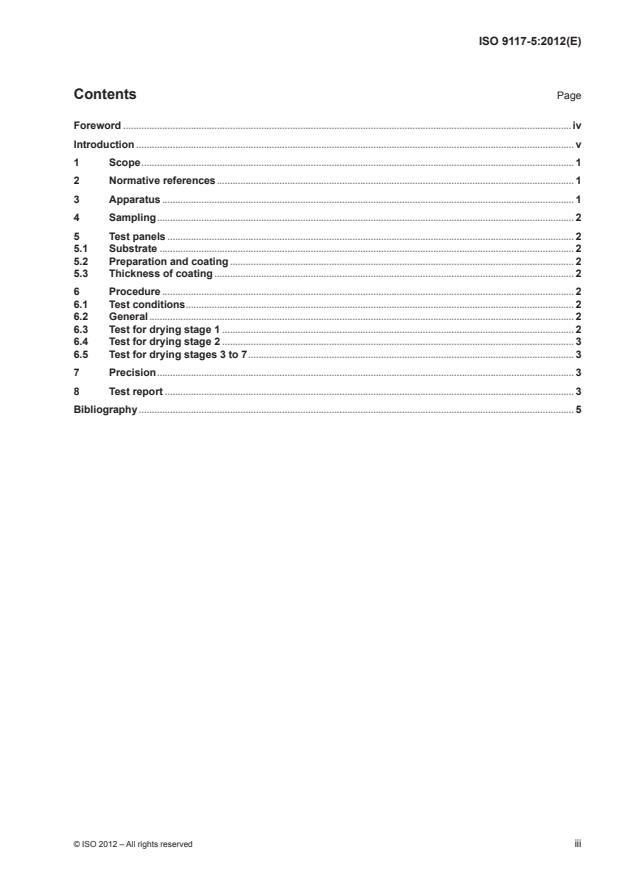
ISO 9117-5:2012 - Paints and varnishes — Drying tests — Part 5: Modified Bandow-Wolff test Released:8/8/2012

ISO 9117-5:2012 - Peintures et vernis — Essais de séchage — Partie 5: Essai Bandow-Wolff modifié Released:8/8/2012
Overview
ISO 9117-5:2012, titled "Paints and varnishes - Drying tests - Part 5: Modified Bandow-Wolff test," is an international standard published by ISO that specifies a standardized method to determine whether coatings- including multi-coat systems-have reached various stages of drying. The standard also enables an assessment of the drying speed of these coatings. This method focuses particularly on the evaluation of the drying process stages using the Modified Bandow-Wolff test, which involves applying different weights and observing physical responses of the coating surface.
Notably, the standard highlights limitations when applied to plastic coatings due to their elasto-plastic behavior, which cannot be fully assessed by temporary visible changes on the surface during drying.
Key Topics
Drying Stage Determination: The standard defines procedures for classifying coatings into drying stages 1 through 7, based on resistance to certain test actions using weights ranging from 20 g to 20 kg.
Modified Bandow-Wolff Test Procedure:
- Application of glass spheres to assess early drying stages.
- Use of paper and rubber discs combined with precise loads to evaluate adhesion and surface changes under stress.
- Specific load and impact test requirements corresponding to each drying stage.
Test Conditions and Equipment:
- Testing performed at controlled laboratory conditions (around 23 ± 2°C, ambient humidity).
- Use of standardized test panels (steel panels 150x95 mm).
- Equipment such as glass spheres, brushes, rubber discs of defined hardness, and weights of specified mass.
Coating Preparation:
- Sample preparation follows ISO standards for sampling, panel selection, and wet film thickness measurements.
- Multi-layer coatings can also be assessed with this test method.
Evaluation Limitations:
- Elasto-plastic coatings like plastics may not reach certain drying stages detectable by this test.
- Visual assessments can be influenced by surface gloss and texture, making interpretation more precise on glossy finishes.
Reporting:
- Comprehensive test reporting requirements including product identification, test conditions, preparation details, drying stage results, anomalies, and any deviations from the standard method.
Applications
Quality Control in Coating Production: ISO 9117-5:2012 provides manufacturers with a reliable method of verifying drying times and performance characteristics of paints and varnishes during formulation and production phases.
Research and Development: Used by formulation scientists to compare drying speeds and optimize multi-coat systems for improved durability and efficiency.
Surface Treatment Validation: Helps verify if coatings applied in industrial or automotive settings have dried sufficiently before subsequent handling or processing.
Coating Performance Certification: Assists certification bodies in confirming compliance with drying time standards for protective and decorative coatings.
Comparative Analysis: Enables benchmarking between different coating products or drying conditions.
Related Standards
ISO 9117 series: Other parts cover complementary drying test methods:
- Part 1: Determination of dry-to-core time.
- Part 2: Pressure test for stackability.
- Part 3: Surface drying test using glass beads.
- Part 4: Mechanical recorder drying test.
- Part 6: Apparent complete drying test.
ISO 1513: Examination and preparation of test samples.
ISO 1514: Standard panels for coating tests.
ISO 2808: Determination of paint film thickness.
ISO 3270: Conditioning and testing ambient temperature and humidity.
ISO 15528: Sampling of paints and varnishes products.
Summary
ISO 9117-5:2012 is a vital international standard that provides a practical, consistent, and repeatable method to measure the drying progression and speed of various paint and varnish coatings. By implementing the Modified Bandow-Wolff test, industries can ensure their coatings meet quality and performance expectations, optimize drying processes, and validate multi-layer coating applications. Understanding the limitations with plastically behaving coatings and combining this test with other drying assessments enhances overall evaluation accuracy.
Keywords: ISO 9117-5:2012, paint drying test, varnish drying stages, Modified Bandow-Wolff test, coating drying speed, multi-coat systems, paint quality control, drying assessment, film thickness measurement, paint testing standard.
Relations
- Effective Date
- 09-Feb-2026
- Effective Date
- 12-Feb-2026
- Effective Date
- 06-Jun-2022
Buy Documents
ISO 9117-5:2012 - Paints and varnishes — Drying tests — Part 5: Modified Bandow-Wolff test Released:8/8/2012
ISO 9117-5:2012 - Peintures et vernis — Essais de séchage — Partie 5: Essai Bandow-Wolff modifié Released:8/8/2012
Frequently Asked Questions
ISO 9117-5:2012 is a standard published by the International Organization for Standardization (ISO). Its full title is "Paints and varnishes — Drying tests — Part 5: Modified Bandow-Wolff test". This standard covers: ISO 9117-5:2012 specifies a method for determining whether coatings, including those produced using multi-coat systems, have reached various stages of drying. Furthermore, it allows the drying speed to be assessed. In the case of plastic coatings, it is only possible to determine to a limited extent whether the later stages of drying have been reached, as the elasto-plastic behaviour of these coatings cannot be evaluated on the basis of a temporary visible change in the coating surface.
ISO 9117-5:2012 specifies a method for determining whether coatings, including those produced using multi-coat systems, have reached various stages of drying. Furthermore, it allows the drying speed to be assessed. In the case of plastic coatings, it is only possible to determine to a limited extent whether the later stages of drying have been reached, as the elasto-plastic behaviour of these coatings cannot be evaluated on the basis of a temporary visible change in the coating surface.
ISO 9117-5:2012 is classified under the following ICS (International Classification for Standards) categories: 87.040 - Paints and varnishes. The ICS classification helps identify the subject area and facilitates finding related standards.
ISO 9117-5:2012 has the following relationships with other standards: It is inter standard links to EN ISO 16927:2014, EN ISO 9117-5:2012, ISO 11140-1:2005. Understanding these relationships helps ensure you are using the most current and applicable version of the standard.
ISO 9117-5:2012 is available in PDF format for immediate download after purchase. The document can be added to your cart and obtained through the secure checkout process. Digital delivery ensures instant access to the complete standard document.
Standards Content (Sample)
INTERNATIONAL ISO
STANDARD 9117-5
First edition
2012-08-15
Paints and varnishes — Drying tests —
Part 5:
Modified Bandow-Wolff test
Peintures et vernis — Essais de séchage —
Partie 5: Essai Bandow-Wolff modifié
Reference number
©
ISO 2012
All rights reserved. Unless otherwise specified, no part of this publication may be reproduced or utilized in any form or by any means,
electronic or mechanical, including photocopying and microfilm, without permission in writing from either ISO at the address below or ISO’s
member body in the country of the requester.
ISO copyright office
Case postale 56 • CH-1211 Geneva 20
Tel. + 41 22 749 01 11
Fax + 41 22 749 09 47
E-mail copyright@iso.org
Web www.iso.org
Published in Switzerland
ii © ISO 2012 – All rights reserved
Contents Page
Foreword .iv
Introduction . v
1 Scope . 1
2 Normative references . 1
3 Apparatus . 1
4 Sampling . 2
5 Test panels . 2
5.1 Substrate . 2
5.2 Preparation and coating . 2
5.3 Thickness of coating . 2
6 Procedure . 2
6.1 Test conditions . 2
6.2 General . 2
6.3 Test for drying stage 1 . 2
6.4 Test for drying stage 2 . 3
6.5 Test for drying stages 3 to 7 . 3
7 Precision . 3
8 Test report . 3
Bibliography . 5
Foreword
ISO (the International Organization for Standardization) is a worldwide federation of national standards bodies
(ISO member bodies). The work of preparing International Standards is normally carried out through ISO
technical committees. Each member body interested in a subject for which a technical committee has been
established has the right to be represented on that committee. International organizations, governmental and
non-governmental, in liaison with ISO, also take part in the work. ISO collaborates closely with the International
Electrotechnical Commission (IEC) on all matters of electrotechnical standardization.
International Standards are drafted in accordance with the rules given in the ISO/IEC Directives, Part 2.
The main task of technical committees is to prepare International Standards. Draft International Standards
adopted by the technical committees are circulated to the member bodies for voting. Publication as an
International Standard requires approval by at least 75 % of the member bodies casting a vote.
Attention is drawn to the possibility that some of the elements of this document may be the subject of patent
rights. ISO shall not be held responsible for identifying any or all such patent rights.
ISO 9117-5 was prepared by Technical Committee ISO/TC 35, Paints and varnishes, Subcommittee SC 9,
General test methods for paints and varnishes.
ISO 9117 consists of the following parts, under the general title Paints and varnishes — Drying tests:
— Part 1: Determination of through-dry state and through-dry time
— Part 2: Pressure test for stackability
— Part 3: Surface-drying test using ballotini
— Part 4: Test using a mechanical recorder
— Part 5: Modified Bandow-Wolff test
— Part 6: Print-free test
iv © ISO 2012 – All rights reserved
Introduction
With regard to drying stages 2 to 7 (see Table 1) defined in this part of ISO 9117, it should be noted that the
drying of different coats applied to the same substrate does not proceed uniformly. The processes which take
place during film formation in the case of physical drying or oxidative/reaction-controlled drying are so different
that a clear distinction between grades is not possible. Therefore, when testing using this part of ISO 9117, it is
possible that, within the range covered by drying stages 4 to 7, a higher drying stage might be reached before
a lower drying stage. For this reason, a difference of one drying stage within this range does not necessarily
mean a specific difference in drying speed. Elasto-plastic coatings might never reach drying stages 5 to 7. If
the surface is tacky, it is also possible that the high drying stages will not be reached, although the surface
appears completely dry. Generally, the visible changes involved in drying stages 4 and 6 (see Table 1) can be
evaluated more exactly on glossy surfaces than on matt or structured surfaces.
The test described in this part of ISO 9117 should therefore be seen as a technological tool with relatively
limited usefulness. The test (if used in connection with other test procedures) should, however, ensure that the
interested parties c
...
NORME ISO
INTERNATIONALE 9117-5
Première édition
2012-08-15
Peintures et vernis — Essais de séchage —
Partie 5:
Essai Bandow-Wolff modifié
Paints and varnishes — Drying tests —
Part 5: Modified Bandow-Wolff test
Numéro de référence
©
ISO 2012
DOCUMENT PROTÉGÉ PAR COPYRIGHT
Droits de reproduction réservés. Sauf prescription différente, aucune partie de cette publication ne peut être reproduite ni utilisée sous
quelque forme que ce soit et par aucun procédé, électronique ou mécanique, y compris la photocopie et les microfilms, sans l’accord écrit
de l’ISO à l’adresse ci-après ou du comité membre de l’ISO dans le pays du demandeur.
ISO copyright office
Case postale 56 • CH-1211 Geneva 20
Tel. + 41 22 749 01 11
Fax + 41 22 749 09 47
E-mail copyright@iso.org
Web www.iso.org
Publié en Suisse
ii © ISO 2012 – Tous droits réservés
Sommaire Page
Avant-propos .iv
Introduction . v
1 Domaine d’application . 1
2 Références normatives . 1
3 Appareillage . 1
4 Échantillonnage . 2
5 Panneaux d’essai . 2
5.1 Subjectile . 2
5.2 Préparation et revêtement . 2
5.3 Épaisseur du revêtement . 2
6 Mode opératoire . 2
6.1 Conditions d’essai . 2
6.2 Généralités . 2
6.3 Essai relatif au stade de séchage 1 . 2
6.4 Essai relatif au stade de séchage 2 . 3
6.5 Essai relatif aux stades de séchage 3 à 7 . 3
7 Fidélité . 3
8 Rapport d’essai . 3
Bibliographie . 5
Avant-propos
L’ISO (Organisation internationale de normalisation) est une fédération mondiale d’organismes nationaux de
normalisation (comités membres de l’ISO). L’élaboration des Normes internationales est en général confiée aux
comités techniques de l’ISO. Chaque comité membre intéressé par une étude a le droit de faire partie du comité
technique créé à cet effet. Les organisations internationales, gouvernementales et non gouvernementales,
en liaison avec l’ISO participent également aux travaux. L’ISO collabore étroitement avec la Commission
électrotechnique internationale (CEI) en ce qui concerne la normalisation électrotechnique.
Les Normes internationales sont rédigées conformément aux règles données dans les Directives ISO/CEI, Partie 2.
La tâche principale des comités techniques est d’élaborer les Normes internationales. Les projets de Normes
internationales adoptés par les comités techniques sont soumis aux comités membres pour vote. Leur publication
comme Normes internationales requiert l’approbation de 75 % au moins des comités membres votants.
L’attention est appelée sur le fait que certains des éléments du présent document peuvent faire l’objet de droits
de propriété intellectuelle ou de droits analogues. L’ISO ne saurait être tenue pour responsable de ne pas avoir
identifié de tels droits de propriété et averti de leur existence.
L’ISO 9117-5 a été élaborée par le Comité Technique ISO/TC 35, Peintures et vernis, sous-comité SC 9,
Méthodes générales d’essais des peintures et vernis.
L’ISO 9117 comprend les parties suivantes, présentées sous le titre général Peintures et vernis — Essais de séchage:
— Partie 1: Détermination du séchage à cœur et du temps de séchage à cœur
— Partie 2: Essai de pression pour aptitude à l’empilement
— Partie 3: Essai de séchage en surface à l’aide de billes de verre
— Partie 4: Essai à l’aide d’un enregistreur mécanique
— Partie 5: Essai Bandow-Wolff modifié
— Partie 6: Essai de séchage apparent complet
iv © ISO 2012 – Tous droits réservés
Introduction
En ce qui concerne les stades de séchage 2 à 7 (voir Tableau 1) définis dans la présente partie de l’ISO 9117,
il convient de noter que le séchage des différents revêtements appliqués sur le même subjectile ne se
produit pas de manière uniforme. Les processus qui surviennent lors de la formation du feuil dans le cas
d’un séchage physique ou dans le cas d’un séchage résultant d’une réaction d’oxydation contrôlée sont si
différents qu’une distinction nette des catégories est impossible. Par conséquent, lorsque des essais sont
réalisés conformément à la présente partie de l’ISO 9117, il se peut que, dans l’intervalle couvert par les stades
de séchage 4 à 7, un stade de séchage plus élevé soit atteint avant un stade de séchage plus faible. Pour
cette raison, une différence de un stade de séchage dans cet intervalle ne signifie pas nécessairement une
différence spécifique de la vitesse de séchage. Les revêtements élasto-plastiques peuvent ne jamais atteindre
les stades de séchage 5 à 7. Si la surface est poisseuse, il est également possible que les stades de séchage
élevés ne soient pas atteints, bien que la surface semble complètement sèche. En général, les changements
visibles impliqués dans les stades de séchage 4 et 6 (voir Tableau 1) peuvent être évalués plus exactement sur
des surfaces brillantes que sur des surfaces mates ou structurées.
Par conséquent, il convient de considérer l’essai décrit dans la présente partie de l’ISO 9117 comme un outil
technique ayant une utilité relativement limitée. Il convient toutefois que l’essai (s’il est utilisé conjointement
avec d’autres modes opératoires d’essai) garantisse que les différentes parties intéressées puissent s’accorder
sur une mesure de la caractéristique de performance désignée par «vitesse de séchage».
NORME INTERNATIONALE ISO 9117-5
...