

ISO 18142:2014
(Main)Carbonaceous materials for the production of primary aluminium — Baked carbon bodies — Determination of the dynamic elasticity modulus by the resonance method
General Information
- Abstract
ISO 18142:2014 specifies a method to determine the dynamic modulus of elasticity of specimens made of solid carbonaceous or graphite materials at room temperature by the resonance method.
- Status
- Published
- Publication Date
- 02-Feb-2014
- Technical Committee
- ISO/TC 226 - Materials for the production of primary aluminium
- Drafting Committee
- ISO/TC 226 - Materials for the production of primary aluminium
- Current Stage
- 9093 - International Standard confirmed
- Start Date
- 24-Oct-2022
- Completion Date
- 29-Aug-2026
Buy Documents
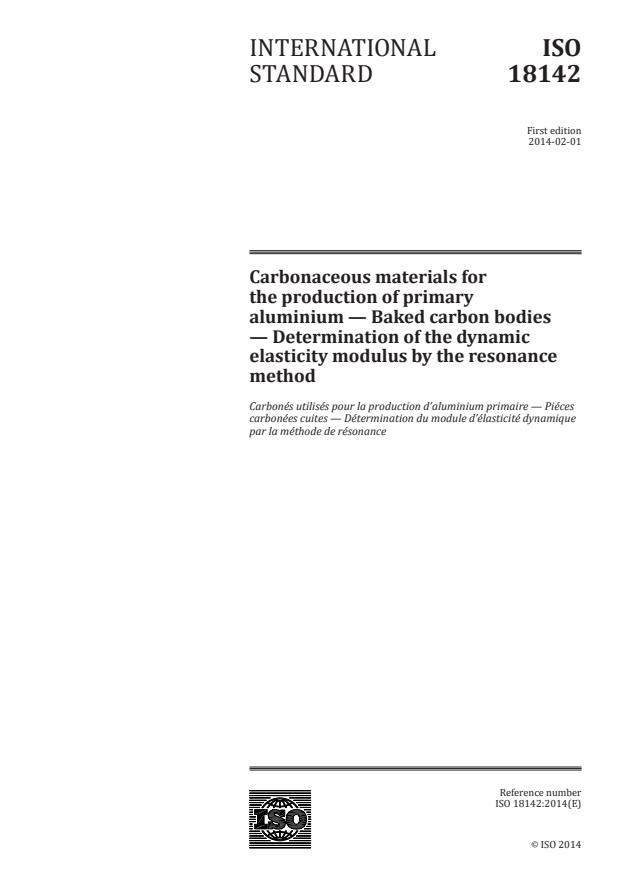

ISO 18142:2014 - Carbonaceous materials for the production of primary aluminium -- Baked carbon bodies -- Determination of the dynamic elasticity modulus by the resonance method
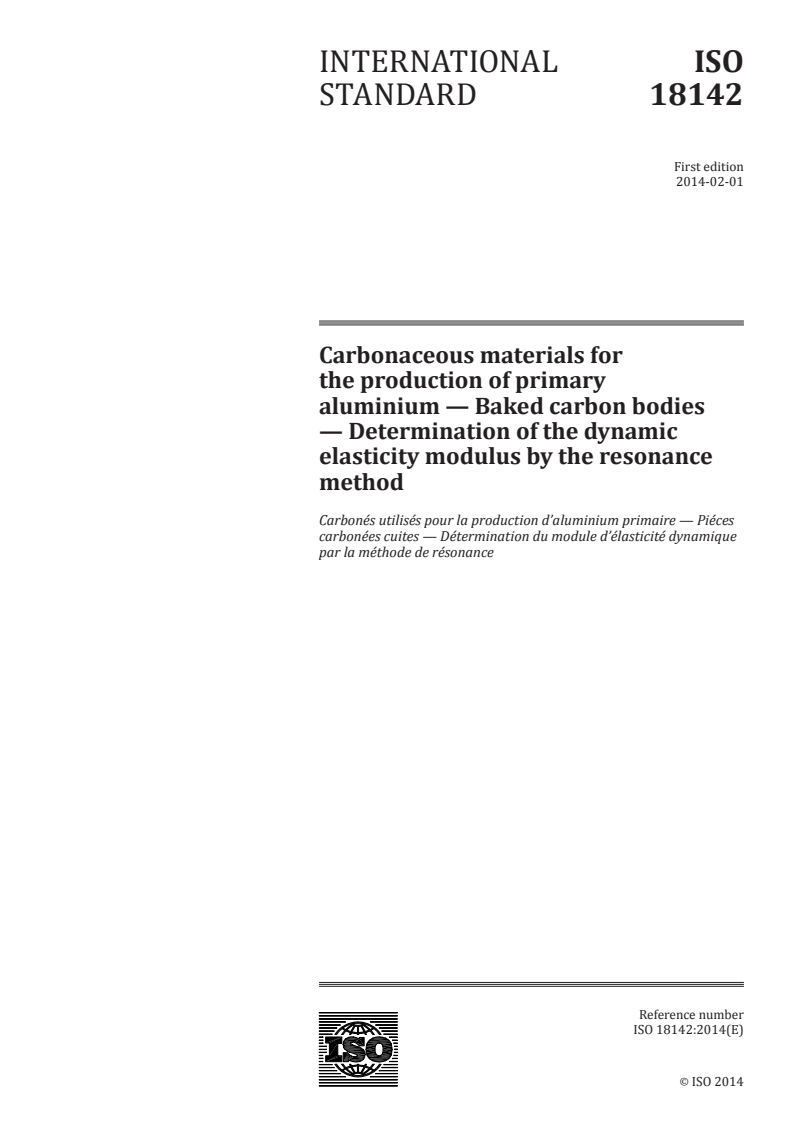

ISO 18142:2014 - Carbonaceous materials for the production of primary aluminium — Baked carbon bodies — Determination of the dynamic elasticity modulus by the resonance method/3/2014
Overview
ISO 18142:2014 specifies a laboratory method to determine the dynamic modulus of elasticity of solid carbonaceous and graphite specimens (baked carbon bodies) used in the production of primary aluminium. The standard uses the resonance method at room temperature: a rod-shaped specimen is excited to longitudinal oscillation, the fundamental resonance frequency is measured, and the dynamic elasticity modulus is calculated from the resulting sound velocity and the specimen’s apparent density.
Keywords: ISO 18142:2014, dynamic modulus of elasticity, resonance method, baked carbon bodies, carbonaceous materials, primary aluminium, resonance frequency, sound velocity.
Key Topics
- Scope and principle
- Applies to solid carbonaceous or graphite specimens at room temperature.
- Dynamic modulus derived from sound velocity obtained from the specimen’s fundamental resonance frequency.
- Based on DIN 51915 methodology.
- Specimen requirements
- Rod-shaped specimens with uniform cross section (circular or rectangular preferred).
- Length at least three times the largest cross-sectional dimension; end faces perpendicular to axis.
- Minimum dimensions related to largest particle size to avoid heterogeneity effects.
- Apparatus and setup
- Frequency generator/receiver, vibration generator, vibration pickup, supports and measuring instruments (callipers/micrometers).
- Specimen supported at quarter-length nodes to allow undisturbed fundamental vibration.
- Probes contact specimen near mid-face with low contact force (adjustable counterweight suggested).
- Calculations and evaluation
- Sound velocity obtained from measured resonance frequency and specimen length.
- Dynamic modulus calculated from sound velocity and apparent density following the formulas provided in the standard.
- Precision
- Repeatability and reproducibility limits are specified (e.g., for 1–10 GPa: repeatability 0.1 GPa, reproducibility 0.2 GPa; over 10 GPa: 0.2 GPa and 0.4 GPa respectively).
- Sampling and reporting
- Sampling in accordance with ISO 8007 series unless otherwise agreed.
- Test report must include reference to ISO 18142:2014, specimen details, individual and mean E_dyn values, and any deviations.
Applications
- Quality control and acceptance testing of baked carbon anodes, cathode blocks and sidewall blocks used in aluminium smelting.
- Materials characterization in R&D labs evaluating thermal shock resistance and elastic deformation behavior of carbonaceous products.
- Supplier verification tests and cross-laboratory comparisons for procurement and production control.
Related Standards
- ISO 8007-1 / ISO 8007-2 / ISO 8007-3 (sampling of carbonaceous materials)
- ISO 3611, ISO 13385-1 (dimensional measuring equipment)
- ISO 4259 (precision data and test method precision)
- DIN 51915 (method on which ISO 18142 is based)
This summary helps engineers, laboratory managers and materials specialists locate and apply ISO 18142:2014 for reliable dynamic elasticity testing of carbonaceous materials used in primary aluminium production.
Buy Documents
ISO 18142:2014 - Carbonaceous materials for the production of primary aluminium -- Baked carbon bodies -- Determination of the dynamic elasticity modulus by the resonance method
ISO 18142:2014 - Carbonaceous materials for the production of primary aluminium — Baked carbon bodies — Determination of the dynamic elasticity modulus by the resonance method/3/2014
Get Certified
Connect with accredited certification bodies for this standard

ECOCERT
Organic and sustainability certification.

Eurofins Food Testing Global
Global leader in food, environment, and pharmaceutical product testing.

Intertek Bangladesh
Intertek certification and testing services in Bangladesh.
Sponsored listings
Frequently Asked Questions
ISO 18142:2014 is a standard published by the International Organization for Standardization (ISO). Its full title is "Carbonaceous materials for the production of primary aluminium — Baked carbon bodies — Determination of the dynamic elasticity modulus by the resonance method". This standard covers: ISO 18142:2014 specifies a method to determine the dynamic modulus of elasticity of specimens made of solid carbonaceous or graphite materials at room temperature by the resonance method.
ISO 18142:2014 specifies a method to determine the dynamic modulus of elasticity of specimens made of solid carbonaceous or graphite materials at room temperature by the resonance method.
ISO 18142:2014 is classified under the following ICS (International Classification for Standards) categories: 71.100.10 - Materials for aluminium production. The ICS classification helps identify the subject area and facilitates finding related standards.
ISO 18142:2014 is available in PDF format for immediate download after purchase. The document can be added to your cart and obtained through the secure checkout process. Digital delivery ensures instant access to the complete standard document.
Standards Content (Sample)
INTERNATIONAL ISO
STANDARD 18142
First edition
2014-02-01
Carbonaceous materials for
the production of primary
aluminium — Baked carbon bodies
— Determination of the dynamic
elasticity modulus by the resonance
method
Carbonés utilisés pour la production d’aluminium primaire — Piéces
carbonées cuites — Détermination du module d’élasticité dynamique
par la méthode de résonance
Reference number
©
ISO 2014
© ISO 2014
All rights reserved. Unless otherwise specified, no part of this publication may be reproduced or utilized otherwise in any form
or by any means, electronic or mechanical, including photocopying, or posting on the internet or an intranet, without prior
written permission. Permission can be requested from either ISO at the address below or ISO’s member body in the country of
the requester.
ISO copyright office
Case postale 56 • CH-1211 Geneva 20
Tel. + 41 22 749 01 11
Fax + 41 22 749 09 47
E-mail copyright@iso.org
Web www.iso.org
Published in Switzerland
ii © ISO 2014 – All rights reserved
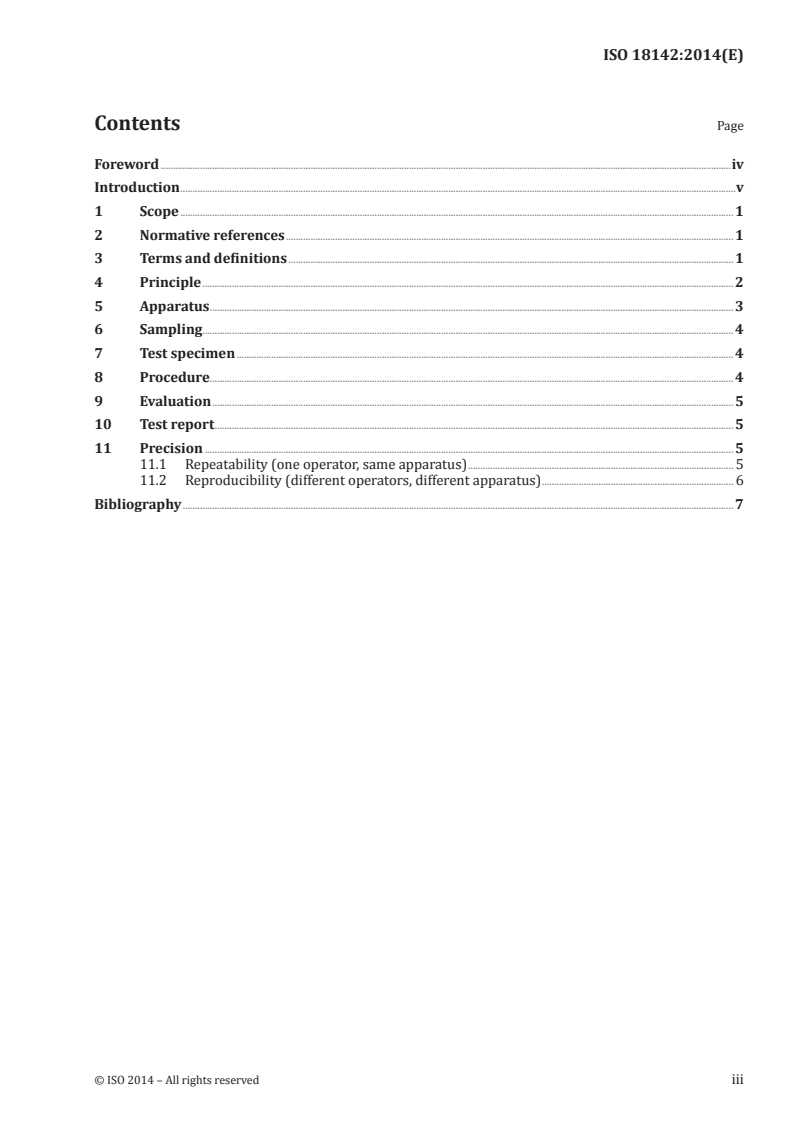
Contents Page
Foreword .iv
Introduction .v
1 Scope . 1
2 Normative references . 1
3 Terms and definitions . 1
4 Principle . 2
5 Apparatus . 3
6 Sampling . 4
7 Test specimen . 4
8 Procedure. 4
9 Evaluation . 5
10 Test report . 5
11 Precision . 5
11.1 Repeatability (one operator, same apparatus) . 5
11.2 Reproducibility (different operators, different apparatus) . 6
Bibliography . 7
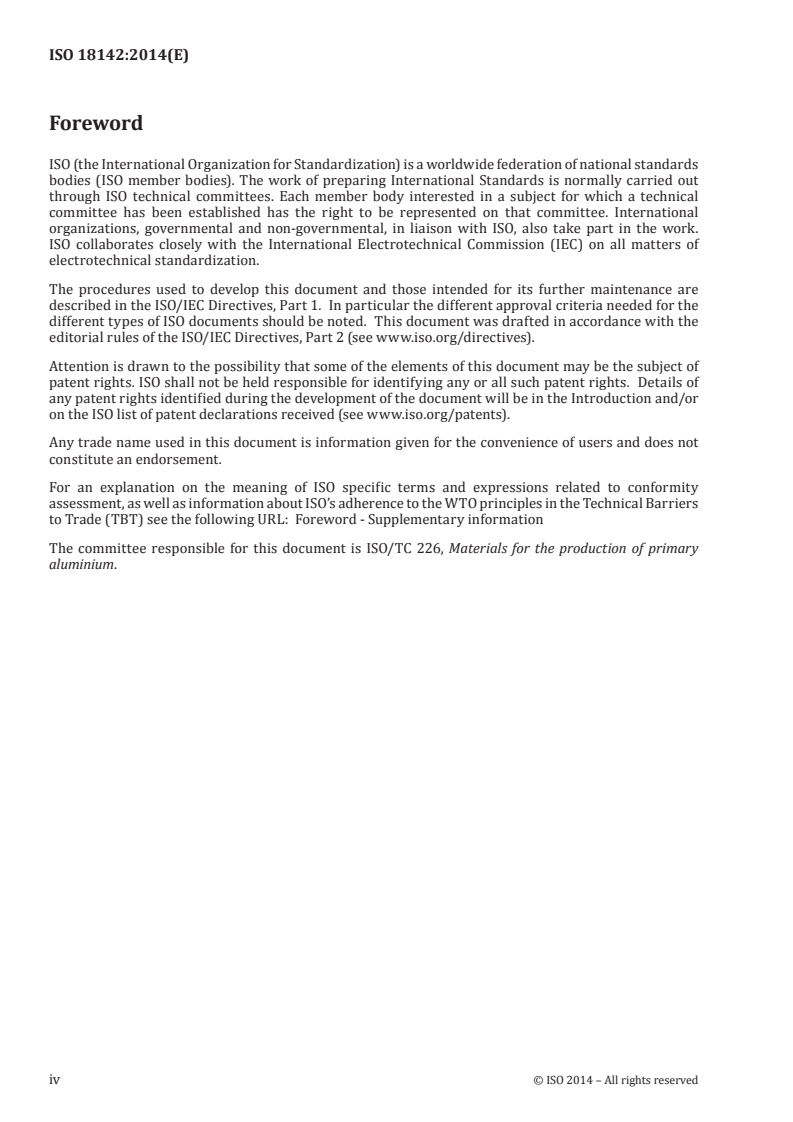
Foreword
ISO (the International Organization for Standardization) is a worldwide federation of national standards
bodies (ISO member bodies). The work of preparing International Standards is normally carried out
through ISO technical committees. Each member body interested in a subject for which a technical
committee has been established has the right to be represented on that committee. International
organizations, governmental and non-governmental, in liaison with ISO, also take part in the work.
ISO collaborates closely with the International Electrotechnical Commission (IEC) on all matters of
electrotechnical standardization.
The procedures used to develop this document and those intended for its further maintenance are
described in the ISO/IEC Directives, Part 1. In particular the different approval criteria needed for the
different types of ISO documents should be noted. This document was drafted in accordance with the
editorial rules of the ISO/IEC Directives, Part 2 (see www.iso.org/directives).
Attention is drawn to the possibility that some of the elements of this document may be the subject of
patent rights. ISO shall not be held responsible for identifying any or all such patent rights. Details of
any patent rights identified during the development of the document will be in the Introduction and/or
on the ISO list of patent declarations received (see www.iso.org/patents).
Any trade name used in this document is information given for the convenience of users and does not
constitute an endorsement.
For an explanation on the meaning of ISO specific terms and expressions related to conformity
assessment, as well as information about ISO’s adherence to the WTO principles in the Technical Barriers
to Trade (TBT) see the following URL: Foreword - Supplementary information
The committee responsible for this document is ISO/TC 226, Materials for the production of primary
aluminium.
iv © ISO 2014 – All rights reserved
Introduction
Determining the dynamic modulus of elasticity of specimens made of carbonaceous or graphite materials
(solids) at room temperature allows conclusions to be drawn on the elastic deformation behaviour and
thermal shock resistance of the material under test.
This International Standard is based on the DIN method, DIN 51915:1997-10.
INTERNATIONAL STANDARD ISO 18142:2014(E)
Carbonaceous materials for the production of primary
aluminium — Baked carbon bodies — Determination of
the dynamic elasticity modulus by the resonance method
1 Scope
This International Standard specifies a method to determine the dynamic modulus of elasticity of
specimens made of solid carbonaceous or graphite materials at room temperature by the resonance
method.
2 Normative references
The following documents, in whole or in part, are normatively referenced in this document and are
indispensable for its application. For dated references, only the edition cited applies. For undated
references, the latest edition of the referenced document (including any amendments) applies.
ISO 3611 — Geometrical product specifications (GPS) — Dimensional measuring equipment: Micrometers
for external measurements — Design and metrological chara
...
INTERNATIONAL ISO
STANDARD 18142
First edition
2014-02-01
Carbonaceous materials for
the production of primary
aluminium — Baked carbon bodies
— Determination of the dynamic
elasticity modulus by the resonance
method
Carbonés utilisés pour la production d’aluminium primaire — Piéces
carbonées cuites — Détermination du module d’élasticité dynamique
par la méthode de résonance
Reference number
©
ISO 2014
© ISO 2014
All rights reserved. Unless otherwise specified, no part of this publication may be reproduced or utilized otherwise in any form
or by any means, electronic or mechanical, including photocopying, or posting on the internet or an intranet, without prior
written permission. Permission can be requested from either ISO at the address below or ISO’s member body in the country of
the requester.
ISO copyright office
Case postale 56 • CH-1211 Geneva 20
Tel. + 41 22 749 01 11
Fax + 41 22 749 09 47
E-mail copyright@iso.org
Web www.iso.org
Published in Switzerland
ii © ISO 2014 – All rights reserved
Contents Page
Foreword .iv
Introduction .v
1 Scope . 1
2 Normative references . 1
3 Terms and definitions . 1
4 Principle . 2
5 Apparatus . 3
6 Sampling . 4
7 Test specimen . 4
8 Procedure. 4
9 Evaluation . 5
10 Test report . 5
11 Precision . 5
11.1 Repeatability (one operator, same apparatus) . 5
11.2 Reproducibility (different operators, different apparatus) . 6
Bibliography . 7
Foreword
ISO (the International Organization for Standardization) is a worldwide federation of national standards
bodies (ISO member bodies). The work of preparing International Standards is normally carried out
through ISO technical committees. Each member body interested in a subject for which a technical
committee has been established has the right to be represented on that committee. International
organizations, governmental and non-governmental, in liaison with ISO, also take part in the work.
ISO collaborates closely with the International Electrotechnical Commission (IEC) on all matters of
electrotechnical standardization.
The procedures used to develop this document and those intended for its further maintenance are
described in the ISO/IEC Directives, Part 1. In particular the different approval criteria needed for the
different types of ISO documents should be noted. This document was drafted in accordance with the
editorial rules of the ISO/IEC Directives, Part 2 (see www.iso.org/directives).
Attention is drawn to the possibility that some of the elements of this document may be the subject of
patent rights. ISO shall not be held responsible for identifying any or all such patent rights. Details of
any patent rights identified during the development of the document will be in the Introduction and/or
on the ISO list of patent declarations received (see www.iso.org/patents).
Any trade name used in this document is information given for the convenience of users and does not
constitute an endorsement.
For an explanation on the meaning of ISO specific terms and expressions related to conformity
assessment, as well as information about ISO’s adherence to the WTO principles in the Technical Barriers
to Trade (TBT) see the following URL: Foreword - Supplementary information
The committee responsible for this document is ISO/TC 226, Materials for the production of primary
aluminium.
iv © ISO 2014 – All rights reserved
Introduction
Determining the dynamic modulus of elasticity of specimens made of carbonaceous or graphite materials
(solids) at room temperature allows conclusions to be drawn on the elastic deformation behaviour and
thermal shock resistance of the material under test.
This International Standard is based on the DIN method, DIN 51915:1997-10.
INTERNATIONAL STANDARD ISO 18142:2014(E)
Carbonaceous materials for the production of primary
aluminium — Baked carbon bodies — Determination of
the dynamic elasticity modulus by the resonance method
1 Scope
This International Standard specifies a method to determine the dynamic modulus of elasticity of
specimens made of solid carbonaceous or graphite materials at room temperature by the resonance
method.
2 Normative references
The following documents, in whole or in part, are normatively referenced in this document and are
indispensable for its application. For dated references, only the edition cited applies. For undated
references, the latest edition of the referenced document (including any amendments) applies.
ISO 3611 — Geometrical product specifications (GPS) — Dimensional measuring equipment: Micrometers
for external measurements — Design and metrological chara
...