

ISO 10303-223:2008
(Main)Industrial automation systems and integration — Product data representation and exchange — Part 223: Application protocol: Exchange of design and manufacturing product information for cast parts
General Information
- Abstract
ISO 10303-223:2008 specifies the use of the integrated resources necessary for the scope and information requirements for exchange, archiving and sharing of design and manufacturing product information for cast parts. The following are within the scope of ISO 10303-223:2008: the manufacturing of a cast part made by sand, die, and investment casting processes; parts that are to be manufactured by casting processes; design data for cast parts, including geometry, materials, tolerances, required physical and mechanical properties, required tests; casting features for defining shapes necessary for casting processes; manufacturing features for defining shapes necessary for machining processes; manufacturing features for defining shapes necessary for casting process; explicit representation of the 3D shape of casting features through bounded geometry representations; geometric and dimensional tolerances of the parts being manufactured; materials, and properties of the parts being manufactured; characterization of products used to make cast parts, including moulds, dies, equipment, materials, and consumable items; customer order administrative data to track receipt of an order for a cast part to the shop floor, but not including tracking of the order on the shop floor; approval data to authorize the manufacture of a cast part; requisition administrative data to identify requirements and track the status of materials and equipment needed to manufacture a cast part; work order data to track and identify the status of a cast part; tracking the state of raw stock for documenting the manufacturing history of a cast part; tracking a design exception notice of a cast part; process plans for parts that are made by sand, die, and investment casting processes: process data for part routing which includes manufacturing process and setup sequencing; process data for operation; work instructions for the tasks required to manufacture a cast part, which include: references to the resources required to perform the work; the sequences of the work instructions; relationships of the work to the part geometry; specifications for patterns and die assemblies; input to and output from casting process simulation software; data exchange between customer and foundry, within the foundry, and between foundry and supplier; use of data for foundry automation and shop floor control; use of data for archiving of design and manufacturing data for cast parts.
- Status
- Published
- Publication Date
- 19-Mar-2008
- Technical Committee
- ISO/TC 184/SC 4 - Industrial data
- Drafting Committee
- ISO/TC 184/SC 4/WG 12 - STEP product modelling and resources
- Current Stage
- 9093 - International Standard confirmed
- Start Date
- 03-Aug-2022
- Completion Date
- 29-Aug-2026
Buy Documents
ISO 10303-223:2008 - Industrial automation systems and integration — Product data representation and exchange — Part 223: Application protocol: Exchange of design and manufacturing product information for cast parts Released:3/20/2008


ISO 10303-223:2008 - Industrial automation systems and integration — Product data representation and exchange — Part 223: Application protocol: Exchange of design and manufacturing product information for cast parts Released:3/20/2008
Overview
ISO 10303-223:2008 is an international standard developed by the International Organization for Standardization (ISO) as part of the ISO 10303 series, also known as STEP (Standard for the Exchange of Product Data). This particular part, ISO 10303-223:2008, specifies an application protocol for the exchange, archiving, and sharing of design and manufacturing product information for cast parts. It provides a comprehensive framework that supports interaction among designers, manufacturers, and customers throughout the lifecycle of cast parts, focusing on sand, die, and investment casting processes.
This standard ensures that detailed product information-including geometric, material, tolerance, and process data-is represented in a computer-interpretable and neutral format. This approach helps organizations improve interoperability, reduce errors, and optimize efficiency in product data communication across various platforms and between different stakeholders in the casting and manufacturing domain.
Key Topics
Product Data Exchange
Standardizes the exchange of design, manufacturing, and simulation data related to cast parts.Support for Casting Processes
Covers sand casting, die casting, and investment casting, including the features and geometries specific to each process.Detailed Design Information
Addresses critical design elements:- 3D geometry and bounded representations of parts
- Material specifications and mechanical properties
- Geometric and dimensional tolerances
- Required physical tests and approval data
Manufacturing Process Information
Includes data for:- Manufacturing features for machining and casting
- Process plans and work instructions
- Tracking status of parts and materials
- Quality control and documentation
Administrative and Lifecycle Tracking
Provides information for:- Customer orders and approvals
- Work orders and requisition tracking
- State of raw stock and design exceptions
Automation and Digital Archiving
Supports data exchange between customers, foundries, suppliers, and shop floor systems, facilitating foundry automation and long-term archiving of product information.
Applications
ISO 10303-223:2008 delivers practical value across numerous industrial automation and integration scenarios, enabling:
Seamless Data Exchange in the Casting Supply Chain
Allows customers, foundries, machinists, and simulation software to share reliable product information, from initial RFQs to delivery of finished cast and machined parts.Improved Interoperability and Reduced Errors
By providing a neutral file format and structured data representation, the standard minimizes manual data re-entry and translation errors between CAD, CAM, CAE, and ERP systems.Process Planning and Optimization
Supports planning and documenting every stage of casting-from mould design and pattern making to machining, quality control, and final inspection.Regulatory and Quality Compliance
Enables traceability, documentation, and process control necessary for audits, customer approvals, and Production Part Approval Process (PPAP) requirements.Long-Term Data Retention
Facilitates archiving of complete design and manufacturing data, supporting product lifecycle management (PLM) and future reference.
Organizations involved in metalcasting, product development, supply chain management, and manufacturing automation benefit from adopting ISO 10303-223:2008 for efficient and error-free data management.
Related Standards
ISO 10303-223:2008 is part of the broader ISO 10303 (STEP) family, which standardizes product data representation and exchange across industries. Closely related standards include:
- ISO 10303-1: Overview and fundamental principles of the STEP standard.
- ISO 10303-224: Focuses on mechanical product definition for manufacturing features.
- ISO 10303-219: Covers the exchange of design and manufacturing information related to forging and casting.
- ISO 10303-240: Details process planning for machined parts.
- ISO 1101, ISO 5459, ISO 8062-1: Define terms and conventions used in tolerancing and geometric specification.
These related standards ensure compatibility, data consistency, and a streamlined approach to product data exchange in industrial automation and manufacturing environments. Integrating ISO 10303-223:2008 with these standards enhances the overall digital thread throughout the product lifecycle.
Buy Documents
ISO 10303-223:2008 - Industrial automation systems and integration — Product data representation and exchange — Part 223: Application protocol: Exchange of design and manufacturing product information for cast parts Released:3/20/2008
ISO 10303-223:2008 - Industrial automation systems and integration — Product data representation and exchange — Part 223: Application protocol: Exchange of design and manufacturing product information for cast parts Released:3/20/2008
Get Certified
Connect with accredited certification bodies for this standard

DVS-ZERT GmbH
German welding certification society.
CARES (UK Certification Authority for Reinforcing Steels)
UK certification for reinforcing steels and construction.
EWF/IIW (European/International Welding Federation)
International welding personnel certification.
Sponsored listings
Frequently Asked Questions
ISO 10303-223:2008 is a standard published by the International Organization for Standardization (ISO). Its full title is "Industrial automation systems and integration — Product data representation and exchange — Part 223: Application protocol: Exchange of design and manufacturing product information for cast parts". This standard covers: ISO 10303-223:2008 specifies the use of the integrated resources necessary for the scope and information requirements for exchange, archiving and sharing of design and manufacturing product information for cast parts. The following are within the scope of ISO 10303-223:2008: the manufacturing of a cast part made by sand, die, and investment casting processes; parts that are to be manufactured by casting processes; design data for cast parts, including geometry, materials, tolerances, required physical and mechanical properties, required tests; casting features for defining shapes necessary for casting processes; manufacturing features for defining shapes necessary for machining processes; manufacturing features for defining shapes necessary for casting process; explicit representation of the 3D shape of casting features through bounded geometry representations; geometric and dimensional tolerances of the parts being manufactured; materials, and properties of the parts being manufactured; characterization of products used to make cast parts, including moulds, dies, equipment, materials, and consumable items; customer order administrative data to track receipt of an order for a cast part to the shop floor, but not including tracking of the order on the shop floor; approval data to authorize the manufacture of a cast part; requisition administrative data to identify requirements and track the status of materials and equipment needed to manufacture a cast part; work order data to track and identify the status of a cast part; tracking the state of raw stock for documenting the manufacturing history of a cast part; tracking a design exception notice of a cast part; process plans for parts that are made by sand, die, and investment casting processes: process data for part routing which includes manufacturing process and setup sequencing; process data for operation; work instructions for the tasks required to manufacture a cast part, which include: references to the resources required to perform the work; the sequences of the work instructions; relationships of the work to the part geometry; specifications for patterns and die assemblies; input to and output from casting process simulation software; data exchange between customer and foundry, within the foundry, and between foundry and supplier; use of data for foundry automation and shop floor control; use of data for archiving of design and manufacturing data for cast parts.
ISO 10303-223:2008 specifies the use of the integrated resources necessary for the scope and information requirements for exchange, archiving and sharing of design and manufacturing product information for cast parts. The following are within the scope of ISO 10303-223:2008: the manufacturing of a cast part made by sand, die, and investment casting processes; parts that are to be manufactured by casting processes; design data for cast parts, including geometry, materials, tolerances, required physical and mechanical properties, required tests; casting features for defining shapes necessary for casting processes; manufacturing features for defining shapes necessary for machining processes; manufacturing features for defining shapes necessary for casting process; explicit representation of the 3D shape of casting features through bounded geometry representations; geometric and dimensional tolerances of the parts being manufactured; materials, and properties of the parts being manufactured; characterization of products used to make cast parts, including moulds, dies, equipment, materials, and consumable items; customer order administrative data to track receipt of an order for a cast part to the shop floor, but not including tracking of the order on the shop floor; approval data to authorize the manufacture of a cast part; requisition administrative data to identify requirements and track the status of materials and equipment needed to manufacture a cast part; work order data to track and identify the status of a cast part; tracking the state of raw stock for documenting the manufacturing history of a cast part; tracking a design exception notice of a cast part; process plans for parts that are made by sand, die, and investment casting processes: process data for part routing which includes manufacturing process and setup sequencing; process data for operation; work instructions for the tasks required to manufacture a cast part, which include: references to the resources required to perform the work; the sequences of the work instructions; relationships of the work to the part geometry; specifications for patterns and die assemblies; input to and output from casting process simulation software; data exchange between customer and foundry, within the foundry, and between foundry and supplier; use of data for foundry automation and shop floor control; use of data for archiving of design and manufacturing data for cast parts.
ISO 10303-223:2008 is classified under the following ICS (International Classification for Standards) categories: 25.040.40 - Industrial process measurement and control. The ICS classification helps identify the subject area and facilitates finding related standards.
ISO 10303-223:2008 is available in PDF format for immediate download after purchase. The document can be added to your cart and obtained through the secure checkout process. Digital delivery ensures instant access to the complete standard document.
Standards Content (Sample)
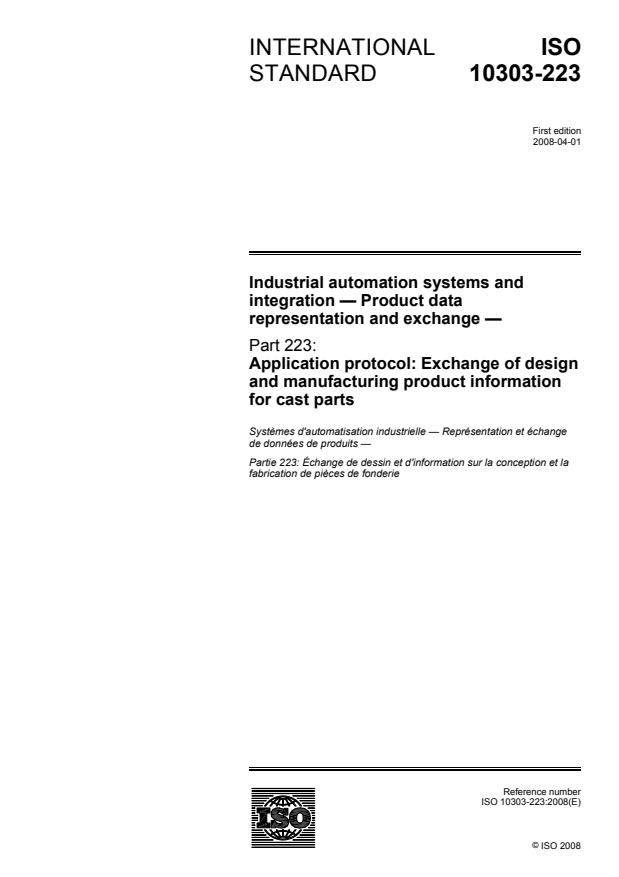
INTERNATIONAL ISO
STANDARD 10303-223
First edition
2008-04-01
Industrial automation systems and
integration — Product data
representation and exchange —
Part 223:
Application protocol: Exchange of design
and manufacturing product information
for cast parts
Systèmes d'automatisation industrielle — Représentation et échange
de données de produits —
Partie 223: Échange de dessin et d'information sur la conception et la
fabrication de pièces de fonderie
Reference number
©
ISO 2008
PDF disclaimer
This PDF file may contain embedded typefaces. In accordance with Adobe's licensing policy, this file may be printed or viewed but
shall not be edited unless the typefaces which are embedded are licensed to and installed on the computer performing the editing. In
downloading this file, parties accept therein the responsibility of not infringing Adobe's licensing policy. The ISO Central Secretariat
accepts no liability in this area.
Adobe is a trademark of Adobe Systems Incorporated.
Details of the software products used to create this PDF file can be found in the General Info relative to the file; the PDF-creation
parameters were optimized for printing. Every care has been taken to ensure that the file is suitable for use by ISO member bodies. In
the unlikely event that a problem relating to it is found, please inform the Central Secretariat at the address given below.
© ISO 2008
All rights reserved. Unless otherwise specified, no part of this publication may be reproduced or utilized in any form or by any means,
electronic or mechanical, including photocopying and microfilm, without permission in writing from either ISO at the address below or
ISO's member body in the country of the requester.
ISO copyright office
Case postale 56 • CH-1211 Geneva 20
Tel. + 41 22 749 01 11
Fax + 41 22 749 09 47
E-mail copyright@iso.org
Web www.iso.org
Published in Switzerland
ii © ISO 2008 – All rights reserved
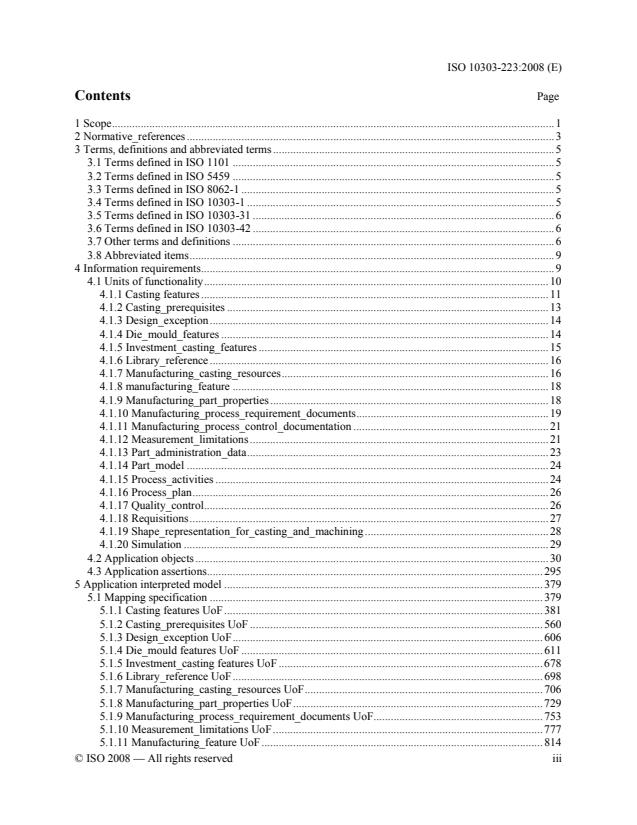
Contents Page
1 Scope.1
2 Normative_references .3
3 Terms, definitions and abbreviated terms .5
3.1 Terms defined in ISO 1101 .5
3.2 Terms defined in ISO 5459 .5
3.3 Terms defined in ISO 8062-1 .5
3.4 Terms defined in ISO 10303-1 .5
3.5 Terms defined in ISO 10303-31 .6
3.6 Terms defined in ISO 10303-42 .6
3.7 Other terms and definitions .6
3.8 Abbreviated items.9
4 Information requirements.9
4.1 Units of functionality.10
4.1.1 Casting features .11
4.1.2 Casting_prerequisites .13
4.1.3 Design_exception.14
4.1.4 Die_mould_features .14
4.1.5 Investment_casting_features .15
4.1.6 Library_reference .16
4.1.7 Manufacturing_casting_resources.16
4.1.8 manufacturing_feature .18
4.1.9 Manufacturing_part_properties.18
4.1.10 Manufacturing_process_requirement_documents.19
4.1.11 Manufacturing_process_control_documentation .21
4.1.12 Measurement_limitations .21
4.1.13 Part_administration_data.23
4.1.14 Part_model .24
4.1.15 Process_activities .24
4.1.16 Process_plan.26
4.1.17 Quality_control.26
4.1.18 Requisitions.27
4.1.19 Shape_representation_for_casting_and_machining.28
4.1.20 Simulation .29
4.2 Application objects.30
4.3 Application assertions.295
5 Application interpreted model .379
5.1 Mapping specification .379
5.1.1 Casting features UoF.381
5.1.2 Casting_prerequisites UoF .560
5.1.3 Design_exception UoF.606
5.1.4 Die_mould features UoF .611
5.1.5 Investment_casting features UoF .678
5.1.6 Library_reference UoF.698
5.1.7 Manufacturing_casting_resources UoF.706
5.1.8 Manufacturing_part_properties UoF.729
5.1.9 Manufacturing_process_requirement_documents UoF.753
5.1.10 Measurement_limitations UoF.777
5.1.11 Manufacturing_feature UoF.814
5.1.12 Manufacturing_process_control_documentation UoF .823
5.1.13 Part_administration_data UoF.842
5.1.14 Part_model UoF .847
5.1.15 Process_activities UoF .863
5.1.16 Process_plan UoF.914
5.1.17 Quality control UoF .925
5.1.18 Requisitions UoF.954
5.1.19 Shape_representation_for_castings UoF.957
5.1.20 Simulation UoF .973
5.2 AIM EXPRESS short listing .998
6 Conformance requirements.1361
Annex A (normative) AIM EXPRESS expanded listing .1397
Annex B (normative) AIM short names .1780
Annex C (normative) Implementation method specific requirements.1801
Annex D (normative) Protocol Implementation Conformance Statement (proforma) .1802
Annex E (normative) Information object registration.1804
Annex F (informative) Application activity model.1805
Annex G (informative) Application reference model .1848
Annex H (informative) AIM EXPRESS-G.1902
Annex I (informative) Computer interpretable listings.1946
Annex J (informative) Application protocol usage guide.1947
Bibliography .2237
Index .2239
Figures
Figure 1 — ISO 10303 manufacturing suite of standards.xi
Figure 2 — Data planning model.xii
Figure 3 — Angular_dimension_tolerance.37
Figure 4 — Angular_size_dimension_tolerance.38
Figure 5 — Chaplet and Chaplet_pad.53
Figure 6 — Choke connection in a Gating_system .57
Figure 7 — Compound_feature .61
Figure 8 — Core and Core_print .66
Figure 9 — Curved_dimension_tolerance .75
Figure 10 — Diameter_dimension_tolerance .88
Figure 11 — Distance_along_curve_tolerance.98
Figure 12 — Filter connection in a Gating_system .124
iv © ISO 2008 — All rights reserved
Figure 13 — Flask .127
Figure 14 — Location_dimension_tolerance.155
Figure 15 — Pattern_plate .200
Figure 16 — Production_core_box with Core.217
Figure 17 — Radial_dimension_tolerance .239
Figure 18 — Riser conection to Gating_system .250
Figure 19 — Sprue conection to Gating_system .277
Figure 20 — Well and associated Gating_system .294
Figure F.1 — IDEF0 basic notation.1805
Figure F.2 — A-0 Exchange of design and manufacturing product information for cast parts.1827
Figure F.3 — A0 Cast a part.1828
Figure F.4 — A1 Sand cast a part.1829
Figure F.5 — A11 Design sand mould and plan process.1830
Figure F.6 — A111 Design sand mould .1831
Figure F.7 — A12 Build sand mould.1832
Figure F.8 — A13 Build pattern and rigging assembly.1833
Figure F.9 — A131 Make sand mould .1834
Figure F.10 — A15 Pour cool and shakeout.1835
Figure F.11 — A2 Die cast a part .1836
Figure F.12 — A12 Design die and plan die casting process .1837
Figure F.13 — A22 Build die .1838
Figure F.14 — A22 Build die .1839
Figure F.15 — A23 Melt, pour, cool and extract.1840
Figure F.16 — A3 Investment cast a part .1841
Figure F.17 — A31 Design investment pattern assembly and plan process.1842
Figure F.18 — A311 Design investment mould .1843
Figure F.19 — A32 Build wax or foam pattern.1844
Figure F.20 — A33 Invest pattern .1845
Figure F.21 — A34 Melt, pour, cool and Knockout.1846
Figure F.22 — A4 Finish and inspect.1847
Figure G.1 — ARM diagram (1 of 53) .1849
Figure G.2 — ARM diagram (2 of 53) .1850
Figure G.3 — ARM diagram (3 of 53) .1851
Figure G.4 — ARM diagram (4 of 53) .1852
Figure G.5 — ARM diagram (5 of 53) .1853
Figure G.6 — ARM diagram (6 of 53) .1854
Figure G.7 — ARM diagram (7 of 53) .1855
Figure G.8 — ARM diagram (8 of 53) .1856
Figure G.9 — ARM diagram (9 of 53) .1857
Figure G.10 — ARM diagram (10 of 53) .1858
Figure G.11 — ARM diagram (11 of 53) .1859
Figure G.12 — ARM diagram (12 of 53) .1860
Figure G.13 — ARM diagram (13 of 53) .1861
Figure G.14 — ARM diagram (14 of 53) .1862
Figure G.15 — ARM diagram (15 of 53) .1863
Figure G.16 — ARM diagram (16 of 53) .1864
Figure G.17 — ARM diagram (17 of 53) .1865
Figure G.18 — ARM diagram (18 of 53) .1866
Figure G.19 — ARM diagram (19 of 53) .1867
Figure G.20 — ARM diagram (20 of 53) .1868
Figure G.21 — ARM diagram (21 of 53) .1869
Figure G.22 — ARM diagram (22 of 53) .1870
Figure G.23 — ARM diagram (23 of 53) .1871
Figure G.24 — ARM diagram (24 of 53) .1872
Figure G.25 — ARM diagram (25 of 53) .1873
Figure G.26 — ARM diagram (26 of 53) .1874
Figure G.27 — ARM diagram (27 of 53) .1875
Figure G.28 — ARM diagram (28 of 53) .1876
Figure G.29 — ARM diagram (29 of 53) .1877
Figure G.30 — ARM diagram (30 of 53) .1878
Figure G.31 — ARM diagram (31 of 53) .1879
Figure G.32 — ARM diagram (32 of 53) .1880
Figure G.33 — ARM diagram (33 of 53) .1881
Figure G.34 — ARM diagram (34 of 53) .1882
Figure G.35 — ARM diagram (35 of 53) .1883
Figure G.36 — ARM diagram (36 of 53) .1884
Figure G.37 — ARM diagram (37 of 53) .1885
Figure G.38 — ARM diagram (38 of 53) .1886
Figure G.39 — ARM diagram (39 of 53) .1887
Figure G.40 — ARM diagram (40 of 53) .1888
Figure G.41 — ARM diagram (41 of 53) .1889
Figure G.42 — ARM diagram (42 of 53) .1890
Figure G.43 — ARM diagram (43 of 53) .1891
Figure G.44 — ARM diagram (44 of 53) .1892
Figure G.45 — ARM diagram (45 of 53) .1893
Figure G.46 — ARM diagram (46 of 53) .1894
Figure G.47 — ARM diagram (47 of 53) .1895
Figure G.48 — ARM diagram (48 of 53) .1896
Figure G.49 — ARM diagram (49 of 53) .1897
Figure G.50 — ARM diagram (50 of 53) .1898
Figure G.51 — ARM diagram (51 of 53) .1899
Figure G.52 — ARM diagram (52 of 53) .1900
Figure G.53 — ARM diagram (53 of 53) .1901
Figure H.1 — AIM EXPRESS-G diagram application_context.1903
Figure H.2 — AIM EXPRESS-G diagram product.1904
Figure H.3 — AIM EXPRESS-G diagram product_definition .1905
Figure H.4 — AIM EXPRESS-G diagram effectivity.1906
Figure H.5 — AIM EXPRESS-G diagram property_definition .1907
Figure H.6 — AIM EXPRESS-G diagram property_definition_representation.1908
Figure H.7 — AIM EXPRESS-G diagram characterizeed_object .1909
Figure H.8 — AIM EXPRESS-G diagram casting_feature_definition .1910
Figure H.9 — AIM EXPRESS-G diagram shape_aspect .1911
Figure H.10 — AIM EXPRESS-G diagram representation.1912
Figure H.11 — AIM EXPRESS-G diagram shape_representation .1913
Figure H.12 — AIM EXPRESS-G diagram representation_item .1914
Figure H.13 — AIM EXPRESS-G diagram point.1915
Figure H.14 — AIM EXPRESS-G diagram placement.1916
Figure H.15 — AIM EXPRESS-G diagram curve .1917
Figure H.16 — AIM EXPRESS-G diagram bounded_curve.1918
Figure H.17 — AIM EXPRESS-G diagram b-spline_curve .1919
vi © ISO 2008 — All rights reserved
Figure H.18 — AIM EXPRESS-G diagram surface.1920
Figure H.19 — AIM EXPRESS-G diagram bounded_surface.1921
Figure H.20 — AIM EXPRESS-G diagram topology.1922
Figure H.21 — AIM EXPRESS-G diagram shell and face_bound .1923
Figure H.22 — AIM EXPRESS-G diagram geometric_tolerance.1924
Figure H.23 — AIM EXPRESS-G diagram datum .1925
Figure H.24 — AIM EXPRESS-G diagram dimensional tolerance .1926
Figure H.25 — AIM EXPRESS-G diagram action .1927
Figure H.26 — AIM EXPRESS-G diagram action_method .1928
Figure H.27 — AIM EXPRESS-G diagram action_method_relationship.1929
Figure H.28 — AIM EXPRESS-G diagram action_property.1930
Figure H.29 — AIM EXPRESS-G diagram action_directive .1931
Figure H.30 — AIM EXPRESS-G diagram resource_property .1932
Figure H.31 — AIM EXPRESS-G diagram action_resource.1933
Figure H.32 — AIM EXPRESS-G diagram document .1934
Figure H.33 — AIM EXPRESS-G diagram group.1935
Figure H.34 — AIM EXPRESS-G diagram externally_defined_item .1936
Figure H.35 — AIM EXPRESS-G diagram approval .1937
Figure H.36 — AIM EXPRESS-G diagram date .1938
Figure H.37 — AIM EXPRESS-G diagram applied assignments.1939
Figure H.38 — AIM EXPRESS-G diagram address .1940
Figure H.39 — AIM EXPRESS-G diagram unit.1941
Figure H.40 — AIM EXPRESS-G diagram measure_with_unit.1942
Figure H.41 — AIM EXPRESS-G diagram id and description attribute .1943
Figure H.42 — AIM EXPRESS-G diagram name and role attribute .1944
Figure H.43 — AIM EXPRESS-G diagram text, label and identifier .1945
Figure J.1 — Manufacturing suite test case test part drawing .2055
Figure J.2 — Manufacturing suite test case part.2056
Tables
Table 1 — Conformance class UoFs .1362
Table 2 — Conformance class elements.1375
Table B.1— AIM short names of entities.1780
Foreword
ISO (the International Organization for Standardization) is a worldwide federation of national standards
bodies (ISO member bodies). The work of preparing International Standards is normally carried out
through ISO technical committees. Each member body interested in a subject for which a technical
committee has been established has the right to be represented on that committee. International
organizations, governmental and non-governmental, in liaison with ISO, also take part in the work. ISO
collaborates closely with the International Electrotechnical Commission (IEC) on all matters of
electrotechnical standardization.
International Standards are drafted in accordance with the rules given in the ISO/ IEC Directives, Part 2.
The main task of technical committees is to prepare International Standards. Draft International Standards
adopted by the technical committees are circulated to the member bodies for voting. Publication as an
International Standard requires approval by at least 75 % of the member bodies casting a vote.
Attention is drawn to the possibility that some of the elements of this document may be the subject of
patent rights. ISO shall not be held responsible for identifying any or all such patent rights.
ISO 10303-223 was prepared by Technical Committee ISO/TC184, Industrial automation systems and
integration, Subcommittee SC 4, Industrial data.
ISO 10303 is organized as a series of parts, each published separately. The structure of ISO 10303 is
described in ISO 10303-1.
Each part of ISO 10303 is a member of one of the following series: description methods, implementation
methods, conformance testing methodology and framework, integrated generic resources, integrated
application resources, application protocols, abstract test suites, application interpreted constructs, and
application modules. This part of ISO 10303 is a member of the application protocol series.
A complete list of parts of ISO 10303 is available from the Internet:
viii © ISO 2008 — All rights reserved
Introduction
ISO 10303 is an International Standard for the computer-interpretable representation of product
information and for the exchange of product data. The objective is to provide a neutral mechanism
capable of describing products throughout their life cycle. This mechanism is suitable not only for neutral
file exchange, but also as a basis for implementing and sharing product databases, and as a basis for
archiving.
This part of ISO 10303 is a member of the application protocol series. This part of ISO 10303 specifies an
application protocol (AP) for the use of product data within a defined context that satisfies an industrial
need to exchange product design, simulation, and manufacturing data for producing cast parts. In addition
this part of ISO 10303 also provides for the exchange of product design and manufacturing data for value
added operations to the cast parts.
This part of ISO 10303 defines the context, scope, and information requirements for the exchange of
design, simulation, manufacturing features, and product information for cast parts and specifies the
integrated resources necessary to satisfy these requirements. This part of ISO 10303 defines data sharing
for the exchange of product specification between a customer and a metalcaster in response to a request
for quote (RFQ) to supply cast parts. This part of ISO 10303 can be used to represent the product design
modifications necessary for tooling design to produce the cast parts. This part of ISO 10303 provides
data sharing and exchange of the original and modified product design between the metalcaster, the
customer, the tool shop, and can provide data as direct input the simulation software. Recently many
metalcasters use simulation software to evaluate a design and analyze a gating system to reduce the
failure rate of the cast part. There is a need to reduce cost, labour time and errors in inputting the part
design. This part of ISO 10303 provides a common neutral data form for this data exchange between
metalcaster, customer, tool shop and simulation software. Should a customer request delivery of a
machined casting to design specifications these value-added operations are supported by the machining
features in this part of ISO 10303. The original part design specification from the customer and the
modified part design from the metalcaster define the manufacturing features of the casting that are to be
machined by a machine shop. This part of ISO 10303 interfaces directly with ISO 10303-224 and
ISO 10303-219 and supports the data exchange between customer, metalcaster, and machine shop
to deliver machined and inspected casting to customer specification. This part of ISO 10303 can also
be used to represent the necessary process data for quality control purposes in support of the Production
Part Approval Process (PPAP). Should the metalcaster require a more complete Process Plan capability,
this part of ISO 10303 provides an interface to ISO 10303-240, the Process Plan for machined parts.
As a member of a suite of application protocols developed to aid in the manufacture of piece parts for
mechanical operations, this part of ISO 10303 has been harmonized to be integrated into that suite.
Application protocols provide the basis for developing implementations of ISO 10303 and abstract test
suites for the conformance testing of AP implementations.
Clause 1 defines the scope of this part of ISO 10303 and summarizes the functionality and data covered
within it. Clause 3 lists the words defined in this part of ISO 10303 and gives pointers to words defined
elsewhere. An application activity model that is the basis for the definition of the scope is provided in
Annex F. The information requirements of the application are specified in Clause 4 using terminology
appropriate to the application. A graphical representation of the information requirements, referred to as
the application reference model, is given in Annex G.
Resource constructs are interpreted to meet the information requirements. This interpretation produces the
application interpreted model (AIM). This interpretation, given in 5.1, shows the correspondence between
the information requirements and the AIM. The short listing of the AIM specifies the interface to the
integrated resources and is given in 5.2. Note that the definitions and EXPRESS provided in the
integrated resources for constructs used in the AIM can include select list items and subtypes which are
not imported into the AIM. The expanded listing given in Annex A contains the complete EXPRESS for
the AIM without annotation while the short names of entities is given in Annex B. Information on where
to get computer interpretable EXPRESS is given in Annex I. A graphical representation of the AIM is
given in Annex H. Additional requirements for specific implementation methods are given in Annex C.
Figure 2 contains the data planning model that provides a high level description of the requirements for
this part of ISO 10303. This planning model was created from the in-scope data from the activities of the
application activity model (AAM) and grouped into logical units of functionality. This planning model is
used as a guide in developing the application reference model (ARM).
In the manufacturing product life cycle area of interest, there have been several application protocols that
have been developed.
NOTE Figure 1 illustrates the application protocols that are of interest to manufacturing, and the relationship of these application
protocols to each other.
As manufacturing application protocols are being developed, there has been a clear architectural plan for
development of new emerging manufacturing standards. The teams developing this set of applicaton
protocols are making a concentrated effort to make sure these standards are harmonized and have a
matching architecture.
The starting point for harmonization is ISO 10303-203. This part of ISO 10303 first developed Boundary
Representation (B-Rep) geometry. This B-Rep geometry resulted in the development of Application
Integrated Construct (AIC) for Advanced Brep – ISO 10303-514. This geometry is used throughout the
manufacturing application protocols.
The next point of harmonization is ISO 10303-224. This part of ISO 10303 first developed machining
features (ISO 10303-522), geometric tolerances (ISO 10303-519), dimensional tolerances, definitions
for implicit shape definitions, and property definitions for materials, process, part, and surface finish.
Since the development of ISO 10303-224, several application protocols have been developed to use constructs
defined by ISO 10303-224. There has been complete harmonization of constructs with all of the other
manufacturing application protocols.
x © ISO 2008 — All rights reserved
Input from
Micro PP
ISO-13399
CMM Inspection
Cutting tools
10303-240
10303- Finished Part
Macro
Micro
Process
Process
ISO-
Plan
Plan
NC programming
fasteners
STEP
Product 10303-
10303-240
Data
10303-240
Generation
And
10303-
10303-202, 10303-203,
10303-238 ISO 6983
10303-214
M&G Codes
10303-
10303-223
203,
Shop
10303-214
Floor
Figure 1 — ISO 10303 manufacturing suite of standards
Figure 2 — Data planning model
xii © ISO 2008 — All rights reserved
INTERNATIONAL STANDARD ISO 10303-223:2008 (E)
Industrial automation systems and integration —
Product data representation and exchange —
Part 223:
Application protocol: Exchange of design and manufacturing
product information for cast parts
1 Scope
This part of ISO 10303 specifies the use of the integrated resources necessary for the scope and
information requirements for exchange, archiving and sharing of design and manufacturing product
information for cast parts.
NOTE 1 The application activity model, in Annex F, provides a graphical representation of the processes and information flows
which are the basis for the definition of the scope of this part of ISO 10303.
The following are within the scope of this part of ISO 10303:
— the manufacturing of a cast part made by sand, die, and investment casting processes;
— parts that are to be manufactured by casting processes;
— design data for cast parts, including geometry, materials, tolerances, required physical and mechanical
properties, required tests;
— casting features for defining shapes necessary for casting processes;
NOTE 2 The casting feature set is defined in this part of ISO 10303.
— manufacturing features for defining shapes necessary for machining processes;
— manufacturing features for defining shapes necessary for casting process;
— explicit representation of the 3D shape of casting features through bounded geometry representations;
— geometric and dimensional tolerances of the parts being manufactured;
— materials, and properties of the parts being manufactured;
— characterization of products used to make cast parts, including moulds, dies, equipment, materials,
and consumable items;
— customer order administrative data to track receipt of an order for a cast part to the shop floor, but not
including tracking of the order on the shop floor;
— approval data to authorize the manufacture of a cast part;
— requisition administrative data to identify requirements and track the status of materials and
equipment needed to manufacture a cast part;
— work order data to track and identify the status of a cast part;
— tracking the state of raw stock for documenting the manufacturing history of a cast part;
— tracking a design exception notice of a cast part;
NOTE 3 The design exception notice relates to discrepancies in the features used to describe a cast part's shape.
— process plans for parts that are made by sand, die, and investment casting processes:
— process data for part routing which includes manufacturing process and setup sequencing;
— process data for operation;
— work instructions for the tasks required to manufacture a cast part, which include:
— references to the resources required to perform the work;
— the sequences of the work instructions;
— relationships of the work to the part geometry;
— specifications for
...
INTERNATIONAL ISO
STANDARD 10303-223
First edition
2008-04-01
Industrial automation systems and
integration — Product data
representation and exchange —
Part 223:
Application protocol: Exchange of design
and manufacturing product information
for cast parts
Systèmes d'automatisation industrielle — Représentation et échange
de données de produits —
Partie 223: Échange de dessin et d'information sur la conception et la
fabrication de pièces de fonderie
Reference number
©
ISO 2008
PDF disclaimer
PDF files may contain embedded typefaces. In accordance with Adobe's licensing policy, such files may be printed or viewed but shall
not be edited unless the typefaces which are embedded are licensed to and installed on the computer performing the editing. In
downloading a PDF file, parties accept therein the responsibility of not infringing Adobe's licensing policy. The ISO Central Secretariat
accepts no liability in this area.
Adobe is a trademark of Adobe Systems Incorporated.
Details of the software products used to create the PDF file(s) constituting this document can be found in the General Info relative to
the file(s); the PDF-creation parameters were optimized for printing. Every care has been taken to ensure that the files are suitable for
use by ISO member bodies. In the unlikely event that a problem relating to them is found, please inform the Central Secretariat at the
address given below.
This CD-ROM contains the publication ISO 10303-23:2008 in portable document format (PDF), which can be
viewed using Adobe® Acrobat® Reader.
Adobe and Acrobat are trademarks of Adobe Systems Incorporated.
© ISO 2008
All rights reserved. Unless required for installation or otherwise specified, no part of this CD-ROM may be reproduced, stored in a retrieval
system or transmitted in any form or by any means without prior permission from ISO. Requests for permission to reproduce this product
should be a
...