

ISO/IEC 8877:1992
(Main)Information technology — Telecommunications and information exchange between systems — Interface connector and contact assignments for ISDN Basic Access Interface located at reference points S and T
General Information
- Abstract
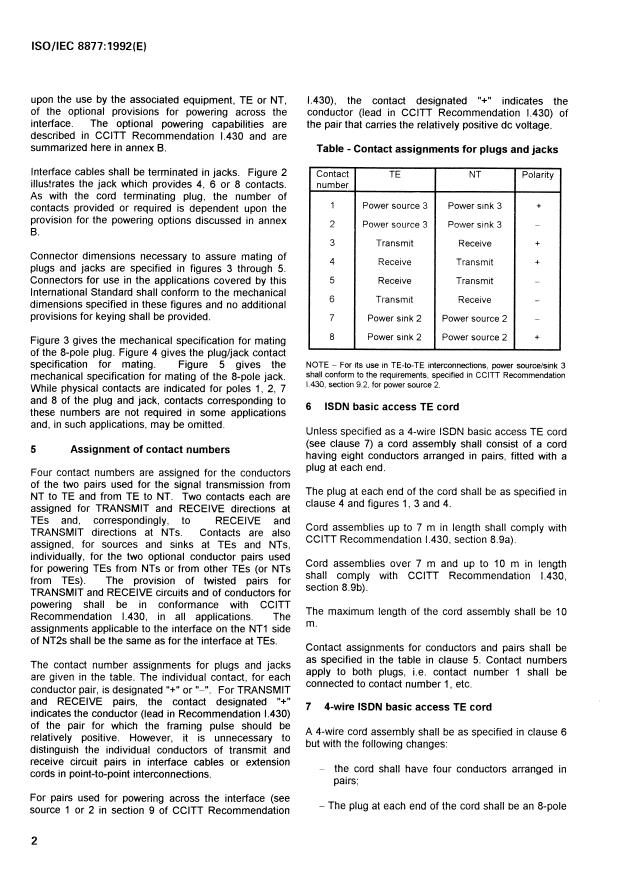
Specifies the 8-pole connector (plug and jack) and the assignments of poles/contacts for use in physical interfaces. These physical interfaces may be located at reference points S and T between TEs and NTs and between NT1s and NT2s and shall conform to CCITT Recommendation I.430. Also specifies the requirements for ISDN basic access cords.
- Status
- Published
- Publication Date
- 11-Nov-1992
- Current Stage
- 9093 - International Standard confirmed
- Start Date
- 16-Aug-2002
- Completion Date
- 29-Aug-2026
Buy Documents
ISO/IEC 8877:1992 - Information technology — Telecommunications and information exchange between systems — Interface connector and contact assignments for ISDN Basic Access Interface located at reference points S and T Released:11/12/1992
Overview
ISO/IEC 8877:1992 specifies the physical connector and contact assignments for ISDN Basic Access interfaces located at the S and T reference points. The standard defines an 8‑pole plug and jack, the required contact/pair assignments used between Terminal Equipment (TE) and Network Termination (NT) devices (including NT1 and NT2), and minimum requirements for ISDN basic access cords. It references and requires conformance with CCITT Recommendation I.430 for signalling, impedance and termination behavior.
Key topics and technical requirements
- Connector type: 8‑pole plug and jack (plug/jack mechanical and contact specifications illustrated in the standard).
- Contact/pair assignments: Wire pairs connect contact pairs 1‑2, 3‑6, 4‑5 and 7‑8. Contact numbering and TX/RX assignment follow I.430; the mapping at TE and NT ends results in the same conductor being connected to the same contact number in jacks at both ends of interface cables.
- Cabling roles: Defines three physical cable types - connecting cords, extension cords and interface cables - and their intended use in point‑to‑point and passive bus topologies.
- Cord length & electrical limits (from I.430 extract):
- Standard TE connecting cord maximum length: 10 m.
- For cords ≤ 7 m: pair capacitance < 300 pF; characteristic impedance > 75 Ω at 96 kHz; crosstalk loss > 60 dB at 96 kHz (with 100 Ω terminations); conductor resistance limits; cords terminated at both ends in plugs.
- For cords > 7 m (up to 10 m): capacitance allowance up to 350 pF; other limits apply.
- Termination resistors: For point‑to‑point wiring, terminating resistors must be located in or at the jack and connected across contact pairs 4‑5 and 3‑6; for passive bus, resistors may be at bus ends.
- Powering options (informative): Optional powering methods include phantom powering over transmit/receive pairs, power on optional pair 7‑8, and optional use of pair 1‑2 for power (powering rules and limits are defined in I.430, section 9). Use of power on 1‑2 supports TE‑to‑TE arrangements via crossover adapters.
Applications and practical use
- Standardizes the physical interface for ISDN Basic Access on customer premises wiring and equipment connections.
- Used when installing or manufacturing:
- ISDN terminal equipment (TE), network terminations (NT1/NT2), and PABX interfaces.
- Wall jacks, user‑premises wiring (interface cables), connecting and extension cords.
- Crossover adapters for TE‑to‑TE connections and installers planning passive bus vs point‑to‑point topologies.
- Ensures interoperability, correct termination, and signal/power behavior between vendors and installers.
Who should use this standard
- Telecom equipment manufacturers and hardware designers
- Network planners and installers for ISDN installations
- Cabling and premises wiring contractors
- Compliance and test labs validating ISDN interfaces
Related standards
- CCITT Recommendation I.430 (detailed ISDN Basic Access requirements referenced throughout)
- IEC 603‑7 (connector specifications for low‑frequency connectors)
Relations
- Effective Date
- 25-Aug-2026
- Effective Date
- 20-Feb-2026
- Effective Date
- 16-Oct-2025
- Effective Date
- 15-Apr-2008
Buy Documents
ISO/IEC 8877:1992 - Information technology — Telecommunications and information exchange between systems — Interface connector and contact assignments for ISDN Basic Access Interface located at reference points S and T Released:11/12/1992
Get Certified
Connect with accredited certification bodies for this standard

BSI Group
BSI (British Standards Institution) is the business standards company that helps organizations make excellence a habit.

NYCE
Mexican standards and certification body.
Sponsored listings
Frequently Asked Questions
ISO/IEC 8877:1992 is a standard published by the International Organization for Standardization (ISO). Its full title is "Information technology — Telecommunications and information exchange between systems — Interface connector and contact assignments for ISDN Basic Access Interface located at reference points S and T". This standard covers: Specifies the 8-pole connector (plug and jack) and the assignments of poles/contacts for use in physical interfaces. These physical interfaces may be located at reference points S and T between TEs and NTs and between NT1s and NT2s and shall conform to CCITT Recommendation I.430. Also specifies the requirements for ISDN basic access cords.
Specifies the 8-pole connector (plug and jack) and the assignments of poles/contacts for use in physical interfaces. These physical interfaces may be located at reference points S and T between TEs and NTs and between NT1s and NT2s and shall conform to CCITT Recommendation I.430. Also specifies the requirements for ISDN basic access cords.
ISO/IEC 8877:1992 is classified under the following ICS (International Classification for Standards) categories: 35.100.10 - Physical layer. The ICS classification helps identify the subject area and facilitates finding related standards.
ISO/IEC 8877:1992 has the following relationships with other standards: It is inter standard links to EN ISO 11073-30200:2005, EN 61850-8-1:2011/A1:2020, ISO 8877:1987/Amd 1:1991, ISO 8877:1987. Understanding these relationships helps ensure you are using the most current and applicable version of the standard.
ISO/IEC 8877:1992 is available in PDF format for immediate download after purchase. The document can be added to your cart and obtained through the secure checkout process. Digital delivery ensures instant access to the complete standard document.
Standards Content (Sample)
NOTE - This Portion of the plug illustrates a structure necessary for securing the cordage and is not pertinent to proper mating with the jack.
Figure 1 - Plug - 8 pole
\
\
Figure 2 - Jack - 8 pole
z
u:
* 4
c
'U!~(6~0'0) ‘IZ’L
L
CP
n
C
.-
-t
E
.-
-
i!
‘9;
E
.-
-
z
E
c
.-
:
.-
c
E
.-
n
a1ou aq1 aas
KOL'O)L9 z
; ( ELL’O) L8'Z
‘XWJ (150’0) ZE’L
--m--L
r
I
I
I
I -
l
I
I
i
I
L, 1 l/ /
1 -
.-
w
- E
.-
L
E g
= m
s e
c;
z
;t
s- ’ *
m
Cu‘ - a
7 .
55 I
2 .----
g:
I
r‘
7 1 1-1 4
I
J -- F3;,
RN 4m
00: $20
%c 19
drrr‘ da
-. - l -P. l
Dimensions in millimetres (inches in parentheses)
See note 2
0,5(0.0195)
- Jack contact
(0.011) min
(0.024)
.
z
E
-
z
e
z
Ln’
-
0103 (0.001)
A
.
.
u
NOTES
7 The 24O min. angle applies only to plugs with front plastic Walls higher than 4,83 mm (0.790 in).
2 Jack contacts may be rectangular with a width of 0,5O (0.079 5) max. and 0,36 (0.014) min.
Figure 4 - Plug/jack contact specification
Cu
-4-d
f”
m 0)
Y =
(L’E’O) 99’8 0 a
l
--
m a
II
2-
-s
/ ('IL2'0196'9
Ir
& *$
‘U!uJ (ISO-01 8O'Z
ü= Q,
.-
I
tiL$
QL
w2
'XeuJ (6+10'0)'7Z4
Ul c
.- .-
Yd--
*
a
m
Ni =r
Aö
3 c?
$ c
.-
. 0
*g ; Q! +1
.- -
-m
E E-Eo
.-
U- 0
yj ,r 5 +I
crogr
.-
EEL$
z z .m;T
m
m
Co
-
-4 ao-J’
E s
t--t3 MN
4-m 66
N - 0
i /
6 0
z
Nu
0 I
ri 6 I
Annex A
(informative)
Interface cabling arrangements!
The interface cabling arrangements, implied by the requirements in CCITT Recommendation 1.430, section 4 are
described in this annex. Figure A.l illustrates the cabling arrangements, for the ISDN basic access interface, and
Shows the different Parts of the physical interconnection: “connecting Cords”, “extension Cords” and “interface
ca bles”.
The same contact numbers assigned at the interface (Point IA in CCITT Recommendation 1.430, figure 2/1.430) of
TEs for TRANSMIT and RECEIVE conductor pairs are assigned at the interface (Point IB in CCITT
Recommendation 1.430, figure 211.430) of NTs for RECEIVE and TRANSMIT , respectively, conductor pairs. This
provides for a given conductor to be connected to the same contact in jacks at both ends of interface cables.
However, it means that interface cables are suitable for NT-to-TE and NTi-to-NT2s interconnections only.
For TE-to-TE interconnections, an adapter with a crossover to connect TRANSMIT to RECEIVE is required. Similar
Statements apply to contactslconductors (pairs assigned to contact numbers 1-2 and 7-8) used for optional power
transfer.
As indicated in Recom mendation 1.430, section 4, interface ca bles are termi nated in the same type of con nector
part (jack) at both ends . This means that NTs or TEs may be connect .ed at eith er end of ’ Point-to-Point cables.
Extension Cords have a plug at one end and a jack at the other end. They cannot be used to extend TE connecting
Cords in connections to Passive Bus wiring configurations because the bridging impedance of an extension Cord (of
even a short length) tan adversely affect Operation (including that of other TEs) in Passive Bus configurations. The
length of the extension Cord(s) associated with a TE in Point-to-Point configurations is limited to 25 m.
Connecting Cords provide a plug for connection to an interface cable (or extension Cord). The acceptable maximum
length of such Cords will generally be limited by the need for compliance with transmit and receive-circuit
impedance requirements specified in CCITT Recommendation 1.430, section 8.
While there is no restriction on the minimum length of such Cords in a particular a pplicati on , TEs are
least 5 m in length .
required to include a Cord of at
lt is also significant that, in most ISDN applications, the interface cable will be user’s premises wiring and the jack
must be available in a form suitable for wall mounting. Available assemblies of the specified jack, which are
intended for such mounting, may provide a housing for a suitable mounting of the transmit and receive pair
terminating resistors. As specified in CCITT Recommendation 1.430, figure Ul.430, the terminating resistors must
be located, for Point-to-Point wiring configurations, in or at the jack and must be connected across contact pairs 4-5
and 3-6. For passive bus wiring configurations, the terminating resistors may be mounted in such jack assemblies
located at the ends of the bus.
lt is equally important to recognize that the interface cable may be wired directly to NTs without the interface
connector and with the interchange circuit terminating resistors provided internal to the equipment. This is possible
where the cable is provided in association with or as part of the NT. In such applications, the only interface of
significance (at which the requirements of CCITT Recommendation 1.430 apply) may be at the jack (Point IA in
CCITT Recommendation 1.430, figure Ul.430) for the connection of TEs . In addition, the combination of the NT
connecting Cord and interface cabling may be of zero length.
Another alternative NT connectio
...