

ISO/IEC 17982:2021
(Main)Information technology — Telecommunications and information exchange between systems — Close capacitive coupling communication physical layer (CCCC PHY)
General Information
- Abstract
This document specifies the close capacitive coupling communication physical layer (CCCC PHY) for full duplex and broadcast communication in time slots on frequency division multiplex channels. NOTE An implementation for small size and low power devices is provided in Annex B.
- Status
- Published
- Publication Date
- 02-May-2021
- Current Stage
- 9093 - International Standard confirmed
- Start Date
- 10-Sep-2026
- Completion Date
- 19-Sep-2026


Overview
ISO/IEC 17982:2021 specifies the Close Capacitive Coupling Communication physical layer (CCCC PHY) used for short-range, capacitive-coupled data exchange between devices. The standard defines full duplex and broadcast communication carried in time slots on frequency division multiplex channels (FDCs). It includes architecture, signal and PDU formats, synchronization and listen-before-talk (LBT) procedures, conformance requirements and normative tests (Annex A). Annex B provides guidance for implementations targeted at small-size, low-power devices.
Key topics and technical requirements
- Physical architecture: Plate‑electrode assembly and mediator models describe how devices couple capacitively via conductive or dielectric materials.
- Channelization: Five frequency division channels (FDCs) are defined by division of a centre frequency; each FDC is further divided into time-segments and eight time division slots (TDS) for TDMA.
- Communication modes: Both full duplex and broadcast operation are supported with synchronous communication.
- Listen Before Talk (LBT): Mandatory LBT procedure for both talker and listener to ensure TDS availability before transmission.
- Protocol units: Definitions and structure for PHY PDU (P‑PDU) and PHY data unit (P‑DU), including preamble/sync, payload, CRC, segmentation/reassembly and DC balance requirements.
- Conformance: Conforming devices must implement talker and listener roles, LBT, association capabilities (e.g., association on FDC2 and communication on specified FDC sets), support all 8 TDS options and pass tests in Annex A.
- Implementation guidance: Annex B offers recommended practices for small size, low power implementations.
- Normative references: Builds on ISO/IEC 7498-1 (OSI basic model) and refers to ITU‑T Rec. V.41 for related error-control considerations.
Applications and who uses it
ISO/IEC 17982:2021 is targeted at designers and implementers of short-range capacitive-coupled interfaces and embedded communications where controlled, close-proximity coupling is desirable. Typical users include:
- Hardware and PCB designers working on capacitive contact interfaces and plate-electrode arrangements
- Firmware and protocol engineers implementing PHY layer framing, LBT and TDMA scheduling
- Product teams developing small, low-power devices and embedded systems (reference: Annex B) requiring reliable, time‑slot‑based full duplex or broadcast capabilities
- Test labs and conformity assessors using Annex A test procedures
Related standards
- ISO/IEC 7498-1 - OSI Basic Reference Model (architecture alignment)
- ITU‑T Rec. V.41 - Code-independent error-control systems (referenced for error control concepts)
Keywords: ISO/IEC 17982:2021, CCCC PHY, close capacitive coupling, physical layer, full duplex, broadcast, frequency division channel, time division slot, listen before talk, Annex B low power.
Relations
- Effective Date
- 28-Jan-2023
- Effective Date
- 23-Apr-2020
Get Certified
Connect with accredited certification bodies for this standard

BSI Group
BSI (British Standards Institution) is the business standards company that helps organizations make excellence a habit.

NYCE
Mexican standards and certification body.
Sponsored listings
Frequently Asked Questions
ISO/IEC 17982:2021 is a standard published by the International Organization for Standardization (ISO). Its full title is "Information technology — Telecommunications and information exchange between systems — Close capacitive coupling communication physical layer (CCCC PHY)". This standard covers: This document specifies the close capacitive coupling communication physical layer (CCCC PHY) for full duplex and broadcast communication in time slots on frequency division multiplex channels. NOTE An implementation for small size and low power devices is provided in Annex B.
This document specifies the close capacitive coupling communication physical layer (CCCC PHY) for full duplex and broadcast communication in time slots on frequency division multiplex channels. NOTE An implementation for small size and low power devices is provided in Annex B.
ISO/IEC 17982:2021 is classified under the following ICS (International Classification for Standards) categories: 35.100.10 - Physical layer. The ICS classification helps identify the subject area and facilitates finding related standards.
ISO/IEC 17982:2021 has the following relationships with other standards: It is inter standard links to ISO 17419:2018/Amd 1:2024, ISO/IEC 17982:2012. Understanding these relationships helps ensure you are using the most current and applicable version of the standard.
ISO/IEC 17982:2021 is available in PDF format for immediate download after purchase. The document can be added to your cart and obtained through the secure checkout process. Digital delivery ensures instant access to the complete standard document.
Standards Content (Sample)
INTERNATIONAL ISO/IEC
STANDARD 17982
Second edition
2021-04
Information technology —
Telecommunications and information
exchange between systems — Close
capacitive coupling communication
physical layer (CCCC PHY)
Technologies de l'information — Téléinformatique — Couche
physique pour communication par couplage capacitif fermé
Reference number
©
ISO/IEC 2021
© ISO/IEC 2021
All rights reserved. Unless otherwise specified, or required in the context of its implementation, no part of this publication may
be reproduced or utilized otherwise in any form or by any means, electronic or mechanical, including photocopying, or posting
on the internet or an intranet, without prior written permission. Permission can be requested from either ISO at the address
below or ISO’s member body in the country of the requester.
ISO copyright office
CP 401 • Ch. de Blandonnet 8
CH-1214 Vernier, Geneva
Phone: +41 22 749 01 11
Email: copyright@iso.org
Website: www.iso.org
Published in Switzerland
ii © ISO/IEC 2021 – All rights reserved
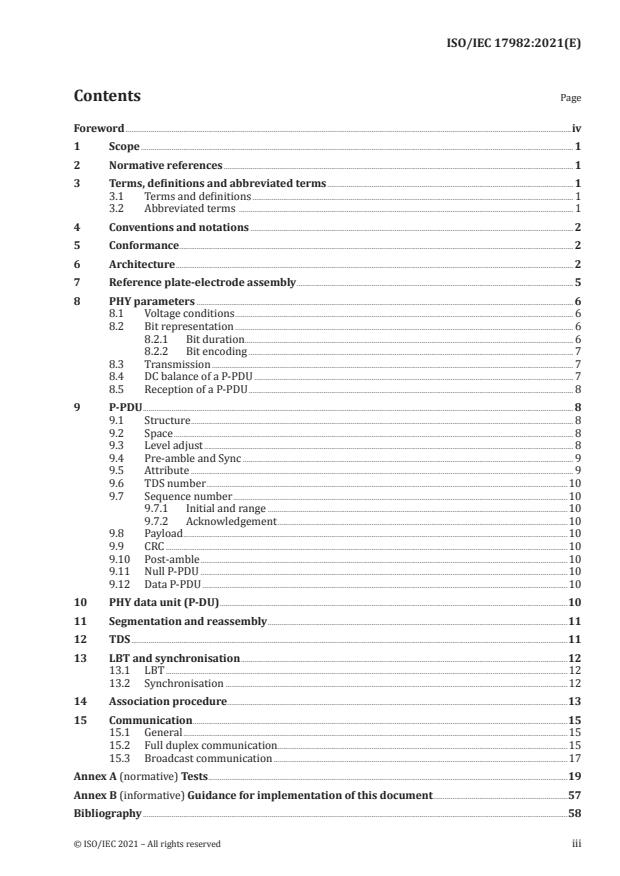
Contents Page
Foreword .iv
1 Scope . 1
2 Normative references . 1
3 Terms, definitions and abbreviated terms . 1
3.1 Terms and definitions . 1
3.2 Abbreviated terms . 1
4 Conventions and notations . 2
5 Conformance . 2
6 Architecture . 2
7 Reference plate-electrode assembly . 5
8 PHY parameters . 6
8.1 Voltage conditions . 6
8.2 Bit representation . 6
8.2.1 Bit duration. 6
8.2.2 Bit encoding . 7
8.3 Transmission . 7
8.4 DC balance of a P-PDU . 7
8.5 Reception of a P-PDU . 8
9 P-PDU . 8
9.1 Structure . 8
9.2 Space . 8
9.3 Level adjust . 8
9.4 Pre-amble and Sync . 9
9.5 Attribute . 9
9.6 TDS number .10
9.7 Sequence number .10
9.7.1 Initial and range .10
9.7.2 Acknowledgement .10
9.8 Payload .10
9.9 CRC .10
9.10 Post-amble .10
9.11 Null P-PDU .10
9.12 Data P-PDU .10
10 PHY data unit (P-DU) .10
11 Segmentation and reassembly .11
12 TDS .11
13 LBT and synchronisation .12
13.1 LBT .12
13.2 Synchronisation .12
14 Association procedure .13
15 Communication .15
15.1 General .15
15.2 Full duplex communication.15
15.3 Broadcast communication .17
Annex A (normative) Tests .19
Annex B (informative) Guidance for implementation of this document .57
Bibliography .58
© ISO/IEC 2021 – All rights reserved iii
Foreword
ISO (the International Organization for Standardization) and IEC (the International Electrotechnical
Commission) form the specialized system for worldwide standardization. National bodies that are
members of ISO or IEC participate in the development of International Standards through technical
committees established by the respective organization to deal with particular fields of technical
activity. ISO and IEC technical committees collaborate in fields of mutual interest. Other international
organizations, governmental and non-governmental, in liaison with ISO and IEC, also take part in the
work.
The procedures used to develop this document and those intended for its further maintenance are
described in the ISO/IEC Directives, Part 1. In particular, the different approval criteria needed for
the different types of document should be noted. This document was drafted in accordance with the
editorial rules of the ISO/IEC Directives, Part 2 (see www .iso .org/ directives or www .iec .ch/ members
_experts/ refdocs).
Attention is drawn to the possibility that some of the elements of this document may be the subject
of patent rights. ISO and IEC shall not be held responsible for identifying any or all such patent
rights. Details of any patent rights identified during the development of the document will be in the
Introduction and/or on the ISO list of patent declarations received (see www .iso .org/ patents) or the IEC
list of patent declarations received (see patents.iec.ch).
Any trade name used in this document is information given for the convenience of users and does not
constitute an endorsement.
For an explanation of the voluntary nature of standards, the meaning of ISO specific terms and
expressions related to conformity assessment, as well as information about ISO's adherence to the
World Trade Organization (WTO) principles in the Technical Barriers to Trade (TBT) see www .iso .org/
iso/ foreword .html. In the IEC, see www .iec .ch/ understanding -standards.
This document was prepared by Joint Technical Committee ISO/IEC JTC 1, Information technology,
Subcommittee SC 6, Telecommunications and information exchange between systems in cooperation with
Ecma International.
This second edition cancels and replaces the first edition (ISO/IEC 17982:2012), which has been
technically revised.
The main changes compared to the previous edition are as follows:
— The document has been fully aligned with the editorial rules in ISO/IEC Directives, Part 2.
— Annex B has been added to guide an implementation for small size and low power devices.
Any feedback or questions on this document should be directed to the user’s national standards body. A
complete listing of these bodies can be found at www .iso .org/ members .html and www .iec .ch/ national
-committees.
iv © ISO/IEC 2021 – All rights reserved
INTERNATIONAL STANDARD ISO/IEC 17982:2021(E)
Information technology — Telecommunications and
information exchange between systems — Close capacitive
coupling communication physical layer (CCCC PHY)
1 Scope
This document specifies the close capacitive coupling communication physical layer (CCCC PHY) for full
duplex and broadcast communication in time slots on frequency division multiplex channels.
NOTE An implementation for small size and low power devices is provided in Annex B.
2 Normative references
The following documents are referred to in the text in such a way that some or all of their content
constitutes requirements of this document. For dated references, only the edition cited applies. For
undated references, the latest edition of the referenced document (including any amendments) applies.
ISO/IEC 7498-1, Information technology — Open Systems Interconnection — Basic Reference Model: The
Basic Model
ITU-T Rec. V.41, Data communication over the telephone network — Code-independent error-control
system
3 Terms, definitions and abbreviated terms
3.1 Terms and definitions
For the purposes of this document, the terms and definitions given in ISO/IEC 7498-1 and the following
apply.
ISO and IEC maintain terminological databases for use in standardization at the following addresses:
— ISO Online browsing platform: available at https:// www .iso .org/ obp
— IEC Electropedia: available at http:// www .electropedia .org/
3.1.1
listener
entity that does not initiate communication
3.1.2
talker
entity that initiates communication
3.2 Abbreviated terms
CRC cyclic redundancy check
CCCC close capacitive coupling communication
DUT device under test
© ISO/IEC 2021 – All rights reserved 1
FDC frequency division channel
LBT listen before talk
LEN length
P-DU PHY data unit
P-PDU PHY PDU
PHY physical layer
RFU reserved for future use
TDS time division slot
4 Conventions and notations
The following conventions and notations apply in this document.
— A sequence of characters of ‘A’, ‘B’, ‘C”, ‘D, ‘E’ or ‘F’ and decimal digits in parentheses represent
numbers in hexadecimal notation unless followed by a ‘b’ character.
— Numbers in binary notation and bit patterns are represented by a sequence of 0 and 1 digits or ‘X’
characters in parentheses followed by a ‘b’ character, e.g. (0X11X010)b. Where X indicates that the
setting of a bit is not specified, and the leftmost bit is the most significant bit unless the sequence is
a bit pattern.
5 Conformance
Conforming entities implement:
— both talker and listener;
— listen before talk (LBT) for both talker and listener;
— the capability to execute association on FDC2 and to communicate on (FDC0 and FDC1), (FDC3 and
FDC4), or (FDC0, FDC1, FDC3 and FDC4);
— the capability for talkers and listeners to use any of the 8 TDS on an FDC;
— both full duplex and broadcast communication, and pass the tests specified in Annex A.
6 Architecture
The protocol architecture of CCCC follows ISO/IEC 7498-1 as the basic model. CCCC devices communicate
through mediators, such as conductive and dielectric materials.
Plate-electrodes for CCCC device E and F are equivalent to the reference plate-electrode assembly.
The plate-electrode A faces to the imaginary point at infinity and the plate-electrode B faces to the
mediator. The plate-electrode C faces to the mediator and the plate-electrode D faces to the imaginary
point at infinity. See Figure 1.
Figure 2 is the equivalent circuit of Figure 1. The voltage of X is the potential of the point at infinity. The
voltage of Y is the potential of the point at infinity. It is deemed that the potential of X and Y is identical.
Therefore, X and Y is imaginary short. Consequently, devices E and F are able to send and receive signal.
Regarding the information transfers from CCCC devices E to F, device E changes the voltage between
plate-electrode A and B. It changes the electric charge between plate-electrode B and the mediator.
2 © ISO/IEC 2021 – All rights reserved
The change in electric charge affects device F by the capacitive coupling between plate-electrode C and
mediator. Plate-electrodes A and B and plate-electrodes C and D have potential differences of reverse
polarity; therefore, device F senses the information as changes in voltage between plate-electrode C
and D.
Key
Components
A plate-electrode A
B plate-electrode B
C plate-electrode C
D plate-electrode D
E CCCC device E
F CCCC device F
a
Mediator, conductive materials or dielectric materials.
b
Point at infinity.
c
Electrostatic capacity.
Figure 1 — Electrical models
© ISO/IEC 2021 – All rights reserved 3
a) Device E is listening and device F is talking
b) Device E is talking and device F is listening
Key
Components
A plate-electrode A
B plate-electrode B
C plate-electrode C
D plate-electrode D
E Closed Capacitive Coupling Communication device E
F Closed Capacitive Coupling Communication device F
a
Conductive materials or dielectric materials.
b
Imaginary short.
Figure 2 — Equivalent circuit
Information transfer between CCCC devices E and F takes place by synchronous communication, see
subclause 13.1. Subclause 8.2.1 specifies five frequency division channels (FDC) by division of the
centre frequency. Each FDC consists of a sequence of time-segments. Each time-segment consists of
eight time division slots (TDS) for time division multiple-access, see Clause 12. Peers use the listen
before talk (LBT) procedure in subclause 13.1 to ascertain that a TDS is not occupied. The TDSs are
negotiated using the association procedure specified in Clause 14.
Subclauses 15.1 and 15.2 specify full duplex and broadcast communication respectively. In full duplex
communication, talkers and listeners exchange P-PDUs (see Clause 9) by synchronous communication.
In broadcast communication, talkers broadcast P-PDUs and listeners receive P-PDUs without
acknowledgment.
Length information and CRC is added to the SDU to construct a PHY data unit (P-DU), see Clause 10. The
sender segments the P-DU into P-PDUs. The receiving entity reassembles the P-PDUs into the P-DU, see
Clause 11, and forwards the SDU to its PHY user as illustrated in Figure 3.
4 © ISO/IEC 2021 – All rights reserved
Key
a
Segmentation.
b
Reassembly.
c
Segmented P-PDU.
t time
Figure 3 — PHY model
7 Reference plate-electrode assembly
The reference plate-electrode assembly for the CCCC devices shall consist of plate-electrode A and plate-
electrode B as specified in Figure 4. Dimensional characteristics are specified for those parameters
deemed to be mandatory.
a = 20,0 ± 0,1 mm
b = 20,0 ± 0,1 mm
The distance c between plate-electrode A and B shall be 5,0 ± 0,1 mm by horizontal flat surface.
d = 0,30 ± 0,03 mm
The displacement of centre of area e between plate-electrode A and B shall be a maximum of 0,1 mm.
The material of the plate-electrodes shall be 99 % to 100 % copper or equivalent.
The twisted-pair wire shall be connected inside the circle area f specified in Figure 4. The circle area f
has a diameter of 2,0 ± 0,5 mm. The twisted-pair wire shall be stranded wire and 26, 27, or 28 specified
American Wire Gauge. The length of the twisted-pair wire for the reference plate-electrode assembly
shall be less than 1,0 m.
© ISO/IEC 2021 – All rights reserved 5
Key
Components
A plate-electrode A
B plate-electrode B
C twist-pair wire
Figure 4 — CCCC reference plate-electrode assembly
8 PHY parameters
8.1 Voltage conditions
The following conditions of the voltage between the outer and the inner plate-electrode shall be used
for communication:
— +m Volts;
— –m Volts;
— 0 Volt;
— OPEN.
The value m depends on implementations. 0 Volt is achieved by shorting the two plate-electrodes in a
plate-electrode assembly. OPEN is achieved by disconnection of the plate-electrode assembly from the
driver circuits.
8.2 Bit representation
8.2.1 Bit duration
The centre frequency f is 40,68 MHz ± 50 Hz/MHz.
c
6 © ISO/IEC 2021 – All rights reserved
The bit duration T equals D/f seconds.
c
Table 1 specifies the relation between FDC and D.
Table 1 — FDC and D
FDC D
0 11
1 7
2 5
3 3
4 1
8.2.2 Bit encoding
Manchester bit encoding is specified in Figure 5. Depending on the relative orientation, bits are received
with either positive or negative polarity. The half bit time transition shall be between 0,4 T and 0,6 T.
a) bit (1)b encoding
b) bit (0)b encoding
Key
X time
T bit time
Figure 5 — Bit encoding
8.3 Transmission
P-PDUs shall be transmitted byte-wise in the sequence specified in subclause 9.1. Bytes shall be
transmitted with the least significant bit first.
8.4 DC balance of a P-PDU
The DC balance of a P-PDU is (Sp - Sn) / (Sp + Sn) x 100 [%] where Sp is the integral of the positive
voltage parts of one P-PDU and where Sn is the integral of the negative voltage parts of one P-PDU. The
DC balance shall be less than ± 10 % per P-PDU.
© ISO/IEC 2021 – All rights reserved 7
8.5 Reception of a P-PDU
While receiving a P-PDU, receivers shall put the voltage condition to OPEN.
9 P-PDU
9.1 Structure
Figure 6 specifies the P-PDU as a sequence of 0,5 T of space, 1,5 T of level adjust, 2 T of pre-amble, 5 T
of sync, 2 T of attribute, 3 T of TDS number, 2 T of sequence number, 32 T of payload, 16 T of CRC, and
2 T of post-amble. The P-PDU continues/ends with 1,5T of level adjust and another 0,5T space. The bit
encoding specified in 8.2.2 shall be applied to attribute, TDS number, sequence number, payload, and
CRC.
66 T is represented by t , t , t , … t .
1 2 3 66
Key
1 pre-amble (2 T)
2 sync (5 T)
3 attribute (2 T)
4 TDS number (3 T)
5 sequence number (2 T)
6 payload (32 T)
7 CRC (16 T)
8 postamble (2 T)
9 P-PDU (66 T)
a
Space (0,5 T).
b
Level adjust (1,5 T).
Figure 6 — P-PDU structure
9.2 Space
The space duration shall be 0,5 T with voltage condition OPEN.
9.3 Level adjust
Level adjust shall be 1,5 T of 0 Volt.
8 © ISO/IEC 2021 – All rights reserved
9.4 Pre-amble and Sync
Figure 7 specifies pre-amble and sync patterns. The transmitter shall apply pattern P. If the receiver
detects sync pattern P then it shall decode the bits in a P-PDU as positive polarity. If the receiver detects
sync pattern Q then it shall decode the bits in a P-PDU as negative polarity. The divisor value shall be
detected from pre-amble and sync. Other patterns shall not be handled as pre-amble and sync.
Key
1 pre-amble (2 T)
2 sync (5 T)
X time
T bit time
Figure 7 — Pre-amble and sync patterns
9.5 Attribute
Table 2 specifies the bit encodings of the attribute settings in a P-PDU. If a receiver gets RFU attribute
settings it shall ignore the P-PDU and stay mute.
Table 2 — Attribute settings
t t Definition
10 11
FDC2 FDC0, FDC1, FDC3, and FDC4
0 0 Association request 1 or Associ- null P-PDU
ation response 2
0 1 Association response 1 or Asso- last data P-PDU
ciation request 2
1 0 RFU first data P-PDU
1 1 RFU data P-PDU between the first and the last data P-PDU
© ISO/IEC 2021 – All rights reserved 9
9.6 TDS number
The TDS number field shall indicate the slot number in which the P-PDU is send; numbers 1 to 8 are
identified by (000)b to (111)b.
9.7 Sequence number
9.7.1 Initial and range
P-PDUs shall be identified by the sequence numbers in the range of (00)b to (11)b. The first P-PDU shall
have (00)b in the sequence number field.
9.7.2 Acknowledgement
To acknowledge correct reception, receivers shall increment the sequence number by 1 (modulo 4) from
the correctly received P-PDU as the sequence number in the next P-PDU.
9.8 Payload
The payload field of a P-PDU contains 4 bytes.
9.9 CRC
The scope of CRC shall be the last 1 T of sync as a bit, attribute, TDS number, sequence number, and
payload. The CRC shall be calculated according to ITU-T V.41 with pre-set value (FF FF). If the CRC of the
received P-PDU and the calculated CRC upon reception differ, the P-DU shall be ignored.
Example with attribute (11)b, TDS number (010)b, sequence number (10)b, payload (55 AA 00 FF) the CRC
is (6F AB).
9.10 Post-amble
Post-ambles consist of 1,5 T of level adjust and 0,5 T of Space.
9.11 Null P-PDU
Null P-PDUs have attribute of (00)b and a payload (00 00 00 00).
9.12 Data P-PDU
Data P-PDUs have a payload with a (possibly segmented) P-DU.
10 PHY data unit (P-DU)
Figure 8 specifies the P-DU. It shall consist of LEN, SDU, and CRC.
10 © ISO/IEC 2021 – All rights reserved
Key
1 2 byte
2 LEN bytes
3 16 bit
Figure 8 — PHY data unit (P-DU)
LEN contains the length of SDU in bytes + 2. The CRC shall be calculated over the LEN value and the SDU
according to ITU-T V.41. The pre-set value shall be (FFFF).
11 Segmentation and reassembly
P-DU shall be segmented and reassembled into 4 byte payloads of P-PDU as illustrated in Figure 9, by
using the attribute settings in Table 2.
a
Segmentation.
b
Reassembly.
c
Duration to be ignored for information exchange.
Figure 9 — Segmentation and reassembly
12 TDS
A TDS is 64 T wide. A P-PDU which is 66 T wide (see Figure 6), shall be transmitted in one TDS. See
Figure 11.
TDSs shall be numbered from 1 to 8 in each time segment as illustrated in Figure 10.
© ISO/IEC 2021 – All rights reserved 11
a
Time-segment.
Figure 10 — Time-segment and TDS
Figure 11 — Mapping of a P-PDU and a TDS
This document specifies full duplex and broadcast communication. A TDS is used for unidirectional
communication. A full duplex channel consists of two TDSs and one TDS is used for broadcast
communication.
The TDS may be either fixed by configuration or be negotiated.
Talkers may either use fixed configured TDS(s) on FDC1 or FDC3 or alternatively negotiate using TDS(s)
on FDC1 or FDC3 using the association procedure. Talkers that select FDC0 or FDC4 shall negotiate TDS
using the association procedure in Clause 14.
Before using a TDS, entities shall use LBT and synchronisation.
13 LBT and synchronisation
13.1 LBT
During LBT, entities shall listen for 576 T on the selected FDC to seek a free TDS. A TDS is occupied
when the entities receive a correct P-PDU.
13.2 Synchronisation
If all TDSs on the FDC that the talker selects are found to be free using LBT, then that talker shall
generate the TDS timing on its selected FDC. Otherwise the talkers shall synchronise to the TDS timing
on the FDC using LBT. Listeners shall always synchronise to the TDS timing on the FDC using LBT.
12 © ISO/IEC 2021 – All rights reserved
14 Association procedure
Talkers use the association procedure to negotiate the communication TDS(s). During this procedure,
talkers and listeners exchange the P-PDUs on 2 full duplex TDS in FDC2, in the following steps:
1) Talker selects a free association TDS in the range from 0 to 3 in FDC2, using LBT.
2) Talker selects (1 for broadcast and 2 for full duplex) free slot(s) in an FDC other than FDC2, using
LBT.
3) Talker sends association request 1 P-PDU specified in Table 3 on the association TDS from step
1 with attribute (00)b, sequence number (00)b and FDC/TDS(s) from step 2 and the selected
communication mode.
4) Listener sends association response 1 P-PDU specified in Table 4 on the association TDS number +
4 with attribute (01)b, sequence number (01)b and random number.
5) Talker sends association request 2 P-PDU specified in Table 4 on the association TDS from step 1
with attribute (01)b, sequence number (10)b and the random number from association response 1.
6) Listener sends association response 2 P-PDU specified in Table 3 on the association TDS number +
4 with attribute (00)b, sequence number (11)b and FDC/TDS(s) from association request 1.
7) Peers attempt communication as specified in Clause 15 on the FDC/TDS(s) from association request
1.
8) If the FDC/TDS(s) from association request 1 are occupied peers may repeat this association
procedure.
Figure 12 illustrates steps 3) to 6).
Figure 12 — Association
© ISO/IEC 2021 – All rights reserved 13
Table 3 — Payload with parameters of association request 1 and association response 2 P-PDU
Payload Settings
t
t
.
. Shall be one’s complement of t , t , t , t , t , t , t , t , t , t , t , t , t , t , t , t
17 18 19 20 21 22 23 24 25 26 27 28 29 30 31 32
.
t
t
t RFU
t RFU
t RFU
t RFU
t RFU
t 0 full duplex 0 broadcast
t 0 communication 1 communication other settings are RFU
t 0 0
t 0 listener 1 listener 0 listener 1 listener 0 listener 1 listener 0 listener 1 listen-
er
t 0 uses 0 uses 1 uses 1 uses 0 Uses 0 uses 1 uses 1 uses
t 0 TDS 1 0 TDS 2 0 TDS 3 0 TDS 4 1 TDS 5 1 TDS 6 1 TDS 7 1 TDS 8
t 0 talker 1 talker 0 talker 1 talker 0 talker 1 talker 0 talker 1 talker
t 0 uses 0 uses 1 uses 1 uses 0 Uses 0 uses 1 uses 1 uses
t 0 TDS 1 0 TDS 2 0 TDS 3 0 TDS 4 1 TDS 5 1 TDS 6 1 TDS 7 1 TDS 8
t 0 use FDC 0 1 use FDC 4 other settings are RFU
t 0 1
14 © ISO/IEC 2021 – All rights reserved
Table 4 — Payload with parameters of association response 1 and association request 2 P-PDU
Payload Settings
t
t
.
. Shall be one’s complement of t , t , t , t , t , t , t , t , t , t , t , t , t , t , t , t
17 18 19 20 21 22 23 24 25 26 27 28 29 30 31 32
.
t
t
t
t
.
. Random number
.
t
t
15 Communication
15.1 General
Entities exchange P-PDUs (see Clause 11) using either full duplex or broadcast communication.
Entities shall send Null P-PDUs when there is no P-DU (see Clause 10) pending until the PHY user stops
communication.
15.2 Full duplex communication
See subclause 9.7.1 for the rules on the sequence numbering.
The sender shall resend the current P-PDU until it is acknowledged. See subclause 9.7.2.
The next P-PDU shall have a sequence number of the (last received sequence number + 1) modulo 4.
Figure 13 illustrates full duplex communication without any errors.
Figure 14 illustrates a full duplex communication flow with receive errors.
© ISO/IEC 2021 – All rights reserved 15
Figure 13 — Example flow of full duplex communication
16 © ISO/IEC 2021 – All rights reserved
Figure 14 — Example flow of full duplex communication with some resending
15.3 Broadcast communication
Broadcast communication is unidirectional and unacknowledged.
For broadcast communication, the talker (hereafter referred to as broadcaster) shall use the LBT
procedure in subclause 13.1 to find a free TDS on FDC0 or FDC4.
Any numbers of receivers may receive broadcasted P-PDUs.
See subclause 9.7.1 for the rules on the sequence numbering.
The broadcaster may repeatedly send identical P-PDUs. The next P-PDU shall have a sequence number
of the (last sent sequence number + 1) modulo 4.
NOTE Repeating identical P-PDUs can increase communication robustness.
Figure 15 illustrates broadcast communication flow. In this example, the broadcaster sends identical
P-PDUs in 2 time-segments.
© ISO/IEC 2021 – All rights reserved 17
Figure 15 — Example flow of broadcast communication
18 © ISO/IEC 2021 – All rights reserved
Annex A
(normative)
Tests
A.1 Reference plate-electrode test
Tests and measurements made to check the requirements of this document shall be carried out in the
following ambient conditions of the air immediately surrounding the plate-electrode assemblies:
— Temperature: 20 °C to 30 °C.
— Relative humidity: 40 % to 70 %.
— Conditioning period before testing: at least 1 hour.
The reference plate-electrode assembly shall be horizontally opposed to the plate-electrode assembly
for DUT. The plate-electrodes shall be terminated by a 50 Ω resistor. See Figure A.1.
The power sources of the signal generator and the spectrum analyser shall be electrically isolated from
each other.
Any conductive materials without air shall not be in range of 50,0 cm from a plate-electrode assembly.
The distance between a plate-electrode assembly and the signal generator shall be from 50,0 cm to
100,0 cm. The distance between a plate-electrode assembly and the spectrum analyser shall be from
50,0 cm to 100,0 cm.
The output and input impedance of the signal generator and the spectrum analyser and the twisted-
pair wire shall be terminated by a 50 Ω resistor.
The output signal level of the signal generator shall be 3,9 dBm of sine wave. The minimum power levels
specified in Table A.1 shall be verified at the spectrum analyser for the specified D and distance.
Table A.1 — Receive power (dBm)
Distance between the fc/D (Mb/s)
plate-electrode assembly
40,68 13,56 8,14 5,81 3,70
(mm)
1,0 ± 0,5 - 43 - 55 - 60 - 64 - 68
3,2 ± 0,5 - 47 - 58 - 64 - 67 - 72
10,0 ± 0,5 - 55 - 67 - 73 - 76 - 81
31,6 ± 0,5 - 65 - 78 - 84 - 88 - 94
100,0 ± 0,5 - 81 - 93 - 99 - 103 - 108
© ISO/IEC 2021 – All rights reserved 19
Key
a
Distance between plate-electrode B and C.
Components
A plate-electrode A
B plate-electrode B
C plate-electrode C
D plate-electrode D
E reference plate-electrode assembly
F plate-electrode assembly for DUT
Equipment
G signal generator
H spectrum analyser
Figure A.1 — Plate-electrode assembly test
A.2 P-PDU DC balance test
The P-PDUs with payloads (00 00 00 00), (FF FF FF FF), (55 55 55 55) and (AA AA AA AA) shall meet the
requirements of DC balance of P-PDU, see 8.4.
A.3 Protocol test
Using the protocol test setup, the tests specified herein shall be completed as specified.
A.3.1 Test setup
The test setup is illustrated in Figure A.2.
The test box shall be able to send and receive the test P-PDUs. The test box shall execute all the test
scenarios regarding DUT.
The protocol test setup shall consist of the reference plate-electrode assembly, test box and DUT. The
reference plate-electrode shall be connected to the test box. The distance between plate-electrodes B
and C shall be 10,0 ± 0,5 mm.
20 © ISO/IEC 2021 – All rights reserved
The power sources of the test box and DUT shall be electrically insulated.
NOTE If the test box and DUT get their power source from the same lamp line, their grounds are connected.
Key
Components
A plate-electrode A
B plate-electrode B
C plate-electrode C
D plate-electrode D
E reference plate-electrode assembly
F DUT
Equipment
G test box
Figure A.2 — Protocol test setup
A.3.2 Test scenario 1
Test box activates as talker and DUT activates as listener.
The devices are tested on FDC0, TDS1 and TDS5 in full duplex communication with LBT and the
association procedure on FDC2, TDS1 and TDS5.
See Table A.2 for details.
A.3.3 Test scenario 2
Test box activates as talker and DUT activates as listener.
The devices are tested on FDC0, TDS1 in broadcast communication with LBT and the association
procedure on FDC2, TDS1 and TDS5.
See Table A.3 for details. Other possible scenarios may be planned.
A.3.4 Test scenario 3
Test box activates as talker and DUT activates as listener.
© ISO/IEC 2021 – All rights reserved 21
The devices are tested on FDC1, TDS1 and TDS5 in full duplex communication without an association
procedure.
See Table A.4 for details. Other possible scenarios may be planned.
A.3.5 Test scenario 4
Test box activates as talker and DUT activates as listener.
The devices are tested on FDC1, TDS1 in broadcast communication without an association procedure.
See Table A.5 for details. Other possible scenarios may be planned.
A.3.6 Test scenario 5
Test box activates as listener and DUT activates as talker.
The devices are tested on FDC0, TDS1 and TDS5 in full duplex communication with LBT and the
association procedure on FDC2, TDS1 and TDS5.
See Table A.6 for details. Other possible scenarios may be planned.
A.3.7 Test scenario 6
Test box activates as listener and DUT activates as talker.
The devices are tested on FDC0, TDS1 in broadcast communication with LBT and the association
procedure on FDC2, TDS1 and TDS5.
See Table A.7 for details. Other possible scenarios may be planned.
A.3.8 Test scenario 7
Test box activates as listener and DUT activates as talker.
The devices are tested on FDC1, TDS1 and TDS5 in full duplex communication without an association
procedure.
See Table A.8 for details. Other possible scenarios may be planned.
A.3.9 Test scenario 8
Test box activates as listener and DUT activates as talker.
The devices are tested on FDC1, TDS1 in broadcast communication without an association procedure.
See Table A.9 for details. Other possible scenarios may be planned.
22 © ISO/IEC 2021 – All rights reserved
Table A.2 — Test scenario 1
Step number
Test box with reference plate-electrode assem-
and Device under test (DUT)
bly
direction
< FDC2/TDS1 : Association Request 1 > 1 < FDC2 : LBT >
Pre-amble/Sync = Pattern P, Attribute = 00, → DUT should be able to detect vacant TDS5 and receive
Association Request 1.
Sequence number = 00, Payload = (20)(00)(DF)(FF)
< FDC2/TDS2 : Association Request 1 >
Pre-amble/Sync = Pattern P, Attribute = 00,
Sequence number = 00, Payload = (00)(00)(FF)(FF)
< FDC2/TDS6 : Association Response 1 >
Pre-amble/Sync = Pattern P, Attribute = 00,
Sequence number = 01, Payload = (00)(00)(FF)(FF)
< FDC2/TDS3 : Association Request 1 >
Pre-amble/Sync = Pattern P, Attribute = 00,
Sequence number = 00, Payload = (00)(00)(FF)(FF)
< FDC2/TDS7 : Association Response 1 >
Pre-amble/Sync = Pattern P, Attribute = 00,
Sequence number = 01, Payload = (00)(00)(FF)(FF)
< FDC2/TDS4 : Association Request 1 >
Pre-amble/Sync = Pattern P, Attribute = 00,
Sequence number = 00, Payload = (00)(00)(FF)(FF)
< FDC2/TDS8 : Association Response 1 >
Pre-amble/Sync = Pattern P, Attribute = 00,
Sequence number = 01, Payload = (00)(00)(FF)(FF)
(Test Box sends Association Request 1 or Associ-
ation Response 1 on TDSs except TDS5 on FDC2.
TDS1 : Used FDC1, talker uses TDS1, listener uses
TDS5, Full duplex)
2 < FDC2/TDS5 : Association Response 1 >
← Pre-amble/Sync = Pattern P, Attribute = 00,
Sequence number = 01, Payload = (00)(00)(FF)(FF)
© ISO/IEC 2021 – All rights reserved 23
Table A.2 (continued)
Step number
Test box with reference plate-electrode assem-
and Device under test (DUT)
bly
direction
< FDC2/TDS1 : Association Request 2 > 3 DUT should be able to receive Association Request 2.
Pre-amble/Sync = Pattern P, Attribute = 01, →
Sequence number = 10, Payload = (00)(00)(FF)(FF)
< FDC2/TDS2 : Association Request 1 >
Pre-amble/Sync = Pattern P, Attribute = 00,
Sequence number = 00, Payload = (00)(00)(FF)(FF)
< FDC2/TDS6 : Association Response 1 >
Pre-amble/Sync = Pattern P, Attribute = 01,
Sequence number = 01, Payload = (00)(00)(FF)(FF)
< FDC2/TDS3 : Association Request 1 >
Pre-amble/Sync = Pattern P, Attribute = 00,
Sequence number = 00, Payload = (00)(00)(FF)(FF)
< FDC2/TDS7 : Association Response 1 >
Pre-amble/Sync = Pattern P, Attribute = 01,
Sequence number = 01, Payload = (00)(00)(FF)(FF)
< FDC2/TDS4 : Association Request 1 >
Pre-amble/Sync = Pattern P, Attribute = 00,
Sequence number = 00, Payload = (00)(00)(FF)(FF)
< FDC2/TDS8 : Association Response 1 >
Pre-amble/Sync = Pattern P, Attribute = 01,
Sequence number = 01, Payload = (00)(00)(FF)(FF)
(Test Box sends Association Request 2 on FDC2/
TDS5 from step 1)
4 < FDC2/TDS5 : Association Response 2 >
← Pre-amble/Sync = Pattern P, Attribute = 01,
Sequence number = 11, Payload = (20)(00)(E0)(FF)
DUT goes to the next step after detecting the silence of
P-PDU on FDC2/TDS1.
24 © ISO/IEC 2021 – All rights reserved
Table A.2 (continued)
Step number
Test box with reference plate-electrode assem-
and Device under test (DUT)
bly
direction
< FDC0/TDS1 : Full duplex > 5 DUT should be able to receive the P-DU segment on
FDC0/TDS1.
Pre-amble/Sync = Pattern P, Attribute = 10, →
Sequence number = 00, Payload = (0A)(00)(55)(AA)
< FDC0/TDS2 : Full duplex >
Pre-amble/Sync = Pattern P, Attribute = 00,
Sequence number = 00, Payload = (00)(00)(FF)(FF)
< FDC0/TDS6 : Full duplex >
Pre-amble/Sync = Pattern P, Attribute = 00,
Sequence number = 01, Payload = (00)(00)(FF)(FF)
< FDC0/TDS3 : Full duplex >
Pre-amble/Sync = Pattern P, Attribute = 00,
Sequence number = 00, Payload = (00)(00)(FF)(FF)
< FDC0/TDS7 : Full duplex >
Pre-amble/Sync = Pattern P, Attribute = 00,
Sequence number = 01, Payload = (00)(00)(FF)(FF)
< FDC0/TDS4 : Full duplex >
Pre-amble/Sync = Pattern P, Attribute = 00,
Sequence number = 00, Payload = (00)(00)(FF)(FF)
< FDC0/TDS8 : Full duplex >
Pre-amble/Sync = Pattern P, Attribute = 00,
Sequence number = 01, Payload = (00)(00)(FF)(FF)
(Test Box sends the first P-DU segment on TDS1 on
FDC2)
6 < FDC0/TDS5 : Full duplex >
← Pre-amble/Sync = Pattern P, Attribute = 10,
Sequence number = 01, Payload = (0A)(00)(55)(AA)
(DUT send back the payload)
© ISO/IEC 2021 – All rights reserved 25
Table A.2 (continued)
Step number
Test box with reference plate-electrode assem-
and Device under test (DUT)
bly
direction
< FDC0/TDS1 : Full duplex > 7 DUT should be able to receive the P-DU segment on
FDC0/TDS1.
Pre-amble/Sync = Pattern P, Attribute = 11, →
Sequence number = 10, Payload = (00)(FF)(C3)(E7)
< FDC0/TDS2 : Full duplex >
Pre-amble/Sync = Pattern P, Attribute = 00,
Sequence number = 00, Payload = (00)(00)(FF)(FF)
< FDC0/TDS6 : Full duplex >
Pre-amble/Sync = Pattern P, Attribute = 00,
Sequence number = 01, Payload = (00)(00)(FF)(FF)
< FDC0/TDS3 : Full du
...