

ISO 1754:2010
(Main)Photography — Cameras using 35 mm film and roll film — Dimensions of picture sizes
General Information
- Abstract
ISO 1754:2010 specifies the dimensions on the film of still picture sizes made with cameras in which the image dimensions are defined by the camera frame. Panoramic image dimensions of cameras featuring a mid-roll panoramic photo are not specified in ISO 1754:2010.
- Status
- Published
- Publication Date
- 03-Jun-2010
- Technical Committee
- ISO/TC 42 - Photography
- Drafting Committee
- ISO/TC 42 - Photography
- Current Stage
- 9093 - International Standard confirmed
- Start Date
- 05-Jun-2025
- Completion Date
- 29-Aug-2026

Overview
ISO 1754:2010 is an international standard published by the International Organization for Standardization (ISO) that specifies the dimensions of picture sizes for cameras using 35 mm film and roll film. This standard applies to still photography cameras where the image size is defined by the camera frame. It provides clear and consistent measurement guidelines for the dimensions on film of various picture formats, ensuring uniformity and compatibility in photographic equipment and media.
Notably, ISO 1754:2010 does not include panoramic image dimensions, such as those from mid-roll panoramic cameras with formats like 13 mm × 36 mm. The focus remains on standard still picture sizes widely recognized in the photography industry.
Key Topics
Picture Size Dimensions
ISO 1754:2010 defines specific nominal dimensions for various film sizes and formats, including:- 18 × 24 mm
- 24 × 36 mm (standard 35 mm format)
- 4.5 × 6 cm
- 6 × 6 cm
- 6 × 7 cm
- 6 × 9 cm
Dimension Tolerances and Radii
The standard details maximum tolerances allowed on dimensions as well as the corner radius for picture sizes, which is critical for ensuring accuracy and quality in film manufacturing and camera framing.Film Size References
- 135-size film (35 mm film) dimensions are referenced through ISO 1007.
- 120-size and 220-size roll films follow specifications detailed in ISO 732.
Applicability to Cameras with Interchangeable Lenses
For cameras with interchangeable lenses, the specified picture size refers to the image produced using the camera’s standard lens, providing a baseline for standardization.
Applications
ISO 1754:2010 serves several practical purposes within the photographic and optical equipment industries:
- Manufacturing Consistency
Camera manufacturers use this standard to design frames, viewfinders, and lenses that correspond accurately to standardized film image sizes. - Film Production Quality Control
Film producers adhere to these defined dimensions to manufacture film stock that fits camera specifications perfectly. - Interoperability Among Brands
By standardizing picture size dimensions, photographers and professionals can rely on compatibility across various types of cameras and films. - Photography Calibration and Testing
Laboratories and developers reference these dimensions to calibrate equipment and verify image outputs from different camera and film combinations.
Related Standards
ISO 1754:2010 works alongside other ISO standards to support full coverage of photographic equipment and film specifications:
- ISO 1007 – Photography - 135-size film and magazine - Specifications
- ISO 732 – Photography - 120-size and 220-size films - Dimensions
- ISO 1203 – Photography - Roll film cameras - Back window location
These standards collectively ensure comprehensive standardization across film types, camera formats, and handling procedures important in analog photography.
By adhering to ISO 1754:2010, manufacturers and users in the photography sector benefit from internationally recognized dimensions for still picture sizes on 35 mm and roll films, contributing to quality assurance, compatibility, and the overall evolution of photographic technology.
Relations
- Effective Date
- 16-Jan-2010
Frequently Asked Questions
ISO 1754:2010 is a standard published by the International Organization for Standardization (ISO). Its full title is "Photography — Cameras using 35 mm film and roll film — Dimensions of picture sizes". This standard covers: ISO 1754:2010 specifies the dimensions on the film of still picture sizes made with cameras in which the image dimensions are defined by the camera frame. Panoramic image dimensions of cameras featuring a mid-roll panoramic photo are not specified in ISO 1754:2010.
ISO 1754:2010 specifies the dimensions on the film of still picture sizes made with cameras in which the image dimensions are defined by the camera frame. Panoramic image dimensions of cameras featuring a mid-roll panoramic photo are not specified in ISO 1754:2010.
ISO 1754:2010 is classified under the following ICS (International Classification for Standards) categories: 37.040.10 - Photographic equipment. Projectors. The ICS classification helps identify the subject area and facilitates finding related standards.
ISO 1754:2010 has the following relationships with other standards: It is inter standard links to ISO 1754:1998. Understanding these relationships helps ensure you are using the most current and applicable version of the standard.
ISO 1754:2010 is available in PDF format for immediate download after purchase. The document can be added to your cart and obtained through the secure checkout process. Digital delivery ensures instant access to the complete standard document.
Standards Content (Sample)
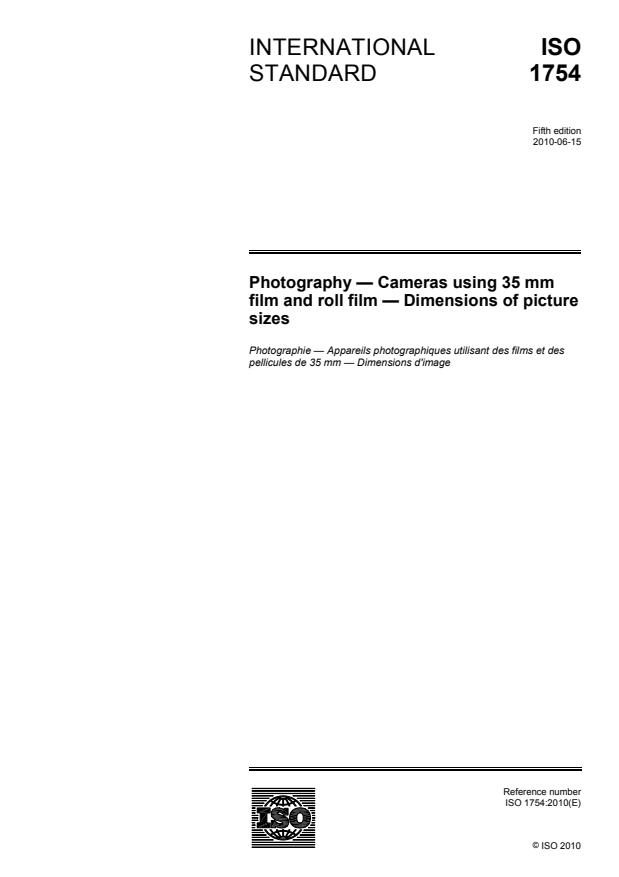
INTERNATIONAL ISO
STANDARD 1754
Fifth edition
2010-06-15
Photography — Cameras using 35 mm
film and roll film — Dimensions of picture
sizes
Photographie — Appareils photographiques utilisant des films et des
pellicules de 35 mm — Dimensions d'image
Reference number
©
ISO 2010
PDF disclaimer
This PDF file may contain embedded typefaces. In accordance with Adobe's licensing policy, this file may be printed or viewed but
shall not be edited unless the typefaces which are embedded are licensed to and installed on the computer performing the editing. In
downloading this file, parties accept therein the responsibility of not infringing Adobe's licensing policy. The ISO Central Secretariat
accepts no liability in this area.
Adobe is a trademark of Adobe Systems Incorporated.
Details of the software products used to create this PDF file can be found in the General Info relative to the file; the PDF-creation
parameters were optimized for printing. Every care has been taken to ensure that the file is suitable for use by ISO member bodies. In
the unlikely event that a problem relating to it is found, please inform the Central Secretariat at the address given below.
© ISO 2010
All rights reserved. Unless otherwise specified, no part of this publication may be reproduced or utilized in any form or by any means,
electronic or mechanical, including photocopying and microfilm, without permission in writing from either ISO at the address below or
ISO's member body in the country of the requester.
ISO copyright office
Case postale 56 • CH-1211 Geneva 20
Tel. + 41 22 749 01 11
Fax + 41 22 749 09 47
E-mail copyright@iso.org
Web www.iso.org
Published in Switzerland
ii © ISO 2010 – All rights reserved
Foreword
ISO (the International Organization for Standardization) is a worldwide federation of national standards bodies
(ISO member bodies). The work of preparing International Standards is normally carried out through ISO
technical committees. Each member body interested in a subject for which a technical committee has been
established has the right to be represented on that committee. International organizations, governmental and
non-governmental, in liaison with ISO, also take part in the work. ISO collaborates closely with the
International Electrotechnical Commission (IEC) on all matters of electrotechnical standardization.
International Standards are drafted in accordance with the rules given in the ISO/IEC Directives, Part 2.
The main task of technical committees is to prepare International Standards. Draft
...