

ISO 7206-2:2011
(Main)Implants for surgery — Partial and total hip joint prostheses — Part 2: Articulating surfaces made of metallic, ceramic and plastics materials
General Information
- Abstract
ISO 7206-2:2011 specifies requirements for the articulating surfaces of those types of total and partial hip joint prostheses that provide a joint replacement of ball and socket configuration, as follows: sphericity and surface finish requirements for metallic and ceramic femoral prostheses for partial hip joint replacement that are in accordance with classification a) of ISO 7206-1; sphericity and surface finish requirements for bipolar heads with plastics inner surfaces which articulate on femoral components that are in accordance with classification a) of ISO 7206-1 and with metallic or ceramic outer surfaces which articulate on the biological acetabulum; sphericity and surface finish requirements and dimensional tolerances for plastics acetabular components that are in accordance with classification b) of ISO 7206-1; sphericity and surface finish requirements and dimensional tolerances for metallic or ceramic femoral components of total hip joint prostheses that are in accordance with classification c) of ISO 7206-1, designed to articulate on plastics acetabular components.
- Status
- Published
- Publication Date
- 23-Mar-2011
- Technical Committee
- ISO/TC 150/SC 4 - Bone and joint replacements
- Drafting Committee
- ISO/TC 150/SC 4 - Bone and joint replacements
- Current Stage
- 9092 - International Standard to be revised
- Start Date
- 21-Apr-2026
- Completion Date
- 29-Aug-2026
Buy Documents


ISO 7206-2:2011 - Implants for surgery — Partial and total hip joint prostheses — Part 2: Articulating surfaces made of metallic, ceramic and plastics materials Released:3/24/2011


ISO 7206-2:2011 - Implants chirurgicaux — Protheses partielles et totales de l'articulation de la hanche — Partie 2: Surfaces articulaires constituées de matériaux métalliques, céramiques et plastiques Released:3/24/2011


ISO 7206-2:2011 - Implants for surgery — Partial and total hip joint prostheses — Part 2: Articulating surfaces made of metallic, ceramic and plastics materials Released:1/8/2014
Overview
ISO 7206-2:2011 is an international standard that specifies stringent requirements for the articulating surfaces of partial and total hip joint prostheses. This standard covers prostheses with a ball-and-socket configuration, detailing the sphericity, surface finish, and dimensional tolerances for components made from metallic, ceramic, and plastic materials. It is part of the ISO 7206 series focusing on implants for surgery, specifically for hip joint replacements, ensuring that prosthetic joints meet high-quality criteria for safety, durability, and biocompatibility.
Key Topics
Sphericity Requirements
The standard defines precise limits on how closely the prosthetic ball and socket surfaces must conform to a true spherical shape. For example:- Metallic and ceramic femoral components for total hip replacements must have a radial separation value not exceeding 10 µm.
- Plastic acetabular components have a maximum radial deviation of 100 µm.
- Bipolar heads combine plastic inner and metallic/ceramic outer surfaces, each meeting specified sphericity parameters.
Surface Finish Standards
Surface texture parameters such as Ra (average roughness), Rt (total height of profile), and Ramax are specified to minimize wear and improve articulation. The standard enumerates:- Maximum Ra of 0.05 µm for metallic and 0.02 µm for ceramic surfaces on femoral components.
- Plastic components require a maximum Ra of 2 µm.
Surface finish is evaluated using ISO 4287 and ISO 4288 methodologies, ensuring consistency and reliability of measurement.
Dimensional Tolerances
Precise dimensional controls guarantee optimal fit and longevity of joint prostheses. For instance:- Femoral heads for total hip replacements must be slightly undersized within −0.2 mm to 0 mm tolerances.
- Plastic acetabular sockets are oversized within +0.1 mm to +0.3 mm tolerance ranges.
Measurement Procedures
The standard prescribes three-dimensional measurement techniques, including the use of stylus and scanning methods, to evaluate surface sphericity and quality comprehensively, supporting reproducibility and standardized testing.
Applications
ISO 7206-2:2011 is crucial for manufacturers and quality assurance teams involved in the design, production, and validation of hip joint prostheses. Applications include:
Medical Device Manufacturing
Ensuring prosthetic components meet international quality requirements for compatibility, performance, and durability.Regulatory Compliance
Supporting adherence to regulatory frameworks by applying internationally recognized standards for hip implant articulating surfaces.Product Development and Testing
Guiding engineering teams in surface engineering, materials selection, and tolerance design for enhanced prosthetic joint function.Clinical Safety and Performance
Helping orthopedic surgeons and hospitals select implants that conform to rigorous technical specifications, optimizing patient outcomes.
Related Standards
- ISO 7206-1: Classification and designation of dimensions for partial and total hip joint prostheses
- ISO 7206-4: Determination of endurance properties and performance of stemmed femoral components
- ISO 7206-6: Endurance properties of the head and neck region of stemmed femoral components
- ISO 7206-8: Endurance performance with torsion of stemmed femoral components
- ISO 7206-10: Resistance to static load of modular femoral heads
- ISO 4287 & ISO 4288: Geometrical Product Specifications for surface texture measurements
By complying with ISO 7206-2:2011, stakeholders in surgical implant manufacturing and healthcare can ensure the highest standards of precision, surface quality, and dimensional accuracy for hip joint prostheses, enhancing longevity and patient mobility while reducing wear and failure risks. This standard is integral to the global advancement of orthopedic implant technology.
Relations
- Effective Date
- 09-Feb-2026
- Effective Date
- 09-Feb-2026
- Effective Date
- 09-Feb-2026
- Effective Date
- 24-Jul-2021
- Effective Date
- 28-Feb-2009
Buy Documents
ISO 7206-2:2011 - Implants for surgery — Partial and total hip joint prostheses — Part 2: Articulating surfaces made of metallic, ceramic and plastics materials Released:3/24/2011
ISO 7206-2:2011 - Implants chirurgicaux — Protheses partielles et totales de l'articulation de la hanche — Partie 2: Surfaces articulaires constituées de matériaux métalliques, céramiques et plastiques Released:3/24/2011
ISO 7206-2:2011 - Implants for surgery — Partial and total hip joint prostheses — Part 2: Articulating surfaces made of metallic, ceramic and plastics materials Released:1/8/2014
Get Certified
Connect with accredited certification bodies for this standard

BSI Group
BSI (British Standards Institution) is the business standards company that helps organizations make excellence a habit.

TÜV Rheinland
TÜV Rheinland is a leading international provider of technical services.

TÜV SÜD
TÜV SÜD is a trusted partner of choice for safety, security and sustainability solutions.
Sponsored listings
Frequently Asked Questions
ISO 7206-2:2011 is a standard published by the International Organization for Standardization (ISO). Its full title is "Implants for surgery — Partial and total hip joint prostheses — Part 2: Articulating surfaces made of metallic, ceramic and plastics materials". This standard covers: ISO 7206-2:2011 specifies requirements for the articulating surfaces of those types of total and partial hip joint prostheses that provide a joint replacement of ball and socket configuration, as follows: sphericity and surface finish requirements for metallic and ceramic femoral prostheses for partial hip joint replacement that are in accordance with classification a) of ISO 7206-1; sphericity and surface finish requirements for bipolar heads with plastics inner surfaces which articulate on femoral components that are in accordance with classification a) of ISO 7206-1 and with metallic or ceramic outer surfaces which articulate on the biological acetabulum; sphericity and surface finish requirements and dimensional tolerances for plastics acetabular components that are in accordance with classification b) of ISO 7206-1; sphericity and surface finish requirements and dimensional tolerances for metallic or ceramic femoral components of total hip joint prostheses that are in accordance with classification c) of ISO 7206-1, designed to articulate on plastics acetabular components.
ISO 7206-2:2011 specifies requirements for the articulating surfaces of those types of total and partial hip joint prostheses that provide a joint replacement of ball and socket configuration, as follows: sphericity and surface finish requirements for metallic and ceramic femoral prostheses for partial hip joint replacement that are in accordance with classification a) of ISO 7206-1; sphericity and surface finish requirements for bipolar heads with plastics inner surfaces which articulate on femoral components that are in accordance with classification a) of ISO 7206-1 and with metallic or ceramic outer surfaces which articulate on the biological acetabulum; sphericity and surface finish requirements and dimensional tolerances for plastics acetabular components that are in accordance with classification b) of ISO 7206-1; sphericity and surface finish requirements and dimensional tolerances for metallic or ceramic femoral components of total hip joint prostheses that are in accordance with classification c) of ISO 7206-1, designed to articulate on plastics acetabular components.
ISO 7206-2:2011 is classified under the following ICS (International Classification for Standards) categories: 11.040.40 - Implants for surgery, prosthetics and orthotics. The ICS classification helps identify the subject area and facilitates finding related standards.
ISO 7206-2:2011 has the following relationships with other standards: It is inter standard links to EN ISO 21535:2009, EN ISO 21535:2024, EN ISO 21535:2009/A1:2016, ISO 7206-2:2011/Amd 1:2016, ISO 7206-2:1996. Understanding these relationships helps ensure you are using the most current and applicable version of the standard.
ISO 7206-2:2011 is available in PDF format for immediate download after purchase. The document can be added to your cart and obtained through the secure checkout process. Digital delivery ensures instant access to the complete standard document.
Standards Content (Sample)
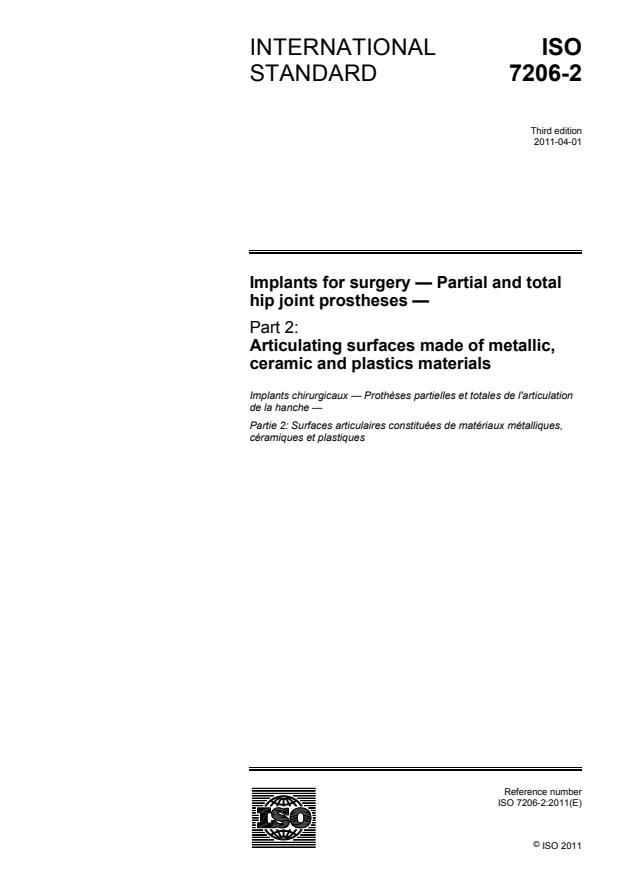
INTERNATIONAL ISO
STANDARD 7206-2
Third edition
2011-04-01
Implants for surgery — Partial and total
hip joint prostheses —
Part 2:
Articulating surfaces made of metallic,
ceramic and plastics materials
Implants chirurgicaux — Prothèses partielles et totales de l'articulation
de la hanche —
Partie 2: Surfaces articulaires constituées de matériaux métalliques,
céramiques et plastiques
Reference number
©
ISO 2011
© ISO 2011
All rights reserved. Unless otherwise specified, no part of this publication may be reproduced or utilized in any form or by any means,
electronic or mechanical, including photocopying and microfilm, without permission in writing from either ISO at the address below or
ISO's member body in the country of the requester.
ISO copyright office
Case postale 56 • CH-1211 Geneva 20
Tel. + 41 22 749 01 11
Fax + 41 22 749 09 47
E-mail copyright@iso.org
Web www.iso.org
Published in Switzerland
ii © ISO 2011 – All rights reserved
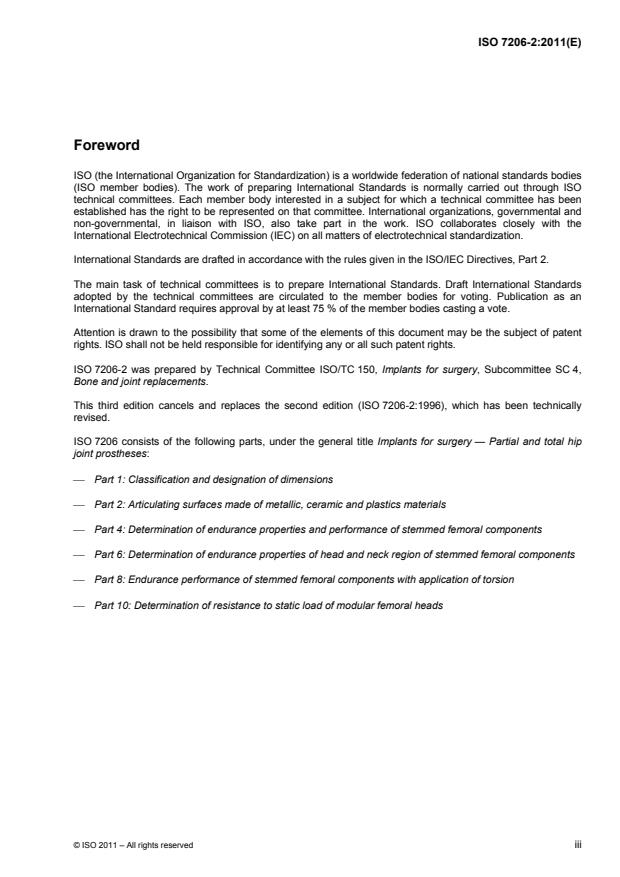
Foreword
ISO (the International Organization for Standardization) is a worldwide federation of national standards bodies
(ISO member bodies). The work of preparing International Standards is normally carried out through ISO
technical committees. Each member body interested in a subject for which a technical committee has been
established has the right to be represented on that committee. International organizations, governmental and
non-governmental, in liaison with ISO, also take part in the work. ISO collaborates closely with the
International Electrotechnical Commission (IEC) on all matters of electrotechnical standardization.
International Standards are drafted in accordance with the rules given in the ISO/IEC Directives, Part 2.
The main task of technical committees is to prepare International Standards. Draft International Standards
adopted by the technical committees are circulated to the member bodies for voting. Publication as an
International Standard requires approval by at least 75 % of the member bodies casting a vote.
Attention is drawn to the possibility that some of the elements of this document may be the subject of patent
rights. ISO shall not be held responsible for identifying any or all such patent rights.
ISO 7206-2 was prepared by Technical Committee ISO/TC 150, Implants for surgery, Subcommittee SC 4,
Bone and joint replacements.
This third edition cancels and replaces the second edition (ISO 7206-2:1996), which has been technically
revised.
ISO 7206 consists of the following parts, under the general title Implants for surgery — Partial and total hip
joint prostheses:
⎯ Part 1: Classification and designation of dimensions
⎯ Part 2: Articulating surfaces made of metallic, ceramic and plastics materials
⎯ Part 4: Determination of endurance properties and performance of stemmed femoral components
⎯ Part 6: Determination of endurance properties of head and neck region of stemmed femoral components
⎯ Part 8: Endurance performance of stemmed femoral components with application of torsion
⎯ Part 10: Determination of resistance to static load of modular femoral heads
INTERNATIONAL STANDARD ISO 7206-2:2011(E)
Implants for surgery — Partial and total hip joint prostheses —
Part 2:
Articulating surfaces made of metallic, ceramic and plastics
materials
1 Scope
This part of ISO 7206 specifies requirements for the articulating surfaces of those types of total and partial hip
joint prostheses that provide a joint replacement of ball and socket configuration, as follows:
a) sphericity and surface finish requirements for metallic and ceramic femoral prostheses for partial hip joint
replacement that are in accordance with classification a) of ISO 7206-1;
b) sphericity and surface finish requirements for bipolar heads with plastics inner surfaces which articulate
on femoral components that are in accordance with classification a) of ISO 7206-1 and with metallic or
ceramic outer surfaces which articulate on the biological acetabulum;
c) sphericity and surface finish requirements and dimensional tolerances for plastics acetabular components
that are in accordance with classification b) of ISO 7206-1;
d) sphericity and surface finish requirements and dimensional tolerances for metallic or ceramic femoral
components of total hip joint prostheses that are in accordance with classification c) of ISO 7206-1,
designed to articulate on plastics acetabular components.
2 Normative references
The following referenced documents are indispensable for the application of this document. For dated
references, only the edition cited applies. For undated references, the latest edition of the referenced
document (including any amendments) applies.
ISO 4287, Geometrical Product Specifications (GPS) — Surface texture: Profile method — Terms, definitions
and surface texture parameters
ISO 4288:1996, Geometrical Product Specifications (GPS) — Surface texture: Profile method — Rules and
procedures for the assessment of surface texture
ISO 7206-1, Implants for surgery — Partial and total hip joint prostheses — Part 1: Classification and
designation of dimensions
3 Terms and definitions
For the purposes of this document, the terms and definitions given in ISO 7206-1 and the following apply.
3.1
spherical pole
point created by the intersection of the axis of symmetry of the partial sphere of the head or cup with the
spherical surface of the head or cup
4 Requirements
4.1 Femoral components of total hip joint prostheses
4.1.1 General
This subclause refers to spherical articulating surfaces of femoral components of total hip joint prostheses in
accordance with classification c) of ISO 7206-1.
4.1.2 Sphericity
When measured in accordance with the method given in A.1, the departure from sphericity of the spherical
articulating surface of a femoral component shall have a radial separation value not greater than 10 µm.
4.1.3 Surface finish
When measured in accordance with the principles given in ISO 4287 and performed according to the
max.-rule in ISO 4288:1996, 5.3, the spherical articulating surfaces of metallic and ceramic components shall
have Ramax values not greater than 0,05 µm and 0,02 µm respectively and an Rtmax value not greater than
1,0 µm, using a cut-off value of 0,08 mm. The measurements shall be taken at five locations on the spherical
surface. One measurement shall be taken in each of four quadrants approximately 30° from the spherical pole
and one at the spherical pole. The following details shall be reported along with the Ramax value:
a) stylus tip radius;
b) position of measurement on specimen;
c) average Ra.
When examined by normal or corrected vision, the articulating surface shall be free from embedded particles
and from scratches and score marks other than those arising from the finishing process.
4.1.4 Dimensional tolerances
The spherical head shall have a diameter equal to the nominal diameter within a tolerance of −0,2 mm to
0 mm, i.e. it shall be undersized within the given tolerance.
4.2 Plastics acetabular components
4.2.1 General
This subclause refers to plastics acetabular components for total hip joint replacements in accordance with
classification b) of ISO 7206-1.
2 © ISO 2011 – All rights reserved
...
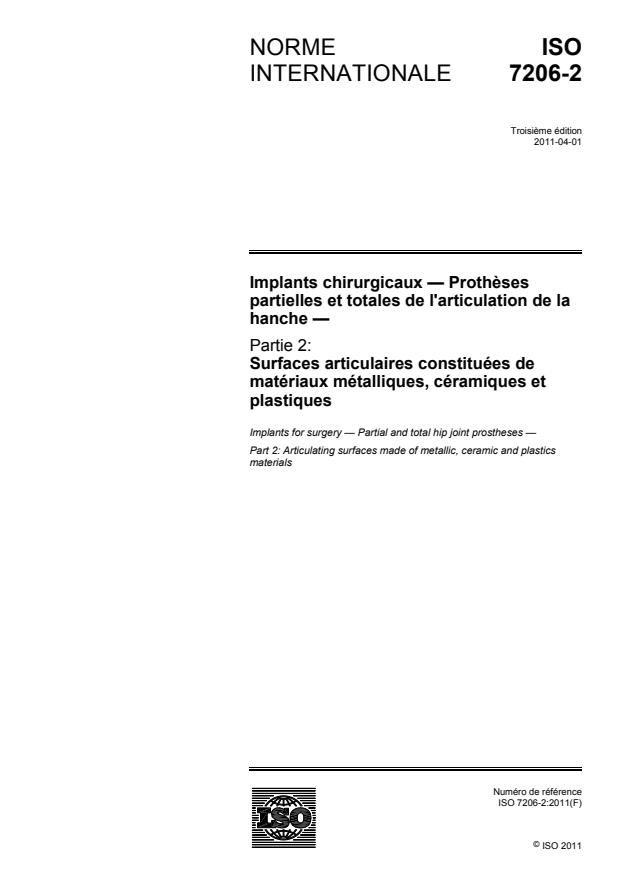
NORME ISO
INTERNATIONALE 7206-2
Troisième édition
2011-04-01
Implants chirurgicaux — Prothèses
partielles et totales de l'articulation de la
hanche —
Partie 2:
Surfaces articulaires constituées de
matériaux métalliques, céramiques et
plastiques
Implants for surgery — Partial and total hip joint prostheses —
Part 2: Articulating surfaces made of metallic, ceramic and plastics
materials
Numéro de référence
©
ISO 2011
DOCUMENT PROTÉGÉ PAR COPYRIGHT
© ISO 2011
Droits de reproduction réservés. Sauf prescription différente, aucune partie de cette publication ne peut être reproduite ni utilisée sous
quelque forme que ce soit et par aucun procédé, électronique ou mécanique, y compris la photocopie et les microfilms, sans l'accord écrit
de l'ISO à l'adresse ci-après ou du comité membre de l'ISO dans le pays du demandeur.
ISO copyright office
Case postale 56 • CH-1211 Geneva 20
Tel. + 41 22 749 01 11
Fax + 41 22 749 09 47
E-mail copyright@iso.org
Web www.iso.org
Publié en Suisse
ii © ISO 2011 – Tous droits réservés
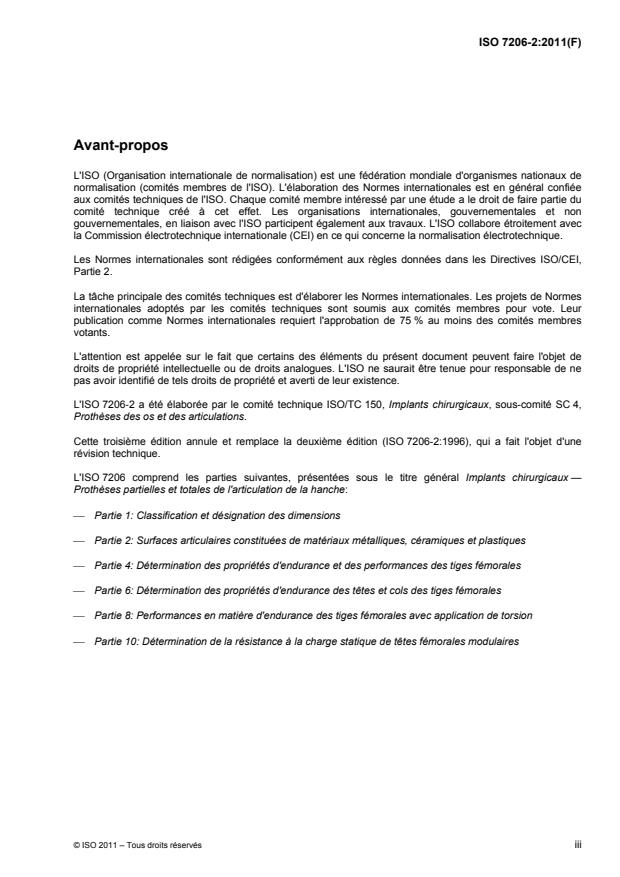
Avant-propos
L'ISO (Organisation internationale de normalisation) est une fédération mondiale d'organismes nationaux de
normalisation (comités membres de l'ISO). L'élaboration des Normes internationales est en général confiée
aux comités techniques de l'ISO. Chaque comité membre intéressé par une étude a le droit de faire partie du
comité technique créé à cet effet. Les organisations internationales, gouvernementales et non
gouvernementales, en liaison avec l'ISO participent également aux travaux. L'ISO collabore étroitement avec
la Commission électrotechnique internationale (CEI) en ce qui concerne la normalisation électrotechnique.
Les Normes internationales sont rédigées conformément aux règles données dans les Directives ISO/CEI,
Partie 2.
La tâche principale des comités techniques est d'élaborer les Normes internationales. Les projets de Normes
internationales adoptés par les comités techniques sont soumis aux comités membres pour vote. Leur
publication comme Normes internationales requiert l'approbation de 75 % au moins des comités membres
votants.
L'attention est appelée sur le fait que certains des éléments du présent document peuvent faire l'objet de
droits de propriété intellectuelle ou de droits analogues. L'ISO ne saurait être tenue pour responsable de ne
pas avoir identifié de tels droits de propriété et averti de leur existence.
L'ISO 7206-2 a été élaborée par le comité technique ISO/TC 150, Implants chirurgicaux, sous-comité SC 4,
Prothèses des os et des articulations.
Cette troisième édition annule et remplace la deuxième édition (ISO 7206-2:1996), qui a fait l'objet d'une
révision technique.
L'ISO 7206 comprend les parties suivantes, présentées sous le titre général Implants chirurgicaux —
Prothèses partielles et totales de l'articulation de la hanche:
⎯ Partie 1: Classification et désignation des dimensions
⎯ Partie 2: Surfaces articulaires constituées de matériaux métalliques, céramiques et plastiques
⎯ Partie 4: Détermination des propriétés d'endurance et des performances des tiges fémorales
⎯ Partie 6: Détermination des propriétés d'endurance des têtes et cols des tiges fémorales
⎯ Partie 8: Performances en matière d'endurance des tiges fémorales avec application de torsion
⎯ Partie 10: Détermination de la résistance à la charge statique de têtes fémorales modulaires
NORME INTERNATIONALE ISO 7206-2:2011(F)
Implants chirurgicaux — Prothèses partielles et totales de
l'articulation de la hanche —
Partie 2:
Surfaces articulaires constituées de matériaux métalliques,
céramiques et plastiques
1 Domaine d'application
La présente partie de l'ISO 7206 spécifie les exigences relatives aux surfaces articulaires des prothèses
partielles et totales de la hanche qui fournissent une néoarticulation de type énarthrose, comme suit:
a) exigences concernant la sphéricité et l'état de surface pour les prothèses fémorales métalliques et
céramiques pour prothèses partielles de la hanche conformément à la classification a) de l'ISO 7206-1;
b) exigences concernant la sphéricité et l'état de surface pour les têtes bipolaires constituées de surfaces
internes en plastique qui s'articulent sur les éléments fémoraux conformément à la classification a) de
l'ISO 7206-1 et de surfaces externes métalliques ou céramiques qui s'articulent sur l'acétabule
biologique;
c) exigences concernant la sphéricité, l'état de surface et les tolérances dimensionnelles pour les éléments
acétabulaires plastiques conformément à la classification b) de l'ISO 7206-1;
d) exigences concernant la sphéricité, l'état de surface et les tolérances dimensionnelles pour les éléments
fémoraux métalliques ou céramiques de prothèses totales de la hanche conformément à la classification
c) de l'ISO 7206-1, conçues pour s'articuler sur des éléments acétabulaires plastiques.
2 Références normatives
Les documents de référence suivants sont indispensables pour l'application du présent document. Pour les
références datées, seule l'édition citée s'applique. Pour les références non datées, la dernière édition du
document de référence s'applique (y compris les éventuels amendements).
ISO 4287, Spécifications géométriques des produits (GPS) — État de surface: Méthode du profil — Termes,
définitions et paramètres d'état de surface
ISO 4288:1996, Spécification géométrique des produits (GPS) — État de surface: Méthode du profil —
Règles et procédures pour l'évaluation de l'état de surface
ISO 7206-1, Implants chirurgicaux — Prothèses partielles et totales de l'articulation de la hanche — Partie 1:
Classification et désignation des dimensions
3 Termes et définitions
Pour les besoins du présent document, les termes et définitions donnés dans l'ISO 7206-1 ainsi que les
suivants s'appliquent.
3.1
pôle de la sphère
point créé par l'intersection de l'axe de symétrie de la sphère partielle de la tête ou de la cupule avec la
surface sphérique de la tête ou de la cupule
4 Exigences
4.1 Éléments fémoraux des prothèses totales de la hanche
4.1.1 Généralités
Le présent paragraphe concerne les surfaces articulaires sphériques des éléments fémoraux des prothèses
totales de la hanche conformément à la classification c) de l'ISO 7206-1.
4.1.2 Sphéricité
L'écart maximal admissible de sphéricité de la surface articulaire sphérique d'un élément fémoral, mesuré
selon la méthode indiquée en A.1, ne doit pas être supérieur à 10 μm.
4.1.3 État de surface
Les valeurs de Ramax des surfaces articulaires sphériques des éléments métalliques et céramiques ne
doivent pas être supérieures à 0,05 μm et 0,02 μm respectivement, et la valeur Rtmax ne doit pas être
supérieure à 1,0 μm, en utilisant une valeur de coupe de 0,08 mm, lorsque l'évaluation s'effectue
conformément aux principes énoncés dans l'ISO 4287 et selon la règle de la valeur maximale de
l'ISO 4288:1996, 5.3. Les mesurages doivent être réalisés en cinq emplacements sur la surface sphérique.
Un mesurage doit être effectué dans chacun des quatre quadrants, à environ 30° du pôle de la sphère et un
mesurage au niveau du pôle de la sphère. Les valeurs suivantes doivent être consignées conjointement avec
la valeur de Ramax:
a) le rayon de courbure de la pointe du palpeur;
b) la position de mesure sur l'éprouvette;
c) la moyenne Ra.
Lors d'un examen en vision normale ou corrigée, la surface articulaire doit être exempte de particules
incrustées, de rayures et de stries autres que celles provenant du procédé de finition.
4.1.4 Tolérances dimensionnelles
La tolérance de la tête sphérique doit être de −0,2 mm à 0 mm par rapport au diamètre nominal (c'est-à-dire
que ce diamètre doit être diminué dans les limites de la tolérance donnée).
4.2 Éléments acétabulaires en plastique
4.2.1 Généralités
Le présent paragraphe concerne les éléments acétabulaires en plastique pour les prothèses totales de la
hanche conformément à la classification b) de l'ISO 7206-1.
2 © ISO 2011 – Tous droits réservés
ISO 7
...
МЕЖДУНАРОДНЫЙ ISO
СТАНДАРТ 7206-2
Третье издание
2011-04-01
Имплантаты хирургические. Полные и
частичные протезы тазобедренных
суставов.
Часть 2.
Соединительные поверхности,
выполненные из металлических,
керамических и пластиковых
материалов
Implants for surgery — Partial and total hip joint prostheses —
Part 2: Articulating surfaces made of metallic, ceramic and plastics
materials
Ответственность за подготовку русской версии несѐт GOST R
(Российская Федерация) в соответствии со статьѐй 18.1 Устава ISO
Ссылочный номер
©
ISO 2011
ДОКУМЕНТ ЗАЩИЩЕН АВТОРСКИМ ПРАВОМ
Все права сохраняются. Если не указано иное, никакую часть настоящей публикации нельзя копировать или использовать в
какой-либо форме или каким-либо электронным или механическим способом, включая фотокопии и микрофильмы, без
предварительного письменного согласия ISO по адресу ниже или представительства ISO в соответствующей стране.
Бюро авторского права ISO
Почтовый ящик 56 CH-1211 Женева 20
Тел. + 41 22 749 01 11
Факс + 41 22 749 09 47
E-mail copyright@iso.org
Web www.iso.org
Опубликовано в Швейцарии
ii © ISO 2011 – Все права сохраняются
Предисловие
Международная организация по стандартизации (ISO) является всемирной федерацией национальных
организаций по стандартизации (комитетов-членов ISO). Разработка международных стандартов
обычно осуществляется техническими комитетами ISO. Каждый комитет-член, заинтересованный в
деятельности, для которой был создан технический комитет, имеет право быть представленным в этом
комитете. Международные правительственные и неправительственные организации, имеющие связи с
ISO, также принимают участие в работах. Что касается стандартизации в области электротехники, то
ISO работает в тесном сотрудничестве с Международной электротехнической комиссией (IEC).
Проекты международных стандартов разрабатываются в соответствии с правилами Директив ISO/IEC,
Часть 2.
Основная задача технических комитетов заключается в подготовке международных стандартов.
Проекты международных стандартов, принятые техническими комитетами, рассылаются комитетам-
членам на голосование. Их опубликование в качестве международных стандартов требует одобрения
не менее 75% комитетов-членов, принимающих участие в голосовании.
Следует иметь в виду, что некоторые элементы настоящего международного стандарта могут быть
объектом патентных прав. ISO не может нести ответственность за идентификацию какого-либо одного
или всех патентных прав.
ISO 7206-2 был подготовлен Техническим Комитетом ISO/TC 150, Имплантаты хирургические,
Подкомитетом SC 4, Заменители костей и суставов.
Данное третье издание отменяет и заменяет второе издание (ISO 7206-2:1996), которое было
технически пересмотрено.
ISO 7206 состоит из следующих частей под общим заголовком Имплантаты хирургические. Полные и
частичные протезы тазобедренных суставов:
Часть 1. Классификация и обозначение размеров
Часть 2. Соединительные поверхности, выполненные из металлических, керамических и
пластиковых материалов
Часть 4. Определение усталостных свойств и рабочих характеристик стержневых бедренных
компонентов
Часть 6. Определение усталостных свойств головки и области шейки стержневых бедренных
компонентов
Часть 8. Усталостные характеристики стержневых бедренных компонентов при приложении
крутящего момента
Часть 10. Определение устойчивости статической нагрузке модульных бедренных головок
МЕЖДУНАРОДНЫЙ СТАНДАРТ ISO 7206-2:2011(R)
Имплантаты хирургические. Полные и частичные протезы
тазобедренных суставов.
Часть 2.
Соединительные поверхности, выполненные из
металлических, керамических и пластиковых материалов
1 Область применения
В данной части ISO 7206 определены следующие требования к соединительным поверхностям полных
и частичных протезов тазобедренных суставов тех типов, которые обеспечивают движение в суставе и
имеют конфигурацию в виде шара и впадины:
a) требования к сферичности и шероховатости поверхностей металлических и керамических
бедренных протезов для частичной замены тазобедренного сустава, соответствующих
классификации a) ISO 7206-1;
b) требования к сферичности и шероховатости поверхностей биполярных головок с пластиковыми
внутренними поверхностями, которые шарнирно соединены с бедренными компонентами,
соответствующими классификации a) ISO 7206-1, и с металлическими или керамическими
внешними поверхностями, которые шарнирно соединены с естественной вертлюжной впадиной;
c) требования к сферичности и шероховатости поверхностей и допускам размеров для пластиковых
вертлюжных компонентов, соответствующих классификации b) ISO 7206-1;
d) требования к сферичности и шероховатости поверхностей и допускам размеров для
металлических или керамических бедренных компонентов полных протезов тазобедренных
суставов, соответствующих классификации c) ISO 7206-1, разработанных для шарнирного
соединения с пластиковыми вертлюжными компонентами.
2 Нормативные ссылки
Ссылка на следующие документы обязательна при использовании данного документа. Для жестких
ссылок применяются только указанное по тексту издание. Для плавающих ссылок необходимо
использовать самое последнее издание нормативного ссылочного документа (включая любые
изменения).
ISO 4287, Спецификации геометрии продукта (Geometrical Product Specifications, GPS). Рельеф
поверхности. Метод профилей. Термины, определения и параметры рельефа поверхности
ISO 4288:1996, Спецификации геометрии продукта (Geometrical Product Specifications, GPS). Рельеф
поверхности. Метод профилей. Правила и процедуры оценки рельефа поверхности
ISO 7206-1, Имплантаты хирургические. Полные и частичные протезы тазобедренных суставов.
Часть 1. Классификация и обозначение размеров
3 Термины и определения
В рамках данного документа применяются термины и определения, приведенные в ISO 7206-1 и
следующие.
3.1
полюс сферы
spherical pole
точка, полученная пересечением оси симметрии неполной сферы головки или чашечки и сферической
поверхности головки или чашечки
4 Требования
4.1 Бедренные компоненты полного протеза тазобедренного сустава
4.1.1 Общие положения
Данный подраздел применяется к сферическим контактным поверхностям бедренных компонентов
полных протезов тазобедренного сустава в соответствии с классификацией c) ISO 7206-1.
4.1.2 Сферичность
При измерении в соответствии с методом, приведенном в A.1, радиальное отклонение от сферичности
сферической контактной поверхности бедренного компонента не должно превышать 10 мкм.
4.1.3 Шероховатость поверхности
При измерении в соответствии с принципами, приведенными в ISO 4287, проведенном в соответствии
с правилом максимума ISO 4288:1996, 5.3, сферические контактные поверхности металлических и
керамических компонентов должны иметь значения Ramax не более 0,05 мкм и 0,02 мкм
соответственно и значения Rtmax не более 1,0 мкм, при использовании отсекающего значения 0,08 мм.
Измерения должны проводиться в пяти областях сферической поверхности. Должно проводиться по
одному измерению в каждом из четырех квадрантов отклоненных примерно на 30° от полюса сферы и
одно измерение в полюсе сферы. Следующие параметры должны быть указаны вместе со значением
Ramax:
a) радиус кончика иглы;
b) область измерения на образце;
c) среднее Ra.
При исследовании нормальным или скорректированным зрением контактные поверхности должны
быть свободны от инородных частиц и от насечек и царапин, кроме возникших в процессе конечной
обработки.
4.1.4 Допуски размеров
Сферическая головка должна иметь диаметр в пределах допусков от 0,2 мм до 0 мм, т.е. она должна
иметь меньший размер в пределах определенного допуска.
2 © ISO 2011 – Все права сохраняются
4.2 Пластиковые вертлюжные компоненты
4.2.1 Общие положения
Данный подраздел применяется к пла
...