

ISO/IEC 11801-3:2017
(Main)Information technology — Generic cabling for customer premises — Part 3: Industrial premises
General Information
- Abstract
ISO/IEC 11801-3:2017(E) This document specifies generic cabling, which is critical for providing robust services to the automation islands in industrial premises, or industrial spaces within other types of building. Additionally those premises can include office spaces (for which generic cabling is specified in ISO/IEC 11801-2) or data centre spaces (for which generic cabling is specified in ISO/IEC 11801-5).
- Status
- Published
- Publication Date
- 20-Nov-2017
- Technical Committee
- ISO/IEC JTC 1/SC 25 - Interconnection of information technology equipment
- Current Stage
- 6060 - International Standard published
- Start Date
- 21-Nov-2017
- Due Date
- 01-Jun-2017
- Completion Date
- 01-Jun-2017
Buy Documents



ISO/IEC 11801-3:2017 - Information technology -- Generic cabling for customer premises

ISO/IEC 11801-3:2017 - Information technology — Generic cabling for customer premises — Part 3: Industrial premises/21/2017
Overview - ISO/IEC 11801-3:2017 (Generic cabling for industrial premises)
ISO/IEC 11801-3:2017 defines generic cabling requirements for industrial premises, specifying how to provide robust, predictable cabling infrastructure to support automation islands and other industrial networked systems. It complements other parts of ISO/IEC 11801 that address office (Part 2) and data centre (Part 5) cabling. The standard covers the structure, functional elements, cabling subsystems, and the environmental and transmission performance needed for reliable industrial communications.
Key topics and technical requirements
- System architecture: Hierarchical and centralized cabling models, including campus/building backbone, floor cabling, intermediate cabling and industrial enclosures.
- Functional elements: Definitions and placement of distributors, telecommunications rooms, equipment rooms and industrial intermediate distributors (IIDs) to support automation islands.
- Channel and link performance: Requirements for channels, permanent links, and end-to-end links covering both balanced cabling (copper) and optical fibre transmission performance.
- Environmental and mechanical performance: Criteria for cables, connecting hardware, and enclosures to withstand industrial conditions (temperature, vibration, ingress protection).
- Cabling components: Specifications for balanced cables, optical-fibre cables, connecting hardware, jumpers, patch cords and apparatus attachment cords.
- Reference implementations: Practical channel configurations, intermediate cabling models, maximum channel lengths and mathematical link equations (provided in tables and annexes).
- Conformance and testing: Interfaces and test points to verify transmission performance and compliance with the standard.
Applications - who uses this standard
ISO/IEC 11801-3:2017 is used by:
- Network designers and system architects planning industrial LAN and control networks
- Automation and control engineers specifying connectivity for automation islands (AIs)
- Consultants and spec writers preparing tender documents for industrial facilities
- Cabling contractors and installers implementing robust copper and fibre links in harsh environments
- Facility and IT managers ensuring continuity, redundancy and maintainability of industrial networks
Practical applications include factory floor networking, process control sites, hybrid buildings with office and industrial areas, and industrial spaces that require resilient connectivity between sensors, controllers, HMIs and corporate IT.
Related standards
- ISO/IEC 11801 (core) - generic cabling framework
- ISO/IEC 11801-2 - Generic cabling for office premises
- ISO/IEC 11801-5 - Generic cabling for data centres
- IEC/ISO JTC 1/SC 25 publications referenced in the standard for component and testing detail
This standard is essential when specifying industrial-grade cabling architectures, selecting components rated for industrial environments, or ensuring that cabling supports deterministic automation and high-availability services.
Relations
- Effective Date
- 28-Aug-2021
- Effective Date
- 05-Nov-2015
- Effective Date
- 04-Nov-2015
Buy Documents
ISO/IEC 11801-3:2017 - Information technology -- Generic cabling for customer premises
ISO/IEC 11801-3:2017 - Information technology — Generic cabling for customer premises — Part 3: Industrial premises/21/2017
Get Certified
Connect with accredited certification bodies for this standard

BSI Group
BSI (British Standards Institution) is the business standards company that helps organizations make excellence a habit.

NYCE
Mexican standards and certification body.
Sponsored listings
Frequently Asked Questions
ISO/IEC 11801-3:2017 is a standard published by the International Organization for Standardization (ISO). Its full title is "Information technology — Generic cabling for customer premises — Part 3: Industrial premises". This standard covers: ISO/IEC 11801-3:2017(E) This document specifies generic cabling, which is critical for providing robust services to the automation islands in industrial premises, or industrial spaces within other types of building. Additionally those premises can include office spaces (for which generic cabling is specified in ISO/IEC 11801-2) or data centre spaces (for which generic cabling is specified in ISO/IEC 11801-5).
ISO/IEC 11801-3:2017(E) This document specifies generic cabling, which is critical for providing robust services to the automation islands in industrial premises, or industrial spaces within other types of building. Additionally those premises can include office spaces (for which generic cabling is specified in ISO/IEC 11801-2) or data centre spaces (for which generic cabling is specified in ISO/IEC 11801-5).
ISO/IEC 11801-3:2017 is classified under the following ICS (International Classification for Standards) categories: 35.200 - Interface and interconnection equipment. The ICS classification helps identify the subject area and facilitates finding related standards.
ISO/IEC 11801-3:2017 has the following relationships with other standards: It is inter standard links to ISO/IEC 11801-3:2017/Amd 1:2021, ISO/IEC 24702:2006/Amd 1:2009, ISO/IEC 24702:2006. Understanding these relationships helps ensure you are using the most current and applicable version of the standard.
ISO/IEC 11801-3:2017 is available in PDF format for immediate download after purchase. The document can be added to your cart and obtained through the secure checkout process. Digital delivery ensures instant access to the complete standard document.
Standards Content (Sample)
ISO/IEC 11801-3
Edition 1.0 2017-11
INTERNATIONAL
STANDARD
Information technology – Generic cabling for customer premises
Part 3: Industrial premises
All rights reserved. Unless otherwise specified, no part of this publication may be reproduced or utilized in any form
or by any means, electronic or mechanical, including photocopying and microfilm, without permission in writing from
either IEC or IEC's member National Committee in the country of the requester. If you have any questions about
ISO/IEC copyright or have an enquiry about obtaining additional rights to this publication, please contact the address
below or your local IEC member National Committee for further information.
IEC Central Office Tel.: +41 22 919 02 11
3, rue de Varembé Fax: +41 22 919 03 00
CH-1211 Geneva 20 info@iec.ch
Switzerland www.iec.ch
About the IEC
The International Electrotechnical Commission (IEC) is the leading global organization that prepares and publishes
International Standards for all electrical, electronic and related technologies.
About IEC publications
The technical content of IEC publications is kept under constant review by the IEC. Please make sure that you have the
latest edition, a corrigenda or an amendment might have been published.
IEC Catalogue - webstore.iec.ch/catalogue Electropedia - www.electropedia.org
The stand-alone application for consulting the entire The world's leading online dictionary of electronic and
bibliographical information on IEC International Standards, electrical terms containing 20 000 terms and definitions in
Technical Specifications, Technical Reports and other English and French, with equivalent terms in 16 additional
documents. Available for PC, Mac OS, Android Tablets and languages. Also known as the International Electrotechnical
iPad. Vocabulary (IEV) online.
IEC publications search - www.iec.ch/searchpub IEC Glossary - std.iec.ch/glossary
The advanced search enables to find IEC publications by a 65 000 electrotechnical terminology entries in English and
variety of criteria (reference number, text, technical French extracted from the Terms and Definitions clause of
committee,…). It also gives information on projects, replaced IEC publications issued since 2002. Some entries have been
and withdrawn publications. collected from earlier publications of IEC TC 37, 77, 86 and
CISPR.
IEC Just Published - webstore.iec.ch/justpublished
Stay up to date on all new IEC publications. Just Published IEC Customer Service Centre - webstore.iec.ch/csc
details all new publications released. Available online and If you wish to give us your feedback on this publication or
also once a month by email. need further assistance, please contact the Customer Service
Centre: csc@iec.ch.
ISO/IEC 11801-3
Edition 1.0 2017-11
INTERNATIONAL
STANDARD
Information technology – Generic cabling for customer premises
Part 3: Industrial premises
INTERNATIONAL
ELECTROTECHNICAL
COMMISSION
ICS 35.200 ISBN 978-2-8322-5032-7
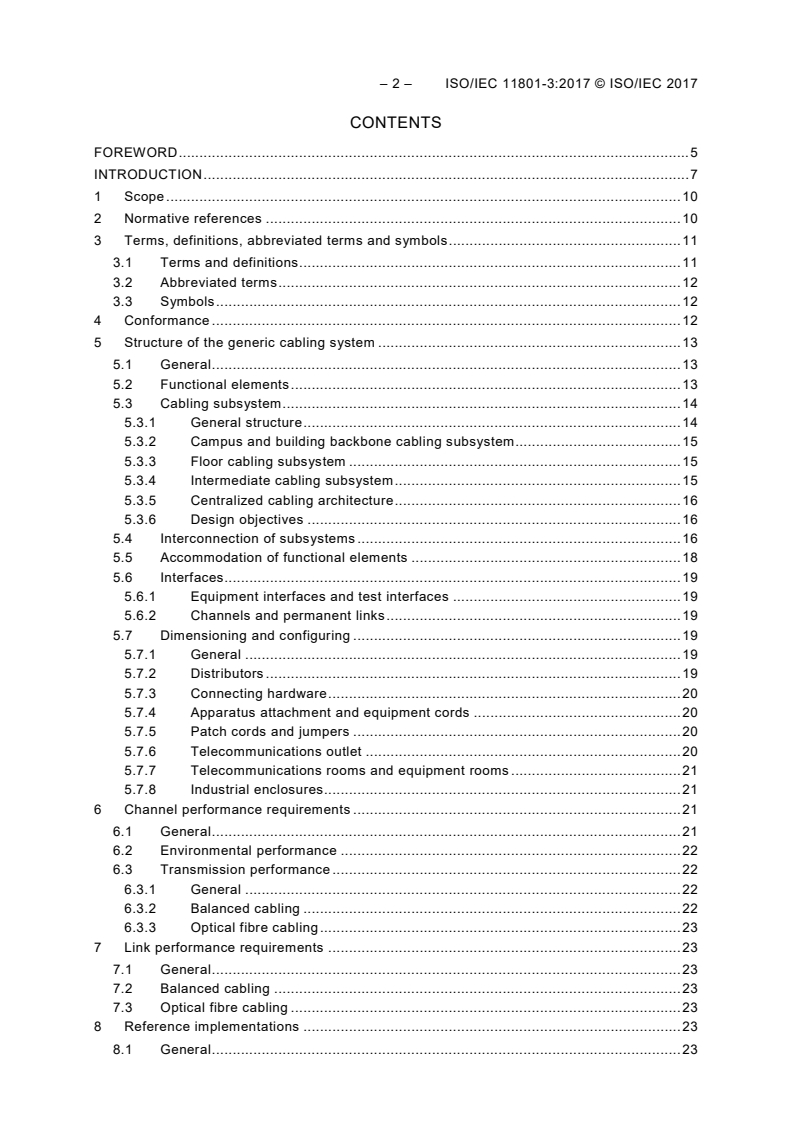
– 2 – ISO/IEC 11801-3:2017 © ISO/IEC 2017
CONTENTS
FOREWORD . 5
INTRODUCTION . 7
1 Scope . 10
2 Normative references . 10
3 Terms, definitions, abbreviated terms and symbols . 11
3.1 Terms and definitions . 11
3.2 Abbreviated terms . 12
3.3 Symbols . 12
4 Conformance . 12
5 Structure of the generic cabling system . 13
5.1 General . 13
5.2 Functional elements . 13
5.3 Cabling subsystem . 14
5.3.1 General structure . 14
5.3.2 Campus and building backbone cabling subsystem . 15
5.3.3 Floor cabling subsystem . 15
5.3.4 Intermediate cabling subsystem . 15
5.3.5 Centralized cabling architecture . 16
5.3.6 Design objectives . 16
5.4 Interconnection of subsystems . 16
5.5 Accommodation of functional elements . 18
5.6 Interfaces . 19
5.6.1 Equipment interfaces and test interfaces . 19
5.6.2 Channels and permanent links . 19
5.7 Dimensioning and configuring . 19
5.7.1 General . 19
5.7.2 Distributors . 19
5.7.3 Connecting hardware . 20
5.7.4 Apparatus attachment and equipment cords . 20
5.7.5 Patch cords and jumpers . 20
5.7.6 Telecommunications outlet . 20
5.7.7 Telecommunications rooms and equipment rooms . 21
5.7.8 Industrial enclosures . 21
6 Channel performance requirements . 21
6.1 General . 21
6.2 Environmental performance . 22
6.3 Transmission performance . 22
6.3.1 General . 22
6.3.2 Balanced cabling . 22
6.3.3 Optical fibre cabling . 23
7 Link performance requirements . 23
7.1 General . 23
7.2 Balanced cabling . 23
7.3 Optical fibre cabling . 23
8 Reference implementations . 23
8.1 General . 23
8.2 Balanced cabling . 23
8.2.1 General . 23
8.2.2 Intermediate cabling subsystem . 24
8.2.3 Floor cabling subsystem . 26
8.2.4 Campus and building backbone cabling subsystem . 28
8.3 Optical fibre cabling . 28
9 Cable requirements . 28
9.1 General . 28
9.2 Balanced cables . 28
9.3 Optical fibre cables . 29
10 Connecting hardware requirements . 29
10.1 General requirements . 29
10.2 Connecting hardware for balanced cabling . 29
10.2.1 General requirements . 29
10.2.2 Electrical, mechanical and environmental performance . 29
10.3 Connecting hardware for optical fibre cabling . 30
10.3.1 General requirements . 30
10.3.2 Optical, mechanical and environmental performance . 30
11 Cords . 30
11.1 Jumpers . 30
11.2 Balanced cords . 30
11.2.1 General . 30
11.2.2 Additional requirements for apparatus attachment cords . 30
11.3 Optical fibre cords . 30
Annex A (normative) Industrial cabling system . 31
A.1 General . 31
A.2 Industrial intermediate cabling subsystem . 31
Annex B (normative) Additional reference implementations . 33
B.1 General . 33
B.2 Channel configurations . 33
B.2.1 General . 33
B.2.2 Channels with no connections . 33
B.2.3 Channels with inter-connections . 34
B.2.4 End-to-end link (E2E link) . 35
B.3 Channels using balanced cabling bulkhead connections . 36
Annex C (informative) Other implementations . 38
C.1 General . 38
C.2 Channels using balanced cabling bulkhead connections with additional
connections . 38
Bibliography . 41
Figure 1 – Relationships between the generic cabling documents produced by
ISO/IEC JTC 1/SC 25 . 7
Figure 2 – Relationships between the ISO/IEC and IEC cabling documents that apply
to industrial premises . 8
Figure 3 – Configuration of apparatus-based functional elements within industrial
premises . 14
Figure 4 – Structure of generic cabling for industrial environment . 14
– 4 – ISO/IEC 11801-3:2017 © ISO/IEC 2017
Figure 5 – Centralized structure of generic cabling for industrial premises . 16
Figure 6 – Hierarchical structure of generic cabling for industrial premises . 17
Figure 7 – Inter-relationship of functional elements in an installation with diversity for
protection against failure (CPs optional between IDs and TOs) . 17
Figure 8 – Accommodation of functional elements (CPs optional between IDs and
TOs) . 18
Figure 9 – Equipment and test interfaces . 19
Figure 10 – Transmission performance of a channel . 21
Figure 11 – Example of a system showing the location of cabling interfaces and extent
of associated channels . 22
Figure 12 – Intermediate cabling models . 25
Figure 13 – Floor cabling model . 27
Figure A.1 – Industrial cabling system supporting several AIs via an IID . 31
Figure A.2 – Combined structure of generic and industrial cabling system using an IID . 32
Figure B.1 – Channel configurations without intermediate connections . 34
Figure B.2 – Channel configurations with inter-connections . 35
Figure B.3 – Channel configurations with bulkhead connections . 36
Figure C.1 – Channel configurations with bulkhead and additional connections . 39
Table 1 – Maximum channel lengths . 20
Table 2 – Length assumptions used in the mathematical modelling of balanced
intermediate cabling . 25
Table 3 – Intermediate link length equations . 26
Table 4 – Floor link length equations . 28
Table B.1 – Channel length equations for balanced cabling with inter-connections . 35
Table B.2 – Channel length equations with bulkhead connections . 37
Table C.1 – Channel equations with bulkhead and additional connections . 40
INFORMATION TECHNOLOGY –
GENERIC CABLING FOR CUSTOMER PREMISES
Part 3: Industrial premises
FOREWORD
1) ISO (the International Organization for Standardization) and IEC (the International Electrotechnical Commission)
form the specialized system for worldwide standardization. National bodies that are members of ISO or IEC
participate in the development of International Standards through technical committees established by the
respective organization to deal with particular fields of technical activity. ISO and IEC technical committees
collaborate in fields of mutual interest. Other international organizations, governmental and non-governmental, in
liaison with ISO and IEC, also take part in the work. In the field of information technology, ISO and IEC have
established a joint technical committee, ISO/IEC JTC 1.
2) The formal decisions or agreements of IEC and ISO on technical matters express, as nearly as possible, an
international consensus of opinion on the relevant subjects since each technical committee has representation
from all interested IEC National Committees and ISO member bodies.
3) IEC, ISO and ISO/IEC publications have the form of recommendations for international use and are accepted
by IEC National Committees and ISO member bodies in that sense. While all reasonable efforts are made to
ensure that the technical content of IEC, ISO and ISO/IEC publications is accurate, IEC or ISO cannot be held
responsible for the way in which they are used or for any misinterpretation by any end user.
4) In order to promote international uniformity, IEC National Committees and ISO member bodies undertake to
apply IEC, ISO and ISO/IEC publications transparently to the maximum extent possible in their national and
regional publications. Any divergence between any ISO, IEC or ISO/IEC publication and the corresponding
national or regional publication should be clearly indicated in the latter.
5) ISO and IEC do not provide any attestation of conformity. Independent certification bodies provide conformity
assessment services and, in some areas, access to IEC marks of conformity. ISO or IEC are not responsible
for any services carried out by independent certification bodies.
6) All users should ensure that they have the latest edition of this publication.
7) No liability shall attach to IEC or ISO or its directors, employees, servants or agents including individual experts
and members of their technical committees and IEC National Committees or ISO member bodies for any
personal injury, property damage or other damage of any nature whatsoever, whether direct or indirect, or for
costs (including legal fees) and expenses arising out of the publication of, use of, or reliance upon, this ISO/IEC
publication or any other IEC, ISO or ISO/IEC publications.
8) Attention is drawn to the normative references cited in this publication. Use of the referenced publications is
indispensable for the correct application of this publication.
9) Attention is drawn to the possibility that some of the elements of this ISO/IEC publication may be the subject of
patent rights. ISO and IEC shall not be held responsible for identifying any or all such patent rights.
International Standard ISO/IEC 11801-3 was prepared by subcommittee 25: Interconnection
of information technology equipment, of ISO/IEC joint technical committee 1: Information
technology.
This first edition cancels and replaces ISO/IEC 24702:2006 and Amendment 1:2009. This
edition constitutes a technical revision.
This edition includes the following significant technical changes with respect to the previous
edition:
a) standard re-structured to contain only those requirements that are specific for generic
cabling systems installed in industrial premises;
b) support of critical process control, monitoring and automation (PCMA) services between
automation islands by adding new Annex A (normative) “Industrial cabling system”;
c) support of specific requirements for industrial cabling the end-to-end link (E2E) has been
introduced and delivers additional channel configuration covered in Annex B (normative);
d) silica optical fibre cabling has been removed from this International Standard.
– 6 – ISO/IEC 11801-3:2017 © ISO/IEC 2017
ISO/IEC 11801-3 is to be read in conjunction with ISO/IEC 11801-1.
This International Standard has been approved by vote of the member bodies, and the voting
results may be obtained from the address given on the second title page.
This document has been drafted in accordance with the ISO/IEC Directives, Part 2.
A list of all parts in the ISO/IEC 11801 series, published under the general title Information
technology – Generic cabling for customer premises, can be found on the IEC website.
INTRODUCTION
The importance of cabling infrastructure is similar to that of other fundamental utilities such as
water and energy supply and interruptions to the services provided over that infrastructure
can have a serious impact. A lack of design foresight, the use of inappropriate components,
incorrect installation, poor administration or inadequate support can threaten quality of service
and have commercial consequence for all types of users.
This document specifies generic cabling, which is critical for providing robust services to the
automation islands in industrial premises, or industrial spaces within other types of building.
Additionally those premises can include
• office spaces for which generic cabling is specified in ISO/IEC 11801-2,
• data centre spaces for which generic cabling is specified in ISO/IEC 11801-5.
Generic cabling for distributed building services in industrial spaces is specified in
ISO/IEC 11801-6, which addresses all of the above premises and spaces within them.
This document has taken into account the correlation between all parts of the ISO/IEC 11801
series and the IEC 61918 and IEC 61784-5 series.
Figure 1 shows the schematic and contextual relationships between the standards relating to
information technology cabling produced by ISO/IEC JTC 1/SC 25, namely the ISO/IEC 11801
series of standards for generic cabling design, standards for the installation, operation and
administration of generic cabling and for testing of installed generic cabling.
PREMISES-SPECIFIC
CABLING TESTING
CABLING DESIGN
STANDARDS
STANDARDS
CABLING INSTALLATION,
OPERATION
and
ADMINISTRATION
STANDARDS
ISO/IEC 11801-1 Examples
ISO/IEC 11801-2
Information Technology: Example
ISO/IEC 11801-3
Generic Cabling:
ISO/IEC 14763-3
General Requirements
ISO/IEC 11801-4
ISO/IEC 11801-5
Examples
ISO/IEC 11801-6
ISO/IEC 14763-2
ISO/IEC 18598
ISO/IEC 30129
CABLING DESIGN
TECHNICAL
REPORTS
Examples
ISO/IEC TR 11801-9901
ISO/IEC TR 11801-9902
ISO/IEC TR 11801-9903
ISO/IEC TR 11801-9904
ISO/IEC TR 11801-9905
ISO/IEC TR 24704
ISO/IEC TR 24750
ISO/IEC TR 29125 IEC
Figure 1 – Relationships between the generic cabling
documents produced by ISO/IEC JTC 1/SC 25
– 8 – ISO/IEC 11801-3:2017 © ISO/IEC 2017
The generic cabling specified by this document provides users with
a) an application independent system capable of supporting a wide range of applications in a
range of installation and operating environments,
b) a flexible scheme such that modifications are both easy and economical,
c) a multi-vendor supply chain within an open market for cabling components.
In addition, this document provides
d) relevant industry professionals with guidance allowing the accommodation of cabling
before specific requirements are known, i.e. in the initial planning either for construction or
refurbishment and for further deployment as the requirements of areas are defined,
e) industry and standardization bodies with a cabling system which supports current products
and provides a basis for future product development and applications standardization.
Applications addressed in this document include those developed by the technical committees
of IEC (including the subcommittees of ISO/IEC JTC 1), including critical industrial process
control and monitoring applications and study groups of ITU-T.
As a result, this document
1) specifies a structure for generic cabling supporting a wide variety of applications,
2) adopts balanced cabling channel and link Classes D, E, E , F and F , specified in
A A
ISO/IEC 11801-1,
3) adopts component requirements, specified in ISO/IEC 11801-1, and specifies cabling
implementations that ensure performance of permanent links and of channels that meet or
exceed the requirements of a specified group (e.g. Class) of applications.
Figure 2 shows the relationship between all the documents (the generic cabling standards
produced by ISO/IEC JTC 1/SC 25 and the application-specific standards produced by
IEC SC 65C) that apply to industrial premises.
IEC
Figure 2 – Relationships between the ISO/IEC and IEC
cabling documents that apply to industrial premises
It is anticipated that the generic cabling system meeting the minimum requirements of this
document will have a life expectancy consistent with other infrastructures within industrial
premises.
This document has taken into account requirements specified in application standards listed
in ISO/IEC 11801-1:2017, Annex E. It refers to International Standards for components and
test methods whenever appropriate International Standards are available.
– 10 – ISO/IEC 11801-3:2017 © ISO/IEC 2017
INFORMATION TECHNOLOGY –
GENERIC CABLING FOR CUSTOMER PREMISES
Part 3: Industrial premises
1 Scope
This part of ISO/IEC 11801 specifies generic cabling for use within industrial premises, or
industrial areas within other types of premises, which can comprise single or multiple
buildings on a campus. It covers balanced cabling and optical fibre cabling.
This document is optimized for premises in which the maximum distance over which
telecommunications services can be distributed is 10 000 m. The principles of this document
can be applied to larger installations.
Cabling defined by this document supports a wide range of services, including automation,
process control, and monitoring applications. That can also incorporate the supply of power.
This document specifies directly or via reference to ISO/IEC 11801-1
a) the structure and minimum configuration for generic cabling within industrial premises,
b) the interfaces at the telecommunications outlet (TO),
c) the performance requirements for cabling links and channels,
d) the implementation requirements and options,
e) the performance requirements for cabling components,
f) the conformance requirements and verification procedures.
The cabling providing critical automation, process control and monitoring applications within
the automation islands is not addressed by this document. Information for this application-
specific cabling is provided in the IEC 61784-5 series (design) and in IEC 61918 (installation).
Safety (electrical safety and protection, fire, etc.) and electromagnetic compatibility (EMC)
requirements are outside the scope of this document, and are covered by other standards and
by regulations. However, information given by this document can be of assistance.
2 Normative references
The following documents are referred to in the text in such a way that some or all of their
content constitutes requirements of this document. For dated references, only the edition
cited applies. For undated references, the latest edition of the referenced document (including
any amendments) applies.
IEC 61918, Industrial communication networks – Installation of communication networks in
industrial premises
IEC 61754-20, Fibre optic interconnecting devices and passive components – Fibre optic
connector interfaces – Part 20: Type LC connector family
IEC 61784-5 (all parts), Industrial communication networks – Profiles – Part 5: Installation of
fieldbuses – Installation profiles for CPF
ISO/IEC 11801-1:2017, Information technology – Generic cabling for customer premises –
Part 1: General requirements
ISO/IEC 11801-2, Information technology – Generic cabling for customer premises – Part 2:
Office premises
ISO/IEC 14763-2, Information technology – Implementation and operation of customer
premises cabling – Part 2: Planning and installation
ISO/IEC 14763-4, Information technology – Implementation and operation of customer
premises cabling – Part 4: Measurement of end-to-end (E2E) links
ISO/IEC 30129, Information technology – Telecommunications bonding networks for buildings
and other structures
3 Terms, definitions, abbreviated terms and symbols
3.1 Terms and definitions
For the purposes of this document, the terms and definitions given in ISO/IEC 11801-1 and
the following apply.
ISO and IEC maintain terminological databases for use in standardization at the following
addresses:
• IEC Electropedia: available at http://www.electropedia.org/
• ISO Online browsing platform: available at http://www.iso.org/obp
3.1.1
apparatus
one or more pieces of equipment having specific and defined overall functions within
industrial premises served by one or more network interfaces
3.1.2
apparatus attachment cord
cord used to connect a telecommunications outlet to a network interface
3.1.3
automation island
premises and areas where a combination of systems that control, monitor and protect
process(es) of a plant are installed
3.1.4
automation outlet
fixed connecting hardware which provides an interface to the automation island (AI)
3.1.5
bulkhead
wall or barrier which maintains the ingress and climatic environmental classifications
applicable on either side
3.1.6
equipment room
room dedicated to housing distributors and application-specific equipment
3.1.7
floor cable
cable connecting the floor distributor to the intermediate distributor
3.1.8
floor distributor
distributor used to make connections between the floor cable, other cabling subsystems and
active equipment
3.1.9
intermediate cable
cable connecting the intermediate distributor to the telecommunications outlet
———————
Under preparation. Stage at time of publication: ISO/IEC CDV 14763-4:2017.
– 12 – ISO/IEC 11801-3:2017 © ISO/IEC 2017
3.1.10
intermediate distributor
distributor used to make connections between the intermediate cable, other cabling
subsystems and active equipment
3.1.11
industrial intermediate distributor
intermediate distributor used to make connections between several automation islands and
transmit critical process control, monitoring and automation data (PCMA) between them
3.1.12
network interface
interface between the apparatus attachment cabling and the apparatus network
3.1.13
telecommunications room
enclosed space for housing telecommunications equipment, cable terminations, interconnect
and cross-connect
3.2 Abbreviated terms
AI automation island
AO automation outlet
CPL CP link
E2E link end-to-end link
FD floor distributor
ID intermediate distributor
IID industrial intermediate distributor
NI network interface
PCMA process control, monitoring and automation (data)
3.3 Symbols
Symbols used in this document are defined at the place where they occur.
Symbols used identically in different parts of ISO/IEC 11801 are defined in
ISO/IEC 11801-1:2017, 3.3.
4 Conformance
For a cabling installation to conform to this document the following applies.
a) The configuration and structure shall conform to the requirements outlined in Clause 5.
b) Channels shall meet the requirements specified in Clause 6 when subjected to
environment conditions, local to the channels (see NOTE below), as defined by the
applicable environmental Class(es) of Clause 6.
This shall be achieved by one of the following:
1) a channel design and implementation ensuring that the prescribed channel
performance of Clause 6 is met;
2) attachment of appropriate components to a permanent link or CP link design meeting
the prescribed performance class of Clause 7. Channel performance shall be ensured
where a channel is created by adding more than one cord to either end of a link
meeting the requirements of Clause 7;
3) for E environments, using the reference implementations of Clause 8 and compatible
cabling components conforming to the requirements of Clauses 9, 10 and 11 based
upon a statistical approach of performance modelling.
c) The interfaces to the cabling at the TO shall conform to the requirements of Clause 10
with respect to mating interfaces and performance when subjected to environment
conditions, local to the connecting hardware (see NOTE below), as defined by the
applicable environmental Class(es) of Clause 6.
d) Connecting hardware at other places in the cabling structure shall meet the performance
requirements specified in Clause 10 when subjected to environment conditions, local to
the connecting hardware (see NOTE below), as defined by the applicable environmental
Class(es) of Clause 6.
e) The requirements of ISO/IEC 14763-2 and ISO/IEC 30129 shall be met.
This document does not specify which tests and sampling levels should be adopted. Test
methods to assess conformance with the channel and link requirements of Clause 6 and
Clause 7, respectively, are specified in ISO/IEC 11801-1. The test parameters to be
measured, the sampling levels and the treatment of measured results to be applied for
particular installation shall be defined in the installation specification and quality plan for that
installation prepared in accordance with ISO/IEC 14763-2.
For installations beyond the IID, IEC 61918 and IEC 61784-5 series shall be met (see
Annex A).
In the absence of the channel, the conformance of the link shall be used to verify
conformance with this document.
Specifications marked "ffs" are preliminary specifications, and are not required for
conformance to this document.
NOTE The applicable environment of ISO/IEC 11801-1:2017, 6.2.2, local to the cabling or cabling component(s),
is that of the external environment or that modified environment created by use of mitigating installation
techniques.
5 Structure of the generic cabling system
5.1 General
Clause 5 identifies the functional elements of generic cabling for industrial premises,
describes how they are connected together to form subsystems and identifies the interfaces at
which application-specific components are connected. Applications listed in
ISO/IEC 11801-1:2017, Annex E, are supported by connecting active equipment at the TOs
and the distributors.
In general, all functional elements, subsystems and interfaces from the campus distributor to
the floor distributor as described in ISO/IEC 11801-1 are applicable.
5.2 Functional elements
In addition to the functional elements of ISO/IEC 11801-1, cabling in accordance with this
document specifies the following functional elements:
a) floor distributor (FD),
b) floor cable,
c) intermediate distributor (ID),
d) intermediate cable,
e) consolidation point (CP) – optional,
f) consolidation cable (CP cable),
g) telecommunications outlet (TO).
As shown in Figure 3, an ID is able to serve TOs on separate pieces of apparatus or multiple
TOs on a single piece of apparatus. The type and nature of the apparatus cabling are beyond
the scope of this document.
Groups of the functional elements are connected together to form cabling subsystems.
– 14 – ISO/IEC 11801-3:2017 © ISO/IEC 2017
IEC
Figure 3 – Configuration of apparatus-based
functional elements within industrial premises
5.3 Cabling subsystem
5.3.1 General structure
Generic cabling schemes for industrial premises contain up to four cabling subsystems:
campus backbone, building backbone, floor and intermediate. In addition, cabling is
necessary to connect telecommunication, process control and monitoring equipment to the
generic cabling. This apparatus attachment cabling is application-specific and therefore not
specified by this document. The composition of the subsystems is described in 5.3.2, 5.3.3
and 5.3.4. The cabling subsystems are connected together to create a generic cabling
structure as shown in Figure 4.
IEC
Figure 4 – Structure of generic cabling for industrial environment
Connections between cabling subsystems are either active, requiring application-specific
equipment, or passive. Connection to application-specific equipment adopts either an
interconnect or a cross-connect approach (see ISO/IEC 11801-1). Passive connections
between cabling subsystems shall be achieved using cross-connections generally by way of
either patch cords or jumpers.
Examples of more complex equipment connection systems that are not in accordance with
Clause 5 are described in Annex A, Annex B and Annex C as follows.
a) Annex A describes the combined cabling structure of generic and industrial cabling
system to connect several AIs via an ID to support critical process, monitoring, control and
automation data (PMCA).
b) Annex B describes reference implementations, using the components of Clauses 9, 10
and 11, which deliver transmission performance in accordance with the Classes of
Clause 6.
c) Annex C describes reference implementations, using the components of Clauses 9, 10
and 11, that are capable of delivering transmission performance in accordance with the
Classes of Clause 6 but are not able to be supported in a normative manner by this
document.
5.3.2 Campus and building backbone cabling subsystem
See ISO/IEC 11801-1:2017, 5.3.2.
5.3.3 Floor cabling subsystem
The floor cabling subsystem extends from a floor distributor (FD) to the ID connected to it.
The subsystem includes
a) the floor cables,
b) the mechanical termination of the floor cables including the connecting hardware (e.g. of
interconnect or cross-connect) at both the FD and IDs together with associated patch
cords and/or jumpers,
c) any passive connections to the building backbone cabling.
Although equipment cords are included in a channel, they are not considered part of the
cabling subsystem because they can be application-specific.
5.3.4 Intermediate cabling subsystem
The intermediate cabling subsystem extends from an ID to the TOs connected to it. The
subsystem includes
a) the intermediate cables,
b) an optional CP,
c) the mechanical termination of the intermediate cables including the connections at the TO
and the ID together with associated patch cords and/or jumpers at the ID,
d) the TO.
Although equipment cords and apparatus attachment cords are included in a channel, they
are not considered part of the cabling subsystem because they can be application-specific.
Intermediate cables should be continuous from the ID to the TOs. The installation of a
consolidation point in the intermediate cabling between the ID and the TO can useful in an
open industrial space where the flexibility of relocating TOs is desired.
It is expected that the industrial environment is harsh and that the cabling is used to carry
control and measurement data and therefore requires additional specifications, for example
based on environmental performance requirements specified by MICE in ISO/IEC 11801-1.
The cabling within and between IDs and the automation islands shall meet the requirements
of ISO/IEC 11801-1.
In the case where several AIs transmit critical process control, monitoring and automation
data (PCMA) via an ID, an additional performance specification may be needed (see
Annex A).
– 16 – ISO/IEC 11801-3:2017 © ISO/IEC 2017
5.3.5 Centralized cabling architecture
Centralized cabling structures as shown in Figure 5 create combined backbone/horizontal
channels. The channels are provided by passive connections in the distributors. The
connections are achieved by using either cross-connections or interconnections. In addition,
for centralized optical fibre cabling, it is possible to create connections at the distributors
using splices although this reduces the ability of the cabling to support re-configuration.
IEC
Figure 5 – Centralized structure of generic cabling for industrial premises
5.3.6 Design objectives
Intermediate cabling can be designed to support the broadest set of existing and emerging
applications and therefore provide the longest operational life. This will minimize disruption
and the high cost of re-cabling in the work area.
Floor and building backbone cabling can be designed for the entire life of the generic cabling
system. However, it is common to adopt short-term approaches that support current and
foreseeable application requirements, particularly where there is good physical access to
pathways. The selection of campus backbone cabling may require a longer-term approach
than that adopted for the building backbone, particularly if access to pathways is more limited.
5.4 Interconnection of subsystems
In cabling for industrial premises, the functional elements of the cabling subsystems are
interconnected to form a hierarchical structure as shown in Figure 6.
IEC
Figure 6 – Hierarchical structure of generic cabling for industrial premises
ID
TO
11-1
TO
NI
Automation
TO
island
TO
FD
NI
1-1
TO
ID TO
11-2
TO
TO
BD
ID
TO
12-1
CD TO
TO
FD
TO
1-2
BD
TO
ID TO
12-2
TO
TO IEC
Figure 7 – Inter-relationship of functional elements in an installation with diversity
for protection against failure (CPs optional between IDs and TOs)
– 18 – ISO/IEC 11801-3:2017 © ISO/IEC 2017
In certain circumstances, for example for security or reliability reasons, redundancy can be
built into a cabling design. Figure 7 is a schematic showing one of many possible examples of
the connection of functional elements within the structured framework to provide such
redundancy. This might form the basis for the design of generic cabling for a building,
providing some protection against such hazards as fire damage or the failure of the cables
providing connection to external service provision.
5.5 Accommodation of functional elements
Figure 8 shows an example of how the functional elements are accommodated in a b
...
ISO/IEC 11801-3
Edition 1.0 2017-11
INTERNATIONAL
STANDARD
Information technology – Generic cabling for customer premises
Part 3: Industrial premises
All rights reserved. Unless otherwise specified, no part of this publication may be reproduced or utilized in any form
or by any means, electronic or mechanical, including photocopying and microfilm, without permission in writing from
either IEC or IEC's member National Committee in the country of the requester. If you have any questions about
ISO/IEC copyright or have an enquiry about obtaining additional rights to this publication, please contact the address
below or your local IEC member National Committee for further information.
IEC Central Office Tel.: +41 22 919 02 11
3, rue de Varembé Fax: +41 22 919 03 00
CH-1211 Geneva 20 info@iec.ch
Switzerland www.iec.ch
About the IEC
The International Electrotechnical Commission (IEC) is the leading global organization that prepares and publishes
International Standards for all electrical, electronic and related technologies.
About IEC publications
The technical content of IEC publications is kept under constant review by the IEC. Please make sure that you have the
latest edition, a corrigenda or an amendment might have been published.
IEC Catalogue - webstore.iec.ch/catalogue Electropedia - www.electropedia.org
The stand-alone application for consulting the entire The world's leading online dictionary of electronic and
bibliographical information on IEC International Standards, electrical terms containing 20 000 terms and definitions in
Technical Specifications, Technical Reports and other English and French, with equivalent terms in 16 additional
documents. Available for PC, Mac OS, Android Tablets and languages. Also known as the International Electrotechnical
iPad. Vocabulary (IEV) online.
IEC publications search - www.iec.ch/searchpub IEC Glossary - std.iec.ch/glossary
The advanced search enables to find IEC publications by a 65 000 electrotechnical terminology entries in English and
variety of criteria (reference number, text, technical French extracted from the Terms and Definitions clause of
committee,…). It also gives information on projects, replaced IEC publications issued since 2002. Some entries have been
and withdrawn publications. collected from earlier publications of IEC TC 37, 77, 86 and
CISPR.
IEC Just Published - webstore.iec.ch/justpublished
Stay up to date on all new IEC publications. Just Published IEC Customer Service Centre - webstore.iec.ch/csc
details all new publications released. Available online and If you wish to give us your feedback on this publication or
also once a month by email. need further assistance, please contact the Customer Service
Centre: csc@iec.ch.
ISO/IEC 11801-3
Edition 1.0 2017-11
INTERNATIONAL
STANDARD
Information technology – Generic cabling for customer premises
Part 3: Industrial premises
INTERNATIONAL
ELECTROTECHNICAL
COMMISSION
ICS 35.200 ISBN 978-2-8322-5032-7
– 2 – ISO/IEC 11801-3:2017 © ISO/IEC 2017
CONTENTS
FOREWORD . 5
INTRODUCTION . 7
1 Scope . 10
2 Normative references . 10
3 Terms, definitions, abbreviated terms and symbols . 11
3.1 Terms and definitions . 11
3.2 Abbreviated terms . 12
3.3 Symbols . 12
4 Conformance . 12
5 Structure of the generic cabling system . 13
5.1 General . 13
5.2 Functional elements . 13
5.3 Cabling subsystem . 14
5.3.1 General structure . 14
5.3.2 Campus and building backbone cabling subsystem . 15
5.3.3 Floor cabling subsystem . 15
5.3.4 Intermediate cabling subsystem . 15
5.3.5 Centralized cabling architecture . 16
5.3.6 Design objectives . 16
5.4 Interconnection of subsystems . 16
5.5 Accommodation of functional elements . 18
5.6 Interfaces . 19
5.6.1 Equipment interfaces and test interfaces . 19
5.6.2 Channels and permanent links . 19
5.7 Dimensioning and configuring . 19
5.7.1 General . 19
5.7.2 Distributors . 19
5.7.3 Connecting hardware . 20
5.7.4 Apparatus attachment and equipment cords . 20
5.7.5 Patch cords and jumpers . 20
5.7.6 Telecommunications outlet . 20
5.7.7 Telecommunications rooms and equipment rooms . 21
5.7.8 Industrial enclosures . 21
6 Channel performance requirements . 21
6.1 General . 21
6.2 Environmental performance . 22
6.3 Transmission performance . 22
6.3.1 General . 22
6.3.2 Balanced cabling . 22
6.3.3 Optical fibre cabling . 23
7 Link performance requirements . 23
7.1 General . 23
7.2 Balanced cabling . 23
7.3 Optical fibre cabling . 23
8 Reference implementations . 23
8.1 General . 23
8.2 Balanced cabling . 23
8.2.1 General . 23
8.2.2 Intermediate cabling subsystem . 24
8.2.3 Floor cabling subsystem . 26
8.2.4 Campus and building backbone cabling subsystem . 28
8.3 Optical fibre cabling . 28
9 Cable requirements . 28
9.1 General . 28
9.2 Balanced cables . 28
9.3 Optical fibre cables . 29
10 Connecting hardware requirements . 29
10.1 General requirements . 29
10.2 Connecting hardware for balanced cabling . 29
10.2.1 General requirements . 29
10.2.2 Electrical, mechanical and environmental performance . 29
10.3 Connecting hardware for optical fibre cabling . 30
10.3.1 General requirements . 30
10.3.2 Optical, mechanical and environmental performance . 30
11 Cords . 30
11.1 Jumpers . 30
11.2 Balanced cords . 30
11.2.1 General . 30
11.2.2 Additional requirements for apparatus attachment cords . 30
11.3 Optical fibre cords . 30
Annex A (normative) Industrial cabling system . 31
A.1 General . 31
A.2 Industrial intermediate cabling subsystem . 31
Annex B (normative) Additional reference implementations . 33
B.1 General . 33
B.2 Channel configurations . 33
B.2.1 General . 33
B.2.2 Channels with no connections . 33
B.2.3 Channels with inter-connections . 34
B.2.4 End-to-end link (E2E link) . 35
B.3 Channels using balanced cabling bulkhead connections . 36
Annex C (informative) Other implementations . 38
C.1 General . 38
C.2 Channels using balanced cabling bulkhead connections with additional
connections . 38
Bibliography . 41
Figure 1 – Relationships between the generic cabling documents produced by
ISO/IEC JTC 1/SC 25 . 7
Figure 2 – Relationships between the ISO/IEC and IEC cabling documents that apply
to industrial premises . 8
Figure 3 – Configuration of apparatus-based functional elements within industrial
premises . 14
Figure 4 – Structure of generic cabling for industrial environment . 14
– 4 – ISO/IEC 11801-3:2017 © ISO/IEC 2017
Figure 5 – Centralized structure of generic cabling for industrial premises . 16
Figure 6 – Hierarchical structure of generic cabling for industrial premises . 17
Figure 7 – Inter-relationship of functional elements in an installation with diversity for
protection against failure (CPs optional between IDs and TOs) . 17
Figure 8 – Accommodation of functional elements (CPs optional between IDs and
TOs) . 18
Figure 9 – Equipment and test interfaces . 19
Figure 10 – Transmission performance of a channel . 21
Figure 11 – Example of a system showing the location of cabling interfaces and extent
of associated channels . 22
Figure 12 – Intermediate cabling models . 25
Figure 13 – Floor cabling model . 27
Figure A.1 – Industrial cabling system supporting several AIs via an IID . 31
Figure A.2 – Combined structure of generic and industrial cabling system using an IID . 32
Figure B.1 – Channel configurations without intermediate connections . 34
Figure B.2 – Channel configurations with inter-connections . 35
Figure B.3 – Channel configurations with bulkhead connections . 36
Figure C.1 – Channel configurations with bulkhead and additional connections . 39
Table 1 – Maximum channel lengths . 20
Table 2 – Length assumptions used in the mathematical modelling of balanced
intermediate cabling . 25
Table 3 – Intermediate link length equations . 26
Table 4 – Floor link length equations . 28
Table B.1 – Channel length equations for balanced cabling with inter-connections . 35
Table B.2 – Channel length equations with bulkhead connections . 37
Table C.1 – Channel equations with bulkhead and additional connections . 40
INFORMATION TECHNOLOGY –
GENERIC CABLING FOR CUSTOMER PREMISES
Part 3: Industrial premises
FOREWORD
1) ISO (the International Organization for Standardization) and IEC (the International Electrotechnical Commission)
form the specialized system for worldwide standardization. National bodies that are members of ISO or IEC
participate in the development of International Standards through technical committees established by the
respective organization to deal with particular fields of technical activity. ISO and IEC technical committees
collaborate in fields of mutual interest. Other international organizations, governmental and non-governmental, in
liaison with ISO and IEC, also take part in the work. In the field of information technology, ISO and IEC have
established a joint technical committee, ISO/IEC JTC 1.
2) The formal decisions or agreements of IEC and ISO on technical matters express, as nearly as possible, an
international consensus of opinion on the relevant subjects since each technical committee has representation
from all interested IEC National Committees and ISO member bodies.
3) IEC, ISO and ISO/IEC publications have the form of recommendations for international use and are accepted
by IEC National Committees and ISO member bodies in that sense. While all reasonable efforts are made to
ensure that the technical content of IEC, ISO and ISO/IEC publications is accurate, IEC or ISO cannot be held
responsible for the way in which they are used or for any misinterpretation by any end user.
4) In order to promote international uniformity, IEC National Committees and ISO member bodies undertake to
apply IEC, ISO and ISO/IEC publications transparently to the maximum extent possible in their national and
regional publications. Any divergence between any ISO, IEC or ISO/IEC publication and the corresponding
national or regional publication should be clearly indicated in the latter.
5) ISO and IEC do not provide any attestation of conformity. Independent certification bodies provide conformity
assessment services and, in some areas, access to IEC marks of conformity. ISO or IEC are not responsible
for any services carried out by independent certification bodies.
6) All users should ensure that they have the latest edition of this publication.
7) No liability shall attach to IEC or ISO or its directors, employees, servants or agents including individual experts
and members of their technical committees and IEC National Committees or ISO member bodies for any
personal injury, property damage or other damage of any nature whatsoever, whether direct or indirect, or for
costs (including legal fees) and expenses arising out of the publication of, use of, or reliance upon, this ISO/IEC
publication or any other IEC, ISO or ISO/IEC publications.
8) Attention is drawn to the normative references cited in this publication. Use of the referenced publications is
indispensable for the correct application of this publication.
9) Attention is drawn to the possibility that some of the elements of this ISO/IEC publication may be the subject of
patent rights. ISO and IEC shall not be held responsible for identifying any or all such patent rights.
International Standard ISO/IEC 11801-3 was prepared by subcommittee 25: Interconnection
of information technology equipment, of ISO/IEC joint technical committee 1: Information
technology.
This first edition cancels and replaces ISO/IEC 24702:2006 and Amendment 1:2009. This
edition constitutes a technical revision.
This edition includes the following significant technical changes with respect to the previous
edition:
a) standard re-structured to contain only those requirements that are specific for generic
cabling systems installed in industrial premises;
b) support of critical process control, monitoring and automation (PCMA) services between
automation islands by adding new Annex A (normative) “Industrial cabling system”;
c) support of specific requirements for industrial cabling the end-to-end link (E2E) has been
introduced and delivers additional channel configuration covered in Annex B (normative);
d) silica optical fibre cabling has been removed from this International Standard.
– 6 – ISO/IEC 11801-3:2017 © ISO/IEC 2017
ISO/IEC 11801-3 is to be read in conjunction with ISO/IEC 11801-1.
This International Standard has been approved by vote of the member bodies, and the voting
results may be obtained from the address given on the second title page.
This document has been drafted in accordance with the ISO/IEC Directives, Part 2.
A list of all parts in the ISO/IEC 11801 series, published under the general title Information
technology – Generic cabling for customer premises, can be found on the IEC website.
INTRODUCTION
The importance of cabling infrastructure is similar to that of other fundamental utilities such as
water and energy supply and interruptions to the services provided over that infrastructure
can have a serious impact. A lack of design foresight, the use of inappropriate components,
incorrect installation, poor administration or inadequate support can threaten quality of service
and have commercial consequence for all types of users.
This document specifies generic cabling, which is critical for providing robust services to the
automation islands in industrial premises, or industrial spaces within other types of building.
Additionally those premises can include
• office spaces for which generic cabling is specified in ISO/IEC 11801-2,
• data centre spaces for which generic cabling is specified in ISO/IEC 11801-5.
Generic cabling for distributed building services in industrial spaces is specified in
ISO/IEC 11801-6, which addresses all of the above premises and spaces within them.
This document has taken into account the correlation between all parts of the ISO/IEC 11801
series and the IEC 61918 and IEC 61784-5 series.
Figure 1 shows the schematic and contextual relationships between the standards relating to
information technology cabling produced by ISO/IEC JTC 1/SC 25, namely the ISO/IEC 11801
series of standards for generic cabling design, standards for the installation, operation and
administration of generic cabling and for testing of installed generic cabling.
PREMISES-SPECIFIC
CABLING TESTING
CABLING DESIGN
STANDARDS
STANDARDS
CABLING INSTALLATION,
OPERATION
and
ADMINISTRATION
STANDARDS
ISO/IEC 11801-1 Examples
ISO/IEC 11801-2
Information Technology: Example
ISO/IEC 11801-3
Generic Cabling:
ISO/IEC 14763-3
General Requirements
ISO/IEC 11801-4
ISO/IEC 11801-5
Examples
ISO/IEC 11801-6
ISO/IEC 14763-2
ISO/IEC 18598
ISO/IEC 30129
CABLING DESIGN
TECHNICAL
REPORTS
Examples
ISO/IEC TR 11801-9901
ISO/IEC TR 11801-9902
ISO/IEC TR 11801-9903
ISO/IEC TR 11801-9904
ISO/IEC TR 11801-9905
ISO/IEC TR 24704
ISO/IEC TR 24750
ISO/IEC TR 29125 IEC
Figure 1 – Relationships between the generic cabling
documents produced by ISO/IEC JTC 1/SC 25
– 8 – ISO/IEC 11801-3:2017 © ISO/IEC 2017
The generic cabling specified by this document provides users with
a) an application independent system capable of supporting a wide range of applications in a
range of installation and operating environments,
b) a flexible scheme such that modifications are both easy and economical,
c) a multi-vendor supply chain within an open market for cabling components.
In addition, this document provides
d) relevant industry professionals with guidance allowing the accommodation of cabling
before specific requirements are known, i.e. in the initial planning either for construction or
refurbishment and for further deployment as the requirements of areas are defined,
e) industry and standardization bodies with a cabling system which supports current products
and provides a basis for future product development and applications standardization.
Applications addressed in this document include those developed by the technical committees
of IEC (including the subcommittees of ISO/IEC JTC 1), including critical industrial process
control and monitoring applications and study groups of ITU-T.
As a result, this document
1) specifies a structure for generic cabling supporting a wide variety of applications,
2) adopts balanced cabling channel and link Classes D, E, E , F and F , specified in
A A
ISO/IEC 11801-1,
3) adopts component requirements, specified in ISO/IEC 11801-1, and specifies cabling
implementations that ensure performance of permanent links and of channels that meet or
exceed the requirements of a specified group (e.g. Class) of applications.
Figure 2 shows the relationship between all the documents (the generic cabling standards
produced by ISO/IEC JTC 1/SC 25 and the application-specific standards produced by
IEC SC 65C) that apply to industrial premises.
IEC
Figure 2 – Relationships between the ISO/IEC and IEC
cabling documents that apply to industrial premises
It is anticipated that the generic cabling system meeting the minimum requirements of this
document will have a life expectancy consistent with other infrastructures within industrial
premises.
This document has taken into account requirements specified in application standards listed
in ISO/IEC 11801-1:2017, Annex E. It refers to International Standards for components and
test methods whenever appropriate International Standards are available.
– 10 – ISO/IEC 11801-3:2017 © ISO/IEC 2017
INFORMATION TECHNOLOGY –
GENERIC CABLING FOR CUSTOMER PREMISES
Part 3: Industrial premises
1 Scope
This part of ISO/IEC 11801 specifies generic cabling for use within industrial premises, or
industrial areas within other types of premises, which can comprise single or multiple
buildings on a campus. It covers balanced cabling and optical fibre cabling.
This document is optimized for premises in which the maximum distance over which
telecommunications services can be distributed is 10 000 m. The principles of this document
can be applied to larger installations.
Cabling defined by this document supports a wide range of services, including automation,
process control, and monitoring applications. That can also incorporate the supply of power.
This document specifies directly or via reference to ISO/IEC 11801-1
a) the structure and minimum configuration for generic cabling within industrial premises,
b) the interfaces at the telecommunications outlet (TO),
c) the performance requirements for cabling links and channels,
d) the implementation requirements and options,
e) the performance requirements for cabling components,
f) the conformance requirements and verification procedures.
The cabling providing critical automation, process control and monitoring applications within
the automation islands is not addressed by this document. Information for this application-
specific cabling is provided in the IEC 61784-5 series (design) and in IEC 61918 (installation).
Safety (electrical safety and protection, fire, etc.) and electromagnetic compatibility (EMC)
requirements are outside the scope of this document, and are covered by other standards and
by regulations. However, information given by this document can be of assistance.
2 Normative references
The following documents are referred to in the text in such a way that some or all of their
content constitutes requirements of this document. For dated references, only the edition
cited applies. For undated references, the latest edition of the referenced document (including
any amendments) applies.
IEC 61918, Industrial communication networks – Installation of communication networks in
industrial premises
IEC 61754-20, Fibre optic interconnecting devices and passive components – Fibre optic
connector interfaces – Part 20: Type LC connector family
IEC 61784-5 (all parts), Industrial communication networks – Profiles – Part 5: Installation of
fieldbuses – Installation profiles for CPF
ISO/IEC 11801-1:2017, Information technology – Generic cabling for customer premises –
Part 1: General requirements
ISO/IEC 11801-2, Information technology – Generic cabling for customer premises – Part 2:
Office premises
ISO/IEC 14763-2, Information technology – Implementation and operation of customer
premises cabling – Part 2: Planning and installation
ISO/IEC 14763-4, Information technology – Implementation and operation of customer
premises cabling – Part 4: Measurement of end-to-end (E2E) links
ISO/IEC 30129, Information technology – Telecommunications bonding networks for buildings
and other structures
3 Terms, definitions, abbreviated terms and symbols
3.1 Terms and definitions
For the purposes of this document, the terms and definitions given in ISO/IEC 11801-1 and
the following apply.
ISO and IEC maintain terminological databases for use in standardization at the following
addresses:
• IEC Electropedia: available at http://www.electropedia.org/
• ISO Online browsing platform: available at http://www.iso.org/obp
3.1.1
apparatus
one or more pieces of equipment having specific and defined overall functions within
industrial premises served by one or more network interfaces
3.1.2
apparatus attachment cord
cord used to connect a telecommunications outlet to a network interface
3.1.3
automation island
premises and areas where a combination of systems that control, monitor and protect
process(es) of a plant are installed
3.1.4
automation outlet
fixed connecting hardware which provides an interface to the automation island (AI)
3.1.5
bulkhead
wall or barrier which maintains the ingress and climatic environmental classifications
applicable on either side
3.1.6
equipment room
room dedicated to housing distributors and application-specific equipment
3.1.7
floor cable
cable connecting the floor distributor to the intermediate distributor
3.1.8
floor distributor
distributor used to make connections between the floor cable, other cabling subsystems and
active equipment
3.1.9
intermediate cable
cable connecting the intermediate distributor to the telecommunications outlet
———————
Under preparation. Stage at time of publication: ISO/IEC CDV 14763-4:2017.
– 12 – ISO/IEC 11801-3:2017 © ISO/IEC 2017
3.1.10
intermediate distributor
distributor used to make connections between the intermediate cable, other cabling
subsystems and active equipment
3.1.11
industrial intermediate distributor
intermediate distributor used to make connections between several automation islands and
transmit critical process control, monitoring and automation data (PCMA) between them
3.1.12
network interface
interface between the apparatus attachment cabling and the apparatus network
3.1.13
telecommunications room
enclosed space for housing telecommunications equipment, cable terminations, interconnect
and cross-connect
3.2 Abbreviated terms
AI automation island
AO automation outlet
CPL CP link
E2E link end-to-end link
FD floor distributor
ID intermediate distributor
IID industrial intermediate distributor
NI network interface
PCMA process control, monitoring and automation (data)
3.3 Symbols
Symbols used in this document are defined at the place where they occur.
Symbols used identically in different parts of ISO/IEC 11801 are defined in
ISO/IEC 11801-1:2017, 3.3.
4 Conformance
For a cabling installation to conform to this document the following applies.
a) The configuration and structure shall conform to the requirements outlined in Clause 5.
b) Channels shall meet the requirements specified in Clause 6 when subjected to
environment conditions, local to the channels (see NOTE below), as defined by the
applicable environmental Class(es) of Clause 6.
This shall be achieved by one of the following:
1) a channel design and implementation ensuring that the prescribed channel
performance of Clause 6 is met;
2) attachment of appropriate components to a permanent link or CP link design meeting
the prescribed performance class of Clause 7. Channel performance shall be ensured
where a channel is created by adding more than one cord to either end of a link
meeting the requirements of Clause 7;
3) for E environments, using the reference implementations of Clause 8 and compatible
cabling components conforming to the requirements of Clauses 9, 10 and 11 based
upon a statistical approach of performance modelling.
c) The interfaces to the cabling at the TO shall conform to the requirements of Clause 10
with respect to mating interfaces and performance when subjected to environment
conditions, local to the connecting hardware (see NOTE below), as defined by the
applicable environmental Class(es) of Clause 6.
d) Connecting hardware at other places in the cabling structure shall meet the performance
requirements specified in Clause 10 when subjected to environment conditions, local to
the connecting hardware (see NOTE below), as defined by the applicable environmental
Class(es) of Clause 6.
e) The requirements of ISO/IEC 14763-2 and ISO/IEC 30129 shall be met.
This document does not specify which tests and sampling levels should be adopted. Test
methods to assess conformance with the channel and link requirements of Clause 6 and
Clause 7, respectively, are specified in ISO/IEC 11801-1. The test parameters to be
measured, the sampling levels and the treatment of measured results to be applied for
particular installation shall be defined in the installation specification and quality plan for that
installation prepared in accordance with ISO/IEC 14763-2.
For installations beyond the IID, IEC 61918 and IEC 61784-5 series shall be met (see
Annex A).
In the absence of the channel, the conformance of the link shall be used to verify
conformance with this document.
Specifications marked "ffs" are preliminary specifications, and are not required for
conformance to this document.
NOTE The applicable environment of ISO/IEC 11801-1:2017, 6.2.2, local to the cabling or cabling component(s),
is that of the external environment or that modified environment created by use of mitigating installation
techniques.
5 Structure of the generic cabling system
5.1 General
Clause 5 identifies the functional elements of generic cabling for industrial premises,
describes how they are connected together to form subsystems and identifies the interfaces at
which application-specific components are connected. Applications listed in
ISO/IEC 11801-1:2017, Annex E, are supported by connecting active equipment at the TOs
and the distributors.
In general, all functional elements, subsystems and interfaces from the campus distributor to
the floor distributor as described in ISO/IEC 11801-1 are applicable.
5.2 Functional elements
In addition to the functional elements of ISO/IEC 11801-1, cabling in accordance with this
document specifies the following functional elements:
a) floor distributor (FD),
b) floor cable,
c) intermediate distributor (ID),
d) intermediate cable,
e) consolidation point (CP) – optional,
f) consolidation cable (CP cable),
g) telecommunications outlet (TO).
As shown in Figure 3, an ID is able to serve TOs on separate pieces of apparatus or multiple
TOs on a single piece of apparatus. The type and nature of the apparatus cabling are beyond
the scope of this document.
Groups of the functional elements are connected together to form cabling subsystems.
– 14 – ISO/IEC 11801-3:2017 © ISO/IEC 2017
IEC
Figure 3 – Configuration of apparatus-based
functional elements within industrial premises
5.3 Cabling subsystem
5.3.1 General structure
Generic cabling schemes for industrial premises contain up to four cabling subsystems:
campus backbone, building backbone, floor and intermediate. In addition, cabling is
necessary to connect telecommunication, process control and monitoring equipment to the
generic cabling. This apparatus attachment cabling is application-specific and therefore not
specified by this document. The composition of the subsystems is described in 5.3.2, 5.3.3
and 5.3.4. The cabling subsystems are connected together to create a generic cabling
structure as shown in Figure 4.
IEC
Figure 4 – Structure of generic cabling for industrial environment
Connections between cabling subsystems are either active, requiring application-specific
equipment, or passive. Connection to application-specific equipment adopts either an
interconnect or a cross-connect approach (see ISO/IEC 11801-1). Passive connections
between cabling subsystems shall be achieved using cross-connections generally by way of
either patch cords or jumpers.
Examples of more complex equipment connection systems that are not in accordance with
Clause 5 are described in Annex A, Annex B and Annex C as follows.
a) Annex A describes the combined cabling structure of generic and industrial cabling
system to connect several AIs via an ID to support critical process, monitoring, control and
automation data (PMCA).
b) Annex B describes reference implementations, using the components of Clauses 9, 10
and 11, which deliver transmission performance in accordance with the Classes of
Clause 6.
c) Annex C describes reference implementations, using the components of Clauses 9, 10
and 11, that are capable of delivering transmission performance in accordance with the
Classes of Clause 6 but are not able to be supported in a normative manner by this
document.
5.3.2 Campus and building backbone cabling subsystem
See ISO/IEC 11801-1:2017, 5.3.2.
5.3.3 Floor cabling subsystem
The floor cabling subsystem extends from a floor distributor (FD) to the ID connected to it.
The subsystem includes
a) the floor cables,
b) the mechanical termination of the floor cables including the connecting hardware (e.g. of
interconnect or cross-connect) at both the FD and IDs together with associated patch
cords and/or jumpers,
c) any passive connections to the building backbone cabling.
Although equipment cords are included in a channel, they are not considered part of the
cabling subsystem because they can be application-specific.
5.3.4 Intermediate cabling subsystem
The intermediate cabling subsystem extends from an ID to the TOs connected to it. The
subsystem includes
a) the intermediate cables,
b) an optional CP,
c) the mechanical termination of the intermediate cables including the connections at the TO
and the ID together with associated patch cords and/or jumpers at the ID,
d) the TO.
Although equipment cords and apparatus attachment cords are included in a channel, they
are not considered part of the cabling subsystem because they can be application-specific.
Intermediate cables should be continuous from the ID to the TOs. The installation of a
consolidation point in the intermediate cabling between the ID and the TO can useful in an
open industrial space where the flexibility of relocating TOs is desired.
It is expected that the industrial environment is harsh and that the cabling is used to carry
control and measurement data and therefore requires additional specifications, for example
based on environmental performance requirements specified by MICE in ISO/IEC 11801-1.
The cabling within and between IDs and the automation islands shall meet the requirements
of ISO/IEC 11801-1.
In the case where several AIs transmit critical process control, monitoring and automation
data (PCMA) via an ID, an additional performance specification may be needed (see
Annex A).
– 16 – ISO/IEC 11801-3:2017 © ISO/IEC 2017
5.3.5 Centralized cabling architecture
Centralized cabling structures as shown in Figure 5 create combined backbone/horizontal
channels. The channels are provided by passive connections in the distributors. The
connections are achieved by using either cross-connections or interconnections. In addition,
for centralized optical fibre cabling, it is possible to create connections at the distributors
using splices although this reduces the ability of the cabling to support re-configuration.
IEC
Figure 5 – Centralized structure of generic cabling for industrial premises
5.3.6 Design objectives
Intermediate cabling can be designed to support the broadest set of existing and emerging
applications and therefore provide the longest operational life. This will minimize disruption
and the high cost of re-cabling in the work area.
Floor and building backbone cabling can be designed for the entire life of the generic cabling
system. However, it is common to adopt short-term approaches that support current and
foreseeable application requirements, particularly where there is good physical access to
pathways. The selection of campus backbone cabling may require a longer-term approach
than that adopted for the building backbone, particularly if access to pathways is more limited.
5.4 Interconnection of subsystems
In cabling for industrial premises, the functional elements of the cabling subsystems are
interconnected to form a hierarchical structure as shown in Figure 6.
IEC
Figure 6 – Hierarchical structure of generic cabling for industrial premises
ID
TO
11-1
TO
NI
Automation
TO
island
TO
FD
NI
1-1
TO
ID TO
11-2
TO
TO
BD
ID
TO
12-1
CD TO
TO
FD
TO
1-2
BD
TO
ID TO
12-2
TO
TO IEC
Figure 7 – Inter-relationship of functional elements in an installation with diversity
for protection against failure (CPs optional between IDs and TOs)
– 18 – ISO/IEC 11801-3:2017 © ISO/IEC 2017
In certain circumstances, for example for security or reliability reasons, redundancy can be
built into a cabling design. Figure 7 is a schematic showing one of many possible examples of
the connection of functional elements within the structured framework to provide such
redundancy. This might form the basis for the design of generic cabling for a building,
providing some protection against such hazards as fire damage or the failure of the cables
providing connection to external service provision.
5.5 Accommodation of functional elements
Figure 8 shows an example of how the functional elements are accommodated in a b
...