


ISO/IEC 24702:2006
(Main)Information technology — Generic cabling — Industrial premises
Information technology — Generic cabling — Industrial premises
In the field of customer premises cabling this International Standard specifies a wide range of communications services including automation, process control and monitoring applications for use in industrial premises. This International Standard complements the requirements of ISO/IEC 11801.
Technologies de l'information — Câblage générique — Locaux industriels
General Information
- Status
- Withdrawn
- Publication Date
- 06-Nov-2006
- Withdrawal Date
- 06-Nov-2006
- Technical Committee
- ISO/IEC JTC 1/SC 25 - Interconnection of information technology equipment
- Current Stage
- 9599 - Withdrawal of International Standard
- Start Date
- 21-Nov-2017
- Completion Date
- 12-Feb-2026
Relations
- Effective Date
- 21-Aug-2021
- Effective Date
- 04-Nov-2015



Get Certified
Connect with accredited certification bodies for this standard

BSI Group
BSI (British Standards Institution) is the business standards company that helps organizations make excellence a habit.

NYCE
Mexican standards and certification body.
Sponsored listings
Frequently Asked Questions
ISO/IEC 24702:2006 is a standard published by the International Organization for Standardization (ISO). Its full title is "Information technology — Generic cabling — Industrial premises". This standard covers: In the field of customer premises cabling this International Standard specifies a wide range of communications services including automation, process control and monitoring applications for use in industrial premises. This International Standard complements the requirements of ISO/IEC 11801.
In the field of customer premises cabling this International Standard specifies a wide range of communications services including automation, process control and monitoring applications for use in industrial premises. This International Standard complements the requirements of ISO/IEC 11801.
ISO/IEC 24702:2006 is classified under the following ICS (International Classification for Standards) categories: 35.200 - Interface and interconnection equipment. The ICS classification helps identify the subject area and facilitates finding related standards.
ISO/IEC 24702:2006 has the following relationships with other standards: It is inter standard links to ISO/IEC 24702:2006/Amd 1:2009, ISO/IEC 11801-3:2017. Understanding these relationships helps ensure you are using the most current and applicable version of the standard.
ISO/IEC 24702:2006 is available in PDF format for immediate download after purchase. The document can be added to your cart and obtained through the secure checkout process. Digital delivery ensures instant access to the complete standard document.
Standards Content (Sample)
INTERNATIONAL ISO/IEC
STANDARD 24702
First edition
2006-10
Information technology –
Generic cabling –
Industrial premises
Reference number
INTERNATIONAL ISO/IEC
STANDARD 24702
First edition
2006-10
Information technology –
Generic cabling –
Industrial premises
Copyright 2006 ISO/IEC, Geneva All rights reserved
No part of this publication may be reproduced or utilized in any form or by any means, electronic or
mechanical, including photocopying and microfilm, without permission in writing from the publisher.
International Electrotechnical Commission, 3, rue de Varembé, PO Box 131, CH-1211 Geneva 20, Switzerland
Telephone: +41 22 919 02 11 Telefax: +41 22 919 03 00 E-mail: inmail@iec.ch Web: www.iec.ch
PRICE CODE
W
For price, see current catalogue
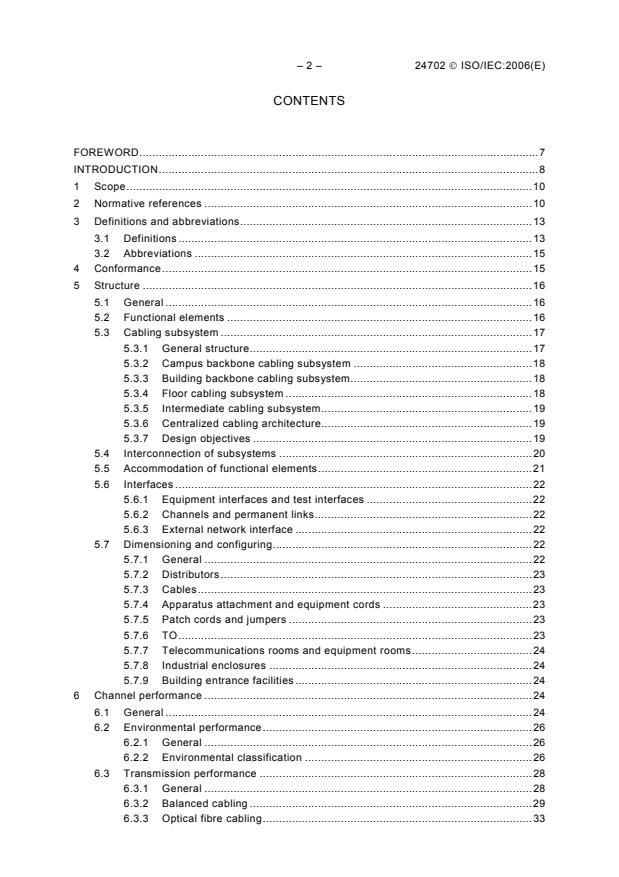
– 2 – 24702 ISO/IEC:2006(E)
CONTENTS
FOREWORD.7
INTRODUCTION.8
1 Scope.10
2 Normative references .10
3 Definitions and abbreviations.13
3.1 Definitions .13
3.2 Abbreviations .15
4 Conformance.15
5 Structure .16
5.1 General .16
5.2 Functional elements .16
5.3 Cabling subsystem .17
5.3.1 General structure.17
5.3.2 Campus backbone cabling subsystem .18
5.3.3 Building backbone cabling subsystem.18
5.3.4 Floor cabling subsystem .18
5.3.5 Intermediate cabling subsystem.19
5.3.6 Centralized cabling architecture.19
5.3.7 Design objectives .19
5.4 Interconnection of subsystems .20
5.5 Accommodation of functional elements.21
5.6 Interfaces .22
5.6.1 Equipment interfaces and test interfaces .22
5.6.2 Channels and permanent links.22
5.6.3 External network interface .22
5.7 Dimensioning and configuring.22
5.7.1 General .22
5.7.2 Distributors.23
5.7.3 Cables.23
5.7.4 Apparatus attachment and equipment cords .23
5.7.5 Patch cords and jumpers .23
5.7.6 TO.23
5.7.7 Telecommunications rooms and equipment rooms.24
5.7.8 Industrial enclosures .24
5.7.9 Building entrance facilities.24
6 Channel performance .24
6.1 General .24
6.2 Environmental performance.26
6.2.1 General .26
6.2.2 Environmental classification .26
6.3 Transmission performance .28
6.3.1 General .28
6.3.2 Balanced cabling .29
6.3.3 Optical fibre cabling.33
24702 ISO/IEC:2006(E) – 3 –
7 Reference implementations .34
7.1 General .34
7.2 Balanced cabling.35
7.2.1 General .35
7.2.2 Intermediate cabling .35
7.2.3 Backbone cabling .35
7.3 Optical fibre cabling .35
7.3.1 General .35
7.3.2 Component choice.35
7.3.3 Maximum channel lengths .35
8 Cable requirements .36
8.1 Introduction .36
8.2 Operating environment .36
8.3 Balanced cables .37
8.4 Optical fibre cables.37
8.4.1 All-silica optical fibre cables .37
8.4.2 Plastic optical fibre cables .38
8.4.3 Plastic clad silica optical fibre cables.39
8.4.4 Propagation delay .39
9 Connecting hardware requirements .39
9.1 Introduction .39
9.2 General requirements.40
9.2.1 Location .40
9.2.2 Design.40
9.2.3 Mounting .40
9.2.4 Marking and colour coding.41
9.3 Operating environment .41
9.4 Connecting hardware for balanced cabling .41
9.4.1 General requirements .41
9.4.2 Performance marking .41
9.4.3 Operating environment .41
9.4.4 Mechanical and electrical characteristics of balanced connecting
hardware .42
9.5 Connecting hardware for optical fibres .44
9.5.1 Operating environment .44
9.5.2 Connecting hardware for all-silica optical fibres .45
9.5.3 Connecting hardware for plastic optical fibres.45
9.5.4 Connecting hardware for plastic clad silica fibres.46
10 Cords .47
10.1 General .47
10.2 Operating environment .47
10.3 Balanced cords .47
10.3.1 General .47
10.3.2 Cable insertion loss .48
10.3.3 Identification.48
10.3.4 Operating environment .48
10.3.5 Electrical performance requirements for patch cords .49
– 4 – 24702 ISO/IEC:2006(E)
10.4 Optical fibre cords .49
10.4.1 General .49
10.4.2 Identification.50
10.4.3 Performance requirements for patch cords .50
10.4.4 Operating environment .50
Annex A (normative) Permanent link performance limits .52
A.1 General .52
A.2 Balanced cabling .52
A.2.1 General .52
A.2.2 Additional requirements.53
A.2.3 Optical fibre cabling .54
Annex B (normative) Test methods .55
B.1 General .55
B.1.1 Visual inspection .55
B.1.2 Measurements.55
B.2 Test parameters for balanced cabling .60
B.2.1 General .60
B.2.2 Wire map.60
B.2.3 Length.60
B.2.4 Propagation delay .60
B.2.5 Delay skew.61
B.2.6 Attenuation (insertion loss).61
B.2.7 Near end crosstalk loss (NEXT, pair-to-pair and power sum) .61
B.2.8 Equal level far end crosstalk loss (ELFEXT, pair-to-pair and power sum) .61
B.2.9 Attenuation to crosstalk ratio (ACR, pair-to-pair and power sum).61
B.2.10 Return loss.61
B.2.11 Coupling attenuation .61
B.2.12 Direct current (d.c.) loop resistance.62
B.3 Test parameters for optical fibre cabling.62
B.3.1 General .62
B.3.2 All-silica optical fibre .62
B.3.3 Plastic optical fibre .62
B.3.4 Plastic clad silica optical fibre.62
Annex C (normative) Reference implementations (not conforming to clause 5) .63
C.1 Introduction .63
C.2 Connection-less channels.63
C.2.1 General .63
C.2.2 Channels with no connections .63
C.2.3 Channels with inter-connections .64
C.3 Channels using balanced cabling bulkhead connections.65
Annex D (informative) Reference implementations.68
D.1 Introduction .68
D.2 Channels using balanced cabling bulkhead connections with additional
connections .68
24702 ISO/IEC:2006(E) – 5 –
Annex E (informative) Supported applications.71
E.1 Supported applications for balanced cabling.71
E.2 Supported applications for optical fibre cabling.71
Annex F (informative) Introduction to environmental classification in clause 6 .73
F.1 General .73
F.2 Application of environmental classification.73
F.2.1 MICE.73
F.2.2 Channel environment .73
F.2.3 Component selection.74
F.3 The MICE system .75
F.4 Guidance with respect to environmental classification .79
Bibliography.83
Figure 1 – Cabling specified by ISO/IEC 24702 and its relationship to OSI reference
model layers .9
Figure 2 – Configuration of apparatus-based functional elements within industrial
premises.17
Figure 3 – Structure of generic cabling for industrial environment .18
Figure 4 – Hierarchical structure of generic cabling for industrial premises .20
Figure 5 – Inter-relationship of functional elements in an installation with diversity for
protection against failure.20
Figure 6 – Accommodation of functional elements .21
Figure 7 – Test and equipment interfaces .22
Figure 8 – Transmission performance of a channel .25
Figure 9 – Example of a system showing the location of cabling interfaces and extent
of associated channels .25
Figure 10 – Eight position jack pin and pair grouping assignments (front view of
connector) .43
Figure 11 – Four position jack pin and pair grouping assignments (front view of
connector) .44
Figure A.1 – Permanent link options .52
Figure B.1 – Reference planes for link and channels (point-to-point).56
Figure B.2 – The test system and the cabling under test .57
Figure C.1 – Balanced cabling channel configurations with no connections.64
Figure C.2 – Balanced cabling channel configurations of Figure C.1 with
interconnection at distributor.65
Figure C.3 – Balanced cabling channel configurations with bulkhead connections .66
Figure D.1 – Channel configurations .69
Figure F.1 – Example of variation of the environment along a cabling channel.74
Figure F.2 – The local environment.74
Figure F.3 – Noise ranges of common industrial machine devices.80
Figure F.4 – Guidance on separation of cabling from noise sources.82
Table 1 – Channel environments.26
Table 2 – Details of environmental classification.27
– 6 – 24702 ISO/IEC:2006(E)
Table 3 – Formulae for TCL limits for an unscreened cabling channel.30
Table 4 – Informative TCL limits for an unscreened cabling channel at key frequencies.30
Table 5 – Formulæ for ELTCTL limits for an unscreened cabling channel .31
Table 6 – Informative ELTCTL limits for an unscreened cabling channel at key
frequencies.31
Table 7 – Formulæ for coupling attenuation limits for a screened cabling channel .32
Table 8 – Informative coupling attenuation limits for a screened cabling channel at key
frequencies.32
Table 9 – Channel attenuation of optical fibre cabling channels .34
Table 10 – Optical fibre channel length equivalence for connecting hardware .36
Table 11 – Environmental performance specifications for balanced cables (in addition
to IEC 61156-5-1 and IEC 61156-6-1).37
Table 12 – Singlemode optical fibre cable (Category OS2) performance requirements.38
Table 13 – Environmental performance specifications for optical fibre cables (in
addition to IEC 60794-2 and IEC 60794-3).38
Table 14 – Optical fibre cable performance requirements.39
Table 15 – Environmental performance specifications for balanced cabling connecting
hardware .42
Table 16 – Environmental performance specifications for optical fibre cabling
connecting hardware.44
Table 17 – Environmental performance specifications for balanced cords (in addition to
a)
IEC/PAS 61935-2-20) .49
Table 18 – Environmental performance specifications for optical fibre cords (in addition
to IEC 61753-X) .51
Table B.1 – Level of accuracy for balanced cabling tester.58
Table B.2 – Cabling characteristics of balanced cabling for acceptance, compliance,
and reference testing .60
Table B.3 – Cabling characteristics of optical fibre cabling for acceptance, compliance,
and reference testing .62
Table C.1 – Channel equations for balanced cabling.65
Table C.2 – Channel equations for bulkhead connections .67
Table D.1 – Channel equations .70
Table E.1 – Supported applications and maximum channel lengths with all-silica
multimode optical fibres .71
Table E.2 – Supported applications and maximum channel lengths with all-silica
singlemode optical fibres .72
Table E.3 – Supported applications and maximum channel lengths with plastic optical
fibres .72
Table F.1 – Derivation of boundaries for mechanical criteria in Table 2.75
Table F.2 – Derivation of boundaries for ingress protection criteria in Table 2.75
Table F.3 – Derivation of boundaries for climatic criteria in Table 2 .76
Table F.4 – Derivation of boundaries for chemical criteria in Table 2 .77
Table F.5 – Derivation of boundaries for electromagnetic criteria in Table 2.79
Table F.6 – Guidance for the classification of electromagnetic environments .81
Table F.7 – Coupling mechanisms for common noise sources.82
24702 ISO/IEC:2006(E) – 7 –
INFORMATION TECHNOLOGY –
GENERIC CABLING – INDUSTRIAL PREMISES
FOREWORD
1) ISO (International Organization for Standardization) and IEC (International Electrotechnical Commission) form the
specialized system for worldwide standardization. National bodies that are members of ISO or IEC participate in
the development of International Standards. Their preparation is entrusted to technical committees; any ISO and
IEC member body interested in the subject dealt with may participate in this preparatory work. International
governmental and non-governmental organizations liaising with ISO and IEC also participate in this preparation.
2) In the field of information technology, ISO and IEC have established a joint technical committee, ISO/IEC JTC 1.
Draft International Standards adopted by the joint technical committee are circulated to national bodies for voting.
Publication as an International Standard requires approval by at least 75 % of the national bodies casting a vote.
3) The formal decisions or agreements of IEC and ISO on technical matters express, as nearly as possible, an
international consensus of opinion on the relevant subjects since each technical committee has representation
from all interested IEC and ISO member bodies.
4) IEC, ISO and ISO/IEC Publications have the form of recommendations for international use and are accepted
by IEC and ISO member bodies in that sense. While all reasonable efforts are made to ensure that the
technical content of IEC, ISO and ISO/IEC Publications is accurate, IEC or ISO cannot be held responsible for
the way in which they are used or for any misinterpretation by any end user.
5) In order to promote international uniformity, IEC and ISO member bodies undertake to apply IEC, ISO and
ISO/IEC Publications transparently to the maximum extent possible in their national and regional publications.
Any divergence between any ISO/IEC Publication and the corresponding national or regional publication
should be clearly indicated in the latter.
6) ISO and IEC provide no marking procedure to indicate their approval and cannot be rendered responsible for
any equipment declared to be in conformity with an ISO/IEC Publication.
7) All users should ensure that they have the latest edition of this publication.
8) No liability shall attach to IEC or ISO or its directors, employees, servants or agents including individual experts
and members of their technical committees and IEC or ISO member bodies for any personal injury, property
damage or other damage of any nature whatsoever, whether direct or indirect, or for costs (including legal fees)
and expenses arising out of the publication of, use of, or reliance upon, this ISO/IEC publication or any other IEC,
ISO or ISO/IEC publications.
9) Attention is drawn to the normative references cited in this publication. Use of the referenced publications is
indispensable for the correct application of this publication.
10) Attention is drawn to the possibility that some of the elements of this International Standard may be the subject of
patent rights. ISO and IEC shall not be held responsible for identifying any or all such patent rights.
International Standard ISO/IEC 24702 was prepared by subcommittee 25: Interconnection of
information technology equipment, of ISO/IEC joint technical committee 1: Information
technology.
ISO/IEC 24702 should be read in conjunction with International Standard ISO/IEC 11801.
This International Standard has been approved by vote of the member bodies, and the voting
results may be obtained from the address given on the title page.
This publication has been drafted in accordance with the ISO/IEC Directives, Part 2.
– 8 – 24702 ISO/IEC:2006(E)
INTRODUCTION
Within premises, the importance of the information technology cabling infrastructure is similar
to that of other fundamental building utilities such as heating, lighting and mains power. As
with other utilities, interruptions to service can have serious impact. Poor quality of service
due to lack of design foresight, use of inappropriate components, incorrect installation, poor
administration or inadequate support can threaten an organization's effectiveness.
Historically, the cabling within premises comprised both application-specific and multipurpose
networks. The subsequent growth of generic cabling designed in accordance with
ISO/IEC 11801 has supported the development of high-data-rate applications based upon a
defined cabling model.
This International Standard recognizes the benefit of generic cabling to interconnect several
pieces of apparatus within industrial premises or industrial areas within other types of
premises (within and between structures and buildings) and should be read in conjunction
with ISO/IEC 11801.
This International Standard provides, for industrial premises:
a) users with an application-independent generic cabling system and an open market for
cabling components;
b) requirements for infrastructures that support critical automation, process control and
monitoring applications in a range of industrial environments;
c) users with a flexible cabling scheme such that modifications are both easy and
economical;
d) building professionals, production and control engineers with guidance allowing the
accommodation of cabling:
before specific requirements are known; i.e. in the initial planning either for
construction or refurbishment;
by further deployment as the requirements of specific industrial areas are defined;
e) industry and standardisation bodies with a cabling system which supports current products
and provides a basis for future product development and applications standardisation.
This International Standard specifies multi-vendor cabling, and is related to
• the associated standard for generic cabling within commercial premises (ISO/IEC 11801),
• standards for cabling components developed by Technical Committees of ISO and IEC,
• standards for the quality assurance and installation of information technology cabling
(series ISO/IEC 14763 and IEC 61918) and testing of installed cabling (IEC 61935-1),
• applications developed by the technical committees of IEC, subcommittees of
ISO/IEC JTC 1 and study groups of ITU-T (for example Fieldbus, LANs and ISDN).
Within this International standard the cabling, defined between the interfaces shown in
Figure 1, contains passive components only.
24702 ISO/IEC:2006(E) – 9 –
OSI
REFERENCE
MODEL
LAYERS
APPLICATION
HIGHER LAYERS HIGHER LAYERS
PRESENTATION
SESSION
LLC or LLC or
OTHER MAC CLIENT OTHER MAC CLIENT
TRANSPORT
MEDIA ACCESS MEDIA ACCESS
CONTROL CONTROL
NETWORK
(MAC) (MAC)
DATA LINK PHYSICAL PHYSICAL
SC65C Interface
(PHY) (PHY)
PHYSICAL
MDI MDI
ISO/IEC 24702 Interface
CABLING
Figure 1 – Cabling specified by ISO/IEC 24702 and its relationship to OSI reference
model layers
It is anticipated that the generic cabling system meeting the minimum requirements of this
International Standard will have a life expectancy consistent with other infrastructures within
industrial premises.
– 10 – 24702 ISO/IEC:2006(E)
INFORMATION TECHNOLOGY
GENERIC CABLING – INDUSTRIAL PREMISES
1 Scope
This International Standard specifies generic cabling that supports a wide range of
communications services including automation, process control and monitoring applications
for use within industrial premises or industrial areas within other types of premises,
comprising single or multiple buildings on a campus. It covers balanced cabling and optical
fibre cabling.
This standard is based upon and references the requirements of ISO/IEC 11801. It contains
additional requirements that are appropriate to industrial premises in which the maximum
distance over which communications services have to be distributed is 10 000 m. The
principles of this International Standard may also be applied to installations that do not fall
within this range.
In addition to the requirements of ISO/IEC 11801, this International Standard specifies
a) a modified structure and configuration for generic cabling within industrial premises in
which information technology applications are used to support process monitoring and
control functions,
b) implementation options,
c) additional requirements that reflect the range of operating environments within industrial
premises.
Safety (electrical safety and protection, fire, etc.) and electromagnetic compatibility (EMC)
requirements are outside the scope of this International Standard and are covered by other
standards and regulations. However, information given in this document may be of assistance
in meeting these standards and regulations.
2 Normative references
The following referenced documents are indispensable for the application of this document.
For dated references, only the edition cited applies. For undated references, the latest edition
of the referenced document (including any amendments) applies.
IEC 60512-4-1, Connectors for electronic equipment – Tests and measurements – Part 4-1:
Voltage stress tests – Test 4a: Voltage proof
IEC 60512-4-2, Connectors for electronic equipment – Tests and measurements – Part 4-2:
Voltage stress tests – Test 4b: Partial discharge
IEC 60512-6-2, Connectors for electronic equipment – Tests and measurements – Part 6-2:
Dynamic stress tests – Test 6b: Bump
IEC 60512-6-3, Connectors for electronic equipment – Tests and measurements – Part 6-3:
Dynamic stress tests – Test 6c: Shock
IEC 60512-6-4, Connectors for electronic equipment – Tests and measurements – Part 6-4:
Dynamic stress tests – Test 6d: Vibration (sinusoidal)
IEC 60512-8, Electromechanical components for electronic equipment; basic testing
procedures and measuring methods – Part 8: Connector tests (mechanical) and mechanical
tests on contacts and terminations
24702 ISO/IEC:2006(E) – 11 –
IEC 60512-9, Electromechanical components for electronic equipment; basic testing
procedures and measuring methods – Part 9: Miscellaneous tests
IEC 60512-11-4, Connectors for electronic equipment – Tests and measurements –
Part 11-4: Climatic tests – Test 11d: Rapid change of temperature
IEC 60512-11-7, Connectors for electronic equipment – Tests and measurements –
Part 11-7: Climatic tests – Test 11g: Flowing mixed gas corrosion test
IEC 60512-11-9, Connectors for electronic equipment – Tests and measurements –
Part 11-9: Climatic tests – Test 11i: Dry heat
IEC 60512-11-10, Connectors for electronic equipment – Tests and measurements –
Part 11-10: Climatic tests – Test 11j: Cold
IEC 60512-11-12, Connectors for electronic equipment – Tests and measurements –
Part 11-12: Climatic tests – Test 11m: Damp heat, cyclic
IEC 60512-19-3, Electromechanical components for electronic equipment – Basic testing
procedures and measuring methods – Part 19: Chemical resistance tests – Section 3: Test
19c – Fluid resistance
IEC 60512-23-3, Electromechanical components for electronic equipment – Basic testing
procedures and measuring methods – Part 23-3: Test 23c: Shielding effectiveness of
connectors and accessories
IEC 60529, Degrees of protection provided by enclosures (IP Code)
IEC 60603-7, Connectors for frequencies below 3 MHz for use with printed boards – Part 7:
Detail specification for connectors, 8-way, including fixed and free connectors with common
mating features, with assessed quality
IEC 60793-1-40, Optical fibres – Part 1-40: Measurement methods and test procedures –
Attenuation
IEC 60793-1-41, Optical fibres – Part 1-41: Measurement methods and test procedures –
Bandwidth
IEC 60793-1-44, Optical fibres – Part 1-44: Measurement methods and test procedures –
Cut-off wavelength
IEC 60793-2-30, Optical fibres – Part 2-30: Product specifications – Sectional specification
for category A3 multimode fibres
IEC 60793-2-40, Optical fibres – Part 2-40: Product specifications – Sectional specification
for category A4 multimode fibres
IEC 60793-2-50, Optical fibres – Part 2-50: Product specifications – Sectional specification
for class B single-mode fibres
IEC 60794-1-2, Optical fibre cables – Part 1-2: Generic specification – Basic optical cable
test procedures
IEC 60794-2, Optical fibre cables – Part 2: Indoor cables – Sectional specification
IEC 60794-3, Optical fibre cables – Part 3: Sectional specification – Outdoor cables
– 12 – 24702 ISO/IEC:2006(E)
IEC 61076-2-101, Connectors for electronic equipment – Part 2-101: Circular connectors –
Detail specification for circular connectors M8 with screw- or snap-locking, M12 with screw-
locking for low voltage applications
IEC 61076-3-106, Connectors for electronic equipment – Product requirements – Part 3-106:
Rectangular connectors – Detail specification for protective housings for use with 8-way
shielded and unshielded connectors for industrial environments incorporating the IEC 60603-7
series interface
IEC 61131-2, Programmable controllers – Part 2: Equipment requirements and tests
IEC 61156 (all parts), Multicore and symmetrical pair/quad cables for digital communications
– Measurement of coupling attenuation of balances cabling in laboratory conditions
IEC 61156-5-1 (all parts), Multicore and symmetrical pair/quad cables for digital
communications
IEC 61156-5-1, Multicore and symmetrical pair/quad cables for digital communications –
Part 5-1: Symmetrical pair/quad cables with transmission characteristics up to 600 MHz –
Horizontal floor wiring - Blank detail specification
IEC 61156-6-1, Multicore and symmetrical pair/quad cables for digital communications –
Part 6-1: Symmetrical pair/quad cables with transmission characteristics up to 600 MHz –
Work area wiring – Blank detail specification
IEC 61300-2-1, Fibre optic interconnecting devices and passive components – Basic test
and measurement procedures – Part 2-1: Tests – Vibration (sinusoidal)
IEC 61300-2-4, Fibre optic interconnecting devices and passive components – Basic test
and measurement procedures – Part 2-4: Tests – Fibre(cable retention
IEC 61300-2-5, Fibre optic interconnecting devices and passive components – Basic test
and measurement procedures – Part 2-5: Tests – Torsion/twist
IEC 61300-2-9, Fibre optic interconnecting devices and passive components – Basic test
and measurement procedures – Part 2-9: Tests – Shock
IEC 61300-2-18, Fibre optic interconnecting devices and passive components – Basic test
and measurement procedures – Part 2-18: Tests – Dry heat – High temperature endurance
IEC 61300-2-22, Fibre optic interconnecting devices and passive components – Basic test
and measurement procedures – Part 2-22: Tests – Change of temperature
IEC 61300-2-30, Fibre optic interconnecting devices and passive components – Basic test
and measurement procedures – Part 2-30: Tests – Solar radiation
IEC 61300-2-34, Fibre optic interconnecting devices and passive components – Basic test
and measurement procedures – Part 2-34: Tests – Resistance to solvents and contaminating
fluids
IEC 61300-2-44, Fibre optic interconnecting devices and passive components – Basic test
and measurement procedures – Part 2-44: Tests – Flexing of the strain relief of fibre optic
devices
IEC 61300-2-46, Fibre optic interconnecting devices and passive components – Basic test
and measurement procedures – Part 2-46: Tests – Damp heat, cyclic
24702 ISO/IEC:2006(E) – 13 –
IEC 61300-3-34, Fibre optic interconnecting devices and passive components – Basic test
and measurement procedures – Part 3-34: Examinations and measurements – Attenuation of
random mated connectors
IEC 61753 (all parts), Fibre optic interconnecting devices and passive components
performance standard – Specification for the testing of optical fibre communication cabling in
accordance with ISO/IEC 24702 – Cords – Blank detail specification
IEC 61754-20, Fibre optic connector interfaces – Part 20: Type LC connector family
IEC 61918, Digital data communications for measurement and control – Installation of
communcation networks in industrial control systems
IEC 61935-1, Testing of balanced communication cabling in accordance with ISO/IEC 11801
– Part 1: Installed cabling
IEC 61935-2, Testing of balanced communication cabling in accordance with
ISO/IEC 11801 – Part 2: Patch cords and work area cords
IEC 62012-1, Multicore and symmetrical pair/quad cables for digital communications to be
used in harsh environments – Part 1: Generic specification
ISO/IEC 11801:2002, Information technology – Generic cabling for customer premises
ISO/IEC 11801, Information technology – Generic cabling for customer premises
NOTE Refer to the second edition of ISO/IEC 11801, published in 2002, where this date has been specified. For
undated references, use the latest edition of ISO/IEC 11801.
ISO/IEC 14763 (all parts), Information technology – Implementation and operation of
customer premises cabling
ISO/IEC 14763-1, Information technology – Implementation and operation of customer
premises cabling – Part 1: Administration
ISO/IEC TR 14763-2, Information technology – Implementation and operation of customer
premises cabling – Part 2: Planning and installation
ISO/IEC 14763-3, Information technology – Implementation and operation of customer
premises cabling – Part 3: Testing of optical fibre cabling
ISO/IEC 18010, Information technology – Pathways and spaces for customer premises
cabli
...
Questions, Comments and Discussion
Ask us and Technical Secretary will try to provide an answer. You can facilitate discussion about the standard in here.
Loading comments...