

ISO 6521-1:2019
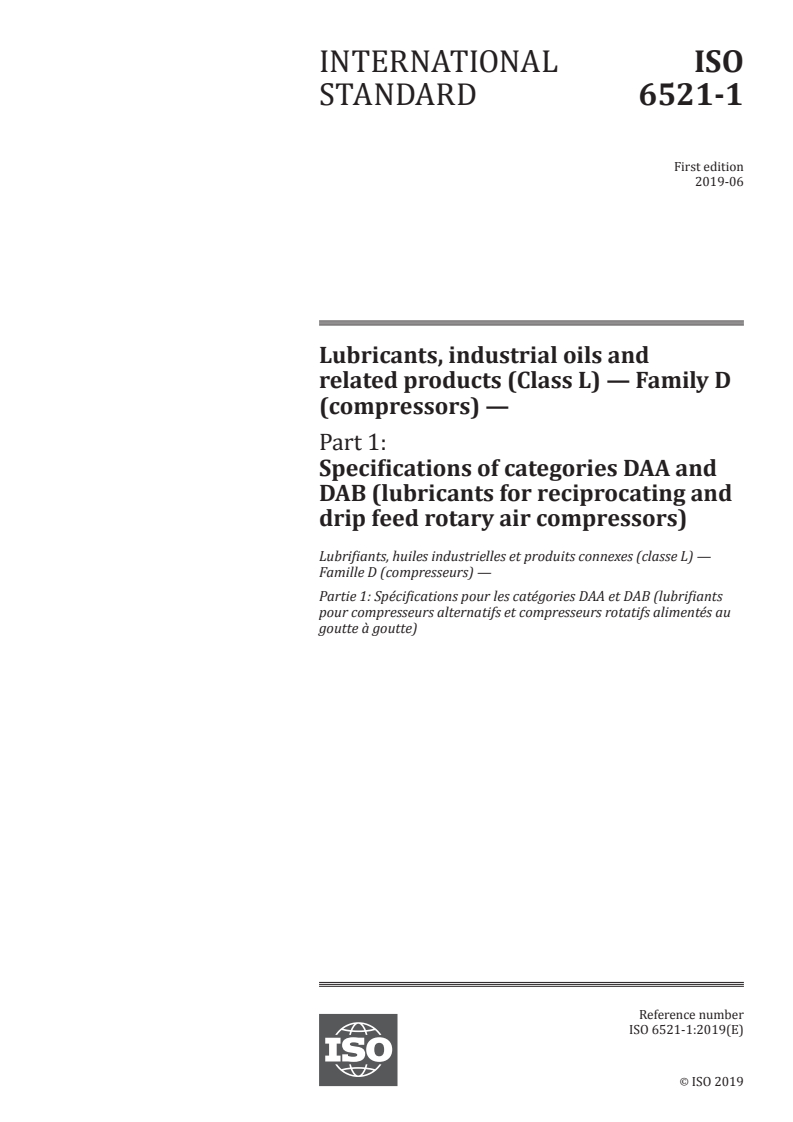
(Main)Lubricants, industrial oils and related products (Class L) — Family D (compressors) — Part 1: Specifications of categories DAA and DAB (lubricants for reciprocating and drip feed rotary air compressors)
General Information
- Abstract
This document specifies the minimum requirements for mineral or synthetic based lubricants intended for use in reciprocating and drip feed rotary air compressors (vane compressors) with the compression chamber(s)/cylinders lubricated by direct lubricant injection. NOTE This document can be read in conjunction with ISO 6743-3[1].
- Status
- Published
- Publication Date
- 26-May-2019
- Technical Committee
- ISO/TC 28/SC 4 - Classifications and specifications
- Current Stage
- 9093 - International Standard confirmed
- Start Date
- 07-Jan-2025
- Completion Date
- 29-Aug-2026
Buy Documents


ISO 6521-1:2019 - Lubricants, industrial oils and related products (Class L) -- Family D (compressors)
ISO 6521-1:2019 - Lubricants, industrial oils and related products (Class L) — Family D (compressors) — Part 1: Specifications of categories DAA and DAB (lubricants for reciprocating and drip feed rotary air compressors)/27/2019


ISO 6521-1:2019 - Lubrifiants, huiles industrielles et produits connexes (classe L) -- Famille D (compresseurs)
ISO 6521-1:2019 - Lubrifiants, huiles industrielles et produits connexes (classe L) — Famille D (compresseurs) — Partie 1: Spécifications pour les catégories DAA et DAB (Lubrifiants pour compresseurs alternatifs et compresseurs rotatifs alimentés au goutte à goutte)/23/2019
Overview
ISO 6521-1:2019 establishes essential specifications for lubricants used in reciprocating and drip feed rotary air compressors, classified under Family D, Class L industrial oils. This international standard defines minimum quality requirements for mineral or synthetic-based lubricants designed to lubricate compressors with direct lubricant injection into the compression chambers or cylinders. It supports proper compressor performance, extends equipment life, and helps maintain operational efficiency.
ISO 6521-1:2019 complements ISO 6743-3 by providing detailed lubricant categorizations-D AA and D AB-that address different service conditions, from normal to severe cycles. The standard is developed by the ISO/TC 28 committee, which specializes in petroleum products, synthetic fuels, and lubricants.
Key Topics
Scope and Application
Specifies requirements for lubricants suitable for reciprocating compressors and drip feed rotary (vane) compressors with direct injection lubrication methods.Lubricant Categories DAA and DAB
- DAA lubricants: Mineral oils refined with oxidation and corrosion inhibitors; optionally include detergent additives. Intended for compressors operating under normal service cycles.
- DAB lubricants: Can be mineral, synthetic, or semi-synthetic oils enhanced with oxidation and corrosion inhibitors and detergents; intended for severe duty cycle compressors.
Performance and Quality Requirements
Lubricants must meet strict criteria concerning:- Viscosity grades and stability (ISO viscosity grades 32 to 150)
- Pour point and flash point to ensure proper thermal and combustion safety
- Corrosion resistance tested via copper strip method
- Water content limits to prevent damage and corrosion
- Foam generation and emulsion stability for reliable operation
- Oxidation stability assessed by carbon residue and aging tests
Sampling and Testing Procedures
Sample collection must comply with ISO 3170 ensuring representative oil analysis. Testing follows prescribed international methods including ISO 2160, ISO 2592, ISO 3104, ISO 6615, and ASTM D1160.Additives and Compatibility
The standard recognizes the role of additives such as antioxidants, rust inhibitors, detergents, and dispersants to improve lubricant longevity, cleanliness, and wear protection in compressor components including crankshaft bearings, valve systems, and piston rings.
Applications
ISO 6521-1:2019 lubricants are critical in various industrial sectors that utilize reciprocating and rotary vane air compressors, including:
Manufacturing and Process Industries
Ensuring compressor efficiency and reliability in factories powering pneumatic tools and automation systems.HVAC and Refrigeration Systems
Lubricants ensure stable compressor operation under cyclical load and temperature variations.Automotive and Transportation
Supporting compressed air systems for braking and suspension control.Energy and Utilities
Maintaining longevity of compressors used in power plants and renewable energy installations.
These lubricants extend compressor service intervals, reduce maintenance costs, prevent contamination-related failures, and optimize energy consumption-key factors for operational sustainability and cost efficiency.
Related Standards
ISO 6743-3
Classification of lubricants including Family D for compressors, providing complementary guidance on lubricant types and service conditions.ISO 2160
Test method for assessing corrosive effects of lubricants on copper strips.ISO 2592 and ISO 2719
Methods for determining flash points using Cleveland open cup and Pensky-Martens closed cup techniques, ensuring operational safety.ISO 3104
Determination of kinematic viscosity, critical for lubricant grade classification.ASTM D1160
Distillation of petroleum products under reduced pressure, important for evaluating lubricant volatility.ISO 3170
Guidelines for manual sampling of petroleum liquids, ensuring sample integrity.
By adhering to ISO 6521-1:2019, industries can assure lubricant quality that meets global standards for compressor operation under varied conditions, promoting equipment durability, environmental compliance, and process reliability.
Keywords: ISO 6521-1:2019, industrial lubricants, compressor oils, reciprocating compressors, drip feed rotary compressors, mineral oils, synthetic lubricants, lubricant specifications, compressor maintenance, oxidation stability, corrosion resistance, viscosity grades, compressor lubricant standard, ISO standards for lubricants.
Relations
- Effective Date
- 06-Jun-2022
Buy Documents
ISO 6521-1:2019 - Lubricants, industrial oils and related products (Class L) -- Family D (compressors)
ISO 6521-1:2019 - Lubricants, industrial oils and related products (Class L) — Family D (compressors) — Part 1: Specifications of categories DAA and DAB (lubricants for reciprocating and drip feed rotary air compressors)/27/2019
ISO 6521-1:2019 - Lubrifiants, huiles industrielles et produits connexes (classe L) -- Famille D (compresseurs)
ISO 6521-1:2019 - Lubrifiants, huiles industrielles et produits connexes (classe L) — Famille D (compresseurs) — Partie 1: Spécifications pour les catégories DAA et DAB (Lubrifiants pour compresseurs alternatifs et compresseurs rotatifs alimentés au goutte à goutte)/23/2019
Get Certified
Connect with accredited certification bodies for this standard

Element Materials Technology
Materials testing and product certification.

ABS Group Brazil
ABS Group certification services in Brazil.

ABS Quality Evaluations Inc.
American Bureau of Shipping quality certification.
Sponsored listings
Frequently Asked Questions
ISO 6521-1:2019 is a standard published by the International Organization for Standardization (ISO). Its full title is "Lubricants, industrial oils and related products (Class L) — Family D (compressors) — Part 1: Specifications of categories DAA and DAB (lubricants for reciprocating and drip feed rotary air compressors)". This standard covers: This document specifies the minimum requirements for mineral or synthetic based lubricants intended for use in reciprocating and drip feed rotary air compressors (vane compressors) with the compression chamber(s)/cylinders lubricated by direct lubricant injection. NOTE This document can be read in conjunction with ISO 6743-3[1].
This document specifies the minimum requirements for mineral or synthetic based lubricants intended for use in reciprocating and drip feed rotary air compressors (vane compressors) with the compression chamber(s)/cylinders lubricated by direct lubricant injection. NOTE This document can be read in conjunction with ISO 6743-3[1].
ISO 6521-1:2019 is classified under the following ICS (International Classification for Standards) categories: 75.100 - Lubricants, industrial oils and related products. The ICS classification helps identify the subject area and facilitates finding related standards.
ISO 6521-1:2019 has the following relationships with other standards: It is inter standard links to ISO 16654:2001/Amd 2:2023. Understanding these relationships helps ensure you are using the most current and applicable version of the standard.
ISO 6521-1:2019 is available in PDF format for immediate download after purchase. The document can be added to your cart and obtained through the secure checkout process. Digital delivery ensures instant access to the complete standard document.
Standards Content (Sample)
INTERNATIONAL ISO
STANDARD 6521-1
First edition
2019-06
Lubricants, industrial oils and
related products (Class L) — Family D
(compressors) —
Part 1:
Specifications of categories DAA and
DAB (lubricants for reciprocating and
drip feed rotary air compressors)
Lubrifiants, huiles industrielles et produits connexes (classe L) —
Famille D (compresseurs) —
Partie 1: Spécifications pour les catégories DAA et DAB (lubrifiants
pour compresseurs alternatifs et compresseurs rotatifs alimentés au
goutte à goutte)
Reference number
©
ISO 2019
© ISO 2019
All rights reserved. Unless otherwise specified, or required in the context of its implementation, no part of this publication may
be reproduced or utilized otherwise in any form or by any means, electronic or mechanical, including photocopying, or posting
on the internet or an intranet, without prior written permission. Permission can be requested from either ISO at the address
below or ISO’s member body in the country of the requester.
ISO copyright office
CP 401 • Ch. de Blandonnet 8
CH-1214 Vernier, Geneva
Phone: +41 22 749 01 11
Fax: +41 22 749 09 47
Email: copyright@iso.org
Website: www.iso.org
Published in Switzerland
ii © ISO 2019 – All rights reserved
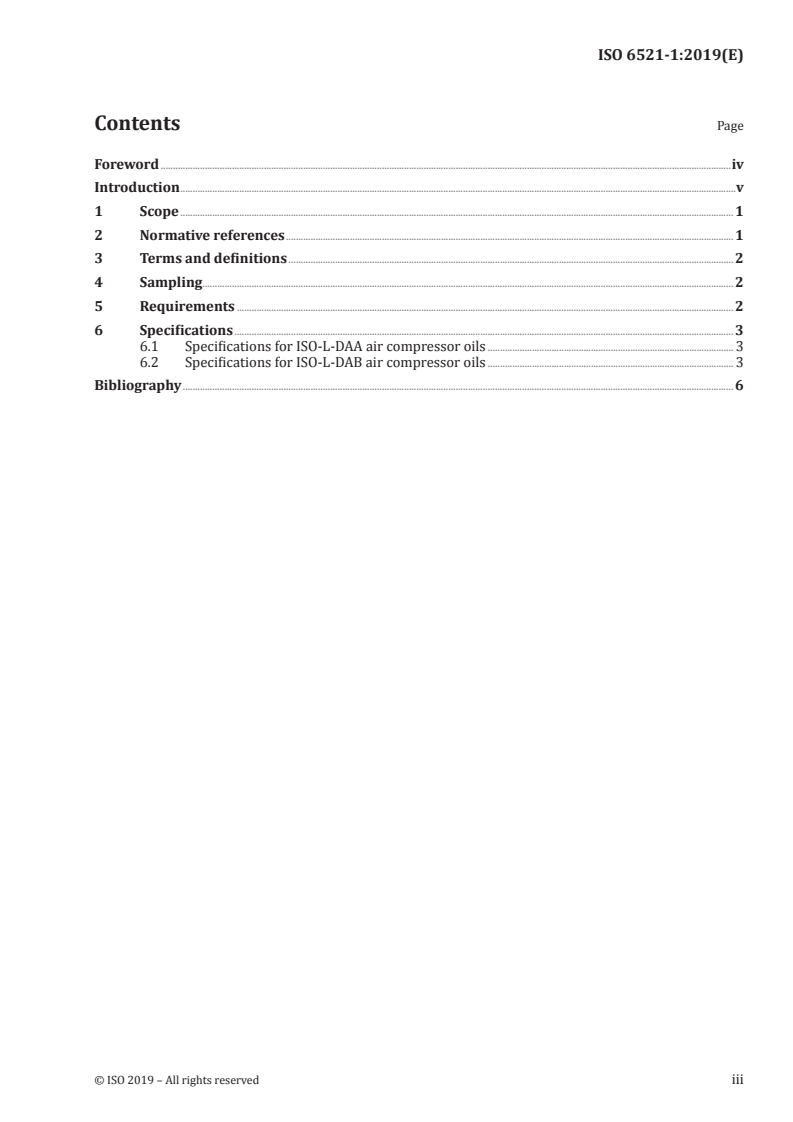
Contents Page
Foreword .iv
Introduction .v
1 Scope . 1
2 Normative references . 1
3 Terms and definitions . 2
4 Sampling . 2
5 Requirements . 2
6 Specifications . 3
6.1 Specifications for ISO-L-DAA air compressor oils . 3
6.2 Specifications for ISO-L-DAB air compressor oils . 3
Bibliography . 6
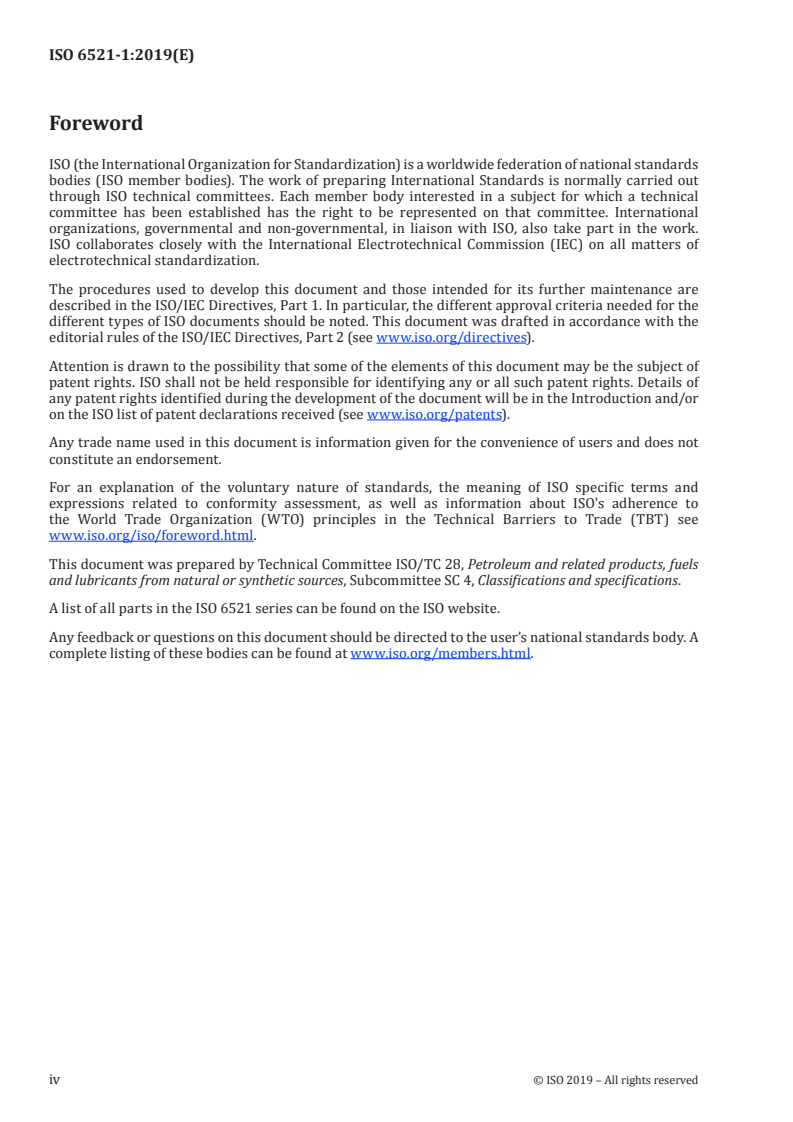
Foreword
ISO (the International Organization for Standardization) is a worldwide federation of national standards
bodies (ISO member bodies). The work of preparing International Standards is normally carried out
through ISO technical committees. Each member body interested in a subject for which a technical
committee has been established has the right to be represented on that committee. International
organizations, governmental and non-governmental, in liaison with ISO, also take part in the work.
ISO collaborates closely with the International Electrotechnical Commission (IEC) on all matters of
electrotechnical standardization.
The procedures used to develop this document and those intended for its further maintenance are
described in the ISO/IEC Directives, Part 1. In particular, the different approval criteria needed for the
different types of ISO documents should be noted. This document was drafted in accordance with the
editorial rules of the ISO/IEC Directives, Part 2 (see www .iso .org/directives).
Attention is drawn to the possibility that some of the elements of this document may be the subject of
patent rights. ISO shall not be held responsible for identifying any or all such patent rights. Details of
any patent rights identified during the development of the document will be in the Introduction and/or
on the ISO list of patent declarations received (see www .iso .org/patents).
Any trade name used in this document is information given for the convenience of users and does not
constitute an endorsement.
For an explanation of the voluntary nature of standards, the meaning of ISO specific terms and
expressions related to conformity assessment, as well as information about ISO's adherence to
the World Trade Organization (WTO) principles in the Technical Barriers to Trade (TBT) see
www .iso .org/iso/foreword .html.
This document was prepared by Technical Committee ISO/TC 28, Petroleum and related products, fuels
and lubricants from natural or synthetic sources, Subcommittee SC 4, Classifications and specifications.
A list of all parts in the ISO 6521 series can be found on the ISO website.
Any feedback or questions on this document should be directed to the user’s national standards body. A
complete listing of these bodies can be found at www .iso .org/members .html.
iv © ISO 2019 – All rights reserved
Introduction
Lubricants for compressors are used in various compressor designs. The lubricants for these applications
can vary in composition, from straight mineral oils to more complex blends, based on mineral oils,
synthetic oils (e.g. poly α-olefins, esters, poly-glycols), and additives. The additives most currently used
are antioxidants, rust and copper corrosion inhibitors. They can be supplemented by detergents and
dispersing additives to improving the cleanliness of the hottest parts of the compressors, e.g. the inlet
and the exhaust valves in reciprocating compressors.
These lubricants are also able to lubricate the mechanical parts of the compressors (crankshaft and
connecting rods bearings, crossheads, rolling bearings).
INTERNATIONAL STANDARD ISO 6521-1:2019(E)
Lubricants, industrial oils and related products (Class L) —
Family D (compressors) —
Part 1:
Specifications of categories DAA and DAB (lubricants for
reciprocating and drip feed rotary air compressors)
1 Scope
This document specifies the minimum requirements for mineral or synthetic based lubricants intended
for use in reciprocating and drip feed rotary air compressors (vane compressors) with the compression
chamber(s)/cylinders lubricated by direct lubricant injection.
[1]
NOTE This document can be read in conjunction with ISO 6743-3 .
2 Normative references
The following documents are referred to in the text in such a way that some or all of their content
constitutes requirements of this document. For dated references, only the edition cited applies. For
undated references, the latest edition of the referenced document (including any amendments) applies.
ISO 2160, Petroleum products — Corrosiveness to copper — Copper strip test
ISO 2592, Petroleum and related products — Determination of flash and fire points — Cleveland open
cup method
ISO 2719, Determination of flash point — Pensky-Martens closed cup method
ISO 2909, Petroleum products — Calculation of viscosity index from kinematic viscosity
ISO 3016, Petroleum and related products from natural or synthetic sources — Determination of pour point
ISO 3104, Petroleum products — Transparent and opaque liquids — Determination of kinematic viscosity
and calculation of dynamic viscosity
ISO 3170, Petroleum liquids — Manual sampling
ISO 3448, Industrial liquid lubricants — ISO viscosity classification
ISO 3675, Crude petroleum and liquid petroleum products — Laboratory determination of density —
Hydrometer method
ISO 3987, Petroleum products — Determination o
...
INTERNATIONAL ISO
STANDARD 6521-1
First edition
2019-06
Lubricants, industrial oils and
related products (Class L) — Family D
(compressors) —
Part 1:
Specifications of categories DAA and
DAB (lubricants for reciprocating and
drip feed rotary air compressors)
Lubrifiants, huiles industrielles et produits connexes (classe L) —
Famille D (compresseurs) —
Partie 1: Spécifications pour les catégories DAA et DAB (lubrifiants
pour compresseurs alternatifs et compresseurs rotatifs alimentés au
goutte à goutte)
Reference number
©
ISO 2019
© ISO 2019
All rights reserved. Unless otherwise specified, or required in the context of its implementation, no part of this publication may
be reproduced or utilized otherwise in any form or by any means, electronic or mechanical, including photocopying, or posting
on the internet or an intranet, without prior written permission. Permission can be requested from either ISO at the address
below or ISO’s member body in the country of the requester.
ISO copyright office
CP 401 • Ch. de Blandonnet 8
CH-1214 Vernier, Geneva
Phone: +41 22 749 01 11
Fax: +41 22 749 09 47
Email: copyright@iso.org
Website: www.iso.org
Published in Switzerland
ii © ISO 2019 – All rights reserved
Contents Page
Foreword .iv
Introduction .v
1 Scope . 1
2 Normative references . 1
3 Terms and definitions . 2
4 Sampling . 2
5 Requirements . 2
6 Specifications . 3
6.1 Specifications for ISO-L-DAA air compressor oils . 3
6.2 Specifications for ISO-L-DAB air compressor oils . 3
Bibliography . 6
Foreword
ISO (the International Organization for Standardization) is a worldwide federation of national standards
bodies (ISO member bodies). The work of preparing International Standards is normally carried out
through ISO technical committees. Each member body interested in a subject for which a technical
committee has been established has the right to be represented on that committee. International
organizations, governmental and non-governmental, in liaison with ISO, also take part in the work.
ISO collaborates closely with the International Electrotechnical Commission (IEC) on all matters of
electrotechnical standardization.
The procedures used to develop this document and those intended for its further maintenance are
described in the ISO/IEC Directives, Part 1. In particular, the different approval criteria needed for the
different types of ISO documents should be noted. This document was drafted in accordance with the
editorial rules of the ISO/IEC Directives, Part 2 (see www .iso .org/directives).
Attention is drawn to the possibility that some of the elements of this document may be the subject of
patent rights. ISO shall not be held responsible for identifying any or all such patent rights. Details of
any patent rights identified during the development of the document will be in the Introduction and/or
on the ISO list of patent declarations received (see www .iso .org/patents).
Any trade name used in this document is information given for the convenience of users and does not
constitute an endorsement.
For an explanation of the voluntary nature of standards, the meaning of ISO specific terms and
expressions related to conformity assessment, as well as information about ISO's adherence to
the World Trade Organization (WTO) principles in the Technical Barriers to Trade (TBT) see
www .iso .org/iso/foreword .html.
This document was prepared by Technical Committee ISO/TC 28, Petroleum and related products, fuels
and lubricants from natural or synthetic sources, Subcommittee SC 4, Classifications and specifications.
A list of all parts in the ISO 6521 series can be found on the ISO website.
Any feedback or questions on this document should be directed to the user’s national standards body. A
complete listing of these bodies can be found at www .iso .org/members .html.
iv © ISO 2019 – All rights reserved
Introduction
Lubricants for compressors are used in various compressor designs. The lubricants for these applications
can vary in composition, from straight mineral oils to more complex blends, based on mineral oils,
synthetic oils (e.g. poly α-olefins, esters, poly-glycols), and additives. The additives most currently used
are antioxidants, rust and copper corrosion inhibitors. They can be supplemented by detergents and
dispersing additives to improving the cleanliness of the hottest parts of the compressors, e.g. the inlet
and the exhaust valves in reciprocating compressors.
These lubricants are also able to lubricate the mechanical parts of the compressors (crankshaft and
connecting rods bearings, crossheads, rolling bearings).
INTERNATIONAL STANDARD ISO 6521-1:2019(E)
Lubricants, industrial oils and related products (Class L) —
Family D (compressors) —
Part 1:
Specifications of categories DAA and DAB (lubricants for
reciprocating and drip feed rotary air compressors)
1 Scope
This document specifies the minimum requirements for mineral or synthetic based lubricants intended
for use in reciprocating and drip feed rotary air compressors (vane compressors) with the compression
chamber(s)/cylinders lubricated by direct lubricant injection.
[1]
NOTE This document can be read in conjunction with ISO 6743-3 .
2 Normative references
The following documents are referred to in the text in such a way that some or all of their content
constitutes requirements of this document. For dated references, only the edition cited applies. For
undated references, the latest edition of the referenced document (including any amendments) applies.
ISO 2160, Petroleum products — Corrosiveness to copper — Copper strip test
ISO 2592, Petroleum and related products — Determination of flash and fire points — Cleveland open
cup method
ISO 2719, Determination of flash point — Pensky-Martens closed cup method
ISO 2909, Petroleum products — Calculation of viscosity index from kinematic viscosity
ISO 3016, Petroleum and related products from natural or synthetic sources — Determination of pour point
ISO 3104, Petroleum products — Transparent and opaque liquids — Determination of kinematic viscosity
and calculation of dynamic viscosity
ISO 3170, Petroleum liquids — Manual sampling
ISO 3448, Industrial liquid lubricants — ISO viscosity classification
ISO 3675, Crude petroleum and liquid petroleum products — Laboratory determination of density —
Hydrometer method
ISO 3987, Petroleum products — Determination o
...
NORME ISO
INTERNATIONALE 6521-1
Première édition
2019-06
Lubrifiants, huiles industrielles
et produits connexes (classe L) —
Famille D (compresseurs) —
Partie 1:
Spécifications pour les catégories
DAA et DAB (Lubrifiants pour
compresseurs alternatifs et
compresseurs rotatifs alimentés au
goutte à goutte)
Lubricants, industrial oils and related products (Class L) — Family D
(compressors) —
Part 1: Specifications of categories DAA and DAB (lubricants for
reciprocating and drip feed rotary air compressors)
Numéro de référence
©
ISO 2019
DOCUMENT PROTÉGÉ PAR COPYRIGHT
© ISO 2019
Tous droits réservés. Sauf prescription différente ou nécessité dans le contexte de sa mise en œuvre, aucune partie de cette
publication ne peut être reproduite ni utilisée sous quelque forme que ce soit et par aucun procédé, électronique ou mécanique,
y compris la photocopie, ou la diffusion sur l’internet ou sur un intranet, sans autorisation écrite préalable. Une autorisation peut
être demandée à l’ISO à l’adresse ci-après ou au comité membre de l’ISO dans le pays du demandeur.
ISO copyright office
Case postale 401 • Ch. de Blandonnet 8
CH-1214 Vernier, Genève
Tél.: +41 22 749 01 11
Fax: +41 22 749 09 47
E-mail: copyright@iso.org
Web: www.iso.org
Publié en Suisse
ii © ISO 2019 – Tous droits réservés
Sommaire Page
Avant-propos .iv
Introduction .v
1 Domaine d'application .1
2 Références normatives .1
3 Termes et définitions .2
4 Échantillonnage .2
5 Exigences .2
6 Spécifications .3
6.1 Spécifications pour les huiles pour compresseurs ISO-L-DAA . 3
6.2 Spécifications pour les huiles pour compresseurs ISO-L-DAB . 3
Bibliographie .6
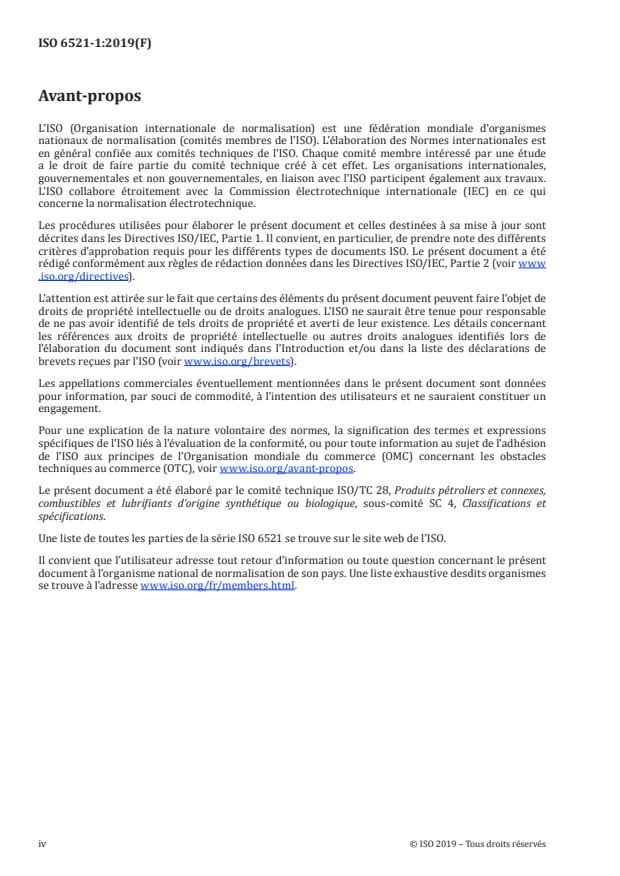
Avant-propos
L'ISO (Organisation internationale de normalisation) est une fédération mondiale d'organismes
nationaux de normalisation (comités membres de l'ISO). L'élaboration des Normes internationales est
en général confiée aux comités techniques de l'ISO. Chaque comité membre intéressé par une étude
a le droit de faire partie du comité technique créé à cet effet. Les organisations internationales,
gouvernementales et non gouvernementales, en liaison avec l'ISO participent également aux travaux.
L'ISO collabore étroitement avec la Commission électrotechnique internationale (IEC) en ce qui
concerne la normalisation électrotechnique.
Les procédures utilisées pour élaborer le présent document et celles destinées à sa mise à jour sont
décrites dans les Directives ISO/IEC, Partie 1. Il convient, en particulier, de prendre note des différents
critères d'approbation requis pour les différents types de documents ISO. Le présent document a été
rédigé conformément aux règles de rédaction données dans les Directives ISO/IEC, Partie 2 (voir www
.iso .org/directives).
L'attention est attirée sur le fait que certains des éléments du présent document peuvent faire l'objet de
droits de propriété intellectuelle ou de droits analogues. L'ISO ne saurait être tenue pour responsable
de ne pas avoir identifié de tels droits de propriété et averti de leur existence. Les détails concernant
les références aux droits de propriété intellectuelle ou autres droits analogues identifiés lors de
l'élaboration du document sont indiqués dans l'Introduction et/ou dans la liste des déclarations de
brevets reçues par l'ISO (voir www .iso .org/brevets).
Les appellations commerciales éventuellement mentionnées dans le présent document sont données
pour information, par souci de commodité, à l’intention des utilisateurs et ne sauraient constituer un
engagement.
Pour une explication de la nature volontaire des normes, la signification des termes et expressions
spécifiques de l'ISO liés à l'évaluation de la conformité, ou pour toute information au sujet de l'adhésion
de l'ISO aux principes de l’Organisation mondiale du commerce (OMC) concernant les obstacles
techniques au commerce (OTC), voir www .iso .org/avant -propos.
Le présent document a été élaboré par le comité technique ISO/TC 28, Produits pétroliers et connexes,
combustibles et lubrifiants d’origine synthétique ou biologique, sous-comité SC 4, Classifications et
spécifications.
Une liste de toutes les parties de la série ISO 6521 se trouve sur le site web de l’ISO.
Il convient que l’utilisateur adresse tout retour d’information ou toute question concernant le présent
document à l’organisme national de normalisation de son pays. Une liste exhaustive desdits organismes
se trouve à l’adresse www .iso .org/fr/members .html.
iv © ISO 2019 – Tous droits réservés
Introduction
Les lubrifiants pour compresseurs sont utilisés dans différents types de compresseurs. La composition
des lubrifiants pour ces applications peut varier, allant d’huiles minérales simples à des mélanges
plus complexes, à base d’huiles minérales, d’huiles synthétiques (par exemple, les poly-α−oléfines, les
esters, les poly-glycols) et d’additifs. Les additifs les plus couramment utilisés sont les antioxydants,
les inhibiteurs de rouille et de corrosion du cuivre. Ils peuvent être associés à des détergents et des
additifs dispersants pour améliorer la propreté des parties les plus chaudes des compresseurs comme
les soupapes d'admission et d'échappement des compresseurs alternatifs.
Ces lubrifiants sont également capables de lubrifier les pièces mécaniques des compresseurs (paliers de
vilebrequin et de bielles, têtes de paliers, roulements).
NORME INTERNATIONALE ISO 6521-1:2019(F)
Lubrifiants, huiles industrielles et produits connexes
(classe L) — Famille D (compresseurs) —
Partie 1:
Spécifications pour les catégories DAA et DAB (Lubrifiants
pour compresseurs alternatifs et compresseurs rotatifs
alimentés au goutte à goutte)
1 Domaine d'application
Le présent document spécifie les exigences minimales relatives aux lubrifiants d’origine minérale
ou synthétique, destinés à être utilisés dans les compresseurs alternatifs et compresseurs rotatifs
alimentés au goutte à goutte (compresseurs à palettes) avec les chambres/cylindres de compression
lubrifiés par injection directe du lubrifiant.
[1]
NOTE Ce document peut être lu conjointement avec l'ISO 6743-3 .
2 Références normatives
Les documents suivants sont cités dans le texte de sorte qu’ils constituent, pour tout ou partie de leur
contenu, des exigences du présent document. Pour les références datées, seule l’édition citée s’applique.
Pour les références non datées, la dernière édition du document de référence s'applique (y compris les
éventuels amendements).
ISO 2160, Produits pétroliers — Action corrosive sur le cuivre — Essai à la lame de cuivre
ISO 2592, Pétrole et produits connexes — Détermination des points d'éclair et de feu — Méthode Cleveland
à vase ouvert
ISO 2719, Détermination du point d'éclair — Méthode Pensky-Martens en vase clos
ISO 2909, Produits pétroliers — Calcul de l'indice de viscosité à partir de la viscosité cinématique
ISO 3016, Produits pétroliers et connexes d’origine naturelle ou synthétique — Détermination du point
d'écoulement
ISO 3104, Produits pétroliers — Liquides opaques et transparents — Détermination de la viscosité
cinématique et calcul de la viscosité dynamique
ISO 3170, Produits pétroliers liquides — Échantillonnage manuel
ISO 3448, Lubrifiants liquides industriels — Classification ISO selon la viscosité
ISO 3675, Pétrole brut et produits pétroliers liquides — Détermination en laboratoire de la masse
volumique — Méthode à l'aréomètre
ISO 3987, Produits pétrolier
...
NORME ISO
INTERNATIONALE 6521-1
Première édition
2019-06
Lubrifiants, huiles industrielles
et produits connexes (classe L) —
Famille D (compresseurs) —
Partie 1:
Spécifications pour les catégories
DAA et DAB (Lubrifiants pour
compresseurs alternatifs et
compresseurs rotatifs alimentés au
goutte à goutte)
Lubricants, industrial oils and related products (Class L) — Family D
(compressors) —
Part 1: Specifications of categories DAA and DAB (lubricants for
reciprocating and drip feed rotary air compressors)
Numéro de référence
©
ISO 2019
DOCUMENT PROTÉGÉ PAR COPYRIGHT
© ISO 2019
Tous droits réservés. Sauf prescription différente ou nécessité dans le contexte de sa mise en œuvre, aucune partie de cette
publication ne peut être reproduite ni utilisée sous quelque forme que ce soit et par aucun procédé, électronique ou mécanique,
y compris la photocopie, ou la diffusion sur l’internet ou sur un intranet, sans autorisation écrite préalable. Une autorisation peut
être demandée à l’ISO à l’adresse ci-après ou au comité membre de l’ISO dans le pays du demandeur.
ISO copyright office
Case postale 401 • Ch. de Blandonnet 8
CH-1214 Vernier, Genève
Tél.: +41 22 749 01 11
Fax: +41 22 749 09 47
E-mail: copyright@iso.org
Web: www.iso.org
Publié en Suisse
ii © ISO 2019 – Tous droits réservés
Sommaire Page
Avant-propos .iv
Introduction .v
1 Domaine d'application .1
2 Références normatives .1
3 Termes et définitions .2
4 Échantillonnage .2
5 Exigences .2
6 Spécifications .3
6.1 Spécifications pour les huiles pour compresseurs ISO-L-DAA . 3
6.2 Spécifications pour les huiles pour compresseurs ISO-L-DAB . 3
Bibliographie .6
Avant-propos
L'ISO (Organisation internationale de normalisation) est une fédération mondiale d'organismes
nationaux de normalisation (comités membres de l'ISO). L'élaboration des Normes internationales est
en général confiée aux comités techniques de l'ISO. Chaque comité membre intéressé par une étude
a le droit de faire partie du comité technique créé à cet effet. Les organisations internationales,
gouvernementales et non gouvernementales, en liaison avec l'ISO participent également aux travaux.
L'ISO collabore étroitement avec la Commission électrotechnique internationale (IEC) en ce qui
concerne la normalisation électrotechnique.
Les procédures utilisées pour élaborer le présent document et celles destinées à sa mise à jour sont
décrites dans les Directives ISO/IEC, Partie 1. Il convient, en particulier, de prendre note des différents
critères d'approbation requis pour les différents types de documents ISO. Le présent document a été
rédigé conformément aux règles de rédaction données dans les Directives ISO/IEC, Partie 2 (voir www
.iso .org/directives).
L'attention est attirée sur le fait que certains des éléments du présent document peuvent faire l'objet de
droits de propriété intellectuelle ou de droits analogues. L'ISO ne saurait être tenue pour responsable
de ne pas avoir identifié de tels droits de propriété et averti de leur existence. Les détails concernant
les références aux droits de propriété intellectuelle ou autres droits analogues identifiés lors de
l'élaboration du document sont indiqués dans l'Introduction et/ou dans la liste des déclarations de
brevets reçues par l'ISO (voir www .iso .org/brevets).
Les appellations commerciales éventuellement mentionnées dans le présent document sont données
pour information, par souci de commodité, à l’intention des utilisateurs et ne sauraient constituer un
engagement.
Pour une explication de la nature volontaire des normes, la signification des termes et expressions
spécifiques de l'ISO liés à l'évaluation de la conformité, ou pour toute information au sujet de l'adhésion
de l'ISO aux principes de l’Organisation mondiale du commerce (OMC) concernant les obstacles
techniques au commerce (OTC), voir www .iso .org/avant -propos.
Le présent document a été élaboré par le comité technique ISO/TC 28, Produits pétroliers et connexes,
combustibles et lubrifiants d’origine synthétique ou biologique, sous-comité SC 4, Classifications et
spécifications.
Une liste de toutes les parties de la série ISO 6521 se trouve sur le site web de l’ISO.
Il convient que l’utilisateur adresse tout retour d’information ou toute question concernant le présent
document à l’organisme national de normalisation de son pays. Une liste exhaustive desdits organismes
se trouve à l’adresse www .iso .org/fr/members .html.
iv © ISO 2019 – Tous droits réservés
Introduction
Les lubrifiants pour compresseurs sont utilisés dans différents types de compresseurs. La composition
des lubrifiants pour ces applications peut varier, allant d’huiles minérales simples à des mélanges
plus complexes, à base d’huiles minérales, d’huiles synthétiques (par exemple, les poly-α−oléfines, les
esters, les poly-glycols) et d’additifs. Les additifs les plus couramment utilisés sont les antioxydants,
les inhibiteurs de rouille et de corrosion du cuivre. Ils peuvent être associés à des détergents et des
additifs dispersants pour améliorer la propreté des parties les plus chaudes des compresseurs comme
les soupapes d'admission et d'échappement des compresseurs alternatifs.
Ces lubrifiants sont également capables de lubrifier les pièces mécaniques des compresseurs (paliers de
vilebrequin et de bielles, têtes de paliers, roulements).
NORME INTERNATIONALE ISO 6521-1:2019(F)
Lubrifiants, huiles industrielles et produits connexes
(classe L) — Famille D (compresseurs) —
Partie 1:
Spécifications pour les catégories DAA et DAB (Lubrifiants
pour compresseurs alternatifs et compresseurs rotatifs
alimentés au goutte à goutte)
1 Domaine d'application
Le présent document spécifie les exigences minimales relatives aux lubrifiants d’origine minérale
ou synthétique, destinés à être utilisés dans les compresseurs alternatifs et compresseurs rotatifs
alimentés au goutte à goutte (compresseurs à palettes) avec les chambres/cylindres de compression
lubrifiés par injection directe du lubrifiant.
[1]
NOTE Ce document peut être lu conjointement avec l'ISO 6743-3 .
2 Références normatives
Les documents suivants sont cités dans le texte de sorte qu’ils constituent, pour tout ou partie de leur
contenu, des exigences du présent document. Pour les références datées, seule l’édition citée s’applique.
Pour les références non datées, la dernière édition du document de référence s'applique (y compris les
éventuels amendements).
ISO 2160, Produits pétroliers — Action corrosive sur le cuivre — Essai à la lame de cuivre
ISO 2592, Pétrole et produits connexes — Détermination des points d'éclair et de feu — Méthode Cleveland
à vase ouvert
ISO 2719, Détermination du point d'éclair — Méthode Pensky-Martens en vase clos
ISO 2909, Produits pétroliers — Calcul de l'indice de viscosité à partir de la viscosité cinématique
ISO 3016, Produits pétroliers et connexes d’origine naturelle ou synthétique — Détermination du point
d'écoulement
ISO 3104, Produits pétroliers — Liquides opaques et transparents — Détermination de la viscosité
cinématique et calcul de la viscosité dynamique
ISO 3170, Produits pétroliers liquides — Échantillonnage manuel
ISO 3448, Lubrifiants liquides industriels — Classification ISO selon la viscosité
ISO 3675, Pétrole brut et produits pétroliers liquides — Détermination en laboratoire de la masse
volumique — Méthode à l'aréomètre
ISO 3987, Produits pétrolier
...