

ISO 9727-2:2007
(Main)Cylindrical cork stoppers — Physical tests — Part 2: Determination of mass and apparent density for agglomerated cork stoppers
General Information
- Abstract
ISO 9727-2:2007 specifies a test method for measuring the mass of cylindrical cork stoppers ready for use or semi-worked, totally or partially made of agglomerated cork, and calculating the apparent density of cylindrical cork stoppers ready for use or semi-worked, totally made of agglomerated cork.
- Status
- Published
- Publication Date
- 15-May-2007
- Technical Committee
- ISO/TC 87 - Cork
- Drafting Committee
- ISO/TC 87 - Cork
- Current Stage
- 9092 - International Standard to be revised
- Start Date
- 04-Dec-2025
- Completion Date
- 29-Aug-2026
Buy Documents



ISO 9727-2:2007 - Cylindrical cork stoppers -- Physical tests

ISO 9727-2:2007 - Cylindrical cork stoppers — Physical tests — Part 2: Determination of mass and apparent density for agglomerated cork stoppers/16/2007



ISO 9727-2:2007 - Bouchons cylindriques en liege -- Essais physiques

ISO 9727-2:2007 - Bouchons cylindriques en liège — Essais physiques — Partie 2: Détermination de la masse et de la masse volumique apparente des bouchons de liège agglomérés/16/2007
Overview
ISO 9727-2:2007 is an international standard developed by the International Organization for Standardization (ISO) that specifies a precise test method for determining the mass and apparent density of cylindrical cork stoppers made wholly or partially from agglomerated cork. This standard focuses on cork stoppers used in bottling applications, providing manufacturers and quality inspectors with a reliable methodology to measure these physical properties accurately.
The standard applies to cork stoppers that are either ready for use or semi-worked and forms part of a comprehensive series (ISO 9727) dedicated to physical testing of cork stoppers. By adhering to the procedures outlined in ISO 9727-2:2007, stakeholders can ensure product consistency and optimize stopper performance, particularly for sealing and durability purposes.
Key Topics
Mass Measurement
The core of ISO 9727-2:2007 involves determining the mass of individual cork stoppers using a precision balance with a resolution of 0.01 grams or better. The mass is recorded for each stopper to compute average results and understand variability within production lots.Apparent Density Calculation
Apparent density is calculated as the ratio of the stopper’s mass to its volume. The volume is derived using measurements of diameter and length-taken according to ISO 9727-1-allowing for a standardized density value expressed in kilograms per cubic meter (kg/m³). This value helps assess material compactness and uniformity.Testing Environment and Conditions
Testing must be conducted under controlled temperature (21 °C ± 4 °C) and relative humidity conditions (60% ± 20%) to minimize variability due to environmental factors. The cork stopper samples themselves should be conditioned to specific humidity and temperature ranges before testing.Sampling and Reporting
Proper sampling ensures representative test results. The standard mandates selecting stoppers free from visible defects and using an agreed sampling plan. Detailed test reports must include sample identification, mass and density results, and any deviations from the standard procedure.
Applications
ISO 9727-2:2007 is widely used in industries involved with wine bottling, spirit packaging, and other sectors relying on cork stoppers for sealing containers. Key applications include:
Quality Control
Manufacturers use the standard to monitor and maintain product quality, ensuring cork stoppers meet mass and density specifications crucial for reliable sealing performance.Material Research and Development
Cork producers assess the physical properties of agglomerated cork to optimize manufacturing processes and develop stoppers with enhanced compression and dimensional recovery.Regulatory Compliance
Compliance with ISO 9727-2 ensures adherence to internationally recognized testing protocols, facilitating trade and certification.Customer Assurance
Bottling companies rely on standardized testing outcomes to guarantee stopper consistency, impacting final product quality and consumer satisfaction.
Related Standards
ISO 9727-2:2007 forms part of the broader ISO 9727 series, which covers comprehensive physical testing of cylindrical cork stoppers:
- ISO 9727-1: Determination of dimensions (length and diameter)
- ISO 9727-3: Determination of humidity content
- ISO 9727-4: Determination of dimensional recovery after compression
- ISO 9727-5: Determination of extraction force
- ISO 9727-6: Determination of liquid tightness
- ISO 9727-7: Determination of dust content
Additionally, ISO 633 provides relevant terminology for cork-related standards, ensuring clarity and uniform understanding across testing procedures.
By following ISO 9727-2:2007, cork stopper producers and users achieve precise measurement of mass and apparent density, critical parameters that influence stopper quality and performance. This standard supports improved product consistency, higher sealing reliability, and greater confidence in cork stopper applications worldwide.
Relations
- Effective Date
- 15-Apr-2008
Buy Documents
ISO 9727-2:2007 - Cylindrical cork stoppers -- Physical tests
ISO 9727-2:2007 - Cylindrical cork stoppers — Physical tests — Part 2: Determination of mass and apparent density for agglomerated cork stoppers/16/2007
ISO 9727-2:2007 - Bouchons cylindriques en liege -- Essais physiques
ISO 9727-2:2007 - Bouchons cylindriques en liège — Essais physiques — Partie 2: Détermination de la masse et de la masse volumique apparente des bouchons de liège agglomérés/16/2007
Get Certified
Connect with accredited certification bodies for this standard

BRCGS (Brand Reputation Compliance Global Standards)
Global food safety and quality standards owner.
Gozdarski inštitut Slovenije
Slovenian Forestry Institute. Forest management certification support, timber testing.
Sponsored listings
Frequently Asked Questions
ISO 9727-2:2007 is a standard published by the International Organization for Standardization (ISO). Its full title is "Cylindrical cork stoppers — Physical tests — Part 2: Determination of mass and apparent density for agglomerated cork stoppers". This standard covers: ISO 9727-2:2007 specifies a test method for measuring the mass of cylindrical cork stoppers ready for use or semi-worked, totally or partially made of agglomerated cork, and calculating the apparent density of cylindrical cork stoppers ready for use or semi-worked, totally made of agglomerated cork.
ISO 9727-2:2007 specifies a test method for measuring the mass of cylindrical cork stoppers ready for use or semi-worked, totally or partially made of agglomerated cork, and calculating the apparent density of cylindrical cork stoppers ready for use or semi-worked, totally made of agglomerated cork.
ISO 9727-2:2007 is classified under the following ICS (International Classification for Standards) categories: 55.100 - Bottles. Pots. Jars; 79.100 - Cork and cork products. The ICS classification helps identify the subject area and facilitates finding related standards.
ISO 9727-2:2007 has the following relationships with other standards: It is inter standard links to ISO 9727:1991. Understanding these relationships helps ensure you are using the most current and applicable version of the standard.
ISO 9727-2:2007 is available in PDF format for immediate download after purchase. The document can be added to your cart and obtained through the secure checkout process. Digital delivery ensures instant access to the complete standard document.
Standards Content (Sample)
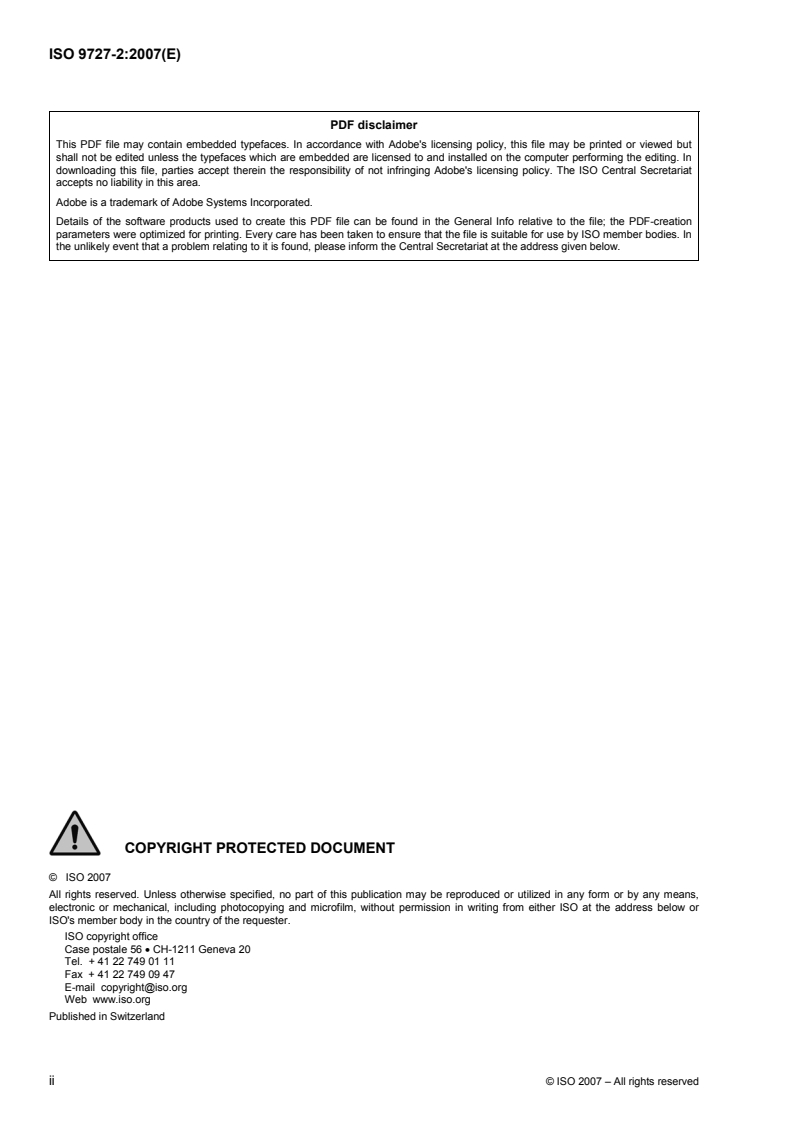
INTERNATIONAL ISO
STANDARD 9727-2
First edition
2007-05-15
Cylindrical cork stoppers — Physical
tests —
Part 2:
Determination of mass and apparent
density for agglomerated cork stoppers
Bouchons cylindriques en liège — Essais physiques —
Partie 2: Détermination de la masse et de la masse volumique
apparente des bouchons de liège agglomérés
Reference number
©
ISO 2007
PDF disclaimer
This PDF file may contain embedded typefaces. In accordance with Adobe's licensing policy, this file may be printed or viewed but
shall not be edited unless the typefaces which are embedded are licensed to and installed on the computer performing the editing. In
downloading this file, parties accept therein the responsibility of not infringing Adobe's licensing policy. The ISO Central Secretariat
accepts no liability in this area.
Adobe is a trademark of Adobe Systems Incorporated.
Details of the software products used to create this PDF file can be found in the General Info relative to the file; the PDF-creation
parameters were optimized for printing. Every care has been taken to ensure that the file is suitable for use by ISO member bodies. In
the unlikely event that a problem relating to it is found, please inform the Central Secretariat at the address given below.
© ISO 2007
All rights reserved. Unless otherwise specified, no part of this publication may be reproduced or utilized in any form or by any means,
electronic or mechanical, including photocopying and microfilm, without permission in writing from either ISO at the address below or
ISO's member body in the country of the requester.
ISO copyright office
Case postale 56 • CH-1211 Geneva 20
Tel. + 41 22 749 01 11
Fax + 41 22 749 09 47
E-mail copyright@iso.org
Web www.iso.org
Published in Switzerland
ii © ISO 2007 – All rights reserved
Foreword
ISO (the International Organization for Standardization) is a worldwide federation of national standards bodies
(ISO member bodies). The work of preparing International Standards is normally carried out through ISO
technical committees. Each member body interested in a subject for which a technical committee has been
established has the right to be represented on that committee. International organizations, governmental and
non-governmental, in liaison with ISO, also take part in the work. ISO collaborates closely with the
International Electrotechnical Commission (IEC) on all matters of electrotechnical standardization.
International Standards are drafted in accordance with the rules given in the ISO/IEC Directives, Part 2.
The main task of technical committees is to prepare International Standards. Draft International Standards
adopted by the technical committees are circulated to the member bodies for voting. Publication as an
International Standard requires approval by at least 75 % of the member bodies casting a vote.
Attention is drawn to the possibility that some of the elements of this document may be the subject of patent
rights. ISO shall not be held responsible for identifying any or all such patent rights.
ISO 9727-2 was prepared by Technical Committee ISO/TC 87, Cork.
This first edition of ISO 9727-2, together with the other parts of ISO 9727:2007, cancels and replaces
ISO 9727:1991, which has been technically revised.
ISO 9727 consists of the following parts, under the general title Cylindrical cork stoppers — Physical tests:
⎯ Part 1: Determination of dimensions
⎯ Part 2: Determination of mass and apparent density for agglomerated cork stoppers
⎯ Part 3: Determination of humidity content
⎯ Part 4: Determination of dimensional recovery after compression
⎯ Part 5: Determination of extraction force
⎯ Part 6: Determination of liquid tightness
⎯ Part 7: Determination of dust content
-------------
...
INTERNATIONAL ISO
STANDARD 9727-2
First edition
2007-05-15
Cylindrical cork stoppers — Physical
tests —
Part 2:
Determination of mass and apparent
density for agglomerated cork stoppers
Bouchons cylindriques en liège — Essais physiques —
Partie 2: Détermination de la masse et de la masse volumique
apparente des bouchons de liège agglomérés
Reference number
©
ISO 2007
PDF disclaimer
This PDF file may contain embedded typefaces. In accordance with Adobe's licensing policy, this file may be printed or viewed but
shall not be edited unless the typefaces which are embedded are licensed to and installed on the computer performing the editing. In
downloading this file, parties accept therein the responsibility of not infringing Adobe's licensing policy. The ISO Central Secretariat
accepts no liability in this area.
Adobe is a trademark of Adobe Systems Incorporated.
Details of the software products used to create this PDF file can be found in the General Info relative to the file; the PDF-creation
parameters were optimized for printing. Every care has been taken to ensure that the file is suitable for use by ISO member bodies. In
the unlikely event that a problem relating to it is found, please inform the Central Secretariat at the address given below.
© ISO 2007
All rights reserved. Unless otherwise specified, no part of this publication may be reproduced or utilized in any form or by any means,
electronic or mechanical, including photocopying and microfilm, without permission in writing from either ISO at the address below or
ISO's member body in the country of the requester.
ISO copyright office
Case postale 56 • CH-1211 Geneva 20
Tel. + 41 22 749 01 11
Fax + 41 22 749 09 47
E-mail copyright@iso.org
Web www.iso.org
Published in Switzerland
ii © ISO 2007 – All rights reserved
Foreword
ISO (the International Organization for Standardization) is a worldwide federation of national standards bodies
(ISO member bodies). The work of preparing International Standards is normally carried out through ISO
technical committees. Each member body interested in a subject for which a technical committee has been
established has the right to be represented on that committee. International organizations, governmental and
non-governmental, in liaison with ISO, also take part in the work. ISO collaborates closely with the
International Electrotechnical Commission (IEC) on all matters of electrotechnical standardization.
International Standards are drafted in accordance with the rules given in the ISO/IEC Directives, Part 2.
The main task of technical committees is to prepare International Standards. Draft International Standards
adopted by the technical committees are circulated to the member bodies for voting. Publication as an
International Standard requires approval by at least 75 % of the member bodies casting a vote.
Attention is drawn to the possibility that some of the elements of this document may be the subject of patent
rights. ISO shall not be held responsible for identifying any or all such patent rights.
ISO 9727-2 was prepared by Technical Committee ISO/TC 87, Cork.
This first edition of ISO 9727-2, together with the other parts of ISO 9727:2007, cancels and replaces
ISO 9727:1991, which has been technically revised.
ISO 9727 consists of the following parts, under the general title Cylindrical cork stoppers — Physical tests:
⎯ Part 1: Determination of dimensions
⎯ Part 2: Determination of mass and apparent density for agglomerated cork stoppers
⎯ Part 3: Determination of humidity content
⎯ Part 4: Determination of dimensional recovery after compression
⎯ Part 5: Determination of extraction force
⎯ Part 6: Determination of liquid tightness
⎯ Part 7: Determination of dust content
-------------
...
NORME ISO
INTERNATIONALE 9727-2
Première édition
2007-05-15
Bouchons cylindriques en liège — Essais
physiques —
Partie 2:
Détermination de la masse et de la masse
volumique apparente des bouchons de
liège agglomérés
Cylindrical cork stoppers — Physical tests —
Part 2: Determination of mass and apparent density for agglomerated
cork stoppers
Numéro de référence
©
ISO 2007
PDF – Exonération de responsabilité
Le présent fichier PDF peut contenir des polices de caractères intégrées. Conformément aux conditions de licence d'Adobe, ce fichier
peut être imprimé ou visualisé, mais ne doit pas être modifié à moins que l'ordinateur employé à cet effet ne bénéficie d'une licence
autorisant l'utilisation de ces polices et que celles-ci y soient installées. Lors du téléchargement de ce fichier, les parties concernées
acceptent de fait la responsabilité de ne pas enfreindre les conditions de licence d'Adobe. Le Secrétariat central de l'ISO décline toute
responsabilité en la matière.
Adobe est une marque déposée d'Adobe Systems Incorporated.
Les détails relatifs aux produits logiciels utilisés pour la création du présent fichier PDF sont disponibles dans la rubrique General Info
du fichier; les paramètres de création PDF ont été optimisés pour l'impression. Toutes les mesures ont été prises pour garantir
l'exploitation de ce fichier par les comités membres de l'ISO. Dans le cas peu probable où surviendrait un problème d'utilisation,
veuillez en informer le Secrétariat central à l'adresse donnée ci-dessous.
DOCUMENT PROTÉGÉ PAR COPYRIGHT
© ISO 2007
Droits de reproduction réservés. Sauf prescription différente, aucune partie de cette publication ne peut être reproduite ni utilisée sous
quelque forme que ce soit et par aucun procédé, électronique ou mécanique, y compris la photocopie et les microfilms, sans l'accord écrit
de l'ISO à l'adresse ci-après ou du comité membre de l'ISO dans le pays du demandeur.
ISO copyright office
Case postale 56 • CH-1211 Geneva 20
Tel. + 41 22 749 01 11
Fax. + 41 22 749 09 47
E-mail copyright@iso.org
Web www.iso.org
Publié en Suisse
ii © ISO 2007 – Tous droits réservés
Avant-propos
L'ISO (Organisation internationale de normalisation) est une fédération mondiale d'organismes nationaux de
normalisation (comités membres de l'ISO). L'élaboration des Normes internationales est en général confiée
aux comités techniques de l'ISO. Chaque comité membre intéressé par une étude a le droit de faire partie du
comité technique créé à cet effet. Les organisations internationales, gouvernementales et non
gouvernementales, en liaison avec l'ISO participent également aux travaux. L'ISO collabore étroitement avec
la Commission électrotechnique internationale (CEI) en ce qui concerne la normalisation électrotechnique.
Les Normes internationales sont rédigées conformément aux règles données dans les Directives ISO/CEI,
Partie 2.
La tâche principale des comités techniques est d'élaborer les Normes internationales. Les projets de Normes
internationales adoptés par les comités techniques sont soumis aux comités membres pour vote. Leur
publication comme Normes internationales requiert l'approbation de 75 % au moins des comités membres
votants.
L'attention est appelée sur le fait que certains des éléments du présent document peuvent faire l'objet de
droits de propriété intellectuelle ou de droits analogues. L'ISO ne saurait être tenue pour responsable de ne
pas avoir identifié de tels droits de propriété et averti de leur existence.
L'ISO 9727-2 a été élaborée par le comité technique ISO/TC 87, Liège.
Cette première édition de l'ISO 9727-2, conjointement aux autres parties de l'ISO 9727:2007, annule et
remplace l'ISO 9727:1991, qui a fait l'objet d'une révision technique.
L'ISO 9727 comprend les parties suivantes, présentées sous le titre général Bouchons cylindriques en
liège — Essais phyiques :
⎯ Partie 1: Détermination des dimensions
⎯ Partie 2: Détermination de la masse et de la masse volumique apparente des bouchons de liège
agglomérés
⎯ Partie 3: Détermination du taux d'humidité
⎯ Partie 4: Détermination du taux de retour dimensionnel après compression
⎯ Partie 5: Détermination de la force d'extraction
⎯ Partie 6: Détermination de l'étanchéité aux liquides
⎯ Partie 7: Détermination de
...
NORME ISO
INTERNATIONALE 9727-2
Première édition
2007-05-15
Bouchons cylindriques en liège — Essais
physiques —
Partie 2:
Détermination de la masse et de la masse
volumique apparente des bouchons de
liège agglomérés
Cylindrical cork stoppers — Physical tests —
Part 2: Determination of mass and apparent density for agglomerated
cork stoppers
Numéro de référence
©
ISO 2007
PDF – Exonération de responsabilité
Le présent fichier PDF peut contenir des polices de caractères intégrées. Conformément aux conditions de licence d'Adobe, ce fichier
peut être imprimé ou visualisé, mais ne doit pas être modifié à moins que l'ordinateur employé à cet effet ne bénéficie d'une licence
autorisant l'utilisation de ces polices et que celles-ci y soient installées. Lors du téléchargement de ce fichier, les parties concernées
acceptent de fait la responsabilité de ne pas enfreindre les conditions de licence d'Adobe. Le Secrétariat central de l'ISO décline toute
responsabilité en la matière.
Adobe est une marque déposée d'Adobe Systems Incorporated.
Les détails relatifs aux produits logiciels utilisés pour la création du présent fichier PDF sont disponibles dans la rubrique General Info
du fichier; les paramètres de création PDF ont été optimisés pour l'impression. Toutes les mesures ont été prises pour garantir
l'exploitation de ce fichier par les comités membres de l'ISO. Dans le cas peu probable où surviendrait un problème d'utilisation,
veuillez en informer le Secrétariat central à l'adresse donnée ci-dessous.
DOCUMENT PROTÉGÉ PAR COPYRIGHT
© ISO 2007
Droits de reproduction réservés. Sauf prescription différente, aucune partie de cette publication ne peut être reproduite ni utilisée sous
quelque forme que ce soit et par aucun procédé, électronique ou mécanique, y compris la photocopie et les microfilms, sans l'accord écrit
de l'ISO à l'adresse ci-après ou du comité membre de l'ISO dans le pays du demandeur.
ISO copyright office
Case postale 56 • CH-1211 Geneva 20
Tel. + 41 22 749 01 11
Fax. + 41 22 749 09 47
E-mail copyright@iso.org
Web www.iso.org
Publié en Suisse
ii © ISO 2007 – Tous droits réservés
Avant-propos
L'ISO (Organisation internationale de normalisation) est une fédération mondiale d'organismes nationaux de
normalisation (comités membres de l'ISO). L'élaboration des Normes internationales est en général confiée
aux comités techniques de l'ISO. Chaque comité membre intéressé par une étude a le droit de faire partie du
comité technique créé à cet effet. Les organisations internationales, gouvernementales et non
gouvernementales, en liaison avec l'ISO participent également aux travaux. L'ISO collabore étroitement avec
la Commission électrotechnique internationale (CEI) en ce qui concerne la normalisation électrotechnique.
Les Normes internationales sont rédigées conformément aux règles données dans les Directives ISO/CEI,
Partie 2.
La tâche principale des comités techniques est d'élaborer les Normes internationales. Les projets de Normes
internationales adoptés par les comités techniques sont soumis aux comités membres pour vote. Leur
publication comme Normes internationales requiert l'approbation de 75 % au moins des comités membres
votants.
L'attention est appelée sur le fait que certains des éléments du présent document peuvent faire l'objet de
droits de propriété intellectuelle ou de droits analogues. L'ISO ne saurait être tenue pour responsable de ne
pas avoir identifié de tels droits de propriété et averti de leur existence.
L'ISO 9727-2 a été élaborée par le comité technique ISO/TC 87, Liège.
Cette première édition de l'ISO 9727-2, conjointement aux autres parties de l'ISO 9727:2007, annule et
remplace l'ISO 9727:1991, qui a fait l'objet d'une révision technique.
L'ISO 9727 comprend les parties suivantes, présentées sous le titre général Bouchons cylindriques en
liège — Essais phyiques :
⎯ Partie 1: Détermination des dimensions
⎯ Partie 2: Détermination de la masse et de la masse volumique apparente des bouchons de liège
agglomérés
⎯ Partie 3: Détermination du taux d'humidité
⎯ Partie 4: Détermination du taux de retour dimensionnel après compression
⎯ Partie 5: Détermination de la force d'extraction
⎯ Partie 6: Détermination de l'étanchéité aux liquides
⎯ Partie 7: Détermination de
...