

ISO/TS 10303-27:2000
(Main)Industrial automation systems and integration — Product data representation and exchange — Part 27: Implementation methods: Java TM programming language binding to the standard data access interface with Internet/Intranet extensions
General Information
- Abstract
This part of ISO 10303 specifies a binding of the Java1) programming language to application data modelled in EXPRESS, ISO 10303-11 and to the standard data access interface, ISO 10303-22. It also specifies an import and export mechanism for data according to the clear text encoding of the exchange structure, ISO 10303-21. A further extension is that SDAI repositories can be created, deleted and linked while the SDAI session is open. Dynamically linking SDAI repositories through a network like Internet or Intranet allows accessing and changing of remote data. In addition to the scope of ISO 10303-22 the scope of this part of ISO 10303 contains: — creating, deletion and linking of the data repositories during an SDAI session; — specific support for linking a remote data repository through a network like Internet or Intranet; — convenience interfaces, classes, fields and methods suitable to this Java programming language binding; — implementation mechanisms for the handling of errors as specified in ISO 10303-22; — import from and export to the clear text encoding of the exchange structure as specified in ISO 10303-21. 1) Java is the trade mark of a product supplied by Sun Microsystems, Inc. This information is given for the convenience of users of this part of ISO 10303 and does not constitute an endorsement by ISO of the product name. Equivalent products may be used if they can be shown to lead to the same result. TECHNICAL SPECIFICATION ISO/TS 10303-27:2000(E)
- Status
- Published
- Publication Date
- 20-Dec-2000
- Technical Committee
- ISO/TC 184/SC 4 - Industrial data
- Drafting Committee
- ISO/TC 184/SC 4/WG 11 - Implementation methods and conformance methods
- Current Stage
- 9093 - International Standard confirmed
- Start Date
- 23-Jun-2025
- Completion Date
- 29-Aug-2026
Buy Documents
ISO/TS 10303-27:2000 - Industrial automation systems and integration — Product data representation and exchange — Part 27: Implementation methods: Java TM programming language binding to the standard data access interface with Internet/Intranet extensions Released:12/21/2000
Overview
ISO/TS 10303-27:2000 defines a Java programming language binding for exchanging and accessing product data modelled in EXPRESS (ISO 10303-11) via the Standard Data Access Interface (SDAI, ISO 10303-22). It specifies how Java applications import/export clear‑text exchange files (ISO 10303-21) and adds Internet/Intranet extensions that allow SDAI repositories to be created, deleted and linked dynamically during an open SDAI session. The technical specification targets Java-based implementations that need standardized access to ISO 10303 product data.
Key topics and technical requirements
- Java SDAI binding: Mapping of EXPRESS data types and SDAI constructs to Java classes, interfaces and methods (e.g., SdaiSession, SdaiRepository, SchemaInstance, SdaiModel, EntityExtent).
- Dynamic repository management: Create, delete and link SDAI repositories while a session is open; support for linking remote repositories over Internet/Intranet.
- Import/export: Mechanisms for import from and export to the clear text encoding of the exchange structure (ISO 10303-21).
- Convenience APIs: Language‑specific interfaces, classes, fields and methods tailored to Java for easier implementation.
- Error handling: Implementation mechanisms for handling SDAI errors consistent with ISO 10303-22.
- Late binding support: Runtime (late) binding of types, select types and aggregates to allow flexible access to entity instances.
- Data model mapping: Mapping of SDAI parameter data schemas (string, binary, integer, real, boolean, logical, aggregates, selects, enumerations, etc.) to Java representations.
- Conformance: Defined conformance requirements for Java implementations to ensure interoperability.
Applications and who uses it
ISO/TS 10303-27 is intended for:
- Software developers and integrators building Java-based CAD/CAM, PLM, PDM or manufacturing data exchange tools that must interoperate with EXPRESS-modeled data.
- Enterprise integrators linking distributed product repositories over Internet/Intranet for collaborative engineering.
- Vendors of data translators and middleware implementing SDAI servers/clients in Java.
- Tooling and research teams prototyping STEP-compatible data services and repository linking.
Practical uses include programmatic read/write of product models, dynamic composition of distributed repositories, server-side import/export of STEP‑formatted files, and building Java applications that manipulate EXPRESS entities and aggregates.
Related standards
- ISO 10303-11 - EXPRESS language (data modelling)
- ISO 10303-22 - Standard Data Access Interface (SDAI)
- ISO 10303-21 - Clear text encoding of the exchange structure (import/export)
Keywords: ISO/TS 10303-27:2000, Java binding, SDAI, EXPRESS, ISO 10303-22, ISO 10303-21, product data exchange, Internet/Intranet extensions, clear text encoding, repository linking.
Relations
- Effective Date
- 25-Aug-2026
- Consolidated By
ISO 17654:2011 - Resistance welding — Destructive tests of welds — Pressure test of resistance seam welds - Effective Date
- 06-Jun-2022
Buy Documents
ISO/TS 10303-27:2000 - Industrial automation systems and integration — Product data representation and exchange — Part 27: Implementation methods: Java TM programming language binding to the standard data access interface with Internet/Intranet extensions Released:12/21/2000
Get Certified
Connect with accredited certification bodies for this standard

DVS-ZERT GmbH
German welding certification society.
CARES (UK Certification Authority for Reinforcing Steels)
UK certification for reinforcing steels and construction.
EWF/IIW (European/International Welding Federation)
International welding personnel certification.
Sponsored listings
Frequently Asked Questions
ISO/TS 10303-27:2000 is a technical specification published by the International Organization for Standardization (ISO). Its full title is "Industrial automation systems and integration — Product data representation and exchange — Part 27: Implementation methods: Java TM programming language binding to the standard data access interface with Internet/Intranet extensions". This standard covers: This part of ISO 10303 specifies a binding of the Java1) programming language to application data modelled in EXPRESS, ISO 10303-11 and to the standard data access interface, ISO 10303-22. It also specifies an import and export mechanism for data according to the clear text encoding of the exchange structure, ISO 10303-21. A further extension is that SDAI repositories can be created, deleted and linked while the SDAI session is open. Dynamically linking SDAI repositories through a network like Internet or Intranet allows accessing and changing of remote data. In addition to the scope of ISO 10303-22 the scope of this part of ISO 10303 contains: — creating, deletion and linking of the data repositories during an SDAI session; — specific support for linking a remote data repository through a network like Internet or Intranet; — convenience interfaces, classes, fields and methods suitable to this Java programming language binding; — implementation mechanisms for the handling of errors as specified in ISO 10303-22; — import from and export to the clear text encoding of the exchange structure as specified in ISO 10303-21. 1) Java is the trade mark of a product supplied by Sun Microsystems, Inc. This information is given for the convenience of users of this part of ISO 10303 and does not constitute an endorsement by ISO of the product name. Equivalent products may be used if they can be shown to lead to the same result. TECHNICAL SPECIFICATION ISO/TS 10303-27:2000(E)
This part of ISO 10303 specifies a binding of the Java1) programming language to application data modelled in EXPRESS, ISO 10303-11 and to the standard data access interface, ISO 10303-22. It also specifies an import and export mechanism for data according to the clear text encoding of the exchange structure, ISO 10303-21. A further extension is that SDAI repositories can be created, deleted and linked while the SDAI session is open. Dynamically linking SDAI repositories through a network like Internet or Intranet allows accessing and changing of remote data. In addition to the scope of ISO 10303-22 the scope of this part of ISO 10303 contains: — creating, deletion and linking of the data repositories during an SDAI session; — specific support for linking a remote data repository through a network like Internet or Intranet; — convenience interfaces, classes, fields and methods suitable to this Java programming language binding; — implementation mechanisms for the handling of errors as specified in ISO 10303-22; — import from and export to the clear text encoding of the exchange structure as specified in ISO 10303-21. 1) Java is the trade mark of a product supplied by Sun Microsystems, Inc. This information is given for the convenience of users of this part of ISO 10303 and does not constitute an endorsement by ISO of the product name. Equivalent products may be used if they can be shown to lead to the same result. TECHNICAL SPECIFICATION ISO/TS 10303-27:2000(E)
ISO/TS 10303-27:2000 is classified under the following ICS (International Classification for Standards) categories: 25.040.40 - Industrial process measurement and control. The ICS classification helps identify the subject area and facilitates finding related standards.
ISO/TS 10303-27:2000 has the following relationships with other standards: It is inter standard links to CR 13935:2000, ISO 17654:2011. Understanding these relationships helps ensure you are using the most current and applicable version of the standard.
ISO/TS 10303-27:2000 is available in PDF format for immediate download after purchase. The document can be added to your cart and obtained through the secure checkout process. Digital delivery ensures instant access to the complete standard document.
Standards Content (Sample)
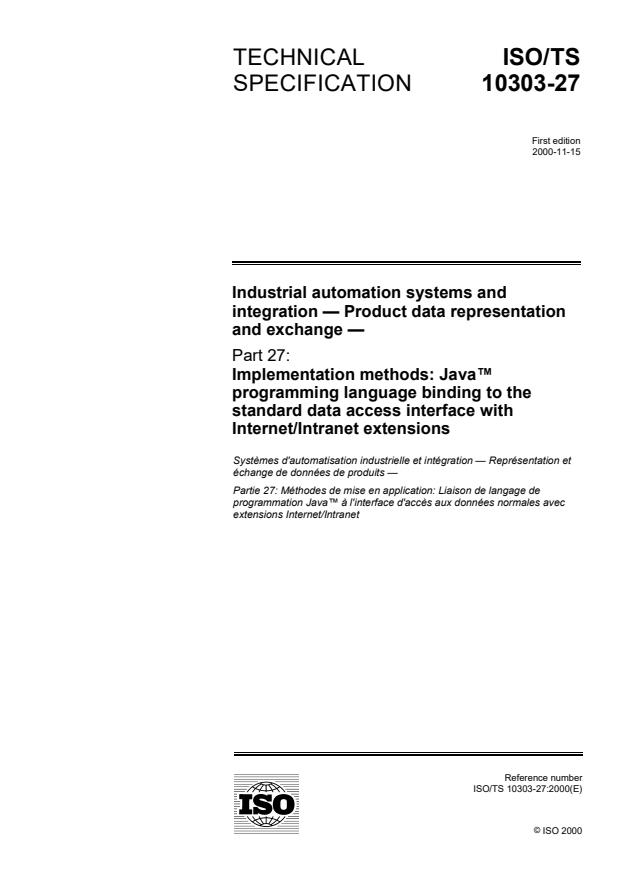
TECHNICAL ISO/TS
SPECIFICATION 10303-27
First edition
2000-11-15
Industrial automation systems and
integration — Product data representation
and exchange —
Part 27:
Implementation methods: Java™
programming language binding to the
standard data access interface with
Internet/Intranet extensions
Systèmes d'automatisation industrielle et intégration — Représentation et
échange de données de produits —
Partie 27: Méthodes de mise en application: Liaison de langage de
programmation Java™ à l'interface d'accès aux données normales avec
extensions Internet/Intranet
Reference number
©
ISO 2000
PDF disclaimer
This PDF file may contain embedded typefaces. In accordance with Adobe's licensing policy, this file may be printed or viewed but shall not
be edited unless the typefaces which are embedded are licensed to and installed on the computer performing the editing. In downloading this
file, parties accept therein the responsibility of not infringing Adobe's licensing policy. The ISO Central Secretariat accepts no liability in this
area.
Adobe is a trademark of Adobe Systems Incorporated.
Details of the software products used to create this PDF file can be found in the General Info relative to the file; the PDF-creation parameters
were optimized for printing. Every care has been taken to ensure that the file is suitable for use by ISO member bodies. In the unlikely event
that a problem relating to it is found, please inform the Central Secretariat at the address given below.
All rights reserved. Unless otherwise specified, no part of this publication may be reproduced or utilized in any form or by any means, electronic
or mechanical, including photocopying and microfilm, without permission in writing from either ISO at the address below or ISO's member body
in the country of the requester.
ISO copyright office
Case postale 56 � CH-1211 Geneva 20
Tel. + 41 22 749 01 11
Fax + 41 22 749 09 47
E-mail copyright@iso.ch
Web www.iso.ch
Printed in Switzerland
ii © ISO 2000 – All rights reserved
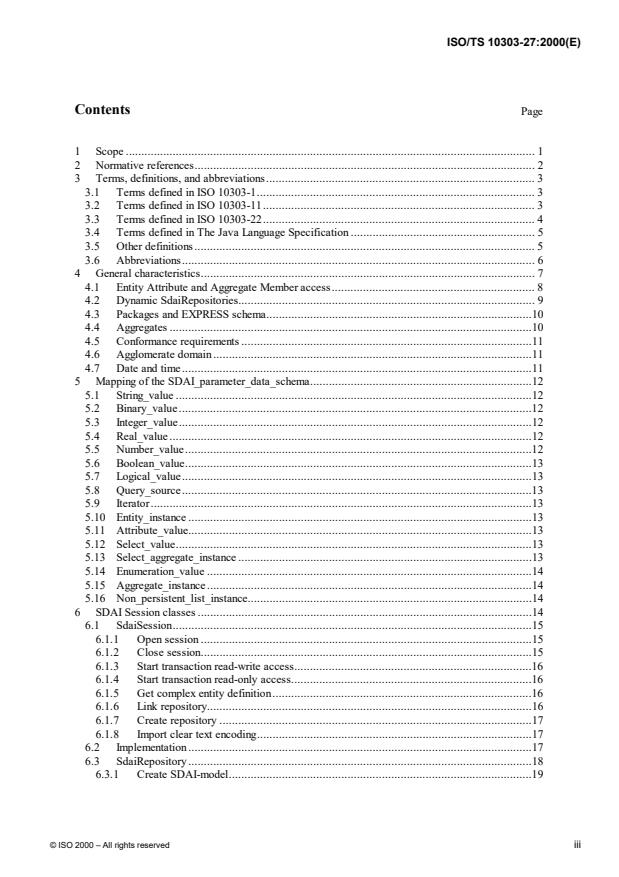
Contents Page
1 Scope . 1
2 Normative references. 2
3 Terms, definitions, and abbreviations. 3
3.1 Terms defined in ISO 10303-1. 3
3.2 Terms defined in ISO 10303-11. 3
3.3 Terms defined in ISO 10303-22. 4
3.4 Terms defined in The Java Language Specification . 5
3.5 Other definitions. 5
3.6 Abbreviations. 6
4 General characteristics. 7
4.1 Entity Attribute and Aggregate Member access. 8
4.2 Dynamic SdaiRepositories. 9
4.3 Packages and EXPRESS schema.10
4.4 Aggregates .10
4.5 Conformance requirements .11
4.6 Agglomerate domain.11
4.7 Date and time .11
5 Mapping of the SDAI_parameter_data_schema.12
5.1 String_value .12
5.2 Binary_value.12
5.3 Integer_value.12
5.4 Real_value .12
5.5 Number_value.12
5.6 Boolean_value.13
5.7 Logical_value.13
5.8 Query_source.13
5.9 Iterator.13
5.10 Entity_instance .13
5.11 Attribute_value.13
5.12 Select_value.13
5.13 Select_aggregate_instance .13
5.14 Enumeration_value .14
5.15 Aggregate_instance .14
5.16 Non_persistent_list_instance.14
6 SDAI Session classes .14
6.1 SdaiSession.15
6.1.1 Open session .15
6.1.2 Close session.15
6.1.3 Start transaction read-write access.16
6.1.4 Start transaction read-only access.16
6.1.5 Get complex entity definition.16
6.1.6 Link repository.16
6.1.7 Create repository .17
6.1.8 Import clear text encoding.17
6.2 Implementation.17
6.3 SdaiRepository.18
6.3.1 Create SDAI-model.19
6.3.2 Create schema instance.19
6.3.3 Open repository .19
6.3.4 Close repository.19
6.3.5 Get session identifier.19
6.3.6 SDAI query .19
6.3.7 Export clear text encoding.20
6.3.8 Delete repository .20
6.3.9 Unlink repository .20
6.4 ASdaiRepository .21
6.5 SdaiTransaction.21
6.5.1 Commit .21
6.5.2 Abort .21
6.5.3 End transaction access and commit.21
6.5.4 End transaction access and abort.21
6.6 SchemaInstance .22
6.6.1 getValidationDateLong.22
6.6.2 Delete schema instance.22
6.6.3 Rename schema instance.22
6.6.4 Add SDAI-model.23
6.6.5 Remove SDAI-model .23
6.6.6 SDAI query .23
6.6.7 Validate global rule.23
6.6.8 Validate uniqueness rule.23
6.6.9 Validate instance reference domain.23
6.6.10 Validate schema instance.23
6.6.11 Is validation current.23
6.7 ASchemaInstance.23
6.7.1 getAssociatedModels .24
6.8 SdaiModel.24
6.8.1 getMode .25
6.8.2 Delete SDAI-model.25
6.8.3 Rename SDAI-model.26
6.8.4 Start read-only access.26
6.8.5 Promote SDAI-model to read-write.26
6.8.6 Reduce SDAI-model to read-only.26
6.8.7 End read-only access.26
6.8.8 Start read-write access.26
6.8.9 End read-write access.26
6.8.10 Get entity definition.27
6.8.11 Create entity instance .27
6.8.12 Copy application instance.27
6.8.13 copyInstances .27
6.8.14 Undo changes.27
6.8.15 Save changes .27
6.8.16 SDAI query .27
6.8.17 Get instances .27
6.8.18 Get exact instances.28
6.8.19 substituteInstance.28
6.8.20 Get defined schema.29
6.9 ASdaiModel.29
iv © ISO 2000 – All rights reserved
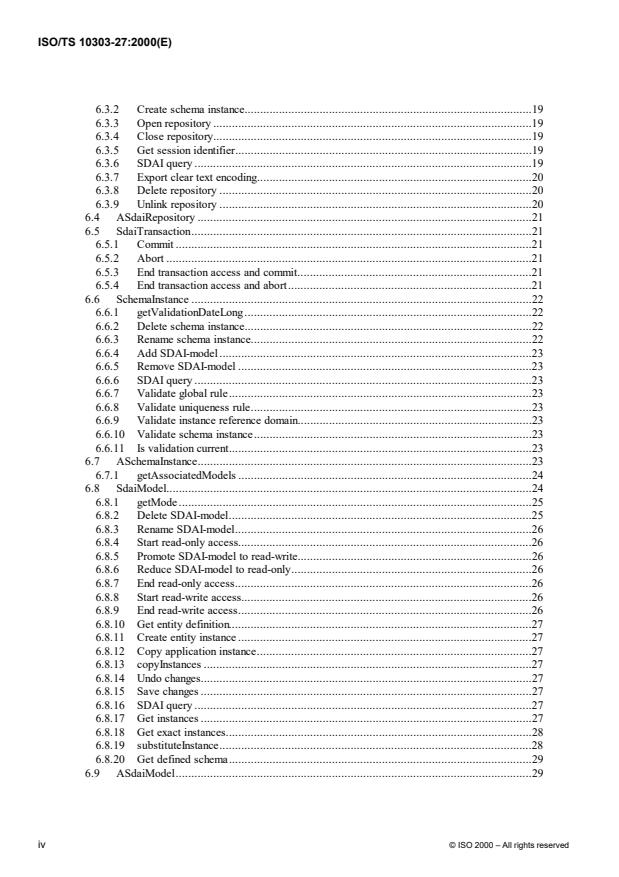
6.10 EntityExtent.29
6.11 AEntityExtent.30
6.12 LOGICAL.30
7 Late binding.30
7.1 Late binding base types .31
7.2 Select data types for late binding .31
7.3 EEntity.32
7.3.1 Get attribute .33
7.3.2 Get inverse attribute.33
7.3.3 Test attribute .33
7.3.4 Find entity instance SDAI-model.34
7.3.5 Get instance type .34
7.3.6 Is instance of.34
7.3.7 Is kind of.34
7.3.8 Find entity instance users.34
7.3.9 Find entity instance usedin.34
7.3.10 Get attribute value bound .34
7.3.11 Find instance roles .35
7.3.12 Find instance data types.35
7.3.13 Delete application instance .35
7.3.14 Put attribute.35
7.3.15 Unset attribute value .35
7.3.16 Create aggregate instance.35
7.3.17 Get persistent label .35
7.3.18 Get description .35
7.3.19 Validate where rule .36
7.3.20 Validate required explicit attributes assigned .36
7.3.21 Validate inverse attributes .36
7.3.22 Validate explicit attributes references .36
7.3.23 Validate aggregates size.36
7.3.24 Validate aggregates uniqueness .36
7.3.25 Validate array not optional.36
7.3.26 Validate string width.36
7.3.27 Validate binary width .36
7.3.28 Validate real precision.37
7.3.29 compareValueBoolean.37
7.3.30 compareValueLogical.37
7.3.31 toString.37
7.4 Aggregate.37
7.4.1 Get aggregation type.39
7.4.2 Get member count.39
7.4.3 Is member.39
7.4.4 Create iterator.39
7.4.5 Attach iterator.40
7.4.6 Get lower bound .40
7.4.7 Get upper bound .40
7.4.8 SDAI query .40
7.4.9 Get by index.40
7.4.10 Get value bound by index.40
7.4.11 Put by index.40
7.4.12 Create aggregate instance by index.40
7.4.13 Test by index for late binding.41
7.4.14 Get lower index.41
7.4.15 Get upper index .41
7.4.16 Unset value by index.41
7.4.17 Reindex array.41
7.4.18 Reset array index .41
7.4.19 Add by index.41
7.4.20 Add aggregate instance by index .41
7.4.21 Remove by index .42
7.4.22 Add unordered.42
7.4.23 Create aggregate instance unordered.42
7.4.24 Remove unordered .42
7.4.25 Test current member.42
7.4.26 Get current member.42
7.4.27 Create aggregate instance as current member.43
7.4.28 Put current member .43
7.4.29 Add before current member .43
7.4.30 Add after current member.43
7.4.31 Create aggregate instance before current member .43
7.4.32 Create aggregate instance after current member.43
7.4.33 Clear.43
7.4.34 toString.44
7.5 SdaiIterator.44
7.5.1 Beginning.44
7.5.2 Next.44
7.5.3 Get value bound by iterator .44
7.5.4 Remove current member.45
7.5.5 End .45
7.5.6 Previous .45
7.5.7 Unset value current member.45
7.6 Aggregates of basic types.45
7.6.1 AEntity.45
7.6.2 A_string .46
7.6.3 Aa_string.46
7.6.4 A_double .46
7.6.5 Aa_double.47
7.6.6 A_integer.47
7.6.7 Aa_integer.47
7.6.8 A_enumeration.48
7.6.9 Aa_ enumeration.48
7.6.10 A_boolean.48
7.6.11 Aa_boolean.49
7.6.12 A_binary .49
7.6.13 Aa_binary.49
8 Early binding.50
8.1 Naming conventions.50
8.2 Schema package .50
8.3 Schema class.50
8.4 Defined type interface.51
vi © ISO 2000 – All rights reserved
8.5 ENUMERATION class.51
8.6 Select data types.52
8.7 Java types for entity attributes and aggregate elements.54
8.8 Access methods for entity attributes.55
8.9 Entity Interface .55
8.9.1 Test attribute .56
8.9.2 Get attribute .56
8.9.3 Unset attribute value .56
8.9.4 Put attribute.56
8.9.5 Create aggregate instance.56
8.10 Entity class.57
8.10.1 Field definition.57
8.10.2 Get attribute definition.57
8.10.3 Find entity instance used in.58
8.11 Aggregate class .58
8.11.1 Is member.58
8.11.2 Test by index.59
8.11.3 Get by index.59
8.11.4 Put by index.59
8.11.5 Create aggregate instance by index.59
8.11.6 Add by index.60
8.11.7 Add aggregate instance by index .60
8.11.8 Test current member.60
8.11.9 Get current member.60
8.11.10 Put current member .61
8.11.11 Create aggregate instance as current member.61
8.11.12 Add before current member .61
8.11.13 Create aggregate instance before current member .61
8.11.14 Add after current member.61
8.11.15 Create aggregate instance after current member.62
8.11.16 Add unordered.62
8.11.17 Create aggregate instance unordered.62
8.11.18 Remove unordered .62
9 Error handling.62
9.1 SdaiException.63
10 SDAI dictionary .67
10.1 Entity_definition.68
10.1.1 Is subtype of.68
10.1.2 Is domain equivalent with .68
Annex A (normative) Information object registration.69
Annex B (normative) Mapping between Part-21 and SDAI.70
Annex C (informative) Events .71
Annex D (informative) Examples.73
D.1 Mass measure schema.73
D.1.1 SMass_measure_schema.java .74
D.1.2 EMeasured_mass.java.74
D.1.3 EComputed_mass.java .74
D.1.4 EEstimated_mass.java.74
D.1.5 EWeight.java .74
D.1.6 EFloatingnumber.java.74
D.1.7 ENotanumber.java.75
D.1.8 ESteel_bar.java.75
D.1.9 CSteel_bar.java .76
D.2 Mass measure schema - early binding access.76
D.3 Mass measure schema - late binding access.79
D.4 XList schema.82
D.4.1 SXlist_schema.java .83
D.4.2 EXx.java .83
D.4.3 CXx.java .83
D.4.4 AXx.java.84
D.4.5 AaXa.java .84
D.4.6 EXlist1.java.84
D.4.7 EXlist2.java.84
D.4.8 EXxlist.java.85
D.4.9 AXselect.java .85
D.4.10 EYy.java .86
D.4.11 CYy.java.87
D.4.12 AYy.java.87
D.5 XList schema - late binding access.88
Annex E (informative) Select path generator .90
Index .97
viii © ISO 2000 – All rights reserved
Foreword
ISO (the International Organization for Standardization) is a worldwide federation of national standards
bodies (ISO member bodies). The work of preparing International Standards is normally carried out
through ISO technical committees. Each member body interested in a subject for which a technical
committee has been established has the right to be represented on that committee. International
organizations, governmental and non-governmental, in liaison with ISO, also take part in the work. ISO
collaborates closely with the International Electrotechnical Commission (IEC) on all matters of
electrotechnical standardization.
International Standards are drafted in accordance with the rules given in the ISO/IEC Directives, Part 3.
The main task of technical committees is to prepare International Standards. Draft International
Standards adopted by the technical committees are circulated to the member bodies for voting.
Publication as an International Standard requires approval by at least 75 % of the member bodies
casting a vote.
In other circumstances, particularly when there is an urgent market requirement for such documents, a
technical committee may decide to publish other types of normative document:
— an ISO Publicly Available Specification (ISO/PAS) represents an agreement between technical
experts in an ISO working group and is accepted for publication if it is approved by more than
50 % of the members of the parent committee casting a vote;
— an ISO Technical Specification (ISO/TS) represents an agreement between the members of a
technical committee and is accepted for publication if it is approved by 2/3 of the members of the
committee casting a vote.
An ISO/PAS or ISO/TS is reviewed every three years with a view to deciding whether it can be
transformed into an International Standard.
Attention is drawn to the possibility that some of the elements of this part of ISO 10303 may be the
subject of patent rights. ISO shall not be held responsible for identifying any or all such patent rights.
ISO/TS 10303-27 was prepared by Technical Committee ISO/TC 184, Industrial automation systems
and integration, Subcommittee SC 4, Industrial data.
ISO 10303 consists of the following parts under the general title Industrial automation systems and
integration — Product data representation and exchange:
— Part 1, Overview and fundamental principles;
— Part 11, Description methods: The EXPRESS language reference manual;
— Part 12, Description methods: The EXPRESS-I language reference manual;
— Part 14, Description methods: The EXPRESS-X language reference manual;
— Part 21, Implementation methods: Clear text encoding of the exchange structure;
— Part 22, Implementation method: Standard data access interface specification;
— Part 23, Implementation method: C++ language binding to the standard data access interface;
— Part 24, Implementation method: C language binding to the standard data access interface;
— Part 26, Implementation method: Interface definition language binding to the standard data access
interface;
TM
— Part 27, Implementation method: Java programming language binding to the standard data access
interface with Internet/Intranet extensions;
— Part 28, Implementation method: XML representation for EXPRESS-driven data;
— Part 29, Implementation method: Lightweight Java programming language binding to the standard
data access interface with Internet/Intranet extensions;
— Part 31, Conformance testing methodology and framework: General concepts;
— Part 32, Conformance testing methodology and framework: Requirements on testing laboratories
and clients;
— Part 34, Conformance testing methodology and framework: Abstract test methods;
— Part 35, Conformance testing methodology and framework: Abstract test methods for standard data
access interface implementations;
— Part 41, Integrated generic resources: Fundamentals of product description and support;
— Part 42, Integrated generic resources: Geometric and topological representation;
— Part 43, Integrated generic resources: Representation structures;
— Part 44, Integrated generic resources: Product structure configuration;
— Part 45, Integrated generic resource: Materials;
— Part 46, Integrated generic resources: Visual presentation;
— Part 47, Integrated generic resource: Shape variation tolerances;
— Part 49, Integrated generic resource: Process structure and properties;
— Part 50, Integrated generic resource: Mathematical construct;
— Part 101, Integrated application resource: Draughting;
— Part 104, Integrated application resource: Finite element analysis;
x © ISO 2000 – All rights reserved
— Part 105, Integrated application resource: Kinematics;
— Part 106, Integrated application resource: Building construction core model;
— Part 107, Integrated application resource: Engineering analysis core application reference model
(EA C-ARM);
— Part 108, Integrated application resource: Parameterization and constraints for explicit geometric
product models;
— Part 201, Application protocol: Explicit draughting;
— Part 202, Application protocol: Associative draughting;
— Part 203, Application protocol: Configuration controlled 3D designs of mechanical parts and
assemblies;
— Part 204, Application protocol: Mechanical design using boundary representation;
— Part 205, Application protocol: Mechanical design using surface representation;
— Part 207, Application protocol: Sheet metal die planning and design;
— Part 208, Application protocol: Life cycle management - Change process;
— Part 209, Application protocol: Composite and metallic structural analysis and related design;
— Part 210, Application protocol: Electronic assembly, interconnect, and packaging design;
— Part 212, Application protocol: Electrotechnical design and installation;
— Part 213, Application protocol: Numerical control process plans for machined parts;
— Part 214, Application protocol: Core data for automotive mechanical design processes;
— Part 215, Application protocol: Ship arrangement;
— Part 216, Application protocol: Ship moulded forms;
— Part 217, Application protocol: Ship piping;
— Part 218, Application protocol: Ship structures;
— Part 221, Application protocol: Functional data and their schematic representation for process
plant;
— Part 223, Application protocol: Exchange of design and manufacturing product information for
casting parts;
— Part 224, Application protocol: Mechanical product definition for process plans using machining
features;
— Part 225, Application protocol: Building elements using explicit shape representation;
— Part 226, Application protocol: Ship mechanical systems;
— Part 227, Application protocol: Plant spatial configuration;
— Part 230, Application protocol: Building structural frame: Steelwork;
— Part 231, Application protocol: Process engineering data: Process design and process specification
of major equipment;
— Part 232, Application protocol: Technical data packaging core information and exchange;
— Part 233, Application Protocol: Systems engineering data representation;
— Part 234, Application protocol: Ship Operational logs, records, and messages;
— Part 235, Application Protocol: Materials information for the design and verification of products;
— Part 236, Application Protocol: Furniture product data and project data;
— Part 301, Abstract test suite: Explicit draughting;
— Part 302, Abstract test suite: Associative draughting;
— Part 303, Abstract test suite: Configuration controlled design;
— Part 304, Abstract test suite: Mechanical design using boundary representation;
— Part 305, Abstract test suite: Mechanical design using surface representation;
— Part 307, Abstract test suite: Sheet metal die planning and design;
— Part 308, Abstract test suite: Life cycle management --- Change process
...