

ISO/IEC 19286:2018
(Main)Identification cards — Integrated circuit cards — Privacy-enhancing protocols and services
General Information
- Abstract
ISO/IEC 19286:2018 aims to normalize privacy-enhancing protocols and services by - using the mechanisms from parts of ISO/IEC 7816 and parts of ISO/IEC 18328 that contribute to security and privacy, - providing discoverability means of privacy-enabling attributes, - defining requirements for attribute-based credential handling, and - identifying data objects and commands for ICCs. Existing privacy-enhancing protocols available in a generic context are adopted for distributed systems including ICCs. Additionally, existing authentication protocols between an ICC and an external device used for establishing a secure channel are enhanced with privacy protection. Secure communication between an ICC and an on-card device is also considered. All the protocols and services described in this document contribute to privacy. Annex B describes an example of privacy impact assessments of respective systems.
- Status
- Published
- Publication Date
- 07-Jan-2018
- Technical Committee
- ISO/IEC JTC 1/SC 17 - Cards and security devices for personal identification
- Current Stage
- 9093 - International Standard confirmed
- Start Date
- 03-Oct-2023
- Completion Date
- 29-Aug-2026
Buy Documents

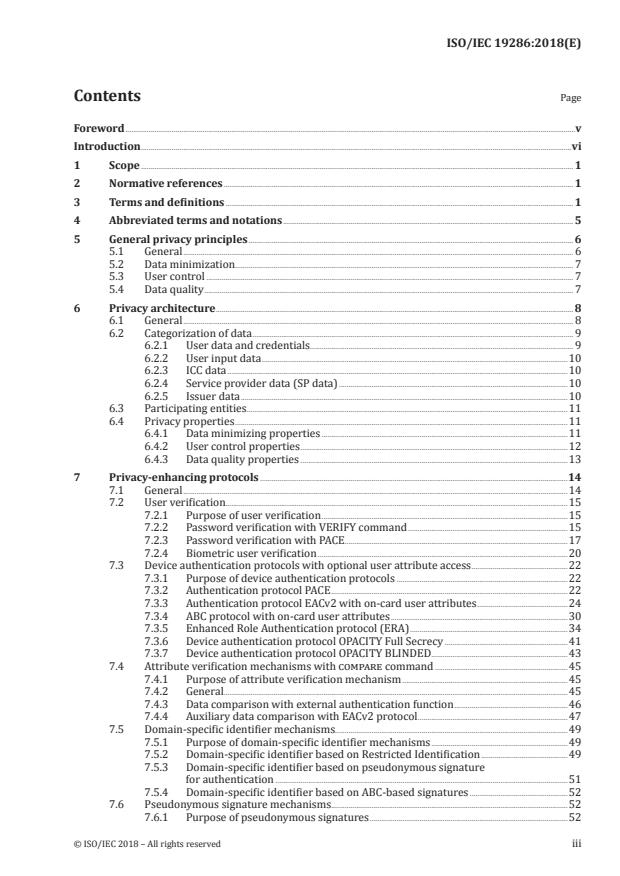
ISO/IEC 19286:2018 - Identification cards -- Integrated circuit cards -- Privacy-enhancing protocols and services

ISO/IEC 19286:2018 - Identification cards — Integrated circuit cards — Privacy-enhancing protocols and services/8/2018
Overview
ISO/IEC 19286:2018 - Identification cards - Integrated circuit cards - Privacy-enhancing protocols and services defines a privacy-focused framework for smart cards and other integrated circuit cards (ICCs). The standard normalizes privacy-enhancing protocols and services at the card edge by re-using relevant mechanisms from ISO/IEC 7816 and ISO/IEC 18328, specifying discoverability of privacy attributes, defining requirements for attribute-based credential handling, and identifying the data objects and commands used by ICCs. It also adapts generic privacy protocols for distributed ICC systems and strengthens authentication protocols (e.g., secure channel establishment) with privacy protections. Annex B provides guidance for privacy impact assessments (PIA).
Key technical topics and requirements
- Privacy architecture & principles: data minimization, user control, data quality and categorization of user, ICC, issuer and service-provider data.
- Discoverability: means for external devices to detect privacy-enabling attributes on an ICC.
- Attribute-based credential handling: requirements for managing and presenting credentials and attribute statements while preserving privacy.
- Privacy-enhancing protocols: standardized descriptions of user verification, device authentication and attribute verification mechanisms tailored for ICCs. Examples covered include PACE, EACv2, ABC-based protocols, ERA and OPACITY (as adapted for ICC use).
- Pseudonymous mechanisms: support for domain-specific identifiers, pseudonymous signatures and credential-based signatures that reduce linkability.
- Data objects & commands: identification of ICC data structures and command sequences needed to implement privacy services and to interoperate with existing ISO/IEC 7816 commands.
- On-card device and secure channel considerations: secure communication between ICC and on-card or external devices, including enhancements to protect privacy during authentication.
- Privacy impact assessment: practical guidance (Annex B) for assessing privacy risks in electronic identification and trust services.
Practical applications
- Electronic passports, national eID and citizen cards
- Employee access badges, health insurance cards, and other identity tokens
- eVoting systems and privacy-sensitive IoT deployments that rely on ICC-based identity
- Payment and loyalty cards requiring pseudonymity or attribute-limited disclosure
Who should use this standard
- Smart card and ICC manufacturers and firmware developers
- Identity providers, issuers and service providers implementing eID/eAuth solutions
- System integrators, security architects and solution designers for identity systems
- Privacy officers, regulators and conformity assessment bodies performing PIAs and evaluations
Related standards (normative references)
- ISO/IEC 7816 series (card organization, security, commands, biometric verification)
- ISO/IEC 18328-3 (ICC-managed devices - organization/security/commands)
Keywords: ISO/IEC 19286, privacy-enhancing protocols, integrated circuit cards, ICC, smart card privacy, attribute-based credentials, PACE, EACv2, OPACITY, pseudonymous signatures, privacy architecture, data minimization.
Buy Documents
ISO/IEC 19286:2018 - Identification cards -- Integrated circuit cards -- Privacy-enhancing protocols and services
ISO/IEC 19286:2018 - Identification cards — Integrated circuit cards — Privacy-enhancing protocols and services/8/2018
Get Certified
Connect with accredited certification bodies for this standard

BSI Group
BSI (British Standards Institution) is the business standards company that helps organizations make excellence a habit.

NYCE
Mexican standards and certification body.
Sponsored listings
Frequently Asked Questions
ISO/IEC 19286:2018 is a standard published by the International Organization for Standardization (ISO). Its full title is "Identification cards — Integrated circuit cards — Privacy-enhancing protocols and services". This standard covers: ISO/IEC 19286:2018 aims to normalize privacy-enhancing protocols and services by - using the mechanisms from parts of ISO/IEC 7816 and parts of ISO/IEC 18328 that contribute to security and privacy, - providing discoverability means of privacy-enabling attributes, - defining requirements for attribute-based credential handling, and - identifying data objects and commands for ICCs. Existing privacy-enhancing protocols available in a generic context are adopted for distributed systems including ICCs. Additionally, existing authentication protocols between an ICC and an external device used for establishing a secure channel are enhanced with privacy protection. Secure communication between an ICC and an on-card device is also considered. All the protocols and services described in this document contribute to privacy. Annex B describes an example of privacy impact assessments of respective systems.
ISO/IEC 19286:2018 aims to normalize privacy-enhancing protocols and services by - using the mechanisms from parts of ISO/IEC 7816 and parts of ISO/IEC 18328 that contribute to security and privacy, - providing discoverability means of privacy-enabling attributes, - defining requirements for attribute-based credential handling, and - identifying data objects and commands for ICCs. Existing privacy-enhancing protocols available in a generic context are adopted for distributed systems including ICCs. Additionally, existing authentication protocols between an ICC and an external device used for establishing a secure channel are enhanced with privacy protection. Secure communication between an ICC and an on-card device is also considered. All the protocols and services described in this document contribute to privacy. Annex B describes an example of privacy impact assessments of respective systems.
ISO/IEC 19286:2018 is classified under the following ICS (International Classification for Standards) categories: 35.240.15 - Identification cards. Chip cards. Biometrics. The ICS classification helps identify the subject area and facilitates finding related standards.
ISO/IEC 19286:2018 is available in PDF format for immediate download after purchase. The document can be added to your cart and obtained through the secure checkout process. Digital delivery ensures instant access to the complete standard document.
Standards Content (Sample)
INTERNATIONAL ISO/IEC
STANDARD 19286
First edition
2018-01
Identification cards — Integrated
circuit cards — Privacy-enhancing
protocols and services
Cartes d'identification — Cartes à circuit intégré — Protocoles et
services renforçant la protection des données personnelles
Reference number
©
ISO/IEC 2018
© ISO/IEC 2018, Published in Switzerland
All rights reserved. Unless otherwise specified, no part of this publication may be reproduced or utilized otherwise in any form
or by any means, electronic or mechanical, including photocopying, or posting on the internet or an intranet, without prior
written permission. Permission can be requested from either ISO at the address below or ISO’s member body in the country of
the requester.
ISO copyright office
Ch. de Blandonnet 8 • CP 401
CH-1214 Vernier, Geneva, Switzerland
Tel. +41 22 749 01 11
Fax +41 22 749 09 47
copyright@iso.org
www.iso.org
ii © ISO/IEC 2018 – All rights reserved
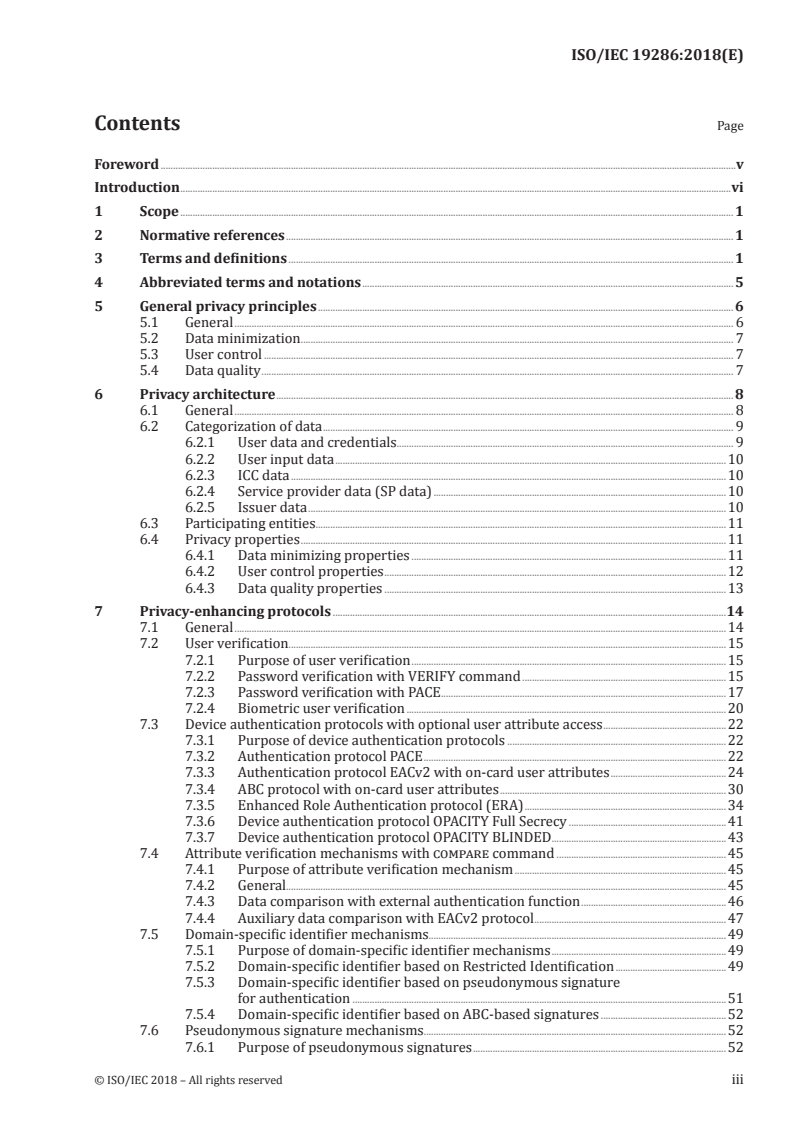
Contents Page
Foreword .v
Introduction .vi
1 Scope .1
2 Normative references .1
3 Terms and definitions .1
4 Abbreviated terms and notations .5
5 General privacy principles .6
5.1 General . 6
5.2 Data minimization . 7
5.3 User control . 7
5.4 Data quality . 7
6 Privacy architecture .8
6.1 General . 8
6.2 Categorization of data . 9
6.2.1 User data and credentials . . 9
6.2.2 User input data .10
6.2.3 ICC data .10
6.2.4 Service provider data (SP data) .10
6.2.5 Issuer data .10
6.3 Participating entities .11
6.4 Privacy properties .11
6.4.1 Data minimizing properties .11
6.4.2 User control properties .12
6.4.3 Data quality properties .13
7 Privacy-enhancing protocols .14
7.1 General .14
7.2 User verification.15
7.2.1 Purpose of user verification .15
7.2.2 Password verification with VERIFY command .15
7.2.3 Password verification with PACE .17
7.2.4 Biometric user verification .20
7.3 Device authentication protocols with optional user attribute access .22
7.3.1 Purpose of device authentication protocols .22
7.3.2 Authentication protocol PACE .22
7.3.3 Authentication protocol EACv2 with on-card user attributes .24
7.3.4 ABC protocol with on-card user attributes .30
7.3.5 Enhanced Role Authentication protocol (ERA) .34
7.3.6 Device authentication protocol OPACITY Full Secrecy .41
7.3.7 Device authentication protocol OPACITY BLINDED .43
7.4 Attribute verification mechanisms with compare command .45
7.4.1 Purpose of attribute verification mechanism .45
7.4.2 General.45
7.4.3 Data comparison with external authentication function .46
7.4.4 Auxiliary data comparison with EACv2 protocol .47
7.5 Domain-specific identifier mechanisms.49
7.5.1 Purpose of domain-specific identifier mechanisms .49
7.5.2 Domain-specific identifier based on Restricted Identification .49
7.5.3 Domain-specific identifier based on pseudonymous signature
for authentication .51
7.5.4 Domain-specific identifier based on ABC-based signatures .52
7.6 Pseudonymous signature mechanisms .52
7.6.1 Purpose of pseudonymous signatures .52
© ISO/IEC 2018 – All rights reserved iii
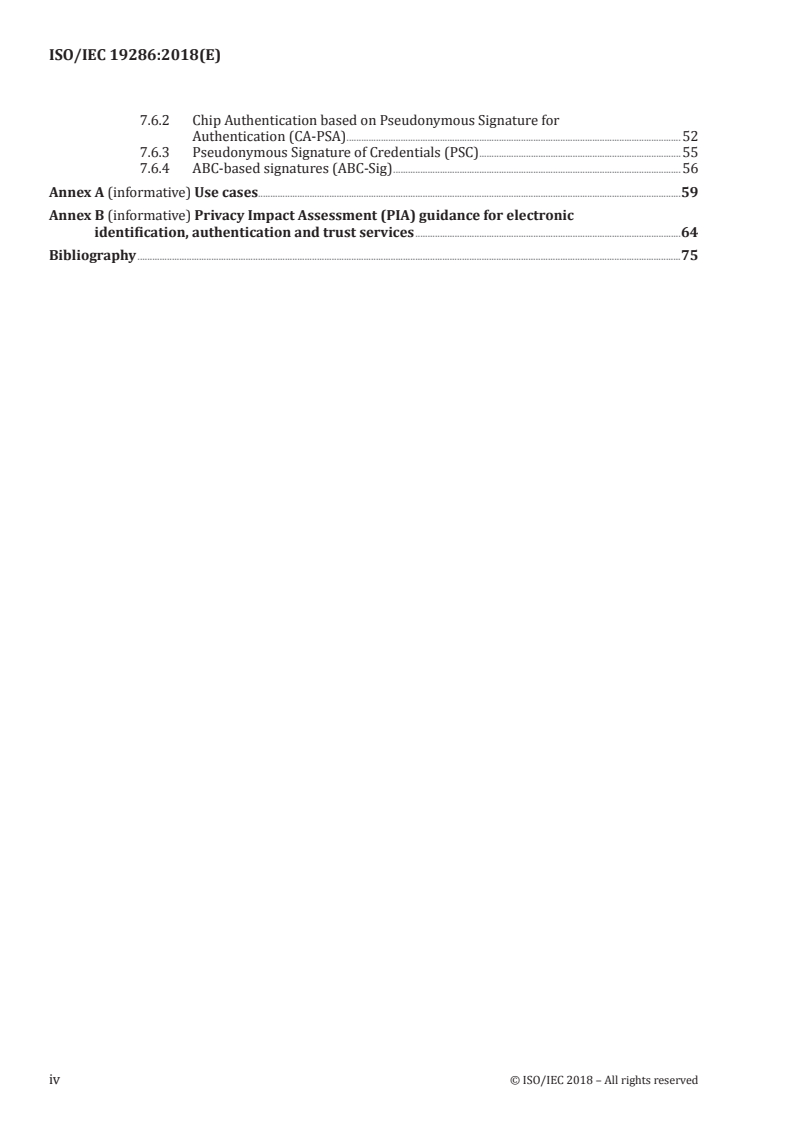
7.6.2 Chip Authentication based on Pseudonymous Signature for
Authentication (CA-PSA) .52
7.6.3 Pseudonymous Signature of Credentials (PSC) .55
7.6.4 ABC-based signatures (ABC-Sig) .56
Annex A (informative) Use cases.59
Annex B (informative) Privacy Impact Assessment (PIA) guidance for electronic
identification, authentication and trust services .64
Bibliography .75
iv © ISO/IEC 2018 – All rights reserved
Foreword
ISO (the International Organization for Standardization) and IEC (the International Electrotechnical
Commission) form the specialized system for worldwide standardization. National bodies that are
members of ISO or IEC participate in the development of International Standards through technical
committees established by the respective organization to deal with particular fields of technical
activity. ISO and IEC technical committees collaborate in fields of mutual interest. Other international
organizations, governmental and non-governmental, in liaison with ISO and IEC, also take part in the
work. In the field of information technology, ISO and IEC have established a joint technical committee,
ISO/IEC JTC 1.
The procedures used to develop this document and those intended for its further maintenance are
described in the ISO/IEC Directives, Part 1. In particular the different approval criteria needed for
the different types of document should be noted. This document was drafted in accordance with the
editorial rules of the ISO/IEC Directives, Part 2 (see www.iso.org/directives).
Attention is drawn to the possibility that some of the elements of this document may be the subject
of patent rights. ISO and IEC shall not be held responsible for identifying any or all such patent
rights. Details of any patent rights identified during the development of the document will be in the
Introduction and/or on the ISO list of patent declarations received (see www.iso.org/patents).
Any trade name used in this document is information given for the convenience of users and does not
constitute an endorsement.
For an explanation on the voluntary nature of standards, the meaning of ISO specific terms and
expressions related to conformity assessment, as well as information about ISO's adherence to the
World Trade Organization (WTO) principles in the Technical Barriers to Trade (TBT) see the following
URL: www.iso.org/iso/foreword.html.
This document was prepared by ISO/IEC JTC 1, Information technology, SC 17, Cards and security devices
for personal identification.
© ISO/IEC 2018 – All rights reserved v
Introduction
National and pan-national (e.g. European) privacy regulations require the protection of personal data
as well as implicitly linked parameters revealing the identity of the cardholder [see relevant documents
in different countries (e.g. EU GDPR, US PIA, Canada PIA or Australian PIA)(see 5.1)].
Privacy-enhancing implementations allow a cardholder to be confident that their sensitive personally
identifiable information (PII) is not exposed to an unauthorized environment. Thereby a cardholder
may be exposed to an environment that might read sensitive PII from the Integrated Circuit Card (ICC)
ahead of any external authentication. Such sensitive PII can be unique parameters of a card (e.g. the
Card ID) or personalized parameters of the cardholder and could be linked to the cardholder.
For instance, if the nationality of a cardholder can be identified by the nature of the ICC description
parameters (e.g. algorithm ID, if unique for particular country) then a cardholder of a certain nationality
could be exposed to observation. An employee identification card, a health insurance card, a passport
are typical examples which may require privacy protection.
ICC services ensuring privacy could, for instance, find further applications in the context of user privacy
issues in eVoting systems with ICCs and in systems using the environment of Internet of Things as well
as access services by means of an ICC.
This document reflects these requirements by harmonized operations and/or services in regard to a
corresponding level of privacy. It envisions
— to strengthen common technical measures about privacy-enabling interchange at card edge and to
facilitate its adoption,
— to harmonize privacy properties or privacy framework definitions when existing, and
— to address generic technical features related to privacy implementation at card edge (interchange)
regardless of the cryptographic mechanisms by considering transactional aspects as asynchronous
protocols involving several entities in privacy context.
vi © ISO/IEC 2018 – All rights reserved
INTERNATIONAL STANDARD ISO/IEC 19286:2018(E)
Identification cards — Integrated circuit cards — Privacy-
enhancing protocols and services
1 Scope
This document aims to normalize privacy-enhancing protocols and services by
— using the mechanisms from parts of ISO/IEC 7816 and parts of ISO/IEC 18328 that contribute to
security and privacy,
— providing discoverability means of privacy-enabling attributes,
— defining requirements for attribute-based credential handling, and
— identifying data objects and commands for ICCs.
Existing privacy-enhancing protocols available in a generic context are adopted for distributed systems
including ICCs. Additionally, existing authentication protocols between an ICC and an external device
used for establishing a secure channel are enhanced with privacy protection. Secure communication
between an ICC and an on-card device is also considered.
All the protocols and services described in this document contribute to privacy. Annex B describes an
example of privacy impact assessments of respective systems.
2 Normative references
The following documents are referred to in the text in such a way that some or all of their content
constitutes requirements of this document. For dated references, only the edition cited applies. For
undated references, the latest edition of the referenced document (including any amendments) applies.
ISO/IEC 7816-4:2013, Identification cards — Integrated circuit cards — Part 4: Organization, security and
commands for interchange
ISO/IEC 7816-8, Identification cards — Integrated circuit cards — Part 8: Commands and mechanisms for
security operations
ISO/IEC 7816-9, Identification cards — Integrated circuit cards with contacts — Part 9: Interindustry
commands for card and file management
ISO/IEC 7816-11, Identification cards — Integrated circuit cards with contacts — Part 11: Personal
verification through biometric methods
ISO/IEC 18328-3, Identification cards — ICC-managed devices — Part 3: Organization, security and
commands for interchange
3 Terms and definitions
For the purposes of this document, the following terms and definitions apply.
ISO and IEC maintain terminological databases for use in standardization at the following addresses:
— IEC Electropedia: available at http://www.electropedia.org/
— ISO Online browsing platform: available at http://www.iso.org/obp
© ISO/IEC 2018 – All rights reserved 1
3.1
access phrase
alpha-numeric string to be captured by interface device to gain access to ICC
EXAMPLE MRZ printed on electronic passports and optically captured by inspection system.
3.2
anonymity
characteristic of information that does not permit a personally identifiable information principal (3.22)
to be identified directly or indirectly
[SOURCE: ISO/IEC 29100:2011, 2.1]
3.3
attribute
user attribute
quality or characteristic ascribed to someone or something
[SOURCE: NIST SP 800-63-3]
EXAMPLE User name, address, date of birth or assertion about date of birth are user attributes.
Note 1 to entry: Examples of user attributes that can be used to identify natural persons are given in
Reference [14].
3.4
attribute integrity
capability of an attribute (3.3) to resist to unintended or unauthorized modification
3.5
attribute provider
entity (3.13) that makes user attributes (3.3) available
Note 1 to entry: An attribute provider may be an identity provider (3.18) or an entity mandated by an identity
provider.
3.6
attribute statement
statement or assertion about user attributes comprising predicates over attributes (3.3)
EXAMPLE The business case age verification usually does not require information about the user attribute
“date of birth” but only the verification if the age is above a specific threshold, i.e. the attribute statement over
the “date of birth” saying “is over 21”.
3.7
authentication
provision of assurance in the identity (3.17) of an entity (3.13)
[SOURCE: ISO/IEC 29115:2013, 3.2]
3.8
authentication protocol
defined sequence of messages between an entity (3.13) and a verifier that enables the verifier to perform
authentication (3.7) of an entity
[SOURCE: ISO/IEC 29115:2013, 3.4]
3.9
credential
set of data presented as evidence of a claimed or asserted identity (3.17) and/or entitlements
[SOURCE: ISO/IEC 29115:2013, 3.8]
2 © ISO/IEC 2018 – All rights reserved
3.10
domain-specific identifier
attribute (3.3) or attribute statement (3.6) over an identifier (3.16) of an entity, which carries semantics
only in specific domains or contexts
Note 1 to entry: In the literature, such domain-specific identifiers may be also referred to as pseudonyms, domain
pseudonyms, context-specific identifiers or sector-identifiers and in pseudonymization (see ISO/IEC 29100 for
definition of pseudonymization).
Note 2 to entry: In contrast to anonymity (3.2), the user (3.32) creates and uses an ambiguous parameter, the
pseudonym (e.g. a phantasy name), which is not sufficient for user identification (3.15) but is useful to partially
recognize and address the user for dedicated communication purpose (e.g. chat room, forum).
3.11
eID-Application
on-card application that manages user attributes (3.3) for electronic identification (3.15) purposes and
controls access to the user attributes
3.12
eID-Server
application running on a local or remote server that enables access to user attributes (3.3) managed by
an eID-Application (3.11)
3.13
entity
something that has separate and distinct existence and that can be identified in a context
[SOURCE: ISO/IEC 29115:2013, 3.10]
3.14
generic attributes
user attributes (3.3) that are not linked to the terminal domain-specific identifier (3.29) of the requesting
terminal stored in a file and identified by a file identifier
3.15
identification
process of distinguishing an entity (3.13) within a given context by the unique association of a set of
descriptive parameters
EXAMPLE User attributes are descriptive parameters.
3.16
identifier
data which identifies an entity (3.13) in a given context towards another entity
3.17
identity
set of attributes (3.3) related to an entity (3.13)
[SOURCE: ISO/IEC 29115:2013, 3.13]
3.18
identity provider
trusted actor that issues and/or manages credentials (3.9)
Note 1 to entry: In literature, such identity provider is often referred to as identity information provider (see
ISO/IEC 24760-1) or credential service provider (see ISO/IEC 29115).
© ISO/IEC 2018 – All rights reserved 3
3.19
issuer
entity that is an identity provider (3.18) or attribute provider
Note 1 to entry: An issuer may also issue the token (3.30).
3.20
mutual authentication
authentication of identities (3.17) of entities (3.13) which provides both entities with assurance of each
other’s identity
3.21
password
alpha-numeric string kept secret by the user and used for user verification
3.22
personally identifiable information
PII
any information that (a) can be used to identify the PII principal (3.23) to whom such information
relates, or (b) is or might be directly or indirectly linked to a PII principal
[SOURCE: ISO/IEC 29100:2011, 2.9]
3.23
PII principal
natural person to whom the personally identifiable information (PII) (3.22) relates
[SOURCE: ISO/IEC 29100:2011, 2.11]
3.24
privacy impact assessment
PIA
overall process of identifying, analysing, evaluating, consulting, communicating and planning
the treatment of potential privacy impacts with regard to the processing of personally identifiable
information (3.22), framed within an organization’s broader risk management framework
Note 1 to entry: This process is also known as a privacy risk assessment.
[SOURCE: ISO/IEC 29134:2017, 3.7]
3.25
secure channel
communication link between the ICC and the external world that provides confidentiality and/or
integrity
3.26
sensitive PII
category of personally identifiable information (PII) (3.22), either whose nature is sensitive, such as those
that relate to the PII principal’s (3.23) most intimate sphere, or that might have a significant impact on
the PII principal
[SOURCE: ISO/IEC 29100:2011, 2.26]
3.27
service provider
entity (3.13) providing one or more services
3.28
specific attributes
user attributes (3.3) that are stored in data containers each linked to a terminal domain-specific
identifier (3.29)
4 © ISO/IEC 2018 – All rights reserved
3.29
terminal domain-specific identifier
identifier of a terminal which carries semantics only in specific domains or contexts
Note 1 to entry: In contrast to domain-specific identifiers generated by the ICC to provide a pseudonym of the
user, a terminal domain-specific identifier links a certain terminal identity to a certain domain (sector).
3.30
token
physical device or digital information, holding credentials (3.9), user attributes (3.3), attribute statements
(3.6) and/or other information to be used in authentication procedures
3.31
unlinkability
property that user’s (3.32) transactions are not linked with other transactions of the same user
3.32
user
natural person who receives and subsequently holds the token (3.30) and uses it to assert user attribute
(3.3) information to relying entities
4 Abbreviated terms and notations
ABC Attribute-Based Credentials
ADF Application Dedicated File
APDU Application Protocol Data Unit
AtP Attribute Provider
CA-ABC Chip Authentication based on ABC-based signatures
CA-PSA Chip Authentication based on Pseudonymous Signature Authentication
CAR Certificate Authority Reference
CAv2 Chip Authentication version 2 as part of EACv2
CHA Certificate Holder Authorization
CIA Cryptographic Information Application
CHAT Certificate Holder Authorization Template
CHR Certificate Holder Reference
C-RP Command Response Pair, i.e. pair of command and response APDU
DF Dedicated File
EACv2 Extended Access Control version 2
NOTE Extended access control version 1 is defined for EU passports.
EF.ATR Elementary File for Answer-To-Reset
eID electronic Identification
eMRTD electronic Machine Readable Travel Document
© ISO/IEC 2018 – All rights reserved 5
ERA Enhance Role Authentication
GUI Graphical User Interface
ICC Integrated Circuit Card
IFD Interface Device
MRZ Machine Readable Zone
OID Object Identifier
PACE Password Authenticated Connection Establishment
PIA Privacy Impact Assessment
PII Personally Identifiable Information
PSC Pseudonymous Signature for Credentials
SM Secure Messaging
SP Service Provider
SW1-SW2 Status Word one and Status Word two
5 General privacy principles
5.1 General
A number of basic principles have evolved [e.g. in ISO/IEC 29100 or Fair Information Practice Principles
[24]
(FIPPs) ] of which this document considers the following general principles as being the most
relevant from the ICC technical perspective:
— data minimization;
— user control over user attribute release;
— quality of user attributes.
Those principles have been expressed, among others, in data protection recommendations or legislation
for the protection of personal data as well as implicitly linked parameters revealing the identity of
1)
the token holder (e.g. the OECD principles for transborder flows of personal data of 2013, the Data
2) 3)
,
Protection Convention and Directive of the Council of Europe (also known as Convention 108) or the
4) 5) 6)
[17]
PIA Frameworks of ISO , the US , Canada and Australia .
1) The Recommendation of the OECD Council concerning Guidelines governing the Protection of Privacy and
Transborder Flows of Personal Data (July 2013).
2) Council of Europe, Convention for the protection of individuals with regard to automatic processing of personal
data, 1981.
3) Regulation 2016/679 of the European parliament and of the council of 27 April 2016 on the protection of
natural persons with regard to the processing of personal data and on the free movement of such data.
4) US Department Of Commerce PIA requirement based on Homeland Security Presidential Directive 12 (HSPD-
12), Policy for a Common Identification Standard for Federal Employees and Contractors (August 27th, 2004).
5) Directive on Privacy Impact Assessment, The Treasury Board of Canada Secretariat’s (TBS), April 1 2010.
6) Office of the Australian Information Commissioner, "Guide to undertaking privacy impact assessments", http://
www.oaic.gov.au/privacy/privacy-resources/privacy-guides/guide-to-undertaking-privacy-impact-assessments
6 © ISO/IEC 2018 – All rights reserved
This document focuses on security safeguards in the context of ICCs to protect PII against risks such as
unauthorized access, use or modification or unintended or inappropriate disclosure.
NOTE ISO/IEC 29100 and FIPPS each list at all 11 and 8 privacy principles, respectively. The application
of all these principles in a certain business case requires additional technical, organizational and procedural
measures (e.g. at issuer, service provider and identity provider side) that are not addressed by this document.
5.2 Data minimization
Data minimization refers to the property of reducing the amount of PII being transmitted in a given
transaction to exactly what is required from the point of view of the underlying business process the
data is required for. The data minimization principle can be derived from the purpose specification and
the proportionality principles.
The excessive release of user attributes as well as the establishment of non-required linkabilities
between transactions is a main problem countering the data minimization principle. For instance,
conventional signature schemes, such as RSA, DSA or elliptic curve use certificates, which may allow
traceability of transactions if not deployed appropriately.
Realizing data minimization in practice does not only require the use of appropriate technology, but
it also requires design of business processes to be data minimizing. Current business processes are
defined with only the traditional technologies in mind and thus, have substantial shortcomings in
terms of data minimization. Thus, implementing the data minimization principle requires the whole
identity system to evolve. This document describes the technology that enables system designers to
develop data minimizing solutions.
5.3 User control
User control of the release of user attributes refers to a user’s authority over which user attribute
is released to which entities. This control over disclosure of attribute information is at the core of
European data protection legislation and also of various large R&D projects in the security and privacy
7) 8)
domain in Europe . User control is also a key principle in the US-based NSTIC program . Different
strengths of user control related to the release of data can be achieved depending on the trust in the
reader devices and online versus offline interaction.
The way a solution is realized from a technical perspective determines the degree of user control. A first
class of use cases is characterized by the ICC being handed over and used in the device of the attribute
recipient, while a second class is characterized by the user using their own device (e.g. computer or
phone). As the user should be able to select the user attributes to be released in the transaction, a user’s
own device may be considered more trusted.
Cryptographic technologies defined in this document can be used to enforce user control for the initial
release of user attributes to a service provider. Though, in today’s complex value chains of online
services, data need to be provided by service providers to third party service providers. Interactions
between the service providers and third-party providers are out of scope of this document.
5.4 Data quality
Data quality relates to user attributes being accurate and kept up to date and inaccurate or incomplete
attributes are rectified or deleted. The correctness aspect of attributes has relevance in the reduction
of cost, increasing efficiencies, and avoiding problems for both processing parties and citizens. Hence,
data quality is the combination of organizational and technical measures. The approach adopted is to
consider technical mechanisms for updating and improving the quality of data retained. Organizational
elements are out of scope of this document.
7) ABC4Trust Consortium, ABC4Trust Web site, available at: https://abc4trust.eu/ PRIME Consortium, PRIME
project web site, 2008, www.prime-project.eu PrimeLife Consortium, Primelife project web site, 2010, www.
primelife.eu
8) NSTIC: National Strategy for Trusted Identities in Cyberspace, available at http://www.nist.gov/nstic/.
© ISO/IEC 2018 – All rights reserved 7
Any technology that can convey attributes in integrity-protected form can help improve data correctness
and thus data quality. Thus, the widespread use of such technology can reduce data management costs
of both public and private sector service providers.
6 Privacy architecture
6.1 General
This clause provides an introductory material for the ICC privacy-enhancing protocols and services.
Command and data flow between the ICC and "the external world" is defined for each protocol in the
following clauses along with its privacy assessment. The "external world" could be one or more of these
entities:
a) an IFD;
b) a GUI controlled by either:
1) the ICC;
2) the IFD;
3) the eID-Server;
c) Service providers;
d) eID-Servers;
e) Attribute providers.
The description of multi-party protocols involving an ICC includes information about what participating
entity has rights to access particular ICC data and how the user can control this access. Clause 6 lists the
participating entities, categorizes the various data and links data with the respective entities. Moreover,
several generic privacy requirements are listed in this clause in order to determine to what extent a
particular protocol or sequence of protocols contributes to privacy. Figure 1 gives an overview of the
document structure focusing on the protocols, mechanisms, data types and participating entities used.
8 © ISO/IEC 2018 – All rights reserved
Figure 1 — Overview on the structure of this document without introductory and general clauses
6.2 Categorization of data
6.2.1 User data and credentials
User data (e.g. user attributes or attribute statements or credentials) are PII and refer to any item of
personal information identifying the user and delivered under control of an issuing authority. Such data
may be stored within an ICC and protected by access rules depending on the issuer’s policy. These data
may be requested either by an authority eligible to identify the user or by a system granting access to
some electronic service (e.g. service provider, identity provider or certification authority).
User attributes
— may be in all or parts of information disclosed to a system upon user consent and upon access
condition defined by issuer's policy,
— may be stored in any structure defined in ISO/IEC 7816-4 or in any proprietary structure depending
on the application,
— may be replicated on-card of an ICC and stored in a database from where they may be updated onto
the ICC,
— may encompass as well the biometric reference data of the user,
— may be permanent or updated over time,
© ISO/IEC 2018 – All rights reserved 9
— may be valid for a single access,
— may be valid for a specific time period (e.g. the time period is indicated by the authority that has
issued the identity attribute), and
— may be valid until revoked.
Attribute statements can be divided into three main sub-types.
9)
— Domain-specific identifiers (pseudonyms) : This sub-type is unique to a domain. A domain-specific
identifier may be generated by the user or resulting from a computing process that can take place
either within an ICC under user control or on server side.
— Dynamic attribute statements: This may be a certified statement signed by an authority, a statement
delivered by a trusted third party under secure conditions or a statement computed by the ICC.
These are generated upon request for a service and may be bound to a given service provider.
— Static attribute statements: This represents statements pre-computed by an authority, i.e. not
generated in the running course of a transaction. They are not associated to a given service provider
and so, they have a generic aspect.
6.2.2 User input data
User input data represent any data deliberately revealed by the user when prompted by a system (e.g.
through a human computer interface). This category includes PIN, password or biometric data (e.g.
fingerprint data captured on an external or an on-card biometric capture device).
The presentation of user input data (e.g. a password) together with authorization to disclose a list of
attributes serves to obtain user consent.
NOTE The very nature of these data can jeopardize the entire privacy measures if not handled with caution
by the user (e.g. choosing weak passwords), but they lie outside the boundaries of controlled digital security and
can only be mitigated by guidelines and recommendations and by improving users’ awareness.
6.2.3 ICC data
This is a category of data stored and retrieved from the ICC and is subject to traceability (e.g. ICC serial
number or cryptographic unique identifier). This data is associated with the ICC and may result from
its personalization and be set before ICC issuance. This data relates to the identification of a physical
support and may be specific to the manufacturer or to the issuer and hence, may allow for indirect user
identification. This data may be protected by security attributes specified in ISO/IEC 7816-4 to prevent
their disclosure to unauthorized entities.
6.2.4 Service provider data (SP data)
Service provider data is information about the service provider [e.g. the Unique Resource Locator
(URL), company name or financial figures]. Parts of this information may be presented to the user by
the service provider. The communication protocol used to request a service by the user from the service
provider (e.g. the user's computer system or web browser) is out of scope of this document.
6.2.5 Issuer data
Issuer data is any information that identifies the issuer (e.g. electronic signatures, cv-certificates
[19]
according to ISO/IEC 7816-8 or X.509 certificates according to ITU-T or organization name). This
data is typically associated with the ICC and may result from its personalization and be set before
9) In the literature, such domain-specific identifiers may be also referred to as pseudonyms, domain pseudonyms,
context-specific identifiers or sector-identifiers. Moreover, there are also other types of pseudonyms in literature,
e.g. transaction pseudonyms.
10 © ISO/IEC 2018 – All rights reserved
ICC issuance. Issuer data may allow for indirect user identification and may be protected by security
attributes specified in ISO/IEC 7816-4 to prevent their disclosure to unauthorized entities.
6.3 Participating entities
The following participating entities are considered in this document.
a) ICC including eID-Application: An ICC may support one or more eID-Applications that manage user
attributes and control the access to the user attributes. The user attributes may be written to the
ICC, including eID-Application, during personalization or after issuing the ICC to the user. Typically,
the eID-Application releases user attributes to a service provider after user authentication.
b) IFD: The IFD generally includes all locally operated components communicating with the ICC. The
IFD may:
1) communicate with the ICC (e.g. according to ISO/IEC 7816-3 or ISO/IEC 14443);
2) provide means for password entry, biometric user authentication or for displaying information
to the user (e.g. a GUI);
3) be embedded in a hardware device or run as software on a local device (e.g. computer or mobile
device) also often referred to as middleware;
4) manage the communication to one or more remote eID-Servers.
c) Graphical User Interface (GUI): A GUI may display information to the user and may request
interaction with the user. A GUI may be controlled by the IFD, by the ICC itself according to ISO/IEC
18328 or by a remote eID-Server.
d) User (see 3.32).
e) eID-Server (see 3.12).
f) Service provider (see 3.27).
g) Attribute provider (see 3.5).
h) Issuer (see 3.19).
i) Certification authority: A certification authority is the entity that certifies a digital identity,
typically by issuing digital certificates binding a public key to an identity. An issuer may run a
certification authority.
6.4 Privacy properties
6.4.1 Data minimizing properties
6.4.1.1 Partial attribute release
Partial release of user attributes and attribute statements contributes to realizing data minimization.
This requires the use of technology, which does not inherently lead to the release of all or large parts of
the PII in each transaction.
NOTE Data minimization is closely linked to the principle of “collection limitation” but goes further than
that. Whereas “collection limitation” refers to limited data being collected in relation to the specified purpose,
“data minimization” strictly minimizes the processing of PII (see ISO/IEC 29100:2011, 5.5).
6.4.1.2 Unlinkability
Unlinkability of transactions at the cryptographic or protocol level may contribute to data minimization.
Any identifiers should be made available consciously to establish linkabilities with other transactions
© ISO/IEC 2018 – All rights reserved 11
as required. Establishing linkability of a transaction with other transactions by default through an
improperly designed cryptographic protocol layer counters the ideas of data minimization.
NOTE Today’s schemes based on conventional signature schemes lead to linkability. This poses an increasing
problem through the use of an eID in a large number of a user's interactions on the Internet.
6.4.1.3 Domain-specific identifier (Pseudonym)
Domain-specific identifiers, or pseudonyms, are another concept towards data minimization. They are
a form of identifiers which avoid the use of the same unique identifier for a user in all its interactions.
Particularly, when an ICC is used for both governmental applications and private sector applications,
some countries mandate different identifiers to be used for public and private sectors. This is to prevent
the exposure of substantial personal information from one entity’s data to other entities.
6.4.1.4 Pseudonymous signatures
Computing a digital signature based on a domain-specific identifier (pseudonym) and associated
attribute statements is a feature relevant for privacy-enhanced interactions where non-repudiation is
required. Those signatures can either be an inherent part of the authentication protocol or exposed as a
feature for legally-acknowledged digital signatures.
6.4.2 User control properties
6.4.2.1 User-centric system
In a user-centric system, the users have control over the use of their attributes, whether the user
attributes are stored within the ICC or managed by an identity provider.
6.4.2.2 Offline/online operation
An online or an offline setting determines whether there is a remote entity (e.g. a service provider) to
the transaction or whether the transaction is carried out autonomously without referral to a remote
entity. In the offline setting, the user is present at the point where the transaction is executed. In this
setting, the ICC may be physically inspected in addition to the use of the digital user attributes. The
offline setting typically does not consider the service provider to communicate over a network.
In the online setting, the user performs the transaction remotely over a communication network.
Stronger data minimizing and accountability properties are desired in online transactions.
6.4.2.3 Sharing protection
Sharing refers to the voluntary act of the user of giving another person access to the ICC. Thereby,
privileges associated with the ICC may be shared with parties who may then be able to illegitimately
claim those privileges without holding them. To avoid this, sharing protection can be seen as a basic
security requirement. It is crucial that sharing be protected against in order to avoid people claiming
privileges they do not hold.
6.4.2.4 U
...
INTERNATIONAL ISO/IEC
STANDARD 19286
First edition
2018-01
Identification cards — Integrated
circuit cards — Privacy-enhancing
protocols and services
Cartes d'identification — Cartes à circuit intégré — Protocoles et
services renforçant la protection des données personnelles
Reference number
©
ISO/IEC 2018
© ISO/IEC 2018, Published in Switzerland
All rights reserved. Unless otherwise specified, no part of this publication may be reproduced or utilized otherwise in any form
or by any means, electronic or mechanical, including photocopying, or posting on the internet or an intranet, without prior
written permission. Permission can be requested from either ISO at the address below or ISO’s member body in the country of
the requester.
ISO copyright office
Ch. de Blandonnet 8 • CP 401
CH-1214 Vernier, Geneva, Switzerland
Tel. +41 22 749 01 11
Fax +41 22 749 09 47
copyright@iso.org
www.iso.org
ii © ISO/IEC 2018 – All rights reserved
Contents Page
Foreword .v
Introduction .vi
1 Scope .1
2 Normative references .1
3 Terms and definitions .1
4 Abbreviated terms and notations .5
5 General privacy principles .6
5.1 General . 6
5.2 Data minimization . 7
5.3 User control . 7
5.4 Data quality . 7
6 Privacy architecture .8
6.1 General . 8
6.2 Categorization of data . 9
6.2.1 User data and credentials . . 9
6.2.2 User input data .10
6.2.3 ICC data .10
6.2.4 Service provider data (SP data) .10
6.2.5 Issuer data .10
6.3 Participating entities .11
6.4 Privacy properties .11
6.4.1 Data minimizing properties .11
6.4.2 User control properties .12
6.4.3 Data quality properties .13
7 Privacy-enhancing protocols .14
7.1 General .14
7.2 User verification.15
7.2.1 Purpose of user verification .15
7.2.2 Password verification with VERIFY command .15
7.2.3 Password verification with PACE .17
7.2.4 Biometric user verification .20
7.3 Device authentication protocols with optional user attribute access .22
7.3.1 Purpose of device authentication protocols .22
7.3.2 Authentication protocol PACE .22
7.3.3 Authentication protocol EACv2 with on-card user attributes .24
7.3.4 ABC protocol with on-card user attributes .30
7.3.5 Enhanced Role Authentication protocol (ERA) .34
7.3.6 Device authentication protocol OPACITY Full Secrecy .41
7.3.7 Device authentication protocol OPACITY BLINDED .43
7.4 Attribute verification mechanisms with compare command .45
7.4.1 Purpose of attribute verification mechanism .45
7.4.2 General.45
7.4.3 Data comparison with external authentication function .46
7.4.4 Auxiliary data comparison with EACv2 protocol .47
7.5 Domain-specific identifier mechanisms.49
7.5.1 Purpose of domain-specific identifier mechanisms .49
7.5.2 Domain-specific identifier based on Restricted Identification .49
7.5.3 Domain-specific identifier based on pseudonymous signature
for authentication .51
7.5.4 Domain-specific identifier based on ABC-based signatures .52
7.6 Pseudonymous signature mechanisms .52
7.6.1 Purpose of pseudonymous signatures .52
© ISO/IEC 2018 – All rights reserved iii
7.6.2 Chip Authentication based on Pseudonymous Signature for
Authentication (CA-PSA) .52
7.6.3 Pseudonymous Signature of Credentials (PSC) .55
7.6.4 ABC-based signatures (ABC-Sig) .56
Annex A (informative) Use cases.59
Annex B (informative) Privacy Impact Assessment (PIA) guidance for electronic
identification, authentication and trust services .64
Bibliography .75
iv © ISO/IEC 2018 – All rights reserved
Foreword
ISO (the International Organization for Standardization) and IEC (the International Electrotechnical
Commission) form the specialized system for worldwide standardization. National bodies that are
members of ISO or IEC participate in the development of International Standards through technical
committees established by the respective organization to deal with particular fields of technical
activity. ISO and IEC technical committees collaborate in fields of mutual interest. Other international
organizations, governmental and non-governmental, in liaison with ISO and IEC, also take part in the
work. In the field of information technology, ISO and IEC have established a joint technical committee,
ISO/IEC JTC 1.
The procedures used to develop this document and those intended for its further maintenance are
described in the ISO/IEC Directives, Part 1. In particular the different approval criteria needed for
the different types of document should be noted. This document was drafted in accordance with the
editorial rules of the ISO/IEC Directives, Part 2 (see www.iso.org/directives).
Attention is drawn to the possibility that some of the elements of this document may be the subject
of patent rights. ISO and IEC shall not be held responsible for identifying any or all such patent
rights. Details of any patent rights identified during the development of the document will be in the
Introduction and/or on the ISO list of patent declarations received (see www.iso.org/patents).
Any trade name used in this document is information given for the convenience of users and does not
constitute an endorsement.
For an explanation on the voluntary nature of standards, the meaning of ISO specific terms and
expressions related to conformity assessment, as well as information about ISO's adherence to the
World Trade Organization (WTO) principles in the Technical Barriers to Trade (TBT) see the following
URL: www.iso.org/iso/foreword.html.
This document was prepared by ISO/IEC JTC 1, Information technology, SC 17, Cards and security devices
for personal identification.
© ISO/IEC 2018 – All rights reserved v
Introduction
National and pan-national (e.g. European) privacy regulations require the protection of personal data
as well as implicitly linked parameters revealing the identity of the cardholder [see relevant documents
in different countries (e.g. EU GDPR, US PIA, Canada PIA or Australian PIA)(see 5.1)].
Privacy-enhancing implementations allow a cardholder to be confident that their sensitive personally
identifiable information (PII) is not exposed to an unauthorized environment. Thereby a cardholder
may be exposed to an environment that might read sensitive PII from the Integrated Circuit Card (ICC)
ahead of any external authentication. Such sensitive PII can be unique parameters of a card (e.g. the
Card ID) or personalized parameters of the cardholder and could be linked to the cardholder.
For instance, if the nationality of a cardholder can be identified by the nature of the ICC description
parameters (e.g. algorithm ID, if unique for particular country) then a cardholder of a certain nationality
could be exposed to observation. An employee identification card, a health insurance card, a passport
are typical examples which may require privacy protection.
ICC services ensuring privacy could, for instance, find further applications in the context of user privacy
issues in eVoting systems with ICCs and in systems using the environment of Internet of Things as well
as access services by means of an ICC.
This document reflects these requirements by harmonized operations and/or services in regard to a
corresponding level of privacy. It envisions
— to strengthen common technical measures about privacy-enabling interchange at card edge and to
facilitate its adoption,
— to harmonize privacy properties or privacy framework definitions when existing, and
— to address generic technical features related to privacy implementation at card edge (interchange)
regardless of the cryptographic mechanisms by considering transactional aspects as asynchronous
protocols involving several entities in privacy context.
vi © ISO/IEC 2018 – All rights reserved
INTERNATIONAL STANDARD ISO/IEC 19286:2018(E)
Identification cards — Integrated circuit cards — Privacy-
enhancing protocols and services
1 Scope
This document aims to normalize privacy-enhancing protocols and services by
— using the mechanisms from parts of ISO/IEC 7816 and parts of ISO/IEC 18328 that contribute to
security and privacy,
— providing discoverability means of privacy-enabling attributes,
— defining requirements for attribute-based credential handling, and
— identifying data objects and commands for ICCs.
Existing privacy-enhancing protocols available in a generic context are adopted for distributed systems
including ICCs. Additionally, existing authentication protocols between an ICC and an external device
used for establishing a secure channel are enhanced with privacy protection. Secure communication
between an ICC and an on-card device is also considered.
All the protocols and services described in this document contribute to privacy. Annex B describes an
example of privacy impact assessments of respective systems.
2 Normative references
The following documents are referred to in the text in such a way that some or all of their content
constitutes requirements of this document. For dated references, only the edition cited applies. For
undated references, the latest edition of the referenced document (including any amendments) applies.
ISO/IEC 7816-4:2013, Identification cards — Integrated circuit cards — Part 4: Organization, security and
commands for interchange
ISO/IEC 7816-8, Identification cards — Integrated circuit cards — Part 8: Commands and mechanisms for
security operations
ISO/IEC 7816-9, Identification cards — Integrated circuit cards with contacts — Part 9: Interindustry
commands for card and file management
ISO/IEC 7816-11, Identification cards — Integrated circuit cards with contacts — Part 11: Personal
verification through biometric methods
ISO/IEC 18328-3, Identification cards — ICC-managed devices — Part 3: Organization, security and
commands for interchange
3 Terms and definitions
For the purposes of this document, the following terms and definitions apply.
ISO and IEC maintain terminological databases for use in standardization at the following addresses:
— IEC Electropedia: available at http://www.electropedia.org/
— ISO Online browsing platform: available at http://www.iso.org/obp
© ISO/IEC 2018 – All rights reserved 1
3.1
access phrase
alpha-numeric string to be captured by interface device to gain access to ICC
EXAMPLE MRZ printed on electronic passports and optically captured by inspection system.
3.2
anonymity
characteristic of information that does not permit a personally identifiable information principal (3.22)
to be identified directly or indirectly
[SOURCE: ISO/IEC 29100:2011, 2.1]
3.3
attribute
user attribute
quality or characteristic ascribed to someone or something
[SOURCE: NIST SP 800-63-3]
EXAMPLE User name, address, date of birth or assertion about date of birth are user attributes.
Note 1 to entry: Examples of user attributes that can be used to identify natural persons are given in
Reference [14].
3.4
attribute integrity
capability of an attribute (3.3) to resist to unintended or unauthorized modification
3.5
attribute provider
entity (3.13) that makes user attributes (3.3) available
Note 1 to entry: An attribute provider may be an identity provider (3.18) or an entity mandated by an identity
provider.
3.6
attribute statement
statement or assertion about user attributes comprising predicates over attributes (3.3)
EXAMPLE The business case age verification usually does not require information about the user attribute
“date of birth” but only the verification if the age is above a specific threshold, i.e. the attribute statement over
the “date of birth” saying “is over 21”.
3.7
authentication
provision of assurance in the identity (3.17) of an entity (3.13)
[SOURCE: ISO/IEC 29115:2013, 3.2]
3.8
authentication protocol
defined sequence of messages between an entity (3.13) and a verifier that enables the verifier to perform
authentication (3.7) of an entity
[SOURCE: ISO/IEC 29115:2013, 3.4]
3.9
credential
set of data presented as evidence of a claimed or asserted identity (3.17) and/or entitlements
[SOURCE: ISO/IEC 29115:2013, 3.8]
2 © ISO/IEC 2018 – All rights reserved
3.10
domain-specific identifier
attribute (3.3) or attribute statement (3.6) over an identifier (3.16) of an entity, which carries semantics
only in specific domains or contexts
Note 1 to entry: In the literature, such domain-specific identifiers may be also referred to as pseudonyms, domain
pseudonyms, context-specific identifiers or sector-identifiers and in pseudonymization (see ISO/IEC 29100 for
definition of pseudonymization).
Note 2 to entry: In contrast to anonymity (3.2), the user (3.32) creates and uses an ambiguous parameter, the
pseudonym (e.g. a phantasy name), which is not sufficient for user identification (3.15) but is useful to partially
recognize and address the user for dedicated communication purpose (e.g. chat room, forum).
3.11
eID-Application
on-card application that manages user attributes (3.3) for electronic identification (3.15) purposes and
controls access to the user attributes
3.12
eID-Server
application running on a local or remote server that enables access to user attributes (3.3) managed by
an eID-Application (3.11)
3.13
entity
something that has separate and distinct existence and that can be identified in a context
[SOURCE: ISO/IEC 29115:2013, 3.10]
3.14
generic attributes
user attributes (3.3) that are not linked to the terminal domain-specific identifier (3.29) of the requesting
terminal stored in a file and identified by a file identifier
3.15
identification
process of distinguishing an entity (3.13) within a given context by the unique association of a set of
descriptive parameters
EXAMPLE User attributes are descriptive parameters.
3.16
identifier
data which identifies an entity (3.13) in a given context towards another entity
3.17
identity
set of attributes (3.3) related to an entity (3.13)
[SOURCE: ISO/IEC 29115:2013, 3.13]
3.18
identity provider
trusted actor that issues and/or manages credentials (3.9)
Note 1 to entry: In literature, such identity provider is often referred to as identity information provider (see
ISO/IEC 24760-1) or credential service provider (see ISO/IEC 29115).
© ISO/IEC 2018 – All rights reserved 3
3.19
issuer
entity that is an identity provider (3.18) or attribute provider
Note 1 to entry: An issuer may also issue the token (3.30).
3.20
mutual authentication
authentication of identities (3.17) of entities (3.13) which provides both entities with assurance of each
other’s identity
3.21
password
alpha-numeric string kept secret by the user and used for user verification
3.22
personally identifiable information
PII
any information that (a) can be used to identify the PII principal (3.23) to whom such information
relates, or (b) is or might be directly or indirectly linked to a PII principal
[SOURCE: ISO/IEC 29100:2011, 2.9]
3.23
PII principal
natural person to whom the personally identifiable information (PII) (3.22) relates
[SOURCE: ISO/IEC 29100:2011, 2.11]
3.24
privacy impact assessment
PIA
overall process of identifying, analysing, evaluating, consulting, communicating and planning
the treatment of potential privacy impacts with regard to the processing of personally identifiable
information (3.22), framed within an organization’s broader risk management framework
Note 1 to entry: This process is also known as a privacy risk assessment.
[SOURCE: ISO/IEC 29134:2017, 3.7]
3.25
secure channel
communication link between the ICC and the external world that provides confidentiality and/or
integrity
3.26
sensitive PII
category of personally identifiable information (PII) (3.22), either whose nature is sensitive, such as those
that relate to the PII principal’s (3.23) most intimate sphere, or that might have a significant impact on
the PII principal
[SOURCE: ISO/IEC 29100:2011, 2.26]
3.27
service provider
entity (3.13) providing one or more services
3.28
specific attributes
user attributes (3.3) that are stored in data containers each linked to a terminal domain-specific
identifier (3.29)
4 © ISO/IEC 2018 – All rights reserved
3.29
terminal domain-specific identifier
identifier of a terminal which carries semantics only in specific domains or contexts
Note 1 to entry: In contrast to domain-specific identifiers generated by the ICC to provide a pseudonym of the
user, a terminal domain-specific identifier links a certain terminal identity to a certain domain (sector).
3.30
token
physical device or digital information, holding credentials (3.9), user attributes (3.3), attribute statements
(3.6) and/or other information to be used in authentication procedures
3.31
unlinkability
property that user’s (3.32) transactions are not linked with other transactions of the same user
3.32
user
natural person who receives and subsequently holds the token (3.30) and uses it to assert user attribute
(3.3) information to relying entities
4 Abbreviated terms and notations
ABC Attribute-Based Credentials
ADF Application Dedicated File
APDU Application Protocol Data Unit
AtP Attribute Provider
CA-ABC Chip Authentication based on ABC-based signatures
CA-PSA Chip Authentication based on Pseudonymous Signature Authentication
CAR Certificate Authority Reference
CAv2 Chip Authentication version 2 as part of EACv2
CHA Certificate Holder Authorization
CIA Cryptographic Information Application
CHAT Certificate Holder Authorization Template
CHR Certificate Holder Reference
C-RP Command Response Pair, i.e. pair of command and response APDU
DF Dedicated File
EACv2 Extended Access Control version 2
NOTE Extended access control version 1 is defined for EU passports.
EF.ATR Elementary File for Answer-To-Reset
eID electronic Identification
eMRTD electronic Machine Readable Travel Document
© ISO/IEC 2018 – All rights reserved 5
ERA Enhance Role Authentication
GUI Graphical User Interface
ICC Integrated Circuit Card
IFD Interface Device
MRZ Machine Readable Zone
OID Object Identifier
PACE Password Authenticated Connection Establishment
PIA Privacy Impact Assessment
PII Personally Identifiable Information
PSC Pseudonymous Signature for Credentials
SM Secure Messaging
SP Service Provider
SW1-SW2 Status Word one and Status Word two
5 General privacy principles
5.1 General
A number of basic principles have evolved [e.g. in ISO/IEC 29100 or Fair Information Practice Principles
[24]
(FIPPs) ] of which this document considers the following general principles as being the most
relevant from the ICC technical perspective:
— data minimization;
— user control over user attribute release;
— quality of user attributes.
Those principles have been expressed, among others, in data protection recommendations or legislation
for the protection of personal data as well as implicitly linked parameters revealing the identity of
1)
the token holder (e.g. the OECD principles for transborder flows of personal data of 2013, the Data
2) 3)
,
Protection Convention and Directive of the Council of Europe (also known as Convention 108) or the
4) 5) 6)
[17]
PIA Frameworks of ISO , the US , Canada and Australia .
1) The Recommendation of the OECD Council concerning Guidelines governing the Protection of Privacy and
Transborder Flows of Personal Data (July 2013).
2) Council of Europe, Convention for the protection of individuals with regard to automatic processing of personal
data, 1981.
3) Regulation 2016/679 of the European parliament and of the council of 27 April 2016 on the protection of
natural persons with regard to the processing of personal data and on the free movement of such data.
4) US Department Of Commerce PIA requirement based on Homeland Security Presidential Directive 12 (HSPD-
12), Policy for a Common Identification Standard for Federal Employees and Contractors (August 27th, 2004).
5) Directive on Privacy Impact Assessment, The Treasury Board of Canada Secretariat’s (TBS), April 1 2010.
6) Office of the Australian Information Commissioner, "Guide to undertaking privacy impact assessments", http://
www.oaic.gov.au/privacy/privacy-resources/privacy-guides/guide-to-undertaking-privacy-impact-assessments
6 © ISO/IEC 2018 – All rights reserved
This document focuses on security safeguards in the context of ICCs to protect PII against risks such as
unauthorized access, use or modification or unintended or inappropriate disclosure.
NOTE ISO/IEC 29100 and FIPPS each list at all 11 and 8 privacy principles, respectively. The application
of all these principles in a certain business case requires additional technical, organizational and procedural
measures (e.g. at issuer, service provider and identity provider side) that are not addressed by this document.
5.2 Data minimization
Data minimization refers to the property of reducing the amount of PII being transmitted in a given
transaction to exactly what is required from the point of view of the underlying business process the
data is required for. The data minimization principle can be derived from the purpose specification and
the proportionality principles.
The excessive release of user attributes as well as the establishment of non-required linkabilities
between transactions is a main problem countering the data minimization principle. For instance,
conventional signature schemes, such as RSA, DSA or elliptic curve use certificates, which may allow
traceability of transactions if not deployed appropriately.
Realizing data minimization in practice does not only require the use of appropriate technology, but
it also requires design of business processes to be data minimizing. Current business processes are
defined with only the traditional technologies in mind and thus, have substantial shortcomings in
terms of data minimization. Thus, implementing the data minimization principle requires the whole
identity system to evolve. This document describes the technology that enables system designers to
develop data minimizing solutions.
5.3 User control
User control of the release of user attributes refers to a user’s authority over which user attribute
is released to which entities. This control over disclosure of attribute information is at the core of
European data protection legislation and also of various large R&D projects in the security and privacy
7) 8)
domain in Europe . User control is also a key principle in the US-based NSTIC program . Different
strengths of user control related to the release of data can be achieved depending on the trust in the
reader devices and online versus offline interaction.
The way a solution is realized from a technical perspective determines the degree of user control. A first
class of use cases is characterized by the ICC being handed over and used in the device of the attribute
recipient, while a second class is characterized by the user using their own device (e.g. computer or
phone). As the user should be able to select the user attributes to be released in the transaction, a user’s
own device may be considered more trusted.
Cryptographic technologies defined in this document can be used to enforce user control for the initial
release of user attributes to a service provider. Though, in today’s complex value chains of online
services, data need to be provided by service providers to third party service providers. Interactions
between the service providers and third-party providers are out of scope of this document.
5.4 Data quality
Data quality relates to user attributes being accurate and kept up to date and inaccurate or incomplete
attributes are rectified or deleted. The correctness aspect of attributes has relevance in the reduction
of cost, increasing efficiencies, and avoiding problems for both processing parties and citizens. Hence,
data quality is the combination of organizational and technical measures. The approach adopted is to
consider technical mechanisms for updating and improving the quality of data retained. Organizational
elements are out of scope of this document.
7) ABC4Trust Consortium, ABC4Trust Web site, available at: https://abc4trust.eu/ PRIME Consortium, PRIME
project web site, 2008, www.prime-project.eu PrimeLife Consortium, Primelife project web site, 2010, www.
primelife.eu
8) NSTIC: National Strategy for Trusted Identities in Cyberspace, available at http://www.nist.gov/nstic/.
© ISO/IEC 2018 – All rights reserved 7
Any technology that can convey attributes in integrity-protected form can help improve data correctness
and thus data quality. Thus, the widespread use of such technology can reduce data management costs
of both public and private sector service providers.
6 Privacy architecture
6.1 General
This clause provides an introductory material for the ICC privacy-enhancing protocols and services.
Command and data flow between the ICC and "the external world" is defined for each protocol in the
following clauses along with its privacy assessment. The "external world" could be one or more of these
entities:
a) an IFD;
b) a GUI controlled by either:
1) the ICC;
2) the IFD;
3) the eID-Server;
c) Service providers;
d) eID-Servers;
e) Attribute providers.
The description of multi-party protocols involving an ICC includes information about what participating
entity has rights to access particular ICC data and how the user can control this access. Clause 6 lists the
participating entities, categorizes the various data and links data with the respective entities. Moreover,
several generic privacy requirements are listed in this clause in order to determine to what extent a
particular protocol or sequence of protocols contributes to privacy. Figure 1 gives an overview of the
document structure focusing on the protocols, mechanisms, data types and participating entities used.
8 © ISO/IEC 2018 – All rights reserved
Figure 1 — Overview on the structure of this document without introductory and general clauses
6.2 Categorization of data
6.2.1 User data and credentials
User data (e.g. user attributes or attribute statements or credentials) are PII and refer to any item of
personal information identifying the user and delivered under control of an issuing authority. Such data
may be stored within an ICC and protected by access rules depending on the issuer’s policy. These data
may be requested either by an authority eligible to identify the user or by a system granting access to
some electronic service (e.g. service provider, identity provider or certification authority).
User attributes
— may be in all or parts of information disclosed to a system upon user consent and upon access
condition defined by issuer's policy,
— may be stored in any structure defined in ISO/IEC 7816-4 or in any proprietary structure depending
on the application,
— may be replicated on-card of an ICC and stored in a database from where they may be updated onto
the ICC,
— may encompass as well the biometric reference data of the user,
— may be permanent or updated over time,
© ISO/IEC 2018 – All rights reserved 9
— may be valid for a single access,
— may be valid for a specific time period (e.g. the time period is indicated by the authority that has
issued the identity attribute), and
— may be valid until revoked.
Attribute statements can be divided into three main sub-types.
9)
— Domain-specific identifiers (pseudonyms) : This sub-type is unique to a domain. A domain-specific
identifier may be generated by the user or resulting from a computing process that can take place
either within an ICC under user control or on server side.
— Dynamic attribute statements: This may be a certified statement signed by an authority, a statement
delivered by a trusted third party under secure conditions or a statement computed by the ICC.
These are generated upon request for a service and may be bound to a given service provider.
— Static attribute statements: This represents statements pre-computed by an authority, i.e. not
generated in the running course of a transaction. They are not associated to a given service provider
and so, they have a generic aspect.
6.2.2 User input data
User input data represent any data deliberately revealed by the user when prompted by a system (e.g.
through a human computer interface). This category includes PIN, password or biometric data (e.g.
fingerprint data captured on an external or an on-card biometric capture device).
The presentation of user input data (e.g. a password) together with authorization to disclose a list of
attributes serves to obtain user consent.
NOTE The very nature of these data can jeopardize the entire privacy measures if not handled with caution
by the user (e.g. choosing weak passwords), but they lie outside the boundaries of controlled digital security and
can only be mitigated by guidelines and recommendations and by improving users’ awareness.
6.2.3 ICC data
This is a category of data stored and retrieved from the ICC and is subject to traceability (e.g. ICC serial
number or cryptographic unique identifier). This data is associated with the ICC and may result from
its personalization and be set before ICC issuance. This data relates to the identification of a physical
support and may be specific to the manufacturer or to the issuer and hence, may allow for indirect user
identification. This data may be protected by security attributes specified in ISO/IEC 7816-4 to prevent
their disclosure to unauthorized entities.
6.2.4 Service provider data (SP data)
Service provider data is information about the service provider [e.g. the Unique Resource Locator
(URL), company name or financial figures]. Parts of this information may be presented to the user by
the service provider. The communication protocol used to request a service by the user from the service
provider (e.g. the user's computer system or web browser) is out of scope of this document.
6.2.5 Issuer data
Issuer data is any information that identifies the issuer (e.g. electronic signatures, cv-certificates
[19]
according to ISO/IEC 7816-8 or X.509 certificates according to ITU-T or organization name). This
data is typically associated with the ICC and may result from its personalization and be set before
9) In the literature, such domain-specific identifiers may be also referred to as pseudonyms, domain pseudonyms,
context-specific identifiers or sector-identifiers. Moreover, there are also other types of pseudonyms in literature,
e.g. transaction pseudonyms.
10 © ISO/IEC 2018 – All rights reserved
ICC issuance. Issuer data may allow for indirect user identification and may be protected by security
attributes specified in ISO/IEC 7816-4 to prevent their disclosure to unauthorized entities.
6.3 Participating entities
The following participating entities are considered in this document.
a) ICC including eID-Application: An ICC may support one or more eID-Applications that manage user
attributes and control the access to the user attributes. The user attributes may be written to the
ICC, including eID-Application, during personalization or after issuing the ICC to the user. Typically,
the eID-Application releases user attributes to a service provider after user authentication.
b) IFD: The IFD generally includes all locally operated components communicating with the ICC. The
IFD may:
1) communicate with the ICC (e.g. according to ISO/IEC 7816-3 or ISO/IEC 14443);
2) provide means for password entry, biometric user authentication or for displaying information
to the user (e.g. a GUI);
3) be embedded in a hardware device or run as software on a local device (e.g. computer or mobile
device) also often referred to as middleware;
4) manage the communication to one or more remote eID-Servers.
c) Graphical User Interface (GUI): A GUI may display information to the user and may request
interaction with the user. A GUI may be controlled by the IFD, by the ICC itself according to ISO/IEC
18328 or by a remote eID-Server.
d) User (see 3.32).
e) eID-Server (see 3.12).
f) Service provider (see 3.27).
g) Attribute provider (see 3.5).
h) Issuer (see 3.19).
i) Certification authority: A certification authority is the entity that certifies a digital identity,
typically by issuing digital certificates binding a public key to an identity. An issuer may run a
certification authority.
6.4 Privacy properties
6.4.1 Data minimizing properties
6.4.1.1 Partial attribute release
Partial release of user attributes and attribute statements contributes to realizing data minimization.
This requires the use of technology, which does not inherently lead to the release of all or large parts of
the PII in each transaction.
NOTE Data minimization is closely linked to the principle of “collection limitation” but goes further than
that. Whereas “collection limitation” refers to limited data being collected in relation to the specified purpose,
“data minimization” strictly minimizes the processing of PII (see ISO/IEC 29100:2011, 5.5).
6.4.1.2 Unlinkability
Unlinkability of transactions at the cryptographic or protocol level may contribute to data minimization.
Any identifiers should be made available consciously to establish linkabilities with other transactions
© ISO/IEC 2018 – All rights reserved 11
as required. Establishing linkability of a transaction with other transactions by default through an
improperly designed cryptographic protocol layer counters the ideas of data minimization.
NOTE Today’s schemes based on conventional signature schemes lead to linkability. This poses an increasing
problem through the use of an eID in a large number of a user's interactions on the Internet.
6.4.1.3 Domain-specific identifier (Pseudonym)
Domain-specific identifiers, or pseudonyms, are another concept towards data minimization. They are
a form of identifiers which avoid the use of the same unique identifier for a user in all its interactions.
Particularly, when an ICC is used for both governmental applications and private sector applications,
some countries mandate different identifiers to be used for public and private sectors. This is to prevent
the exposure of substantial personal information from one entity’s data to other entities.
6.4.1.4 Pseudonymous signatures
Computing a digital signature based on a domain-specific identifier (pseudonym) and associated
attribute statements is a feature relevant for privacy-enhanced interactions where non-repudiation is
required. Those signatures can either be an inherent part of the authentication protocol or exposed as a
feature for legally-acknowledged digital signatures.
6.4.2 User control properties
6.4.2.1 User-centric system
In a user-centric system, the users have control over the use of their attributes, whether the user
attributes are stored within the ICC or managed by an identity provider.
6.4.2.2 Offline/online operation
An online or an offline setting determines whether there is a remote entity (e.g. a service provider) to
the transaction or whether the transaction is carried out autonomously without referral to a remote
entity. In the offline setting, the user is present at the point where the transaction is executed. In this
setting, the ICC may be physically inspected in addition to the use of the digital user attributes. The
offline setting typically does not consider the service provider to communicate over a network.
In the online setting, the user performs the transaction remotely over a communication network.
Stronger data minimizing and accountability properties are desired in online transactions.
6.4.2.3 Sharing protection
Sharing refers to the voluntary act of the user of giving another person access to the ICC. Thereby,
privileges associated with the ICC may be shared with parties who may then be able to illegitimately
claim those privileges without holding them. To avoid this, sharing protection can be seen as a basic
security requirement. It is crucial that sharing be protected against in order to avoid people claiming
privileges they do not hold.
6.4.2.4 U
...