


ISO 10303-42:1994
(Main)Industrial automation systems and integration — Product data representation and exchange — Part 42: Integrated generic resources: Geometric and topological representation
Industrial automation systems and integration — Product data representation and exchange — Part 42: Integrated generic resources: Geometric and topological representation
La présente partie de l'ISO 10303 spécifie les ressources élémentaires relatives à la représentation géométrique et topologique explicite de la forme d'un produit. Le domaine d'application est déterminé par les exigences relatives à la représentation explicite d'un modèle de produit idéal ; les tolérances et les formes implicites de représentation, en termes de caractéristiques, ne font pas partie du domaine d'application. La géométrie décrite à l'article 4 et la topologie décrite à l'article 5 peuvent être utilisées indépendamment, tout comme elles sont utilisées largement par les différentes formes de modèle géométrique, décrites à l'article 6. En outre, la présente partie de l'ISO 10303 précise les spécialisations des concepts de représentation, où les éléments de représentation sont géométriques.
Systèmes d'automatisation industrielle et intégration — Représentation et échange de données de produits — Partie 42: Ressources génériques intégrées: Représentation géométrique et topologique
General Information
- Status
- Withdrawn
- Publication Date
- 21-Dec-1994
- Withdrawal Date
- 21-Dec-1994
- Technical Committee
- ISO/TC 184/SC 4 - Industrial data
- Drafting Committee
- ISO/TC 184/SC 4/WG 12 - STEP product modelling and resources
- Current Stage
- 9599 - Withdrawal of International Standard
- Start Date
- 02-Apr-2012
- Completion Date
- 12-Feb-2026
Relations
- Effective Date
- 15-Apr-2008
Get Certified
Connect with accredited certification bodies for this standard

National Aerospace and Defense Contractors Accreditation Program (NADCAP)
Global cooperative program for special process quality in aerospace.
CARES (UK Certification Authority for Reinforcing Steels)
UK certification for reinforcing steels and construction.
DVS-ZERT GmbH
German welding certification society.
Sponsored listings
Frequently Asked Questions
ISO 10303-42:1994 is a standard published by the International Organization for Standardization (ISO). Its full title is "Industrial automation systems and integration — Product data representation and exchange — Part 42: Integrated generic resources: Geometric and topological representation". This standard covers: La présente partie de l'ISO 10303 spécifie les ressources élémentaires relatives à la représentation géométrique et topologique explicite de la forme d'un produit. Le domaine d'application est déterminé par les exigences relatives à la représentation explicite d'un modèle de produit idéal ; les tolérances et les formes implicites de représentation, en termes de caractéristiques, ne font pas partie du domaine d'application. La géométrie décrite à l'article 4 et la topologie décrite à l'article 5 peuvent être utilisées indépendamment, tout comme elles sont utilisées largement par les différentes formes de modèle géométrique, décrites à l'article 6. En outre, la présente partie de l'ISO 10303 précise les spécialisations des concepts de représentation, où les éléments de représentation sont géométriques.
La présente partie de l'ISO 10303 spécifie les ressources élémentaires relatives à la représentation géométrique et topologique explicite de la forme d'un produit. Le domaine d'application est déterminé par les exigences relatives à la représentation explicite d'un modèle de produit idéal ; les tolérances et les formes implicites de représentation, en termes de caractéristiques, ne font pas partie du domaine d'application. La géométrie décrite à l'article 4 et la topologie décrite à l'article 5 peuvent être utilisées indépendamment, tout comme elles sont utilisées largement par les différentes formes de modèle géométrique, décrites à l'article 6. En outre, la présente partie de l'ISO 10303 précise les spécialisations des concepts de représentation, où les éléments de représentation sont géométriques.
ISO 10303-42:1994 is classified under the following ICS (International Classification for Standards) categories: 25.040.40 - Industrial process measurement and control. The ICS classification helps identify the subject area and facilitates finding related standards.
ISO 10303-42:1994 has the following relationships with other standards: It is inter standard links to ISO 10303-42:2000. Understanding these relationships helps ensure you are using the most current and applicable version of the standard.
ISO 10303-42:1994 is available in PDF format for immediate download after purchase. The document can be added to your cart and obtained through the secure checkout process. Digital delivery ensures instant access to the complete standard document.
Standards Content (Sample)
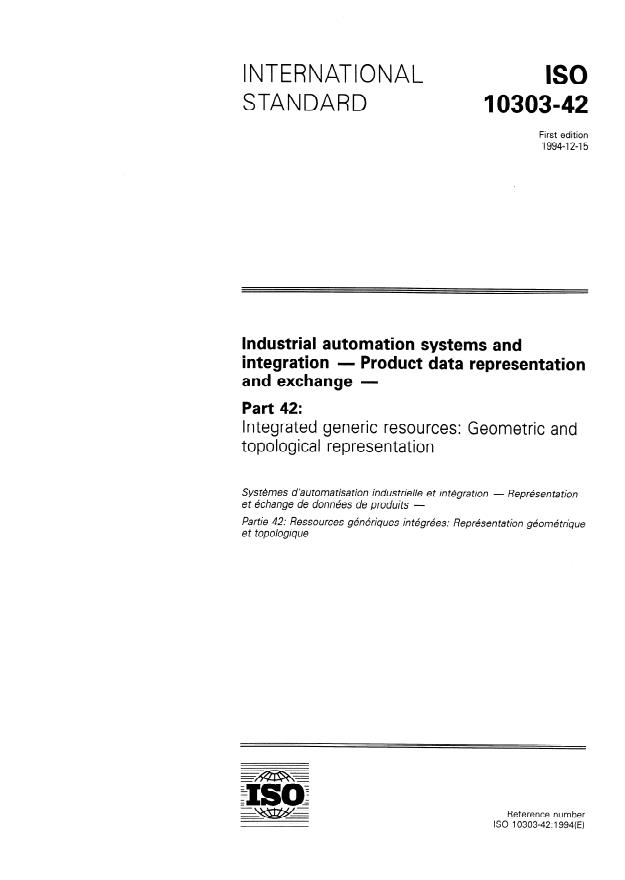
INTERNATIONAL
IS0
STANDARD
10303-42
First edition
1994-l 2-l 5
Industrial automation systems and
integration - Product data representation
and exchange -
Part 42:
Integrated generic resources: Geometric and
topological representation
Sys t&mes d ‘automa tisa tion indus trielle et in t6gra tion - Rep&en ta tion
et Gchange de don&es de produits -
Partie 42: Ressources gbnbriques in t&g&es: Rep&en tation geom&rique
et topologique
Reference number
IS0 10303-42: 1994(E)
IS0 10303-42:1994(E)
Page
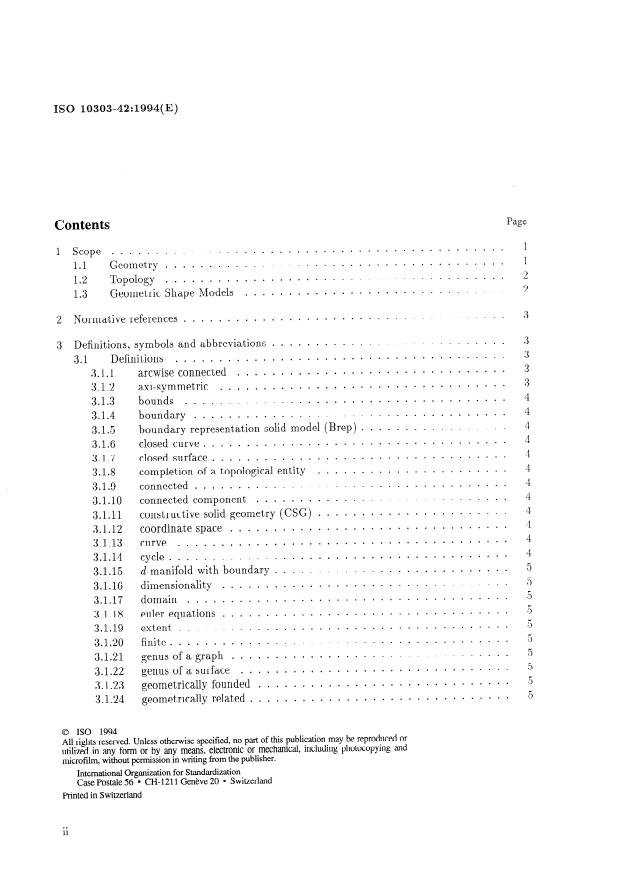
Contents
1 Scope . . .e.O.~.~.‘O~O
11 . Geometry . e . . . . . . . . . . . . . . . . o o . . o o . . . O . . . ., . o . s . . e
i
‘
12 . Topology . e . . . . . . . . . . . 0 . . . . . . . . . 0 . . . . . . . . . . e D . . .
13 . Geometric Shape Models O . . . . . e . . . . . . . . . . . . . s . . . . . . . . .
2 Normative references . . . . . . . . . . . o . . . . . . . . . . . . . . . . . . . . . . . . .
3 Definitions, symbols and abbreviations . . . . . . . . . . . . . . . . . . . . . . . . . . .
31 . Definitions . . . . . . . . . . . . . . . . . . . . . . . . . . . . . . a . . . . . . .
arcwise connected . . . . . . . . . . . . . . . . . . . . . . . . . . . . . . O
3.1.1
. . . . . . . . . . . . . 3
. . . . . . . . . .
3.1.2 axi-symmetric . . . . . . . . . .
:. . 4
.....................
3.1.3 bounds
....................................
3.1.4 boundary
.................
3.1.5 boundary representation solid model (Brep)
..................................
3.16 closed curve.
.................................
3.1.7 closed surface.
......................
3.1.8 completion of a topological entity
....................................
connected
3.1.9
.............................
3.1.10 connected component
......................
3.1.11 constructive solid geometry (CSG)
................................
3.1.12 coordinate space
...................................... 4
3.1.13 curve
3.1.14 cycle .
...........................
3.1.15 d-manifold with boundary
.................................
3.1.16 dimensionality
3.1.17 domain . . . . . . . . . . . . . . . . . . . . . . . . . . . . . . . . . . . . .
.................................
3.1.18 euler equations
:ej
3.1.19 extent-. .
.......................................
3.1.20 finite
................................
3.1.21 genus of a graph
...............................
3.1.22 genus of a surface
.............................
3.1.23 geometrically founded
..............................
3.1.24 geometrically related
0 IS0 1994
All rights reserved. Unless otherwise specified, no part of this publication may be reproduced or
utilized in any form or by any means, electronic or mechanical, including photocopying and
microfilm, without permission in writing from the publisher.
International Organization for Standardization
Case Postale 56 l W-121 1 Genkve 20 l Switzerland
Printed in Switzerland
ii
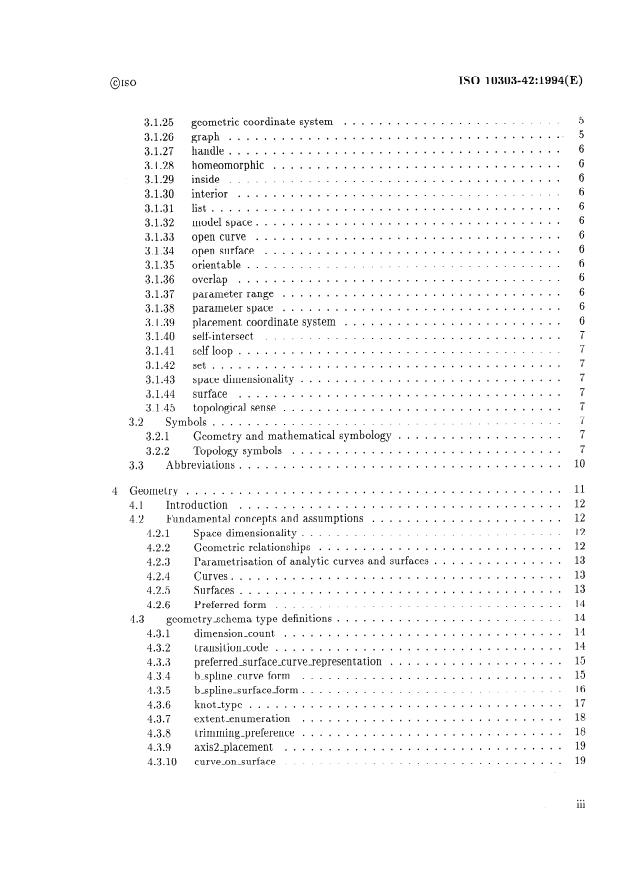
IS0 10303=42:1994(E)
c IS0
......................... 5
3.1.25 geometric coordinate system
......................................
3.1.26 graph
3.1.27 handle .
................................. 6
3.1.28 homeomorphic
inside .
3.1.29
interior . . . . . . . . . . . . . . . . . . . . . . . . . . . . . . . . . . . . .
3.1.30
.
. . . . . .* . . . . . . . . . . . . l .* . . . . . . . . . . . . . . . .
3.1.31 11st
model space. . . . . . . . . . . . . . . . . . . . . . . . . . . . . . . . . . .
3.1.32
................................... 6
3.1.33 open curve
.................................. 6
open surface
3.1.34
....................................
orientable
3.1.35
3.1.36 overlap . . . . . . . . . . . . . . . . . . . . . . . . . . . . . . . . . . . . .
................................ 6
parameter range
3.1.37
................................ 6
3.1.38 parameter space
......................... 6
3.1.39 placement coordinate system
.................................. 7
3.1.40 self-intersect
..................................... 7
3.1.41 self-loop
set .
3.1.42
..............................
3.1.43 space dimensionality
..................................... 7
3.1.44 surface
................................ 7
3.1.45 topological sense
32 . Symbols.
3.2.1 Geometry and mathematical symbology . . . . . . . . . . . . . . . . . . .
3.2.2 Topology symbols . e . . . . . . . . . . . . . . . . . . . . . . . . . . . . .
33 . Abbreviations . . . . . . . . . . . . . . . . . . . . . . . . . . . . . . . . . . . . .
........................................... 11
4 Geometry
..................................... 12
41 . Introduction
...................... 12
Fundamental concepts and assumptions
42 .
.............................. 12
4.2.1 Space dimensionality
............................ 12
4.2.2 Geometric relationships
............... 13
4.2.3 Parametrisation of analytic curves and surfaces
4.2.4 Curves .
Surfaces .
4.2.5
................................. 14
4.2.6 Preferred form
.......................... 14
43 . geometry-schema type definitions
................................ 14
4.3.; dimension-count
................................. 14
4.3.2 transition-code
.................... 15
4.3.3 preferred-surface-curverepresent ation
.............................. 15
4.3.4 bspline-curve-form
..............................
4.3.5 bspline-surface-form
.................................... 17
knot-type
4.3.6
.............................. 18
4.3.7 extent-enumeration
.............................. 18
4.3.8 trimming-preference
................................ 19
4.3.9 axis2-placement
................................ 19
4.3.10 curve-on-surface
. . .
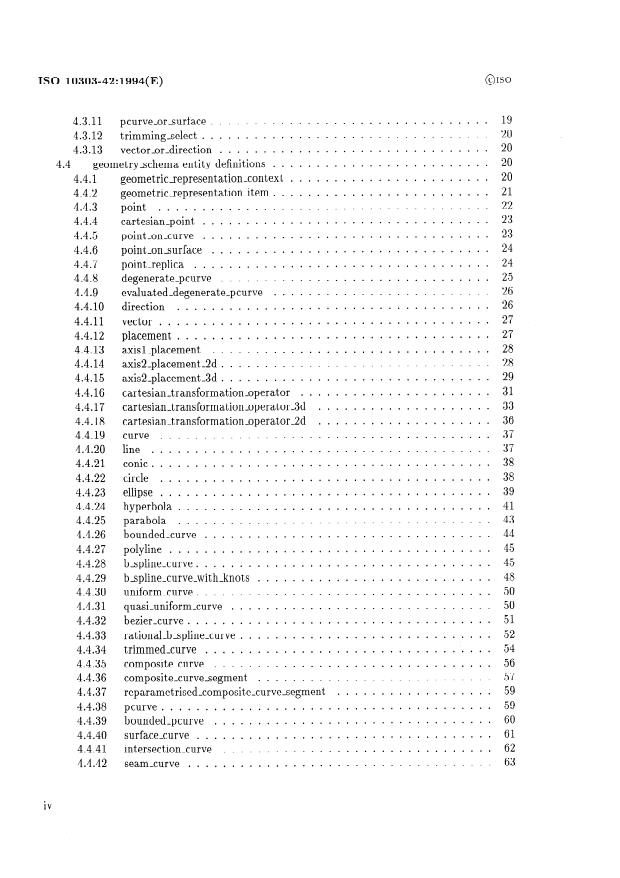
c IS0
IS0 10303-42:1994(E) 0
................................
4.3.11 pcurve-or-surface
.................................
trimming-select
4.3.12
...............................
4.3.13 vector-or-direction
.........................
44 . geometryschema entity definitions
....................... 20
4.4.1 geometricrepresentation-context
.........................
4.4.2 geometricrepresentationitem
4.4.3 point . . . . . . . . . . . . . . . . . . . . . . . . . . . . . . . . . . . . . .
................................. 23
4.4.4 Cartesian-point
.................................
4.4.5 point -on-curve
................................ 24
4.4.6 point -on-surface
4.4.7 point -replica . . . . . . . . . . . . . . . . . . . . . . . . . . . . . . . . . .
...............................
4.4.8 degenerate-pcurve
......................... 26
4.4.9 evaluated-degenerate-pcurve
....................................
direction
4.4.10
4.4.11 vector. .
.................................... 27
4.4.12 placement
................................ 28
4.4.13 axis 1 -placement
...............................
4.4.14 axis2-placement -2d
............................... 29
4.4.15 axis2-placement -3d
......................
4.4.16 Cartesian-transformation-operator
.................... 33
4.4.17 Cartesian-transformation-operator-3d
.................... 36
4.4.18 Cartesian-transformation-operator_2d
4.4.19 curve .
4.4.20 line .
4.4.21 conic . . . . . . .
.................................
4.4.22 circle . . . . .
4.4.23 ellipse . . . . . .
.................................
4.4.24 hyperbola . . .
4.4.25 parabola . . . .
.................................
4.4.26 bounded-curve
polyline . . . . .
4.4.27
r
4.4.28 bspline-curve . .
4.4.29 bspline-curve-with-knots . . . . . . . . . . . . . . . . . . . . . . . . . . .
.................................. 50
uniform-curve
4.4.30
.............................. 50
4.4.31 quasi-uniform-curve
...................................
4.4.32 bezier-curve
rational-b-spline-curve .
4.4.33
.................................
4.4.34 trimmed-curve
................................
4.4.35 composite-curve
........................... 57
4.4.36 composite-curve-segment
..................
4.4.37 reparametrised-composite-curve-segment
4.4.38 pcurve .
................................
4.4.39 bounded-pcurve
..................................
4.4.40 surface-curve
4.4.41 intersection-curve . . . . . . . . . . . . . . . . . . . . . . . . . . . . . . .
4.4.42 seam-curve . . . . . . . . . . . . . . . . . . . . . . . . . . . . . . . . . . .
IS0 10303-42:1994(E)
c IS0
.............................
bounded-surface-curve
4.4.43
..........................
composite-curve-on-surface
4.4.44
.................................
offset-curve-2d
4.4.45
.................................
offset-curve-3d
4.4.46
..................................
4.4.47 curve-replica
.....................................
4.4.48 surface
...............................
4.4.49 elementarysurface
plane .
4.4.50
...............................
cylindrical-surface
4.4.51
.................................
4.4.52 conical-surface
spherical-surface . . . . . . . . . . . . . . . . . . . . . . . . . . . . . . . . 73
4.4.53
.................................
4.4.54 toroidalsurface
..........................
degenerate-toroidal-surface
4.4.55
..................................
4.4.56 swept-surface
..........................
4.4.57 surface-oflinear-extrusion
..............................
surface-of-revolution
4.4.58
................................
bounded-surface
4.4.59
bspline-surface .
4.4.60
bspline-surface-with-knots . . . . . . . . . . . . . . . . . . . . . . . . . . 81
4.4.61
.................................
4.4.62 uniform-surface
.............................
4.4.63 quasi-uniform-surface
..................................
bezier-surface
4.4.64
............................
4.4.65 rational-b-spline-surface
rectangular-trimmed-surface .
4.4.66
..............................
4.4.67 curve-bounded-surface
boundary-curve . . . . . . . . . . . . . . . . . . . . . . . . . . . . . . . . . 89
4.4.68
.............................
outer-boundary-curve
4.4.69
........................
4.4.70 rectangular-composite-surface
surface-patch .
4.4.71
..................................
4.4.72 offsetsurface
.................................
4.4.73 surfaceseplica
..........................
geometryschema rule definitions
45 .
.............................
4.5.1 compatible-dimension
........................
46 . geometryschema function definitions
dimension-of .
4.6.1
..............................
4.6.2 acyclic-curve-replica
..............................
4.6.3 acyclic-point-replica
.............................
4.6.4 acyclic-surface-replica
...............................
4.6.5 associated-surface
base-axis .
4.6.6
...................................
4.6.7 build-2axes
...................................
4.6.8 build-axes.
............................
orthogonal-complement
4.6.9
..................................
4.6.10 first-projaxis
................................
second-proj-axis
4.6.11
..................................
4.6.12 cross-product
V
c IS0
IS0 10303-42:1994(E) 0
dot-product .
4.6.13
normalise .
4.6.14
...............................
4.6.15 scalar-times-vector
...................................
4.6.16 vectorsum
vector-difference .
4.6.17
...........................
4.6.18 default-bspline-knotmult
default-bspline-knots .
4.6.19
........................
default-bspline-curve-weights
4.6.20
.......................
4.6.21 default -bspline-surface-weights
..........................
constraints-param-b-spline
4.6.22
.............................
4.6.23 curve-weights-positive
...................
4.6.24 constraints-composite-curve-on-surface
4.6.25 get-basis-surface .
............................
4.6.26 surface-weights-positive
..................
4.6.27 constraints-rectangular-composite-surface
4.6.28 list-to-array .
..............................
4.6.29 make-array-of-array
...........................................
5 Topology
. Introduction .
......................
52 . Fundamental concepts and assumptions
5.2.1 Geometric associations .
................
5.2.2 Associations with parameter space geometry
126,
.........................
5.2.3 Graphs, cycles, and traversals
..........................
53 . topology-schema type definitions
f & . 127
...........................
5.3.1 shell
W . L .
5.3.2 reversible-topologyitem .
.........................
5.3.3 list-of-reversible-to,poEogyitem
set-ofseversible-topologyitem .
5.3.4
...............................
5.3.5 reversible-topology
.........................
54 . topology-schema entity definitions
5.4.1 topological-representationitem .
5.4.2 vertex .
vertex-point
5.4.3 .
edge. .
5.4.4
5.4.5 edge-curve .
oriented-edge
5.4.6 .
5.4.7 path .
5.4.8 oriented-path . . . . . . . . . . . . . . . . . . . . . . . . . . . . . . . . . . 134
open-path. .
5.4.9
5.4.10 loop .
5.4.11 vertexloop . . . . . . . . . . . . . . . . . . . . . . . . . . . . . . . . . . . 137
5.4.12 edgeloop . . . . . . . . . . . . . . . . . . . . . . . . . . . . . . . . . . . . 137
5.4.13 polyloop .
5.4.14 face-bound .
5.4.15 face-outer-bound . . . . . . . . . . . . . . . . . . . . . . . . . . . . . . . . 139
c IS0
IS0 10303-42:1994(E)
face .
5.4.16 140
5.4.17 face-surface
................................... 142
5.4.18 oriented-face
.................................. 143
5.4.19 subface
.....................................
5.4.20 connected-face-set
............................... 144
5.4.21 vertex-shell 144
...................................
5.4.22 wire-shell
....................................
5.4.23 open-shell 146
....................................
5.4.24 oriented-open-shell
...............................
5.4.25 closed-shell
................................... 150
5.4.26 oriented-closed-shell
.............................. 151
5.4.27 connected-edge-set
............................... 152
55 . topology-schema function definitions
........................ 153
conditional-reverse
5.5.1 153
...............................
topology-reversed
5.5.2 153
...............................
edge-reversed
5.5.3
.................................. 154
path-reversed
5.5.4 155
..................................
5.5.5 face-bound-reversed
..............................
faceseversed
5.5.6 156
..................................
shell-reversed
5.5.7 156
..................................
5.5.8 set-of-topology-reversed
............................ 157
list-of-topology_reversed
5.5.9
............................ 158
5.5.10 boolean-choose
................................. 158
5.5.11 path-head-to-tail
................................ 159
5.5.12 list-faceloops
..................................
5.5.13 listloop-edges
................................. 160
5.5.14 list-shell-edges
..... ‘. 160
...........................
5.5.15 list-shell-faces
..................................
5.5.16 list-shell-loops
................................. 161
5.5.17 mixedloop-typeset
..............................
5.5.18 list-to-set
....................................
edge-curve-pcurves
5.5.19 163
...............................
5.5.20 vertex-point-pcurves
..............................
6 Geometric models
...................................... 166
61 . Introduction
.....................................
62 . Fundamental concepts and assumptions
......................
.
63 geometric-model-schema type definitions
...................... 167
boolean-operand
6.3.1 167
................................
6.3.2 boolean-operator
............................... 167
csg-primitive
6.3.3 168
..................................
6.3.4 csgselect
....................................
6.3.5 geometricsetselect
.............................. 169
6.3.6 surface-model.
.................................
6.3.7 wireframemodel
................................ 169
geometricmodel-schema entity definitions
64 .
..................... 170
vii
c IS0
IS0 10303-42:1994(E) 0
................................... 170
6.4.1 solid-model
..............................
manifold-solid-brep
6.4.2
.................................
brep-with-voids
6.4.3
..................................
6.4.4 faceted-brep
.....................................
csgsolid
6.4.5
.................................
boolean-result
6.4.6
......................................
6.4.7 sphere
...............................
6.4.8 right-circular-cone
.............................
6.4.9 right -circular-cylinder
......................................
torus.
6.4.10
......................................
block
6.4.11
..............................
right -angular-wedge
6.4.12
.................................
sweptfacesolid
6.4.13
...............................
6.4.14 extruded_facesolid
............................... 181
6.4.15 revolvedface,solid
................................
6.4.16 swept-area-solid
...............................
6.4.17 extruded-areasolid
...............................
6.4.18 revolved-area-solid
.................................
6.4.19 half-spacesolid
................................ 185
6.4.20 boxed-half-space
...................................
6.4.21 box-domain
...................................
6.4.22 solid-replica
...........................
6.4.23 shell-basedsurface-model
........................... 188
6.4.24 face,based-surfacemodel
.........................
shell-based-wireframe-model
6.4.25
.........................
6.4.26 edge-based-wireframe-model
..................................
6.4.27 geometric-set
..............................
geometric-curve-set
6.4.28
..............................
6.4.29 geometricsetseplica
...................
65 . geometricmodel-schema function definitions
19 1
..............................
6.5.1 acyclic-solid-replica
...............................
6.5.2 acyclic-set-replica
..............
6.5.3 constraints-geometry-shell-based-surfacemodel
............. 193
6.5.4 constraints-geometryshell-based-wireframemodel
.............................
6.5.5 build-transformed-set
Annexes
Short names of entities . . . . . . . . . . . . . . . . . . . . . . . . . . . . . . . . . . . 196
A
B Information object registration . . . . . . . . . . . . . . . . . . . . . . . . . . . . . . 202
Computer-interpretable listings . . . . . . . . . . . . . . . . . . . . . . . . . . . . . . 203
C
D EXPRESS-G diagrams . . . . . . . . . . . . . . . . . . . . . . . . . . . . . . . . . . . 204
E Bibliography . . . . . . . . . . . . . . . . . . . . . . . . . . . . . . . . . . . . . . . . 223
. . .
Vlll
IS0 10303=42:1994(E)
c-m0
Index . . . . . . . . . . . . . . . . . . . . . . . . . . . . . . . . . . . . . . . . . . . . . . .
Figures
1 Axis2 placement 3D .
2 (a) Cartesian transformation operator 3D .
2 (b) Cartesian transformation operator 3D .
.......................... 35
2 (c) Cartesian transformation operator
Circle .
4 Ellipse. .
Hyperbola .
Parabola .
B-spline curve. .
Composite curve .
Conical surface .
Curve bounded surface . 88
11 Edgecurve .
........................... 179
12 Right angular wedge and its attributes
Revolved face solid . 182
D.l geometryschema EXPRESS-G diagram 1 of 12 - Subtypes of geometric representa-
........................................... 205
tionitem
geometryschema EXPRESS-G diagram 2 of 12 - Placement and transformation sub-
D.2
............................................. 206
types
.......... 207
D.3 geometryschema EXPRESS-G diagram 3 of 12- Subtypes of point
......... 208
D.4 geometryschema EXPRESS-G diagram 4 of 12 - Subtypes of curve
. . 209
D5 geometryschema EXPRESS-G diagram 5 of 12 - Subtypes of surface
.......... 210
D6 . geometry-schema EXPRESS-G diagram 6 of 12 - Subtypes of conic
............ 211
D.7 geometry-schema EXPRESS-G diagram 7 of 12 - Surface curve
........... 212
D.8 geometry-schema EXPRESS-G diagram 8 of 12 - Bounded curves
........... 213
D9 . geometry-schema EXPRESS-G diagram 9 of 12 - B-spline-curve
D.10 geometryschema EXPRESS-G diagram 10 of 12 - Elementary surface . . . . . . . .
D.ll geometryschema EXPRESS-G diagram 11 of 12 - Subtypes of bounded surface . . .
D.12 geometry-schema EXPRESS-G diagram 12 of 12 - Bspline-surface . . . . . . . . . .
1x
IS0 10303-42:1994(E) c IS0
D.13 topology-schema EXPRESS-G diagram 1 of 3 - Subtypes of topological representation
item . . . . . . . . . . . . . . . . . . . . . . . . . . . . . . . . . . . . . . . . . . . . . 217
D.14 topology-schema EXPRESS-G diagram 2 of 3 . . . . . . . . . . . . . . . . . . . . . . 218
D.15 topology-schema EXPRESS-G diagram 3 of 3 . . . . . . . . . . . . . . . . . . . . . . 219
D.16 geometricmodelschema EXPRESS-G diagram 1 of 3 - Subtypes of solid model . . . 220
D.17 geometricmodel-schema EXPRESS-G diagram 2 of 3 - CSG solid . . . . . . . . . . 221
D.18 geometricmodelschema EXPRESS-G diagram 3 of 3 - Models of external shape . . 222
Tables
1 Geometry mathematical symbology .
2 Topology Symbol Definitions . 9
A.1 Short names of entities . 196
X
IS0 10303-42:1994(E)
c IS0
Foreword
is a worldwide federation of national
The International Organization for Standardization (ISO)
standards bodies (IS0 member bodies). The work of preparing International Standards is nor-
mally carried out through IS0 technical committees. Ealch member body interested in a subject
for which a technical committee has been established has the right to be represented on that
International organizations, government al and non-government al, in liaison with
committee.
ISO, also take part in the work. IS0 collaborates closely with the International Electrotechnical
on all matters of electrotechnical standardization.
Commission (IEC)
Draft International Standards adopted by technical committees are circulated to the member
Publication as an International Standard requires approval by at least 7’5%
bodies for voting.
of the member bodies casting a vote.
International Standard IS0 10303-42 was prepared by Technical Committee ISO/TC 184, In-
dustrial automation systems and integration, Subcommittee SC4, Industrial data and global
manufacturing programming languages.
IS0 10303 consists of the following parts under the general title Industrial automation systems
and integration - Product data representation and exchange:
- Part 1, Overview and fundamental principles;
- Part 11, Description methods: The EXPRESS language reference manual;
- Part 21, Implementation methods: Clear text encoding of the exchange structure;
- Part 22, Implementation methods: Standard data access interface specification;
-
Part 31, Conformance testing methodology and framework: General concepts;
- Part 32, Conformance testing methodology and framework: Requirements on testing
laboratories and clients;
- Part 41, Integrated generic resources: Fundamentals of product description and support;
Geometric and topological representation;
- Part 42, Integrated generic resources:
- Part 43, Integrated generic resources: Representation structures;
-
Part 44, Integrated generic resources: Product structure configuration;
-
Part 45, Integrated generic resources: Materials;
- Part 46, Integrated generi c resources: Visual presen tation;
- Part 47, Integrated generic resources: Shape variation tolerances;
Process structure and properties;
Part 49, Integrated generic resources:
Xi
c IS0
IS0 10303-42:1994(E) 0
-
Part 101, Integrated application resources: Draughting;
- Part 104, Integrated application resources: Finite element analysis;
- Part 105, Integrated application resources: Kinematics;
-
Part 201, Application protocol: Explicit draughting;
-
Part 202, Application protocol: Associative draughting;
-
Part 203, Application protocol: Configuration controlled design;
-
Part 207, Application protocol: Sheet metal die planning and design;
-
Part 210, Application protocol: Printed circuit assembly product design data;
-
Part 213, Application protocol: Numerical control process plans for machined parts.
The structure of this International Standard is described in IS0 10303-l. The numbering of the
parts of this International Standard reflects its structure:
-
Part 11 specifies the description methods;
-
Parts 21 and 22 specify the implementation methods;
-
Parts 31 and 32 specify the conformance testing methodology and framework;
-
Parts 41 to 49 specify the integrated generic resources;
-
Parts 101 to 105 specify the integrated application resources;
-
Parts 201 to 213 specify the application protocols.
Should further parts be published, they will follow the same numbering pattern.
Annexes A and B form an integral part of this part of IS0 10303. Annexes C, D, E are for
information only.
Diskette
Users should note that this part of IS0 10303 comprises a diskette:
- the short names of entities given in annex A are also included on the diskette;
- the EXPRESS listings (annex C) are provided on the diskette only;
a method to enable users to report errors in the documentation is given. Full details are
provided in the file.
x11
IS0 10303=42:1994(E)
c IS0
Introduction
IS0 10303 is an International Standard for the computer-interpretable representation and ex-
change of product data. The objective is to provide a neutral mechanism capable of describing
product data throughout the life cycle of a product independent from any particular system.
The nature of this description makes it suitable not only for neutral file exchange, but also as a
basis for implementing and sharing product databases and archiving.
This International Standard is organized as a series of parts, each published separately. The
parts of IS0 10303 fall into one of the following series: description methods, integrated resources,
application protocols, abstract test suites, implementation methods, and conformance testing.
The series are described in IS0 10303-l. This part of IS0 10303 is a member of the integrated
resources series. Major subdivisions of this International Standard are:
-
Geometry
- Topology
Geometric models
This part of IS0 10303 specifies the integrated resources used for geometric and topological
representation. Their primary application is for explicit representation of the shape or geometric
form of a product model. The shape representation presented here has been designed to facilitate
stable and efficient communication when mapped to a physical file.
The geometry in clause 4 is exclusively the geometry of parametric curves and surfaces. It
includes the curve and surface entities and other entities, functions and data types necessary for
their definition. A common scheme has been used for the definition of both two-dimensional and
three-dimensional geometry. All geometry is defined in a coordinate system which is established
as part of the context of the item which it represents. These concepts are fully defined in IS0
10303 Part 43.
The topology in clause 5 is concerned with connectivity relationships between objects rather than
with the precise geometric form of objects. This clause contains the basic topological entities
and specialised subtypes of these. In some cases the subtypes have geometric associations.
Also included are functions, particularly constraint functions, and data types necessary for the
definitions of the topological entities.
The geometric models in clause 6 provide basic resources for the communication of data describ-
ing the precise size and shape of three-dimensional solid objects. The geometric shape models
provide a complete representation of the shape which in many cases includes both geometric
and topological data. Included here are the two classical types of solid model, constructive solid
geometry (CSG) and boundary representation (B-rep). Other entities, providing a rather less
complete description of the geometry of a product, and with less consistency constraints, are
also included.
. . .
x111
This page intentionally left blank
IS0 10303=42:1994(E)
INTERNATIONAL STANDARD @so
Industrial automation systems and integration -
Product data representation and exchange -
Part 42 :
Integrated generic resources:
Geometric and topological representation
1 Scope
10303 specifies the resource constructs for the explicit geometric and topological
This part of IS0
The scope is determined by the requirements for the
representation of the shape of a product.
explicit representation of an ideal product model; tolerances and implicit forms of representation
in terms of features are out of scope. The geometry in clause 4 a,nd the topology in clause 5 are
available for use independently and are also extensively used by the various forms of geometric
shape model in clause 6. In addition, this part of IS0 10303 specifies specialisations of the
concepts of representation where the elements of representation are geometric.
1.1 Geometry
The following are within the scope of the geometry schema:
- definition of points, vectors, parametric curves and parametric surfaces;
- definition of transformation operators;
-
points defined directly by their coordinate values or in terms of the parameters of an
existing curve or surface;
- definition of conic curves and elementary surfaces;
- definition of curves defined on a parametric surface;
- definition of general parametric spline curves and surfaces;
- definition of point, curve and surface replicas;
- definition of offset curves and surfaces;
- definition of intersection curves.
The following are outside the scope of this part of IS0 10303:
-
all other forms of procedurally defined curves and surfaces;
c IS0
IS0 10303-42:1994(E)
-
curves and surfaces which do not have a parametric form of representation;
-
form of explicit representation of a ruled surface.
any
NOTE - For a ruled surface the geometry is critically dependent upon the parametrisation of
the boundary curves and the method of associating pairs of points on the two curves. A ruled
surface with B-spline boundary curves can however be exactly represented by the B-spline surface
entity.
1.2 Topology
The following are within the scope of the topology schema:
-
definition of the fundamental topological entities vertex, edge, and face, each with a
specialised subtype to enable it to be associated with the geometry of a point, curve, or
surface, respectively;
-
collections of the basic entities to form topological structures of path, loop and shell
and constraints to ensure the integrity of these structures;
-
orientation of topological entities.
1.3 Geometric Shape Models
The following are within the scope of the geometric model schema:
-
data describing the precise geometric form of three-dimensional solid objects;
- constructive solid geometry (CSG) models;
- definition of CSG primitives and half-spaces;
-
creation of solid models by sweeping operations;
-
manifold boundary representation (B-rep) models;
-
constraints to ensure the integrity of B-rep models;
-
surface models;
wireframe models;
- geometric Sets;
-
creation of a replica of a solid model in a new location.
The following are outside the scope of this part of IS0 10303:
-
non-manifold boundary representation models;
IS0 10303=42:1994(E)
c IS0
-
spatial occupancy forms of solid models (such as octree models);
-
assemblies and mechanisms.
2 Normative references
through reference in this text, constitute
The following standards contain provisions which,
provisions of this part of IS0 10303. At the time of publication, the editions indicated were
valid. All standards are subject to revision, and parties to agreements based on this part of
IS0 10303. are encouraged to investigate the possibility of applying the most recent editions of
the standards indicated below. Members of IEC and IS0 maintain registers of currently valid
International Standards.
l -U Information Technology - Open Sysyems Interconnection - Abstract Syn-
ISO/IEC 8824-l.
tax Notation One (ASN. 1) - Part 1: Specification of Basic Notation.
IS0 10303-1:1994, Industrial automation systems and integration - Product data representation
and exchange - Part 1: Overview and fundamental principles.
IS0 10303~ll:MM, Industrial au.tomation systems and integration - Product data representa-
The EXPRESSLanguage Reference Manual.
tion and exchange - Part 11: Description methods:
IS0 lO303--41:1g$M, Industrial automation systems and integration - Product data representa-
tion and exchange - Part 41 : Integrated generic resources: Fundamentals of product description
and support.
IS0 10303-43:1994, Industrial automation systems and integration - Product data representa-
tion and exchange - Part 43 : Integrated generic resources: Representation structures.
3 Definitions, symbols and abbreviations
3.1 Definitions
For the purposes of this part of IS0 10303, the following definitions apply.
3.1.1 arcwise connected: an entity is arcwise connected if any two arbitrary points in its
domain can be a curve that lies entirely within the domain.
connected by
3.1.2 axi-symmetric: an entity is axi-symmetric if it has an axis of symmetry such that the
object is invariant under all rotations about this axis.
‘)To be published.
c IS0
IS0 10303=42:1994(E)
3.1.3 bounds: the topological entities of lower dimensionality which mark the limits of a top-
ological entity. The bounds of a face are loops, and the bounds of an edge are vertices.
Xl.4 boundary: the set of mathematical points x in a domain X contained in R” for which
there is an open ball U in Rm containing x such that the intersection UnX is homeomorphic to an
’ for some d 5 m, where the homeomorphism
open set in the closed d -dimensional half-space R,,
carries C-E into the origin in R$.
NOTES
1 - RfS. is defined to be the set of all mathematical points (21, . . . . Q) in Rd with x1 > 0.
-
has its usual mathematical meaning. It does not relate to
2 - For this purpose, the word “open”
“open surface” as defined elsewhere in this part of IS0 10303.
3.1.5 boundary representation solid model (Brep): a type of geometric model in which
the size and shape of the solid is defined in terms of the faces, edges and vertices which make
up its boundary.
3.1.6 closed curve: a curve such that both end points are the same.
3.1.7 closed surface: a connected Smanifold that divides space into exact&y IJWO connected
components, one of which is finite.
3.1.8 completion of a topological entity: a set consisting~ of’ the entity in question together
with all ithe faces, edges and vertices referenced, directly or indirectly, in the d&nHtion of the
bounds of that entity.
3.1.9 iconnected: equi valent to arcwise connected.
3.1.10 .connected component: a maximal connected subset of a domain.
3.1.11 constructive solid geometry (CSG):
a type of geometric modelling in which a solid
is defined as the result of a sequence of regularised Boolean operations operating on solid models.
3.1.12 .coordinate space: a reference system that associates aI unique set of n parametesrs
with each point in an n-dimensional space.
3.1.13 .curve: a set of mathematical points which is the image, in two- or three-dimensional
space, of a continuous function defined over a connected subset of the real line (RI), and which
is not a single point.
3.1.14 cycle: a chain of alternating vertices and edges in a graph such that the first and last
vertices >are the same.
IS0 10303=42:1994(E)
c IS0
3.1.15 d-manifold with boundary: a domain which is the union of its d-dimensional interior
and its boundary.
3.1.16 dimensionality: the number of independent coordinates in the parameter space of a
geometric entity. The dimensionality of topological entities which need not have domains is
specified in the entity definitions. The dimensionality of a list or set is the maximum of the
dimensionalities of the elements of that list or set.
3.1.17 domain: the mathematical point set in model space corresponding to an entity.
3.1.18 euler equations: Equations used to verify the topological consistency of objects. Var-
ious equalities relating topological properties of entities are derived from the invariance of a
Typically, these are used as quick checks on the
number known as the Euler characteristic.
integrity of the topological structure. A violation of an Euler condition signals an “impossible”
object. Two special cases are important in this document. The Euler equation for graphs is
discussed in 5.2.3. Euler conditions for surfaces are discussed in 5.4.23 and 5.4.25.
3.1.19 extent: the measure of the content of the domain of an entity, measured in units ap-
propriate to the dimensionality of the entity. Thus, length, area and volume are used for
dimensionalities 1, 2, and 3, respectively. Where necessary, the symbol Z will be used to denote
extent.
3.1.20 finite: an entity is finite (sometimes called bounded) if there is a finite upper bound on
the distance between any two points in its domain.
3.1.21 genus of a graph: the integer-valued invariant defined algorithmically by the graph
traversal algorithm described in the note in 5.2.3.
3.1.22 genus of a surface: the number of handles that must be added to a sphere to produce
a surface homeomorphic to the surface in question.
3.1.23 geometrically founded: a property of geometric-representation-items asserting
their relationship to a coordinate space in which the coordinate values of points and directions
on which they depend for position and orientation are measured.
3.1.24 geometrically related: the relationship between two geometric-representation--
items in the same context by which the concepts of distance and direction between them are
defined.
3.1.25 geometric coordinate system: the underlying global rectangular Cartesian coordi-
nate sy
stem to which all geometry refers.
3.1.26 graph: a set of vertices and edges. The graphs discussed in this document are generally
called pseudographs in the technical literature because they allow self-loops and also multiple
edges connecting the same two vertices.
c IS0
IS0 lox&42:1994(E)
3.1.27 handle: the structure distinguishing a torus from a sphere, which can be viewed as a
cylindrical tube connecting two holes in a surface.
3.1.28 homeomorphic: domains X and Y are homeomorphic if there is a continuous function
f from X to Y which is a one-to-one correspondence, so that the inverse function f-r exists,
and if f-r is also continuous.
3.1.29 inside: domain X is inside domain Y if both domains are contained in the same Eu-
into exactly two connected components, one of which
clidean space, R", and Y separates Rm
is finite, and X is contained in the finite component.
3.1.30 interior: the d-dimensional interior of a d-dimensional domain X contained in Rm is
the set of mathematical points z in X for which there is an open ball U in Rm containing x
such that the intersection U n X is homeomorphic to an open ball in Rd.
3.1.31 list: an ordered homogeneous collection with possibly duplicate members. A list is
represented by an enclosing pair of brackets, i.e. [A].
3.1.32 model space: a space with dimensionality 2 or 3 in which the geometry of a physical
object is defined.
3.1.33 open curve: a curve which has two distinct end points.
3.1.34 open surface: a surface which is a manifold with boun dary, but is not closed. Ie .
‘7
either i t is not finite, or iace int 0 exactly two connected
it does not divide sp components.
3.1.35 orientable: a surface is orientable if a consistent, continuously varying choice can be
made of the sense of the normal vectors to the surface.
NOTE - This does not require a continuously varying choice of the vnlues of the normal vectors;
the surface may have tangent plane discontinuities.
3.1.36 overlap: two entities overlap when they have shells, faces, edges, or vertices in common.
3.1.37 parameter range: the range of valid parameter values for a curve or surface.
3.1.38 parameter space: the one-dimensional space associated with a curve via its uniquely
defined parametrisation or the two-dimensional space associated with a surface.
3.1.39 placement coordinate system: a rectangular Cartesian coordinate system associated
with the placement of a geometric entity in space, used to describe the interpretation of the
attributes and to associate a unique parametrisation with curve and surface entities.
3.1.40 self-intersect: a curve or surface self-intersects if there is a mathematical point
...
Questions, Comments and Discussion
Ask us and Technical Secretary will try to provide an answer. You can facilitate discussion about the standard in here.
Loading comments...