

ISO 13355:2016
(Main)Packaging — Complete, filled transport packages and unit loads — Vertical random vibration test
General Information
- Abstract
ISO 13355:2016 specifies a method to carry out a vertical random vibration test on a complete, filled transport package(s) and unit loads using random excitation[1]. This document also provides methods for assessing the performance of a package in terms of its strength or the protection that it offers to its contents when it is subjected to vertical vibration. The test discussed in this document can be performed either as a single test to investigate the effects of vertical vibration, or as a part of a sequence of tests designed to measure the ability of a test specimen to withstand a distribution system that includes a vibration hazard. NOTE In this International Standard, a package or unit load is referred to as test specimen. [1] Random vibration theory is discussed in IEC 60068-2-64.
- Status
- Published
- Publication Date
- 26-Jul-2016
- Current Stage
- 9093 - International Standard confirmed
- Start Date
- 22-Dec-2021
- Completion Date
- 29-Aug-2026
Buy Documents

ISO 13355:2016 - Packaging -- Complete, filled transport packages and unit loads -- Vertical random vibration test

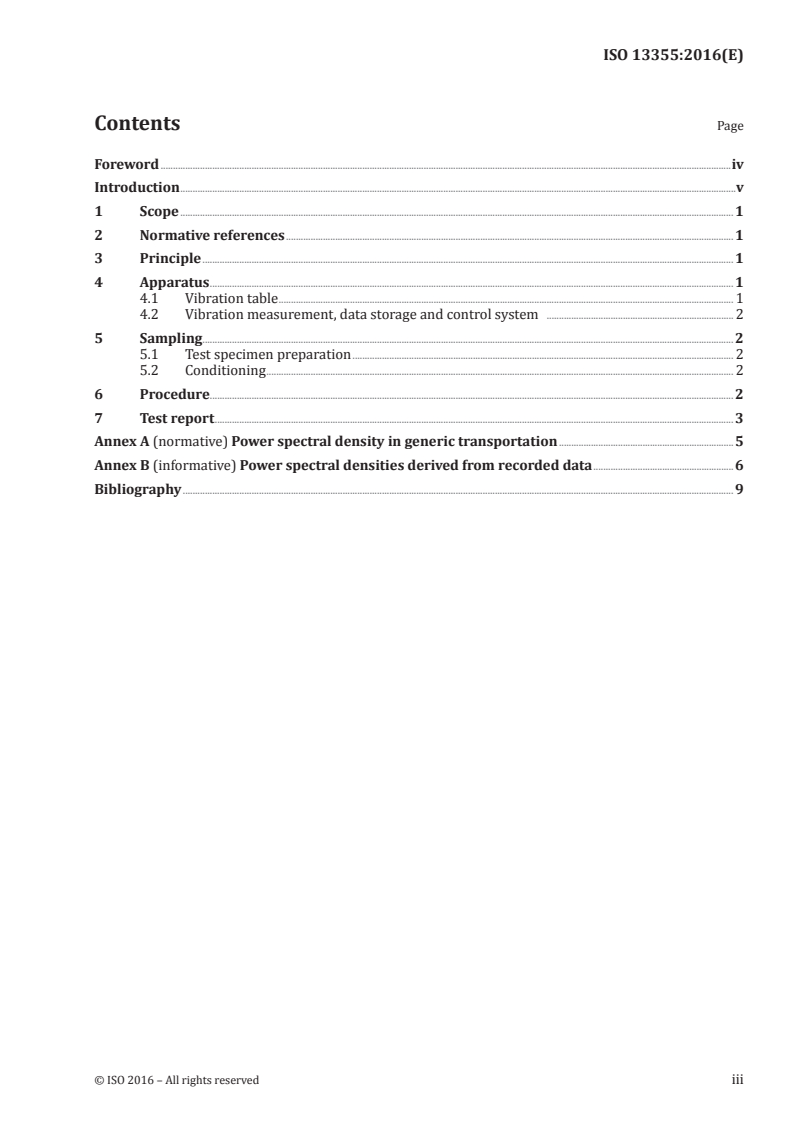
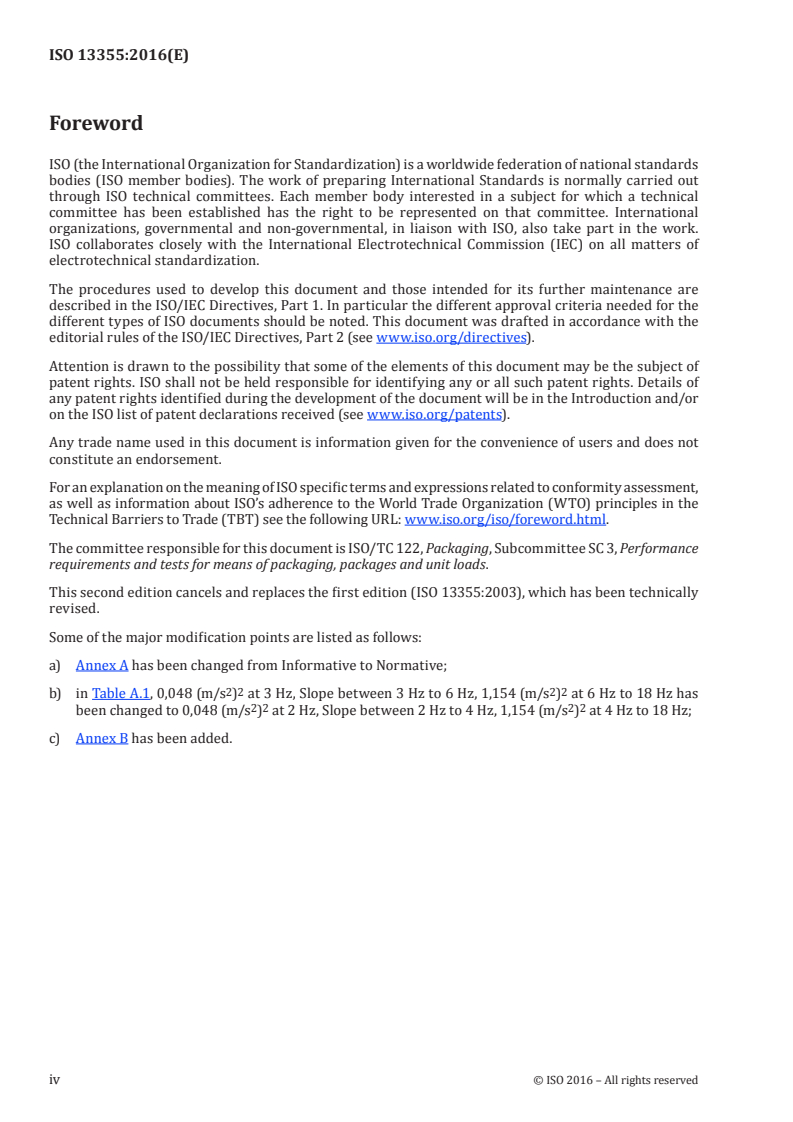
ISO 13355:2016 - Packaging — Complete, filled transport packages and unit loads — Vertical random vibration test/27/2016
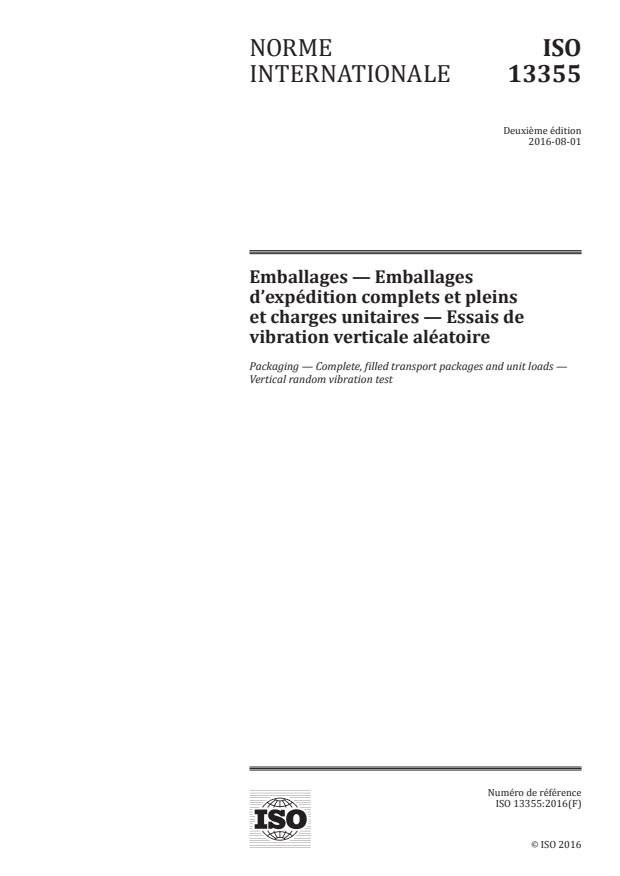

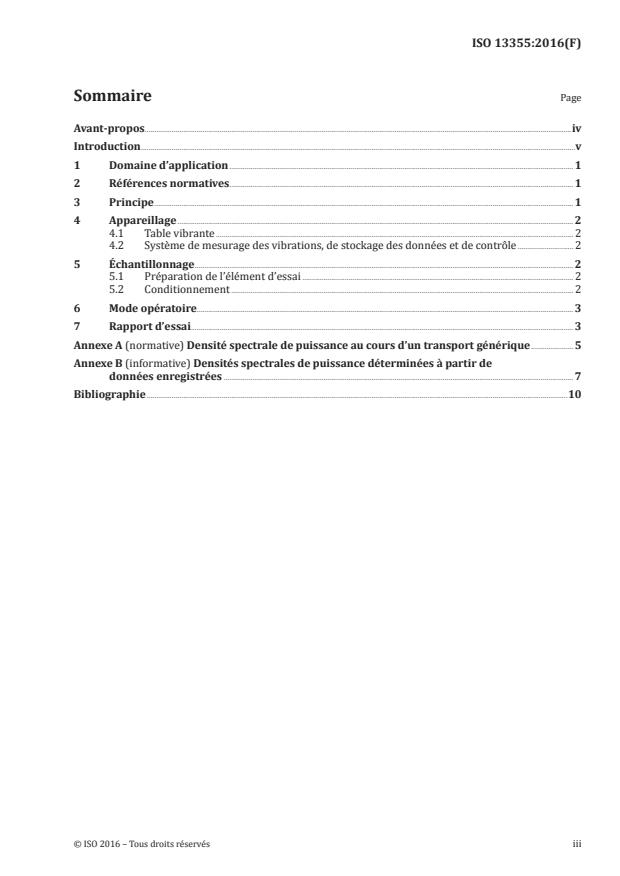
ISO 13355:2016 - Emballages -- Emballages d'expédition complets et pleins et charges unitaires -- Essais de vibration verticale aléatoire
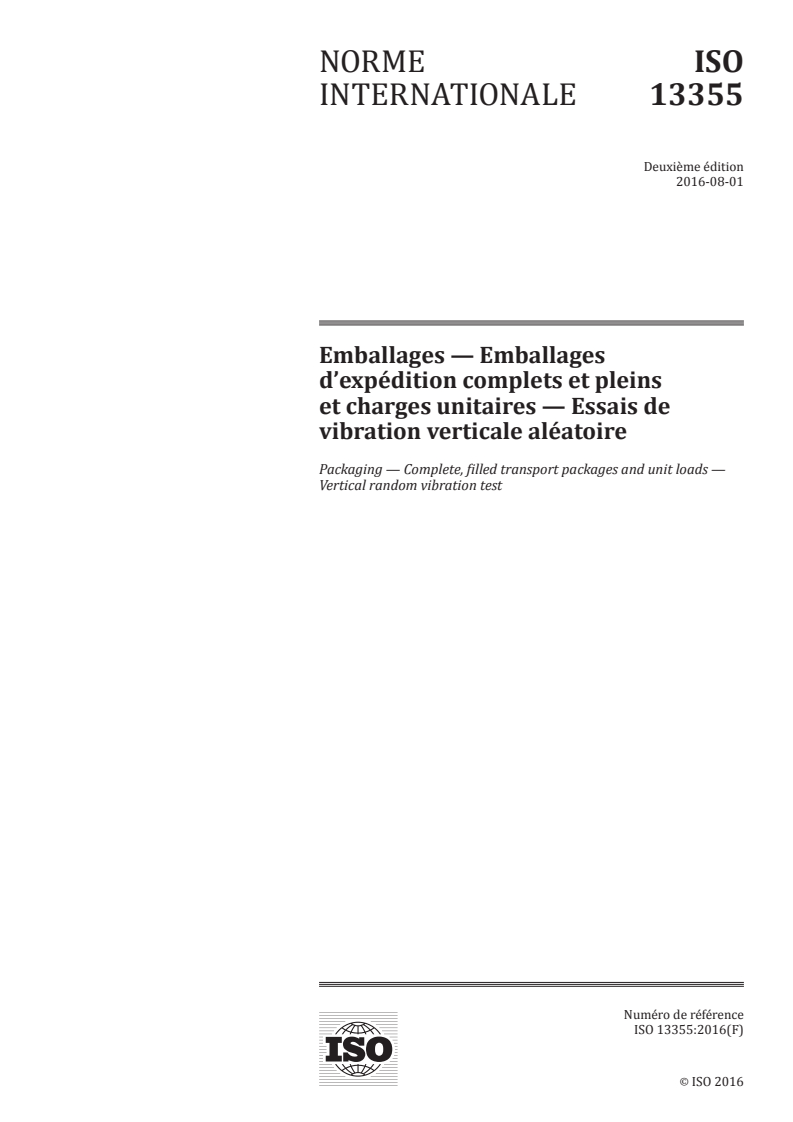

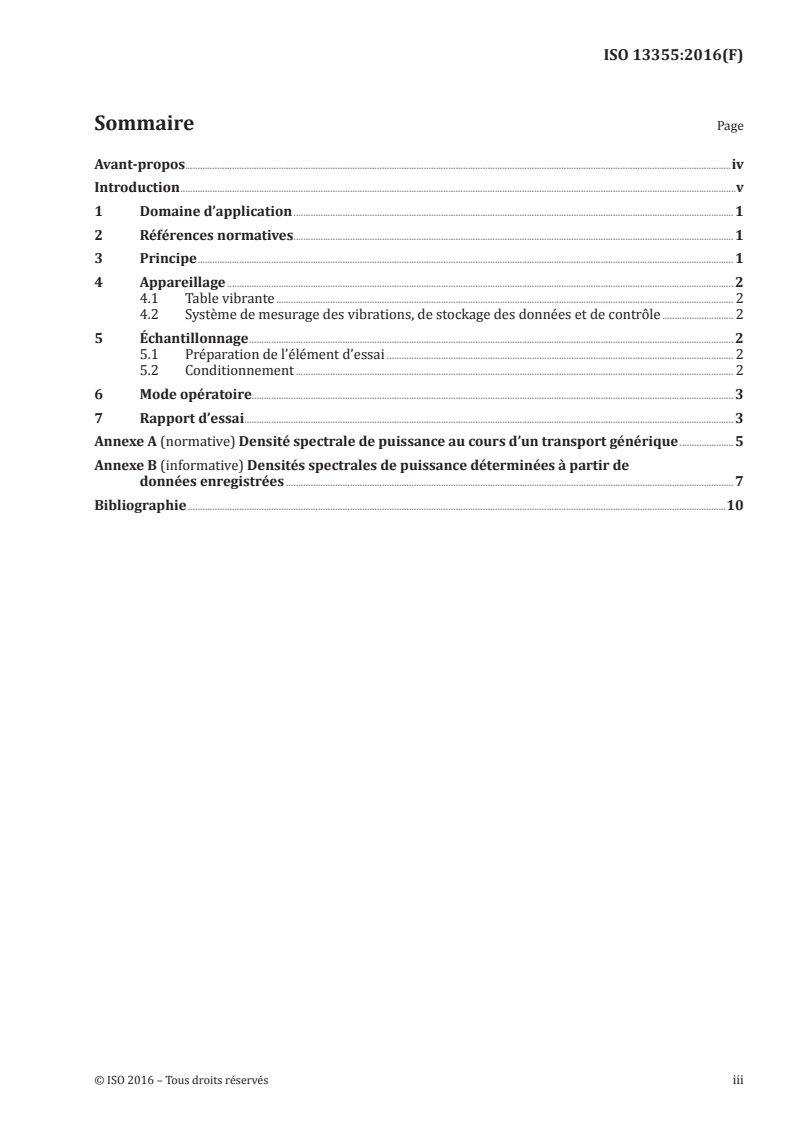
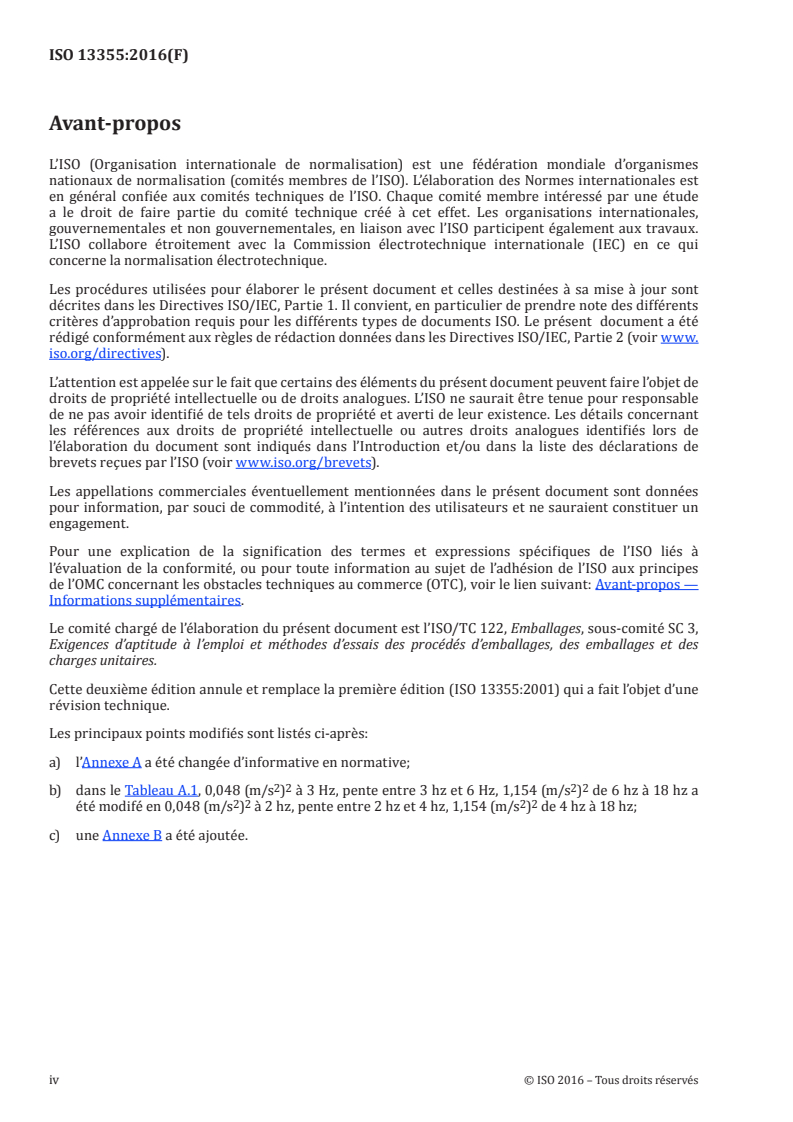
ISO 13355:2016 - Emballages — Emballages d'expédition complets et pleins et charges unitaires — Essais de vibration verticale aléatoire/27/2016
Overview
ISO 13355:2016 - Packaging - Complete, filled transport packages and unit loads - Vertical random vibration test specifies a laboratory method for subjecting complete, filled transport packages and unit loads (test specimens) to vertical random vibration. The standard defines how to generate and control a random excitation (power spectral density, PSD), how to measure and report imposed accelerations, and how to assess package strength and protection of contents under vertical vibration hazards encountered in distribution.
Key topics and technical requirements
- Scope: Vertical random vibration test on complete, filled transport packages and unit loads; can be standalone or part of a test sequence.
- Excitation / PSD: Annex A gives a generic transport PSD (useful when field recordings are not available); Annex B provides PSDs derived from recorded data (Europe, Japan).
- Frequency range: Typical test band is 2 Hz to 200 Hz with at least 1 Hz resolution (lower end may be adjusted by agreement).
- Apparatus:
- Vibration table with sufficient power, displacement and stiffness (table resonant frequency above the test band).
- Measurement/control system (accelerometers, signal conditioners, data acquisition) capable of generating required PSD and controlling table acceleration.
- Optional fences or means to retain test specimens and apply superimposed loads (per ISO 2234).
- Measurement & control:
- Control accelerometer and closed-loop control to match PSD.
- Data acquisition & control channels accurate to ±5% over the test frequency range.
- Analysis performed with at least 120 statistical degrees of freedom.
- Procedure basics:
- Condition specimens per ISO 2233; place specimen with CG near table center.
- Start test 6 dB below target level to stabilize PSD, then raise to full level.
- Tolerances: overall RMS acceleration variation ≤ ±15%; PSD deviation ≤ ±3 dB across the band; horizontal components ≤ 20% of vertical.
- Minimum recommended test duration: 30 minutes per test attitude (generic PSD total RMS ~0.604 g).
- Reporting: Detailed test report requirements include specimen description (ISO 2206), PSD applied, frequency range, RMS values, conditioning, test duration, restraints, any deviations, and results/observations.
Applications and users
ISO 13355:2016 is used to:
- Validate packaging designs and cushioning for road, rail and multimodal transport.
- Qualify unit loads, pallets and crates for distribution vibration hazards.
- Support failure analysis, risk reduction, and return-cost minimization. Typical users:
- Packaging engineers and designers
- Independent test laboratories and certification bodies
- Supply chain/QA managers, logistics engineers
- Manufacturers of fragile or sensitive goods
Related standards
- IEC 60068-2-64 (random vibration theory and methods)
- ISO 2233 (conditioning of specimens)
- ISO 2206 (test specimen identification)
- ISO 2234 (superimposed load / stacking test)
Keywords: ISO 13355:2016, vertical random vibration test, packaging testing, power spectral density, PSD, vibration testing, transport packages, unit loads, packaging qualification.
Relations
- Effective Date
- 25-Aug-2026
- Effective Date
- 12-Feb-2026
- Effective Date
- 06-Jun-2022
- Effective Date
- 19-May-2012
Buy Documents
ISO 13355:2016 - Packaging -- Complete, filled transport packages and unit loads -- Vertical random vibration test
ISO 13355:2016 - Packaging — Complete, filled transport packages and unit loads — Vertical random vibration test/27/2016
ISO 13355:2016 - Emballages -- Emballages d'expédition complets et pleins et charges unitaires -- Essais de vibration verticale aléatoire
ISO 13355:2016 - Emballages — Emballages d'expédition complets et pleins et charges unitaires — Essais de vibration verticale aléatoire/27/2016
Get Certified
Connect with accredited certification bodies for this standard

BRCGS (Brand Reputation Compliance Global Standards)
Global food safety and quality standards owner.
Sponsored listings
Frequently Asked Questions
ISO 13355:2016 is a standard published by the International Organization for Standardization (ISO). Its full title is "Packaging — Complete, filled transport packages and unit loads — Vertical random vibration test". This standard covers: ISO 13355:2016 specifies a method to carry out a vertical random vibration test on a complete, filled transport package(s) and unit loads using random excitation[1]. This document also provides methods for assessing the performance of a package in terms of its strength or the protection that it offers to its contents when it is subjected to vertical vibration. The test discussed in this document can be performed either as a single test to investigate the effects of vertical vibration, or as a part of a sequence of tests designed to measure the ability of a test specimen to withstand a distribution system that includes a vibration hazard. NOTE In this International Standard, a package or unit load is referred to as test specimen. [1] Random vibration theory is discussed in IEC 60068-2-64.
ISO 13355:2016 specifies a method to carry out a vertical random vibration test on a complete, filled transport package(s) and unit loads using random excitation[1]. This document also provides methods for assessing the performance of a package in terms of its strength or the protection that it offers to its contents when it is subjected to vertical vibration. The test discussed in this document can be performed either as a single test to investigate the effects of vertical vibration, or as a part of a sequence of tests designed to measure the ability of a test specimen to withstand a distribution system that includes a vibration hazard. NOTE In this International Standard, a package or unit load is referred to as test specimen. [1] Random vibration theory is discussed in IEC 60068-2-64.
ISO 13355:2016 is classified under the following ICS (International Classification for Standards) categories: 55.180.40 - Complete, filled transport packages. The ICS classification helps identify the subject area and facilitates finding related standards.
ISO 13355:2016 has the following relationships with other standards: It is inter standard links to EN ISO 4180:2019, EN ISO 13355:2016, ISO 2789:2006, ISO 13355:2001. Understanding these relationships helps ensure you are using the most current and applicable version of the standard.
ISO 13355:2016 is available in PDF format for immediate download after purchase. The document can be added to your cart and obtained through the secure checkout process. Digital delivery ensures instant access to the complete standard document.
Standards Content (Sample)
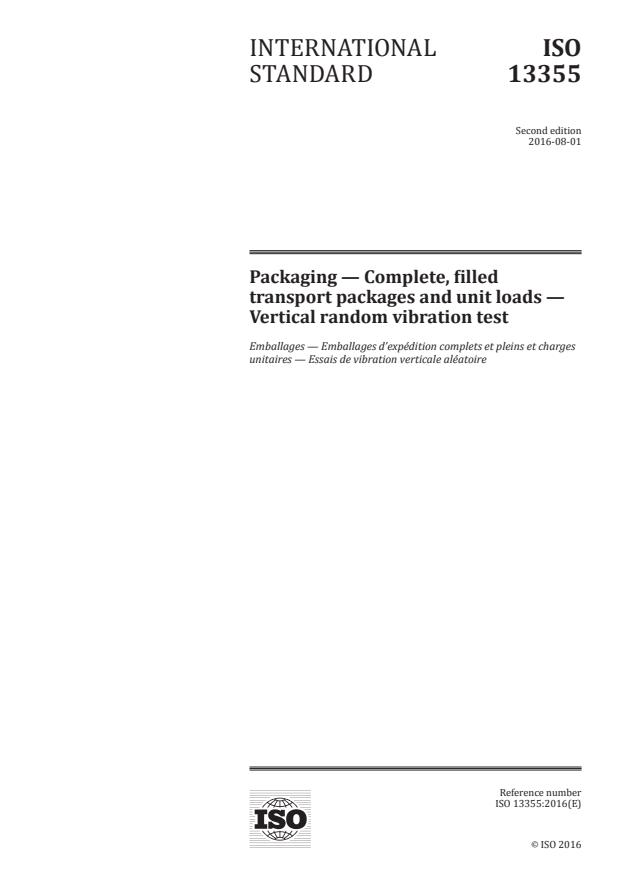
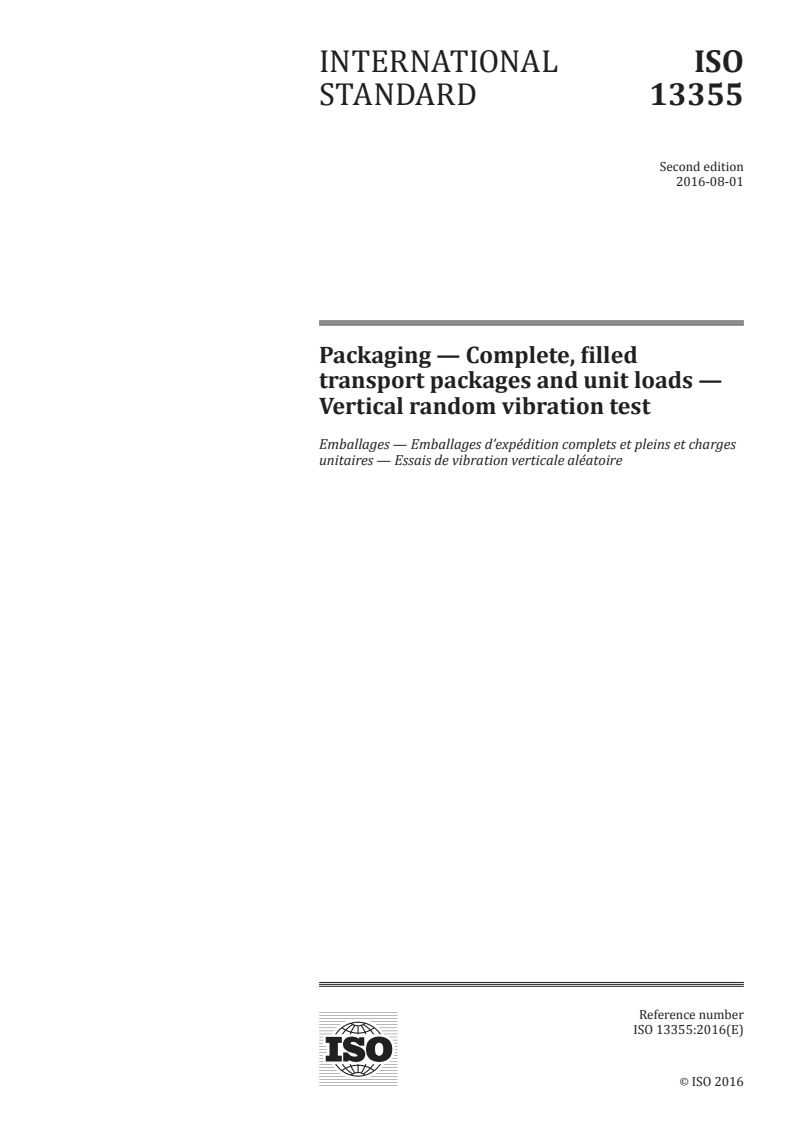
INTERNATIONAL ISO
STANDARD 13355
Second edition
2016-08-01
Packaging — Complete, filled
transport packages and unit loads —
Vertical random vibration test
Emballages — Emballages d’expédition complets et pleins et charges
unitaires — Essais de vibration verticale aléatoire
Reference number
©
ISO 2016
© ISO 2016, Published in Switzerland
All rights reserved. Unless otherwise specified, no part of this publication may be reproduced or utilized otherwise in any form
or by any means, electronic or mechanical, including photocopying, or posting on the internet or an intranet, without prior
written permission. Permission can be requested from either ISO at the address below or ISO’s member body in the country of
the requester.
ISO copyright office
Ch. de Blandonnet 8 • CP 401
CH-1214 Vernier, Geneva, Switzerland
Tel. +41 22 749 01 11
Fax +41 22 749 09 47
copyright@iso.org
www.iso.org
ii © ISO 2016 – All rights reserved
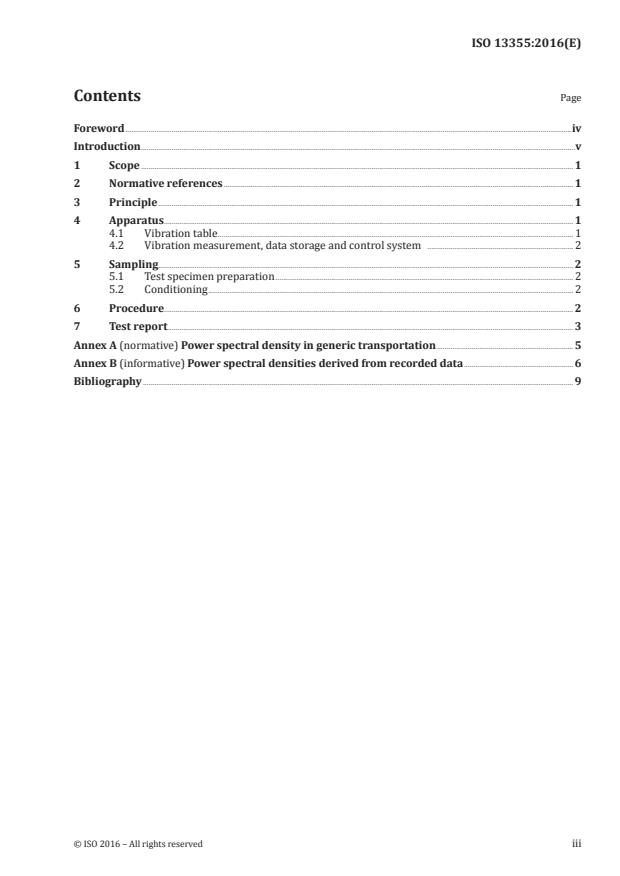
Contents Page
Foreword .iv
Introduction .v
1 Scope . 1
2 Normative references . 1
3 Principle . 1
4 Apparatus . 1
4.1 Vibration table . 1
4.2 Vibration measurement, data storage and control system . 2
5 Sampling . 2
5.1 Test specimen preparation . 2
5.2 Conditioning . 2
6 Procedure. 2
7 Test report . 3
Annex A (normative) Power spectral density in generic transportation . 5
Annex B (informative) Power spectral densities derived from recorded data .6
Bibliography . 9
Foreword
ISO (the International Organization for Standardization) is a worldwide federation of national standards
bodies (ISO member bodies). The work of preparing International Standards is normally carried out
through ISO technical committees. Each member body interested in a subject for which a technical
committee has been established has the right to be represented on that committee. International
organizations, governmental and non-governmental, in liaison with ISO, also take part in the work.
ISO collaborates closely with the International Electrotechnical Commission (IEC) on all matters of
electrotechnical standardization.
The procedures used to develop this document and those intended for its further maintenance are
described in the ISO/IEC Directives, Part 1. In particular the different approval criteria needed for the
different types of ISO documents should be noted. This document was drafted in accordance with the
editorial rules of the ISO/IEC Directives, Part 2 (see www.iso.org/directives).
Attention is drawn to the possibility that some of the elements of this document may be the subject of
patent rights. ISO shall not be held responsible for identifying any or all such patent rights. Details of
any patent rights identified during the development of the document will be in the Introduction and/or
on the ISO list of patent declarations received (see www.iso.org/patents).
Any trade name used in this document is information given for the convenience of users and does not
constitute an endorsement.
For an explanation on the meaning of ISO specific terms and expressions related to conformity assessment,
as well as information about ISO’s adherence to the World Trade Organization (WTO) principles in the
Technical Barriers to Trade (TBT) see the following URL: www.iso.org/iso/foreword.html.
The committee responsible for this document is ISO/TC 122, Packaging, Subcommittee SC 3, Performance
requirements and tests for means of packaging, packages and unit loads.
This second edition cancels and replaces the first edition (ISO 13355:2003), which has been technically
revised.
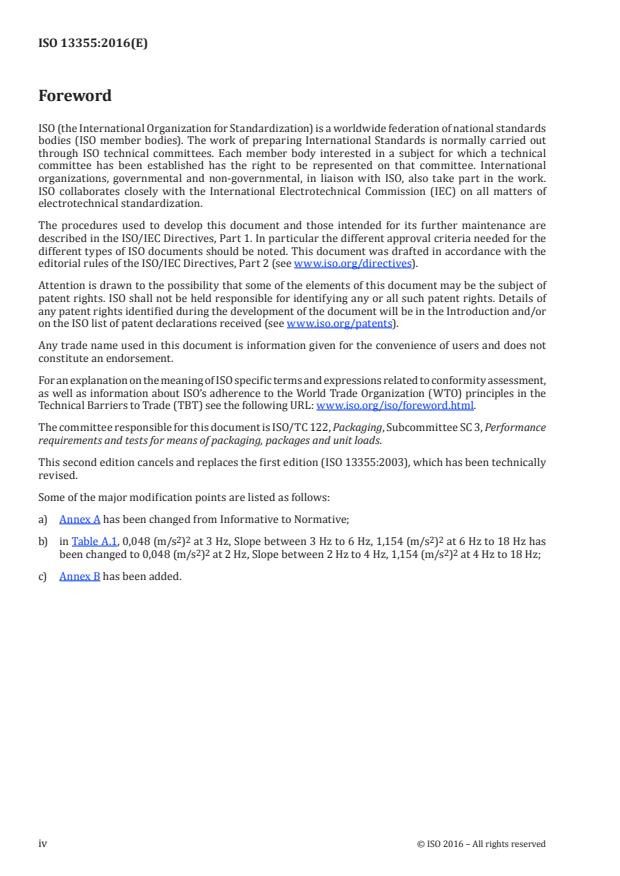
Some of the major modification points are listed as follows:
a) Annex A has been changed from Informative to Normative;
2 2 2 2
b) in Table A.1, 0,048 (m/s ) at 3 Hz, Slope between 3 Hz to 6 Hz, 1,154 (m/s ) at 6 Hz to 18 Hz has
2 2 2 2
been changed to 0,048 (m/s ) at 2 Hz, Slope between 2 Hz to 4 Hz, 1,154 (m/s ) at 4 Hz to 18 Hz;
c) Annex B has been added.
iv © ISO 2016 – All rights reserved
Introduction
A random vibration test is a more realistic method in reproducing environmental vibration during
transportation than sinusoidal vibration test. For this reason, if suitable laboratory facilities are
available, a vibration test is more preferable than any fixed or swept frequency sinusoidal vibration
tests similar to those given in ISO 2247 and ISO 8318.
INTERNATIONAL STANDARD ISO 13355:2016(E)
Packaging — Complete, filled transport packages and unit
loads — Vertical random vibration test
1 Scope
This International Standard specifies a method to carry out a vertical random vibration test on a
1)
complete, filled transport package(s) and unit loads using random excitation . This document also
provides methods for assessing the performance of a package in terms of its strength or the protection
that it offers to its contents when it is subjected to vertical vibration. The test discussed in this document
can be performed either as a single test to investigate the effects of vertical vibration, or as a part of a
sequence of tests designed to measure the ability of a test specimen to withstand a distribution system
that includes a vibration hazard.
NOTE In this International Standard, a package or unit load is referred to as test specimen.
2 Normative references
The following documents, in whole or in part, are normatively referenced in this document and are
indispensable for its application. For dated references, only the edition cited applies. For undated
references, the latest edition of the referenced document (including any amendments) applies.
ISO 2206, Packaging — Complete, filled transport packages — Identification of parts when testing
ISO 2233, Packaging — Complete, filled transport packages and unit loads — Conditioning for testing
ISO 2234, Packaging — Complete, filled transport packages and unit loads — Stacking tests using a
static load
3 Principle
The test specimen is placed on a vibration table and made to vibrate using random excitation with an
effective frequency range for the test specimen. Atmospheric conditions, test duration, acceleration
power spectral density, attitude of the test specimen and method of restraint are predetermined.
Specific requirements for mounting a test specimen on the vibrating platform are given in
ISO 4180:2009, 10.7.1.
NOTE When required, a load is superimposed on the test specimen to simulate the conditions at the bottom
of a stack.
4 Apparatus
4.1 Vibration table
A table of sufficient size and performance (in terms of power, displacement, frequency range) capable of
being stiff (its lower resonant frequency shall be higher than the higher test frequency) and remaining
horizontal during the test.
Random vibration theory is discussed in IEC 60068-2-64.
1)
The frequency range shall be 2 Hz to 200 Hz, with a resolution of at least 1 Hz. By considering the
resonance frequency of the seismic-base of the test equipment, the frequency range at the low end may
be modified based on the agreement between the involved stakeholders or on the technical instruction
of the test equipment.
The table may be equipped with the following components:
— Low fences restricting sideways and endways movements during testing;
— High fences or other means of maintaining a superimposed load in position on the test specimen
during testing.
Furthermore, the apparatus shall meet the requirements and tolerances of Clause 6.
4.2 Vibration measurement, data storage
...
INTERNATIONAL ISO
STANDARD 13355
Second edition
2016-08-01
Packaging — Complete, filled
transport packages and unit loads —
Vertical random vibration test
Emballages — Emballages d’expédition complets et pleins et charges
unitaires — Essais de vibration verticale aléatoire
Reference number
©
ISO 2016
© ISO 2016, Published in Switzerland
All rights reserved. Unless otherwise specified, no part of this publication may be reproduced or utilized otherwise in any form
or by any means, electronic or mechanical, including photocopying, or posting on the internet or an intranet, without prior
written permission. Permission can be requested from either ISO at the address below or ISO’s member body in the country of
the requester.
ISO copyright office
Ch. de Blandonnet 8 • CP 401
CH-1214 Vernier, Geneva, Switzerland
Tel. +41 22 749 01 11
Fax +41 22 749 09 47
copyright@iso.org
www.iso.org
ii © ISO 2016 – All rights reserved
Contents Page
Foreword .iv
Introduction .v
1 Scope . 1
2 Normative references . 1
3 Principle . 1
4 Apparatus . 1
4.1 Vibration table . 1
4.2 Vibration measurement, data storage and control system . 2
5 Sampling . 2
5.1 Test specimen preparation . 2
5.2 Conditioning . 2
6 Procedure. 2
7 Test report . 3
Annex A (normative) Power spectral density in generic transportation . 5
Annex B (informative) Power spectral densities derived from recorded data .6
Bibliography . 9
Foreword
ISO (the International Organization for Standardization) is a worldwide federation of national standards
bodies (ISO member bodies). The work of preparing International Standards is normally carried out
through ISO technical committees. Each member body interested in a subject for which a technical
committee has been established has the right to be represented on that committee. International
organizations, governmental and non-governmental, in liaison with ISO, also take part in the work.
ISO collaborates closely with the International Electrotechnical Commission (IEC) on all matters of
electrotechnical standardization.
The procedures used to develop this document and those intended for its further maintenance are
described in the ISO/IEC Directives, Part 1. In particular the different approval criteria needed for the
different types of ISO documents should be noted. This document was drafted in accordance with the
editorial rules of the ISO/IEC Directives, Part 2 (see www.iso.org/directives).
Attention is drawn to the possibility that some of the elements of this document may be the subject of
patent rights. ISO shall not be held responsible for identifying any or all such patent rights. Details of
any patent rights identified during the development of the document will be in the Introduction and/or
on the ISO list of patent declarations received (see www.iso.org/patents).
Any trade name used in this document is information given for the convenience of users and does not
constitute an endorsement.
For an explanation on the meaning of ISO specific terms and expressions related to conformity assessment,
as well as information about ISO’s adherence to the World Trade Organization (WTO) principles in the
Technical Barriers to Trade (TBT) see the following URL: www.iso.org/iso/foreword.html.
The committee responsible for this document is ISO/TC 122, Packaging, Subcommittee SC 3, Performance
requirements and tests for means of packaging, packages and unit loads.
This second edition cancels and replaces the first edition (ISO 13355:2003), which has been technically
revised.
Some of the major modification points are listed as follows:
a) Annex A has been changed from Informative to Normative;
2 2 2 2
b) in Table A.1, 0,048 (m/s ) at 3 Hz, Slope between 3 Hz to 6 Hz, 1,154 (m/s ) at 6 Hz to 18 Hz has
2 2 2 2
been changed to 0,048 (m/s ) at 2 Hz, Slope between 2 Hz to 4 Hz, 1,154 (m/s ) at 4 Hz to 18 Hz;
c) Annex B has been added.
iv © ISO 2016 – All rights reserved
Introduction
A random vibration test is a more realistic method in reproducing environmental vibration during
transportation than sinusoidal vibration test. For this reason, if suitable laboratory facilities are
available, a vibration test is more preferable than any fixed or swept frequency sinusoidal vibration
tests similar to those given in ISO 2247 and ISO 8318.
INTERNATIONAL STANDARD ISO 13355:2016(E)
Packaging — Complete, filled transport packages and unit
loads — Vertical random vibration test
1 Scope
This International Standard specifies a method to carry out a vertical random vibration test on a
1)
complete, filled transport package(s) and unit loads using random excitation . This document also
provides methods for assessing the performance of a package in terms of its strength or the protection
that it offers to its contents when it is subjected to vertical vibration. The test discussed in this document
can be performed either as a single test to investigate the effects of vertical vibration, or as a part of a
sequence of tests designed to measure the ability of a test specimen to withstand a distribution system
that includes a vibration hazard.
NOTE In this International Standard, a package or unit load is referred to as test specimen.
2 Normative references
The following documents, in whole or in part, are normatively referenced in this document and are
indispensable for its application. For dated references, only the edition cited applies. For undated
references, the latest edition of the referenced document (including any amendments) applies.
ISO 2206, Packaging — Complete, filled transport packages — Identification of parts when testing
ISO 2233, Packaging — Complete, filled transport packages and unit loads — Conditioning for testing
ISO 2234, Packaging — Complete, filled transport packages and unit loads — Stacking tests using a
static load
3 Principle
The test specimen is placed on a vibration table and made to vibrate using random excitation with an
effective frequency range for the test specimen. Atmospheric conditions, test duration, acceleration
power spectral density, attitude of the test specimen and method of restraint are predetermined.
Specific requirements for mounting a test specimen on the vibrating platform are given in
ISO 4180:2009, 10.7.1.
NOTE When required, a load is superimposed on the test specimen to simulate the conditions at the bottom
of a stack.
4 Apparatus
4.1 Vibration table
A table of sufficient size and performance (in terms of power, displacement, frequency range) capable of
being stiff (its lower resonant frequency shall be higher than the higher test frequency) and remaining
horizontal during the test.
Random vibration theory is discussed in IEC 60068-2-64.
1)
The frequency range shall be 2 Hz to 200 Hz, with a resolution of at least 1 Hz. By considering the
resonance frequency of the seismic-base of the test equipment, the frequency range at the low end may
be modified based on the agreement between the involved stakeholders or on the technical instruction
of the test equipment.
The table may be equipped with the following components:
— Low fences restricting sideways and endways movements during testing;
— High fences or other means of maintaining a superimposed load in position on the test specimen
during testing.
Furthermore, the apparatus shall meet the requirements and tolerances of Clause 6.
4.2 Vibration measurement, data storage
...
NORME ISO
INTERNATIONALE 13355
Deuxième édition
2016-08-01
Emballages — Emballages
d’expédition complets et pleins
et charges unitaires — Essais de
vibration verticale aléatoire
Packaging — Complete, filled transport packages and unit loads —
Vertical random vibration test
Numéro de référence
©
ISO 2016
DOCUMENT PROTÉGÉ PAR COPYRIGHT
© ISO 2016, Publié en Suisse
Droits de reproduction réservés. Sauf indication contraire, aucune partie de cette publication ne peut être reproduite ni utilisée
sous quelque forme que ce soit et par aucun procédé, électronique ou mécanique, y compris la photocopie, l’affichage sur
l’internet ou sur un Intranet, sans autorisation écrite préalable. Les demandes d’autorisation peuvent être adressées à l’ISO à
l’adresse ci-après ou au comité membre de l’ISO dans le pays du demandeur.
ISO copyright office
Ch. de Blandonnet 8 • CP 401
CH-1214 Vernier, Geneva, Switzerland
Tel. +41 22 749 01 11
Fax +41 22 749 09 47
copyright@iso.org
www.iso.org
ii © ISO 2016 – Tous droits réservés
Sommaire Page
Avant-propos .iv
Introduction .v
1 Domaine d’application . 1
2 Références normatives . 1
3 Principe . 1
4 Appareillage . 2
4.1 Table vibrante . 2
4.2 Système de mesurage des vibrations, de stockage des données et de contrôle . 2
5 Échantillonnage . 2
5.1 Préparation de l’élément d’essai . 2
5.2 Conditionnement . 2
6 Mode opératoire. 3
7 Rapport d’essai . 3
Annexe A (normative) Densité spectrale de puissance au cours d’un transport générique .5
Annexe B (informative) Densités spectrales de puissance déterminées à partir de
données enregistrées . 7
Bibliographie .10
Avant-propos
L’ISO (Organisation internationale de normalisation) est une fédération mondiale d’organismes
nationaux de normalisation (comités membres de l’ISO). L’élaboration des Normes internationales est
en général confiée aux comités techniques de l’ISO. Chaque comité membre intéressé par une étude
a le droit de faire partie du comité technique créé à cet effet. Les organisations internationales,
gouvernementales et non gouvernementales, en liaison avec l’ISO participent également aux travaux.
L’ISO collabore étroitement avec la Commission électrotechnique internationale (IEC) en ce qui
concerne la normalisation électrotechnique.
Les procédures utilisées pour élaborer le présent document et celles destinées à sa mise à jour sont
décrites dans les Directives ISO/IEC, Partie 1. Il convient, en particulier de prendre note des différents
critères d’approbation requis pour les différents types de documents ISO. Le présent document a été
rédigé conformément aux règles de rédaction données dans les Directives ISO/IEC, Partie 2 (voir www.
iso.org/directives).
L’attention est appelée sur le fait que certains des éléments du présent document peuvent faire l’objet de
droits de propriété intellectuelle ou de droits analogues. L’ISO ne saurait être tenue pour responsable
de ne pas avoir identifié de tels droits de propriété et averti de leur existence. Les détails concernant
les références aux droits de propriété intellectuelle ou autres droits analogues identifiés lors de
l’élaboration du document sont indiqués dans l’Introduction et/ou dans la liste des déclarations de
brevets reçues par l’ISO (voir www.iso.org/brevets).
Les appellations commerciales éventuellement mentionnées dans le présent document sont données
pour information, par souci de commodité, à l’intention des utilisateurs et ne sauraient constituer un
engagement.
Pour une explication de la signification des termes et expressions spécifiques de l’ISO liés à
l’évaluation de la conformité, ou pour toute information au sujet de l’adhésion de l’ISO aux principes
de l’OMC concernant les obstacles techniques au commerce (OTC), voir le lien suivant: Avant-propos —
Informations supplémentaires.
Le comité chargé de l’élaboration du présent document est l’ISO/TC 122, Emballages, sous-comité SC 3,
Exigences d’aptitude à l’emploi et méthodes d’essais des procédés d’emballages, des emballages et des
charges unitaires.
Cette deuxième édition annule et remplace la première édition (ISO 13355:2001) qui a fait l’objet d’une
révision technique.
Les principaux points modifiés sont listés ci-après:
a) l’Annexe A a été changée d’informative en normative;
2 2 2 2
b) dans le Tableau A.1, 0,048 (m/s ) à 3 Hz, pente entre 3 hz et 6 Hz, 1,154 (m/s ) de 6 hz à 18 hz a
2 2 2 2
été modifé en 0,048 (m/s ) à 2 hz, pente entre 2 hz et 4 hz, 1,154 (m/s ) de 4 hz à 18 hz;
c) une Annexe B a été ajoutée.
iv © ISO 2016 – Tous droits réservés
Introduction
Un essai de vibration aléatoire est une méthode pour reproduire les effets vibratoires occasionnés
pendant le transport plus réaliste que l’essai de vibration sinusoïdale. Pour cette raison, si des
installations de laboratoire appropriées sont disponibles, un essai de vibration est préférable à tout
essai de vibration à fréquence fixe ou à balayage de fréquence sinusoïdale similaire à ceux donnés dans
[1]
l’ISO 2247 et dans l’ISO 8318.
NORME INTERNATIONALE ISO 13355:2016(F)
Emballages — Emballages d’expédition complets et
pleins et charges unitaires — Essais de vibration verticale
aléatoire
1 Domaine d’application
La présente Norme internationale spécifie une méthode pour réaliser un essai de vibration verticale
aléatoire sur un (des) emballage(s) d’expédition complet(s) et plein(s) et les charges unitaires à l’aide
1)
d’une excitation aléatoire .
Ce document fournit des méthodes pour évaluer la performance d’un emballage en fonction de sa
résistance ou de la protection qu’il offre à son contenu lorsqu’il est soumis à des vibrations verticales.
L’essai abordé dans la présente Norme internationale peut être effectué comme un essai isolé, dans le
but d’examiner les effets d’une vibration verticale, ou peut faire partie d’une série d’essais destinés à
mesurer la résistance d’un élément d’essai dans un système de distribution qui comprend un risque de
vibration.
NOTE Dans la présente Norme internationale, un emballage ou une charge unitaire est nommé un élément
d’essai.
2 Références normatives
Les documents de référence suivants sont indispensables pour l’application du présent document. Pour
les références datées, seule l’édition citée s’applique. Pour les références non datées, la dernière édition
du document de référence s’applique (y compris les éventuels amendements).
ISO 2206, Emballages — Emballages d’expédition complets et pleins — Identification des différentes parties
en vue des essais
ISO 2233, Emballages — Emballages d’expédition complets et pleins et charges unitaires — Conditionnement
en vue des essais
ISO 2234, Emballages — Emballages d’expédition complets et pleins et charges unitaires — Essais de
gerbage utilisant une charge statique
3 Principe
Un élément d’essai est placé sur une table vibrante et soumis à des vibrations en utilisant une excitation
aléatoire dans une gamme de fréquences effective pour l’élément d’essai. Les conditions atmosphériques,
la durée de l’essai, la densité spectrale de puissance d’accélération, la position de l’élément d’essai et son
mode de fixation sont prédéterminés.
Des exigences spécifiques relatives au montage de l’élément d’essai sur la table vibrante sont spécifiées
dans l’ISO 4180:2009, 10.7.1.
NOTE Si nécessaire, une charge peut être superposée sur l’élément d’essai en vue de simuler les conditions
pouvant exister à la base d’un empilement.
1) La théorie de la vibration aléatoire est abordée dans la norme IEC 60068-2-64.
4 Appareillage
4.1 Table vibrante
Table de dimensions et performance suffisantes (en termes de puissance, de déplacement et de gamme
de fréquences), capable d’être rigide (sa fréquence de résonance inférieure doit être supérieure à la
fréquence d’essai la plus élevée) et de rester en position horizontale pendant l’essai.
La gamme de fréquences doit aller de 2 Hz à 200 Hz, avec une résolution d’au moins 1 Hz. Compte tenu
de la fréquence de résonance de la base sismique de l’équipement d’essai, la gamme de fréquences à
l’extrémité inférieure peut être modifiée par accord entre les parties prenantes concernées ou sur la
base des instructions techniques relatives à l’équipement d’essai.
La table peut être équipée des éléments suivants:
— Clôture basse destinée à restreindre les mouvements latéraux et longitudinaux de la charge pendant
l’essai.
— Clôture haute ou tout autre dispositif permettant de maintenir en place, au cours de l’essai, la charge
superposée à l’élément d’essai.
L’appareillage doit, en outre, satisfaire aux exigences et tolérances indiquées à l’Article 6.
4.2 Système de mesurage des vibrations, de stockage des données et de contrôle
Système comprenant des accéléromètres, des systèmes de traitement des signaux et un calculateur
présentant les caractéristiques suivantes:
— capacité de générer des vibrations ayant la densité spectrale de puissance requise;
— capacité de contrôler les mouvements de la table vibrante en renvoyant le signal de l’accéléromètre
de contrôle qui surveille l’accélération de la table;
— capacité d’
...
NORME ISO
INTERNATIONALE 13355
Deuxième édition
2016-08-01
Emballages — Emballages
d’expédition complets et pleins
et charges unitaires — Essais de
vibration verticale aléatoire
Packaging — Complete, filled transport packages and unit loads —
Vertical random vibration test
Numéro de référence
©
ISO 2016
DOCUMENT PROTÉGÉ PAR COPYRIGHT
© ISO 2016, Publié en Suisse
Droits de reproduction réservés. Sauf indication contraire, aucune partie de cette publication ne peut être reproduite ni utilisée
sous quelque forme que ce soit et par aucun procédé, électronique ou mécanique, y compris la photocopie, l’affichage sur
l’internet ou sur un Intranet, sans autorisation écrite préalable. Les demandes d’autorisation peuvent être adressées à l’ISO à
l’adresse ci-après ou au comité membre de l’ISO dans le pays du demandeur.
ISO copyright office
Ch. de Blandonnet 8 • CP 401
CH-1214 Vernier, Geneva, Switzerland
Tel. +41 22 749 01 11
Fax +41 22 749 09 47
copyright@iso.org
www.iso.org
ii © ISO 2016 – Tous droits réservés
Sommaire Page
Avant-propos .iv
Introduction .v
1 Domaine d’application . 1
2 Références normatives . 1
3 Principe . 1
4 Appareillage . 2
4.1 Table vibrante . 2
4.2 Système de mesurage des vibrations, de stockage des données et de contrôle . 2
5 Échantillonnage . 2
5.1 Préparation de l’élément d’essai . 2
5.2 Conditionnement . 2
6 Mode opératoire. 3
7 Rapport d’essai . 3
Annexe A (normative) Densité spectrale de puissance au cours d’un transport générique .5
Annexe B (informative) Densités spectrales de puissance déterminées à partir de
données enregistrées . 7
Bibliographie .10
Avant-propos
L’ISO (Organisation internationale de normalisation) est une fédération mondiale d’organismes
nationaux de normalisation (comités membres de l’ISO). L’élaboration des Normes internationales est
en général confiée aux comités techniques de l’ISO. Chaque comité membre intéressé par une étude
a le droit de faire partie du comité technique créé à cet effet. Les organisations internationales,
gouvernementales et non gouvernementales, en liaison avec l’ISO participent également aux travaux.
L’ISO collabore étroitement avec la Commission électrotechnique internationale (IEC) en ce qui
concerne la normalisation électrotechnique.
Les procédures utilisées pour élaborer le présent document et celles destinées à sa mise à jour sont
décrites dans les Directives ISO/IEC, Partie 1. Il convient, en particulier de prendre note des différents
critères d’approbation requis pour les différents types de documents ISO. Le présent document a été
rédigé conformément aux règles de rédaction données dans les Directives ISO/IEC, Partie 2 (voir www.
iso.org/directives).
L’attention est appelée sur le fait que certains des éléments du présent document peuvent faire l’objet de
droits de propriété intellectuelle ou de droits analogues. L’ISO ne saurait être tenue pour responsable
de ne pas avoir identifié de tels droits de propriété et averti de leur existence. Les détails concernant
les références aux droits de propriété intellectuelle ou autres droits analogues identifiés lors de
l’élaboration du document sont indiqués dans l’Introduction et/ou dans la liste des déclarations de
brevets reçues par l’ISO (voir www.iso.org/brevets).
Les appellations commerciales éventuellement mentionnées dans le présent document sont données
pour information, par souci de commodité, à l’intention des utilisateurs et ne sauraient constituer un
engagement.
Pour une explication de la signification des termes et expressions spécifiques de l’ISO liés à
l’évaluation de la conformité, ou pour toute information au sujet de l’adhésion de l’ISO aux principes
de l’OMC concernant les obstacles techniques au commerce (OTC), voir le lien suivant: Avant-propos —
Informations supplémentaires.
Le comité chargé de l’élaboration du présent document est l’ISO/TC 122, Emballages, sous-comité SC 3,
Exigences d’aptitude à l’emploi et méthodes d’essais des procédés d’emballages, des emballages et des
charges unitaires.
Cette deuxième édition annule et remplace la première édition (ISO 13355:2001) qui a fait l’objet d’une
révision technique.
Les principaux points modifiés sont listés ci-après:
a) l’Annexe A a été changée d’informative en normative;
2 2 2 2
b) dans le Tableau A.1, 0,048 (m/s ) à 3 Hz, pente entre 3 hz et 6 Hz, 1,154 (m/s ) de 6 hz à 18 hz a
2 2 2 2
été modifé en 0,048 (m/s ) à 2 hz, pente entre 2 hz et 4 hz, 1,154 (m/s ) de 4 hz à 18 hz;
c) une Annexe B a été ajoutée.
iv © ISO 2016 – Tous droits réservés
Introduction
Un essai de vibration aléatoire est une méthode pour reproduire les effets vibratoires occasionnés
pendant le transport plus réaliste que l’essai de vibration sinusoïdale. Pour cette raison, si des
installations de laboratoire appropriées sont disponibles, un essai de vibration est préférable à tout
essai de vibration à fréquence fixe ou à balayage de fréquence sinusoïdale similaire à ceux donnés dans
[1]
l’ISO 2247 et dans l’ISO 8318.
NORME INTERNATIONALE ISO 13355:2016(F)
Emballages — Emballages d’expédition complets et
pleins et charges unitaires — Essais de vibration verticale
aléatoire
1 Domaine d’application
La présente Norme internationale spécifie une méthode pour réaliser un essai de vibration verticale
aléatoire sur un (des) emballage(s) d’expédition complet(s) et plein(s) et les charges unitaires à l’aide
1)
d’une excitation aléatoire .
Ce document fournit des méthodes pour évaluer la performance d’un emballage en fonction de sa
résistance ou de la protection qu’il offre à son contenu lorsqu’il est soumis à des vibrations verticales.
L’essai abordé dans la présente Norme internationale peut être effectué comme un essai isolé, dans le
but d’examiner les effets d’une vibration verticale, ou peut faire partie d’une série d’essais destinés à
mesurer la résistance d’un élément d’essai dans un système de distribution qui comprend un risque de
vibration.
NOTE Dans la présente Norme internationale, un emballage ou une charge unitaire est nommé un élément
d’essai.
2 Références normatives
Les documents de référence suivants sont indispensables pour l’application du présent document. Pour
les références datées, seule l’édition citée s’applique. Pour les références non datées, la dernière édition
du document de référence s’applique (y compris les éventuels amendements).
ISO 2206, Emballages — Emballages d’expédition complets et pleins — Identification des différentes parties
en vue des essais
ISO 2233, Emballages — Emballages d’expédition complets et pleins et charges unitaires — Conditionnement
en vue des essais
ISO 2234, Emballages — Emballages d’expédition complets et pleins et charges unitaires — Essais de
gerbage utilisant une charge statique
3 Principe
Un élément d’essai est placé sur une table vibrante et soumis à des vibrations en utilisant une excitation
aléatoire dans une gamme de fréquences effective pour l’élément d’essai. Les conditions atmosphériques,
la durée de l’essai, la densité spectrale de puissance d’accélération, la position de l’élément d’essai et son
mode de fixation sont prédéterminés.
Des exigences spécifiques relatives au montage de l’élément d’essai sur la table vibrante sont spécifiées
dans l’ISO 4180:2009, 10.7.1.
NOTE Si nécessaire, une charge peut être superposée sur l’élément d’essai en vue de simuler les conditions
pouvant exister à la base d’un empilement.
1) La théorie de la vibration aléatoire est abordée dans la norme IEC 60068-2-64.
4 Appareillage
4.1 Table vibrante
Table de dimensions et performance suffisantes (en termes de puissance, de déplacement et de gamme
de fréquences), capable d’être rigide (sa fréquence de résonance inférieure doit être supérieure à la
fréquence d’essai la plus élevée) et de rester en position horizontale pendant l’essai.
La gamme de fréquences doit aller de 2 Hz à 200 Hz, avec une résolution d’au moins 1 Hz. Compte tenu
de la fréquence de résonance de la base sismique de l’équipement d’essai, la gamme de fréquences à
l’extrémité inférieure peut être modifiée par accord entre les parties prenantes concernées ou sur la
base des instructions techniques relatives à l’équipement d’essai.
La table peut être équipée des éléments suivants:
— Clôture basse destinée à restreindre les mouvements latéraux et longitudinaux de la charge pendant
l’essai.
— Clôture haute ou tout autre dispositif permettant de maintenir en place, au cours de l’essai, la charge
superposée à l’élément d’essai.
L’appareillage doit, en outre, satisfaire aux exigences et tolérances indiquées à l’Article 6.
4.2 Système de mesurage des vibrations, de stockage des données et de contrôle
Système comprenant des accéléromètres, des systèmes de traitement des signaux et un calculateur
présentant les caractéristiques suivantes:
— capacité de générer des vibrations ayant la densité spectrale de puissance requise;
— capacité de contrôler les mouvements de la table vibrante en renvoyant le signal de l’accéléromètre
de contrôle qui surveille l’accélération de la table;
— capacité d’
...