


ISO 10303-239:2024
(Main)Industrial automation systems and integration — Product data representation and exchange — Part 239: Application protocol: Product life cycle support
Industrial automation systems and integration — Product data representation and exchange — Part 239: Application protocol: Product life cycle support
This document specifies the application protocol for product life cycle support. The following are within the scope of this document: information for defining a complex product and its support solution; information required to maintain a complex product; information required for through life configuration change management of a product and its support solution; the representation of product assemblies including: the identification and representation of parts, their versions, definitions, and documentation and management information, such as dates and approvals assigned to parts; the representation of multiple product structure views and product breakdowns; the representation of the shape of an assembly as the composition of the shape representation of its components; the identification of positions within an assembly of parts to which component parts can be attached; the association of valued properties to a part or to an assembly; the representation of interfaces between products; the classification of parts, documents and assemblies. the representation of a product through life including: the representation of product requirements and their fulfilment; the representation of existing or potential future products; the identification of the configuration of a product for a given role; the specification of effectivity constraints applied to configuration of a product; the representation of predicted and observed states of products. the specification and planning of activities for a product including: the specification of tasks to be performed on a product; the representation of conditions for performing the tasks, including the resources required and the location of the resources and product; the representation of the type of person and skills required for performing a task; the representation of planning and scheduling of the tasks and the management and authorization of the subsequent work. the representation of the activity history of a product including: the recording of the usage of a product and the resource usage; the recording of the activities performed on a product and the resource usage. the representation of the product history including: a historical record of the states of a product; a historical record of the configuration status of the product; the location of product data; the observation of product data. The following are outside the scope of this document: the representation of business transactions for ordering, supplying or returning products and other resources needed for product support; the representation of business transactions concerning the transportation, shipment and receipt of products and other resources needed for product support.
Systèmes d'automatisation industrielle et intégration — Représentation et échange de données de produits — Partie 239: Protocole d'application: Soutien du cycle de vie du produit
General Information
- Status
- Not Published
- Publication Date
- 30-Oct-2024
- Technical Committee
- ISO/TC 184/SC 4 - Industrial data
- Drafting Committee
- ISO/TC 184/SC 4/WG 12 - STEP product modelling and resources
- Current Stage
- 6060 - International Standard published
- Start Date
- 31-Oct-2024
- Due Date
- 15-Jun-2024
- Completion Date
- 31-Oct-2024
Relations
- Effective Date
- 23-Apr-2020
Overview
ISO 10303-239:2024, titled "Industrial automation systems and integration - Product data representation and exchange - Part 239: Application protocol: Product life cycle support," is a key international standard published by ISO. This document specifies comprehensive application protocols to manage and support complex products throughout their entire life cycle. It enables consistent representation and exchange of product data, focusing on product maintenance, configuration change management, assembly representation, planning and scheduling of tasks, activity history, and product state tracking.
The standard primarily targets industries requiring sophisticated product life cycle management tools and data interoperability across various automation and integration systems.
Key Topics
Complex Product Definition and Support Solution
Detailing the information needed to define complex products along with their support frameworks.Product Maintenance and Configuration Management
Guidelines for maintaining products and managing configuration changes throughout the product life cycle.Product Assemblies and Structure Views
Representation of product assemblies, including identification and versioning of parts, multiple product breakdown structures, and shape composition of assemblies from component shapes.Part Positioning and Interfaces
Identification of assembly positions where components attach and detailed representation of interfaces between products.Valued Properties and Classification
Associating properties to parts or assemblies and classification of parts, documents, and whole product assemblies.Life Cycle Representation
Representation of product requirements, current and future product configurations, effectivity constraints, and the predicted and observed states of products.Task Specification and Planning
Specification of tasks including conditions, required resources, locations, skills, planning, scheduling, management, and authorization.Activity and Product History
Recording usage and activities performed on products, resource usage, and maintaining historical records of product states and configurations.
Applications
ISO 10303-239:2024 facilitates:
Industrial Automation Systems
Integration and interoperability of automated manufacturing, maintenance, and service systems.Product Life Cycle Management (PLM)
Supporting seamless data exchange and consistent tracking of product configuration, requirements, and maintenance activities.Configuration Change Management
Effective handling of updates to product designs, assembly structures, or support solutions over a product's lifetime.Maintenance and Service Planning
Detailed mapping of maintenance tasks, resource allocation, and scheduling to optimize product uptime and service quality.Product Data Interchange
Standardized exchange of product definition, state, and history data across different IT systems and stakeholders.Quality and Compliance Tracking
Recording approval dates, version control, and documentation management to ensure compliance with industrial standards.
Related Standards
ISO 13584 (Parts Library - EXPRESS Schemas)
Provides logical models and EXPRESS-based definitions supporting representation of components and expressions, referenced in product data modeling.ISO 10303 (STEP - Standard for the Exchange of Product Model Data)
The overarching framework for product data representation and exchange, of which ISO 10303-239 is a crucial application protocol.ISO/TC 184/SC 4 Standards
Industrial data standards focusing on automation systems and integration that complement the protocols for product life cycle support.
Practical Value
Adopting ISO 10303-239:2024 equips organizations with a robust framework to manage the entire product life cycle digitally and consistently. It enhances collaboration among engineering, manufacturing, maintenance, and supply chain teams by ensuring all stakeholders have access to harmonized product information. The standard's comprehensive approach to task planning, configuration change management, and activity history tracking supports predictive maintenance and improves product reliability, reducing downtime and operational costs.
By integrating this standard into digital product data systems, industries can achieve optimized lifecycle management, improved data accuracy, and better regulatory compliance - all critical for modern industrial automation and smart manufacturing environments.
ISO_13584-20_1998_Cor_1_2014 - ISO/DIS 10303-239 - Industrial automation systems and integration — Product data representation and exchange — Part 239: Application protocol: Product life cycle support (PLCS) Released:31. 05. 2023
ISO_13584-42_2010(E)-Character_PDF_document - ISO/DIS 10303-239 - Industrial automation systems and integration — Product data representation and exchange — Part 239: Application protocol: Product life cycle support (PLCS) Released:31. 05. 2023
Get Certified
Connect with accredited certification bodies for this standard

National Aerospace and Defense Contractors Accreditation Program (NADCAP)
Global cooperative program for special process quality in aerospace.
CARES (UK Certification Authority for Reinforcing Steels)
UK certification for reinforcing steels and construction.
DVS-ZERT GmbH
German welding certification society.
Sponsored listings
Frequently Asked Questions
ISO 10303-239:2024 is a draft published by the International Organization for Standardization (ISO). Its full title is "Industrial automation systems and integration — Product data representation and exchange — Part 239: Application protocol: Product life cycle support". This standard covers: This document specifies the application protocol for product life cycle support. The following are within the scope of this document: information for defining a complex product and its support solution; information required to maintain a complex product; information required for through life configuration change management of a product and its support solution; the representation of product assemblies including: the identification and representation of parts, their versions, definitions, and documentation and management information, such as dates and approvals assigned to parts; the representation of multiple product structure views and product breakdowns; the representation of the shape of an assembly as the composition of the shape representation of its components; the identification of positions within an assembly of parts to which component parts can be attached; the association of valued properties to a part or to an assembly; the representation of interfaces between products; the classification of parts, documents and assemblies. the representation of a product through life including: the representation of product requirements and their fulfilment; the representation of existing or potential future products; the identification of the configuration of a product for a given role; the specification of effectivity constraints applied to configuration of a product; the representation of predicted and observed states of products. the specification and planning of activities for a product including: the specification of tasks to be performed on a product; the representation of conditions for performing the tasks, including the resources required and the location of the resources and product; the representation of the type of person and skills required for performing a task; the representation of planning and scheduling of the tasks and the management and authorization of the subsequent work. the representation of the activity history of a product including: the recording of the usage of a product and the resource usage; the recording of the activities performed on a product and the resource usage. the representation of the product history including: a historical record of the states of a product; a historical record of the configuration status of the product; the location of product data; the observation of product data. The following are outside the scope of this document: the representation of business transactions for ordering, supplying or returning products and other resources needed for product support; the representation of business transactions concerning the transportation, shipment and receipt of products and other resources needed for product support.
This document specifies the application protocol for product life cycle support. The following are within the scope of this document: information for defining a complex product and its support solution; information required to maintain a complex product; information required for through life configuration change management of a product and its support solution; the representation of product assemblies including: the identification and representation of parts, their versions, definitions, and documentation and management information, such as dates and approvals assigned to parts; the representation of multiple product structure views and product breakdowns; the representation of the shape of an assembly as the composition of the shape representation of its components; the identification of positions within an assembly of parts to which component parts can be attached; the association of valued properties to a part or to an assembly; the representation of interfaces between products; the classification of parts, documents and assemblies. the representation of a product through life including: the representation of product requirements and their fulfilment; the representation of existing or potential future products; the identification of the configuration of a product for a given role; the specification of effectivity constraints applied to configuration of a product; the representation of predicted and observed states of products. the specification and planning of activities for a product including: the specification of tasks to be performed on a product; the representation of conditions for performing the tasks, including the resources required and the location of the resources and product; the representation of the type of person and skills required for performing a task; the representation of planning and scheduling of the tasks and the management and authorization of the subsequent work. the representation of the activity history of a product including: the recording of the usage of a product and the resource usage; the recording of the activities performed on a product and the resource usage. the representation of the product history including: a historical record of the states of a product; a historical record of the configuration status of the product; the location of product data; the observation of product data. The following are outside the scope of this document: the representation of business transactions for ordering, supplying or returning products and other resources needed for product support; the representation of business transactions concerning the transportation, shipment and receipt of products and other resources needed for product support.
ISO 10303-239:2024 is classified under the following ICS (International Classification for Standards) categories: 25.040.40 - Industrial process measurement and control. The ICS classification helps identify the subject area and facilitates finding related standards.
ISO 10303-239:2024 has the following relationships with other standards: It is inter standard links to ISO 10303-239:2012. Understanding these relationships helps ensure you are using the most current and applicable version of the standard.
ISO 10303-239:2024 is available in PDF format for immediate download after purchase. The document can be added to your cart and obtained through the secure checkout process. Digital delivery ensures instant access to the complete standard document.
Standards Content (Sample)
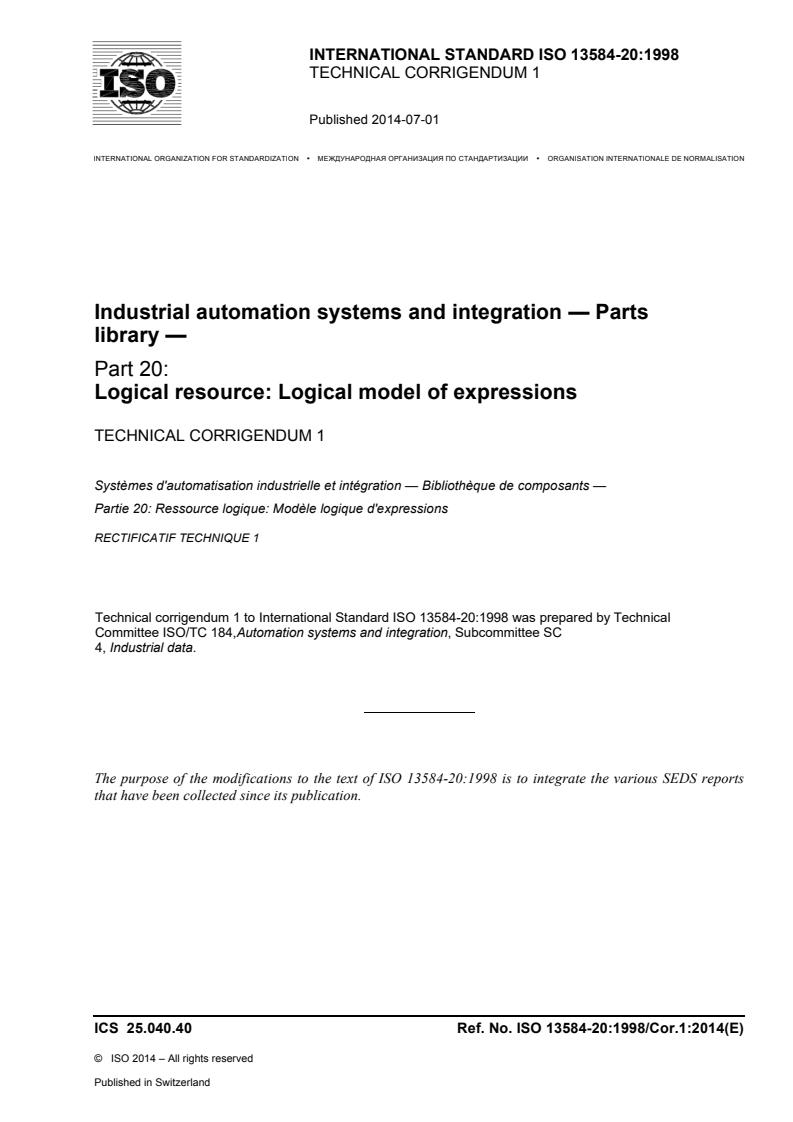
INTERNATIONAL STANDARD ISO 13584-20:1998
TECHNICAL CORRIGENDUM 1
Published 2014-07-01
INTERNATIONAL ORGANIZATION FOR STANDARDIZATION • МЕЖДУНАРОДНАЯ ОРГАНИЗАЦИЯ ПО СТАНДАРТИЗАЦИИ • ORGANISATION INTERNATIONALE DE NORMALISATION
Industrial automation systems and integration — Parts
library —
Part 20:
Logical resource: Logical model of expressions
TECHNICAL CORRIGENDUM 1
Systèmes d'automatisation industrielle et intégration — Bibliothèque de composants —
Partie 20: Ressource logique: Modèle logique d'expressions
RECTIFICATIF TECHNIQUE 1
Technical corrigendum 1 to International Standard ISO 13584-20:1998 was prepared by Technical
Committee ISO/TC 184,Automation systems and integration, Subcommittee SC
4, Industrial data.
The purpose of the modifications to the text of ISO 13584-20:1998 is to integrate the various SEDS reports
that have been collected since its publication.
ICS 25.040.40 Ref. No. ISO 13584-20:1998/Cor.1:2014(E)
© ISO 2014 – All rights reserved
Published in Switzerland
ISO 13584-20:1998/Cor.1:2014(E)
Modifications to the text of ISO 13584-20:1998
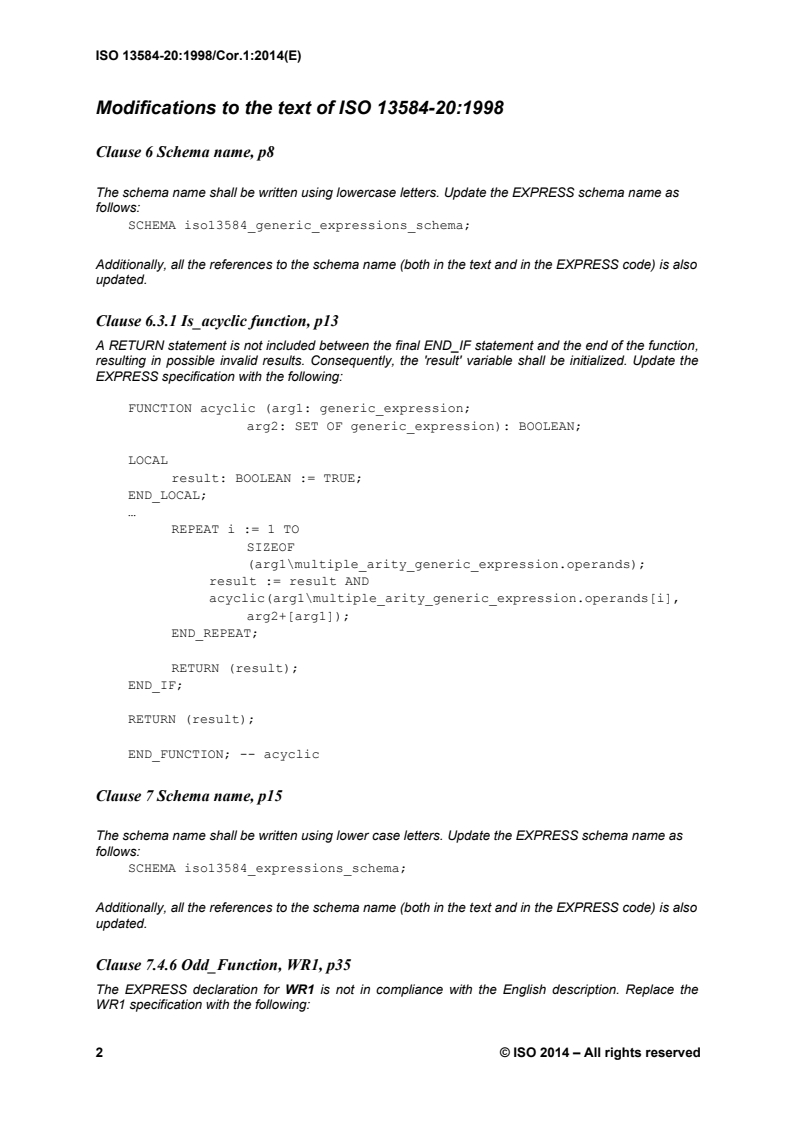
Clause 6 Schema name, p8
The schema name shall be written using lowercase letters. Update the EXPRESS schema name as
follows:
SCHEMA iso13584_generic_expressions_schema;
Additionally, all the references to the schema name (both in the text and in the EXPRESS code) is also
updated.
Clause 6.3.1 Is_acyclic function, p13
A RETURN statement is not included between the final END_IF statement and the end of the function,
resulting in possible invalid results. Consequently, the 'result' variable shall be initialized. Update the
EXPRESS specification with the following:
FUNCTION acyclic (arg1: generic_expression;
arg2: SET OF generic_expression): BOOLEAN;
LOCAL
result: BOOLEAN := TRUE;
END_LOCAL;
…
REPEAT i := 1 TO
SIZEOF
(arg1\multiple_arity_generic_expression.operands);
result := result AND
acyclic(arg1\multiple_arity_generic_expression.operands[i],
arg2+[arg1]);
END_REPEAT;
RETURN (result);
END_IF;
RETURN (result);
END_FUNCTION; -- acyclic
Clause 7 Schema name, p15
The schema name shall be written using lower case letters. Update the EXPRESS schema name as
follows:
SCHEMA iso13584_expressions_schema;
Additionally, all the references to the schema name (both in the text and in the EXPRESS code) is also
updated.
Clause 7.4.6 Odd_Function, WR1, p35
The EXPRESS declaration for WR1 is not in compliance with the English description. Replace the
WR1 specification with the following:
2 © ISO 2014 – All rights reserved
ISO 13584-20:1998/Cor.1:2014(E)
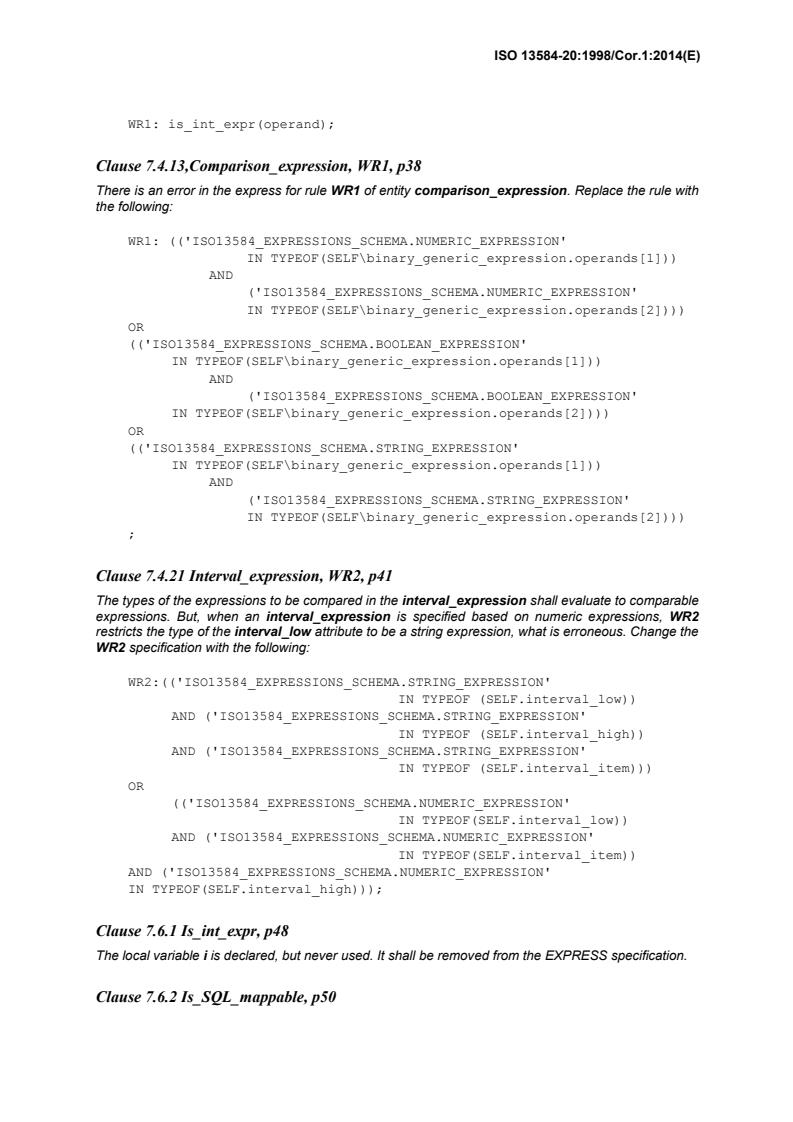
WR1: is_int_expr(operand);
Clause 7.4.13,Comparison_expression, WR1, p38
There is an error in the express for rule WR1 of entity comparison_expression. Replace the rule with
the following:
WR1: (('ISO13584_EXPRESSIONS_SCHEMA.NUMERIC_EXPRESSION'
IN TYPEOF(SELF\binary_generic_expression.operands[1]))
AND
('ISO13584_EXPRESSIONS_SCHEMA.NUMERIC_EXPRESSION'
IN TYPEOF(SELF\binary_generic_expression.operands[2])))
OR
(('ISO13584_EXPRESSIONS_SCHEMA.BOOLEAN_EXPRESSION'
IN TYPEOF(SELF\binary_generic_expression.operands[1]))
AND
('ISO13584_EXPRESSIONS_SCHEMA.BOOLEAN_EXPRESSION'
IN TYPEOF(SELF\binary_generic_expression.operands[2])))
OR
(('ISO13584_EXPRESSIONS_SCHEMA.STRING_EXPRESSION'
IN TYPEOF(SELF\binary_generic_expression.operands[1]))
AND
('ISO13584_EXPRESSIONS_SCHEMA.STRING_EXPRESSION'
IN TYPEOF(SELF\binary_generic_expression.operands[2])))
;
Clause 7.4.21 Interval_expression, WR2, p41
The types of the expressions to be compared in the interval_expression shall evaluate to comparable
expressions. But, when an interval_expression is specified based on numeric expressions, WR2
restricts the type of the interval_low attribute to be a string expression, what is erroneous. Change the
WR2 specification with the following:
WR2:(('ISO13584_EXPRESSIONS_SCHEMA.STRING_EXPRESSION'
IN TYPEOF (SELF.interval_low))
AND ('ISO13584_EXPRESSIONS_SCHEMA.STRING_EXPRESSION'
IN TYPEOF (SELF.interval_high))
AND ('ISO13584_EXPRESSIONS_SCHEMA.STRING_EXPRESSION'
IN TYPEOF (SELF.interval_item)))
OR
(('ISO13584_EXPRESSIONS_SCHEMA.NUMERIC_EXPRESSION'
IN TYPEOF(SELF.interval_low))
AND ('ISO13584_EXPRESSIONS_SCHEMA.NUMERIC_EXPRESSION'
IN TYPEOF(SELF.interval_item))
AND ('ISO13584_EXPRESSIONS_SCHEMA.NUMERIC_EXPRESSION'
IN TYPEOF(SELF.interval_high)));
Clause 7.6.1 Is_int_expr, p48
The local variable i is declared, but never used. It shall be removed from the EXPRESS specification.
Clause 7.6.2 Is_SQL_mappable, p50
ISO 13584-20:1998/Cor.1:2014(E)
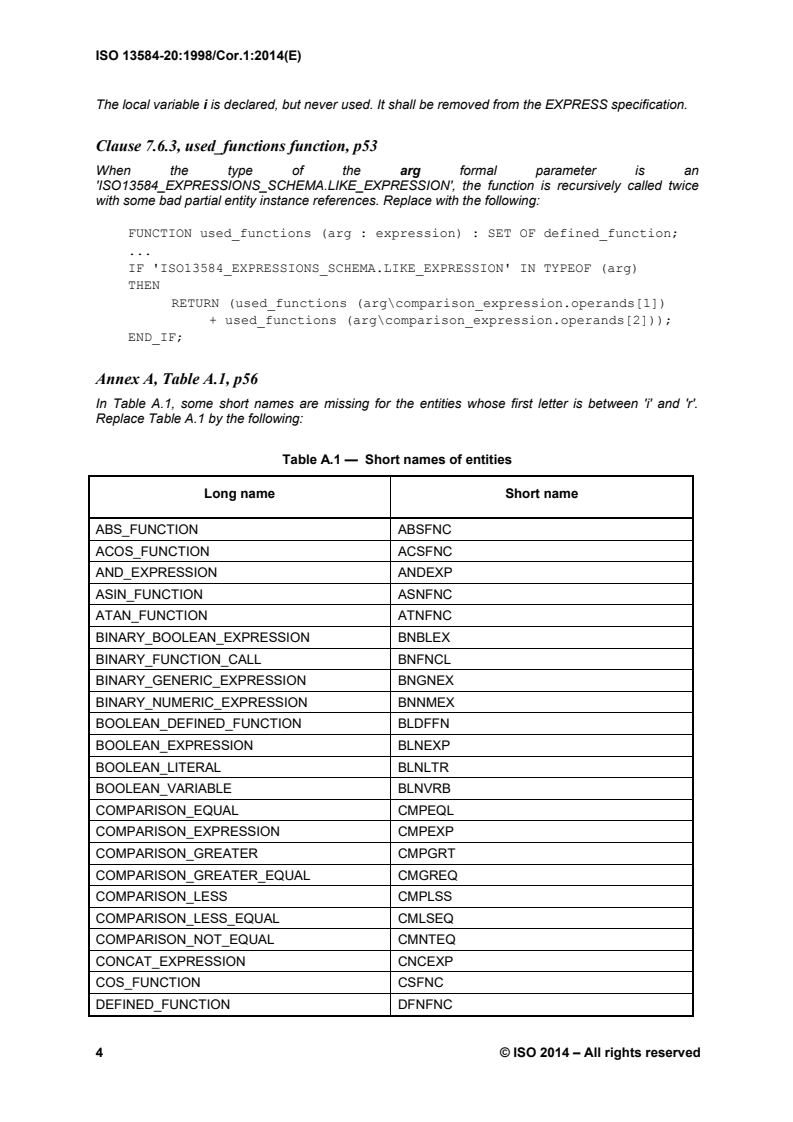
The local variable i is declared, but never used. It shall be removed from the EXPRESS specification.
Clause 7.6.3, used_functions function, p53
When the type of the arg formal parameter is an
'ISO13584_EXPRESSIONS_SCHEMA.LIKE_EXPRESSION', the function is recursively called twice
with some bad partial entity instance references. Replace with the following:
FUNCTION used_functions (arg : expression) : SET OF defined_function;
...
IF 'ISO13584_EXPRESSIONS_SCHEMA.LIKE_EXPRESSION' IN TYPEOF (arg)
THEN
RETURN (used_functions (arg\comparison_expression.operands[1])
+ used_functions (arg\comparison_expression.operands[2]));
END_IF;
Annex A, Table A.1, p56
In Table A.1, some short names are missing for the entities whose first letter is between 'i' and 'r'.
Replace Table A.1 by the following:
Table A.1 — Short names of entities
Long name Short name
ABS_FUNCTION ABSFNC
ACOS_FUNCTION ACSFNC
AND_EXPRESSION ANDEXP
ASIN_FUNCTION ASNFNC
ATAN_FUNCTION ATNFNC
BINARY_BOOLEAN_EXPRESSION BNBLEX
BINARY_FUNCTION_CALL BNFNCL
BINARY_GENERIC_EXPRESSION BNGNEX
BINARY_NUMERIC_EXPRESSION BNNMEX
BOOLEAN_DEFINED_FUNCTION BLDFFN
BOOLEAN_EXPRESSION BLNEXP
BOOLEAN_LITERAL BLNLTR
BOOLEAN_VARIABLE BLNVRB
COMPARISON_EQUAL CMPEQL
COMPARISON_EXPRESSION CMPEXP
COMPARISON_GREATER CMPGRT
COMPARISON_GREATER_EQUAL CMGREQ
COMPARISON_LESS CMPLSS
COMPARISON_LESS_EQUAL CMLSEQ
COMPARISON_NOT_EQUAL
...
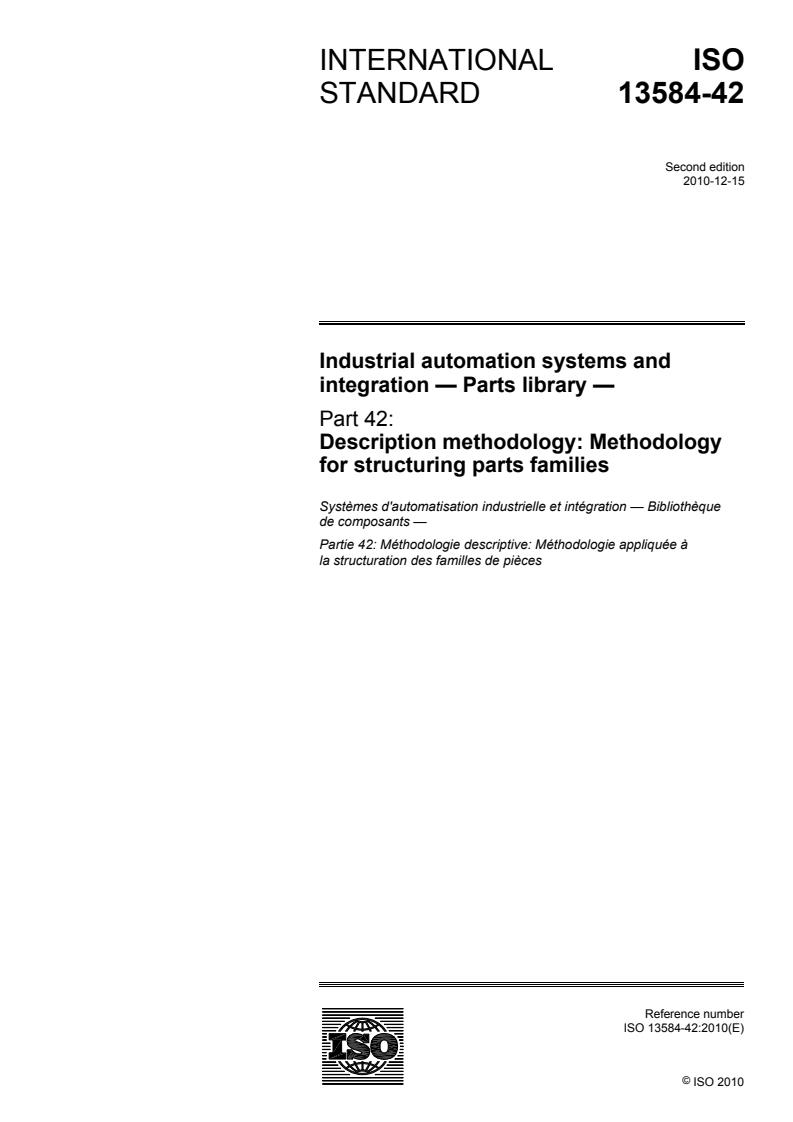
INTERNATIONAL ISO
STANDARD 13584-42
Second edition
2010-12-15
Industrial automation systems and
integration — Parts library —
Part 42:
Description methodology: Methodology
for structuring parts families
Systèmes d'automatisation industrielle et intégration — Bibliothèque
de composants —
Partie 42: Méthodologie descriptive: Méthodologie appliquée à
la structuration des familles de pièces
Reference number
ISO 13584-42:2010(E)
©
ISO 2010
ISO 13584-42:2010(E)
PDF disclaimer
This PDF file may contain embedded typefaces. In accordance with Adobe's licensing policy, this file may be printed or viewed but
shall not be edited unless the typefaces which are embedded are licensed to and installed on the computer performing the editing. In
downloading this file, parties accept therein the responsibility of not infringing Adobe's licensing policy. The ISO Central Secretariat
accepts no liability in this area.
Adobe is a trademark of Adobe Systems Incorporated.
Details of the software products used to create this PDF file can be found in the General Info relative to the file; the PDF-creation
parameters were optimized for printing. Every care has been taken to ensure that the file is suitable for use by ISO member bodies. In
the unlikely event that a problem relating to it is found, please inform the Central Secretariat at the address given below.
© ISO 2010
All rights reserved. Unless otherwise specified, no part of this publication may be reproduced or utilized in any form or by any means,
electronic or mechanical, including photocopying and microfilm, without permission in writing from either ISO at the address below or
ISO's member body in the country of the requester.
ISO copyright office
Case postale 56 • CH-1211 Geneva 20
Tel. + 41 22 749 01 11
Fax + 41 22 749 09 47
E-mail copyright@iso.org
Web www.iso.org
Published in Switzerland
ii © ISO 2010 – All rights reserved
ISO 13584-42:2010(E)
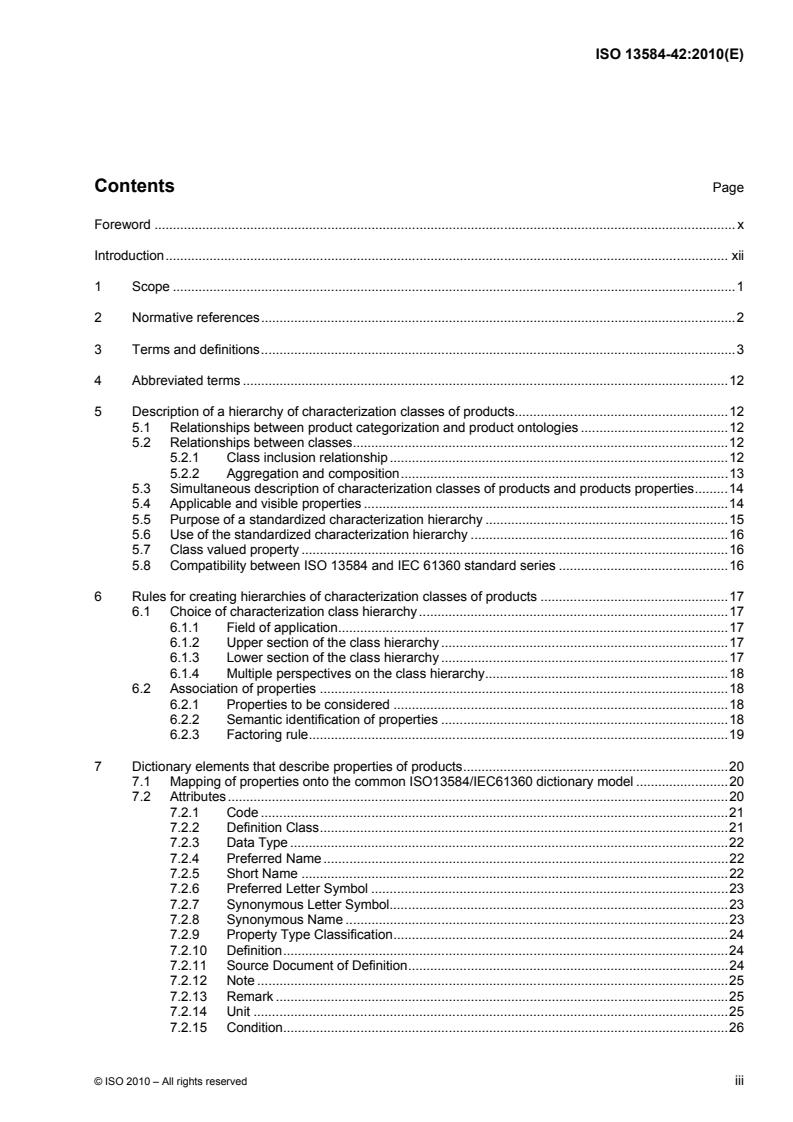
Contents Page
Foreword . x
Introduction. xii
1 Scope .1
2 Normative references.2
3 Terms and definitions.3
4 Abbreviated terms .12
5 Description of a hierarchy of characterization classes of products.12
5.1 Relationships between product categorization and product ontologies .12
5.2 Relationships between classes.12
5.2.1 Class inclusion relationship .12
5.2.2 Aggregation and composition.13
5.3 Simultaneous description of characterization classes of products and products properties.14
5.4 Applicable and visible properties .14
5.5 Purpose of a standardized characterization hierarchy .15
5.6 Use of the standardized characterization hierarchy .16
5.7 Class valued property .16
5.8 Compatibility between ISO 13584 and IEC 61360 standard series .16
6 Rules for creating hierarchies of characterization classes of products .17
6.1 Choice of characterization class hierarchy.17
6.1.1 Field of application.17
6.1.2 Upper section of the class hierarchy .17
6.1.3 Lower section of the class hierarchy .17
6.1.4 Multiple perspectives on the class hierarchy.18
6.2 Association of properties .18
6.2.1 Properties to be considered .18
6.2.2 Semantic identification of properties .18
6.2.3 Factoring rule.19
7 Dictionary elements that describe properties of products.20
7.1 Mapping of properties onto the common ISO13584/IEC61360 dictionary model .20
7.2 Attributes.20
7.2.1 Code .21
7.2.2 Definition Class.21
7.2.3 Data Type .22
7.2.4 Preferred Name .22
7.2.5 Short Name .22
7.2.6 Preferred Letter Symbol .23
7.2.7 Synonymous Letter Symbol.23
7.2.8 Synonymous Name .23
7.2.9 Property Type Classification.24
7.2.10 Definition.24
7.2.11 Source Document of Definition.24
7.2.12 Note .25
7.2.13 Remark .25
7.2.14 Unit .25
7.2.15 Condition.26
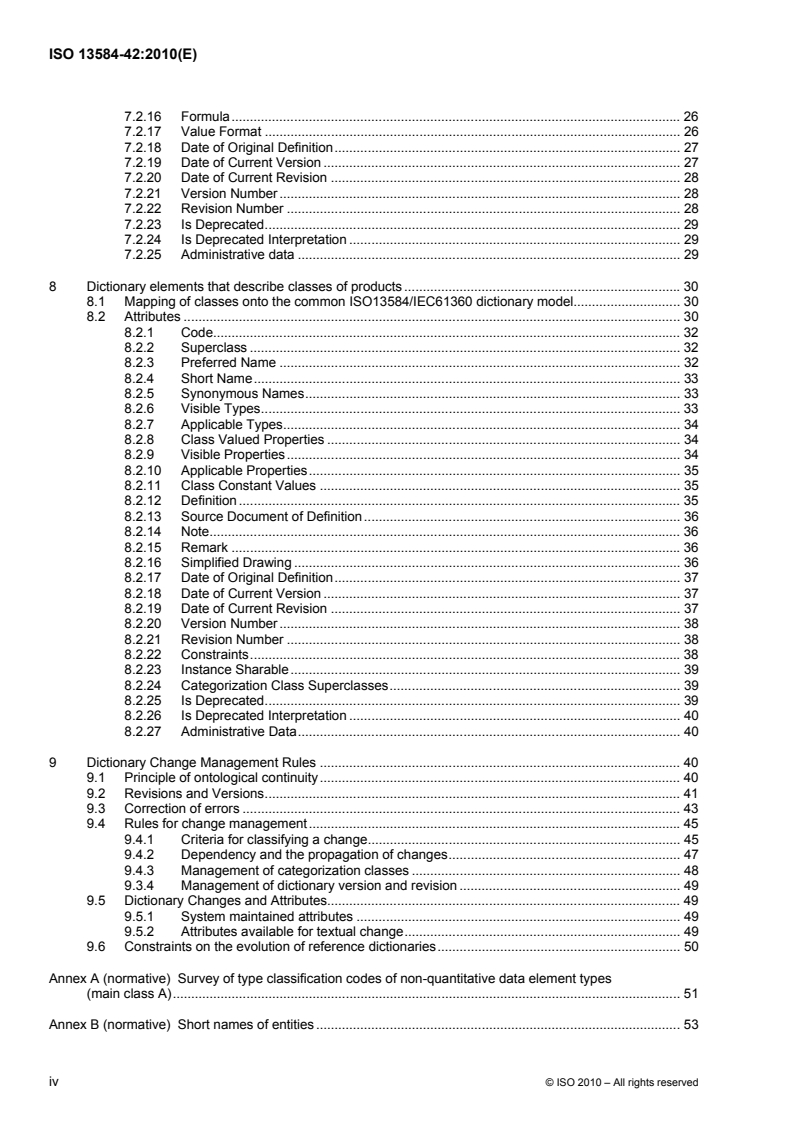
ISO 13584-42:2010(E)
7.2.16 Formula. 26
7.2.17 Value Format . 26
7.2.18 Date of Original Definition. 27
7.2.19 Date of Current Version . 27
7.2.20 Date of Current Revision . 28
7.2.21 Version Number. 28
7.2.22 Revision Number . 28
7.2.23 Is Deprecated. 29
7.2.24 Is Deprecated Interpretation . 29
7.2.25 Administrative data . 29
8 Dictionary elements that describe classes of products .30
8.1 Mapping of classes onto the common ISO13584/IEC61360 dictionary model. 30
8.2 Attributes . 30
8.2.1 Code. 32
8.2.2 Superclass . 32
8.2.3 Preferred Name . 32
8.2.4 Short Name. 33
8.2.5 Synonymous Names. 33
8.2.6 Visible Types. 33
8.2.7 Applicable Types. 34
8.2.8 Class Valued Properties . 34
8.2.9 Visible Properties. 34
8.2.10 Applicable Properties. 35
8.2.11 Class Constant Values . 35
8.2.12 Definition . 35
8.2.13 Source Document of Definition. 36
8.2.14 Note. 36
8.2.15 Remark .36
8.2.16 Simplified Drawing . 36
8.2.17 Date of Original Definition. 37
8.2.18 Date of Current Version . 37
8.2.19 Date of Current Revision . 37
8.2.20 Version Number. 38
8.2.21 Revision Number . 38
8.2.22 Constraints.38
8.2.23 Instance Sharable. 39
8.2.24 Categorization Class Superclasses. 39
8.2.25 Is Deprecated. 39
8.2.26 Is Deprecated Interpretation . 40
8.2.27 Administrative Data. 40
9 Dictionary Change Management Rules . 40
9.1 Principle of ontological continuity. 40
9.2 Revisions and Versions. 41
9.3 Correction of errors . 43
9.4 Rules for change management.45
9.4.1 Criteria for classifying a change. 45
9.4.2 Dependency and the propagation of changes. 47
9.4.3 Management of categorization classes . 48
9.3.4 Management of dictionary version and revision . 49
9.5 Dictionary Changes and Attributes. 49
9.5.1 System maintained attributes . 49
9.5.2 Attributes available for textual change. 49
9.6 Constraints on the evolution of reference dictionaries. 50
Annex A (normative) Survey of type classification codes of non-quantitative data element types
(main class A). 51
Annex B (normative) Short names of entities. 53
iv © ISO 2010 – All rights reserved
ISO 13584-42:2010(E)
Annex C (normative) Computer interpretable listings .56
Annex D (normative) Value format specification.58
D.1 Notation.58
D.2 Data value format types.60
D.3 Meta-identifier used to define the formats .60
D.4 Quantitative value formats .60
D.4.1 NR1-value format .61
D.4.2 NR2-value format .61
D.4.3 NR3-value format .62
D.4.4 NR4-value format .63
D.5 Non-quantitative value formats .63
D.5.1 Alphabetic Value Format .64
D.5.2 Mixed Characters Value Format.64
D.5.3 Number Value Format .65
D.5.4 Mixed Alphabetic or Numeric Characters Value Format.65
D.5.5 Binary Value Format.66
D.6 Value examples .66
D.7 Characters from ISO/IEC 10646-1.68
Annex E (normative) Information object registration.74
E.1 Document identification.74
E.2 Schema identification.74
E.2.1 ISO13584_IEC61360_dictionary_schema .74
E.2.2 ISO13584_IEC61360_language_resource_schema .74
E.2.3 ISO13584_IEC61360_class_constraint_schema .74
E.2.4 ISO13584_IEC61360_item_class_case_of_schema.75
Annex F (informative) Subset of the common IEC/ISO dictionary schema documented in this part of
ISO 13584 .76
F.1 General .76
F.1.1 Scope and object of the common ISO13584/IEC61360 dictionary model.76
F.1.2 Interoperability of ISO 13584 and IEC 61360 .77
F.2 Overview of the subset of the common ISO13584/IEC61360 dictionary model documented in this
part of ISO 13584.77
F.3 ISO13584_IEC61360_dictionary_schema .78
F.3.1 Introduction of the schema of the schema .78
F.3.1.1 Declaration of the schema .78
F.3.1.2 References to other schemata.78
F.3.2 Constant definitions.79
F.3.3 Identification of a dictionary.80
F.3.4 Basic Semantic Units: defining and using the dictionary .81
F.3.4.1 Requirements for exchange.81
F.3.4.2 Three levels architecture of the dictionary data.81
F.3.4.2.1 Basic_semantic_unit.82
F.3.4.2.2 Dictionary_element.83
F.3.4.2.3 Content_item .85
F.3.4.3 Overview of basic semantic units and dictionary elements .85
F.3.4.4 Identification of dictionary elements: three levels structure .86
F.3.4.5 Extension possibilities for other types of data.86
F.3.4.5.1 Supplier_related_BSU .86
F.3.4.5.2 Class_related_BSU .87
F.3.4.5.3 Supplier_BSU_relationship.87
F.3.4.5.4 Class_BSU_relationship.87
F.3.5 Supplier Data.88
F.3.5.1 Supplier_BSU.88
F.3.5.2 Supplier_element .89
F.3.6 Class Data .89
F.3.6.1 General.89
F.3.6.1.1 Class_BSU .91
ISO 13584-42:2010(E)
F.3.6.1.2 Class_and_property_elements. 92
F.3.6.1.3 Class . 93
F.3.6.2 Item_class . 97
F.3.6.3 Categorization_class . 98
F.3.7 Data Element Type / properties data. 100
F.3.7.1 Property_BSU. 100
F.3.7.2 Property_DET. 101
F.3.7.3 Condition, dependent and non-dependent Data Element Types. 103
F.3.7.3.1 Condition_DET. 103
F.3.7.3.2 Dependent_P_DET. 103
F.3.7.3.3 Non_dependent_P_DET. 104
F.3.7.4 Class_value_assignment. 104
F.3.8 Domain data: the type system . 105
F.3.8.1 General. 105
F.3.8.1.1 Data_type_BSU . 105
F.3.8.1.2 Data_type_element. 106
F.3.8.2 The type system . 107
F.3.8.2.1 Data_type. 107
F.3.8.2.2 Simple_type . 107
F.3.8.2.3 Number_type . 108
F.3.8.2.4 Int_type . 108
F.3.8.2.5 Int_measure_type . 109
F.3.8.2.6 Int_currency_type . 110
F.3.8.2.7 Non_quantitative_int_type . 110
F.3.8.2.8 Real_type. 111
F.3.8.2.9 Real_measure_type. 111
F.3.8.2.10 Real_currency_type. 113
F.3.8.2.11 Rational_type . 113
F.3.8.2.12 Rational_measure_type. 113
F.3.8.2.13 boolean_type . 115
F.3.8.2.14 String_type. 115
F.3.8.2.15 Translatable_string_type. 115
F.3.8.2.16 Non_translatable_string_type . 116
F.3.8.2.17 URI_type . 116
F.3.8.2.18 Date_time_data_type. 116
F.3.8.2.19 Date_data_type. 117
F.3.8.2.20 Time_data_type . 117
F.3.8.2.21 Non_quantitative_code_type . 118
F.3.8.2.22 Complex_type . 119
F.3.8.2.23 Level_type. 119
F.3.8.2.24 Level. 120
F.3.8.2.25 Class_reference_type. 120
F.3.8.2.26 Entity_instance_type. 121
F.3.8.2.27 Placement_type . 121
F.3.8.2.28 Axis1_placement_type. 122
F.3.8.2.29 Axis2_placement_2d_type. 122
F.3.8.2.30 Axis2_placement_3d_type. 123
F.3.8.2.31 Named_type. 123
F.3.8.3 Values. 123
F.3.8.3.1 Value_domain . 124
F.3.8.3.2 Value_type . 125
F.3.8.3.3 Dic_value . 125
F.3.8.3.4 Administrative_data . 126
F.3.8.3.5 Translation_data . 128
F.3.8.4 Extension to ISO 10303-41 unit definitions . 128
F.3.8.4.1 Non_si_unit . 128
F.3.8.4.2 Assert_ONEOF rule. 129
F.3.8.4.3 Dic_unit . 129
F.3.9 Basic type and entity definitions . 130
F.3.9.1 Basic type definitions. 130
vi © ISO 2010 – All rights reserved
ISO 13584-42:2010(E)
F.3.9.1.1 Class_code_type .130
F.3.9.1.2 Code_type .130
F.3.9.1.3 Currency_code .131
F.3.9.1.4 Data_type_code_type.131
F.3.9.1.5 Date_type .131
F.3.9.1.6 Definition_type.132
F.3.9.1.7 DET_classification_type .132
F.3.9.1.8 Note_type .132
F.3.9.1.9 Pref_name_type .132
F.3.9.1.10 Property_code_type .133
F.3.9.1.11 Remark_type .133
F.3.9.1.12 Hierarchical_position_type .133
F.3.9.1.13 Revision_type .134
F.3.9.1.14 Short_name_type .134
F.3.9.1.15 Supplier_code_type.134
F.3.9.1.16 Syn_name_type.135
F.3.9.1.17 Keyword_type.135
F.3.9.1.18 ISO_29002_IRDI_type .135
F.3.9.1.19 Constraint_identifier.136
F.3.9.1.20 Dic_unit_identifier .136
F.3.9.1.21 Dic_value_identifier .137
F.3.9.1.22 Value_code_type.137
F.3.9.1.23 Value_format_type .137
F.3.9.1.24 Version_type.138
F.3.9.1.25 Status_type.138
F.3.9.1.26 Dictionary_code_type .139
F.3.9.2 Basic entity definitions.139
F.3.9.2.1 Dates .139
F.3.9.2.2 Document .139
F.3.9.2.3 Graphics .140
F.3.9.2.4 External_graphics.140
F.3.9.2.5 Graphic_files.140
F.3.9.2.6 Identified_document .141
F.3.9.2.7 Item_names.141
F.3.9.2.8 Label_with_language.143
F.3.9.2.9 Mathematical_string .143
F.3.10 Function definitions.143
F.3.10.1 Acyclic_superclass_relationship function .143
F.3.10.2 Check_syn_length function.144
F.3.10.3 Codes_are_unique function.144
F.3.10.4 Definition_available_implies function.145
F.3.10.5 Is_subclass function.146
F.3.10.6 String_for_derived_unit function .146
F.3.10.7 String_for_named_unit function.148
F.3.10.8 String_for_SI_unit function.149
F.3.10.9 String_for_unit function .150
F.3.10.10 All_class_descriptions_reachable function.151
F.3.10.11 Compute_known_visible_properties function .151
F.3.10.12 Compute_known_visible_data_types function.152
F.3.10.13 Compute_known_applicable_properties function.153
F.3.10.14 Compute_known_applicable_data_types function .154
F.3.10.15 List_to_set function .155
F.3.10.16 Check_properties_applicability function .155
F.3.10.17 Check_datatypes_applicability function.156
F.3.10.18 One_language_per_translation function.156
F.3.10.19 Allowed_values_integer_types function.157
F.3.10.20 Is_class_valued_property function.157
F.3.10.21 Class_value_assigned function .158
F.4 ISO13584_IEC61360_language_resource_schema.159
F.4.1 ISO13584_IEC61360_language_resource_schema type and entity definitions .160
ISO 13584-42:2010(E)
F.4.1.1 Language_code. 160
F.4.1.2 Global_language_assignment. 161
F.4.1.3 Present_translations. 161
F.4.1.4 Translatable_label . 162
F.4.1.5 Translated_label. 162
F.4.1.6 Translatable_text. 162
F.4.1.7 Translated_text. 163
F.4.2 ISO13584_IEC61360_language_resource_schema function definitions. 163
F.4.2.1 Check_label_length function . 163
F.4.3 ISO13584_IEC61360_language_resource_schema rule definition . 164
F.5 ISO13584_IEC61360_class_constraint_schema . 164
F.5.1 Introduction to the ISO13584_IEC61360_class_constraint_schema. 165
F.5.2 ISO13584_IEC61360_class_constraint_schema entity definitions. 166
F.5.2.1 Constraint . 166
F.5.2.2 Property_constraint . 166
F.5.2.3 Class_constraint. 167
F.5.2.4 Configuration_control_constraint . 167
F.5.2.5 Filter. 168
F.5.2.6 Integrity_constraint . 169
F.5.2.7 Context_restriction_constraint. 169
F.5.2.8 Domain_constraint . 170
F.5.2.9 Subclass_constraint . 170
F.5.2.10 Entity_subtype_constraint . 171
F.5.2.11 Enumeration_constraint . 171
F.5.2.12 Range_constraint . 172
F.5.2.13 String_size_constraint . 173
F.5.2.14 String_pattern_constraint . 174
F.5.2.15 Cardinality_constraint. 175
F.5.3 ISO13584_IEC61360_class_constraint_schema type definitions. 175
F.5.3.1 Constraint_or_constraint_id . 175
F.5.4 ISO13584_IEC61360_class_constraint_schema function definition. 175
F.5.4.1 Integer_values_in_range function . 176
F.5.4.2 Correct_precondition function . 176
F.5.4.3 Correct_constraint_type function . 177
F.5.4.4 Compatible_data_type_and_value function. 180
F.5.5 ISO13584_IEC61360_class_constraint_schema rule definition . 183
F.5.5.1 Unique_constraint_id. 183
F.6 ISO13584_IEC61360_item_class_case_of_schema . 184
F.6.1 Introduction to the ISO13584_IEC61360_item_class_case_of_schema. 185
F.6.2 ISO13584_IEC61360_item_class_case_of_schema entity definitions. 185
F.6.2.1 A priori semantic relationship . 185
F.6.2.2 Item_class_case_of. 187
F.6.3 ISO13584_IEC61360_item_class_case_of_schema function definitions. 190
F.6.3.1 Compute_known_property_constraints function . 190
F.6.3.2 Compute_known_referenced_property_constraints function. 191
F.6.3.3 Superclass_of_item_is_item function. 192
F.6.3.4 Check_is_case_of_referenced_classes_definition function . 192
F.6.4 ISO13584_IEC61360_item_class_case_of_schema rule definitions. 193
F.6.4.1 Imported_properties_are_visible_or_applicable_rule rule . 193
F.6.4.2 Imported_data_types_are_visible_or_applicable_rule rule . 194
F.6.4.3 Allowed_named_type_usage_rule rule. 194
F.7 Example of physical file. 195
F.7.1 File Header . 195
F.7.2 Supplier data. 195
F.7.3 Root class data . 195
F.7.4 Material data . 196
F.7.5 Component data . 197
F.7.6 Electric / electronic component data. 198
Annex G (informative) Survey of main classes and categories of properties. 200
viii © ISO 2010 – All rights reserved
ISO 13584-42:2010(E)
Annex H (informative) Survey of type classification codes of quantitative data element types .201
Annex I (informative) EXPRESS-G diagrams .208
Annex J (informative) Partial dictionaries.219
Annex K (informative) Information to support implementations .220
Bibliography.221
Index .
...
Questions, Comments and Discussion
Ask us and Technical Secretary will try to provide an answer. You can facilitate discussion about the standard in here.
Loading comments...