

ISO/TR 17772-2:2018
(Main)Energy performance of buildings — Overall energy performance assessment procedures — Part 2: Guideline for using indoor environmental input parameters for the design and assessment of energy performance of buildings
General Information
- Abstract
ISO/TR 17772-2:2018 deals with the indoor environmental parameters for thermal environment, indoor air quality, lighting and acoustic. It explains how to use ISO 17772‑1 for specifying indoor environmental input parameters for building system design and energy performance calculations. ISO/TR 17772-2:2018: - specifies methods for long-term evaluation of the indoor environment obtained as a result of calculations or measurements; - specifies criteria for measurements which can be used if required to measure compliance by inspection; - identifies parameters to be used by monitoring and displaying the indoor environment in existing buildings. ISO/TR 17772-2:2018 is applicable where the criteria for indoor environment are set by human occupancy and where the production or process does not have a major impact on indoor environment. It explains how different categories of criteria for the indoor environment can be used.
- Status
- Published
- Publication Date
- 03-Apr-2018
- Technical Committee
- ISO/TC 163 - Thermal performance and energy use in the built environment
- Drafting Committee
- ISO/TC 163/WG 4 - Joint ISO/TC 163 - ISO/TC 205 WG: Energy performance of buildings using holistic approach
- Parallel Committee
- ISO/TC 205 - Building environment design
- Current Stage
- 6060 - International Standard published
- Start Date
- 04-Apr-2018
- Completion Date
- 29-Aug-2026
Buy Documents



ISO/TR 17772-2:2018 - Energy performance of buildings -- Overall energy performance assessment procedures
ISO/TR 17772-2:2018 - Energy performance of buildings — Overall energy performance assessment procedures — Part 2: Guideline for using indoor environmental input parameters for the design and assessment of energy performance of buildings/4/2018
Overview
ISO/TR 17772-2:2018 - "Energy performance of buildings - Overall energy performance assessment procedures - Part 2" - is a technical report that provides guidance on using indoor environmental input parameters for building design and energy performance assessment. It supplements ISO 17772‑1 by explaining how to specify indoor environmental criteria for the thermal environment, indoor air quality (IAQ), lighting and acoustic conditions, and how to use those criteria in energy calculations, monitoring and long‑term evaluation.
Key topics and requirements
- Scope and applicability
- Applies where indoor environment criteria are driven by human occupancy and where production or process loads do not dominate indoor conditions.
- Explains categories of criteria that can be adapted for building type, occupant type, climate and national differences.
- Design input criteria
- Guidance for establishing input parameters used to dimension heating, cooling, ventilation and lighting systems.
- Separate treatment of mechanically conditioned buildings, naturally ventilated buildings, increased air velocity and personalized systems.
- Indoor air quality and ventilation
- Methods for specifying ventilation rates for residential and non‑residential buildings.
- Consideration of filtration, air cleaning and access to operable windows.
- Lighting, humidity and noise
- Recommendations for lighting input parameters, humidity control and indoor noise criteria for energy assessments.
- Energy calculation inputs
- How to adopt indoor environmental parameters for seasonal, monthly and hourly/dynamic building simulations.
- Evaluation and long‑term indicators
- Methods for long‑term evaluation of indoor environment from calculations or measurements, including hourly criteria, degree‑hours and weighted comfort indices.
- Measurements and inspections
- Criteria for in‑situ measurements to verify compliance by inspection and guidance for monitoring and displaying indoor environmental data.
- Informative annexes
- Includes annexes with recommended thermal criteria, IAQ basis, lighting examples, noise criteria, occupant schedules, monitoring methods and links to WHO health criteria.
Applications and who uses it
ISO/TR 17772-2:2018 is intended for:
- Building designers and HVAC engineers specifying system setpoints and ventilation strategies
- Energy modelers and simulation specialists selecting indoor environment inputs
- Facility managers and building owners monitoring performance and occupant comfort
- Certification bodies and inspectors verifying compliance by measurements
- Policy makers defining national or regional criteria for building performance
Practical uses include setting input assumptions for energy simulations, defining monitoring parameters for building dashboards, preparing inspection protocols and aligning occupant comfort targets with energy efficiency goals.
Related standards
- ISO 17772‑1 (companion document for overall energy performance assessment procedures)
- Relevant ISO/TC 163 publications and WHO indoor environment health guidance (referenced in Annex N)
Keywords: ISO/TR 17772-2:2018, energy performance of buildings, indoor environmental parameters, indoor air quality, thermal environment, ventilation rates, building energy calculations, lighting, acoustic, monitoring.
Relations
- Effective Date
- 06-Jun-2022
Buy Documents
ISO/TR 17772-2:2018 - Energy performance of buildings -- Overall energy performance assessment procedures
ISO/TR 17772-2:2018 - Energy performance of buildings — Overall energy performance assessment procedures — Part 2: Guideline for using indoor environmental input parameters for the design and assessment of energy performance of buildings/4/2018
Get Certified
Connect with accredited certification bodies for this standard

DIBt (Deutsches Institut für Bautechnik)
German Institute for Building Technology.
DIN CERTCO
DIN Group product certification.

Aboma Certification B.V.
Specialized in construction, metal, and transport sectors.
Sponsored listings
Frequently Asked Questions
ISO/TR 17772-2:2018 is a technical report published by the International Organization for Standardization (ISO). Its full title is "Energy performance of buildings — Overall energy performance assessment procedures — Part 2: Guideline for using indoor environmental input parameters for the design and assessment of energy performance of buildings". This standard covers: ISO/TR 17772-2:2018 deals with the indoor environmental parameters for thermal environment, indoor air quality, lighting and acoustic. It explains how to use ISO 17772‑1 for specifying indoor environmental input parameters for building system design and energy performance calculations. ISO/TR 17772-2:2018: - specifies methods for long-term evaluation of the indoor environment obtained as a result of calculations or measurements; - specifies criteria for measurements which can be used if required to measure compliance by inspection; - identifies parameters to be used by monitoring and displaying the indoor environment in existing buildings. ISO/TR 17772-2:2018 is applicable where the criteria for indoor environment are set by human occupancy and where the production or process does not have a major impact on indoor environment. It explains how different categories of criteria for the indoor environment can be used.
ISO/TR 17772-2:2018 deals with the indoor environmental parameters for thermal environment, indoor air quality, lighting and acoustic. It explains how to use ISO 17772‑1 for specifying indoor environmental input parameters for building system design and energy performance calculations. ISO/TR 17772-2:2018: - specifies methods for long-term evaluation of the indoor environment obtained as a result of calculations or measurements; - specifies criteria for measurements which can be used if required to measure compliance by inspection; - identifies parameters to be used by monitoring and displaying the indoor environment in existing buildings. ISO/TR 17772-2:2018 is applicable where the criteria for indoor environment are set by human occupancy and where the production or process does not have a major impact on indoor environment. It explains how different categories of criteria for the indoor environment can be used.
ISO/TR 17772-2:2018 is classified under the following ICS (International Classification for Standards) categories: 91.120.10 - Thermal insulation of buildings. The ICS classification helps identify the subject area and facilitates finding related standards.
ISO/TR 17772-2:2018 has the following relationships with other standards: It is inter standard links to ISO 4126-10:2024. Understanding these relationships helps ensure you are using the most current and applicable version of the standard.
ISO/TR 17772-2:2018 is available in PDF format for immediate download after purchase. The document can be added to your cart and obtained through the secure checkout process. Digital delivery ensures instant access to the complete standard document.
Standards Content (Sample)
TECHNICAL ISO/TR
REPORT 17772-2
First edition
2018-04
Energy performance of buildings —
Overall energy performance
assessment procedures —
Part 2:
Guideline for using indoor
environmental input parameters for
the design and assessment of energy
performance of buildings
Performance énergétique des bâtiments — Modes opératoires
d'évaluation de la performance énergétique globale —
Partie 2: Lignes directrices pour l'utilisation des paramètres d'entrée
de l'environnement intérieur pour la conception et l'évaluation de la
performance énergétique des bâtiments
Reference number
©
ISO 2018
© ISO 2018
All rights reserved. Unless otherwise specified, or required in the context of its implementation, no part of this publication may
be reproduced or utilized otherwise in any form or by any means, electronic or mechanical, including photocopying, or posting
on the internet or an intranet, without prior written permission. Permission can be requested from either ISO at the address
below or ISO’s member body in the country of the requester.
ISO copyright office
CP 401 • Ch. de Blandonnet 8
CH-1214 Vernier, Geneva
Phone: +41 22 749 01 11
Fax: +41 22 749 09 47
Email: copyright@iso.org
Website: www.iso.org
Published in Switzerland
ii © ISO 2018 – All rights reserved
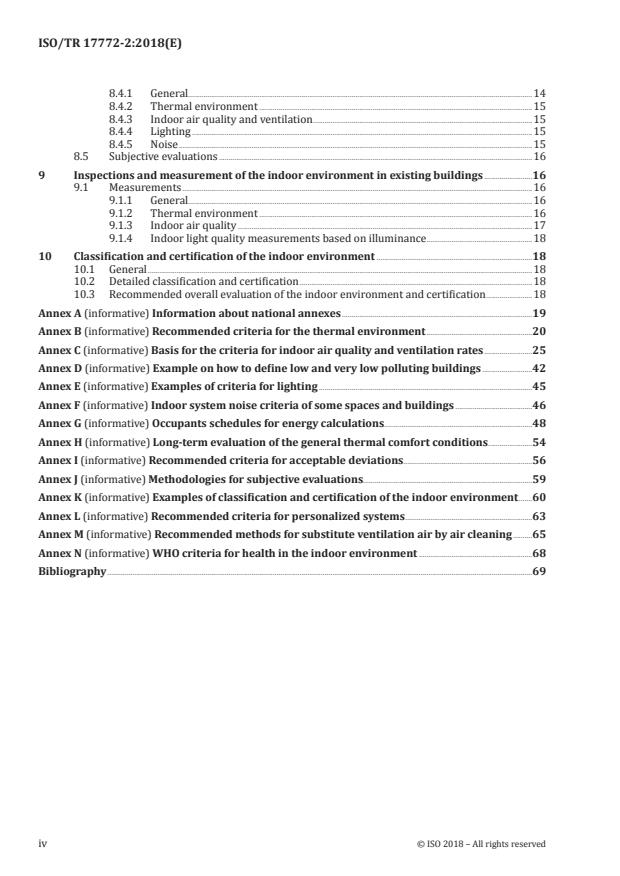
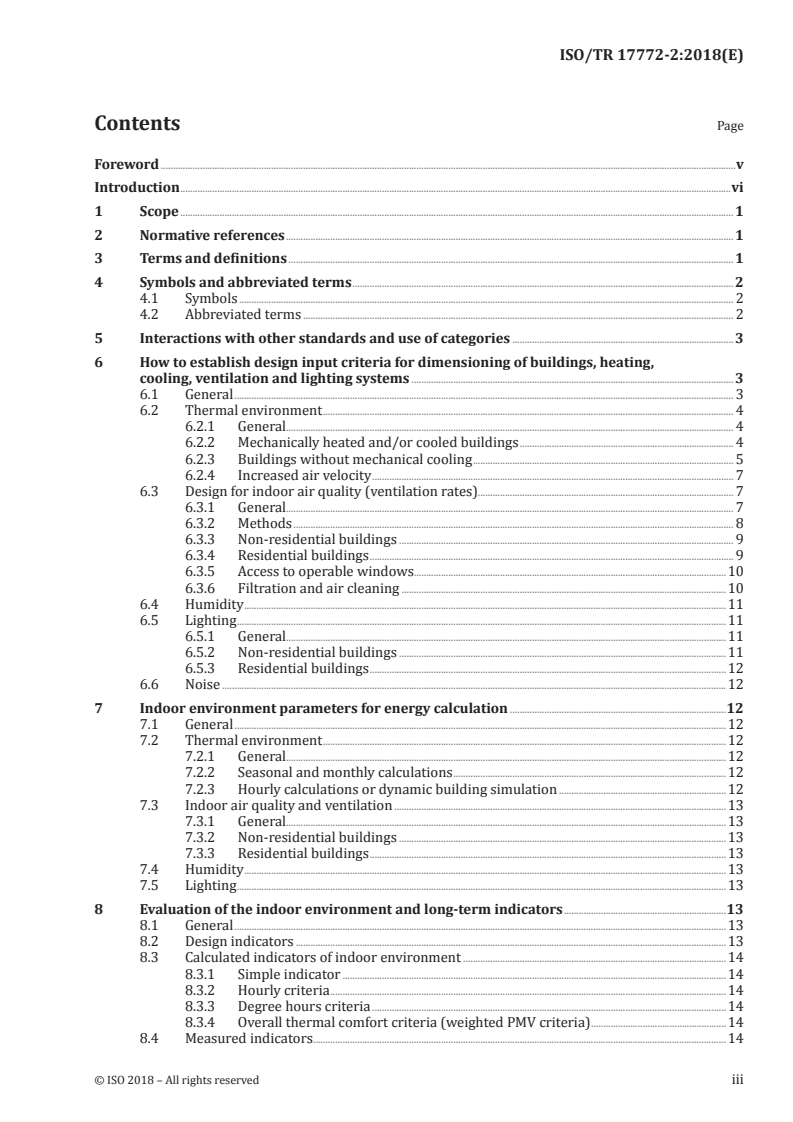
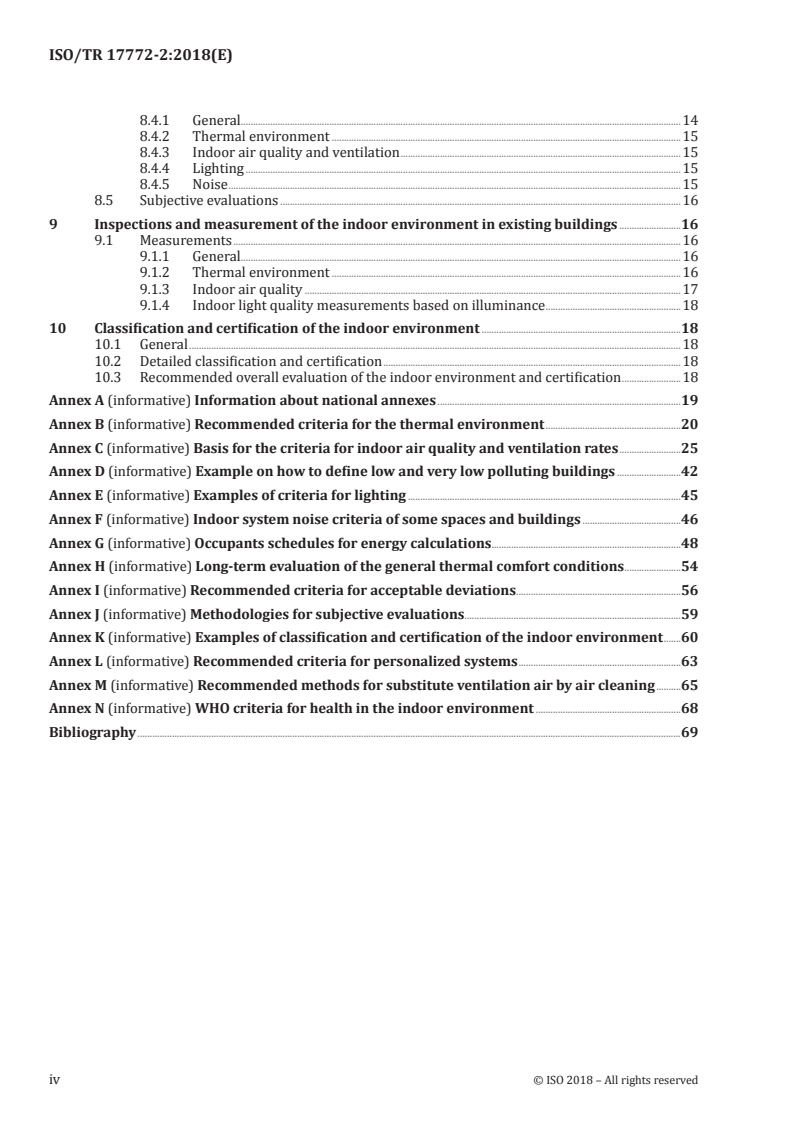
Contents Page
Foreword .v
Introduction .vi
1 Scope . 1
2 Normative references . 1
3 Terms and definitions . 1
4 Symbols and abbreviated terms . 2
4.1 Symbols . 2
4.2 Abbreviated terms . 2
5 Interactions with other standards and use of categories . 3
6 How to establish design input criteria for dimensioning of buildings, heating,
cooling, ventilation and lighting systems . 3
6.1 General . 3
6.2 Thermal environment . 4
6.2.1 General. 4
6.2.2 Mechanically heated and/or cooled buildings . 4
6.2.3 Buildings without mechanical cooling . 5
6.2.4 Increased air velocity . 7
6.3 Design for indoor air quality (ventilation rates). 7
6.3.1 General. 7
6.3.2 Methods . 8
6.3.3 Non-residential buildings . 9
6.3.4 Residential buildings . 9
6.3.5 Access to operable windows .10
6.3.6 Filtration and air cleaning .10
6.4 Humidity .11
6.5 Lighting .11
6.5.1 General.11
6.5.2 Non-residential buildings .11
6.5.3 Residential buildings .12
6.6 Noise .12
7 Indoor environment parameters for energy calculation .12
7.1 General .12
7.2 Thermal environment .12
7.2.1 General.12
7.2.2 Seasonal and monthly calculations .12
7.2.3 Hourly calculations or dynamic building simulation .12
7.3 Indoor air quality and ventilation .13
7.3.1 General.13
7.3.2 Non-residential buildings .13
7.3.3 Residential buildings .13
7.4 Humidity .13
7.5 Lighting .13
8 Evaluation of the indoor environment and long-term indicators .13
8.1 General .13
8.2 Design indicators .13
8.3 Calculated indicators of indoor environment .14
8.3.1 Simple indicator .14
8.3.2 Hourly criteria .14
8.3.3 Degree hours criteria .14
8.3.4 Overall thermal comfort criteria (weighted PMV criteria) .14
8.4 Measured indicators .14
8.4.1 General.14
8.4.2 Thermal environment .15
8.4.3 Indoor air quality and ventilation .15
8.4.4 Lighting .15
8.4.5 Noise .15
8.5 Subjective evaluations .16
9 Inspections and measurement of the indoor environment in existing buildings .16
9.1 Measurements .16
9.1.1 General.16
9.1.2 Thermal environment .16
9.1.3 Indoor air quality .17
9.1.4 Indoor light quality measurements based on illuminance .18
10 Classification and certification of the indoor environment .18
10.1 General .18
10.2 Detailed classification and certification .18
10.3 Recommended overall evaluation of the indoor environment and certification .18
Annex A (informative) Information about national annexes .19
Annex B (informative) Recommended criteria for the thermal environment .20
Annex C (informative) Basis for the criteria for indoor air quality and ventilation rates .25
Annex D (informative) Example on how to define low and very low polluting buildings .42
Annex E (informative) Examples of criteria for lighting .45
Annex F (informative) Indoor system noise criteria of some spaces and buildings .46
Annex G (informative) Occupants schedules for energy calculations .48
Annex H (informative) Long-term evaluation of the general thermal comfort conditions .54
Annex I (informative) Recommended criteria for acceptable deviations .56
Annex J (informative) Methodologies for subjective evaluations.59
Annex K (informative) Examples of classification and certification of the indoor environment .60
Annex L (informative) Recommended criteria for personalized systems .63
Annex M (informative) Recommended methods for substitute ventilation air by air cleaning .65
Annex N (informative) WHO criteria for health in the indoor environment .68
Bibliography .69
iv © ISO 2018 – All rights reserved
Foreword
ISO (the International Organization for Standardization) is a worldwide federation of national standards
bodies (ISO member bodies). The work of preparing International Standards is normally carried out
through ISO technical committees. Each member body interested in a subject for which a technical
committee has been established has the right to be represented on that committee. International
organizations, governmental and non-governmental, in liaison with ISO, also take part in the work.
ISO collaborates closely with the International Electrotechnical Commission (IEC) on all matters of
electrotechnical standardization.
The procedures used to develop this document and those intended for its further maintenance are
described in the ISO/IEC Directives, Part 1. In particular the different approval criteria needed for the
different types of ISO documents should be noted. This document was drafted in accordance with the
editorial rules of the ISO/IEC Directives, Part 2 (see www .iso .org/ directives).
Attention is drawn to the possibility that some of the elements of this document may be the subject of
patent rights. ISO shall not be held responsible for identifying any or all such patent rights. Details of
any patent rights identified during the development of the document will be in the Introduction and/or
on the ISO list of patent declarations received (see www .iso .org/ patents).
Any trade name used in this document is information given for the convenience of users and does not
constitute an endorsement.
For an explanation on the voluntary nature of standards, the meaning of ISO specific terms and
expressions related to conformity assessment, as well as information about ISO's adherence to the
World Trade Organization (WTO) principles in the Technical Barriers to Trade (TBT) see the following
URL: www .iso .org/ iso/ foreword .html.
This document was prepared by Technical Committee ISO/TC 163, Thermal performance and energy use
in the built environment.
Introduction
This document provides guidance to users in the application of ISO 17772-1 and gives additional
background information. This document also describes and recommends additional topics related
to the evaluation of the indoor environmental quality and new possibilities to improve the indoor
environmental quality and reduce energy use of buildings like personalized systems, air cleaning
technologies, consideration of adapted persons, etc.
This document explains how design criteria can be established and used for dimensioning of systems.
It explains how to establish and define the main parameters to be used as input for building energy
calculation and long-term evaluation of the indoor environment. This document also describes how gas
phase air cleaning in the future can improve the indoor air quality and partly substitute for outside air.
Finally, it identifies parameters to be used for monitoring and displaying of the indoor environment.
Different categories of criteria can be used depending on type of building, type of occupants, type of
climate and national differences. This document explains how these different categories of indoor
environment can be individually selected as national criteria, be used in project agreement for design
criteria and for displaying the yearly building performance in relation to indoor environmental quality.
The designer can also define other categories using the principles from ISO 17772-1 and this document.
vi © ISO 2018 – All rights reserved
TECHNICAL REPORT ISO/TR 17772-2:2018(E)
Energy performance of buildings — Overall energy
performance assessment procedures —
Part 2:
Guideline for using indoor environmental input
parameters for the design and assessment of energy
performance of buildings
1 Scope
This document deals with the indoor environmental parameters for thermal environment, indoor air
quality, lighting and acoustic. It explains how to use ISO 17772-1 for specifying indoor environmental
input parameters for building system design and energy performance calculations.
This document:
— specifies methods for long-term evaluation of the indoor environment obtained as a result of
calculations or measurements;
— specifies criteria for measurements which can be used if required to measure compliance by
inspection;
— identifies parameters to be used by monitoring and displaying the indoor environment in existing
buildings.
This document is applicable where the criteria for indoor environment are set by human occupancy and
where the production or process does not have a major impact on indoor environment. It explains how
different categories of criteria for the indoor environment can be used.
2 Normative references
The following documents are referred to in the text in such a way that some or all of their content
constitutes requirements of this document. For dated references, only the edition cited applies. For
undated references, the latest edition of the referenced document (including any amendments) applies.
ISO 13731, Ergonomics of the thermal environment — Vocabulary and symbols
ISO 17772-1, Energy performance of buildings — Indoor environmental quality — Part 1: Indoor
environmental input parameters for the design and assessment of energy performance of buildings
3 Terms and definitions
For the purposes of this document, the terms and definitions given in ISO 13731 and ISO 17772-1 apply.
ISO and IEC maintain terminological databases for use in standardization at the following addresses:
— IEC Electropedia: available at http:// www .electropedia .org/
— ISO Online browsing platform: available at https:// www .iso .org/ obp
4 Symbols and abbreviated terms
4.1 Symbols
For the purposes of this document, the symbols given in ISO 52000-1:2017, Annex C, and the
following apply.
Symbol Quantity Unit
θ indoor operative temperature °C
o
θ outdoor temperature °C
e
Θ running mean outdoor air temperature °C
m
Θ daily mean outdoor temperature °C
ed-i
Θ operative temperature, design and energy calculations °C
o
Θ running mean outdoor temperature °C
rm-i
v air speed (average/maximum) m/s
a
Θ floor surface temperature °C
f
ΔCO concentration ppm
ΔΘ radiant temperature asymmetry K
pr
ΔΘ vertical air temperature difference K
a
α constant for running mean calculations
q total ventilation rate l/s
tot
q ventilation rate for building materials l/s (m )
B
q ventilation rate for persons l/s (per person)
p
q total ventilation rate in occupied zone l/s (m ), l/s (person)
tot
n number of persons
q ventilation rate required for dilution of pollutant L/s
h
G generation of a pollutant µg/s
h
C guideline value of a pollutant µg/L
h,
C guideline value of the substance µg /m
h,i
C supply concentration of a pollutant at air intake µg/L
h,o
ε ventilation effectiveness —
v
A floor area m
L A-weighed sound pressure level dB(A)
p,A
L equivalent continuous sound pressure level dB(A)
eq, nT,A
D daylight factor
DC daylight quotient of the Calculated area j
a,j
E average maintained illuminance lx
m
M activity level met
I assumed clothing level winter/summer clo
cl
4.2 Abbreviated terms
ACH air changers per hour
DR draught rate, %
DSNA daylight quotient sunscreen not activated
IEQ indoor environmental quality
IEQ indoor environmental quality category for design
cat
2 © ISO 2018 – All rights reserved
LPB low polluting building class
1–3
PD percentage dissatisfied for local thermal discomfort
PMV predicted mean vote
PPD predicted percentage of dissatisfied, %
RH relative humidity
5 Interactions with other standards and use of categories
This document interacts mainly with ISO 17772-1. This document explains how the indoor
environmental criteria in ISO 17772-1 can be used for the design of building and HVAC systems. The
thermal criteria (design indoor temperature in winter, design indoor temperature in summer) are used
as input for heating and cooling load calculations and sizing of the installed systems. Ventilation rates
are used for sizing ventilation systems, and lighting levels for design of lighting system including the use
of day lighting. The design values for sizing the building services are needed to avoid possible negative
effect of indoor environment and to give advice in respect of improvement of the energy efficiency of
existing buildings as well as of the heating and cooling of buildings.
This document explains how values for the indoor environment (temperature, ventilation, lighting)
are used as input to the calculation of the energy demand (building energy demand). Output from
measured indoor environmental parameters in existing buildings (temperature, CO , ventilation rates,
illumination levels) will enable the evaluation of overall annual performance and can be used to display
the indoor environmental factors together with data for the energy performance.
Output from room temperature calculations and yearly dynamic building simulations will enable
evaluation of the annual performance of buildings at the design stage.
This document describes methods for measurement of the indoor environment and for treating
measured data related to the inspection of HVAC systems.
This document provides a method for categorization of indoor environment (Clause 10). This method
can be used to integrate complex indoor environment information to simple classification for a possible
indoor environment certificate.
6 How to establish design input criteria for dimensioning of buildings, heating,
cooling, ventilation and lighting systems
6.1 General
Recommended input values are given for each of the different categories as shown in Table 1. These
categories can be used in different ways. First and foremost, they can be used to establish different
levels of criteria for the design of buildings and building services. Different countries can standardize
one category for design. The consultant and client of a building project can use the categories to agree
on a specific design level. The intention is not that a building should be operated strictly in one class
the whole year round. Instead the categories can be used to describe the yearly indoor environmental
performance of a building by showing the distribution of the parameters in the different categories. It
can then, on the national level or in a design/operation contract, be specified how much of the time the
categories can be exceeded. This is shown in this document with some examples.
Table 1 — Categories of indoor environmental quality
Category Level of expectation Explanation
IEQ High Should be selected for occupants with
I
special needs (children, elderly, handi-
capped).
IEQ Medium The normal level used for design and
II
operation.
IEQ Moderate Will still provide an acceptable environ-
III
ment. Some risk of reduced performance
of the occupants.
IEQ Low Should only be used for a short time of
IV
the year or in spaces with very short
time of occupancy.
Even if a building is designed for category III, it can still be operated at a greater part of the year in
category I or II. When the outdoor conditions are less severe (warmer in winter, colder in summer)
than the design day, the capacity of the heating/cooling system will be large enough to keep the indoor
environment within a narrower range.
It can be argued that selecting a higher category can increase the energy consumption. The energy
requirement is, however, regulated by national building codes and cannot be exceeded. The challenge
is then for the designer/operator of the building to obtain a high level of indoor environmental quality
within the required energy criteria.
For design of buildings and dimensioning of room conditioning systems, the thermal comfort criteria
(minimum room operative temperature in winter, maximum room operative temperature in summer)
will be used as input for heating load and cooling load calculations. The design ventilation rates that are
used for sizing the equipment are also used for energy calculations. The criteria are used as input values
for the sizing and dimensioning of the systems as well as for design of buildings (facades, orientation,
solar shading, etc.). Using a higher category will result in systems with a higher capacity; but depending
on how the system is operated, the energy use is not necessarily higher. In the design a design external
temperature for heating and a design day (including solar load) for cooling will normally be used.
To protect the designer/installer against complaint for not meeting the design intend, it is very
important that the basis for design (boundary conditions, occupant density, etc.) are documented in the
design documents. This will avoid discussions when these boundary conditions are changed during the
lifetime of the building and the performance criteria cannot be met.
6.2 Thermal environment
6.2.1 General
Field studies in office buildings have shown that people’s expectations regarding the thermal
environment can be different for buildings with installed mechanical cooling and buildings where the
occupant only have the possibility to open windows to influence the thermal environment. Therefore,
the design criteria are different for the two types of office buildings: mechanical heated and cooled
buildings and buildings without mechanical cooling (see the definition in ISO 17772-1). The decision on
which approach to use is taken by the client together with his consultant. It is possible for the consultant
to show the difference between the two methods (acceptable indoor temperatures, energy use, etc.).
6.2.2 Mechanically heated and/or cooled buildings
Criteria for the thermal environment in heated and/or cooled buildings, in ISO 17772-1 are based on
the thermal comfort indices Predicted Mean Vote-Predicted Percentage of Dissatisfied (PMV-PPD)
with assumed typical levels of activity and typical values of thermal insulation for clothing (winter and
summer) as described in detail in ISO 7730. Assuming different criteria for the PPD, different categories
of the indoor environment are established. The PMV-PPD index considers the influence of all six thermal
4 © ISO 2018 – All rights reserved
parameters (clothing, activity, air temperature, mean radiant temperature, air velocity and humidity)
and can be directly used as a criteria.
With a specified combination of activity and clothing, an assumed 50 % relative humidity and low air
velocities (<0,1 m/s), the criteria can also be expressed as operative temperature as shown in Annex B.
For other air velocities and humilities, the corresponding operative temperature will be different. Some
examples of recommended design indoor operative temperatures for heating and cooling, derived
according to this principle, are presented in Table B.2. This presents design values for the indoor
operative temperature in buildings that have active heating systems in operation during winter season
and active cooling systems during summer season, assumed clothing level for winter (1,0 clo) and
summer (0,5 clo) and activity level (sedentary, 1,2 met). Note that the operative temperature limits
should be adjusted when clothing levels and/or activity levels are different from the values mentioned
in the table.
In some types of room, there can be a mixed type of occupants (sedentary-standing/walking) with
different type of clothing (visitor to department store in outdoor clothing and shop assistance in
indoor clothing). In these cases, a compromise should be found for the design criteria and the boundary
conditions; this should be documented in the design documents and agreed by the client.
The temperatures in ISO 17772-1:2017, Table H.2) are operative temperatures (ISO 7726) with design
loads at the design weather conditions which are specified nationally according to ISO 15927-4 and
ISO 15927-5.
In most cases, the average room air temperature can be used as defining the design indoor temperature,
but if temperatures of large room surfaces differ significantly from the air temperature (windows in
winter and summer) or in situations where building occupants are often exposed to direct sun, the
operative temperature should be used. Further information on clothing and activity can be found
in ISO 9920 and ISO 8996. The value of design temperature can vary from the values shown, to take
account of, for example, local custom (clothing) or a desire for energy saving so long as the within-day
variation from the design temperature is within the given range, and the occupants are given time and
opportunity to adapt to the modified design temperature.
The design criteria in this subclause are both for design of buildings (dimensioning of windows, solar
shading, building mass, etc.) and for design HVAC systems.
6.2.2.1 Local thermal discomfort
Criteria for local thermal discomfort (see ISO 17772-1), such as draught, radiant temperature
asymmetry, vertical air temperature differences and floor surface temperatures, will also have an
influence on the design of buildings and systems, and should be taken account of.
6.2.2.2 Personalized systems
Individual preferences regarding the indoor environment can be very different. Therefore, there is
an increasing interest in using personalized systems for providing thermal comfort at individual
workplaces. With personalized systems, it can be possible to satisfy all occupants. Recommended
criteria for these types of systems are included in Annex L.
6.2.3 Buildings without mechanical cooling
During the summer season and during the between-seasons (spring and autumn), the so-called adaptive
criteria (upper and lower temperature limits that change with the running mean outside temperature)
can be applied (see the category I, II and III upper and lower limits in ISO 17772-1:2017, Figure H.2).
During the winter season, the same temperature limits should be applied as presented for buildings
with mechanical cooling systems.
The adaptive criteria are based on data for office buildings, but could possibly be used for other
buildings of similar type used mainly for human occupancy with mainly sedentary activities, where
there is easy access to operable windows and occupants can freely adapt their clothing to the indoor
and/or external thermal conditions. This method only applies to spaces where occupants during the
majority of their time have metabolic rates ranging from 1,0 met to 1,3 met. It is also important that
strict clothing policies inside the building are avoided and that building occupants are free to adapt
their clothing to indoor and/or external thermal conditions within a range of at least 0,4 clo to 1,0 clo.
The upper and lower limits presented in ISO 17772-1:2017, Figure H.2 only apply when the running
mean external temperature is between 10 °C and 30 °C.
The temperature limits for the summer and the in-between-seasons only apply when the thermal
conditions in the spaces at hand are regulated (during those seasons) primarily by the occupants
through opening and closing of windows. Several field studies have shown that occupants’ thermal
responses in such spaces depend in part on the external climate, and differ from the thermal responses
of occupants in buildings with mechanical cooling systems, mainly because of differences in thermal
experience, presence of adaptive opportunities, differences in perceived control and shifts in occupants’
expectations.
For this optional adaptive method to apply, the spaces in question should be equipped with operable
windows or comparable facade components which open to the externals and which can be readily
opened and adjusted by the occupants of the spaces. These operable windows (facade components)
should be designed and positioned in such a way that on warmer days they allow occupants to fine tune
the (wind pressure driven) air speeds inside.
There should be no mechanical cooling in operation in the space. Mechanical ventilation with
unconditioned air (in summer) can be utilized, but opening and closing of windows should be of
primary importance as a means of regulating thermal conditions in the space. In addition, occupants
can have additional options for personal control over the indoor environment such as solar shading,
fans, shutters, night ventilation, etc.
The spaces can be provided by a heating system, but this optional method does not apply during times
of the year when the heating system is in operation.
In residential buildings, the opportunities for (behavioural) adaptation are relatively wide: one
is relatively free to adjust metabolism and clothing insulation according to outside weather and
momentary indoor temperatures. With an exception for bedrooms where the lower limit should
be lower than in other rooms, studies have shown that operative temperature in bedrooms have a
significant impact on sleep quality and general health.
Note that the field studies on the temperature limits shown in ISO 17772-1:2017, Annex H do not take
work performance effects into account.
In landscaped (open plan) offices most occupants have only limited access to operable windows and
therefore typically reduced personal control over natural ventilation, e.g. if there are workplaces placed
in the middle of the room, away from direct access to operable windows. Therefore, the temperature
limits established by this method will not always apply in such situations.
ISO 17772-1:2017, Figure H.1 includes three categories of temperature limits for use as outlined in
the introduction and in ISO 17772-1:2017, Clause 5. The allowable indoor operative temperatures of
Figure H.1 are plotted against the running mean external temperature Θ .
rm
The following approximate Formula (1) can be used where records of daily mean external temperature
are available:
(,ΘΘ++08 06,,ΘΘ++05 04,,ΘΘ++03 0,22Θ )
ed−−12ed ed−−34ed ed−−56ed ed−7
Θ = (1)
rm
38,
The temperature limits presented in ISO 17772-1:2017, Figure H.1 should be used for the dimensioning
of passive means to prevent overheating in summer conditions. Some examples are: dimensioning
and orientation of windows, dimensioning of solar shading systems and of the thermal capacity of the
building. Where the adaptive temperature limits presented in ISO 17772-1:2017, Figure H.1 (upper
limits) cannot be guaranteed by passive means, then mechanical cooling should be used. In such
6 © ISO 2018 – All rights reserved
cases, the design criteria for buildings with mechanical cooling should be used (see summer limits in
ISO 17772-1:2017, H.1).
Note that ISO 17772-1:2017, Figure H.1 already accounts for people’s clothing adaptation, therefore,
it is not necessary to estimate the clothing values when using the adaptive method presented in
ISO 17772-1:2017, H.1. Also, it is normally not required that the following parameters be separately
evaluated: local thermal discomfort, clothing insulation, metabolic rate, humidity and air speed.
6.2.4 Increased air velocity
Under summer comfort conditions with indoor operative temperatures >25 °C, increased air velocity
can be used to compensate for increased air temperatures. Where there are fans (that can be controlled
directly by occupants) or other means for personal air speed adjustment (e.g. personal ventilation
systems, or personally operable windows), the upper limits presented in ISO 17772-1:2017, Table H.2
and Figure H.1 can be increased by 2 K to 3 K. The exact temperature correction depends upon the air
speed and can be derived from Table B.3 and ISO 17772-1:2017, Table H.2 and Figure H.1. This method
can also be used to overcome excessive temperatures in buildings if the local method for controlling air
movement (fan, etc.) is available.
Considering the latter: if building occupants have access to fans, personal ventilation systems,
personally operable windows, etc. that provide them with precise and step less control over air speed,
the upper ISO 17772-1:2017, Table H.4 can be relaxed. The airspeed – temperature offset relation
presented in the table is based upon heat transfer from the skin calculations.
The temperature correction by increased air velocity is assumed to be included in the adaptive method
for free running buildings, as a prerequisite for this method is that occupants have access to operable
windows under their personal control.
For buildings designed using the PMV-PPD approach, the temperature correction can be applied also if
occupants have access to operable windows, and not only if the air velocity is provided from fans, etc.
6.3 Design for indoor air quality (ventilation rates)
6.3.1 General
6.3.1.1 Overview
The source control strategy together with ventilation (natural, mechanical and hybrid), placement of
air intakes and filtration and air cleaning technologies contribute to improve the indoor air quality.
The source control strategy is very important since air pollutants often are generated indoors. For
residential buildings, indoor sources will often be the predominant source of air pollutants.
6.3.1.2 Source control
Source control should as often as possible be the primary strategy for controlling the level of air
substances. In many cases, the sources will not be known, or little information about emission from
building materials and furnishing are known or sources are brought into the space by occupants after
the construction of the building. There are several national certification methods for materials that can
be used for source control. A local exhaust of a high emitting source (kitchen hood, toilet exhaust, etc.)
is also a type of source control.
6.3.1.3 Ventilation
The pollution remaining after source control is dealt with by dilution or displacement with appropriate
ventilation air flow rates.
6.3.1.4 Time periods used for determining air flow rates
The methods described in this clause assume that pollutants emissions are constant in each time period
considered and lead to a constant design ventilation air flow rate for each time period, therefore it can
be a need to look at different time periods with constant values.
6.3.1.5 Building damage
Building damage can occur both at high indoor temperatures (very high room temperatures during
warm summer days or if cooling is turned off) or too low temperature due to risk of condensation and
resulting mould growth. Therefore, some heating, cooling and/or ventilation could also be needed
outside the time of occupancy.
6.3.1.6 Design documentation
The design documents are very important to protect both the designer and the owner. During the
lifetime of a building the use and loads can change. It is therefore essential that the original design
criteria are documented.
6.3.2 Methods
6.3.2.1 General
6.3.2.1.1 Overview
ISO 17772-1 includes three methods for estimating the design air flow rates, which not necessarily will
result in the same indoor air quality. The reason for including many methods is to be open for national
preferences in choice of method. Again, it should be clearly stated in the design documents which
method was used and why the method was chosen.
6.3.2.2 Method 1 based on perceived air quality
The perceived air quality is basically the odour level in the space perceived by the occupants. As odours
will consist of emission from occupants (bio effluents) and emission from building materials and
furnishing, Formula (2) is recommended:
qn=⋅qA+⋅q (2)
totp RB
As we add the odours from people we also have to add the odour from other sources. The knowledge
[12][13][22][23]
about the people component is relatively well-established , while the contribution from
other sources is less well-documented. Because of differences in the building component (selection of
indoor materials, etc.), the method includes three different building types (see Annex D).
[25][26]
Studies have shown that people adapt to the odour from bio effluents, but very little to the
emission from building materials and furnishing (reference). This does not mean that adapted persons
are not subject to fatigue, impaired concentrat
...
TECHNICAL ISO/TR
REPORT 17772-2
First edition
2018-04
Energy performance of buildings —
Overall energy performance
assessment procedures —
Part 2:
Guideline for using indoor
environmental input parameters for
the design and assessment of energy
performance of buildings
Performance énergétique des bâtiments — Modes opératoires
d'évaluation de la performance énergétique globale —
Partie 2: Lignes directrices pour l'utilisation des paramètres d'entrée
de l'environnement intérieur pour la conception et l'évaluation de la
performance énergétique des bâtiments
Reference number
©
ISO 2018
© ISO 2018
All rights reserved. Unless otherwise specified, or required in the context of its implementation, no part of this publication may
be reproduced or utilized otherwise in any form or by any means, electronic or mechanical, including photocopying, or posting
on the internet or an intranet, without prior written permission. Permission can be requested from either ISO at the address
below or ISO’s member body in the country of the requester.
ISO copyright office
CP 401 • Ch. de Blandonnet 8
CH-1214 Vernier, Geneva
Phone: +41 22 749 01 11
Fax: +41 22 749 09 47
Email: copyright@iso.org
Website: www.iso.org
Published in Switzerland
ii © ISO 2018 – All rights reserved
Contents Page
Foreword .v
Introduction .vi
1 Scope . 1
2 Normative references . 1
3 Terms and definitions . 1
4 Symbols and abbreviated terms . 2
4.1 Symbols . 2
4.2 Abbreviated terms . 2
5 Interactions with other standards and use of categories . 3
6 How to establish design input criteria for dimensioning of buildings, heating,
cooling, ventilation and lighting systems . 3
6.1 General . 3
6.2 Thermal environment . 4
6.2.1 General. 4
6.2.2 Mechanically heated and/or cooled buildings . 4
6.2.3 Buildings without mechanical cooling . 5
6.2.4 Increased air velocity . 7
6.3 Design for indoor air quality (ventilation rates). 7
6.3.1 General. 7
6.3.2 Methods . 8
6.3.3 Non-residential buildings . 9
6.3.4 Residential buildings . 9
6.3.5 Access to operable windows .10
6.3.6 Filtration and air cleaning .10
6.4 Humidity .11
6.5 Lighting .11
6.5.1 General.11
6.5.2 Non-residential buildings .11
6.5.3 Residential buildings .12
6.6 Noise .12
7 Indoor environment parameters for energy calculation .12
7.1 General .12
7.2 Thermal environment .12
7.2.1 General.12
7.2.2 Seasonal and monthly calculations .12
7.2.3 Hourly calculations or dynamic building simulation .12
7.3 Indoor air quality and ventilation .13
7.3.1 General.13
7.3.2 Non-residential buildings .13
7.3.3 Residential buildings .13
7.4 Humidity .13
7.5 Lighting .13
8 Evaluation of the indoor environment and long-term indicators .13
8.1 General .13
8.2 Design indicators .13
8.3 Calculated indicators of indoor environment .14
8.3.1 Simple indicator .14
8.3.2 Hourly criteria .14
8.3.3 Degree hours criteria .14
8.3.4 Overall thermal comfort criteria (weighted PMV criteria) .14
8.4 Measured indicators .14
8.4.1 General.14
8.4.2 Thermal environment .15
8.4.3 Indoor air quality and ventilation .15
8.4.4 Lighting .15
8.4.5 Noise .15
8.5 Subjective evaluations .16
9 Inspections and measurement of the indoor environment in existing buildings .16
9.1 Measurements .16
9.1.1 General.16
9.1.2 Thermal environment .16
9.1.3 Indoor air quality .17
9.1.4 Indoor light quality measurements based on illuminance .18
10 Classification and certification of the indoor environment .18
10.1 General .18
10.2 Detailed classification and certification .18
10.3 Recommended overall evaluation of the indoor environment and certification .18
Annex A (informative) Information about national annexes .19
Annex B (informative) Recommended criteria for the thermal environment .20
Annex C (informative) Basis for the criteria for indoor air quality and ventilation rates .25
Annex D (informative) Example on how to define low and very low polluting buildings .42
Annex E (informative) Examples of criteria for lighting .45
Annex F (informative) Indoor system noise criteria of some spaces and buildings .46
Annex G (informative) Occupants schedules for energy calculations .48
Annex H (informative) Long-term evaluation of the general thermal comfort conditions .54
Annex I (informative) Recommended criteria for acceptable deviations .56
Annex J (informative) Methodologies for subjective evaluations.59
Annex K (informative) Examples of classification and certification of the indoor environment .60
Annex L (informative) Recommended criteria for personalized systems .63
Annex M (informative) Recommended methods for substitute ventilation air by air cleaning .65
Annex N (informative) WHO criteria for health in the indoor environment .68
Bibliography .69
iv © ISO 2018 – All rights reserved
Foreword
ISO (the International Organization for Standardization) is a worldwide federation of national standards
bodies (ISO member bodies). The work of preparing International Standards is normally carried out
through ISO technical committees. Each member body interested in a subject for which a technical
committee has been established has the right to be represented on that committee. International
organizations, governmental and non-governmental, in liaison with ISO, also take part in the work.
ISO collaborates closely with the International Electrotechnical Commission (IEC) on all matters of
electrotechnical standardization.
The procedures used to develop this document and those intended for its further maintenance are
described in the ISO/IEC Directives, Part 1. In particular the different approval criteria needed for the
different types of ISO documents should be noted. This document was drafted in accordance with the
editorial rules of the ISO/IEC Directives, Part 2 (see www .iso .org/ directives).
Attention is drawn to the possibility that some of the elements of this document may be the subject of
patent rights. ISO shall not be held responsible for identifying any or all such patent rights. Details of
any patent rights identified during the development of the document will be in the Introduction and/or
on the ISO list of patent declarations received (see www .iso .org/ patents).
Any trade name used in this document is information given for the convenience of users and does not
constitute an endorsement.
For an explanation on the voluntary nature of standards, the meaning of ISO specific terms and
expressions related to conformity assessment, as well as information about ISO's adherence to the
World Trade Organization (WTO) principles in the Technical Barriers to Trade (TBT) see the following
URL: www .iso .org/ iso/ foreword .html.
This document was prepared by Technical Committee ISO/TC 163, Thermal performance and energy use
in the built environment.
Introduction
This document provides guidance to users in the application of ISO 17772-1 and gives additional
background information. This document also describes and recommends additional topics related
to the evaluation of the indoor environmental quality and new possibilities to improve the indoor
environmental quality and reduce energy use of buildings like personalized systems, air cleaning
technologies, consideration of adapted persons, etc.
This document explains how design criteria can be established and used for dimensioning of systems.
It explains how to establish and define the main parameters to be used as input for building energy
calculation and long-term evaluation of the indoor environment. This document also describes how gas
phase air cleaning in the future can improve the indoor air quality and partly substitute for outside air.
Finally, it identifies parameters to be used for monitoring and displaying of the indoor environment.
Different categories of criteria can be used depending on type of building, type of occupants, type of
climate and national differences. This document explains how these different categories of indoor
environment can be individually selected as national criteria, be used in project agreement for design
criteria and for displaying the yearly building performance in relation to indoor environmental quality.
The designer can also define other categories using the principles from ISO 17772-1 and this document.
vi © ISO 2018 – All rights reserved
TECHNICAL REPORT ISO/TR 17772-2:2018(E)
Energy performance of buildings — Overall energy
performance assessment procedures —
Part 2:
Guideline for using indoor environmental input
parameters for the design and assessment of energy
performance of buildings
1 Scope
This document deals with the indoor environmental parameters for thermal environment, indoor air
quality, lighting and acoustic. It explains how to use ISO 17772-1 for specifying indoor environmental
input parameters for building system design and energy performance calculations.
This document:
— specifies methods for long-term evaluation of the indoor environment obtained as a result of
calculations or measurements;
— specifies criteria for measurements which can be used if required to measure compliance by
inspection;
— identifies parameters to be used by monitoring and displaying the indoor environment in existing
buildings.
This document is applicable where the criteria for indoor environment are set by human occupancy and
where the production or process does not have a major impact on indoor environment. It explains how
different categories of criteria for the indoor environment can be used.
2 Normative references
The following documents are referred to in the text in such a way that some or all of their content
constitutes requirements of this document. For dated references, only the edition cited applies. For
undated references, the latest edition of the referenced document (including any amendments) applies.
ISO 13731, Ergonomics of the thermal environment — Vocabulary and symbols
ISO 17772-1, Energy performance of buildings — Indoor environmental quality — Part 1: Indoor
environmental input parameters for the design and assessment of energy performance of buildings
3 Terms and definitions
For the purposes of this document, the terms and definitions given in ISO 13731 and ISO 17772-1 apply.
ISO and IEC maintain terminological databases for use in standardization at the following addresses:
— IEC Electropedia: available at http:// www .electropedia .org/
— ISO Online browsing platform: available at https:// www .iso .org/ obp
4 Symbols and abbreviated terms
4.1 Symbols
For the purposes of this document, the symbols given in ISO 52000-1:2017, Annex C, and the
following apply.
Symbol Quantity Unit
θ indoor operative temperature °C
o
θ outdoor temperature °C
e
Θ running mean outdoor air temperature °C
m
Θ daily mean outdoor temperature °C
ed-i
Θ operative temperature, design and energy calculations °C
o
Θ running mean outdoor temperature °C
rm-i
v air speed (average/maximum) m/s
a
Θ floor surface temperature °C
f
ΔCO concentration ppm
ΔΘ radiant temperature asymmetry K
pr
ΔΘ vertical air temperature difference K
a
α constant for running mean calculations
q total ventilation rate l/s
tot
q ventilation rate for building materials l/s (m )
B
q ventilation rate for persons l/s (per person)
p
q total ventilation rate in occupied zone l/s (m ), l/s (person)
tot
n number of persons
q ventilation rate required for dilution of pollutant L/s
h
G generation of a pollutant µg/s
h
C guideline value of a pollutant µg/L
h,
C guideline value of the substance µg /m
h,i
C supply concentration of a pollutant at air intake µg/L
h,o
ε ventilation effectiveness —
v
A floor area m
L A-weighed sound pressure level dB(A)
p,A
L equivalent continuous sound pressure level dB(A)
eq, nT,A
D daylight factor
DC daylight quotient of the Calculated area j
a,j
E average maintained illuminance lx
m
M activity level met
I assumed clothing level winter/summer clo
cl
4.2 Abbreviated terms
ACH air changers per hour
DR draught rate, %
DSNA daylight quotient sunscreen not activated
IEQ indoor environmental quality
IEQ indoor environmental quality category for design
cat
2 © ISO 2018 – All rights reserved
LPB low polluting building class
1–3
PD percentage dissatisfied for local thermal discomfort
PMV predicted mean vote
PPD predicted percentage of dissatisfied, %
RH relative humidity
5 Interactions with other standards and use of categories
This document interacts mainly with ISO 17772-1. This document explains how the indoor
environmental criteria in ISO 17772-1 can be used for the design of building and HVAC systems. The
thermal criteria (design indoor temperature in winter, design indoor temperature in summer) are used
as input for heating and cooling load calculations and sizing of the installed systems. Ventilation rates
are used for sizing ventilation systems, and lighting levels for design of lighting system including the use
of day lighting. The design values for sizing the building services are needed to avoid possible negative
effect of indoor environment and to give advice in respect of improvement of the energy efficiency of
existing buildings as well as of the heating and cooling of buildings.
This document explains how values for the indoor environment (temperature, ventilation, lighting)
are used as input to the calculation of the energy demand (building energy demand). Output from
measured indoor environmental parameters in existing buildings (temperature, CO , ventilation rates,
illumination levels) will enable the evaluation of overall annual performance and can be used to display
the indoor environmental factors together with data for the energy performance.
Output from room temperature calculations and yearly dynamic building simulations will enable
evaluation of the annual performance of buildings at the design stage.
This document describes methods for measurement of the indoor environment and for treating
measured data related to the inspection of HVAC systems.
This document provides a method for categorization of indoor environment (Clause 10). This method
can be used to integrate complex indoor environment information to simple classification for a possible
indoor environment certificate.
6 How to establish design input criteria for dimensioning of buildings, heating,
cooling, ventilation and lighting systems
6.1 General
Recommended input values are given for each of the different categories as shown in Table 1. These
categories can be used in different ways. First and foremost, they can be used to establish different
levels of criteria for the design of buildings and building services. Different countries can standardize
one category for design. The consultant and client of a building project can use the categories to agree
on a specific design level. The intention is not that a building should be operated strictly in one class
the whole year round. Instead the categories can be used to describe the yearly indoor environmental
performance of a building by showing the distribution of the parameters in the different categories. It
can then, on the national level or in a design/operation contract, be specified how much of the time the
categories can be exceeded. This is shown in this document with some examples.
Table 1 — Categories of indoor environmental quality
Category Level of expectation Explanation
IEQ High Should be selected for occupants with
I
special needs (children, elderly, handi-
capped).
IEQ Medium The normal level used for design and
II
operation.
IEQ Moderate Will still provide an acceptable environ-
III
ment. Some risk of reduced performance
of the occupants.
IEQ Low Should only be used for a short time of
IV
the year or in spaces with very short
time of occupancy.
Even if a building is designed for category III, it can still be operated at a greater part of the year in
category I or II. When the outdoor conditions are less severe (warmer in winter, colder in summer)
than the design day, the capacity of the heating/cooling system will be large enough to keep the indoor
environment within a narrower range.
It can be argued that selecting a higher category can increase the energy consumption. The energy
requirement is, however, regulated by national building codes and cannot be exceeded. The challenge
is then for the designer/operator of the building to obtain a high level of indoor environmental quality
within the required energy criteria.
For design of buildings and dimensioning of room conditioning systems, the thermal comfort criteria
(minimum room operative temperature in winter, maximum room operative temperature in summer)
will be used as input for heating load and cooling load calculations. The design ventilation rates that are
used for sizing the equipment are also used for energy calculations. The criteria are used as input values
for the sizing and dimensioning of the systems as well as for design of buildings (facades, orientation,
solar shading, etc.). Using a higher category will result in systems with a higher capacity; but depending
on how the system is operated, the energy use is not necessarily higher. In the design a design external
temperature for heating and a design day (including solar load) for cooling will normally be used.
To protect the designer/installer against complaint for not meeting the design intend, it is very
important that the basis for design (boundary conditions, occupant density, etc.) are documented in the
design documents. This will avoid discussions when these boundary conditions are changed during the
lifetime of the building and the performance criteria cannot be met.
6.2 Thermal environment
6.2.1 General
Field studies in office buildings have shown that people’s expectations regarding the thermal
environment can be different for buildings with installed mechanical cooling and buildings where the
occupant only have the possibility to open windows to influence the thermal environment. Therefore,
the design criteria are different for the two types of office buildings: mechanical heated and cooled
buildings and buildings without mechanical cooling (see the definition in ISO 17772-1). The decision on
which approach to use is taken by the client together with his consultant. It is possible for the consultant
to show the difference between the two methods (acceptable indoor temperatures, energy use, etc.).
6.2.2 Mechanically heated and/or cooled buildings
Criteria for the thermal environment in heated and/or cooled buildings, in ISO 17772-1 are based on
the thermal comfort indices Predicted Mean Vote-Predicted Percentage of Dissatisfied (PMV-PPD)
with assumed typical levels of activity and typical values of thermal insulation for clothing (winter and
summer) as described in detail in ISO 7730. Assuming different criteria for the PPD, different categories
of the indoor environment are established. The PMV-PPD index considers the influence of all six thermal
4 © ISO 2018 – All rights reserved
parameters (clothing, activity, air temperature, mean radiant temperature, air velocity and humidity)
and can be directly used as a criteria.
With a specified combination of activity and clothing, an assumed 50 % relative humidity and low air
velocities (<0,1 m/s), the criteria can also be expressed as operative temperature as shown in Annex B.
For other air velocities and humilities, the corresponding operative temperature will be different. Some
examples of recommended design indoor operative temperatures for heating and cooling, derived
according to this principle, are presented in Table B.2. This presents design values for the indoor
operative temperature in buildings that have active heating systems in operation during winter season
and active cooling systems during summer season, assumed clothing level for winter (1,0 clo) and
summer (0,5 clo) and activity level (sedentary, 1,2 met). Note that the operative temperature limits
should be adjusted when clothing levels and/or activity levels are different from the values mentioned
in the table.
In some types of room, there can be a mixed type of occupants (sedentary-standing/walking) with
different type of clothing (visitor to department store in outdoor clothing and shop assistance in
indoor clothing). In these cases, a compromise should be found for the design criteria and the boundary
conditions; this should be documented in the design documents and agreed by the client.
The temperatures in ISO 17772-1:2017, Table H.2) are operative temperatures (ISO 7726) with design
loads at the design weather conditions which are specified nationally according to ISO 15927-4 and
ISO 15927-5.
In most cases, the average room air temperature can be used as defining the design indoor temperature,
but if temperatures of large room surfaces differ significantly from the air temperature (windows in
winter and summer) or in situations where building occupants are often exposed to direct sun, the
operative temperature should be used. Further information on clothing and activity can be found
in ISO 9920 and ISO 8996. The value of design temperature can vary from the values shown, to take
account of, for example, local custom (clothing) or a desire for energy saving so long as the within-day
variation from the design temperature is within the given range, and the occupants are given time and
opportunity to adapt to the modified design temperature.
The design criteria in this subclause are both for design of buildings (dimensioning of windows, solar
shading, building mass, etc.) and for design HVAC systems.
6.2.2.1 Local thermal discomfort
Criteria for local thermal discomfort (see ISO 17772-1), such as draught, radiant temperature
asymmetry, vertical air temperature differences and floor surface temperatures, will also have an
influence on the design of buildings and systems, and should be taken account of.
6.2.2.2 Personalized systems
Individual preferences regarding the indoor environment can be very different. Therefore, there is
an increasing interest in using personalized systems for providing thermal comfort at individual
workplaces. With personalized systems, it can be possible to satisfy all occupants. Recommended
criteria for these types of systems are included in Annex L.
6.2.3 Buildings without mechanical cooling
During the summer season and during the between-seasons (spring and autumn), the so-called adaptive
criteria (upper and lower temperature limits that change with the running mean outside temperature)
can be applied (see the category I, II and III upper and lower limits in ISO 17772-1:2017, Figure H.2).
During the winter season, the same temperature limits should be applied as presented for buildings
with mechanical cooling systems.
The adaptive criteria are based on data for office buildings, but could possibly be used for other
buildings of similar type used mainly for human occupancy with mainly sedentary activities, where
there is easy access to operable windows and occupants can freely adapt their clothing to the indoor
and/or external thermal conditions. This method only applies to spaces where occupants during the
majority of their time have metabolic rates ranging from 1,0 met to 1,3 met. It is also important that
strict clothing policies inside the building are avoided and that building occupants are free to adapt
their clothing to indoor and/or external thermal conditions within a range of at least 0,4 clo to 1,0 clo.
The upper and lower limits presented in ISO 17772-1:2017, Figure H.2 only apply when the running
mean external temperature is between 10 °C and 30 °C.
The temperature limits for the summer and the in-between-seasons only apply when the thermal
conditions in the spaces at hand are regulated (during those seasons) primarily by the occupants
through opening and closing of windows. Several field studies have shown that occupants’ thermal
responses in such spaces depend in part on the external climate, and differ from the thermal responses
of occupants in buildings with mechanical cooling systems, mainly because of differences in thermal
experience, presence of adaptive opportunities, differences in perceived control and shifts in occupants’
expectations.
For this optional adaptive method to apply, the spaces in question should be equipped with operable
windows or comparable facade components which open to the externals and which can be readily
opened and adjusted by the occupants of the spaces. These operable windows (facade components)
should be designed and positioned in such a way that on warmer days they allow occupants to fine tune
the (wind pressure driven) air speeds inside.
There should be no mechanical cooling in operation in the space. Mechanical ventilation with
unconditioned air (in summer) can be utilized, but opening and closing of windows should be of
primary importance as a means of regulating thermal conditions in the space. In addition, occupants
can have additional options for personal control over the indoor environment such as solar shading,
fans, shutters, night ventilation, etc.
The spaces can be provided by a heating system, but this optional method does not apply during times
of the year when the heating system is in operation.
In residential buildings, the opportunities for (behavioural) adaptation are relatively wide: one
is relatively free to adjust metabolism and clothing insulation according to outside weather and
momentary indoor temperatures. With an exception for bedrooms where the lower limit should
be lower than in other rooms, studies have shown that operative temperature in bedrooms have a
significant impact on sleep quality and general health.
Note that the field studies on the temperature limits shown in ISO 17772-1:2017, Annex H do not take
work performance effects into account.
In landscaped (open plan) offices most occupants have only limited access to operable windows and
therefore typically reduced personal control over natural ventilation, e.g. if there are workplaces placed
in the middle of the room, away from direct access to operable windows. Therefore, the temperature
limits established by this method will not always apply in such situations.
ISO 17772-1:2017, Figure H.1 includes three categories of temperature limits for use as outlined in
the introduction and in ISO 17772-1:2017, Clause 5. The allowable indoor operative temperatures of
Figure H.1 are plotted against the running mean external temperature Θ .
rm
The following approximate Formula (1) can be used where records of daily mean external temperature
are available:
(,ΘΘ++08 06,,ΘΘ++05 04,,ΘΘ++03 0,22Θ )
ed−−12ed ed−−34ed ed−−56ed ed−7
Θ = (1)
rm
38,
The temperature limits presented in ISO 17772-1:2017, Figure H.1 should be used for the dimensioning
of passive means to prevent overheating in summer conditions. Some examples are: dimensioning
and orientation of windows, dimensioning of solar shading systems and of the thermal capacity of the
building. Where the adaptive temperature limits presented in ISO 17772-1:2017, Figure H.1 (upper
limits) cannot be guaranteed by passive means, then mechanical cooling should be used. In such
6 © ISO 2018 – All rights reserved
cases, the design criteria for buildings with mechanical cooling should be used (see summer limits in
ISO 17772-1:2017, H.1).
Note that ISO 17772-1:2017, Figure H.1 already accounts for people’s clothing adaptation, therefore,
it is not necessary to estimate the clothing values when using the adaptive method presented in
ISO 17772-1:2017, H.1. Also, it is normally not required that the following parameters be separately
evaluated: local thermal discomfort, clothing insulation, metabolic rate, humidity and air speed.
6.2.4 Increased air velocity
Under summer comfort conditions with indoor operative temperatures >25 °C, increased air velocity
can be used to compensate for increased air temperatures. Where there are fans (that can be controlled
directly by occupants) or other means for personal air speed adjustment (e.g. personal ventilation
systems, or personally operable windows), the upper limits presented in ISO 17772-1:2017, Table H.2
and Figure H.1 can be increased by 2 K to 3 K. The exact temperature correction depends upon the air
speed and can be derived from Table B.3 and ISO 17772-1:2017, Table H.2 and Figure H.1. This method
can also be used to overcome excessive temperatures in buildings if the local method for controlling air
movement (fan, etc.) is available.
Considering the latter: if building occupants have access to fans, personal ventilation systems,
personally operable windows, etc. that provide them with precise and step less control over air speed,
the upper ISO 17772-1:2017, Table H.4 can be relaxed. The airspeed – temperature offset relation
presented in the table is based upon heat transfer from the skin calculations.
The temperature correction by increased air velocity is assumed to be included in the adaptive method
for free running buildings, as a prerequisite for this method is that occupants have access to operable
windows under their personal control.
For buildings designed using the PMV-PPD approach, the temperature correction can be applied also if
occupants have access to operable windows, and not only if the air velocity is provided from fans, etc.
6.3 Design for indoor air quality (ventilation rates)
6.3.1 General
6.3.1.1 Overview
The source control strategy together with ventilation (natural, mechanical and hybrid), placement of
air intakes and filtration and air cleaning technologies contribute to improve the indoor air quality.
The source control strategy is very important since air pollutants often are generated indoors. For
residential buildings, indoor sources will often be the predominant source of air pollutants.
6.3.1.2 Source control
Source control should as often as possible be the primary strategy for controlling the level of air
substances. In many cases, the sources will not be known, or little information about emission from
building materials and furnishing are known or sources are brought into the space by occupants after
the construction of the building. There are several national certification methods for materials that can
be used for source control. A local exhaust of a high emitting source (kitchen hood, toilet exhaust, etc.)
is also a type of source control.
6.3.1.3 Ventilation
The pollution remaining after source control is dealt with by dilution or displacement with appropriate
ventilation air flow rates.
6.3.1.4 Time periods used for determining air flow rates
The methods described in this clause assume that pollutants emissions are constant in each time period
considered and lead to a constant design ventilation air flow rate for each time period, therefore it can
be a need to look at different time periods with constant values.
6.3.1.5 Building damage
Building damage can occur both at high indoor temperatures (very high room temperatures during
warm summer days or if cooling is turned off) or too low temperature due to risk of condensation and
resulting mould growth. Therefore, some heating, cooling and/or ventilation could also be needed
outside the time of occupancy.
6.3.1.6 Design documentation
The design documents are very important to protect both the designer and the owner. During the
lifetime of a building the use and loads can change. It is therefore essential that the original design
criteria are documented.
6.3.2 Methods
6.3.2.1 General
6.3.2.1.1 Overview
ISO 17772-1 includes three methods for estimating the design air flow rates, which not necessarily will
result in the same indoor air quality. The reason for including many methods is to be open for national
preferences in choice of method. Again, it should be clearly stated in the design documents which
method was used and why the method was chosen.
6.3.2.2 Method 1 based on perceived air quality
The perceived air quality is basically the odour level in the space perceived by the occupants. As odours
will consist of emission from occupants (bio effluents) and emission from building materials and
furnishing, Formula (2) is recommended:
qn=⋅qA+⋅q (2)
totp RB
As we add the odours from people we also have to add the odour from other sources. The knowledge
[12][13][22][23]
about the people component is relatively well-established , while the contribution from
other sources is less well-documented. Because of differences in the building component (selection of
indoor materials, etc.), the method includes three different building types (see Annex D).
[25][26]
Studies have shown that people adapt to the odour from bio effluents, but very little to the
emission from building materials and furnishing (reference). This does not mean that adapted persons
are not subject to fatigue, impaired concentrat
...