

ISO/IEC 22237-4:2021
(Main)Information technology — Data centre facilities and infrastructures — Part 4: Environmental control
General Information
- Abstract
This document addresses environmental control within data centres based upon the criteria and classifications for “availability”, “security” and “energy efficiency enablement” within ISO/IEC 22237‑1. This document specifies requirements and recommendations for the following: a) temperature control; b) fluid movement control; c) relative humidity control; d) particulate control; e) vibration; f) physical security of environmental control systems.
- Status
- Published
- Publication Date
- 28-Oct-2021
- Technical Committee
- ISO/IEC JTC 1/SC 39 - Sustainability, IT and data centres
- Drafting Committee
- ISO/IEC JTC 1/SC 39/WG 3 - Sustainable facilities and infrastructures
- Current Stage
- 6060 - International Standard published
- Start Date
- 29-Oct-2021
- Due Date
- 18-May-2022
- Completion Date
- 29-Oct-2021
Buy Documents
ISO/IEC 22237-4:2021 - Information technology -- Data centre facilities and infrastructures
ISO/IEC 22237-4:2021 - Information technology — Data centre facilities and infrastructures — Part 4: Environmental control/29/2021
Overview
ISO/IEC 22237-4:2021 - Information technology - Data centre facilities and infrastructures - Part 4: Environmental control - defines requirements and recommendations for environmental control in data centres. It is founded on the availability, security, and energy efficiency enablement classifications in ISO/IEC 22237-1 and provides guidance on how to manage environmental conditions that affect IT reliability, safety and energy performance.
Keywords: ISO/IEC 22237-4:2021, data centre environmental control, data centre facilities, temperature control, humidity control, particulate control.
Key Topics
The standard covers both requirements and recommended practices for environmental systems that support data centre operations, including:
- Temperature control - specification of control and measurement points for computer rooms and external environments.
- Fluid movement control - air flow management and containment strategies to prevent undesirable circulation.
- Relative humidity control - limits and measurement approaches for external and computer-room humidity.
- Particulate control - filtration and particulate management to protect IT equipment.
- Vibration - mitigation and acceptable levels to avoid damage to sensitive equipment.
- Physical security of environmental control systems - protection and access controls for HVAC and related infrastructure.
Additional technical elements in the document:
- Availability class design options and environmental requirements by space type (computer rooms, telecom spaces, UPS, generator and transformer areas, mechanical and electrical rooms, loading docks, offices, storage).
- Capacity planning for expansion and resilience of environmental control systems.
- Energy-efficiency enablement metrics: temperature, humidity, air pressure measurement, coolant flow rates, heat removal, and use of outside air.
- Interfaces for monitoring and operational data to support management and performance verification.
Applications
ISO/IEC 22237-4:2021 is used to design, specify, commission and operate environmental control systems in data centres to:
- Ensure IT availability and reduce downtime risk.
- Improve energy efficiency and support sustainability targets (reduced carbon footprint, lower operating costs).
- Protect equipment from particulate, humidity and vibration damage.
- Define security requirements for environmental control assets.
Typical users:
- Data centre owners and operators, facility managers, and ICT managers.
- Architects, MEP and HVAC designers, system integrators and contractors.
- Auditors, commissioning agents and maintenance teams.
Related Standards
- ISO/IEC 22237-1 (General concepts: availability, security, energy-efficiency classifications)
- ISO/IEC 22237-3 (Power distribution)
- ISO/IEC TS 22237-7 (Management and operational information / monitoring interfaces)
- Other parts of the ISO/IEC 22237 series covering building construction, cabling and security systems.
Use ISO/IEC 22237-4:2021 when specifying environmental controls to align data centre design with internationally recognized requirements for reliability, safety and energy efficiency.
Relations
- Effective Date
- 23-Apr-2020
Buy Documents
ISO/IEC 22237-4:2021 - Information technology -- Data centre facilities and infrastructures
ISO/IEC 22237-4:2021 - Information technology — Data centre facilities and infrastructures — Part 4: Environmental control/29/2021
Get Certified
Connect with accredited certification bodies for this standard

BSI Group
BSI (British Standards Institution) is the business standards company that helps organizations make excellence a habit.

NYCE
Mexican standards and certification body.
Sponsored listings
Frequently Asked Questions
ISO/IEC 22237-4:2021 is a standard published by the International Organization for Standardization (ISO). Its full title is "Information technology — Data centre facilities and infrastructures — Part 4: Environmental control". This standard covers: This document addresses environmental control within data centres based upon the criteria and classifications for “availability”, “security” and “energy efficiency enablement” within ISO/IEC 22237‑1. This document specifies requirements and recommendations for the following: a) temperature control; b) fluid movement control; c) relative humidity control; d) particulate control; e) vibration; f) physical security of environmental control systems.
This document addresses environmental control within data centres based upon the criteria and classifications for “availability”, “security” and “energy efficiency enablement” within ISO/IEC 22237‑1. This document specifies requirements and recommendations for the following: a) temperature control; b) fluid movement control; c) relative humidity control; d) particulate control; e) vibration; f) physical security of environmental control systems.
ISO/IEC 22237-4:2021 is classified under the following ICS (International Classification for Standards) categories: 35.020 - Information technology (IT) in general. The ICS classification helps identify the subject area and facilitates finding related standards.
ISO/IEC 22237-4:2021 has the following relationships with other standards: It is inter standard links to ISO/IEC TS 22237-4:2018. Understanding these relationships helps ensure you are using the most current and applicable version of the standard.
ISO/IEC 22237-4:2021 is available in PDF format for immediate download after purchase. The document can be added to your cart and obtained through the secure checkout process. Digital delivery ensures instant access to the complete standard document.
Standards Content (Sample)
INTERNATIONAL ISO/IEC
STANDARD 22237-4
First edition
2021-10
Information technology — Data centre
facilities and infrastructures —
Part 4:
Environmental control
Technologie de l’information — Installation et infrastructures de
centres de traitement de données —
Partie 4: Contrôle environnemental
Reference number
© ISO/IEC 2021
© ISO/IEC 2021
All rights reserved. Unless otherwise specified, or required in the context of its implementation, no part of this publication may
be reproduced or utilized otherwise in any form or by any means, electronic or mechanical, including photocopying, or posting on
the internet or an intranet, without prior written permission. Permission can be requested from either ISO at the address below
or ISO’s member body in the country of the requester.
ISO copyright office
CP 401 • Ch. de Blandonnet 8
CH-1214 Vernier, Geneva
Phone: +41 22 749 01 11
Email: copyright@iso.org
Website: www.iso.org
Published in Switzerland
ii
© ISO/IEC 2021 – All rights reserved
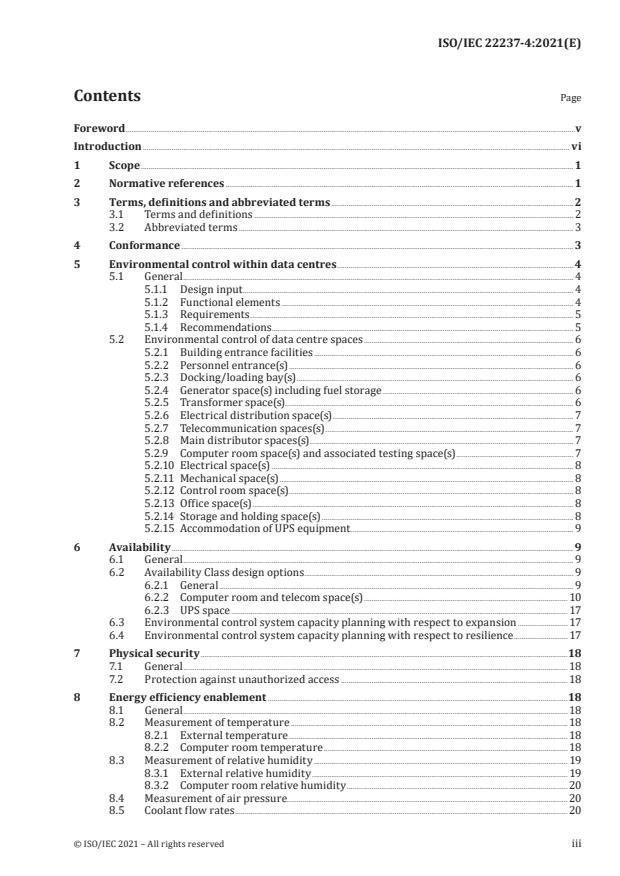
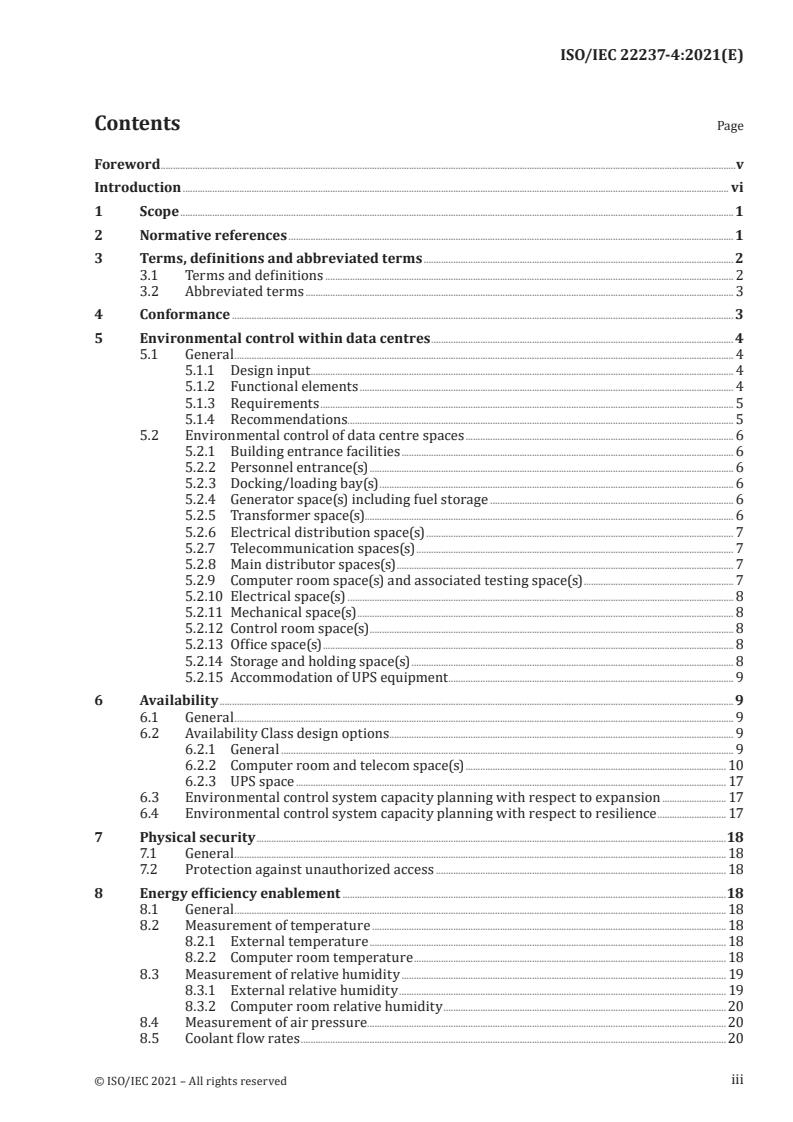
Contents Page
Foreword .v
Introduction . vi
1 Scope . 1
2 Normative references . 1
3 Terms, definitions and abbreviated terms . 2
3.1 Terms and definitions . 2
3.2 Abbreviated terms . 3
4 Conformance . 3
5 Environmental control within data centres . 4
5.1 General . 4
5.1.1 Design input . 4
5.1.2 Functional elements . 4
5.1.3 Requirements . 5
5.1.4 Recommendations. 5
5.2 Environmental control of data centre spaces . 6
5.2.1 Building entrance facilities . 6
5.2.2 Personnel entrance(s) . 6
5.2.3 Docking/loading bay(s) . 6
5.2.4 Generator space(s) including fuel storage . 6
5.2.5 Transformer space(s). 6
5.2.6 Electrical distribution space(s) . 7
5.2.7 Telecommunication spaces(s) . 7
5.2.8 Main distributor spaces(s) . 7
5.2.9 Computer room space(s) and associated testing space(s) . 7
5.2.10 Electrical space(s) . 8
5.2.11 Mechanical space(s) . 8
5.2.12 Control room space(s) . 8
5.2.13 Office space(s) . 8
5.2.14 Storage and holding space(s) . 8
5.2.15 Accommodation of UPS equipment . 9
6 Availability . 9
6.1 General . 9
6.2 Availability Class design options . . 9
6.2.1 General . 9
6.2.2 Computer room and telecom space(s) . 10
6.2.3 UPS space . 17
6.3 Environmental control system capacity planning with respect to expansion . 17
6.4 Environmental control system capacity planning with respect to resilience . 17
7 Physical security .18
7.1 General . 18
7.2 Protection against unauthorized access . 18
8 Energy efficiency enablement .18
8.1 General . 18
8.2 Measurement of temperature . 18
8.2.1 External temperature . 18
8.2.2 Computer room temperature . 18
8.3 Measurement of relative humidity . 19
8.3.1 External relative humidity . 19
8.3.2 Computer room relative humidity . 20
8.4 Measurement of air pressure. 20
8.5 Coolant flow rates . 20
iii
© ISO/IEC 2021 – All rights reserved
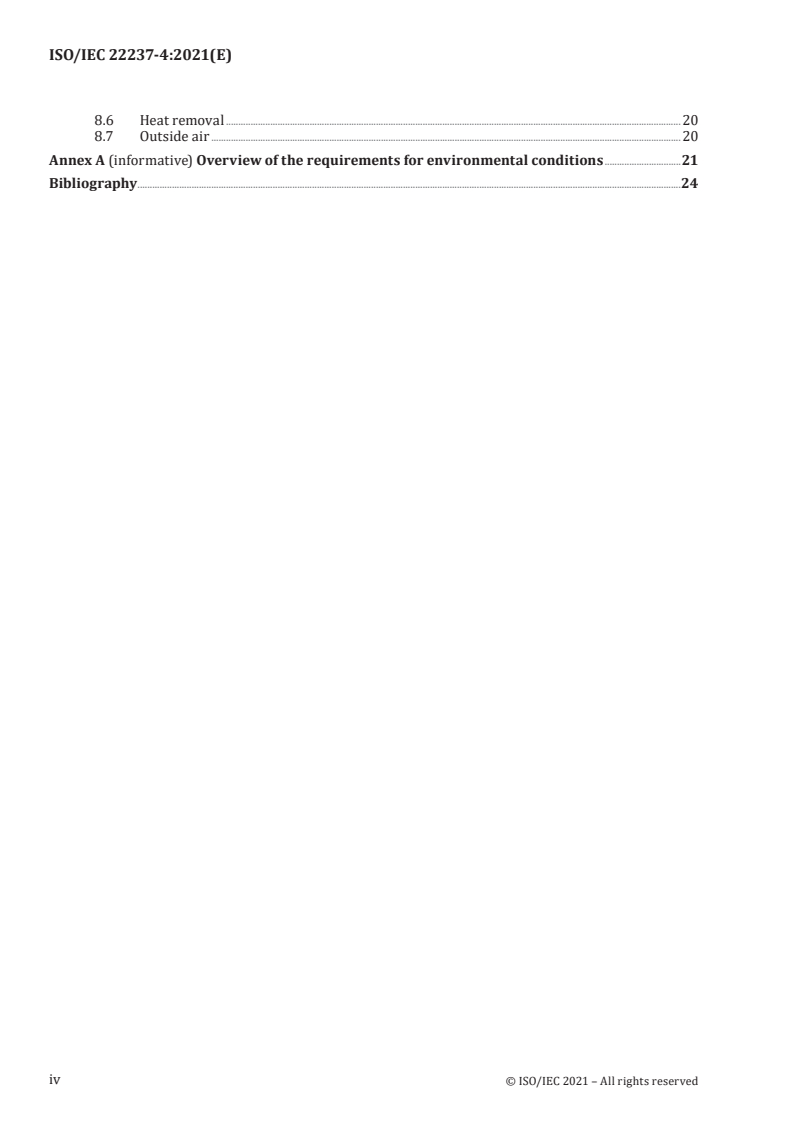
8.6 Heat removal . 20
8.7 Outside air . 20
Annex A (informative) Overview of the requirements for environmental conditions .21
Bibliography .24
iv
© ISO/IEC 2021 – All rights reserved
Foreword
ISO (the International Organization for Standardization) and IEC (the International Electrotechnical
Commission) form the specialized system for worldwide standardization. National bodies that are
members of ISO or IEC participate in the development of International Standards through technical
committees established by the respective organization to deal with particular fields of technical
activity. ISO and IEC technical committees collaborate in fields of mutual interest. Other international
organizations, governmental and non-governmental, in liaison with ISO and IEC, also take part in the
work.
The procedures used to develop this document and those intended for its further maintenance
are described in the ISO/IEC Directives, Part 1. In particular, the different approval criteria
needed for the different types of document should be noted. This document was drafted in
accordance with the editorial rules of the ISO/IEC Directives, Part 2 (see www.iso.org/directives or
www.iec.ch/members_experts/refdocs).
Attention is drawn to the possibility that some of the elements of this document may be the subject
of patent rights. ISO and IEC shall not be held responsible for identifying any or all such patent
rights. Details of any patent rights identified during the development of the document will be in the
Introduction and/or on the ISO list of patent declarations received (see www.iso.org/patents) or the IEC
list of patent declarations received (see patents.iec.ch).
Any trade name used in this document is information given for the convenience of users and does not
constitute an endorsement.
For an explanation of the voluntary nature of standards, the meaning of ISO specific terms and
expressions related to conformity assessment, as well as information about ISO's adherence to
the World Trade Organization (WTO) principles in the Technical Barriers to Trade (TBT) see
www.iso.org/iso/foreword.html. In the IEC, see www.iec.ch/understanding-standards.
This document was prepared by Joint Technical Committee ISO/IEC JTC 1, Information technology,
Subcommittee SC 39, Sustainability, IT & Data Centres.
This first edition cancels and replaces the first edition (ISO/IEC TS 22237-4:2018), which has been
technically revised.
The main changes are as follows:
— availability requirements have been aligned with ISO/IEC 22237-1 and ISO/IEC 22237-3;
— figures have been updated.
A list of all parts in the ISO/IEC 22237 series can be found on the ISO and IEC websites.
Any feedback or questions on this document should be directed to the user’s national standards
body. A complete listing of these bodies can be found at www.iso.org/members.html and
www.iec.ch/national-committees.
v
© ISO/IEC 2021 – All rights reserved
Introduction
The unrestricted access to internet-based information demanded by the information society has led to
an exponential growth of both internet traffic and the volume of stored/retrieved data. Data centres
are housing and supporting the information technology and network telecommunications equipment
for data processing, data storage and data transport. They are required both by network operators
(delivering those services to customer premises) and by enterprises within those customer premises.
Data centres need to provide modular, scalable and flexible facilities and infrastructures to easily
accommodate the rapidly changing requirements of the market. In addition, energy consumption
of data centres has become critical, both from an environmental point of view (reduction of carbon
footprint), and with respect to economic considerations (cost of energy) for the data centre operator.
The implementation of data centres varies in terms of:
a) purpose (enterprise, co-location, co-hosting or network operator facilities);
b) security level;
c) physical size; and
d) accommodation (mobile, temporary and permanent constructions).
NOTE Cloud services can be provided by all data centre types mentioned.
The needs of data centres also vary in terms of availability of service, the provision of security and
the objectives for energy efficiency. These needs and objectives influence the design of data centres in
terms of building construction, power distribution, environmental control, telecommunications cabling
and physical security. Effective management and operational information are required to monitor
achievement of the defined needs and objectives.
The ISO/IEC 22237 series specifies requirements and recommendations to support the various parties
involved in the design, planning, procurement, integration, installation, operation and maintenance of
facilities and infrastructures within data centres. These parties include:
1) owners, operators, facility managers, ICT managers, project managers, main contractors;
2) consultants, architects, building designers and builders, system and installation designers, auditors
and commissioning agents;
3) suppliers of equipment; and
4) installers, maintainers.
At the time of publication of this document, the ISO/IEC 22237 series comprises the following
documents:
— ISO/IEC 22237-1, Information technology — Data centre facilities and infrastructures — Part 1:
General concepts;
— ISO/IEC TS 22237-2, Information technology — Data centre facilities and infrastructures — Part 2:
Building construction;
— ISO/IEC 22237-3, Information technology — Data centre facilities and infrastructures — Part 3: Power
distribution;
— ISO/IEC 22237-4 (this document), Information technology — Data centre facilities and infrastructures —
Part 4: Environmental control;
— ISO/IEC TS 22237-5, Information technology — Data centre facilities and infrastructures — Part 5:
Telecommunications cabling infrastructure;
vi
© ISO/IEC 2021 – All rights reserved
— ISO/IEC TS 22237-6, Information technology — Data centre facilities and infrastructures — Part 6:
Security systems;
— ISO/IEC TS 22237-7, Information technology — Data centre facilities and infrastructures — Part 7:
Management and operational information.
The inter-relationship of the specifications within the ISO/IEC 22237 series is shown in Figure 1.
Figure 1 — Schematic relationship between the ISO/IEC 22237 series of documents
ISO/IEC TS 22237-2 to ISO/IEC TS 22237-6 specify requirements and recommendations for particular
facilities and infrastructures to support the relevant classification for “availability”, “physical security”
and “energy efficiency enablement” selected from ISO/IEC 22237-1.
This document, ISO/IEC 22237-4, addresses the environmental control facilities and infrastructure
within data centres together with the interfaces for monitoring the performance of those facilities
and infrastructures in line with ISO/IEC TS 22237-7 (in accordance with the requirements of
ISO/IEC 22237-1).
ISO/IEC TS 22237-7 addresses the operational and management information (in accordance with the
requirements of ISO/IEC 22237-1).
This document is intended for use by and collaboration between architects, building designers and
builders, and system and installation designers.
The ISO/IEC 22237 series does not address the selection of information technology and network
telecommunications equipment, software and associated configuration issues.
vii
© ISO/IEC 2021 – All rights reserved
INTERNATIONAL STANDARD ISO/IEC 22237-4:2021(E)
Information technology — Data centre facilities and
infrastructures —
Part 4:
Environmental control
1 Scope
This document addresses environmental control within data centres based upon the criteria and
classifications for “availability”, “security” and “energy efficiency enablement” within ISO/IEC 22237-1.
This document specifies requirements and recommendations for the following:
a) temperature control;
b) fluid movement control;
c) relative humidity control;
d) particulate control;
e) vibration;
f) physical security of environmental control systems.
2 Normative references
The following documents are referred to in the text in such a way that some or all of their content
constitutes requirements of this document. For dated references, only the edition cited applies. For
undated references, the latest edition of the referenced document (including any amendments) applies.
ISO 14644-8, Cleanrooms and associated controlled environments — Part 8: Classification of air cleanliness
by chemical concentration (ACC)
ISO 16890-1, Air filters for general ventilation — Part 1: Technical specifications, requirements and
classification system based upon particulate matter efficiency (ePM)
ISO/IEC 22237-1, Information technology — Data centre facilities and infrastructures — Part 1: General
concepts
ISO/IEC 22237-3, Information technology — Data centre facilities and infrastructures — Part 3: Power
distribution
ISO/IEC/TS 22237-6, Information technology — Data centre facilities and infrastructures — Part 6:
Security systems
IEC 61439-1, Low-voltage switchgear and controlgear assemblies — Part 1: General rules
IEC 62040-3, Uninterruptible power systems (UPS) — Part 3: Method of specifying the performance and
test requirements
© ISO/IEC 2021 – All rights reserved
3 Terms, definitions and abbreviated terms
3.1 Terms and definitions
For the purposes of this document, the following terms and definitions apply.
ISO and IEC maintain terminology databases for use in standardization at the following addresses:
— ISO Online browsing platform: available at https:// www .iso .org/ obp
— IEC Electropedia: available at http:// www .electropedia .org/
3.1.1
access floor
system consisting of completely removable and interchangeable floor panels that are supported on
adjustable pedestals connected by stringers to allow the area beneath the floor to be used by building
services
Note 1 to entry: Also known as raised floor.
[SOURCE: ISO/IEC TS 22237-2:2018, 3.1.1 – modified: added note 1 to entry]
3.1.2
comfort environmental control
control which produces an environment which is appropriate for the effective performance of personnel
in a given space
3.1.3
dew point
temperature at which the water vapour in a gas begins to deposit as a liquid or ice, under standardized
conditions
3.1.4
direct fresh air cooling
cooling system that uses the external air that can be filtered to cool the IT equipment in the data centre
3.1.5
diesel rotary uninterruptible power system
DRUPS
system where the output waveform is produced by a rotating machine that is mechanically connected
to a flywheel stored energy source, and the flywheel stored energy source is coupled to a backup engine
with an electro-magnetic clutch
3.1.6
inlet air temperature
temperature of the (cold) air entering the rack or IT equipment
3.1.7
relative humidity
ratio, expressed as a percentage, of the vapour pressure of water vapour in moist air to the saturation
vapour pressure with respect to water or ice at the same temperature
[SOURCE: IEC 60050-705:1995, 705-05-09]
3.1.8
return air temperature
temperature of the (warm) air re-entering the environmental control system, e.g. the air handling unit
© ISO/IEC 2021 – All rights reserved
3.1.9
rotary uninterruptible power system
rotary UPS
system where the output waveform is produced by a rotating machine, using either batteries or
flywheel as stored energy source
3.1.10
static uninterruptible power system
static UPS
system where the output waveform is produced by electronic circuits, using either batteries or flywheel
as stored energy source
3.1.11
supply air temperature
temperature of the (cold) air leaving the environmental control system e.g. the air handling unit
3.1.12
ventilation
supply of air motion in a space by circulation or by moving air through the space
Note 1 to entry: Ventilation can be produced by any combination of natural or mechanical supply and exhaust.
Note 2 to entry: Such systems can include partial treatment such as heating, relative humidity (3.1.7) control,
filtering or purification, and, in some cases, evaporative cooling.
3.2 Abbreviated terms
For the purposes of this document, the abbreviated terms given in ISO/IEC 22237-1 and the following
apply.
AHU air handling unit
DX direct expansion cooling unit
IT information technology
ICT information and communication technology
4 Conformance
For a data centre to conform to this document:
a) it shall feature an environmental control solution that meets the requirements of Clauses 5 and 6;
b) it shall feature an approach to physical security in relation to the environmental control solution
that meets the requirements of Clause 7;
c) it shall feature an energy efficiency enablement solution that meets the requirements of the
relevant Granularity Level of Clause 8;
d) local regulations, including safety, shall be met.
The required Class of the Environmental Control system of a data centre is based on the required
Availability Class of the data centre.
© ISO/IEC 2021 – All rights reserved
5 Environmental control within data centres
5.1 General
5.1.1 Design input
Power supply, distribution and environmental control are important primary facilities and
infrastructures of a data centre and have inter-related design aspects:
a) power supplied to IT equipment which is converted to heat output;
b) power supplied to the environmental control system to remove the heat output.
Figure 2 — Logical representation of environmental control of data centre spaces
5.1.2 Functional elements
The environmental control system is one of the most important parts of the data centre infrastructure.
Excessive variations of temperature or relative humidity can directly affect the functional capability of
the data centre and its infrastructures.
The functional elements of the environmental control system are divided into supply and distribution
elements. The division of environmental control systems into supply and distribution reflects energy
efficiency where data centres use multiple cooling sources in various combinations (e.g. cold water
from public grids, non-dedicated central cooling plants, geothermal systems, rivers, and compressor
systems).
Supply elements relate to the generation of temperature-controlled fluids. Distribution elements relate
to the distribution of fluids generated by the supply elements. Distribution elements are differentiated
in devices (units) and paths. See Table 1 for examples of these elements.
It should be noted that for environmental control systems the electrical energy flow is into the
system and the thermal flow is from within the controlled environment outwards to the uncontrolled
environment (exhausted from the building).
Some environmental systems combine the function of supply and distribution elements.
Table 1 — Examples of supply and distribution elements
Functional element(s)
Area Fluid
Device/Functional ele- Path/Functional
ment element
Supply Water/Refrigerant External water supply, Pipe system
chiller, pump(s), condens-
ing unit
© ISO/IEC 2021 – All rights reserved
Table 1 (continued)
Functional element(s)
Area Fluid
Device/Functional ele- Path/Functional
ment element
Air Outside air intake, filter(s), Duct/Plenum system
heat exchanger
Distribution Water/Refrigerant Pump(s), heat exchanger Pipe system
Air CRAC, CRAH, louvres, AHU Duct/Plenum system
5.1.3 Requirements
The approach taken for the design of the environmental control system shall take into account available
technology, physical security, data centre availability, maintenance and future extension (continuity of
service).
Physical data centre location and external conditions (minimum, median and maximum external
temperature and humidity rate) have to be taken into account for the selection of the functional
elements.
The design of the environmental control system and the selection and installation of functional
elements shall take into consideration the effect of vibration on the data centre spaces.
The design of the environmental control system and the selection and installation of functional elements
shall take into consideration the effect of friction and/or obstruction in the pathways for temperature-
controlled fluids. Operational controls shall be provided to ensure no degradation of fluid flow due to
changes in the pathways (see ISO/IEC TS 22237-7).
During the design phase, the requirement for the number of air changes per unit time and air pressure
shall be established.
In all data centre spaces, the requirements for air quality shall be considered.
In all spaces with a risk of damage to static-sensitive equipment from electro-static discharge,
the relative humidity shall be maintained in accordance with the instructions of the supplier of the
equipment to be accommodated. Where no information exists or where the equipment manufacturer is
not specified, a minimum dew point of 5,5 °C shall be maintained.
Where direct fresh air cooling solutions are chosen, the requirements analysis and the resulting
methodology of monitoring and control is of prime importance. In these circumstances, particular
consideration shall be given to the control of contaminants.
For guidance on the ventilation requirements of activated gaseous suppression systems that have been
discharged, see ISO/IEC TS 22237-6.
An overview of the requirements on environmental conditions is given in Annex A.
5.1.4 Recommendations
Opportunities for reductions in energy consumption exist where wider tolerances of temperature and
relative humidity can be accepted in defined data centre spaces (see CLC/TR 50600-99-1).
Measurements are requested at various points in the text to provide insight, the ability to analyse and
ultimately to improve energy efficiency.
Devices of the environmental control system with integrated vibration decoupling for all rotating parts
(e.g. fan, compressor) or low vibration parts should be selected.
Where devices of the environmental control system or other external devices with rotating parts are
not equipped with integrated vibration decoupling, the whole unit should be decoupled.
© ISO/IEC 2021 – All rights reserved
Where the design of the cooling system relies on the use of “F-gaseous” coolants, the long-term
availability of such coolants and the subsequent effect on the cooling system efficiency should be
considered.
5.2 Environmental control of data centre spaces
5.2.1 Building entrance facilities
No specific requirements.
5.2.2 Personnel entrance(s)
Comfort environmental controls shall be applied to this space.
5.2.3 Docking/loading bay(s)
No specific requirements.
5.2.4 Generator space(s) including fuel storage
5.2.4.1 Generator and DRUPS spaces
Temperature shall be maintained in accordance with the instructions of the supplier of the equipment to
be accommodated. Where no information exists or where the equipment manufacturer is not specified,
the temperature shall be maintained above 0 °C and should be above 10 °C.
Adequate ventilation shall be provided for combustion and for radiator cooling.
Where the manufacturer is not known at the time of design, the maximum temperature shall be 35 °C.
Anti-condensation measures shall be taken for generator and switchgear.
5.2.4.2 Fuel systems
The fuel system shall be protected against sub-zero ambient temperatures to avoid fuel solidification.
NOTE The availability of generators can be adversely affected by cold (< 10 °C) or poor-quality fuel and
can be improved through the installation of crankcase heaters, or by installing the generators in a conditioned,
purpose-built space within the data centre facility.
5.2.5 Transformer space(s)
The temperature shall be maintained in accordance with the instructions of the supplier of the
equipment to be accommodated unless the system has been de-rated for operation at higher ambient
temperatures. Where the manufacturer is not known at the time of design, the maximum temperature
shall be in accordance with IEC 61439-1.
Where necessary, filtration against particulate contamination shall be provided to prevent build-
up of dust in accordance with the instructions of the supplier of the equipment to be accommodated.
Measures shall be provided to allow inspection and cleaning of the transformer and the transformer
space(s).
Forced air cooling of the transformer should be considered at the design phase where this would
represent an improvement in transformer efficiency.
Anti-condensation measures shall be taken for switchgear.
© ISO/IEC 2021 – All rights reserved
5.2.6 Electrical distribution space(s)
Temperature shall be maintained in accordance with the instructions of the supplier of the equipment to
be accommodated. Where no information exists or where the equipment manufacturer is not specified,
the temperature shall be maintained above 0 °C and should be above 10 °C.
Where practicable, natural ventilation shall be provided.
The maximum ambient temperature shall not exceed the maximum temperature specified by the
supplier of the equipment to be accommodated unless the system has been de-rated for operation at
higher ambient temperatures. Where the manufacturer is not known at the time of design the maximum
temperature shall be 40 °C.
Anti-condensation measures shall be taken.
If required, temperature-controlled air extraction shall be provided.
5.2.7 Telecommunication spaces(s)
Temperature and relative humidity shall be maintained in accordance with the requirements of 5.2.9.
Temperature and relative humidity shall be monitored.
Where the data centre is supported by a single telecommunications space, or by multiple, non-resilient
telecommunications spaces, the space(s) shall have a single path environmental control system (for
examples see 6.2.2.2 and 6.2.2.3).
5.2.8 Main distributor spaces(s)
The requirements of 5.2.9 shall be applied.
5.2.9 Computer room space(s) and associated testing space(s)
The computer room space is the most important space from an environmental control perspective. The
designer of the environmental control system shall assess the impact of the failure of the system on the
data centre infrastructure.
Outside air shall be filtered according to ISO 16890-1, with the Class depending on the local air quality,
and minimum filter Class M5.
An analysis examining the balance between energy management and environmental control parameters
with reference to the type of IT equipment to be accommodated shall be performed by the owner of the
data centre. The results of this analysis shall be compared with the business model for the data centre.
CLC/TR 50600-99-1 provides further information to assist with this analysis.
Environmental controls shall be applied that maintain the following parameters within limits defined
by the requirements of the analysis described above:
a) supply air temperature;
b) supply air relative humidity;
c) air quality:
1) particulate content;
2) gaseous contaminants.
For the classification of air cleanness by chemical concentration (ACC), ISO 14644-8 shall be applied.
Gaseous contaminants should be measured periodically or monitored continuously regarding ANSI/
ISA-71-04-2013. Where no information exists or where the equipment manufacturer is not specified,
a minimum class G1 should be maintained. Visual inspection of hardware within the space should
© ISO/IEC 2021 – All rights reserved
be performed as part of the maintenance routines to mitigate the potential risk of damage due to
corrosion. Additional information as to the nature and concentration of contaminants can be obtained
by laboratory analysis of collected dust from the data centre and/or specimens collected using carbon
adhesive tabs.
The supply air temperature shall be monitored with temperature sensors in the supply path near the IT
equipment. The number of sensors shall be chosen so as to provide a representative average supply air
temperature and shall be in accordance with 8.2. In areas of high thermal load additional temperature
sensors can be necessary to detect hot spots.
Where air containments are used, it is recommended that the supply air temperature be monitored
by temperature sensors in the containment. The number of sensors shall be chosen so as to provide a
representative average supply air temperature.
The relative humidity of supply air shall be monitored in the supply path. The number of sensors shall
be chosen so as to provide a representative average value.
A combined sensor for temperature and relative humidity is allowed. Depending on the availability
class, redundant temperature and humidity sensors shall be installed.
It is recommended to install a dew point sensor where relative humidity is measured, or to calculate a
dew point from temperature and relative humidity data.
5.2.10 Electrical space(s)
If the electrical space contains UPS equipment, see 5.2.15.
Anti-condensation measures shall be taken.
Where practicable, natural ventilation shall be provided.
The maximum ambient temperature shall not exceed the maximum temperature specified by the
supplier of the equipment to be accommodated unless the system has been de-rated for operation
at higher ambient temperatures. Where the manufacturer is not known at the time of design, the
maximum temperature shall be in accordance with IEC 61439-1.
Temperature and relative humidity should be monitored.
5.2.11 Mechanical space(s)
If the mechanical space accommodates electrical equipment, then the requirements of 5.2.10 apply.
Otherwise, temperature and humidity shall be maintained in accordance with the instructions of the
supplier of the equipment to be accommodated.
5.2.12 Control room space(s)
Comfort environmental controls shall be applied to this space.
5.2.13 Office space(s)
Comfort environmental controls shall be applied to this space.
5.2.14 Storage and holding space(s)
Basic environmental controls should be applied (temperature and relative humidity); temperature
should be monitored. Measures addressing gaseous contaminants (see 5.2.9) should be considered.
© ISO/IEC 2021 – All rights reserved
5.2.15 Accommodation of UPS equipment
5.2.15.1 Static UPS and rotary UPS
Temperature shall be maintained in accordance with the instructions of the supplier of the equipment
to be accommodated. Where no information exists or where the UPS equipment is not specified, the
temperature shall be maintained between 15 °C and 35 °C (non-condensing). Where storage batteries
are included in the UPS space, the requirements of 5.2.15.3 shall be applied.
Air-conditioning, rated for the maximum heat output of the UPS system, shall be provided if the external
ambient conditions preclude the use of filtered fresh air.
Monitoring for temperature shall be provided.
Waste heat should be used to pre-heat the standby generator plant of the UPS system where possible.
5.2.15.2 DRUPS
The environmental controls required for the accommodation of Diesel Rotary UPS are stated in 5.2.4.1.
5.2.15.3 Batteries
Where batteries are located away from the UPS equipment that they serve, the temperature shall be
controlled in accordance with the manufacturer’s instructions to maintain planned battery lifetime.
Where no information exists or where the equipment is not specified the temperature shall be
maintained at (20 ± 2) °C.
If required, a resilient fresh air ventilation shall be provided to avoid hydrogen accumulation.
It is recommended that hydrogen monitoring be provided.
See EN 50272-2 for further information on safety requirements for secondary batteries.
6 Availability
6.1 General
The environmental control system shall be designed to support the Availability Class chosen
following the risk assessment undertaken in accordance with the availability classification defined in
ISO/IEC 22237-1.
This document defines four Classes of Environmental Control Systems of increasing availability (Class
1, Class 2, Class 3 and Class 4).
6.2 Availability Class design options
6.2.1 General
To maximize the utilization of capital plant, and to minimize energy standing losses, the designer shall
take into account the increased redundancy for running at partial load when choosing how to specify
the configuration.
In systems with multiple paths it is permissible to utilize different technologies for each path.
For examples of current “Best Practice” for environmental control, see CLC/TR 50600-99-1.
Scalable design options are not available for rooms other than those described in 6.2.2 and 6.2.3.
Four design options, of increasing Availability Class, are specified:
© ISO/IEC 2021 – All rights reserved
A Class 1 solution (single path) is appropriate where the outcome of the risk assessment deems it
acceptable that:
— a single fault in a functional element can result in loss of functional capability;
— planned maintenance can require the load to be shut down.
A Class 2 solution (single path with redundancy) is appropriate where the outcome of the risk
assessment deems it necessary that:
— a single fault in a device shall not result in loss of functional capability of that path (via redundant
devices);
— routine planned maintenance of a redundant device shall not require the load to be shut down.
NOTE Failure of the path can result in unplanned load shutdown and routine maintenance of non-redundant
devices can require planned load shutdown.
A Class 3 solution (multiple paths providing a concurrent repair/operate solution) is appropriate where
the outcome of the risk assessment deems it necessary that:
— a fault of a functional element shall not result in loss of functional capability;
— although a failure of a path can result in unplanned load shutdown, maintenance routines shall not
require planned load shutdown as the passive path serves to act as the concurrent maintenance
enabler as well as reducing the recovery of service time (minimizing the mean downtime) after the
failure of a path;
— planned maintenance shall not require the load to be shut down.
All paths shall be designed to sustain the maximum load.
A Class 4 solution (fault-tolerant solution except during maintenance) is appropriate where the outcome
of the risk assessment deems it necessary that:
— a fault of a functional element shall not result in loss of functional capability;
— for power supply and distribution: any single event impacting a functional element shall not result
in load shutdown;
— for environmental control: a failure of one path shall not result in unplanned load shutdown;
— planned maintenance shall not require the load to be shut down.
All paths shall be designed to sustain the maximum load.
6.2.2 Computer room and telecom space(s)
6.2.2.1 General
The designer of systems which require an additional primary supply (e.g. water) shall consider that the
continuity of the primary supply has to meet the requirements of the chosen availability class.
Environmental control systems shall be able to restart automatically after disruption to their power
supply. The designer of the system shall consider the effect of power supply disruption and the
duration of the restart time following power supply disruption on the environmental conditions within
the controlled space. The designer shall also consider delayed operation time in the design of the
environmental control system, e.g. sizing of buffer tanks.
When environmental control systems are connected to a UPS, the UPS should be separated from the
UPS for the IT equipment.
It should be noted that the examples given in the following subclauses are non-exclusive.
© ISO/IEC 2021 – All rights reserved
6.2.2.2 Class 1 — Supply: Single path system
6.2.2.2.1 General
Figure 3 shows a Class 1 cooling supply system with a single supply sub-system and a single path to the
distribution sub-system. Examples of a Class 1 cooling supply sub-system are:
a) a single compressor-based chiller and a pump;
b) an inlet fan and a cooling coil.
6.2.2.2.2 Power supply
The environmental control system shall be fed from a power supply system that meets at least the
requirements of ISO/IEC 22237-3, Class 1.
6.2.2.2.3 Power distribution
The designer of the system shall determine the power connection requirements (e.g. unprotected or
protected) of control and other functional elements of the environmental control system along with
any required management routines such that the design objectives of 6.2.2.1 are me
...
INTERNATIONAL ISO/IEC
STANDARD 22237-4
First edition
2021-10
Information technology — Data centre
facilities and infrastructures —
Part 4:
Environmental control
Technologie de l’information — Installation et infrastructures de
centres de traitement de données —
Partie 4: Contrôle environnemental
Reference number
© ISO/IEC 2021
© ISO/IEC 2021
All rights reserved. Unless otherwise specified, or required in the context of its implementation, no part of this publication may
be reproduced or utilized otherwise in any form or by any means, electronic or mechanical, including photocopying, or posting on
the internet or an intranet, without prior written permission. Permission can be requested from either ISO at the address below
or ISO’s member body in the country of the requester.
ISO copyright office
CP 401 • Ch. de Blandonnet 8
CH-1214 Vernier, Geneva
Phone: +41 22 749 01 11
Email: copyright@iso.org
Website: www.iso.org
Published in Switzerland
ii
© ISO/IEC 2021 – All rights reserved
Contents Page
Foreword .v
Introduction . vi
1 Scope . 1
2 Normative references . 1
3 Terms, definitions and abbreviated terms . 2
3.1 Terms and definitions . 2
3.2 Abbreviated terms . 3
4 Conformance . 3
5 Environmental control within data centres . 4
5.1 General . 4
5.1.1 Design input . 4
5.1.2 Functional elements . 4
5.1.3 Requirements . 5
5.1.4 Recommendations. 5
5.2 Environmental control of data centre spaces . 6
5.2.1 Building entrance facilities . 6
5.2.2 Personnel entrance(s) . 6
5.2.3 Docking/loading bay(s) . 6
5.2.4 Generator space(s) including fuel storage . 6
5.2.5 Transformer space(s). 6
5.2.6 Electrical distribution space(s) . 7
5.2.7 Telecommunication spaces(s) . 7
5.2.8 Main distributor spaces(s) . 7
5.2.9 Computer room space(s) and associated testing space(s) . 7
5.2.10 Electrical space(s) . 8
5.2.11 Mechanical space(s) . 8
5.2.12 Control room space(s) . 8
5.2.13 Office space(s) . 8
5.2.14 Storage and holding space(s) . 8
5.2.15 Accommodation of UPS equipment . 9
6 Availability . 9
6.1 General . 9
6.2 Availability Class design options . . 9
6.2.1 General . 9
6.2.2 Computer room and telecom space(s) . 10
6.2.3 UPS space . 17
6.3 Environmental control system capacity planning with respect to expansion . 17
6.4 Environmental control system capacity planning with respect to resilience . 17
7 Physical security .18
7.1 General . 18
7.2 Protection against unauthorized access . 18
8 Energy efficiency enablement .18
8.1 General . 18
8.2 Measurement of temperature . 18
8.2.1 External temperature . 18
8.2.2 Computer room temperature . 18
8.3 Measurement of relative humidity . 19
8.3.1 External relative humidity . 19
8.3.2 Computer room relative humidity . 20
8.4 Measurement of air pressure. 20
8.5 Coolant flow rates . 20
iii
© ISO/IEC 2021 – All rights reserved
8.6 Heat removal . 20
8.7 Outside air . 20
Annex A (informative) Overview of the requirements for environmental conditions .21
Bibliography .24
iv
© ISO/IEC 2021 – All rights reserved
Foreword
ISO (the International Organization for Standardization) and IEC (the International Electrotechnical
Commission) form the specialized system for worldwide standardization. National bodies that are
members of ISO or IEC participate in the development of International Standards through technical
committees established by the respective organization to deal with particular fields of technical
activity. ISO and IEC technical committees collaborate in fields of mutual interest. Other international
organizations, governmental and non-governmental, in liaison with ISO and IEC, also take part in the
work.
The procedures used to develop this document and those intended for its further maintenance
are described in the ISO/IEC Directives, Part 1. In particular, the different approval criteria
needed for the different types of document should be noted. This document was drafted in
accordance with the editorial rules of the ISO/IEC Directives, Part 2 (see www.iso.org/directives or
www.iec.ch/members_experts/refdocs).
Attention is drawn to the possibility that some of the elements of this document may be the subject
of patent rights. ISO and IEC shall not be held responsible for identifying any or all such patent
rights. Details of any patent rights identified during the development of the document will be in the
Introduction and/or on the ISO list of patent declarations received (see www.iso.org/patents) or the IEC
list of patent declarations received (see patents.iec.ch).
Any trade name used in this document is information given for the convenience of users and does not
constitute an endorsement.
For an explanation of the voluntary nature of standards, the meaning of ISO specific terms and
expressions related to conformity assessment, as well as information about ISO's adherence to
the World Trade Organization (WTO) principles in the Technical Barriers to Trade (TBT) see
www.iso.org/iso/foreword.html. In the IEC, see www.iec.ch/understanding-standards.
This document was prepared by Joint Technical Committee ISO/IEC JTC 1, Information technology,
Subcommittee SC 39, Sustainability, IT & Data Centres.
This first edition cancels and replaces the first edition (ISO/IEC TS 22237-4:2018), which has been
technically revised.
The main changes are as follows:
— availability requirements have been aligned with ISO/IEC 22237-1 and ISO/IEC 22237-3;
— figures have been updated.
A list of all parts in the ISO/IEC 22237 series can be found on the ISO and IEC websites.
Any feedback or questions on this document should be directed to the user’s national standards
body. A complete listing of these bodies can be found at www.iso.org/members.html and
www.iec.ch/national-committees.
v
© ISO/IEC 2021 – All rights reserved
Introduction
The unrestricted access to internet-based information demanded by the information society has led to
an exponential growth of both internet traffic and the volume of stored/retrieved data. Data centres
are housing and supporting the information technology and network telecommunications equipment
for data processing, data storage and data transport. They are required both by network operators
(delivering those services to customer premises) and by enterprises within those customer premises.
Data centres need to provide modular, scalable and flexible facilities and infrastructures to easily
accommodate the rapidly changing requirements of the market. In addition, energy consumption
of data centres has become critical, both from an environmental point of view (reduction of carbon
footprint), and with respect to economic considerations (cost of energy) for the data centre operator.
The implementation of data centres varies in terms of:
a) purpose (enterprise, co-location, co-hosting or network operator facilities);
b) security level;
c) physical size; and
d) accommodation (mobile, temporary and permanent constructions).
NOTE Cloud services can be provided by all data centre types mentioned.
The needs of data centres also vary in terms of availability of service, the provision of security and
the objectives for energy efficiency. These needs and objectives influence the design of data centres in
terms of building construction, power distribution, environmental control, telecommunications cabling
and physical security. Effective management and operational information are required to monitor
achievement of the defined needs and objectives.
The ISO/IEC 22237 series specifies requirements and recommendations to support the various parties
involved in the design, planning, procurement, integration, installation, operation and maintenance of
facilities and infrastructures within data centres. These parties include:
1) owners, operators, facility managers, ICT managers, project managers, main contractors;
2) consultants, architects, building designers and builders, system and installation designers, auditors
and commissioning agents;
3) suppliers of equipment; and
4) installers, maintainers.
At the time of publication of this document, the ISO/IEC 22237 series comprises the following
documents:
— ISO/IEC 22237-1, Information technology — Data centre facilities and infrastructures — Part 1:
General concepts;
— ISO/IEC TS 22237-2, Information technology — Data centre facilities and infrastructures — Part 2:
Building construction;
— ISO/IEC 22237-3, Information technology — Data centre facilities and infrastructures — Part 3: Power
distribution;
— ISO/IEC 22237-4 (this document), Information technology — Data centre facilities and infrastructures —
Part 4: Environmental control;
— ISO/IEC TS 22237-5, Information technology — Data centre facilities and infrastructures — Part 5:
Telecommunications cabling infrastructure;
vi
© ISO/IEC 2021 – All rights reserved
— ISO/IEC TS 22237-6, Information technology — Data centre facilities and infrastructures — Part 6:
Security systems;
— ISO/IEC TS 22237-7, Information technology — Data centre facilities and infrastructures — Part 7:
Management and operational information.
The inter-relationship of the specifications within the ISO/IEC 22237 series is shown in Figure 1.
Figure 1 — Schematic relationship between the ISO/IEC 22237 series of documents
ISO/IEC TS 22237-2 to ISO/IEC TS 22237-6 specify requirements and recommendations for particular
facilities and infrastructures to support the relevant classification for “availability”, “physical security”
and “energy efficiency enablement” selected from ISO/IEC 22237-1.
This document, ISO/IEC 22237-4, addresses the environmental control facilities and infrastructure
within data centres together with the interfaces for monitoring the performance of those facilities
and infrastructures in line with ISO/IEC TS 22237-7 (in accordance with the requirements of
ISO/IEC 22237-1).
ISO/IEC TS 22237-7 addresses the operational and management information (in accordance with the
requirements of ISO/IEC 22237-1).
This document is intended for use by and collaboration between architects, building designers and
builders, and system and installation designers.
The ISO/IEC 22237 series does not address the selection of information technology and network
telecommunications equipment, software and associated configuration issues.
vii
© ISO/IEC 2021 – All rights reserved
INTERNATIONAL STANDARD ISO/IEC 22237-4:2021(E)
Information technology — Data centre facilities and
infrastructures —
Part 4:
Environmental control
1 Scope
This document addresses environmental control within data centres based upon the criteria and
classifications for “availability”, “security” and “energy efficiency enablement” within ISO/IEC 22237-1.
This document specifies requirements and recommendations for the following:
a) temperature control;
b) fluid movement control;
c) relative humidity control;
d) particulate control;
e) vibration;
f) physical security of environmental control systems.
2 Normative references
The following documents are referred to in the text in such a way that some or all of their content
constitutes requirements of this document. For dated references, only the edition cited applies. For
undated references, the latest edition of the referenced document (including any amendments) applies.
ISO 14644-8, Cleanrooms and associated controlled environments — Part 8: Classification of air cleanliness
by chemical concentration (ACC)
ISO 16890-1, Air filters for general ventilation — Part 1: Technical specifications, requirements and
classification system based upon particulate matter efficiency (ePM)
ISO/IEC 22237-1, Information technology — Data centre facilities and infrastructures — Part 1: General
concepts
ISO/IEC 22237-3, Information technology — Data centre facilities and infrastructures — Part 3: Power
distribution
ISO/IEC/TS 22237-6, Information technology — Data centre facilities and infrastructures — Part 6:
Security systems
IEC 61439-1, Low-voltage switchgear and controlgear assemblies — Part 1: General rules
IEC 62040-3, Uninterruptible power systems (UPS) — Part 3: Method of specifying the performance and
test requirements
© ISO/IEC 2021 – All rights reserved
3 Terms, definitions and abbreviated terms
3.1 Terms and definitions
For the purposes of this document, the following terms and definitions apply.
ISO and IEC maintain terminology databases for use in standardization at the following addresses:
— ISO Online browsing platform: available at https:// www .iso .org/ obp
— IEC Electropedia: available at http:// www .electropedia .org/
3.1.1
access floor
system consisting of completely removable and interchangeable floor panels that are supported on
adjustable pedestals connected by stringers to allow the area beneath the floor to be used by building
services
Note 1 to entry: Also known as raised floor.
[SOURCE: ISO/IEC TS 22237-2:2018, 3.1.1 – modified: added note 1 to entry]
3.1.2
comfort environmental control
control which produces an environment which is appropriate for the effective performance of personnel
in a given space
3.1.3
dew point
temperature at which the water vapour in a gas begins to deposit as a liquid or ice, under standardized
conditions
3.1.4
direct fresh air cooling
cooling system that uses the external air that can be filtered to cool the IT equipment in the data centre
3.1.5
diesel rotary uninterruptible power system
DRUPS
system where the output waveform is produced by a rotating machine that is mechanically connected
to a flywheel stored energy source, and the flywheel stored energy source is coupled to a backup engine
with an electro-magnetic clutch
3.1.6
inlet air temperature
temperature of the (cold) air entering the rack or IT equipment
3.1.7
relative humidity
ratio, expressed as a percentage, of the vapour pressure of water vapour in moist air to the saturation
vapour pressure with respect to water or ice at the same temperature
[SOURCE: IEC 60050-705:1995, 705-05-09]
3.1.8
return air temperature
temperature of the (warm) air re-entering the environmental control system, e.g. the air handling unit
© ISO/IEC 2021 – All rights reserved
3.1.9
rotary uninterruptible power system
rotary UPS
system where the output waveform is produced by a rotating machine, using either batteries or
flywheel as stored energy source
3.1.10
static uninterruptible power system
static UPS
system where the output waveform is produced by electronic circuits, using either batteries or flywheel
as stored energy source
3.1.11
supply air temperature
temperature of the (cold) air leaving the environmental control system e.g. the air handling unit
3.1.12
ventilation
supply of air motion in a space by circulation or by moving air through the space
Note 1 to entry: Ventilation can be produced by any combination of natural or mechanical supply and exhaust.
Note 2 to entry: Such systems can include partial treatment such as heating, relative humidity (3.1.7) control,
filtering or purification, and, in some cases, evaporative cooling.
3.2 Abbreviated terms
For the purposes of this document, the abbreviated terms given in ISO/IEC 22237-1 and the following
apply.
AHU air handling unit
DX direct expansion cooling unit
IT information technology
ICT information and communication technology
4 Conformance
For a data centre to conform to this document:
a) it shall feature an environmental control solution that meets the requirements of Clauses 5 and 6;
b) it shall feature an approach to physical security in relation to the environmental control solution
that meets the requirements of Clause 7;
c) it shall feature an energy efficiency enablement solution that meets the requirements of the
relevant Granularity Level of Clause 8;
d) local regulations, including safety, shall be met.
The required Class of the Environmental Control system of a data centre is based on the required
Availability Class of the data centre.
© ISO/IEC 2021 – All rights reserved
5 Environmental control within data centres
5.1 General
5.1.1 Design input
Power supply, distribution and environmental control are important primary facilities and
infrastructures of a data centre and have inter-related design aspects:
a) power supplied to IT equipment which is converted to heat output;
b) power supplied to the environmental control system to remove the heat output.
Figure 2 — Logical representation of environmental control of data centre spaces
5.1.2 Functional elements
The environmental control system is one of the most important parts of the data centre infrastructure.
Excessive variations of temperature or relative humidity can directly affect the functional capability of
the data centre and its infrastructures.
The functional elements of the environmental control system are divided into supply and distribution
elements. The division of environmental control systems into supply and distribution reflects energy
efficiency where data centres use multiple cooling sources in various combinations (e.g. cold water
from public grids, non-dedicated central cooling plants, geothermal systems, rivers, and compressor
systems).
Supply elements relate to the generation of temperature-controlled fluids. Distribution elements relate
to the distribution of fluids generated by the supply elements. Distribution elements are differentiated
in devices (units) and paths. See Table 1 for examples of these elements.
It should be noted that for environmental control systems the electrical energy flow is into the
system and the thermal flow is from within the controlled environment outwards to the uncontrolled
environment (exhausted from the building).
Some environmental systems combine the function of supply and distribution elements.
Table 1 — Examples of supply and distribution elements
Functional element(s)
Area Fluid
Device/Functional ele- Path/Functional
ment element
Supply Water/Refrigerant External water supply, Pipe system
chiller, pump(s), condens-
ing unit
© ISO/IEC 2021 – All rights reserved
Table 1 (continued)
Functional element(s)
Area Fluid
Device/Functional ele- Path/Functional
ment element
Air Outside air intake, filter(s), Duct/Plenum system
heat exchanger
Distribution Water/Refrigerant Pump(s), heat exchanger Pipe system
Air CRAC, CRAH, louvres, AHU Duct/Plenum system
5.1.3 Requirements
The approach taken for the design of the environmental control system shall take into account available
technology, physical security, data centre availability, maintenance and future extension (continuity of
service).
Physical data centre location and external conditions (minimum, median and maximum external
temperature and humidity rate) have to be taken into account for the selection of the functional
elements.
The design of the environmental control system and the selection and installation of functional
elements shall take into consideration the effect of vibration on the data centre spaces.
The design of the environmental control system and the selection and installation of functional elements
shall take into consideration the effect of friction and/or obstruction in the pathways for temperature-
controlled fluids. Operational controls shall be provided to ensure no degradation of fluid flow due to
changes in the pathways (see ISO/IEC TS 22237-7).
During the design phase, the requirement for the number of air changes per unit time and air pressure
shall be established.
In all data centre spaces, the requirements for air quality shall be considered.
In all spaces with a risk of damage to static-sensitive equipment from electro-static discharge,
the relative humidity shall be maintained in accordance with the instructions of the supplier of the
equipment to be accommodated. Where no information exists or where the equipment manufacturer is
not specified, a minimum dew point of 5,5 °C shall be maintained.
Where direct fresh air cooling solutions are chosen, the requirements analysis and the resulting
methodology of monitoring and control is of prime importance. In these circumstances, particular
consideration shall be given to the control of contaminants.
For guidance on the ventilation requirements of activated gaseous suppression systems that have been
discharged, see ISO/IEC TS 22237-6.
An overview of the requirements on environmental conditions is given in Annex A.
5.1.4 Recommendations
Opportunities for reductions in energy consumption exist where wider tolerances of temperature and
relative humidity can be accepted in defined data centre spaces (see CLC/TR 50600-99-1).
Measurements are requested at various points in the text to provide insight, the ability to analyse and
ultimately to improve energy efficiency.
Devices of the environmental control system with integrated vibration decoupling for all rotating parts
(e.g. fan, compressor) or low vibration parts should be selected.
Where devices of the environmental control system or other external devices with rotating parts are
not equipped with integrated vibration decoupling, the whole unit should be decoupled.
© ISO/IEC 2021 – All rights reserved
Where the design of the cooling system relies on the use of “F-gaseous” coolants, the long-term
availability of such coolants and the subsequent effect on the cooling system efficiency should be
considered.
5.2 Environmental control of data centre spaces
5.2.1 Building entrance facilities
No specific requirements.
5.2.2 Personnel entrance(s)
Comfort environmental controls shall be applied to this space.
5.2.3 Docking/loading bay(s)
No specific requirements.
5.2.4 Generator space(s) including fuel storage
5.2.4.1 Generator and DRUPS spaces
Temperature shall be maintained in accordance with the instructions of the supplier of the equipment to
be accommodated. Where no information exists or where the equipment manufacturer is not specified,
the temperature shall be maintained above 0 °C and should be above 10 °C.
Adequate ventilation shall be provided for combustion and for radiator cooling.
Where the manufacturer is not known at the time of design, the maximum temperature shall be 35 °C.
Anti-condensation measures shall be taken for generator and switchgear.
5.2.4.2 Fuel systems
The fuel system shall be protected against sub-zero ambient temperatures to avoid fuel solidification.
NOTE The availability of generators can be adversely affected by cold (< 10 °C) or poor-quality fuel and
can be improved through the installation of crankcase heaters, or by installing the generators in a conditioned,
purpose-built space within the data centre facility.
5.2.5 Transformer space(s)
The temperature shall be maintained in accordance with the instructions of the supplier of the
equipment to be accommodated unless the system has been de-rated for operation at higher ambient
temperatures. Where the manufacturer is not known at the time of design, the maximum temperature
shall be in accordance with IEC 61439-1.
Where necessary, filtration against particulate contamination shall be provided to prevent build-
up of dust in accordance with the instructions of the supplier of the equipment to be accommodated.
Measures shall be provided to allow inspection and cleaning of the transformer and the transformer
space(s).
Forced air cooling of the transformer should be considered at the design phase where this would
represent an improvement in transformer efficiency.
Anti-condensation measures shall be taken for switchgear.
© ISO/IEC 2021 – All rights reserved
5.2.6 Electrical distribution space(s)
Temperature shall be maintained in accordance with the instructions of the supplier of the equipment to
be accommodated. Where no information exists or where the equipment manufacturer is not specified,
the temperature shall be maintained above 0 °C and should be above 10 °C.
Where practicable, natural ventilation shall be provided.
The maximum ambient temperature shall not exceed the maximum temperature specified by the
supplier of the equipment to be accommodated unless the system has been de-rated for operation at
higher ambient temperatures. Where the manufacturer is not known at the time of design the maximum
temperature shall be 40 °C.
Anti-condensation measures shall be taken.
If required, temperature-controlled air extraction shall be provided.
5.2.7 Telecommunication spaces(s)
Temperature and relative humidity shall be maintained in accordance with the requirements of 5.2.9.
Temperature and relative humidity shall be monitored.
Where the data centre is supported by a single telecommunications space, or by multiple, non-resilient
telecommunications spaces, the space(s) shall have a single path environmental control system (for
examples see 6.2.2.2 and 6.2.2.3).
5.2.8 Main distributor spaces(s)
The requirements of 5.2.9 shall be applied.
5.2.9 Computer room space(s) and associated testing space(s)
The computer room space is the most important space from an environmental control perspective. The
designer of the environmental control system shall assess the impact of the failure of the system on the
data centre infrastructure.
Outside air shall be filtered according to ISO 16890-1, with the Class depending on the local air quality,
and minimum filter Class M5.
An analysis examining the balance between energy management and environmental control parameters
with reference to the type of IT equipment to be accommodated shall be performed by the owner of the
data centre. The results of this analysis shall be compared with the business model for the data centre.
CLC/TR 50600-99-1 provides further information to assist with this analysis.
Environmental controls shall be applied that maintain the following parameters within limits defined
by the requirements of the analysis described above:
a) supply air temperature;
b) supply air relative humidity;
c) air quality:
1) particulate content;
2) gaseous contaminants.
For the classification of air cleanness by chemical concentration (ACC), ISO 14644-8 shall be applied.
Gaseous contaminants should be measured periodically or monitored continuously regarding ANSI/
ISA-71-04-2013. Where no information exists or where the equipment manufacturer is not specified,
a minimum class G1 should be maintained. Visual inspection of hardware within the space should
© ISO/IEC 2021 – All rights reserved
be performed as part of the maintenance routines to mitigate the potential risk of damage due to
corrosion. Additional information as to the nature and concentration of contaminants can be obtained
by laboratory analysis of collected dust from the data centre and/or specimens collected using carbon
adhesive tabs.
The supply air temperature shall be monitored with temperature sensors in the supply path near the IT
equipment. The number of sensors shall be chosen so as to provide a representative average supply air
temperature and shall be in accordance with 8.2. In areas of high thermal load additional temperature
sensors can be necessary to detect hot spots.
Where air containments are used, it is recommended that the supply air temperature be monitored
by temperature sensors in the containment. The number of sensors shall be chosen so as to provide a
representative average supply air temperature.
The relative humidity of supply air shall be monitored in the supply path. The number of sensors shall
be chosen so as to provide a representative average value.
A combined sensor for temperature and relative humidity is allowed. Depending on the availability
class, redundant temperature and humidity sensors shall be installed.
It is recommended to install a dew point sensor where relative humidity is measured, or to calculate a
dew point from temperature and relative humidity data.
5.2.10 Electrical space(s)
If the electrical space contains UPS equipment, see 5.2.15.
Anti-condensation measures shall be taken.
Where practicable, natural ventilation shall be provided.
The maximum ambient temperature shall not exceed the maximum temperature specified by the
supplier of the equipment to be accommodated unless the system has been de-rated for operation
at higher ambient temperatures. Where the manufacturer is not known at the time of design, the
maximum temperature shall be in accordance with IEC 61439-1.
Temperature and relative humidity should be monitored.
5.2.11 Mechanical space(s)
If the mechanical space accommodates electrical equipment, then the requirements of 5.2.10 apply.
Otherwise, temperature and humidity shall be maintained in accordance with the instructions of the
supplier of the equipment to be accommodated.
5.2.12 Control room space(s)
Comfort environmental controls shall be applied to this space.
5.2.13 Office space(s)
Comfort environmental controls shall be applied to this space.
5.2.14 Storage and holding space(s)
Basic environmental controls should be applied (temperature and relative humidity); temperature
should be monitored. Measures addressing gaseous contaminants (see 5.2.9) should be considered.
© ISO/IEC 2021 – All rights reserved
5.2.15 Accommodation of UPS equipment
5.2.15.1 Static UPS and rotary UPS
Temperature shall be maintained in accordance with the instructions of the supplier of the equipment
to be accommodated. Where no information exists or where the UPS equipment is not specified, the
temperature shall be maintained between 15 °C and 35 °C (non-condensing). Where storage batteries
are included in the UPS space, the requirements of 5.2.15.3 shall be applied.
Air-conditioning, rated for the maximum heat output of the UPS system, shall be provided if the external
ambient conditions preclude the use of filtered fresh air.
Monitoring for temperature shall be provided.
Waste heat should be used to pre-heat the standby generator plant of the UPS system where possible.
5.2.15.2 DRUPS
The environmental controls required for the accommodation of Diesel Rotary UPS are stated in 5.2.4.1.
5.2.15.3 Batteries
Where batteries are located away from the UPS equipment that they serve, the temperature shall be
controlled in accordance with the manufacturer’s instructions to maintain planned battery lifetime.
Where no information exists or where the equipment is not specified the temperature shall be
maintained at (20 ± 2) °C.
If required, a resilient fresh air ventilation shall be provided to avoid hydrogen accumulation.
It is recommended that hydrogen monitoring be provided.
See EN 50272-2 for further information on safety requirements for secondary batteries.
6 Availability
6.1 General
The environmental control system shall be designed to support the Availability Class chosen
following the risk assessment undertaken in accordance with the availability classification defined in
ISO/IEC 22237-1.
This document defines four Classes of Environmental Control Systems of increasing availability (Class
1, Class 2, Class 3 and Class 4).
6.2 Availability Class design options
6.2.1 General
To maximize the utilization of capital plant, and to minimize energy standing losses, the designer shall
take into account the increased redundancy for running at partial load when choosing how to specify
the configuration.
In systems with multiple paths it is permissible to utilize different technologies for each path.
For examples of current “Best Practice” for environmental control, see CLC/TR 50600-99-1.
Scalable design options are not available for rooms other than those described in 6.2.2 and 6.2.3.
Four design options, of increasing Availability Class, are specified:
© ISO/IEC 2021 – All rights reserved
A Class 1 solution (single path) is appropriate where the outcome of the risk assessment deems it
acceptable that:
— a single fault in a functional element can result in loss of functional capability;
— planned maintenance can require the load to be shut down.
A Class 2 solution (single path with redundancy) is appropriate where the outcome of the risk
assessment deems it necessary that:
— a single fault in a device shall not result in loss of functional capability of that path (via redundant
devices);
— routine planned maintenance of a redundant device shall not require the load to be shut down.
NOTE Failure of the path can result in unplanned load shutdown and routine maintenance of non-redundant
devices can require planned load shutdown.
A Class 3 solution (multiple paths providing a concurrent repair/operate solution) is appropriate where
the outcome of the risk assessment deems it necessary that:
— a fault of a functional element shall not result in loss of functional capability;
— although a failure of a path can result in unplanned load shutdown, maintenance routines shall not
require planned load shutdown as the passive path serves to act as the concurrent maintenance
enabler as well as reducing the recovery of service time (minimizing the mean downtime) after the
failure of a path;
— planned maintenance shall not require the load to be shut down.
All paths shall be designed to sustain the maximum load.
A Class 4 solution (fault-tolerant solution except during maintenance) is appropriate where the outcome
of the risk assessment deems it necessary that:
— a fault of a functional element shall not result in loss of functional capability;
— for power supply and distribution: any single event impacting a functional element shall not result
in load shutdown;
— for environmental control: a failure of one path shall not result in unplanned load shutdown;
— planned maintenance shall not require the load to be shut down.
All paths shall be designed to sustain the maximum load.
6.2.2 Computer room and telecom space(s)
6.2.2.1 General
The designer of systems which require an additional primary supply (e.g. water) shall consider that the
continuity of the primary supply has to meet the requirements of the chosen availability class.
Environmental control systems shall be able to restart automatically after disruption to their power
supply. The designer of the system shall consider the effect of power supply disruption and the
duration of the restart time following power supply disruption on the environmental conditions within
the controlled space. The designer shall also consider delayed operation time in the design of the
environmental control system, e.g. sizing of buffer tanks.
When environmental control systems are connected to a UPS, the UPS should be separated from the
UPS for the IT equipment.
It should be noted that the examples given in the following subclauses are non-exclusive.
© ISO/IEC 2021 – All rights reserved
6.2.2.2 Class 1 — Supply: Single path system
6.2.2.2.1 General
Figure 3 shows a Class 1 cooling supply system with a single supply sub-system and a single path to the
distribution sub-system. Examples of a Class 1 cooling supply sub-system are:
a) a single compressor-based chiller and a pump;
b) an inlet fan and a cooling coil.
6.2.2.2.2 Power supply
The environmental control system shall be fed from a power supply system that meets at least the
requirements of ISO/IEC 22237-3, Class 1.
6.2.2.2.3 Power distribution
The designer of the system shall determine the power connection requirements (e.g. unprotected or
protected) of control and other functional elements of the environmental control system along with
any required management routines such that the design objectives of 6.2.2.1 are me
...