

ISO 8000-130:2016
(Main)Data quality — Part 130: Master data: Exchange of characteristic data: Accuracy
General Information
- Abstract
ISO 8000-130:2016 is an optional addition to ISO 8000‑120 and specifies requirements for representation and exchange of information about accuracy of master data that consists of characteristic data. ISO 8000-130:2016 does not specify a complete model for characteristic data, nor does it specify an exchange format for characteristic data with data accuracy information. The following are within the scope of ISO 8000-130:2016: · requirements for capture and exchange of data accuracy information in the form of statements and assertions of data accuracy; · conceptual data model for data accuracy information in the form of statements and assertions of data accuracy. The following are outside the scope of ISO 8000-130:2016: · requirements for data accuracy; · exchange format for data accuracy information; · scheme for registering and resolving organization identifiers and person identifiers; · accuracy of data that are not characteristic data represented as property values; · syntax of identifiers; · resolution of identifiers. Some of the requirements in ISO 8000-130:2016 can apply to exchange of data that is not master data which consists of characteristic data represented as property values.
- Status
- Published
- Publication Date
- 22-Sep-2016
- Technical Committee
- ISO/TC 184/SC 4 - Industrial data
- Drafting Committee
- ISO/TC 184/SC 4/WG 13 - Industrial Data Quality
- Current Stage
- 9093 - International Standard confirmed
- Start Date
- 30-Dec-2021
- Completion Date
- 29-Aug-2026
Overview
ISO 8000-130:2016 - "Data quality - Part 130: Master data: Exchange of characteristic data: Accuracy" defines requirements for representing and exchanging information about the accuracy of master data that consists of characteristic data. It is an optional extension to ISO 8000-120 and provides a conceptual data model and rules for capturing statements and assertions of data accuracy. The standard does not prescribe exchange formats, numeric accuracy requirements, identifier registration schemes, or identifier syntax/resolution.
Key topics and technical requirements
- Scope and purpose: Focuses on how to record and exchange accuracy metadata for property values (characteristic data) rather than prescribing what accuracy thresholds must be met.
- Accuracy data model: Includes a UML conceptual model linking target data (via the property_value_assignment) to accuracy metadata. Core entities include:
- accuracy_event - records an event that documents accuracy information (statement or assertion), who performed it, and when.
- accuracy_method - describes how accuracy is measured or expressed (e.g., percent, probability, qualitative ranking).
- data accuracy record - the chain of custody/derivation for a property value; may be embedded in the property-value structure or stored separately and referenced.
- Statement vs. Assertion:
- Statement of data accuracy: factual information enabling recipients to judge fitness for use (process, test results, known inaccuracies).
- Assertion of data accuracy: a written declaration that the property value meets an objective measure; must include the measure, claim process, service address, and remediation commitments.
- Conformance: Defines conformance requirements for representing accuracy metadata; normative references include ISO 8000-2 (vocabulary) and ISO 8000-120 (provenance).
Practical applications
- Enabling reliable master data exchange between suppliers, manufacturers, and buyers by providing standardized accuracy metadata.
- Supporting Master Data Management (MDM) implementations and data governance programs that require provenance and accuracy traceability.
- Improving supply chain interoperability where recipients need to assess whether shared characteristic data is fit for a particular purpose.
- Integrating accuracy metadata into APIs, XML/JSON payloads, or MDM repositories (the standard shows embedding or referencing options rather than prescribing a syntax).
Who should use this standard
- Data stewards, MDM architects, and data governance leads
- System integrators and software vendors implementing master data exchange
- Procurement, asset management, and supply chain professionals who exchange technical characteristic data
- Organizations seeking to add formal data accuracy metadata to product, part, or asset records
Related standards
- ISO 8000-120 (Provenance of characteristic data)
- ISO 8000-110, ISO 8000-2 (vocabulary)
- ISO/IEC 6523 (organization identifier structures)
- ISO/TS 22745-40 (examples of standards referencing ISO 8000-130)
Keywords: ISO 8000-130:2016, data quality, master data, accuracy, characteristic data, data accuracy record, accuracy_event, accuracy_method, MDM, data provenance.
Relations
- Effective Date
- 06-Jul-2012
Get Certified
Connect with accredited certification bodies for this standard

DVS-ZERT GmbH
German welding certification society.
CARES (UK Certification Authority for Reinforcing Steels)
UK certification for reinforcing steels and construction.
EWF/IIW (European/International Welding Federation)
International welding personnel certification.
Sponsored listings
Frequently Asked Questions
ISO 8000-130:2016 is a standard published by the International Organization for Standardization (ISO). Its full title is "Data quality — Part 130: Master data: Exchange of characteristic data: Accuracy". This standard covers: ISO 8000-130:2016 is an optional addition to ISO 8000‑120 and specifies requirements for representation and exchange of information about accuracy of master data that consists of characteristic data. ISO 8000-130:2016 does not specify a complete model for characteristic data, nor does it specify an exchange format for characteristic data with data accuracy information. The following are within the scope of ISO 8000-130:2016: · requirements for capture and exchange of data accuracy information in the form of statements and assertions of data accuracy; · conceptual data model for data accuracy information in the form of statements and assertions of data accuracy. The following are outside the scope of ISO 8000-130:2016: · requirements for data accuracy; · exchange format for data accuracy information; · scheme for registering and resolving organization identifiers and person identifiers; · accuracy of data that are not characteristic data represented as property values; · syntax of identifiers; · resolution of identifiers. Some of the requirements in ISO 8000-130:2016 can apply to exchange of data that is not master data which consists of characteristic data represented as property values.
ISO 8000-130:2016 is an optional addition to ISO 8000‑120 and specifies requirements for representation and exchange of information about accuracy of master data that consists of characteristic data. ISO 8000-130:2016 does not specify a complete model for characteristic data, nor does it specify an exchange format for characteristic data with data accuracy information. The following are within the scope of ISO 8000-130:2016: · requirements for capture and exchange of data accuracy information in the form of statements and assertions of data accuracy; · conceptual data model for data accuracy information in the form of statements and assertions of data accuracy. The following are outside the scope of ISO 8000-130:2016: · requirements for data accuracy; · exchange format for data accuracy information; · scheme for registering and resolving organization identifiers and person identifiers; · accuracy of data that are not characteristic data represented as property values; · syntax of identifiers; · resolution of identifiers. Some of the requirements in ISO 8000-130:2016 can apply to exchange of data that is not master data which consists of characteristic data represented as property values.
ISO 8000-130:2016 is classified under the following ICS (International Classification for Standards) categories: 25.040.40 - Industrial process measurement and control. The ICS classification helps identify the subject area and facilitates finding related standards.
ISO 8000-130:2016 has the following relationships with other standards: It is inter standard links to ISO/TS 8000-130:2009. Understanding these relationships helps ensure you are using the most current and applicable version of the standard.
ISO 8000-130:2016 is available in PDF format for immediate download after purchase. The document can be added to your cart and obtained through the secure checkout process. Digital delivery ensures instant access to the complete standard document.
Standards Content (Sample)
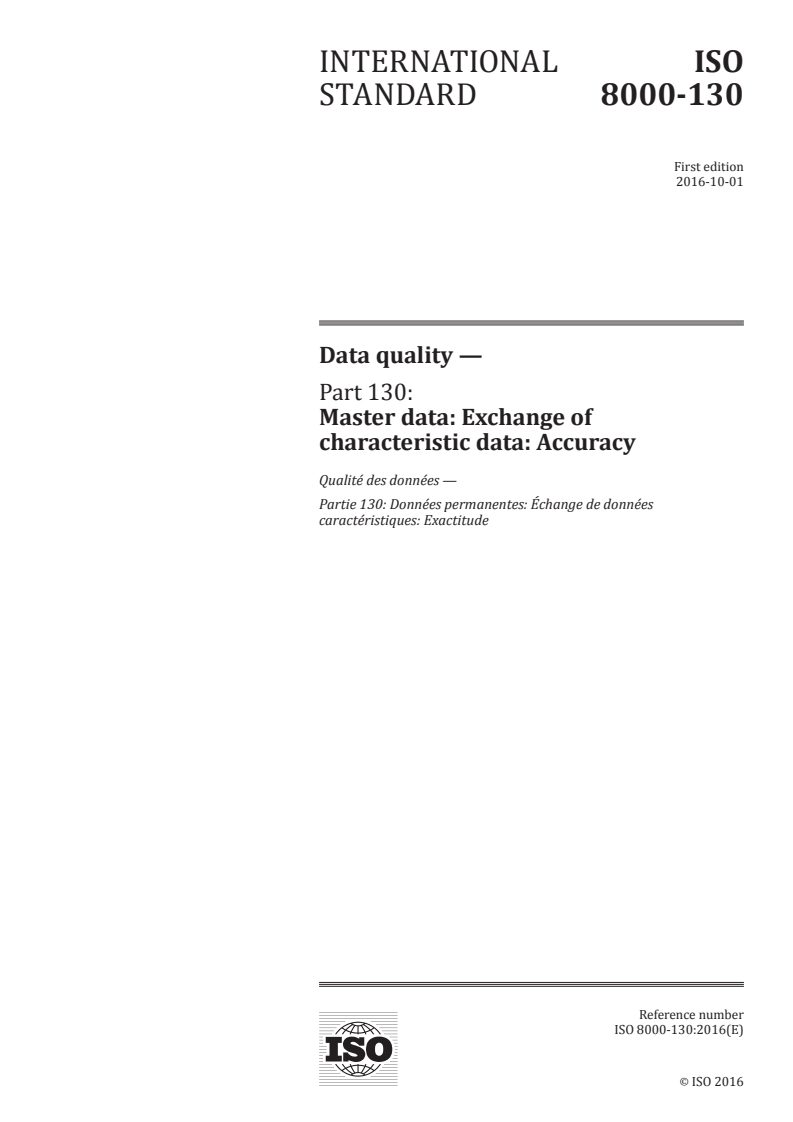
INTERNATIONAL ISO
STANDARD 8000-130
First edition
2016-10-01
Data quality —
Part 130:
Master data: Exchange of
characteristic data: Accuracy
Qualité des données —
Partie 130: Données permanentes: Échange de données
caractéristiques: Exactitude
Reference number
©
ISO 2016
© ISO 2016, Published in Switzerland
All rights reserved. Unless otherwise specified, no part of this publication may be reproduced or utilized otherwise in any form
or by any means, electronic or mechanical, including photocopying, or posting on the internet or an intranet, without prior
written permission. Permission can be requested from either ISO at the address below or ISO’s member body in the country of
the requester.
ISO copyright office
Ch. de Blandonnet 8 • CP 401
CH-1214 Vernier, Geneva, Switzerland
Tel. +41 22 749 01 11
Fax +41 22 749 09 47
copyright@iso.org
www.iso.org
ii © ISO 2016 – All rights reserved
Contents Page
Foreword .iv
Introduction .v
1 Scope . 1
2 Normative references . 1
3 Terms and definitions . 2
4 Abbreviated terms . 2
5 General . 2
6 Accuracy data model . 2
6.1 Referenced types and entities . 2
6.2 Diagram . 2
6.3 completeness_event . 3
6.4 accuracy_method . 3
7 Statement of data accuracy . 4
8 Assertion of data accuracy . 4
9 Data accuracy record . 5
10 Conformance requirements . 6
Annex A (normative) Document identification . 8
Annex B (informative) Information to support implementations . 9
Annex C (informative) Codes used in examples .10
Bibliography .11
Foreword
ISO (the International Organization for Standardization) is a worldwide federation of national standards
bodies (ISO member bodies). The work of preparing International Standards is normally carried out
through ISO technical committees. Each member body interested in a subject for which a technical
committee has been established has the right to be represented on that committee. International
organizations, governmental and non-governmental, in liaison with ISO, also take part in the work.
ISO collaborates closely with the International Electrotechnical Commission (IEC) on all matters of
electrotechnical standardization.
The procedures used to develop this document and those intended for its further maintenance are
described in the ISO/IEC Directives, Part 1. In particular the different approval criteria needed for the
different types of ISO documents should be noted. This document was drafted in accordance with the
editorial rules of the ISO/IEC Directives, Part 2 (see www.iso.org/directives).
Attention is drawn to the possibility that some of the elements of this document may be the subject of
patent rights. ISO shall not be held responsible for identifying any or all such patent rights. Details of
any patent rights identified during the development of the document will be in the Introduction and/or
on the ISO list of patent declarations received (see www.iso.org/patents).
Any trade name used in this document is information given for the convenience of users and does not
constitute an endorsement.
For an explanation on the meaning of ISO specific terms and expressions related to conformity assessment,
as well as information about ISO’s adherence to the World Trade Organization (WTO) principles in the
Technical Barriers to Trade (TBT) see the following URL: www.iso.org/iso/foreword.html.
The committee responsible for this document is Technical Committee ISO/TC 184, Automation systems
and integration, Subcommittee SC 4, Industrial data.
This first edition of ISO 8000-130 cancels and replaces ISO/TS 8000-130:2009, which has been
technically revised.
ISO 8000 is organized as a series of parts, each published separately. The structure of ISO 8000 is
described in ISO/TS 8000-1.
Each part of ISO 8000 is a member of one of the following series: general data quality, master data
quality, transactional data quality, and product data quality. This part of ISO 8000 is a member of the
master data quality series.
A list of all parts in the ISO 8000 series can be found on the ISO website.
iv © ISO 2016 – All rights reserved
Introduction
The ability to create, collect, store, maintain, transfer, process and present data to support business
processes in a timely and cost effective manner requires both an understanding of the characteristics
of the data that determine its quality, and an ability to measure, manage and report on data quality.
ISO 8000 defines characteristics that can be tested by any organization in the data supply chain to
objectively determine conformance of the data to ISO 8000.
ISO 8000 provides frameworks for improving data quality for specific kinds of data. The frameworks
can be used independently or in conjunction with quality management systems.
ISO 8000 covers industrial data quality characteristics throughout the product life cycle from
conception to disposal. ISO 8000 addresses specific kinds of data including, but not limited to, master
data, transaction data, and product data.
Data is created as the result of a process, typically an observation, a measurement or a transformation.
While the accuracy of the process will determine the accuracy of the data in terms of its proximity to
the true value, the accuracy of the transfer of the data from one system to another can also affect data
accuracy. The accuracy of a transfer of data can be measured by comparison to authoritative data source.
This part of ISO 8000 is an optional addition to ISO 8000-120 and specifies requirements for
representation and exchange of information about accuracy of master data that consists of
characteristic data. ISO 8000-120 is an optional addition to ISO 8000-110 and specifies requirements
for representation and exchange of information about provenance of master data that consists of
characteristic data. ISO 8000-110 specifies basic requirements for representation and exchange
of information about provenance of master data that consists of characteristic data, in particular,
conformance to a formal syntax, semantic encoding, and conformance to a data specification.
INTERNATIONAL STANDARD ISO 8000-130:2016(E)
Data quality —
Part 130:
Master data: Exchange of characteristic data: Accuracy
1 Scope
This part of ISO 8000 is an optional addition to ISO 8000-120 and specifies requirements for representation
and exchange of information about accuracy of master data that consists of characteristic data.
NOTE 1 ISO 8000-110 specifies that such data be represented as property values. ISO 8000-120 provides
additional requirements for property values when data provenance information needs to be captured.
This part of ISO 8000 does not specify a complete model for characteristic data, nor does it specify an
exchange format for characteristic data with data accuracy information.
NOTE 2 This is done in other standards that reference this part of ISO 8000, e.g. ISO/TS 22745-40.
The following are within the scope of this part of ISO 8000:
— requirements for capture and exchange of data accuracy information in the form of statements and
assertions of data accuracy;
— conceptual data model for data accuracy information in the form of statements and assertions of
data accuracy.
The following are outside the scope of this part of ISO 8000:
— requirements for data accuracy;
NOTE 3 The requirements for data accuracy depend on many factors, e.g. the kind of data, how the data
are being used, industry, and needs of the partners exchanging the data. It is not possible to state general
requirements for data accuracy.
— exchange format for data accuracy information;
— scheme for registering and resolving organization identifiers and person identifiers;
— accuracy of data that are not characteristic data represented as property values;
— syntax of identifiers;
— resolution of identifiers.
Some of the requirements in this part of ISO 8000 can apply to exchange of data that is not master data
which consists of characteristic data represented as property values.
2 Normative references
The following referenced documents are indispensable for the application of this document. For dated
references, only the edition cited applies. For undated references, the latest edition of the referenced
document (including any amendments) applies.
ISO 8000-2, Data quality — Part 2: Vocabulary
ISO 8000-120, Data quality — Part 120: Master data: Exchange of characteristic data: Provenance
3 Terms and definitions
For the purposes of this document, the terms and definitions given in ISO 8000-2 apply.
4 Abbreviated terms
UML Unified Modeling Language
XML Extensible Markup Language
5 General
A data provider may declare the accuracy of data through either a statement (see Clause 7) or an
assertion (see Clause 8).
6 Accuracy data model
6.1 Referenced types and entities
The following types and entities are used by the accuracy model:
— ISO_6523_identifier, defined in ISO 8000-120;
— date_and_time, defined in ISO 8000-120;
— property_value_assignment, defined in ISO 8000-120.
6.2 Diagram
The UML class diagram for the accuracy model is given in Figure 1.
Figure 1 — UML class diagram for accuracy model
2 © ISO 2016 – All rights reserved
NOTE The entity property_value_assignment is the intersection point between this data model and the
target data model: the model of data for which accuracy informa
...
INTERNATIONAL ISO
STANDARD 8000-130
First edition
2016-10-01
Data quality —
Part 130:
Master data: Exchange of
characteristic data: Accuracy
Qualité des données —
Partie 130: Données permanentes: Échange de données
caractéristiques: Exactitude
Reference number
©
ISO 2016
© ISO 2016, Published in Switzerland
All rights reserved. Unless otherwise specified, no part of this publication may be reproduced or utilized otherwise in any form
or by any means, electronic or mechanical, including photocopying, or posting on the internet or an intranet, without prior
written permission. Permission can be requested from either ISO at the address below or ISO’s member body in the country of
the requester.
ISO copyright office
Ch. de Blandonnet 8 • CP 401
CH-1214 Vernier, Geneva, Switzerland
Tel. +41 22 749 01 11
Fax +41 22 749 09 47
copyright@iso.org
www.iso.org
ii © ISO 2016 – All rights reserved
Contents Page
Foreword .iv
Introduction .v
1 Scope . 1
2 Normative references . 1
3 Terms and definitions . 2
4 Abbreviated terms . 2
5 General . 2
6 Accuracy data model . 2
6.1 Referenced types and entities . 2
6.2 Diagram . 2
6.3 completeness_event . 3
6.4 accuracy_method . 3
7 Statement of data accuracy . 4
8 Assertion of data accuracy . 4
9 Data accuracy record . 5
10 Conformance requirements . 6
Annex A (normative) Document identification . 8
Annex B (informative) Information to support implementations . 9
Annex C (informative) Codes used in examples .10
Bibliography .11
Foreword
ISO (the International Organization for Standardization) is a worldwide federation of national standards
bodies (ISO member bodies). The work of preparing International Standards is normally carried out
through ISO technical committees. Each member body interested in a subject for which a technical
committee has been established has the right to be represented on that committee. International
organizations, governmental and non-governmental, in liaison with ISO, also take part in the work.
ISO collaborates closely with the International Electrotechnical Commission (IEC) on all matters of
electrotechnical standardization.
The procedures used to develop this document and those intended for its further maintenance are
described in the ISO/IEC Directives, Part 1. In particular the different approval criteria needed for the
different types of ISO documents should be noted. This document was drafted in accordance with the
editorial rules of the ISO/IEC Directives, Part 2 (see www.iso.org/directives).
Attention is drawn to the possibility that some of the elements of this document may be the subject of
patent rights. ISO shall not be held responsible for identifying any or all such patent rights. Details of
any patent rights identified during the development of the document will be in the Introduction and/or
on the ISO list of patent declarations received (see www.iso.org/patents).
Any trade name used in this document is information given for the convenience of users and does not
constitute an endorsement.
For an explanation on the meaning of ISO specific terms and expressions related to conformity assessment,
as well as information about ISO’s adherence to the World Trade Organization (WTO) principles in the
Technical Barriers to Trade (TBT) see the following URL: www.iso.org/iso/foreword.html.
The committee responsible for this document is Technical Committee ISO/TC 184, Automation systems
and integration, Subcommittee SC 4, Industrial data.
This first edition of ISO 8000-130 cancels and replaces ISO/TS 8000-130:2009, which has been
technically revised.
ISO 8000 is organized as a series of parts, each published separately. The structure of ISO 8000 is
described in ISO/TS 8000-1.
Each part of ISO 8000 is a member of one of the following series: general data quality, master data
quality, transactional data quality, and product data quality. This part of ISO 8000 is a member of the
master data quality series.
A list of all parts in the ISO 8000 series can be found on the ISO website.
iv © ISO 2016 – All rights reserved
Introduction
The ability to create, collect, store, maintain, transfer, process and present data to support business
processes in a timely and cost effective manner requires both an understanding of the characteristics
of the data that determine its quality, and an ability to measure, manage and report on data quality.
ISO 8000 defines characteristics that can be tested by any organization in the data supply chain to
objectively determine conformance of the data to ISO 8000.
ISO 8000 provides frameworks for improving data quality for specific kinds of data. The frameworks
can be used independently or in conjunction with quality management systems.
ISO 8000 covers industrial data quality characteristics throughout the product life cycle from
conception to disposal. ISO 8000 addresses specific kinds of data including, but not limited to, master
data, transaction data, and product data.
Data is created as the result of a process, typically an observation, a measurement or a transformation.
While the accuracy of the process will determine the accuracy of the data in terms of its proximity to
the true value, the accuracy of the transfer of the data from one system to another can also affect data
accuracy. The accuracy of a transfer of data can be measured by comparison to authoritative data source.
This part of ISO 8000 is an optional addition to ISO 8000-120 and specifies requirements for
representation and exchange of information about accuracy of master data that consists of
characteristic data. ISO 8000-120 is an optional addition to ISO 8000-110 and specifies requirements
for representation and exchange of information about provenance of master data that consists of
characteristic data. ISO 8000-110 specifies basic requirements for representation and exchange
of information about provenance of master data that consists of characteristic data, in particular,
conformance to a formal syntax, semantic encoding, and conformance to a data specification.
INTERNATIONAL STANDARD ISO 8000-130:2016(E)
Data quality —
Part 130:
Master data: Exchange of characteristic data: Accuracy
1 Scope
This part of ISO 8000 is an optional addition to ISO 8000-120 and specifies requirements for representation
and exchange of information about accuracy of master data that consists of characteristic data.
NOTE 1 ISO 8000-110 specifies that such data be represented as property values. ISO 8000-120 provides
additional requirements for property values when data provenance information needs to be captured.
This part of ISO 8000 does not specify a complete model for characteristic data, nor does it specify an
exchange format for characteristic data with data accuracy information.
NOTE 2 This is done in other standards that reference this part of ISO 8000, e.g. ISO/TS 22745-40.
The following are within the scope of this part of ISO 8000:
— requirements for capture and exchange of data accuracy information in the form of statements and
assertions of data accuracy;
— conceptual data model for data accuracy information in the form of statements and assertions of
data accuracy.
The following are outside the scope of this part of ISO 8000:
— requirements for data accuracy;
NOTE 3 The requirements for data accuracy depend on many factors, e.g. the kind of data, how the data
are being used, industry, and needs of the partners exchanging the data. It is not possible to state general
requirements for data accuracy.
— exchange format for data accuracy information;
— scheme for registering and resolving organization identifiers and person identifiers;
— accuracy of data that are not characteristic data represented as property values;
— syntax of identifiers;
— resolution of identifiers.
Some of the requirements in this part of ISO 8000 can apply to exchange of data that is not master data
which consists of characteristic data represented as property values.
2 Normative references
The following referenced documents are indispensable for the application of this document. For dated
references, only the edition cited applies. For undated references, the latest edition of the referenced
document (including any amendments) applies.
ISO 8000-2, Data quality — Part 2: Vocabulary
ISO 8000-120, Data quality — Part 120: Master data: Exchange of characteristic data: Provenance
3 Terms and definitions
For the purposes of this document, the terms and definitions given in ISO 8000-2 apply.
4 Abbreviated terms
UML Unified Modeling Language
XML Extensible Markup Language
5 General
A data provider may declare the accuracy of data through either a statement (see Clause 7) or an
assertion (see Clause 8).
6 Accuracy data model
6.1 Referenced types and entities
The following types and entities are used by the accuracy model:
— ISO_6523_identifier, defined in ISO 8000-120;
— date_and_time, defined in ISO 8000-120;
— property_value_assignment, defined in ISO 8000-120.
6.2 Diagram
The UML class diagram for the accuracy model is given in Figure 1.
Figure 1 — UML class diagram for accuracy model
2 © ISO 2016 – All rights reserved
NOTE The entity property_value_assignment is the intersection point between this data model and the
target data model: the model of data for which accuracy informa
...