


ISO 22514-2
(Main)Statistical methods in process management — Capability and performance — Part 2: Process capability and performance of time-dependent process models
Statistical methods in process management — Capability and performance — Part 2: Process capability and performance of time-dependent process models
ISO 22514-2:2017 describes a procedure for the determination of statistics for estimating the quality capability or performance of product and process characteristics. The process results of these quality characteristics are categorized into eight possible distribution types. Calculation formulae for the statistical measures are placed with every distribution. The statistical methods described in this document only relate to continuous quality characteristics. They are applicable to processes in any industrial or economical sector. NOTE This method is usually applied in case of a great number of serial process results, but it can also be used for small series (a small number of process results).
Méthodes statistiques dans la gestion de processus — Aptitude et performance — Partie 2: Aptitude de processus et performance des modèles de processus dépendants du temps
General Information
- Status
- Not Published
- Technical Committee
- ISO/TC 69/SC 4 - Applications of statistical methods in product and process management
- Drafting Committee
- ISO/TC 69/SC 4/WG 11 - Process capability and performance
- Current Stage
- 6000 - International Standard under publication
- Start Date
- 14-Jan-2026
- Completion Date
- 17-Jan-2026
Relations
- Effective Date
- 20-Jan-2024
Overview
ISO/FDIS 22514-2:2025, titled Statistical methods in process management - Capability and performance - Part 2: Process capability and performance of time-dependent process models, is an international standard developed by ISO to provide a framework for evaluating process capability and performance when processes exhibit time-dependent behavior. Unlike traditional capability analysis that assumes stability and normality, this standard recognizes that industrial processes often display changing behavior over time-such as shifts in mean and variability-and offers statistical methods to assess capability for such dynamic scenarios.
This standard applies specifically to continuous quality characteristics and is relevant across all industrial and economic sectors. It covers eight possible distribution types to categorize process outcomes and includes detailed procedures for calculating capability and performance indices adapted to time-dependent process models.
Key Topics
Time-Dependent Process Models: The standard classifies processes into four main time-dependent models based on whether the process location (mean) and dispersion (variance) are constant or changing over time:
- Model A: Both location and dispersion constant
- Model B: Location constant, dispersion changing
- Model C: Location changing, dispersion constant
- Model D: Both location and dispersion changing
Distribution Types and Statistical Measures: It addresses instantaneous distributions and overall resulting distributions of process characteristics. The distributions can be normal or non-normal, unimodal or multimodal, and these distinctions define the process model classification.
Calculation of Capability and Performance Indices: The document provides formulas and methods for estimating:
- Process Capability Index (C)
- Process Performance Index (P) These indices are tailored to account for time-dependent variations. The standard also discusses how to handle one-sided specification limits.
Process Analysis and Control: The importance of prior process analysis, including statistical process control (SPC) and control charts, is emphasized to determine if a process is statistically stable or requires performance indices due to instability.
Use of Statistical Tools: Methods such as Analysis of Variance (ANOVA) and probability plots are recommended to validate model fit for time-dependent distribution types.
Reporting and Interpretation: The standard highlights the importance of reporting capability and performance indices alongside confidence intervals to represent estimation uncertainty.
Applications
ISO 22514-2 is widely applicable in sectors requiring rigorous quality and process management, including:
- Manufacturing and Production: Enables robust evaluation of process capability for products subject to time-varying conditions affecting quality characteristics.
- Chemical and Pharmaceutical Industries: Supports quality assurance for continuous processes with fluctuating parameters.
- Automotive and Aerospace: Helps assess capability of complex processes where dynamics impact compliance with strict specifications.
- Service and Economic Sectors: Applicable where quality characteristics evolve over time, influencing service delivery or economic output.
By offering a structured approach for analyzing time-dependent processes, organizations can improve product quality, optimize process control strategies, and make informed decisions on process improvements under real-world conditions where stability assumptions do not hold.
Related Standards
To effectively implement ISO/FDIS 22514-2:2025, it is helpful to be familiar with related ISO standards:
- ISO 22514-1: Statistical methods in process management – Capability and performance – Part 1: General principles and concepts - foundational concepts for process capability analysis.
- ISO 3534-2: Statistics - Vocabulary and symbols - Part 2: Applied statistics - terminology and symbols used in statistical analysis.
- ISO 5479: Statistical interpretation of data - Tests for departure from the normal distribution - methods to assess distribution normality.
- ISO 7870-2: Control charts - Part 2: Shewhart control charts - tools for process control and monitoring.
Adhering to these interconnected standards enhances the effective application of process capability evaluations and quality management aligned with international best practices.
Keywords: ISO/FDIS 22514-2, statistical methods, process management, process capability, process performance, time-dependent process models, continuous quality characteristics, process stability, control charts, capability indices, performance indices, process analysis, quality assurance, industrial process control, statistical process control (SPC).

ISO/FDIS 22514-2 - Statistical methods in process management — Capability and performance — Part 2: Process capability and performance of time-dependent process models Released:4. 11. 2025
REDLINE ISO/FDIS 22514-2 - Statistical methods in process management — Capability and performance — Part 2: Process capability and performance of time-dependent process models Released:4. 11. 2025
Frequently Asked Questions
ISO 22514-2 is a draft published by the International Organization for Standardization (ISO). Its full title is "Statistical methods in process management — Capability and performance — Part 2: Process capability and performance of time-dependent process models". This standard covers: ISO 22514-2:2017 describes a procedure for the determination of statistics for estimating the quality capability or performance of product and process characteristics. The process results of these quality characteristics are categorized into eight possible distribution types. Calculation formulae for the statistical measures are placed with every distribution. The statistical methods described in this document only relate to continuous quality characteristics. They are applicable to processes in any industrial or economical sector. NOTE This method is usually applied in case of a great number of serial process results, but it can also be used for small series (a small number of process results).
ISO 22514-2:2017 describes a procedure for the determination of statistics for estimating the quality capability or performance of product and process characteristics. The process results of these quality characteristics are categorized into eight possible distribution types. Calculation formulae for the statistical measures are placed with every distribution. The statistical methods described in this document only relate to continuous quality characteristics. They are applicable to processes in any industrial or economical sector. NOTE This method is usually applied in case of a great number of serial process results, but it can also be used for small series (a small number of process results).
ISO 22514-2 is classified under the following ICS (International Classification for Standards) categories: 03.120.30 - Application of statistical methods. The ICS classification helps identify the subject area and facilitates finding related standards.
ISO 22514-2 has the following relationships with other standards: It is inter standard links to ISO 22514-2:2017. Understanding these relationships helps ensure you are using the most current and applicable version of the standard.
ISO 22514-2 is available in PDF format for immediate download after purchase. The document can be added to your cart and obtained through the secure checkout process. Digital delivery ensures instant access to the complete standard document.
Standards Content (Sample)
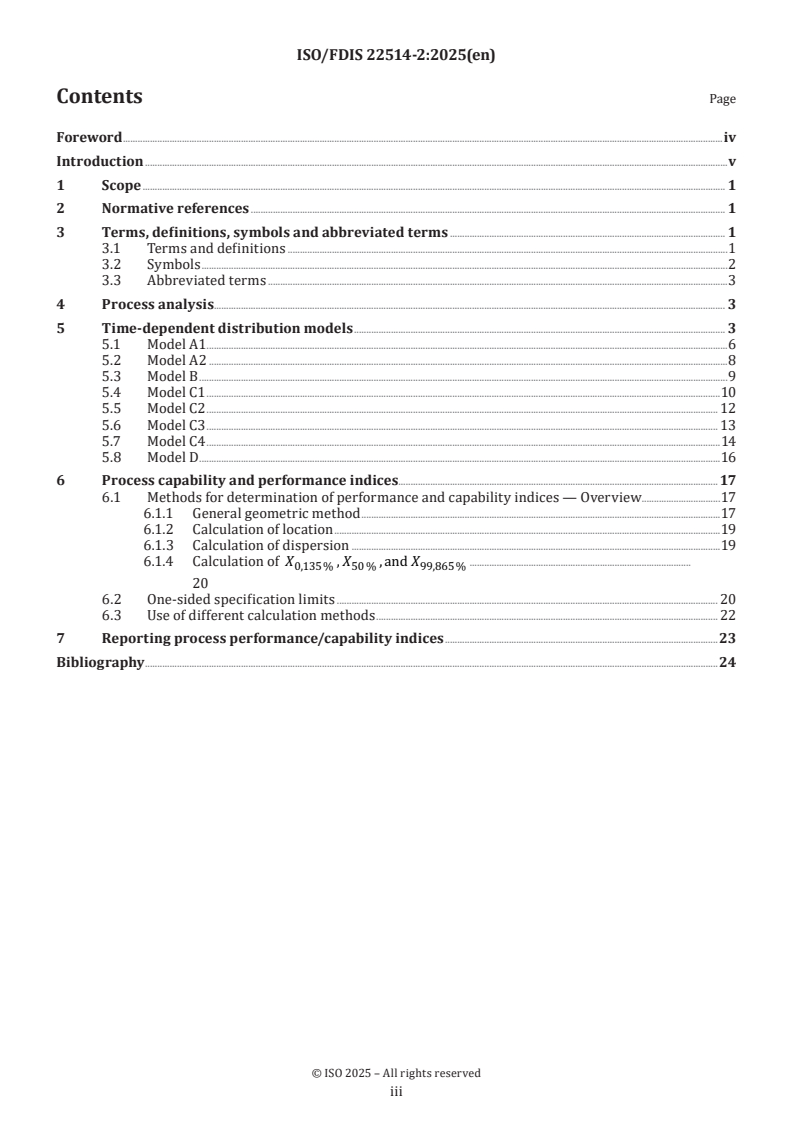
FINAL DRAFT
International
Standard
ISO/FDIS 22514-2
ISO/TC 69/SC 4
Statistical methods in process
Secretariat: DIN
management — Capability and
Voting begins on:
performance —
2025-11-18
Part 2:
Voting terminates on:
2026-01-13
Process capability and performance
of time-dependent process models
Méthodes statistiques dans la gestion de processus — Aptitude et
performance —
Partie 2: Aptitude de processus et performance des modèles de
processus dépendants du temps
RECIPIENTS OF THIS DRAFT ARE INVITED TO SUBMIT,
WITH THEIR COMMENTS, NOTIFICATION OF ANY
RELEVANT PATENT RIGHTS OF WHICH THEY ARE AWARE
AND TO PROVIDE SUPPOR TING DOCUMENTATION.
IN ADDITION TO THEIR EVALUATION AS
BEING ACCEPTABLE FOR INDUSTRIAL, TECHNO-
LOGICAL, COMMERCIAL AND USER PURPOSES, DRAFT
INTERNATIONAL STANDARDS MAY ON OCCASION HAVE
TO BE CONSIDERED IN THE LIGHT OF THEIR POTENTIAL
TO BECOME STAN DARDS TO WHICH REFERENCE MAY BE
MADE IN NATIONAL REGULATIONS.
Reference number
ISO/FDIS 22514-2:2025(en) © ISO 2025
FINAL DRAFT
ISO/FDIS 22514-2:2025(en)
International
Standard
ISO/FDIS 22514-2
ISO/TC 69/SC 4
Statistical methods in process
Secretariat: DIN
management — Capability and
Voting begins on:
performance —
Part 2:
Voting terminates on:
Process capability and performance
of time-dependent process models
Méthodes statistiques dans la gestion de processus — Aptitude et
performance —
Partie 2: Aptitude de processus et performance des modèles de
processus dépendants du temps
RECIPIENTS OF THIS DRAFT ARE INVITED TO SUBMIT,
WITH THEIR COMMENTS, NOTIFICATION OF ANY
RELEVANT PATENT RIGHTS OF WHICH THEY ARE AWARE
AND TO PROVIDE SUPPOR TING DOCUMENTATION.
© ISO 2025
IN ADDITION TO THEIR EVALUATION AS
All rights reserved. Unless otherwise specified, or required in the context of its implementation, no part of this publication may
BEING ACCEPTABLE FOR INDUSTRIAL, TECHNO-
LOGICAL, COMMERCIAL AND USER PURPOSES, DRAFT
be reproduced or utilized otherwise in any form or by any means, electronic or mechanical, including photocopying, or posting on
INTERNATIONAL STANDARDS MAY ON OCCASION HAVE
the internet or an intranet, without prior written permission. Permission can be requested from either ISO at the address below
TO BE CONSIDERED IN THE LIGHT OF THEIR POTENTIAL
or ISO’s member body in the country of the requester.
TO BECOME STAN DARDS TO WHICH REFERENCE MAY BE
MADE IN NATIONAL REGULATIONS.
ISO copyright office
CP 401 • Ch. de Blandonnet 8
CH-1214 Vernier, Geneva
Phone: +41 22 749 01 11
Email: copyright@iso.org
Website: www.iso.org
Published in Switzerland Reference number
ISO/FDIS 22514-2:2025(en) © ISO 2025
ii
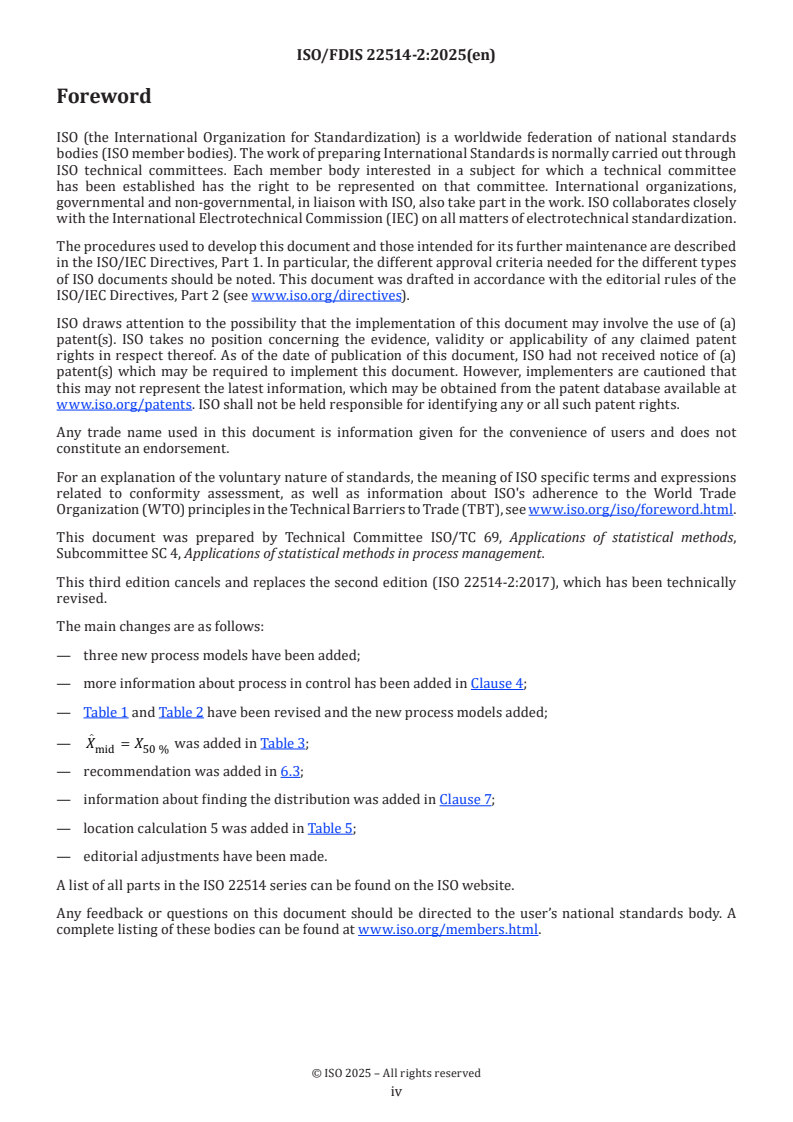
ISO/FDIS 22514-2:2025(en)
Contents Page
Foreword .iv
Introduction .v
1 Scope . 1
2 Normative references . 1
3 Terms, definitions, symbols and abbreviated terms . 1
3.1 Terms and definitions .1
3.2 Symbols .2
3.3 Abbreviated terms .3
4 Process analysis. 3
5 Time-dependent distribution models . 3
5.1 Model A1 .6
5.2 Model A2 .8
5.3 Model B .9
5.4 Model C1 .10
5.5 Model C2 . 12
5.6 Model C3 . 13
5.7 Model C4 .14
5.8 Model D .16
6 Process capability and performance indices. 17
6.1 Methods for determination of performance and capability indices — Overview .17
6.1.1 General geometric method .17
6.1.2 Calculation of location .19
6.1.3 Calculation of dispersion .19
6.1.4 Calculation of XX,,and X .
0,135%50% 99,865%
6.2 One-sided specification limits . 20
6.3 Use of different calculation methods . 22
7 Reporting process performance/capability indices .23
Bibliography .24
iii
ISO/FDIS 22514-2:2025(en)
Foreword
ISO (the International Organization for Standardization) is a worldwide federation of national standards
bodies (ISO member bodies). The work of preparing International Standards is normally carried out through
ISO technical committees. Each member body interested in a subject for which a technical committee
has been established has the right to be represented on that committee. International organizations,
governmental and non-governmental, in liaison with ISO, also take part in the work. ISO collaborates closely
with the International Electrotechnical Commission (IEC) on all matters of electrotechnical standardization.
The procedures used to develop this document and those intended for its further maintenance are described
in the ISO/IEC Directives, Part 1. In particular, the different approval criteria needed for the different types
of ISO documents should be noted. This document was drafted in accordance with the editorial rules of the
ISO/IEC Directives, Part 2 (see www.iso.org/directives).
ISO draws attention to the possibility that the implementation of this document may involve the use of (a)
patent(s). ISO takes no position concerning the evidence, validity or applicability of any claimed patent
rights in respect thereof. As of the date of publication of this document, ISO had not received notice of (a)
patent(s) which may be required to implement this document. However, implementers are cautioned that
this may not represent the latest information, which may be obtained from the patent database available at
www.iso.org/patents. ISO shall not be held responsible for identifying any or all such patent rights.
Any trade name used in this document is information given for the convenience of users and does not
constitute an endorsement.
For an explanation of the voluntary nature of standards, the meaning of ISO specific terms and expressions
related to conformity assessment, as well as information about ISO's adherence to the World Trade
Organization (WTO) principles in the Technical Barriers to Trade (TBT), see www.iso.org/iso/foreword.html.
This document was prepared by Technical Committee ISO/TC 69, Applications of statistical methods,
Subcommittee SC 4, Applications of statistical methods in process management.
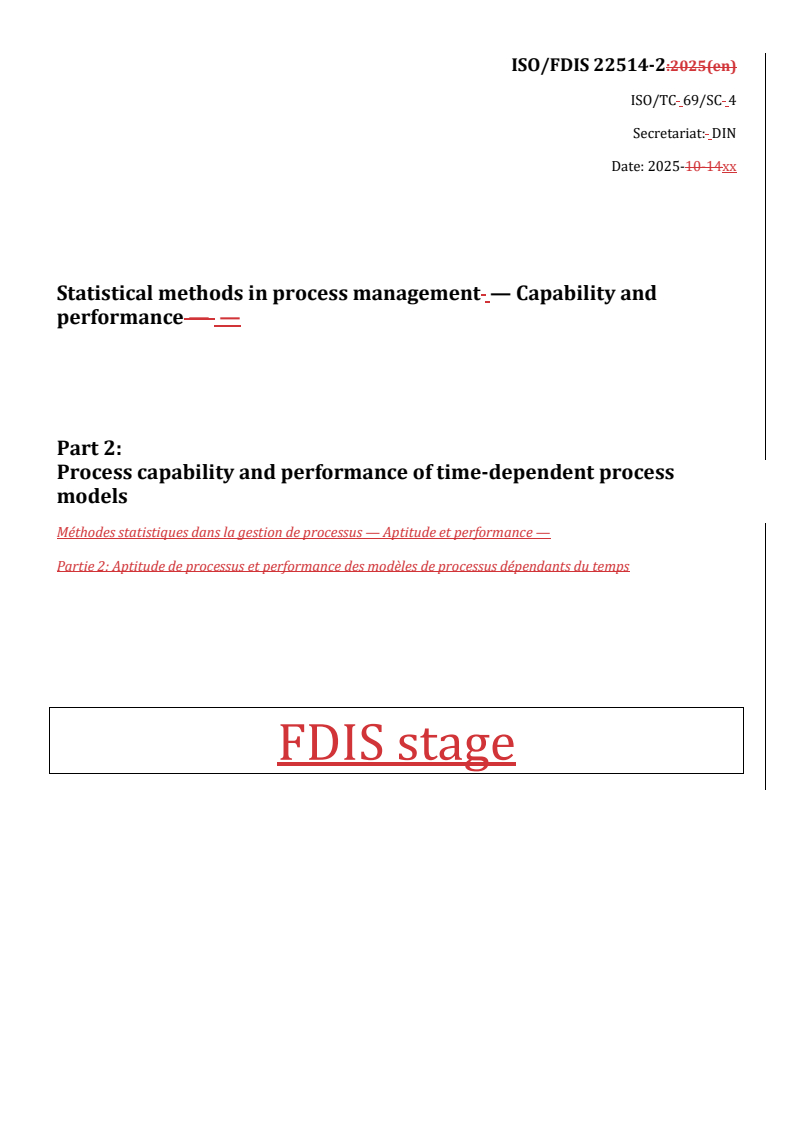
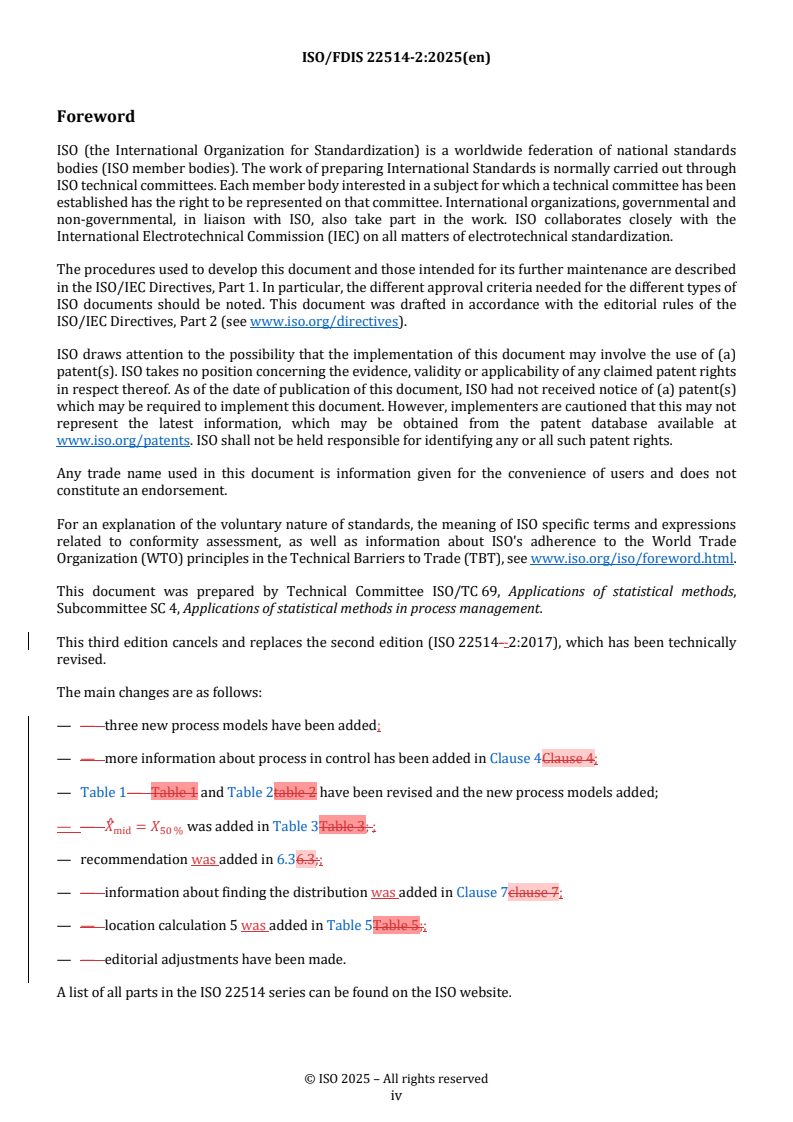
This third edition cancels and replaces the second edition (ISO 22514-2:2017), which has been technically
revised.
The main changes are as follows:
— three new process models have been added;
— more information about process in control has been added in Clause 4;
— Table 1 and Table 2 have been revised and the new process models added;
ˆ
— XX= was added in Table 3;
mid 50%
— recommendation was added in 6.3;
— information about finding the distribution was added in Clause 7;
— location calculation 5 was added in Table 5;
— editorial adjustments have been made.
A list of all parts in the ISO 22514 series can be found on the ISO website.
Any feedback or questions on this document should be directed to the user’s national standards body. A
complete listing of these bodies can be found at www.iso.org/members.html.
iv
ISO/FDIS 22514-2:2025(en)
Introduction
Many standards have been created concerning the quality capability/performance of processes by
international, regional and national standardization bodies and also by industry. All of them assume that
the process is in a state of statistical control, with stationary, normally distributed processes. However, a
comprehensive analysis of production processes shows that, over time, it is very rare for processes to remain
in such a state.
In recognition of this fact, this document provides a framework for estimating the quality capability/
performance of industrial processes for an array of standard circumstances. These circumstances are
categorized based on the stability of the mean and variance, as to whether they are constant, changing
systematically, or changing randomly. As such, the quality capability/performance can be assessed for very
differently shaped distributions with respect to time.
In other parts of ISO 22514 more detailed information about calculations of indices can be found. It should be
noted that where the capability indices given in this document are computed they only form point estimates
of their true values. It is therefore recommended that wherever possible the indices’ confidence intervals
are computed and reported.
v
FINAL DRAFT International Standard ISO/FDIS 22514-2:2025(en)
Statistical methods in process management — Capability and
performance —
Part 2:
Process capability and performance of time-dependent
process models
1 Scope
This document describes a procedure for the determination of statistics for estimating the capability or
performance of processes, particularly when the of process does not remain in statistical control.
The process results of these quality characteristics are categorized into eight possible distribution types.
The statistical methods described in this document only apply to continuous quality characteristics. They
are applicable to processes in any industrial or economical sector.
NOTE This method is usually applied in case of a great number of serial process results, but it can also be used for
small series (a small number of process results).
2 Normative references
The following documents are referred to in the text in such a way that some or all of their content constitutes
requirements of this document. For dated references, only the edition cited applies. For undated references,
the latest edition of the referenced document (including any amendments) applies.
ISO 3534-2, Statistics — Vocabulary and symbols — Part 2: Applied statistics
ISO 5479, Statistical interpretation of data — Tests for departure from the normal distribution
ISO 22514-1, Statistical methods in process management — Capability and performance — Part 1: General
principles and concepts
3 Terms, definitions, symbols and abbreviated terms
3.1 Terms and definitions
For the purposes of this document, the terms and definitions given in ISO 3534-2 and ISO 22514-1 apply.
ISO and IEC maintain terminology databases for use in standardization at the following addresses:
— ISO Online browsing platform: available at https:// www .iso .org/ obp
— IEC Electropedia: available at https:// www .electropedia .org/
3.1.1
product characteristic in control
product characteristic parameter of the distribution of the characteristic values of which practically do not
change or do change only in a known manner or within known limits
Note 1 to entry: A production in control is a production with processes in control.
ISO/FDIS 22514-2:2025(en)
[SOURCE: ISO 22514-1:2014, 3.1.20, modified — Note 1 to entry has been added and reference numbers in
the definition text referring to definitions in ISO 22514-1 have been deleted.]
3.1.2
stable process
process in a state of statistical control
process subject only to random causes
Note 1 to entry: A stable process will generally behave as though the samples from the process at any time are simple
random samples from the same population.
Note 2 to entry: This state does not imply that the random variation is large or small, within or outside of specification,
but rather that the variation is predictable using statistical techniques.
[SOURCE: ISO 22514-1:2014, 3.1.21, modified — Note 1 to entry has been deleted (moved to the definition of
“product characteristic in control”) and reference numbers in the definition text referring to definitions in
ISO 22514-1 have been deleted.]
3.2 Symbols
C process capability index
p
C minimum process capability index
pk
C
lower process capability index
pk
L
C
upper process capability index
pk
U
c constant based on subgroup size n
Δ dispersion of the process (reference interval)
Δ difference between X and X of the distribution of the product characteristic
L mid 0,135 %
Δ difference between X and X of the distribution of the product characteristic
U 99,865 % mid
d constant based on subgroup size n
k number of subgroups of the same size n
μ average location of the process
L lower specification limit
M calculation methods with location method label l and dispersion method label d
l,d
n sub group size
N sample size (whole dataset)
p lower fraction nonconforming
L
p total fraction nonconforming
t
p upper fraction nonconforming
U
P process performance index
p
P minimum process performance index
pk
P
lower process performance index
pk
L
ISO/FDIS 22514-2:2025(en)
P
upper process performance index
pk
U
th
R range of the i subgroup
i
σ standard deviation, population
s standard deviation, sample statistic
th
s observed sample standard deviation of the i subgroup
i
S standard deviation, with the subscript “t” indicating total standard deviation
t
U upper specification limit
X 0,135 % distribution quantile (Lower reference limit)
0,135 %
X 99,865 % distribution quantile (Upper reference limit)
99,865 %
X 50 % distribution quantile
50 %
X distribution midpoint
mid
3.3 Abbreviated terms
ANOVA analysis of variance
SPC statistical process control
4 Process analysis
The purpose of process analysis is to obtain knowledge of a process. This knowledge is necessary for
controlling the process efficiently and effectively so that the products realized by the process fulfil the
quality requirement. It is a general assumption of this document that a process analysis has been carried out
and subsequent process improvements have been implemented.
The behaviour of a characteristic under consideration can be described by the distribution. Its parameters
such as the location (central tendency), the dispersion (variability) and the shape (distribution pattern) are
time-dependent functions, in general. Different models of such resulting distributions, whose parameters
are time-dependent functions are discussed in Clause 5 and Clause 6. To indicate whether a time-dependent
distribution model fits, statistical methods [e.g. estimating parameters, analysis of variance (ANOVA)]
including graphical tools (e.g. probability plots, control charts) are used.
The values of the characteristics under consideration are typically determined based on samples taken from
the process flow. The sample size and frequency should be chosen depending on the type of process and the
type of product so that all important changes are detected in time. The samples should be representative
of the characteristic under consideration. To assess the stability of the process, a control chart should be
used. Information on the use of control charts can be found in ISO 7870 series control cards. As defined
in ISO 22514-1, a product characteristic in control, also known as a predictable characteristic, is a process
characteristic that exhibits only random variation or changes only in a known manner or within known
limits. This process exhibits a kind of “controlled stability”. A statistically stable process is defined as a
process in statistical control and is not influenced by assignable causes. In both cases process capability
indices are calculated, else process performance indices are determined. In each case, indices are calculated
based on the general geometric method as shown in Clause 6.
5 Time-dependent distribution models
The instantaneous distribution characterizes the behaviour of the characteristic under investigation during
a short interval. Usually, it is the time interval during which the sample (e.g. the subgroup) can be taken from
the process. The resulting distribution is the overall representation of the process output over a longer time
ISO/FDIS 22514-2:2025(en)
interval capturing both short term variation and the time dependent changes in process distribution and is
described by a corresponding time-dependent distribution model that reflects the following two below-items:
— the instantaneous distribution of the characteristic under consideration;
— the changes of its location, dispersion and shape parameters during the time interval of process
observation.
In practice, the resulting distribution can be represented by the whole data set, e.g. when SPC is applied, by
all subgroups gained during the interval of the process observation.
Time-dependent distribution models can be classified into four groups according to whether the location
and dispersion moments are constant or changing (see Table 1).
a) A process whose location and dispersion are constant is in time-dependent distribution model A. In this
case, all the means and variances of the instantaneous distributions are equal to each other, and to the
resulting distribution.
b) If the dispersion of a process is changing over time, but the location stays constant, the pr
...
ISO/FDIS 22514-2:2025(en)
ISO/TC 69/SC 4
Secretariat: DIN
Date: 2025-10-14xx
Statistical methods in process management — Capability and
performance — —
Part 2:
Process capability and performance of time-dependent process
models
Méthodes statistiques dans la gestion de processus — Aptitude et performance —
Partie 2: Aptitude de processus et performance des modèles de processus dépendants du temps
FDIS stage
ISO/FDIS 22514-2:2025(en)
All rights reserved. Unless otherwise specified, or required in the context of its implementation, no part of this publication
may be reproduced or utilized otherwise in any form or by any means, electronic or mechanical, including photocopying,
or posting on the internet or an intranet, without prior written permission. Permission can be requested from either ISO
at the address below or ISO’s member body in the country of the requester.
ISO copyright office
CP 401 • Ch. de Blandonnet 8
CH-1214 Vernier, Geneva
Phone: + 41 22 749 01 11
EmailE-mail: copyright@iso.org
Website: www.iso.org
Published in Switzerland
ii
ISO/FDIS 22514-2:2025(en)
Contents
Foreword . iv
Introduction . vi
1 Scope . 1
2 Normative references . 1
3 Terms, definitions, symbols and abbreviated terms . 1
3.1 Terms and definitions . 1
3.2 Symbols . 2
3.3 Abbreviated terms . 3
4 Process analysis . 3
5 Time-dependent distribution models . 3
5.1 Model A1 . 6
5.2 Model A2 . 7
5.3 Model B . 7
5.4 Model C1 . 8
5.5 Model C2 . 9
5.6 Model C3 . 9
5.7 Model C4 . 10
5.8 Model D . 11
6 Process capability and performance indices . 12
6.1 Methods for determination of performance and capability indices — Overview . 12
6.2 One-sided specification limits . 15
6.3 Use of different calculation methods . 17
7 Reporting process performance/capability indices . 18
Bibliography . 20
iii
ISO/FDIS 22514-2:2025(en)
Foreword
ISO (the International Organization for Standardization) is a worldwide federation of national standards
bodies (ISO member bodies). The work of preparing International Standards is normally carried out through
ISO technical committees. Each member body interested in a subject for which a technical committee has been
established has the right to be represented on that committee. International organizations, governmental and
non-governmental, in liaison with ISO, also take part in the work. ISO collaborates closely with the
International Electrotechnical Commission (IEC) on all matters of electrotechnical standardization.
The procedures used to develop this document and those intended for its further maintenance are described
in the ISO/IEC Directives, Part 1. In particular, the different approval criteria needed for the different types of
ISO documents should be noted. This document was drafted in accordance with the editorial rules of the
ISO/IEC Directives, Part 2 (see www.iso.org/directives).
ISO draws attention to the possibility that the implementation of this document may involve the use of (a)
patent(s). ISO takes no position concerning the evidence, validity or applicability of any claimed patent rights
in respect thereof. As of the date of publication of this document, ISO had not received notice of (a) patent(s)
which may be required to implement this document. However, implementers are cautioned that this may not
represent the latest information, which may be obtained from the patent database available at
www.iso.org/patents. ISO shall not be held responsible for identifying any or all such patent rights.
Any trade name used in this document is information given for the convenience of users and does not
constitute an endorsement.
For an explanation of the voluntary nature of standards, the meaning of ISO specific terms and expressions
related to conformity assessment, as well as information about ISO's adherence to the World Trade
Organization (WTO) principles in the Technical Barriers to Trade (TBT), see www.iso.org/iso/foreword.html.
This document was prepared by Technical Committee ISO/TC 69, Applications of statistical methods,
Subcommittee SC 4, Applications of statistical methods in process management.
This third edition cancels and replaces the second edition (ISO 22514--2:2017), which has been technically
revised.
The main changes are as follows:
— — three new process models have been added;
— — more information about process in control has been added in Clause 4Clause 4;
— Table 1— Table 1 and Table 2table 2 have been revised and the new process models added;
^
— — 𝑋𝑋 =𝑋𝑋 was added in Table 3Table 3; ;
mid 50 %
— recommendation was added in 6.36.3;;
— — information about finding the distribution was added in Clause 7clause 7;
— — location calculation 5 was added in Table 5Table 5;;
— — editorial adjustments have been made.
A list of all parts in the ISO 22514 series can be found on the ISO website.
iv
ISO/FDIS 22514-2:2025(en)
Any feedback or questions on this document should be directed to the user’s national standards body. A
complete listing of these bodies can be found at www.iso.org/members.html.
v
ISO/FDIS 22514-2:2025(en)
Introduction
Many standards have been created concerning the quality capability/performance of processes by
international, regional and national standardization bodies and also by industry. All of them assume that the
process is in a state of statistical control, with stationary, normally distributed processes. However, a
comprehensive analysis of production processes shows that, over time, it is very rare for processes to remain
in such a state.
In recognition of this fact, this document provides a framework for estimating the quality
capability/performance of industrial processes for an array of standard circumstances. These circumstances
are categorized based on the stability of the mean and variance, as to whether they are constant, changing
systematically, or changing randomly. As such, the quality capability/performance can be assessed for very
differently shaped distributions with respect to time.
In other parts of ISO 22514 more detailed information about calculations of indices can be found. It should be
noted that where the capability indices given in this document are computed they only form point estimates
of their true values. It is therefore recommended that wherever possible the indices’ confidence intervals are
computed and reported.
vi
ISO/FDIS 22514-2:2025(en)
Statistical methods in process management — Capability and
performance —
Part 2:
Process capability and performance of time-dependent process
models
1 Scope
This document describes a procedure for the determination of statistics for estimating the capability or
performance of processes, particularly when the of process does not remain in statistical control.
The process results of these quality characteristics are categorized into eight possible distribution types.
The statistical methods described in this document only apply to continuous quality characteristics. They are
applicable to processes in any industrial or economical sector.
NOTE This method is usually applied in case of a great number of serial process results, but it can also be used for
small series (a small number of process results).
2 Normative references
The following documents are referred to in the text in such a way that some or all of their content constitutes
requirements of this document. For dated references, only the edition cited applies. For undated references,
the latest edition of the referenced document (including any amendments) applies.
ISO 3534--2, Statistics — Vocabulary and symbols — Part 2: Applied statistics
ISO 5479, Statistical interpretation of data — Tests for departure from the normal distribution
ISO 22514--1, Statistical methods in process management — Capability and performance — Part 1: General
principles and concepts
ISO 7870-2, Control charts — Part 2: Shewhart control charts
3 Terms, definitions, symbols and abbreviated terms
3.1 Terms and definitions
For the purposes of this document, the terms and definitions given in ISO 3534--2 and ISO 22514--1 apply.
ISO and IEC maintain terminology databases for use in standardization at the following addresses:
— — ISO Online browsing platform: available at https://www.iso.org/obp
— — IEC Electropedia: available at https://www.electropedia.org/
3.1.1 3.1.1
product characteristic in control
product characteristic parameter of the distribution of the characteristic values of which practically do not
change or do change only in a known manner or within known limits
Note 1 to entry: A production in control is a production with processes in control.
ISO/FDIS 22514-2:2025(en)
[SOURCE: ISO 22514-1:2014;, 3.1.20, modified: — Note 1 to entry has been added and reference numbers in
the definition text referring to definitions in ISO 22514-1 have been deleted].]
3.1.2 3.1.2
stable process
process in a state of statistical control
process subject only to random causes
Note 1 to entry: A stable process will generally behave as though the samples from the process at any time are simple
random samples from the same population.
Note 2 to entry: This state does not imply that the random variation is large or small, within or outside of specification,
but rather that the variation is predictable using statistical techniques.
[SOURCE: ISO 22514-1:2014;, 3.1.21, modified: — Note 1 to entry has been deleted (moved to the definition
of “product characteristic in control”) and reference numbers in the definition text referring to definitions in
ISO 22514-1 have been deleted].]
3.2 Symbols
C process capability index
p
C minimum process capability index
pk
𝐶𝐶 lower process capability index
pk
L
𝐶𝐶 upper process capability index
pk
U
c constant based on subgroup size n
Δ dispersion of the process (reference interval)
Δ difference between X and X of the distribution of the product characteristic
L mid 0,135 %
Δ difference between X and X of the distribution of the product characteristic
U 99,865 % mid
d constant based on subgroup size n
k number of subgroups of the same size n
μ average location of the process
L lower specification limit
M calculation methods with location method label l and dispersion method label d
l,d
n sub group size
N sample size (whole dataset)
p lower fraction nonconforming
L
p total fraction nonconforming
t
p upper fraction nonconforming
U
P process performance index
p
Ppk minimum process performance index
𝑃𝑃 lower process performance index
pk
L
𝑃𝑃 upper process performance index
pk
U
th
R range of the i subgroup
i
ISO/FDIS 22514-2:2025(en)
σ standard deviation, population
s standard deviation, sample statistic
th
s observed sample standard deviation of the i subgroup
i
S standard deviation, with the subscript “t” indicating total standard deviation
t
U upper specification limit
X 0,135 % distribution quantile (Lower reference limit)
0,135 %
X 99,865 % distribution quantile (Upper reference limit)
99,865 %
X 50 % distribution quantile
50 %
X distribution midpoint
mid
3.3 Abbreviated terms
ANOVA analysis of variance
SPC statistical process control
4 Process analysis
The purpose of process analysis is to obtain knowledge of a process. This knowledge is necessary for
controlling the process efficiently and effectively so that the products realized by the process fulfil the quality
requirement. It is a general assumption of this document that a process analysis has been carried out and
subsequent process improvements have been implemented.
The behaviour of a characteristic under consideration can be described by the distribution. Its parameters
such as the location (central tendency), the dispersion (variability) and the shape (distribution pattern) are
time-dependent functions, in general. Different models of such resulting distributions, whose parameters are
time-dependent functions are discussed in Clause 5Clause 5 and Clause 6Clause 6. To indicate whether a
time-dependent distribution model fits, statistical methods [e.g. estimating parameters, analysis of variance
(ANOVA)] including graphical tools (e.g. probability plots, control charts) are used.
The values of the characteristics under consideration are typically determined based on samples taken from
the process flow. The sample size and frequency should be chosen depending on the type of process and the
type of product so that all important changes are detected in time. The samples should be representative of
the characteristic under consideration. To assess the stability of the process, a control chart should be used.
Information on the use of control charts can be found in ISO 7870 series control cards. As defined in
ISO 22514-1, a product characteristic in control, also known as a predictable characteristic, is a process
characteristic that exhibits only random variation or changes only in a known manner or within known limits.
This process exhibits a kind of “controlled stability”. A statistically stable process is defined as a process in
statistical control and is not influenced by assignable causes. In both cases process capability indices are
calculated, else process performance indices are determined. In each case, indices are calculated based on the
general geometric method as shown in Clause 6Clause 6.
5 Time-dependent distribution models
The instantaneous distribution characterizes the behaviour of the characteristic under investigation during a
short interval. Usually, it is the time interval during which the sample (e.g. the subgroup) can be taken from
the process. The resulting distribution is the overall representation of the process output over a longer time
interval capturing both short term variation and the time dependent changes in process distribution and is
described by a corresponding time-dependent distribution model that reflects the following two below-items:
— — the instantaneous distribution of the characteristic under consideration;
ISO/FDIS 22514-2:2025(en)
— — the changes of its location, dispersion and shape parameters during the time interval of process
observation.
In practice, the resulting distribution can be represented by the whole data set, e.g. when SPC is applied, by all
subgroups gained during the interval of the process observation.
Time-dependent distribution models can be classified into four groups according to whether the location and
dispersion moments are constant or changing (see Table 1Table 1).).
a) a) A process whose location and dispersion are constant is in time-dependent distribution
model A. In this case, all the means and variances of the instantaneous distributions are equal to each
other, and to the resulting distribution.
b) b) If the dispersion of a process is changing over time, but the location stays constant, the process
is said to be in time-dependent distribution model B.
c) c) If the dispersion is constant, but the location is changing, then it is a time-dependent
distribution model C.
d) d) Otherwise, we have time-dependent distribution model D.
ISO/FDIS 22514-2:2025(en)
Table 1 — Classification of time-dependent distribution models
Process- Process location over time
dispersion
Constant Not constant
over time
A C
A1 A2 C1.1 C1.2 C2.1 C2.2 C3 C4
Systematic Systematic
Location Random Random Random Random
(e.g. trend) (e.g. lot to lot)
constant
Not normal Not normal
Not normal Instantaneous Normal Normal
Instantaneous Normal distributed – distributed – unimodal unimodal
distributed – distribution distributed distributed
distribution distributed unimodal unimodal
unimodal
Not normal
Not normal
Resulting Normal Any shape (e.g.
distributed
distributed – Any shape Any shape
distribution distributed multimodal)
unimodal
unimodal
B1 B2 D
Not
Resulting Resulting
constantNotcons
Unimodal- Any shape –
distribution distribution
Any shape
tant
symmetric unimodal
ISO/FDIS 22514-2:2025(en)
The models can be classified based on whether the variations in moments (such as mean and variance) are
random, systematic, or a combination of both.”
NOTE Model A2 is known as stationary in time-series analysis literature and model A1 is known as second order
stationary.
Table 2Table 2 summarizes the basic features of individual time-dependent distribution models; their
graphical representations are given in Figure 1Figure 1 to Figure 8Figure 8. There are subclasses of time-
dependent distribution models A and C which are introduced due to their practical importance. They differ in
the shape of the resulting distribution and in the cause of the process being in an out-of-control state.
Table 2 — Basic features of time-dependent distribution models
a
Characteristic Time-dependent distribution models
A1 A2 B1 B2 C1.1 C1.2 C2.1 C2.2 C3 C4 D
Location c c c c r r r r s s/r s/r
Dispersion c c s/r s/r c c c c c c s/r
In
...
Questions, Comments and Discussion
Ask us and Technical Secretary will try to provide an answer. You can facilitate discussion about the standard in here.
Loading comments...