


ISO/TR 14073:2016
(Main)Environmental management — Water footprint — Illustrative examples on how to apply ISO 14046
Environmental management — Water footprint — Illustrative examples on how to apply ISO 14046
ISO/TR 14073:2016 provides illustrative examples of how to apply ISO 14046, in order to assess the water footprint of products, processes and organizations based on life cycle assessment. The examples are presented to demonstrate particular aspects of the application of ISO 14046 and therefore do not present all of the details of an entire water footprint study report as required by ISO 14046. NOTE The examples are presented as different ways of applying ISO 14046 and do not preclude alternative ways of calculating the water footprint, provided they are in accordance with ISO 14046.
Management environnemental — Empreinte eau — Exemples illustrant l'application de l'ISO 14046
General Information
- Status
- Withdrawn
- Publication Date
- 18-Aug-2016
- Withdrawal Date
- 18-Aug-2016
- Technical Committee
- ISO/TC 207/SC 5 - Life cycle assessment
- Drafting Committee
- ISO/TC 207/SC 5 - Life cycle assessment
- Current Stage
- 9599 - Withdrawal of International Standard
- Start Date
- 24-Aug-2016
- Completion Date
- 12-Feb-2026
Relations
- Consolidated By
ISO 13297:2020 - Small craft — Electrical systems — Alternating and direct current installations - Effective Date
- 06-Jun-2022
- Effective Date
- 03-Sep-2016


Get Certified
Connect with accredited certification bodies for this standard

BSI Group
BSI (British Standards Institution) is the business standards company that helps organizations make excellence a habit.

Bureau Veritas
Bureau Veritas is a world leader in laboratory testing, inspection and certification services.

DNV
DNV is an independent assurance and risk management provider.
Sponsored listings
Frequently Asked Questions
ISO/TR 14073:2016 is a technical report published by the International Organization for Standardization (ISO). Its full title is "Environmental management — Water footprint — Illustrative examples on how to apply ISO 14046". This standard covers: ISO/TR 14073:2016 provides illustrative examples of how to apply ISO 14046, in order to assess the water footprint of products, processes and organizations based on life cycle assessment. The examples are presented to demonstrate particular aspects of the application of ISO 14046 and therefore do not present all of the details of an entire water footprint study report as required by ISO 14046. NOTE The examples are presented as different ways of applying ISO 14046 and do not preclude alternative ways of calculating the water footprint, provided they are in accordance with ISO 14046.
ISO/TR 14073:2016 provides illustrative examples of how to apply ISO 14046, in order to assess the water footprint of products, processes and organizations based on life cycle assessment. The examples are presented to demonstrate particular aspects of the application of ISO 14046 and therefore do not present all of the details of an entire water footprint study report as required by ISO 14046. NOTE The examples are presented as different ways of applying ISO 14046 and do not preclude alternative ways of calculating the water footprint, provided they are in accordance with ISO 14046.
ISO/TR 14073:2016 is classified under the following ICS (International Classification for Standards) categories: 13.020.10 - Environmental management; 13.020.60 - Product life-cycles. The ICS classification helps identify the subject area and facilitates finding related standards.
ISO/TR 14073:2016 has the following relationships with other standards: It is inter standard links to ISO 13297:2020, ISO/TR 14073:2017. Understanding these relationships helps ensure you are using the most current and applicable version of the standard.
ISO/TR 14073:2016 is available in PDF format for immediate download after purchase. The document can be added to your cart and obtained through the secure checkout process. Digital delivery ensures instant access to the complete standard document.
Standards Content (Sample)
TECHNICAL ISO/TR
REPORT 14073
First edition
2016-09-01
Environmental management — Water
footprint — Illustrative examples on
how to apply ISO 14046
Management environnemental — Empreinte eau — Exemples
illustrant l’application de l’ISO 14046
Reference number
©
ISO 2016
© ISO 2016, Published in Switzerland
All rights reserved. Unless otherwise specified, no part of this publication may be reproduced or utilized otherwise in any form
or by any means, electronic or mechanical, including photocopying, or posting on the internet or an intranet, without prior
written permission. Permission can be requested from either ISO at the address below or ISO’s member body in the country of
the requester.
ISO copyright office
Ch. de Blandonnet 8 • CP 401
CH-1214 Vernier, Geneva, Switzerland
Tel. +41 22 749 01 11
Fax +41 22 749 09 47
copyright@iso.org
www.iso.org
ii © ISO 2016 – All rights reserved
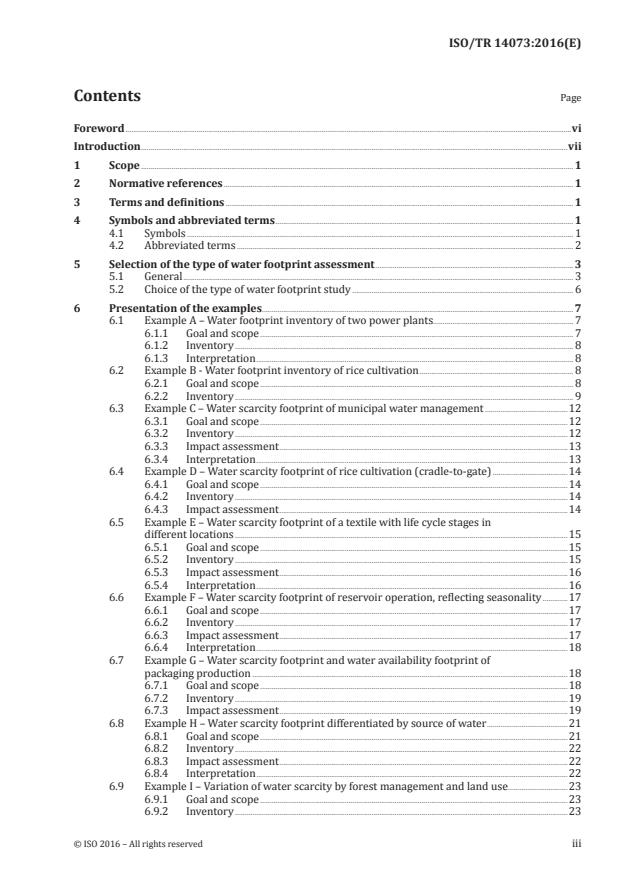
Contents Page
Foreword .vi
Introduction .vii
1 Scope . 1
2 Normative references . 1
3 Terms and definitions . 1
4 Symbols and abbreviated terms . 1
4.1 Symbols . 1
4.2 Abbreviated terms . 2
5 Selection of the type of water footprint assessment . 3
5.1 General . 3
5.2 Choice of the type of water footprint study . 6
6 Presentation of the examples . 7
6.1 Example A – Water footprint inventory of two power plants. 7
6.1.1 Goal and scope . 7
6.1.2 Inventory . 8
6.1.3 Interpretation . 8
6.2 Example B - Water footprint inventory of rice cultivation . 8
6.2.1 Goal and scope . 8
6.2.2 Inventory . 9
6.3 Example C – Water scarcity footprint of municipal water management .12
6.3.1 Goal and scope .12
6.3.2 Inventory .12
6.3.3 Impact assessment .13
6.3.4 Interpretation .13
6.4 Example D – Water scarcity footprint of rice cultivation (cradle-to-gate) .14
6.4.1 Goal and scope .14
6.4.2 Inventory .14
6.4.3 Impact assessment .14
6.5 Example E – Water scarcity footprint of a textile with life cycle stages in
different locations .15
6.5.1 Goal and scope .15
6.5.2 Inventory .15
6.5.3 Impact assessment .16
6.5.4 Interpretation .16
6.6 Example F – Water scarcity footprint of reservoir operation, reflecting seasonality .17
6.6.1 Goal and scope .17
6.6.2 Inventory .17
6.6.3 Impact assessment .17
6.6.4 Interpretation .18
6.7 Example G – Water scarcity footprint and water availability footprint of
packaging production .18
6.7.1 Goal and scope .18
6.7.2 Inventory .19
6.7.3 Impact assessment .19
6.8 Example H – Water scarcity footprint differentiated by source of water .21
6.8.1 Goal and scope .21
6.8.2 Inventory .22
6.8.3 Impact assessment .22
6.8.4 Interpretation .22
6.9 Example I – Variation of water scarcity by forest management and land use .23
6.9.1 Goal and scope .23
6.9.2 Inventory .23
6.9.3 Impact assessment .23
6.9.4 Interpretation .24
6.10 Example J - Water eutrophication footprint of maize cultivation, calculated as one
or two indicator results .24
6.10.1 Goal and scope .24
6.10.2 Inventory .24
6.10.3 Impact assessment .25
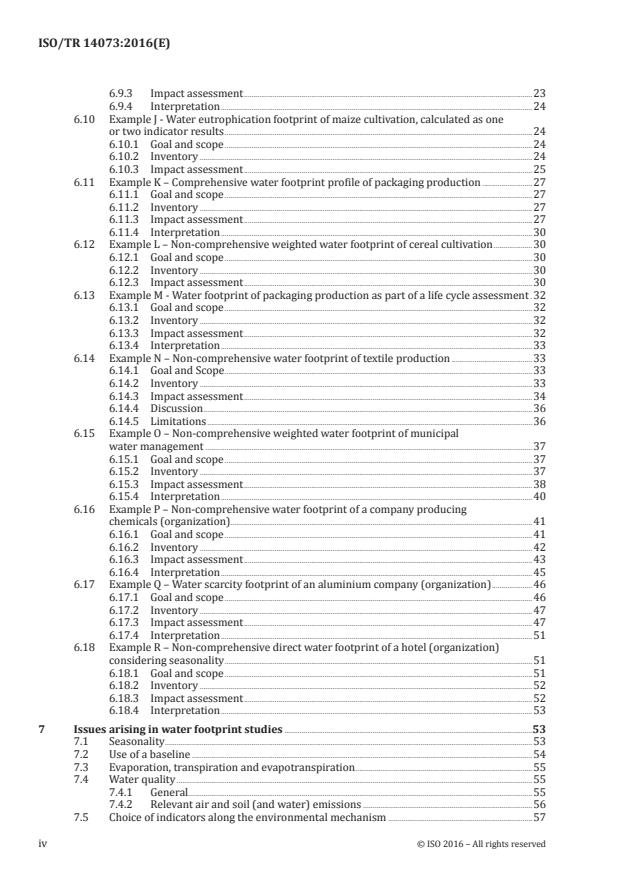
6.11 Example K – Comprehensive water footprint profile of packaging production .27
6.11.1 Goal and scope .27
6.11.2 Inventory .27
6.11.3 Impact assessment .27
6.11.4 Interpretation .30
6.12 Example L – Non-comprehensive weighted water footprint of cereal cultivation .30
6.12.1 Goal and scope .30
6.12.2 Inventory .30
6.12.3 Impact assessment .30
6.13 Example M - Water footprint of packaging production as part of a life cycle assessment .32
6.13.1 Goal and scope .32
6.13.2 Inventory .32
6.13.3 Impact assessment .32
6.13.4 Interpretation .33
6.14 Example N – Non-comprehensive water footprint of textile production .33
6.14.1 Goal and Scope .33
6.14.2 Inventory .33
6.14.3 Impact assessment .34
6.14.4 Discussion .36
6.14.5 Limitations .36
6.15 Example O – Non-comprehensive weighted water footprint of municipal
water management .37
6.15.1 Goal and scope .37
6.15.2 Inventory .37
6.15.3 Impact assessment .38
6.15.4 Interpretation .40
6.16 Example P – Non-comprehensive water footprint of a company producing
chemicals (organization).41
6.16.1 Goal and scope .41
6.16.2 Inventory .42
6.16.3 Impact assessment .43
6.16.4 Interpretation .45
6.17 Example Q – Water scarcity footprint of an aluminium company (organization) .46
6.17.1 Goal and scope .46
6.17.2 Inventory .47
6.17.3 Impact assessment .47
6.17.4 Interpretation .51
6.18 Example R – Non-comprehensive direct water footprint of a hotel (organization)
considering seasonality .51
6.18.1 Goal and scope .51
6.18.2 Inventory .52
6.18.3 Impact assessment .52
6.18.4 Interpretation .53
7 Issues arising in water footprint studies .53
7.1 Seasonality .53
7.2 Use of a baseline .54
7.3 Evaporation, transpiration and evapotranspiration .55
7.4 Water quality .55
7.4.1 General.55
7.4.2 Relevant air and soil (and water) emissions .56
7.5 Choice of indicators along the environmental mechanism .57
iv © ISO 2016 – All rights reserved
7.6 Identification of foreseen consequences of the excluded impacts .58
7.7 Sensitivity analysis .58
Bibliography .60
Foreword
ISO (the International Organization for Standardization) is a worldwide federation of national standards
bodies (ISO member bodies). The work of preparing International Standards is normally carried out
through ISO technical committees. Each member body interested in a subject for which a technical
committee has been established has the right to be represented on that committee. International
organizations, governmental and non-governmental, in liaison with ISO, also take part in the work.
ISO collaborates closely with the International Electrotechnical Commission (IEC) on all matters of
electrotechnical standardization.
The procedures used to develop this document and those intended for its further maintenance are
described in the ISO/IEC Directives, Part 1. In particular the different approval criteria needed for the
different types of ISO documents should be noted. This document was drafted in accordance with the
editorial rules of the ISO/IEC Directives, Part 2 (see www.iso.org/directives).
Attention is drawn to the possibility that some of the elements of this document may be the subject of
patent rights. ISO shall not be held responsible for identifying any or all such patent rights. Details of
any patent rights identified during the development of the document will be in the Introduction and/or
on the ISO list of patent declarations received (see www.iso.org/patents).
Any trade name used in this document is information given for the convenience of users and does not
constitute an endorsement.
For an explanation on the meaning of ISO specific terms and expressions related to conformity assessment,
as well as information about ISO’s adherence to the World Trade Organization (WTO) principles in the
Technical Barriers to Trade (TBT) see the following URL: www.iso.org/iso/foreword.html.
The committee responsible for this document is Technical Committee ISO/TC 207, Environmental
management, Subcommittee SC 5, Life cycle assessment.
vi © ISO 2016 – All rights reserved
Introduction
Principles, requirements and guidelines for the quantification and reporting of a water footprint are
given in ISO 14046. The water footprint assessment according to ISO 14046 can be conducted as a
stand-alone assessment, where only impacts related to water are assessed, or as part of a life cycle
assessment. In addition, a variety of modelling choices and approaches are possible depending on the
goal and scope of the assessment. The water footprint can be reported as a single value or as a profile of
impact category indicator results.
This document provides illustrative examples on the application of ISO 14046 to further enhance
understanding of ISO 14046 and to facilitate its widespread application.
At the time of the publication of this document, water footprint assessment methods are developing
rapidly. Practitioners are encouraged to be aware of the latest developments when undertaking water
footprint studies.
These examples are for illustrative purposes only and some of the data used are fictitious. The data are
not intended be used outside of the context of this document.
The Bibliography might contain references to methods that are not fully compliant with ISO 14046:2014.
TECHNICAL REPORT ISO/TR 14073:2016(E)
Environmental management — Water footprint —
Illustrative examples on how to apply ISO 14046
1 Scope
This document provides illustrative examples of how to apply ISO 14046, in order to assess the water
footprint of products, processes and organizations based on life cycle assessment.
The examples are presented to demonstrate particular aspects of the application of ISO 14046 and
therefore do not present all of the details of an entire water footprint study report as required by
ISO 14046.
NOTE The examples are presented as different ways of applying ISO 14046 and do not preclude alternative
ways of calculating the water footprint, provided they are in accordance with ISO 14046.
2 Normative references
The following documents are referred to in the text in such a way that some or all of their content
constitutes requirements of this document. For dated references, only the edition cited applies. For
undated references, the latest edition of the referenced document (including any amendments) applies.
ISO 14046:2014, Environmental management — Water footprint — Principles, requirements and guidelines
3 Terms and definitions
For the purposes of this document, the terms and definitions given in ISO 14046:2014 apply.
ISO and IEC maintain terminological databases for use in standardization at the following addresses:
— ISO Online browsing platform: available at http://www.iso.org/obp
— IEC Electropedia: available at http://www.electropedia.org/
4 Symbols and abbreviated terms
4.1 Symbols
α characterization factor
C concentration
E emission
F footprint
R rainfall
V volume
4.2 Abbreviated terms
1,4-DB 1,4-Dichlorobenzene
2,4-D 2,4-Dichlorophenoxyacetic acid
APSIM Agricultural Production Systems sIMulator
BOD Biological Oxygen Demand (BOD5 means “measured during 5 days”)
CF Characterization Factor
COD Chemical Oxygen Demand
CTU Comparative Toxic Unit
NOTE 1 “CTU ” for ecosystems; “CTU ” for humans; “CTU ” for cancer; “CTU ” for
e h c n-c
non-cancer.
CWU Consumptive Water Use
CWV Critical Water Volume
DALY Disability Adjusted Life Years
DWU Degradative Water Use
DWCM-AgWU Distributed Water Circulation Model Incorporating Agricultural Water Use
ET Evapotranspiration
FU Functional Unit
H O-eq Water “equivalent”
NOTE 2 Typical unit to express the impact score associated with water scarcity. Some-
times the term H O-eq is written H O eq, or H Oe.
2 2 2
LCA Life Cycle Assessment
LCI Life Cycle Inventory
LCIA Life Cycle Impact Assessment
OEF Organization Environmental Footprint
PEF Product Environmental Footprint
PDF Potentially Disappeared Fraction of species
PAF Potentially Affected Fraction of species
RU Reporting Unit
TOC Total Organic Carbon
WSI Water Scarcity Index
2 © ISO 2016 – All rights reserved
NOTE 3 Sometimes the term water stress index (also abbreviated as WSI) is used in the
literature for what is termed a water scarcity index in this document.
WSF Water Scarcity Footprint
WULCA Water Use in LCA
5 Selection of the type of water footprint assessment
5.1 General
The water footprint assessment conducted according to ISO 14046 can be:
— a stand-alone assessment where only impacts related to water are assessed;
— a part of a life cycle assessment (LCA) where consideration is given to a comprehensive set of
environmental impacts, which are not only impacts related to water.
Table 1 lists the illustrative examples in this document and the different topics that are highlighted in
each example.
Table 1 — Types of water footprint assessment shown in the examples
Product/
Case study Impact
process or Topic highlight- Type of footprint System
Example used in the assessment
a a
organization ed boundary
a
example method
focus
n/a (Water foot-
Product/ Water footprint n/a (inventory
A Power plant print inventory Gate-to-gate
Process inventory only)
only)
Water footprint n/a (Water foot-
Product/ Rice cultiva- n/a (inventory
B inventory using a print inventory Gate-to-gate
Process tion only)
baseline only)
Boulay et al.
Option com- Municipal
Product/ Water scarcity
(2016) (WU
C parison using water manage- Gate-to-gate
Process footprint
scarcity ment
[5]
LCA)
Application of Ridoutt and
Product/ Water scarcity
D water scarcity Rice Gate-to-gate Pfister (2010)
Process footprint
[6]
footprint method
Boulay et
al. (2016)
(WULCA)
[5]
; Pfister et
[7]
al. (2009) ;
Frischknecht
et al. (2008)
Influence of im-
[8]
; EU (2013)
Product/ pact assessment Water scarcity Cradle-to-
[9]
E Textile (PEF/OEF) ;
Process method chosen footprint grave
Boulay et al.
for scarcity
[10]
(2011a) ;
Hoekstra et al.
(2012) (Water
Footprint Net-
work - WFN)
[11]
; Berger et
[12]
al. (2014)
a
All examples explicitly or implicitly contain a water footprint inventory.
Table 1 (continued)
Product/
Case study Impact
process or Topic highlight- Type of footprint System
Example used in the assessment
a a
organization ed boundary
a
example method
focus
Pfister and
Product/ Reservoir Water scarcity
F Seasonality Gate-to-gate Bayer (2014)
Process operation footprint
[13]
Water scarcity
Product/ Scarcity vs avail- Packaging footprint; water Boulay et al.
G Gate-to-gate
[10]
Process ability production availability foot- (2011a)
print
Product/ Influence of Wheat cultiva- Water scarcity Yano et al.
H Gate-to-gate
[14]
Process water sources tion footprint (2015)
Influence of for-
Product/ Beer produc- Water scarcity Yano et al.
I est management Gate-to-gate
[14]
Process tion footprint (2015)
/ land use change
EU (2013)
[9]
(PEF/OEF) ;
Number of indi-
Product/ Water eutrophica- Cradle-to- Jolliet et al.
J cators per type Maize
Process tion footprint gate (2003) (IM-
of impact
PACT 2002+)
[15]
Bulle et
al. (2016)
(IMPACT
[16]
World+) ;
Rosenbaum
et al. (2008)
[17]
(USEtox) ;
Guinée et
[19]
al. 2001 ;
Water footprint
EU (2013)
Product/ Comprehensive Packaging Cradle-to-
K (comprehensive
(PEF/OEF)
Process water footprint product gate
profile) [9]
; Verones
et al. (2011)
[19]
; Boulay
et al. (2016)
[5]
(WULCA) ;
Boulay et al.
[9]
(2011a) ;
Hannafiah et
[20]
al. (2011)
Goedkoop
et al. (2009)
[21]
(ReCiPe) ;
Applying weight- Non-comprehen-
Product/ Cereal cultiva- Ridoutt and
L ing to obtain a sive weighted Gate-to-gate
Process tion Pfister (2010)
single value water footprint
[6]
; Ridoutt
and Pfister
[22]
(2013)
a
All examples explicitly or implicitly contain a water footprint inventory.
4 © ISO 2016 – All rights reserved
Table 1 (continued)
Product/
Case study Impact
process or Topic highlight- Type of footprint System
Example used in the assessment
a a
organization ed boundary
a
example method
focus
Boulay et
al. (2016)
[5]
(WULCA)
Product/ Water footprint Packaging Water footprint as Cradle-to-
(Water
M
Process as part of an LCA product part of an LCA gate
degradation
footprint
profile already
present)
Hoekstra et
Non-compre- al. (2012);
Product/ Cradle-to-
N Seasonality Textile product hensive water (Water Foot-
Process gate
footprint print Network
[11]
- WFN)
Pfister et al.
[7]
(2009) ;
Ridoutt and
Pfister (2013)
[22]
;
Goedkoop et
Applying weight- Municipal Non-comprehen-
al., (2009)
Product/ Cradle-to-
O ing to obtain to water manage- sive weighted
(ReCiPe)
Process grave
single value ment water footprint
[21]
; Jolliet
et al. (2003)
(IMPACT
[15]
2002+) ;
Rosenbaum
et al. (2008)
[17]
(USEtox)
Berger et al.
Applying water Non-compre-
[12]
Chemical pro- (2014) ;
P Organization footprint to dif- hensive water Gate-to-gate
duction Saling et al.
ferent sites footprint
[23]
(2002)
Applying water
footprint to Aluminium Water scarcity Cradle-to- Pfister et al.
Q Organization
[7]
supply chain of a production footprint gate (2009)
company
Boulay et
al. (2016)
[5]
(WULCA) at
Applying water Non-compre-
the monthly
Hotel opera-
R Organization footprint to a ser- hensive water Gate-to-gate
approach;
tion
vice company footprint
Goedkoop
et al. (2009)
[21]
(ReCiPe)
a
All examples explicitly or implicitly contain a water footprint inventory.
NOTE 1 Guidance about application of LCA to organizations is given in ISO/TS 14072. In addition,
ISO 14046:2014, Annex A, provides guidelines for water footprint assessment of organizations.
NOTE 2 The principles of comprehensiveness for an LCA study and for a water footprint assessment are
different (see ISO 14040:2006, 4.1.7, and ISO 14046:2014, 4.13).
NOTE 3 The term “partial” is sometimes used as a synonym for “non-comprehensive”. However, “partial” is
avoided in this document as it is also used with a different meaning, such as in ISO/TS 14067.
5.2 Choice of the type of water footprint study
The different types of water footprint are defined in ISO 14046:2014, 5.4.5 to 5.4.7. The choice of a
particular type of water footprint to be assessed in a stand-alone water footprint study is determined
in the goal and scope definition phase.
In addition to the goal of the study (see ISO 14046:2014, 5.2.1) the choice of type of water footprint may
be influenced by consideration of an appropriate system boundary, the type(s) of water resource used
and affected water resources, the associated changes in water quantity and quality and determination
of relevant impact assessment categories and methodologies.
Figure 1 illustrates a procedure for choosing the type of water footprint for a stand-alone water
footprint study.
Figure 1 — Procedure for choosing the type of a water footprint assessment for a stand-alone
water footprint study
The procedure for choosing an appropriate system boundary in a water footprint study as defined in
ISO 14046:2014, 3.3.8, can be supported by collation of additional information such as:
— developing a map showing the geographical location of each unit process;
— identification of the unit processes that are located in areas of critical water availability (taking into
account relevant seasonal and temporal variability);
— identification of the unit processes with air, water and soil emissions that can potentially affect
ecologically vulnerable water bodies.
All water inputs and outputs relevant to the system (see examples in Figure 2) are considered for
relevant changes in water quantity (volume) and water quality parameters and/or characteristics,
including emissions to air, water and soil that affect water quality. Estimates may be based on readily
available data or models.
6 © ISO 2016 – All rights reserved
Figure 2 — Examples of water inputs (left) and outputs (right) for a unit process under study
In addition to the goal of the water footprint study, the information collected in order to define the
system boundary, the type(s) of water resource used and affected water resources, and the associated
(quantitative and/or qualitative) changes in water, can assist in determining the appropriate impact
categories, category indicators and the characterization models to be considered for the water
footprint study – and therefore choice of a type of water footprint. Based on the information collected,
it is possible to:
— estimate the degree of likely significance (i.e. potential contribution to the water footprint) of each
unit process for the study, and therefore which unit processes should become the focus for more
detailed data collection;
— specify the data requirements (e.g. primary data, secondary data, estimated data) based on the
likely significance of each unit process for the water footprint;
— define the initial cut-off criteria for the study (which are revisited throughout the study following
ISO 14046:2014, 4.5).
Based on this information and general information related to the goal of the study (see ISO 14046:2014,
5.2.1) the type of water footprint that will be a result of the water footprint study can be chosen.
6 Presentation of the examples
6.1 Example A – Water footprint inventory of two power plants
6.1.1 Goal and scope
This example illustrates the compilation of water flows and emissions affecting water of a unit process.
A utility wanting to evaluate which of two planned options has the lowest direct water footprint starts
by creating the direct water footprint inventory of both options, from a gate-to-gate perspective.
This direct water footprint inventory can then be used in combination with water footprint impact
assessment methods, considering water scarcity footprint and/or water degradation footprint, to
evaluate the direct water footprint of both options.
NOTE The term “direct” is used as “what happens on the site” (see ISO 14046:2014, 3.5.14) (gate-to-gate,
excluding any inputs such as infrastructure production, maintenance and outputs such as electricity). The term
“indirect” is used for background processes (see ISO 14046:2014, 3.5.15).
6.1.2 Inventory
Table 2 shows the water footprint inventory associated with both options. The inventory is based on
collected and modelled data and expressed per kWh of electricity produced.
Table 2 — Gate-to-gate water footprint inventory associated with two power plants options
Option 2
Option 1
Unit
(power plant, situated in a
(power plant, situated in a
Flows
(per kWh location B, with lower river
location A, using through
produced) flow and therefore using a
flow without cooling tower)
cooling tower)
Address of the power plant — AA BB
— Location A (name of the Location B (name of the
Location country and if possible country and if possible
drainage basin) drainage basin)
— Assumed to be a constant Assumed to be a constant
Temporal variation
use of water use of water
Water withdrawal l 40 10
Water release l 38 6
Temperature of water released °C 25 25
Water consumed l 2 4
Chromium (III) emitted to water g 0,001 0,001
Oil emitted to water g 0,02 0,02
SO emitted to air g 0,7 0,7
NO emitted to air g 0,6 0,6
x
Mercury emitted to air mg 0,04 0,04
Dioxin, 2,3,7,8, Tetrachlorodibenzo-p- ng 0,07 0,07
More if available … … …
6.1.3 Interpretation
Such an inventory can be as extensive as needed to capture all emissions (as well as other information)
useful to apply the impact assessment methods that will be chosen in the study. The quality of the data
is sometimes specified in order to provide information about the accuracy of the water footprint that
will be calculated based on this inventory. The naming of the flows in the inventory is matched with the
naming of the flows in the impact assessment.
From the address of the power plants, the data of the location (e.g. the water scarcity index) can be
determined within a subsequent impact assessment using satellite imagery. As the water scarcity
footprint of both locations can be very different, comparison between both options on the inventory
level can be misleading.
6.2 Example B - Water footprint inventory of rice cultivation
6.2.1 Goal and scope
This example illustrates calculation of water flows based on the hydrology of an area.
This example is not a traditional LCA case study, but it illustrates a special case, considering non-
irrigated paddies as the baseline.
The example is shown as an exercise of a non-comprehensive water footprint inventory by utilizing
existing hydrological knowledge, namely the usage of a hydrological model to analyse water footprint
inventory of unit processes.
8 © ISO 2016 – All rights reserved
This example refers to rice cultivation, as an example of a water footprint inventory analysis, in a
country in monsoon Asia with moderate rainfall and suitable rice cultivation practices. An irrigated
area lies downstream of the intake facility (Figure 3) and the baseline land use is rainfed (i.e. non-
irrigated) rice.
This is a “gate-to-gate” example. For the purpose of this example, energy and goods required for rice
cultivation are excluded.
Figure 3 — Depiction of basin-wide processes
6.2.2 Inventory
The elementary flows are quantified by utilizing a hydrological model, such as DWCM-AgWU (Yoshida et
[24] [25]
al. 2012 ; Masumoto et al. 2009 ), at the scale of drainage basins. Agricultural situations typically
require modelling because it is difficult, or even impossible, to measure all the elementary flows.
The elementary flows quantified in the water footprint inventory can be used to determine the water
scarcity footprint which is described in other examples. In order to determine the water availability
footprint, the water degradation footprint or a water footprint profile, other elementary flows related
to water quality need to be determined.
6.2.2.1 Elementary flows
In this approach, a single process in an agricultural area receives rainfall, irrigation and residual water
(water that has not been diverted from the river for the intention to irrigate this area; inflow locations)
as inputs, and have evaporation, transpiration, percolation to groundwater and return flow to the river
as outputs (Figure 4).
Furthermore, it is shown that all input water is withdrawn from the location of the process and all
output water is released to the location of the process. Part of water output as groundwater gradually
returns back into the river systems or is utilized as the source of public water supply.
In paddy areas, the source of freshwater differs between rainfed (precipitation) and irrigated
paddies (irrigation water). In both cases, various types of water use exist, such as three types in
rainfed agriculture (only rainfall, rainfall plus supplementary water stored in small ponds, and using
flooding water) and six categories in irrigated paddies (gravity-fed water, pumped water, reservoirs,
impounding of silty water (colmatage), release of river water into coastal wetlands and near-shore
waters by managing controlling tides, and groundwater).
NOTE 1 Upwelling flow is defined as part of seepage NOTE 2 The irrigated area is delineated for the
returning to the surface from the ground within an DWCM-AgWU.
irrigated area.
a) Water balance b) Inflow and outflows in an irrigated area
Figure 4 — Schematics of the calculation for hydrological components and river return ratio
6.2.2.2 Calculation procedure of water footprint inventory
The water footprint inventory is determined as follows:
a) the estimation in water footprint inventory of unit process for rice cultivation in paddy areas is
carried out at the scale of the irrigated area;
b) each elementary flow is modelled using DWCM-AgWU, which comprises water allocation and
management, evapotranspiration, planting time/area (rice phenology), paddy water use and runoff
[24] [25]
models (Yoshida et al. 2012 ; Masumoto et al. 2009 );
c) the water balance of the baseline situation is calculated assuming no irrigation is carried out.
NOTE In the paddy-dominant areas with two or three crops within a year, paddies are classified into rainfed
in rainy seasons and irrigated in dry season. As for the baseline situation, it is assumed that an irrigation system
is not introduced, so paddies are regarded as rainfed types.
These results are then summed across the basin (an example in one region of the basin; Table 3) and
3 3
expressed in the units m per ha per irrigation period, or m per kg brown rice for example.
6.2.2.3 Input parameters and calculated results of unit processes
Input parameters into the DWCM-AgWU model are land use data, meteorological data, geological and
geomorphologic data, and celled basin data. The model estimates the planting area of paddies, intake
amount and soil moistur
...
Questions, Comments and Discussion
Ask us and Technical Secretary will try to provide an answer. You can facilitate discussion about the standard in here.
Loading comments...