

ISO/IEC 14496-27:2009/Amd 6:2015
(Amendment)Information technology — Coding of audio-visual objects — Part 27: 3D Graphics conformance — Amendment 6: Pattern-based 3D mesh coding conformance
General Information
- Abstract
- Status
- Published
- Publication Date
- 13-Dec-2015
- Current Stage
- 6060 - International Standard published
- Start Date
- 14-Dec-2015
- Due Date
- 15-Nov-2016
- Completion Date
- 15-Oct-2015


Overview
ISO/IEC 14496-27:2009/Amd 6:2015 is an amendment to the international standard for coding of audio-visual objects, specifically focusing on 3D Graphics conformance. This amendment introduces pattern-based 3D mesh coding conformance methods designed to enhance the efficiency and accuracy of encoding 3D mesh data. The standard is developed and maintained by ISO and IEC, under the joint technical committee ISO/IEC JTC 1 which specializes in information technology standards.
The 2015 Amendment 6 expands on the original 3D graphics conformance standard by specifying requirements and testing files for pattern-based repetitions in 3D meshes. This enables improved compression and standardized decoding of complex 3D models with repeated elements, such as leaves on a tree or identical objects in different transformations.
Key Topics
Pattern-Based 3D Mesh Coding
The amendment supports encoding repeated patterns in 3D meshes to optimize file size and decoding performance, especially useful for objects with multiple identical parts.Instance Transformations
It specifies several types of transformations applied to repeated patterns, including:- Translation
- Rotation
- Reflection
- Scaling
These transformations are encoded to maintain the spatial arrangement and appearance of 3D objects.
Conformance Testing Files
The amendment provides a collection of test 3D mesh files exemplifying different transformation scenarios, such as:- Identical repeated elements with only positional differences
- Repeated elements with position and orientation variations
- Instances with scaling and reflection differences
- Unique elements combined with repeated patterns
- Textured 3D meshes with repeated and unique textures
- Color attribute variations for repeated elements
These files enable implementers to verify compliance with the pattern-based coding requirements.
Data Encoding Modes
Conformance includes verifying elementary instance data modes and grouped instance data modes, ensuring robustness in coded bitstreams and decoding processes.Error Compensation
The amendment supports error compensation data in encoded bitstreams to maintain visual quality after decoding.
Applications
ISO/IEC 14496-27:2009/Amd 6:2015 is critical for various fields relying on 3D graphics and efficient data transmission:
3D Modeling and Animation
Enables standardized encoding of complex models with repeated structures, reducing file sizes while preserving accuracy.Virtual Reality (VR) and Augmented Reality (AR)
Efficient mesh coding improves loading times and rendering performance in immersive environments.Gaming Industry
Supports game engines by providing mechanisms to encode repeated 3D assets with transformations, minimizing storage and network requirements.3D Printing and CAD
Accurate and efficient representation of repeated geometric features increases data management efficiency.Multimedia Streaming
Enhances audio-visual object coding by integrating 3D mesh patterns into streaming content with better compression.3D Content Interchange
Facilitates interoperability between different software and platforms by adhering to a common conformance standard.
Related Standards
ISO/IEC 14496 (MPEG-4)
The broader standard for coding of audio-visual objects which includes parts for video, audio, and graphics.ISO/IEC 14496-2
Focuses on video coding (MPEG-4 Visual).ISO/IEC 14496-3
Addresses audio coding, complementing the visual data compression.ISO/IEC 14496-28 (3D Audio)
Related part that handles 3D audio coding to complement 3D visual objects.ISO/IEC JTC 1 SC 29
The subcommittee responsible for developing multimedia coding standards, including the MPEG series.
Summary
ISO/IEC 14496-27:2009/Amd 6:2015 provides an essential update to 3D graphics conformance testing, introducing pattern-based 3D mesh coding methods that improve efficiency, consistency, and interoperability. Its practical applications span multiple industries in need of standardized, high-quality 3D content encoding. By following this amendment, technology developers ensure compliance with international best practices for 3D mesh pattern encoding and transformation handling.
Relations
- Effective Date
- 11-Dec-2021
Get Certified
Connect with accredited certification bodies for this standard

BSI Group
BSI (British Standards Institution) is the business standards company that helps organizations make excellence a habit.

NYCE
Mexican standards and certification body.
Sponsored listings
Frequently Asked Questions
ISO/IEC 14496-27:2009/Amd 6:2015 is a standard published by the International Organization for Standardization (ISO). Its full title is "Information technology — Coding of audio-visual objects — Part 27: 3D Graphics conformance — Amendment 6: Pattern-based 3D mesh coding conformance". This standard covers: Information technology — Coding of audio-visual objects — Part 27: 3D Graphics conformance — Amendment 6: Pattern-based 3D mesh coding conformance
Information technology — Coding of audio-visual objects — Part 27: 3D Graphics conformance — Amendment 6: Pattern-based 3D mesh coding conformance
ISO/IEC 14496-27:2009/Amd 6:2015 is classified under the following ICS (International Classification for Standards) categories: 35.040 - Information coding; 35.040.40 - Coding of audio, video, multimedia and hypermedia information. The ICS classification helps identify the subject area and facilitates finding related standards.
ISO/IEC 14496-27:2009/Amd 6:2015 has the following relationships with other standards: It is inter standard links to ISO/IEC 14496-27:2009. Understanding these relationships helps ensure you are using the most current and applicable version of the standard.
ISO/IEC 14496-27:2009/Amd 6:2015 is available in PDF format for immediate download after purchase. The document can be added to your cart and obtained through the secure checkout process. Digital delivery ensures instant access to the complete standard document.
Standards Content (Sample)
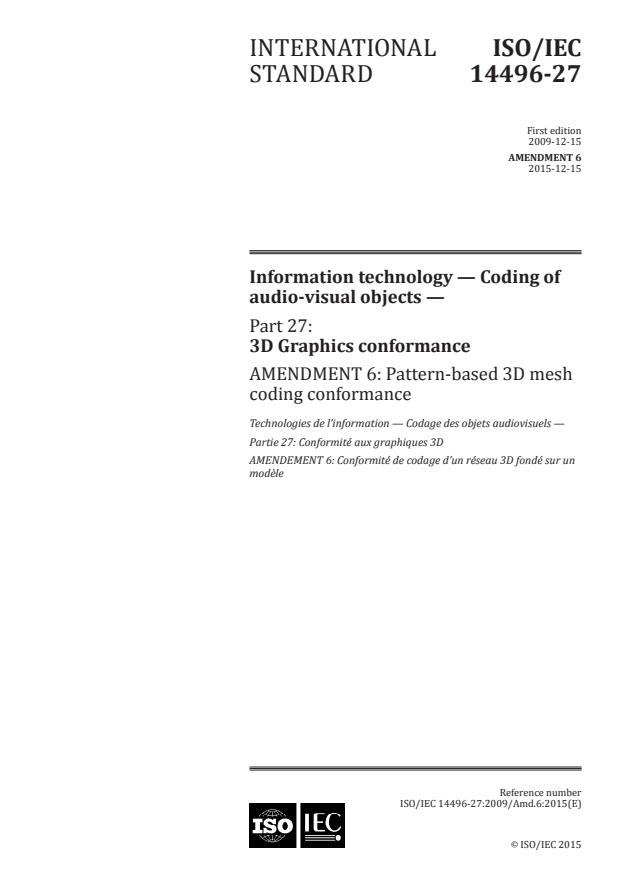
INTERNATIONAL ISO/IEC
STANDARD 14496-27
First edition
2009-12-15
AMENDMENT 6
2015-12-15
Information technology — Coding of
audio-visual objects —
Part 27:
3D Graphics conformance
AMENDMENT 6: Pattern-based 3D mesh
coding conformance
Technologies de l’information — Codage des objets audiovisuels —
Partie 27: Conformité aux graphiques 3D
AMENDEMENT 6: Conformité de codage d’un réseau 3D fondé sur un
modèle
Reference number
ISO/IEC 14496-27:2009/Amd.6:2015(E)
©
ISO/IEC 2015
ISO/IEC 14496-27:2009/Amd.6:2015(E)
© ISO/IEC 2015, Published in Switzerland
All rights reserved. Unless otherwise specified, no part of this publication may be reproduced or utilized otherwise in any form
or by any means, electronic or mechanical, including photocopying, or posting on the internet or an intranet, without prior
written permission. Permission can be requested from either ISO at the address below or ISO’s member body in the country of
the requester.
ISO copyright office
Ch. de Blandonnet 8 • CP 401
CH-1214 Vernier, Geneva, Switzerland
Tel. +41 22 749 01 11
Fax +41 22 749 09 47
copyright@iso.org
www.iso.org
ii © ISO/IEC 2015 – All rights reserved
ISO/IEC 14496-27:2009/Amd.6:2015(E)
Foreword
ISO (the International Organization for Standardization) and IEC (the International Electrotechnical
Commission) form the specialized system for worldwide standardization. National bodies that are
members of ISO or IEC participate in the development of International Standards through technical
committees established by the respective organization to deal with particular fields of technical
activity. ISO and IEC technical committees collaborate in fields of mutual interest. Other international
organizations, governmental and non-governmental, in liaison with ISO and IEC, also take part in the
work. In the field of information technology, ISO and IEC have established a joint technical committee,
ISO/IEC JTC 1.
The procedures used to develop this document and those intended for its further maintenance are
described in the ISO/IEC Directives, Part 1. In particular the different approval criteria needed for
the different types of document should be noted. This document was drafted in accordance with the
editorial rules of the ISO/IEC Directives, Part 2 (see www.iso.org/directives).
Attention is drawn to the possibility that some of the elements of this document may be the subject
of patent rights. ISO and IEC shall not be held responsible for identifying any or all such patent
rights. Details of any patent rights identified during the development of the document will be in the
Introduction and/or on the ISO list of patent declarations received (see www.iso.org/patents).
Any trade name used in this document is information given for the convenience of users and does not
constitute an endorsement.
For an explanation on the meaning of ISO specific terms and expressions related to conformity
assessment, as well as information about ISO’s adherence to the WTO principles in the Technical
Barriers to Trade (TBT) see the following URL: Foreword - Supplementary information
The committee responsible for this document is ISO/IEC JTC 1, Information technology, SC 29, Coding of
audio, picture, multimedia and hypermedia information.
© ISO/IEC 2015 – All rights reserved iii
ISO/IEC 14496-27:2009/Amd.6:2015(E)
Information technology — Coding of audio-visual objects —
Part 27:
3D Graphics conformance
AMENDMENT 6: Pattern-based 3D mesh coding conformance
All the files required for conformance testing are available as electronic insert.
Name (for bitstream file-
Attribute/Parameter
name
...