

ISO 8255-1:2017
(Main)Microscopes — Cover glasses — Part 1: Dimensional tolerances, thickness and optical properties
General Information
- Abstract
ISO 8255-1:2017 specifies requirements for dimensional tolerances, thickness and optical properties for microscope cover glasses used for transmitted light microscopy in the visible spectral range (400 nm to 760 nm).
- Status
- Published
- Publication Date
- 05-Jun-2017
- Technical Committee
- ISO/TC 172/SC 5 - Microscopes and endoscopes
- Drafting Committee
- ISO/TC 172/SC 5 - Microscopes and endoscopes
- Current Stage
- 9093 - International Standard confirmed
- Start Date
- 14-Sep-2022
- Completion Date
- 29-Aug-2026

Overview
ISO 8255-1:2017 is an international standard published by ISO that defines the dimensional tolerances, thickness, and optical properties of microscope cover glasses. These cover glasses are vital components used in transmitted light microscopy within the visible spectral range, specifically from 400 nm to 760 nm. This standard ensures consistency and quality in microscope cover glasses to optimize optical performance and imaging accuracy.
Maintaining proper cover glass specifications is critical as it directly affects the optical quality of microscopy observations, especially for objectives with high numerical apertures. ISO 8255-1:2017 provides guidelines for manufacturers and users to guarantee reliable and high-quality cover glass products that meet stringent dimensional and optical requirements.
Key Topics
- Scope: Specifies requirements for thickness, dimensional tolerances, and optical properties of microscope cover glasses for use in visible light microscopy.
- Dimensional Tolerances:
- Thickness tolerances defined for types such as No. 1, No. 1 ½, and No. 1 ½ H cover glasses.
- Thickness tolerance examples: No. 1 ½ has a design thickness of 0.17 mm with a tolerance of +0.005 mm/-0.001 mm.
- Length, width, and diameter tolerances for rectangular and round cover glasses are ±0.5 mm.
- Optical Properties:
- Principal refractive index: n = 1.5255 ± 0.0015 at a wavelength of 546.07 nm.
- Abbe number (ν): 56 ± 2, which represents chromatic dispersion and is critical for maintaining color correction.
- Marking and Labeling: Packaging must include thickness designation, dimensions, average quantity or mass, manufacturer details, and compliance markings.
- Guidelines for Selection: Annex A recommends suitable cover glass types based on immersion media (air, water, glycerol, immersion oil) and the numerical aperture of microscope objectives.
- Typical Dimensions: Annex B lists common sizes for rectangular and round cover glasses to assist in selection.
Applications
ISO 8255-1:2017 serves a broad range of stakeholders involved in microscopy, including manufacturers, laboratory technicians, quality control personnel, and researchers. Key applications include:
- Microscope manufacturing and calibration: Ensuring cover glasses meet dimensional and optical standards for optimal instrument performance.
- Biomedical research and clinical diagnostics: Providing reliable cover glasses that minimize optical aberrations for accurate cell and tissue observation.
- Materials science and industrial inspection: Facilitating high-resolution microscopy with standardized cover glass specifications.
- Education: Guaranteeing consistent quality in microscopy accessories for teaching and training environments.
By adhering to ISO 8255-1 requirements, users can expect reduced spherical aberrations, improved image quality, and consistent microscopy results, especially when using high numerical aperture objectives sensitive to cover glass properties.
Related Standards
- ISO 8036 – Specifies properties for immersion liquids used with microscopes and is referenced in selecting compatible immersion media.
- ISO 8255-2 – Covers quality requirements and test methods for microscope cover glass materials, complementing the dimensional and optical criteria of ISO 8255-1.
- ISO 7944 – Defines reference wavelengths for optical instruments, important for accurate refractive index measurements referenced in ISO 8255-1.
Together, these standards form a comprehensive framework for the production and use of microscope cover glasses, ensuring high-performance optical microscopy globally.
Adopting ISO 8255-1:2017 improves microscopy precision by standardizing critical cover glass specifications, supporting advancements across scientific research, clinical diagnostics, and industrial applications. For optimal microscopy results, selecting cover glasses that conform to this standard is essential for minimizing optical distortions and achieving accurate visualization.
Relations
- Effective Date
- 10-Dec-2016
Frequently Asked Questions
ISO 8255-1:2017 is a standard published by the International Organization for Standardization (ISO). Its full title is "Microscopes — Cover glasses — Part 1: Dimensional tolerances, thickness and optical properties". This standard covers: ISO 8255-1:2017 specifies requirements for dimensional tolerances, thickness and optical properties for microscope cover glasses used for transmitted light microscopy in the visible spectral range (400 nm to 760 nm).
ISO 8255-1:2017 specifies requirements for dimensional tolerances, thickness and optical properties for microscope cover glasses used for transmitted light microscopy in the visible spectral range (400 nm to 760 nm).
ISO 8255-1:2017 is classified under the following ICS (International Classification for Standards) categories: 37.020 - Optical equipment. The ICS classification helps identify the subject area and facilitates finding related standards.
ISO 8255-1:2017 has the following relationships with other standards: It is inter standard links to ISO 8255-1:2011. Understanding these relationships helps ensure you are using the most current and applicable version of the standard.
ISO 8255-1:2017 is available in PDF format for immediate download after purchase. The document can be added to your cart and obtained through the secure checkout process. Digital delivery ensures instant access to the complete standard document.
Standards Content (Sample)
INTERNATIONAL ISO
STANDARD 8255-1
Third edition
2017-06
Microscopes — Cover glasses —
Part 1:
Dimensional tolerances, thickness and
optical properties
Microscopes — Lamelles couvre-objet —
Partie 1: Tolérances dimensionnelles, épaisseur et propriétés optiques
Reference number
©
ISO 2017
© ISO 2017, Published in Switzerland
All rights reserved. Unless otherwise specified, no part of this publication may be reproduced or utilized otherwise in any form
or by any means, electronic or mechanical, including photocopying, or posting on the internet or an intranet, without prior
written permission. Permission can be requested from either ISO at the address below or ISO’s member body in the country of
the requester.
ISO copyright office
Ch. de Blandonnet 8 • CP 401
CH-1214 Vernier, Geneva, Switzerland
Tel. +41 22 749 01 11
Fax +41 22 749 09 47
copyright@iso.org
www.iso.org
ii © ISO 2017 – All rights reserved
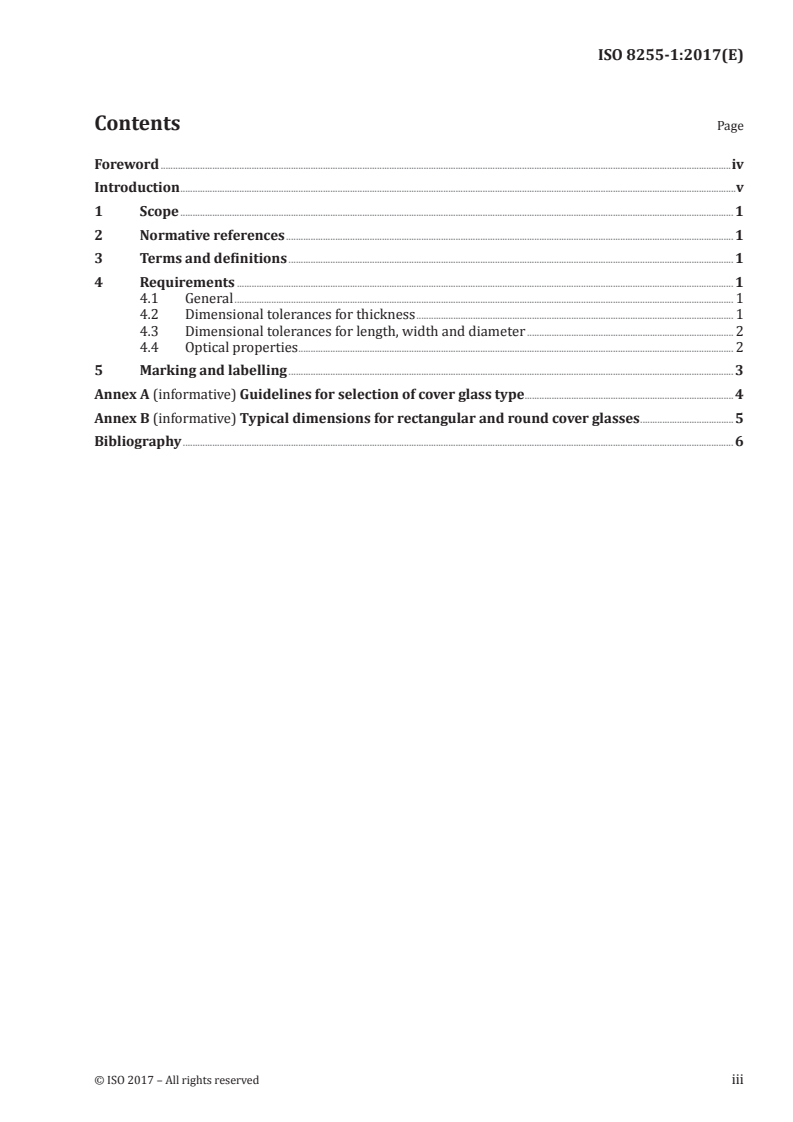
Contents Page
Foreword .iv
Introduction .v
1 Scope . 1
2 Normative references . 1
3 Terms and definitions . 1
4 Requirements . 1
4.1 General . 1
4.2 Dimensional tolerances for thickness . 1
4.3 Dimensional tolerances for length, width and diameter . 2
4.4 Optical properties . 2
5 Marking and labelling . 3
Annex A (informative) Guidelines for selection of cover glass type . 4
Annex B (informative) Typical dimensions for rectangular and round cover glasses .5
Bibliography . 6
Foreword
ISO (the International Organization for Standardization) is a worldwide federation of national standards
bodies (ISO member bodies). The work of preparing International Standards is normally carried out
through ISO technical committees. Each member body interested in a subject for which a technical
committee has been established has the right to be represented on that committee. International
organizations, governmental and non-governmental, in liaison with ISO, also take part in the work.
ISO collaborates closely with the International Electrotechnical Commission (IEC) on all matters of
electrotechnical standardization.
The procedures used to develop this document and those intended for its further maintenance are
described in the ISO/IEC Directives, Part 1. In particular the different approval criteria needed for the
different types of ISO documents should be noted. This document was drafted in accordance with the
editorial rules of the ISO/IEC Directives, Part 2 (see www .iso .org/ directives).
Attention is drawn to the possibility that some of the elements of this document may be the subject of
patent rights. ISO shall not be held responsible for identifying any or all such patent rights. Details of
any patent rights identified during the development of the document will be in the Introduction and/or
on the ISO list of patent declarations received (see www .iso .org/ patents).
Any trade name used in this document is information given for the convenience of users and does not
constitute an endorsement.
For an explanation on the voluntary nature of standards, the meaning of ISO specific terms and
expressions related to conformity assessment, as well as information about ISO’s adherence to the
World Trade Organization (WTO) principles in the Technical Barriers to Trade (TBT) see the following
URL: w w w . i s o .org/ iso/ foreword .html.
The committee responsible for this document is ISO/TC 172, Optics and photonics, Subcommittee SC 5,
Microscopes and endoscopes.
This third edition cancels and replaces the second edition (ISO 8255-1:2011), of which it constitutes a
minor revision to correct the designation of cover glass.
A list of all parts in the ISO 8255 series can be found on the ISO website.
iv © ISO 2017 – All rights reserved
Introduction
This document defines dimensions and specifies optical quality requirements in order to guarantee the
quality of observation.
The data given in this document are applicable to most products in use and have been adapted to take
into account the relevant national standards in vigour.
This document contains requirements for dimensional tolerances, thickness and optical properties,
whereas quality requirements and test methods related to the material a
...
INTERNATIONAL ISO
STANDARD 8255-1
Third edition
2017-06
Microscopes — Cover glasses —
Part 1:
Dimensional tolerances, thickness and
optical properties
Microscopes — Lamelles couvre-objet —
Partie 1: Tolérances dimensionnelles, épaisseur et propriétés optiques
Reference number
©
ISO 2017
© ISO 2017, Published in Switzerland
All rights reserved. Unless otherwise specified, no part of this publication may be reproduced or utilized otherwise in any form
or by any means, electronic or mechanical, including photocopying, or posting on the internet or an intranet, without prior
written permission. Permission can be requested from either ISO at the address below or ISO’s member body in the country of
the requester.
ISO copyright office
Ch. de Blandonnet 8 • CP 401
CH-1214 Vernier, Geneva, Switzerland
Tel. +41 22 749 01 11
Fax +41 22 749 09 47
copyright@iso.org
www.iso.org
ii © ISO 2017 – All rights reserved
Contents Page
Foreword .iv
Introduction .v
1 Scope . 1
2 Normative references . 1
3 Terms and definitions . 1
4 Requirements . 1
4.1 General . 1
4.2 Dimensional tolerances for thickness . 1
4.3 Dimensional tolerances for length, width and diameter . 2
4.4 Optical properties . 2
5 Marking and labelling . 3
Annex A (informative) Guidelines for selection of cover glass type . 4
Annex B (informative) Typical dimensions for rectangular and round cover glasses .5
Bibliography . 6
Foreword
ISO (the International Organization for Standardization) is a worldwide federation of national standards
bodies (ISO member bodies). The work of preparing International Standards is normally carried out
through ISO technical committees. Each member body interested in a subject for which a technical
committee has been established has the right to be represented on that committee. International
organizations, governmental and non-governmental, in liaison with ISO, also take part in the work.
ISO collaborates closely with the International Electrotechnical Commission (IEC) on all matters of
electrotechnical standardization.
The procedures used to develop this document and those intended for its further maintenance are
described in the ISO/IEC Directives, Part 1. In particular the different approval criteria needed for the
different types of ISO documents should be noted. This document was drafted in accordance with the
editorial rules of the ISO/IEC Directives, Part 2 (see www .iso .org/ directives).
Attention is drawn to the possibility that some of the elements of this document may be the subject of
patent rights. ISO shall not be held responsible for identifying any or all such patent rights. Details of
any patent rights identified during the development of the document will be in the Introduction and/or
on the ISO list of patent declarations received (see www .iso .org/ patents).
Any trade name used in this document is information given for the convenience of users and does not
constitute an endorsement.
For an explanation on the voluntary nature of standards, the meaning of ISO specific terms and
expressions related to conformity assessment, as well as information about ISO’s adherence to the
World Trade Organization (WTO) principles in the Technical Barriers to Trade (TBT) see the following
URL: w w w . i s o .org/ iso/ foreword .html.
The committee responsible for this document is ISO/TC 172, Optics and photonics, Subcommittee SC 5,
Microscopes and endoscopes.
This third edition cancels and replaces the second edition (ISO 8255-1:2011), of which it constitutes a
minor revision to correct the designation of cover glass.
A list of all parts in the ISO 8255 series can be found on the ISO website.
iv © ISO 2017 – All rights reserved
Introduction
This document defines dimensions and specifies optical quality requirements in order to guarantee the
quality of observation.
The data given in this document are applicable to most products in use and have been adapted to take
into account the relevant national standards in vigour.
This document contains requirements for dimensional tolerances, thickness and optical properties,
whereas quality requirements and test methods related to the material a
...