

ISO 19012-4:2024
(Main)Microscopes — Designation of microscope objectives — Part 4: Polarization characteristics
General Information
- Abstract
This document specifies the use of the marking on objectives for polarization microscopes and defines measurands and measurement procedures of polarization characteristics of the objectives for qualitative polarization imaging. These measurements are defined on the image plane of the objective lens. This marking is consistent with ISO 8578. NOTE This document does not apply to objectives exclusively used on stereomicroscopes.
- Status
- Published
- Publication Date
- 14-May-2024
- Technical Committee
- ISO/TC 172/SC 5 - Microscopes and endoscopes
- Drafting Committee
- ISO/TC 172/SC 5 - Microscopes and endoscopes
- Current Stage
- 6060 - International Standard published
- Start Date
- 15-May-2024
- Due Date
- 27-Sep-2024
- Completion Date
- 15-May-2024
Overview
ISO 19012-4:2024 is an international standard that specifies the designation and polarization characteristics of microscope objectives used in polarization microscopy. It defines the marking system for polarization microscope objectives and establishes standardized measurement procedures to evaluate their polarization performance. This ensures consistent qualitative polarization imaging by detailing the extinction ratio measurement on the image plane of the objective lens. The standard aligns with ISO 8578 regarding marking conventions but excludes objectives used exclusively on stereomicroscopes.
This standard supports manufacturers and users in verifying and communicating objective lenses' polarization properties, essential for accurate microscopy applications where polarization effects are critical.
Key Topics
Polarization Characteristics of Objectives
The standard focuses on minimizing the influence of objective lenses on polarization imaging by defining measurable polarization parameters.Extinction Ratio Definition and Requirements
The extinction ratio (r) is key to assessing polarization performance, calculated as the ratio of transmitted intensity through parallel polarizers to that through crossed polarizers. Required minimum extinction ratios vary by numerical aperture (NA) ranges:- NA < 0.5: r ≥ 12,000
- 0.5 ≤ NA < 0.75: r ≥ 10,000
- 0.75 ≤ NA < 1.0: r ≥ 5,000
- NA ≥ 1.0: r ≥ 2,500
Measurement Procedures and Environment
Detailed procedures include controlling environmental conditions (23 °C, 50% humidity, suitable atmospheric pressure), microscope settings (light source at 546 nm ± 5 nm, diaphragms, polarizer and analyzer quality), and detector sensitivity. Proper setup minimizes external influences such as ambient light or dust.Microscope Configuration for Testing
The document specifies the use of polarizers and analyzers with extinction ratios greater than 20,000 and the importance of uniform illumination at 25% of the numerical aperture. Extinction ratio measurements involve capturing light intensity with parallel and crossed polarizers at the objective’s image plane.
Applications
Polarization Microscopy Calibration
ISO 19012-4:2024 aids in configuring polarization microscopes for research and industrial use, ensuring objectives meet strict polarization criteria for qualitative imaging.Quality Control in Objective Lens Manufacturing
Objective manufacturers can apply this standard to benchmark and mark lenses accurately, facilitating compliance and product differentiation in the market.Microscopy in Material Science and Biology
Polarization objectives are essential for examining birefringent materials, biological tissues, crystals, and composites. Accurate polarization characterization improves data reliability.Educational and Research Institutions
Provides a reliable framework for training in polarization techniques and maintaining consistency in scientific experiments using polarization microscopy.
Related Standards
ISO 8578: Microscopes - Marking of Objectives and Eyepieces
Provides marking conventions consistent with those applied in ISO 19012-4:2024 for microscope components.ISO 10934: Microscopes - Vocabulary for Light Microscopy
Defines standardized terminology used throughout ISO 19012-4, ensuring clear communication.ISO 554: Standard Atmospheres for Conditioning and/or Testing
Specifies environmental conditions required during measurement to ensure repeatability and accuracy.
Keywords: ISO 19012-4, polarization microscope objectives, microscope objective designation, extinction ratio, polarization characteristics, qualitative polarization imaging, microscope calibration, ISO microscopy standards, polarization imaging measurement, microscope objective marking.
Frequently Asked Questions
ISO 19012-4:2024 is a standard published by the International Organization for Standardization (ISO). Its full title is "Microscopes — Designation of microscope objectives — Part 4: Polarization characteristics". This standard covers: This document specifies the use of the marking on objectives for polarization microscopes and defines measurands and measurement procedures of polarization characteristics of the objectives for qualitative polarization imaging. These measurements are defined on the image plane of the objective lens. This marking is consistent with ISO 8578. NOTE This document does not apply to objectives exclusively used on stereomicroscopes.
This document specifies the use of the marking on objectives for polarization microscopes and defines measurands and measurement procedures of polarization characteristics of the objectives for qualitative polarization imaging. These measurements are defined on the image plane of the objective lens. This marking is consistent with ISO 8578. NOTE This document does not apply to objectives exclusively used on stereomicroscopes.
ISO 19012-4:2024 is classified under the following ICS (International Classification for Standards) categories: 37.020 - Optical equipment. The ICS classification helps identify the subject area and facilitates finding related standards.
ISO 19012-4:2024 is available in PDF format for immediate download after purchase. The document can be added to your cart and obtained through the secure checkout process. Digital delivery ensures instant access to the complete standard document.
Standards Content (Sample)
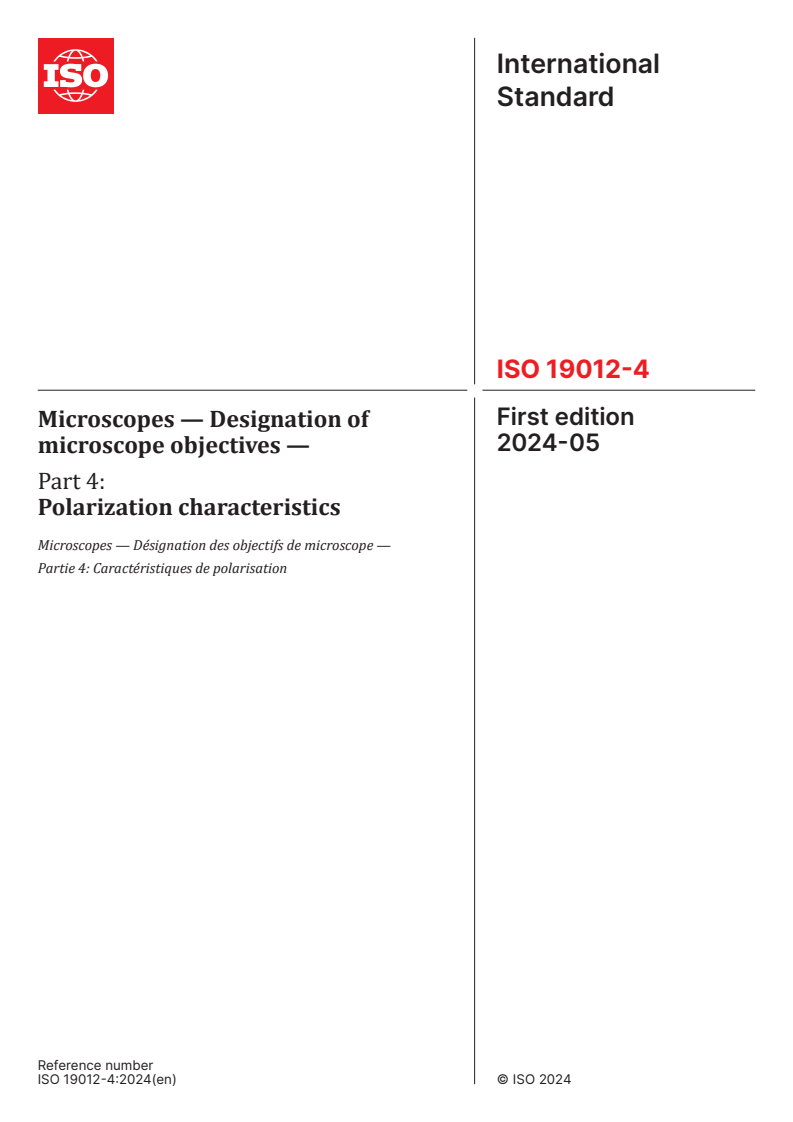
International
Standard
ISO 19012-4
First edition
Microscopes — Designation of
2024-05
microscope objectives —
Part 4:
Polarization characteristics
Microscopes — Désignation des objectifs de microscope —
Partie 4: Caractéristiques de polarisation
Reference number
© ISO 2024
All rights reserved. Unless otherwise specified, or required in the context of its implementation, no part of this publication may
be reproduced or utilized otherwise in any form or by any means, electronic or mechanical, including photocopying, or posting on
the internet or an intranet, without prior written permission. Permission can be requested from either ISO at the address below
or ISO’s member body in the country of the requester.
ISO copyright office
CP 401 • Ch. de Blandonnet 8
CH-1214 Vernier, Geneva
Phone: +41 22 749 01 11
Email: copyright@iso.org
Website: www.iso.org
Published in Switzerland
ii
Contents Page
Foreword .iv
Introduction .v
1 Scope . 1
2 Normative references . 1
3 Terms and definitions . 1
4 Requirements . 1
4.1 General .1
4.2 Extinction ratio .1
4.3 Definition of objectives named POL, PO or P .2
4.4 Measurement procedure .2
4.4.1 General .2
4.4.2 Measurement environment .2
4.4.3 Microscope settings .2
4.4.4 Measurement of extinction ratio .3
Bibliography . 5
iii
Foreword
ISO (the International Organization for Standardization) is a worldwide federation of national standards
bodies (ISO member bodies). The work of preparing International Standards is normally carried out through
ISO technical committees. Each member body interested in a subject for which a technical committee
has been established has the right to be represented on that committee. International organizations,
governmental and non-governmental, in liaison with ISO, also take part in the work. ISO collaborates closely
with the International Electrotechnical Commission (IEC) on all matters of electrotechnical standardization.
The procedures used to develop this document and those intended for its further maintenance are described
in the ISO/IEC Directives, Part 1. In particular, the different approval criteria needed for the different types
of ISO document should be noted. This document was drafted in accordance with the editorial rules of the
ISO/IEC Directives, Part 2 (see www.iso.org/directives).
ISO draws attention to the possibility that the implementation of this document may involve the use of (a)
patent(s). ISO takes no position concerning the evidence, validity or applicability of any claimed patent
rights in respect thereof. As of the date of publication of this document, ISO had not received notice of (a)
patent(s) which may be required to implement this document. However, implementers are cautioned that
this may not represent the latest information, which may be obtained from the patent database available at
www.iso.org/patents. ISO shall not be held responsible for identifying any or all such patent rights.
Any trade name used in this document is information given for the convenience of users and does not
constitute an endorsement.
For an explanation of the voluntary nature of standards, the meaning of ISO specific terms and expressions
related to conformity assessment, as well as information about ISO's adherence to the World Trade
Organization (WTO) principles in the Technical Barriers to Trade (TBT), see www.iso.org/iso/foreword.html.
This document was prepared by Technical Committee ISO/TC 172 Optics and photonics, Subcommittee SC 5
Microscopes and endoscopes.
A list of all parts in the ISO 19012 series can be found on the ISO website.
Any feedback or questions on this document should be directed to the user’s national standards body. A
complete listing of these bodies can be found at www.iso.org/members.html.
iv
Introduction
The polarization characteristics of microscope objectives are important parameters that allow users
to choose the appropriate product for a given application. This document shows the requirement(s)
for the marking of polarizing objective lenses along with the measurement procedure, environmental
conditions, and microscope settings to be carried out correctly in order to arrive at the stated performance
characteristics.
...